International stories that caught my attention

One of the advantages of having a break from blogging (not tweeting) is that one can gather the various news items and commentary together to have a more complete picture. Here is what caught my eye over the past few weeks.

UK

An interesting looking back at Enoch Powell’s ‘rivers of blood’ speech, how elements remain today (An Anti-Immigration Speech Divided Britain 50 Years Ago. It Still Echoes Today) and how these perhaps help explain the inexplicable treatment of long-term immigrants and others as exemplified by Windrush immigrants (post World War II immigrants from former British Caribbean colonies).

There was considerable and justifiable on the callousness of UK immigration and citizenship policies, including both news articles and commentary, highlighting some of what I would consider ethical lapses in developing and implementing policy (British Citizen One Day, Illegal Immigrant the Next, UK removed legal protection for Windrush immigrants in 2014, Immigration scandal expected to spread beyond Windrush group,  Woman told she is not British by the Home Office despite living in UK all her life), ‘Not British enough’: ex-high commissioner’s baby denied UK passport in 2011Damian Green ‘dismissed Windrush citizenship pleas’.

Nesrine Malek’s It’s not just Windrush. Theresa May has created hostility to all immigrants makes perhaps the harshest critique:

If you are angry about the treatment of the Windrush generation it is important to understand that this anger cannot be selective, if there are to be no more violations. There is no cross-party, cross-media support for a different type of immigration policy victim than the Windrush scandal has managed to muster. Not for those who are illegally detained, those on hunger strike in protest against poor conditions. Not for those whose illnesses were treated as lies and to which they later succumbed. Not for the sexually exploitedand not for the children separated from their parents. Not even for those British subjects separated from their families by unreasonably high income visa requirements.

During my own long battle with the Home Office to secure residency, I spent many hours in Croydon. I went on one occasion to withdraw my passport, which had languished unprocessed for months, to travel to see my sick mother. Driven wild with fear that I would not be able to see her if the unthinkable happened, I was ready to risk not being allowed back in the country. The waiting room was a holding pen of quiet individual tragedies, full of people whose personal and professional lives had been thrown into turmoil by loss of documents, technical glitches and glacial incompetence. The cruelty we all experienced was not a bug, it was a feature.

The scandal of the Windrush generation is the kind of thing that happens when this rot sets in so deep that the infrastructure of a civilised society begins to fall apart. The rise in the number of the persecuted is analogous to the doubling in deaths of homeless people. There is only so much austerity an economy can take before the human toll rises. And there is only so much ideological fixation on “sending people home” before we are deporting grandmothers who arrived in this country when they were children.

And make no mistake, it is ideological. The Conservative party has been consistent in its aggressive immigration policy since 2010, when David Cameron decided that a tough stance on immigration was a flagship party offering to its base supporters. No ifs, no buts, he said. Detention, deportation and NHS treatment refusal is the culmination of the party’s most lucid positions. It is not incompetence, it is not even malice. It is an enthusiastic strategy that over the past decade has become a cornerstone, a defining element of Conservative governments. An immigration policy, very much like austerity, unafraid to be brutal if the deserving, whether they are the “indigenous population” of the country or hardworking taxpayers, are to be protected from those who are after a “free ride”.

There has been no bureaucratic snafu. The only miscalculation was that everyone got a little bit cocky, and who can blame them. The error was that the dragnet picked up some people who fall into a popular sympathy sweet spot. The elderly ones who came here from the Commonwealth to rebuild Britain and who even the Daily Mail can look kindly upon. They appeal to a patrician nostalgia and have a humanising narrative that others who come to this country in different circumstances do not enjoy. An apology and exceptions made for Windrush cases alone is not enough. If we are to be content with only this, then the government’s furtive shimmy away from the crime scene will be successful, and the Home Office’s daily violations of human rights will continue. If we are to prevent the assaults against those we can relate to, we must also be angry for those we cannot.

The UK government was forced to reverse its policy given the public backlash.

And a few articles on UK perceptions of multiculturalism: Multiculturalism has failed, believe substantial minority of Britons‘Multiculturalism is defunct’: British Government signals U-turn on 70 years of social policy – Dr. Jenny Taylor.

US

Yet another article on the effect of Trump administration policies on the tech sector (Silicon Valley is fighting a brain-drain war with Trump that it may lose) but with one study suggesting the Valley is not as dependent on immigration as may appear (Shocker: San Francisco Tech Companies Not So Reliant On Immigrants):

A surprising survey by Envoy Global suggests that while San Francisco is not giving up on the H-1B, companies there need it less than they have professed to need it.  Call it an adjustment to the immigration policies of the new President. But despite a historical reliance on highly skilled foreign-born talent, most San Francisco employers say they do not consider sourcing foreign national workers as a top talent acquisition priority.

The San Francisco Insights on Immigration Report, conducted by Harris Poll on behalf of Envoy, aggregated the responses of 171 San Francisco-based HR professionals and hiring managers regarding global hiring practices. Key takeaways from the survey showed that local companies view hiring foreign talent is still very much a business norm, but today only 8% of San Francisco tech companies say they proactively seek out foreign employees compared with 24% of tech companies in other tech hubs who say they are looking abroad for talent. Some 54% of San Francisco tech companies said sourcing foreign national employees is not very important to their company’s talent acquisition strategy at the moment.

The de-emphasis on immigrant workers this year is the fact that the H-1B application process has become more cumbersome under Trump.  Trump has promised to make it harder for tech firms to hire foreign workers, though the companies all still insist they need them.

In response to changes in immigration regulations, 33% of San Francisco employers say they are hiring fewer foreign nationals compared to 26% of employers nationwide.

A further tightening of citizenship rules for children born abroad and out of wedlock to US parents USCIS tightens rules on US citizenship for children born outside America is being implemented.

Australia

A series of articles based upon the Australian race commissioner’s report on the appalling lack of diversity among Australian leadership (In a Proudly Diverse Australia, White People Still Run Almost Everything‘Dismal’ diversity among Australian business and civic leadersWhy we should look at targets to get more non-Europeans into top jobs: Tim Soutphommasane):

Based on the 2016 Census data on ancestry, we estimate about 58 per cent of Australians have an Anglo-Celtic background, 18 per cent have a European background, 21 per cent have a non-European background, and 3 per cent have an Indigenous background.

However, our examination of almost 2500 senior leaders in business, politics, government and higher education shows only very limited cultural diversity. Almost 95 per cent of senior leaders at the chief executive or “c-suite” levels have an Anglo-Celtic or European background. Of the 372 chief executives and equivalents we identified, 97 per cent have an Anglo-Celtic or European background.

Here’s a breakdown. Within the ASX 200 companies, there appears only to be eight chief executives who have a non-European background – enough to squeeze into a Tarago. Of the 30 members of the federal ministry, there is no one who has a non-European background, and one who has an Indigenous background. It is similarly bleak within the public service, where 99 per cent of the heads of federal and state government departments have an Anglo-Celtic or European background (that’s one of 103). Universities don’t fare much better: just one of the 39 vice-chancellors of Australian universities has a non-European background.

All up there are 11 of the 372 chief executives and equivalents who have a non-European or Indigenous background. A mere cricket team’s worth of diversity.

These are dismal statistics for a society that prides itself on its multiculturalism. They challenge our egalitarian self-image. And they challenge our future prosperity as a nation. If we aren’t making the most of our multicultural talents, we may be squandering opportunities.

I often hear from people that it will only be a matter of time before cultural diversity is better represented. We should be encouraged, for example, that there doesn’t appear to be any lack of European backgrounds among senior leaders. Just as it took time before we saw Australian chief executives from Italian or Greek backgrounds, we may have to wait a little longer before we see more from Asian, Middle-Eastern, or African backgrounds.

Time alone may not resolve the problem. Economists at the University of Sydney, in a recent study involving resumes, found those with an Anglo name are three times more likely to be invited for interview, compared to candidates with a Chinese name. (The study also found that those with Chinese names who had an Anglicised first name doubled their chances of receiving a job interview.)

If we are serious about shifting numbers, it may be necessary to consider targets for cultural diversity – if not quotas. Such measures don’t stand in opposition to a principle of merit. After all, meritocracy presumes a level playing field. Yet do we seriously believe that a perfectly level playing field exists, when there is such dramatic under-representation of cultural diversity within leadership positions?

Multiculturalism can be as superficial as food and festivals. But if we’re serious about our diversity, we must be prepared to hold up a mirror to ourselves – and ask if what we see looks right for an egalitarian and multicultural Australia.

Hungary

Lastly, relevant and disturbing commentary on the recent Hungarian election and the country’s descent into autocracy (Hungary Is Winning Its War on Muslim Immigrants: Leonid BershidskyA Democracy Disappears: Andrew Sullivan), with Sullivan noting the parallels with the US under Trump:

The recipe is a familiar one by now. In a society where social mores, especially in the big cities, appear to be changing very fast, there is a classic reaction. More traditional voters in the heartland begin to feel left behind, and their long-held values spurned. At the same time, a wave of unlawful migrants, fleeing terror and deprivation, appear to threaten the demographic and cultural balance still further, and seem to be encouraged by international post-national entities such as the European Union. A leftist ruling party in disarray gives a right-wing demagogue an opening, and he seizes it. And so in 2010, Orbán was able to exploit a political crisis triggered by an imploding and scandal-ridden Socialist government, and, alongside coalition partners, win a supermajority for the right in parliament.

Once in power, that supermajority allowed Orbán to amend the constitution in 2011, reducing the number of seats in the parliament from 386 to 199, gerrymandering them brutally to shore up his party’s standing in future elections, barring gay marriage in perpetuity, and mandating that in election campaigns, state media would take precedence over independent sources. He also forced a wave of early retirements in the judiciary in order to pack the courts with loyalists.

As Mounk notes, Orbán also tapped into deep grievances rooted in Hungary’s loss of territory in the 20th century, by giving the vote to ethnic Hungarians in neighboring Romania and removing it from more culturally progressive expats. But it was in response to the migration crisis in 2015, that Orbán truly galvanized public opinion behind him. Hungary, as Paul Lendvai noted in The Atlantic, had been deluged with asylum claims: 174,000 in 2015 alone, the highest per capita in the EU. Orbán responded by spreading fears of an influx of terrorists and criminals, of a poisoning of Hungarian culture, and expressing visceral nationalist hostility to the diktats of the European Union. Added to all that, of course, was a generous salting of classic central European anti-Semitism. Voters especially in rural areas flocked to him.

He further shifted the public discourse by creating and advancing new media outlets that amplified his propaganda, while attacking, harassing, and undermining all the others. He erected a huge fence to keep Muslim immigrants out, and refused to accept any of the 50,000 refugees the EU wanted to settle in his country. His political allies began to get very rich, as crony capitalism spread. By last year, Orbán had turned George Soros into a version of 1984’s Emmanuel Goldstein — an “enemy of the state” — with billboards and endless speeches, demonizing the Jewish billionaire and philanthropist, and vowing to protect the nation from external, malignant forces.

It was a potent formula, especially when backed up by the rigging of the parliamentary seats. Last week, in a surge of voter turnout, Orban won almost 50 percent of the vote, but two-thirds of the seats, giving him another supermajority (this time without coalition partners) in parliament, with further chances to amend the constitution in his favor. His voters in the heartland swamped a majority for the opposition in Budapest. One of two remaining opposition newspapers, Magyar Nemzet, shut down on Wednesday after 80 years in print. Orbán had withdrawn all government advertising in it. Some wonder whether there will ever be a free election again.

If you find many of these themes familiar, you’ve been paying attention. In the middle of a reaction against massive social change and a wave of illegal immigration, a right-wing party decides to huff some populism. A charismatic figure emerges, defined by hostility to immigration, becomes an iconic figure, and even though he doesn’t win a majority of votes, comes to office. His party is further shored up by gerrymandering, giving it a structural advantage in gaining and keeping power, including a seven percentage-point head start in the House of Representatives. That party does what it can to further suppress the vote of its opponents, especially ethnic minorities, and focuses on packing the courts, even rupturing long-standing precedents to deny a president of the opposing party his right to fill a vacant Supreme Court seat.

Openly propagandist media companies emerge, fake news surges, while the president uses the powers of his office to attack, delegitimize, and discredit other media sources, even to the point of threatening a company like Amazon. A mighty wall is proposed against immigrants on the border, alongside fears of a mass “invasion” from the South. Social conservatives are embraced tightly. The census is altered to ensure one party’s advantage in future district-drawing. Courts are disparaged and the justice system derided as rigged by political opponents.

The difference, of course, is that Orbán is an experienced politician, and knows exactly what he’s doing. Trump is a fool, an incompetent, and incapable of forming any kind of strategy, or sticking to one. The forces arrayed against the populist right, moreover, are much stronger in the U.S. than in Hungary; our institutions more robust; our culture much more diverse. Our democracy is far, far older.

And yet almost every single trend in Hungary is apparent here as well. The party of the left has deep divisions, and no unifying leader, while the ruling party is a loyalist leader-cult. The president’s party is a machine that refuses to share power, and seeks total control of all branches of government. It is propelled by powerful currents of reaction, seems indifferent to constitutional norms, and dedicated to incendiary but extremely potent populist rhetoric. The president’s supporters now support a purge in the Department of Justice and the FBI, to protect the president from being investigated.

The president himself has repeatedly demonstrated contempt for liberal norms; and despite a chaotic first year and a half, is still supported by a solid and slightly growing 42 percent of the public. Meanwhile, the immigration issue continues to press down, the culture wars are intensifying again, and the broad reasons for Trump’s election in the first place remain in place: soaring social and economic inequality, cultural insecurity, intensifying globalization, and a racially fraught period when white Americans will, for the first time, not form a majority of citizens.

History is not over; and real, profound political choices are here again. My hope is that the descent into illiberalism across the West might shake up the rest of us in defending core liberal democratic principles, wherever they are threatened, bringing us to the ballot box in huge numbers this fall, and abandoning the complacency so many have lapsed into.

Geddes tries to explain former PM Harper’s congratulations to Orban (Why Stephen Harper congratulating Viktor Orbán matters: John Geddes):

Tone matters. If this were only a pro forma note, Harper is more than capable, as anyone who followed him in Canadian politics can attest, of draining any message of liveliness or affect. And, by his own stated standard, he would have had grounds for keeping any hint of enthusiasm out of this one. After all, Harper has said that his aim as IDU chair is partly “ensuring that we address the concerns of frustrated conservatives and that they do not drift to extreme options.”

If we’re talking extreme options, Orban looks like a prime example these days. Numerous credible critics charge that he has coopted Hungary’s courts and schools, skewed its electoral system to his advantage, all while voicing admiration for Turkey and China, and criticizing Western European tolerance for Muslim immigration. Still, political science professor Achim Hurrelmann, director of Carleton University’s Institute of European, Russian and Eurasian Studies, says Orban’s core message—beyond his destructive domestic tactics—is being heard by conservatives outside Hungary. “[Fidesz] has primarily been anti-migration, emphasizing the Christian roots of Europe, and being very much against diversity,” Hurrelmann told me in an interview. “In that position, they find common ground with some other mainstream conservative parties.”

I can’t guess if Harper’s calculation in issuing that tweet took into account an awareness that Orban, dangerous as he may be, isn’t irrelevant beyond Hungary. Whatever Harper’s reasoning, he has undoubtedly damaged his reputation among many who view Orban with justifiable distaste and alarm. I’m reminded again of the steep learning curve Harper had to climb after barely travelling outside Canada, and concentrating almost entirely on domestic issues, rather than foreign policy, before his 2006 election win. “Since coming to office,” he told Maclean’s in 2011, “the thing that’s probably struck me the most in terms of my previous expectations—I don’t even know what my expectations were—is not just how important foreign affairs/foreign relations is, but, in fact, that it’s become almost everything.”

It’s worth noting that Andrew Scheer seems to be on his own version of that learning curve now. In this recent interview with my colleague Paul Wells, the Conservative leader surprised me by going on at some length about his reasons for supporting Brexit. Scheer spoke about how staying in the EU impinged on British sovereignty and embroiled Britain in the Brussels bureaucracy. He scoffed at “this notion that somehow they would lose access to the European market.” He repeated the debunked canard that EU rules required a certain curvature on bananas.

To my ear, all this pro-Brexit blather was by far the least convincing part of Scheer’s performance in that interesting conversation. Conservatism’s most treacherous currents are global, especially in the age of Donald Trump. In Harper’s congratulatory message to Orban, and Scheer’s laudatory position on Brexit, the difficulty finding a solidly respectable place to stand in that international discourse becomes glaringly obvious. These issues might not seem central to Canadian voters in any federal election, but, as Harper reminded us, they soon are to whoever wins one.


Why Trump’s Census Change Could Hit Asian-Americans Especially Hard

Some interesting analysis of how certain groups of Asian Americans will be more affected (and the corresponding groups that overall are doing well and are unlikely to be affected, which the article does not mention):

The Trump administration’s decision to add a question about citizenship to the census does not bode well for Asian-Americans and Pacific Islanders, civil rights groups fear.

Research has already shown that the minority group is significantly undercounted in the survey, with one-fifth of Asian-Americans and one-third of Native Hawaiians and Pacific Islanders living in hard-to-count census areas. This is partly due to the fact that some Asian-American and Pacific Islander, or AAPI, subgroups have relatively high rates of poverty, unemployment and educational attainment, among other factors.

Experts say the question about citizenship will significantly reduce participation in the census, and Asian-American civil rights organizations are worried about how the question could affect the growing minority group.

“Given the high number of Asian immigrants, any question regarding citizenship is likely to scare the Asian community. We are very concerned that the addition of citizenship question will disproportionately cause an undercount in the Asian community,” John C. Yang, president and executive director of the civil rights group Asian Americans Advancing Justice | AAJC, told HuffPost by email.

“The community already is fearful of the anti-immigrant rhetoric and immigration policies advanced by this administration,” Yang added. “At a minimum, the addition of this question will make it even more challenging to ensure that the community has sufficient trust in the census such that they will respond.”

Treating AAPIs as a monolith ignores how poverty and other factors contribute to undercounting in particular AAPI subgroups, according to a joint fact sheet by the Leadership Conference Education Fund and Georgetown Law’s Center On Poverty and Inequality. While it’s often assumed that AAPIs are financially well-off, reports show that Cambodian-, Hmong- and Laotian-Americans, who predominantly came to the U.S. as refugees, experience higher than average rates of poverty and lower levels of income. More than one-third of Nepalese-Americans also live in poverty.

Communities with lower educational attainment are more difficult to count, too. And Southeast Asian-Americans have some of the highest dropout rates in the country, with about 34.3 percent of Laotian-American adults lacking high school diplomas, as well as 40 percent of Hmong-American and nearly the same percentage of Cambodian-American adults. Yet about 90 percent of the general U.S. adult population finishes high school or gets a GED certificate.

Lower rates of English proficiency contribute to undercounting in the census as well. More than one-third of AAPIs have limited English proficiency, defined as a limited ability to read, speak, write or understand English. And the majority of AAPIs speak a language other than English.

What’s more, much of the AAPI community in the U.S. is made up of immigrants. In fact, almost 60 percent of AAPIs were born in another country, and an estimated 1.7 million undocumented AAPI immigrants live in U.S. The concept of a census is completely foreign for many new immigrants, Yang said, which, along with the citizenship question, would further discourage many AAPIs from participating.

Increased undercounting of AAPIs could have notable repercussions, Yang noted. A report from the GW Institute of Public Policy shows that more than $800 billion of federal funding in fiscal year 2016 relied on census data. And with census data meant to determine political representation, lower participation in the survey could mean AAPI concerns go ignored while resources for hospitals, disaster relief services, health care services and more are misallocated, Yang said.

“Undercount of the Asian American Pacific Islander community will leave the community underrepresented, under-resourced, and under-protected,” he explained. “An undercount will mean that congressional districts will be allocated and drawn without an accurate understanding [of] the Asian American community.”

Already, several AAPI organizations have spoken out against the citizenship question. The Congressional Asian Pacific American Caucus (CAPAC) chair, Rep. Judy Chu (D-Calif.), issued a statement condemning the new measure and expressing her commitment to using the legislative process to stop its implementation.

“The census is essential for ensuring fair and accurate representation and distribution of government resources,” Chu wrote. “But by including a question on citizenship, which is not required by the Constitution, the Trump Administration is exploiting the fear of immigrant communities who are already reticent to divulge personal information to the federal government.”

Social services nonprofit Asian American Federation, along with 35 partners, sent letters to both the CAPAC and the New York Congressional Delegation to advocate against the question. Citing the cost of hiring additional staff for follow-up on unanswered census questions, the question’s lack of testing, and the concerns of immigrant communities, the federation’s executive director, Jo-Ann Yoo, called on legislators to speak out.

Yang is now encouraging members of the public to fight back and make their views known once the U.S. Census Bureau seeks public comment on the questions. He also urges people to call members of Congress to show them how important the issue is to them.

via Why Trump’s Census Change Could Hit Asian-Americans Especially Hard

Better Immigration Policies Would Help U.S. Tech Companies

Another American commentator effectively states a Canadian advantage:

Donald Trump recently declared that $60 billion in new tariffs against China would help U.S. technology companies preserve their intellectual property. Trade experts doubt compelling Americans to pay more for products imported from China will solve any problems. However, if the Trump administration wants to help U.S. tech companies, the solution isn’t to impose tariffs on Chinese imports but to enact better immigration policies.

For a U.S. technology company – and, really, almost any company today – the most important input is human capital. When companies make decisions on where to invest resources, the ability to hire a sufficient number of qualified workers in that location is paramount.

Restrictive immigration policies encourage U.S. companies to place more resources – and people – in foreign countries. Moreover, many U.S. companies contract out information technology and other services to focus on their core line of business. Burdensome policies, such as the Trump administration’s new third-party placement requirements, encourage more of those services to be delivered from outside the United States.

“Today, 81 percent of the full-time graduate students at U.S. universities in electrical engineering and 79 percent in computer science are international students,” according to a National Foundation for American Policy analysis. In other words, when U.S. companies recruit on college campuses they hire U.S. students, of course, but also find the vast majority of the graduate students in many key technical fields are foreign nationals who cannot work in America unless U.S. immigration rules are reasonable.

H-1B status is typically the only way a high-skilled foreign national or international student graduating from a U.S. university can work long-term in the United States. The wait for employment-based green cards often stretches to years, making them impractical to use for hiring most people. That means despite its limitations, H-1B visas are the key way U.S. companies employ high-skilled foreigners. Companies can transfer certain employees to the U.S. but they must have worked abroad for at least a year and gaining approvals even for those types of visas has become more difficult.

The first week of April is when employers file for H-1Bs – even though the start date for the professionals will not be until October, the beginning of the next fiscal year. This will be the 16thconsecutive year the supply of H-1Bs runs out, both the 65,000-annual limit and the additional 20,000 reserved for international students from U.S. graduate schools.

The reason H-1B visas run out each year is simple: The small annual limit of 65,000 (for an economy with over 160 million workers) was set back in 1990. Since then the World Wide Web, social media, smartphones, 3-D printing, and advances in biotech and other fields have fueled the demand for high-skilled technical labor. Most H-1B visa holders have earned a master’s degree or higher.

Trump administration officials have said America should shift to a “merit-based” immigration system but that is code for eliminating most family-sponsored immigration categories and reducing legal immigration, not admitting more high-skilled foreign nationals. In fact, since many family-sponsored individuals possess high levels of education, preventing them from immigrating to the United States would result in the admission of fewer highly educated immigrants.

When asked, immigration attorneys cannot name any policies the Trump administration has established or proposed to make it easier for high-skilled foreign nationals to work in or immigrate to the United States – and can talk for hours about all the new measures that have made life more difficult for immigrants and employers.

If the Trump administration wanted to make U.S. high tech companies more competitive in global markets, then here are the immigration policies it should enact:

First, on the legislative front, the administration should support H.R. 392, which eliminates the per-country limit that contributes to high-skilled immigrants from India waiting potentially decades to receive permanent residence. Congress should also raise the annual limit on employment-based green cards and add exemptions for individual with degrees in science, technology, engineering and math (STEM) and the dependents of employer-sponsored immigrants. The annual limit on H-1B visas should be raised substantially to reflect the demand for high-skilled labor in today’s modern economy.

Second, the administration should stop trying to repeal the worthwhile regulation that allows many spouses of H-1B visa holders to work in the United States. This 2015 regulation helps retain skilled workers and provides greater dignity to spouses, many of whom are well-educated women born in India. Immigration officials should also halt plans to eliminate or make unduly burdensome the ability of international students to work after graduation for 12 months on Optional Practical Training (OPT) or an additional 24 months for individuals in a STEM field. Another problematic administration policy is its plan to rescind a regulation that allows international entrepreneurs to remain in the U.S. after starting new job-creating businesses.

Third, the Trump administration should cease what attorneys and businesses view as an assault on the ability of companies to employ high-skilled foreign nationals in the United States. Over the past year, these measures have included immigration adjudicators demanding employers comply with many more Requests for Evidence and denying more H-1B applications; the administration telling adjudicators not to “defer to prior determinations,” including approvals or findings of facts, when renewing  an H-1B or other high-skilled visa (making denials more likely); the administration’s travel bans against individuals from Muslim-majority countries; and the effort by U.S. Citizenship and Immigration Services to battle against a common business practice whereby companies focus on core competencies and contract out other functions, sometimes resulting in workers performing some work on customer sites. (For a more complete list of administration actions look here and here.)

Already we can see a negative impact from administration policies. “The number of international students from India enrolled in graduate level programs in computer science and engineering declined by 21%, or 18,590 fewer graduate students, from 2016 to 2017,” a recent analysis of government data found. One plausible explanation for this drop is that highly educated foreign nationals no longer see America as the best place to build a career. And remember, unlike when a factory closes, U.S. companies don’t issue press releases every time they place more work in offices overseas in response to the U.S. government’s restrictions on immigration.

Observers believe administration policies directed against high-skilled foreign-born professionals and the companies that employ them are driven by a half-dozen or more appointees who share a common worldview. They have worked much of their careers to reduce the number of immigrants coming into the United States, regardless of skill level. Moreover, they possess little understanding of how labor markets function, particularly in today’s global economy, or simply ignore these realities.

There is not a fixed number of jobs in the United States. When immigrants fill jobs, they create more jobs through their consumer spending, investments and entrepreneurship. Their availability as workers can encourage additional investments.

If companies are not allowed to hire (or transfer) high-skilled foreign nationals in America, then these companies will hire and keep them outside the United States, taking many jobs and innovations with them to other countries. Pretending companies do not possess other options in the face of government restrictions is misguided.

For the good of the country, to set things on the right track on high-skilled immigration, there is a simple solution for Trump administration officials: Just do the opposite of everything they’ve done since taking office.

via Better Immigration Policies Would Help U.S. Tech Companies

Are You a U.S. Citizen? How a 2020 Census Question Could Affect States – The New York Times

Good data rich analysis:

The Trump administration on Tuesday announced that it would add a citizenship question to the decennial census in 2020, citing the need for more granular data for determining Voting Rights Act violations. Critics say that adding the question could cause some immigrants — particularly those who are not citizens — not to respond, resulting in an undercount.

There is no reliable data to estimate how many people would opt out of the census, but a panel of experts from inside the United States Census Bureau still expressed opposition to the move, in part because of concerns about accuracy.

“Just because there is not clear evidence that adding the question would harm the census accuracy, this is not evidence that it will not,” they wrote in a memo.

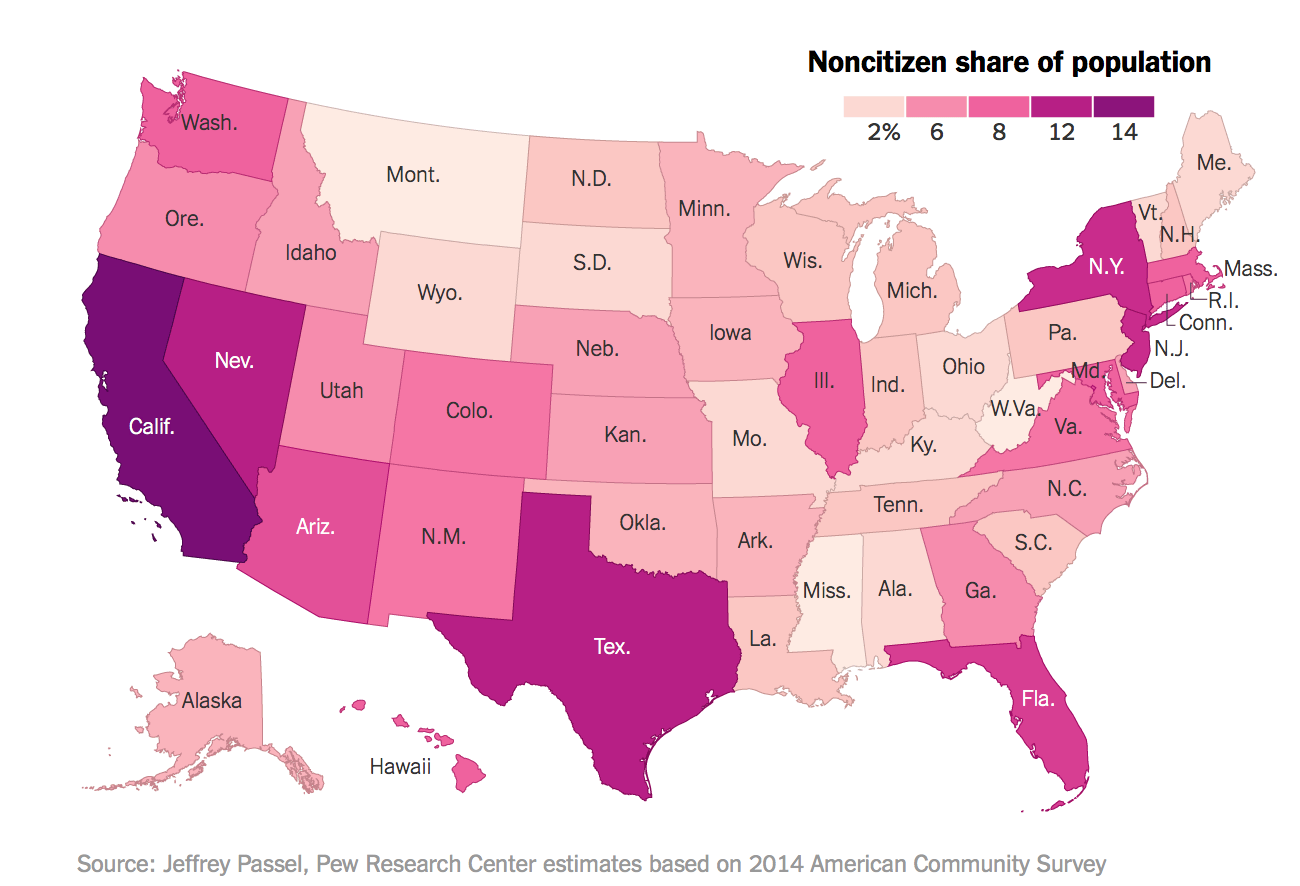
About 56 percent of the nation’s 44 million immigrants are not United States citizens, and an estimated 45 percent of noncitizens are undocumented. Among those who are not citizens, undocumented immigrants have the lowest rates of participation in census surveys in general, experts say.

Accurate census counts are critical for many functions, including the disbursement of billions in federal and state dollars and the distribution of congressional seats and representation in state and local governments. At least 12 states, including New York and California, have filed lawsuits or have said they plan to sue the administration over the change.

An undercount of population could affect federal funding to states.

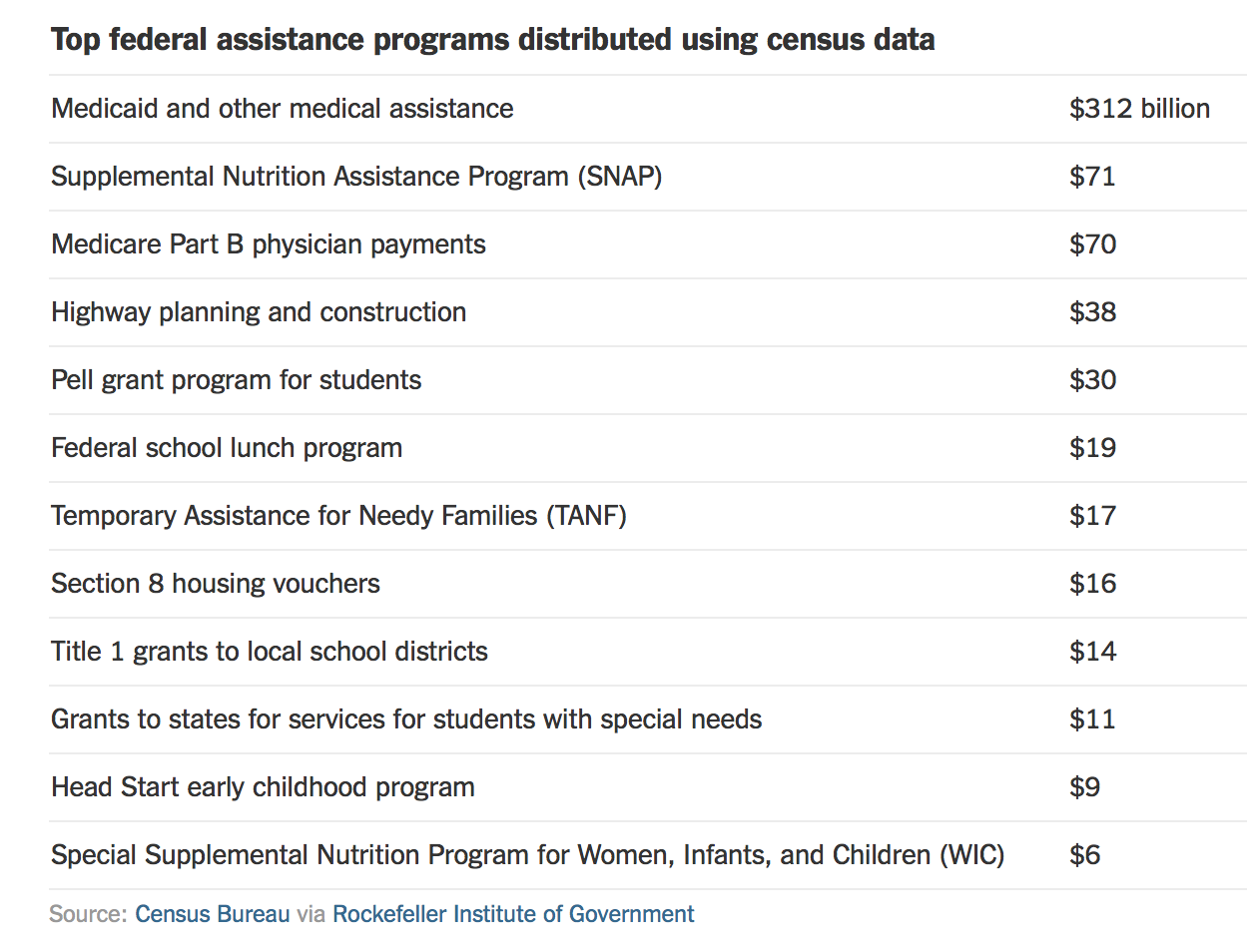
A recent Census Bureau report found that 132 programs used decennial census or related data to distribute more than $675 billion to states in 2015. Most of the money was related to health care, education and assistance for the poor.

Top federal assistance programs distributed using census data


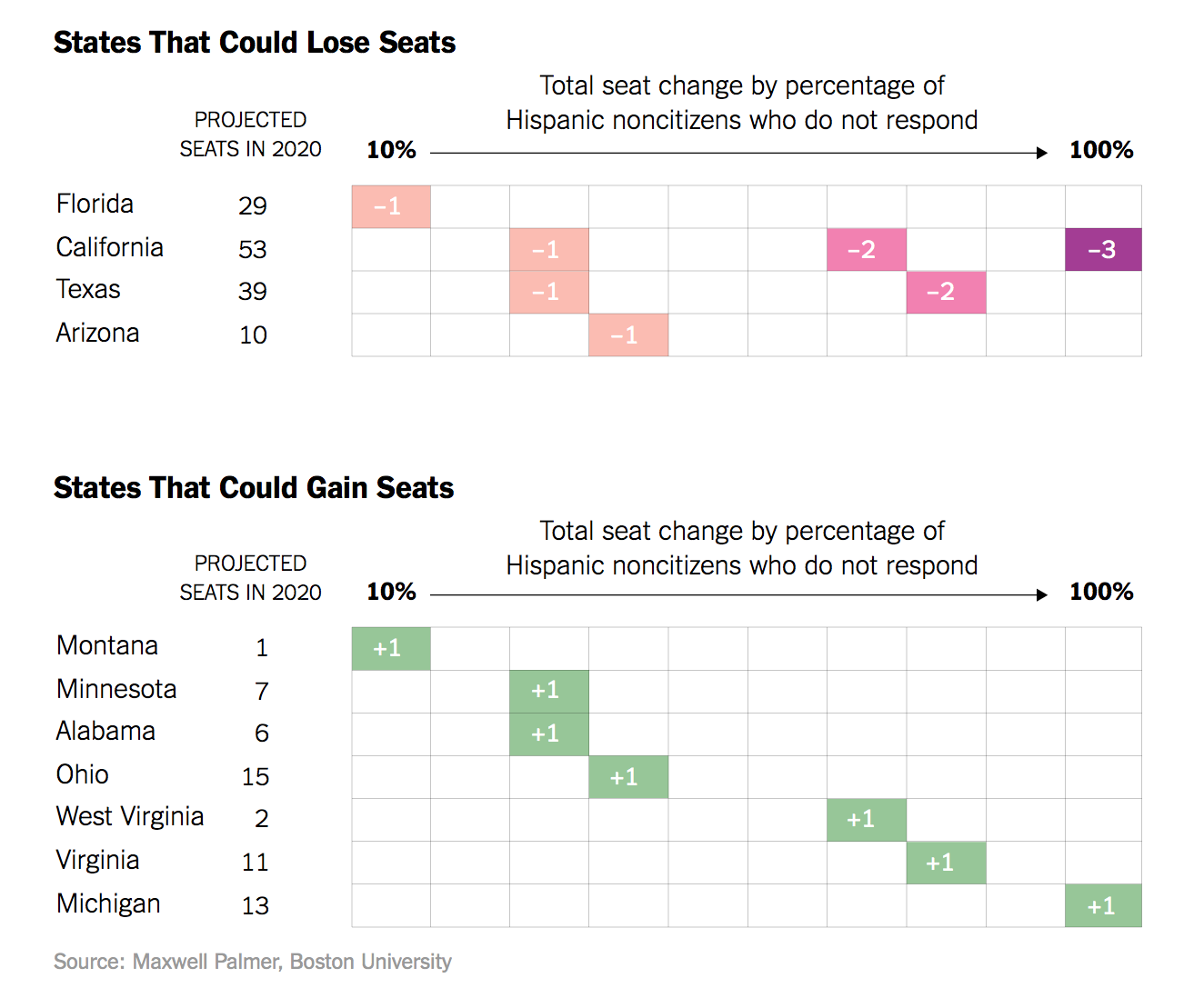
A significant level of nonparticipation could affect congressional seats.

Some academics have created hypothetical scenarios to show how a reduction in participation could affect the distribution of congressional seats among states, which are determined by total residents, not just citizens.


According to Maxwell Palmer, an assistant professor of political science at Boston University, if 10 percent of Hispanic noncitizens opted out, Florida could lose one congressional seat, and Montana could gain one. In an extreme case, in which 100 percent of Hispanic noncitizens did not participate, a total of seven congressional seats could be reshuffled, with three lost by California and two by Texas, Dr. Palmer said.

Andrew A. Beveridge, a Queens College sociologist, warned against overstating the potential effects of the citizenship question. He said that the maximum share of noncitizens who do not respond would be 20 percent, which is not enough to trigger a huge change.

“This, as the analysis shows, would only move a couple of seats,” said Dr. Beveridge, who is also president of Social Explorer, a research site that analyzes census data.

via Are You a U.S. Citizen? How a 2020 Census Question Could Affect States – The New York Times

There is nothing wrong with a census question about citizenship | The Sacramento Bee

The contrary opinion by Marc Thiessen (thankfully, the citizenship question in Canada has never been controversial and has been around for a long time):

The Trump administration is being sued over its plans to include a question about citizenship in the 2020 Census, which California Attorney General Xavier Becerra says “is not just a bad idea – it is illegal.”

No, it’s not. There is nothing wrong with asking about citizenship. Canada asks a citizenship question on its census. So do Australia and many other U.S. allies. The U.S. government asked about citizenship for 130 years – from 1820 to 1950 – as part of the decennial “short form” census and continued to do so in the “long form” survey – distributed to 1 in 6 people – through 2000, when the long form was replaced by the annual American Community Survey. The ACS goes to about 2.6 percent of the population each year and asks about citizenship to this day.

So why are many on the left up in arms over a question that should be relatively uncontroversial? Answer: Money and power. Democrats are worried that adding a citizenship question will dampen participation in the census by illegal immigrants, reducing the total population count in the Democratic-leaning metropolitan areas where illegal immigrants are largely concentrated. Because census data is used to determine the distribution of federal funds, that could decrease the cities’ share of more than $675 billion a year in federal funding. And because census data is also used to create and apportion congressional seats, Democrats fear that if illegal immigrants don’t participate it could shift power from Democratic cities to rural communities, which tend to vote Republican.

At least, that’s Democrats’ theory. But there is no evidence that a citizenship question would dramatically impact census participation. The census is not like a telemarketing survey where people have the option of adding their names to a “do not call” list. Everyone is required by law to respond. If a household does not fill out the census form, then census workers visit that household to gather census data. If they still cannot get a household to cooperate, nonrespondents can be fined or prosecuted – though in practice they rarely are. Usually, the Census Bureau instead asks neighbors about the household in order to get as much accurate information as possible. This may add costs to the census, but it is not likely to produce inaccurate data.

Moreover, if asking about citizenship is a deterrent to participation by illegal immigrants, then what about the existing census question that asks whether respondents are “of Hispanic, Latino, or Spanish origin” – the only ethnic group specifically called out. Respondents are required by law to tell the government whether they are of Mexican, Puerto Rican, Cuban or other Hispanic origin, which they are required to list (”print origin, for example, Argentinean, Colombian, Dominican, Nicaraguan, Salvadoran, Spaniard, and so on”). If that does not deter the participation of many illegal immigrants, how would a question on citizenship?

There is no good reason not to answer the census, whether one is here legally or illegally. As the Census Bureau points out, “It is against the law for any Census Bureau employee to disclose or publish any census or survey information that identifies an individual or business .?.?. the FBI and other government entities do not have the legal right to access this information.” Furthermore, the proposed question is about citizenship, not legal status. This question should not be a deterrent to participation for anyone.

But let’s say for the sake of argument that some illegal immigrants do decide not to participate in the 2020 Census. So what? Illegal immigrants are here illegally. If they choose to violate U.S. law yet again by refusing to participate in the census because of a perfectly legitimate question about citizenship, that’s not the U.S. government’s fault.

This is a losing issue for Democrats. They are effectively arguing that sanctuary cities should be rewarded with more federal money for interfering with the federal enforcement of our immigration laws and turning themselves into magnets for illegal immigrants. And Democrats, who claim to be deeply concerned about foreign interference in our democracy, seem to have no problem with foreign interference when it comes to noncitizens in the United States illegally affecting the distribution of seats in Congress. If Democrats want to make that argument to the American people, go for it. It will further alienate millions of voters who abandoned the Democratic Party in the 2016 election.

via There is nothing wrong with a census question about citizenship | The Sacramento Bee

The Census’s New Citizenship Question Could Hurt Communities That Are Already Undercounted | FiveThirtyEight

Good detailed and balanced analysis:

After a long career as a banker and investor, Commerce Secretary Wilbur Ross is no doubt familiar with cost-benefit analyses. That seems to have carried over to his political work. In a memo declaring that the 2020 census would ask U.S. inhabitants whether they are U.S. citizens,1 he wrote, “I find that the need for accurate citizenship data and the limited burden that the reinstatement of the citizenship question would impose outweigh fears about a potentially lower response rate.” The inclusion of the question was a request of the Justice Department, which says that it needs the information to enforce the Voting Rights Act.

But Ross isn’t the only one weighing costs against benefits when it comes to the census — respondents do it as well. Demographers and civil rights groups are concerned that under a president who has called for a ban on Muslims and immigrants from certain countries, dramatically reduced the number of refugees allowed into the country and cracked down on undocumented immigrants without criminal records, a citizenship question will push more people to decide that the risks of responding accurately to the questionnaire, or responding at all, outweigh the benefits. And the groups that seem most likely to be put off from responding — immigrants, members of households with immigrants, people living in poverty, among others — are the same ones that are already at highest risk of being uncounted.

There’s a lot at stake: The census has been used for hundreds of years to determine how many U.S. House members each state will have,2 and it currently helps determine how hundreds of billions of dollars in federal spending is divvied up. “The risk that really troubles me is that there’s a big undercount and then there’s a big lack of representation,” said John Thompson, who was director of the U.S. Census Bureau until he resigned last year (the bureau is still without a director).

Many groups were already less likely than others to respond to the census. Some of the non-response trends are geographical. The rural South and the Texas-Mexico border, for example, had many areas with low response rates during the last census, in 2010, according to data from the Center for Urban Research at the City University of New York’s Graduate Center.

But there are pockets with low response rates almost everywhere, said Steven Romalewski, director of the center’s mapping service. “Every state has them,” he said. “Most congressional districts have them. It’s urban, rural and suburban, and they are scattered throughout the country.”

That’s at least partly because there are differences in mail-in response rates among demographic groups. African-Americans and Hispanics respond at lower rates than non-Hispanic white people. Immigrants (particularly the undocumented), people who rent their homes and those living in poverty have been less likely to mail back the form.

Those are also some of the groups that have historically been undercounted. For example, young children — the group most likely to be undercounted – disproportionately live in households with parents who are young, who earn poverty wages, and who are Hispanic or African-American.

The citizenship question could exacerbate the problems of non-response and undercounting. In pre-census focus groups, respondents have expressed concerns that other government agencies will be able to access data related to immigration and that it could harm their residency status (even if they are authorized). Community groups across the country have been educating undocumented immigrants and their families about their rights, encouraging them not to let law enforcement officials into their homes. This could make it more difficult for census workers to access households. It’s not just the undocumented who are at risk of not responding or not showing up on the census. The 23 million non-citizensliving in the U.S. often live with U.S. citizens as well — if the door doesn’t open, citizens are at risk of not showing up in the census, too.

Researchers believe that a resistance to sharing any personal information and the fear that one’s information will not be secure are among the reasons that people don’t respond to the census. Lawmakers themselves, most recently Republicans, have expressed concerns about the broad nature of census questions, calling as recently as this decade to end the American Community Survey — an annual survey also conducted by the Census Bureau that does ask about citizenship status. We don’t know how much public fears and political rhetoric have affected people’s willingness to participate in the census over time, but we do know that when the bureau began spending millions of dollars on advertising campaigns to assuage those concerns (“Your answers are protected by law”), response rates went up.

There’s a tradeoff between privacy and accuracy, said Kenneth Prewitt, who was census director from 1998 to 2001. The more infringement there is on information that people view as private, the less accurate the results will be. And this close to the 2020 survey, it’s likely not only the citizenship question that puts the census at risk, Prewitt said. That the census is now mired in a national political conversation about immigration, as well as various court cases pushing to keep the question off the survey, polarizes it in a way that could hurt response rates.

We don’t know whether the addition of the citizenship question will make the data that the census collects less accurate as a whole, though census workers have heard an alarming increase in concerns around immigration and privacy in focus groups conducted in advance of 2020. We can’t know what the question may do because it hasn’t been tested in a way that follows standard scientific practice, said Terri Ann Lowenthal, who is a former staff director for the U.S. House census oversight subcommittee and now works as a consultant. In surveying, many things can change response rates and the truthfulness of responses, including the order of questions, the wording on instructions and the way it’s laid out visually. The only way to know how well a question will work is by testing it repeatedly, over a number of years, she said.

“It is somewhat puzzling, in my opinion, that Secretary Ross — who is a well-respected businessman — would agree to move forward with something that I’m sure he knows in any other setting, whether scientific or business, wouldn’t pass muster in terms of readiness,” Lowenthal said.

But even though a citizenship question hasn’t been tested for the current census (or in the current political environment), there’s good reason to believe the answers will be inaccurate for those who do fill out the form, at least among non-citizens. According to Ross’s memo, some 30 percent of non-citizen respondents on the American Community Survey are believed to give incorrect responses.

There’s no good way to fix the census if there is a problematic count — we’re stuck with it for a decade. In the late 1990s, the bureau floated plans to use statistical methods to make up for chronic undercounts of groups like kids, renters and certain minority groups. The House sued, and the Supreme Court ultimately ruled that because of the way the Census Act is written, statistical sampling can’t be used for apportionment. The census is a one-shot deal.

More than a dozen states are suing to block the citizenship question from appearing on the 2020 census. And civil rights groups say they are holding out hope that Congress, which has jurisdiction over the survey, will intervene.

In the end, as Ross seemed to hint at, the citizenship question is about tradeoffs. It may provide additional information about the number of citizens and non-citizens in the U.S., but only if people respond. Because the question hasn’t been tested, understanding how it will affect the outcome is difficult. But a chorus of experts, including people who have worked at the Census Bureau, say that there’s real cause for concern and that our representation at the federal level is at stake.

via The Census’s New Citizenship Question Could Hurt Communities That Are Already Undercounted | FiveThirtyEight

Christian Colleges Are Tangled In Their Own LGBT Policies : NPR

Interesting – belief grappling with the reality of people:

Conservative Christian colleges, once relatively insulated from the culture war, are increasingly entangled in the same battles over LGBT rights and related social issues that have divided other institutions in America.

Students and faculty at many religious institutions are asked to accept a “faith statement” outlining the school’s views on such matters as evangelical doctrine, scriptural interpretation and human sexuality. Those statements often include a rejection of homosexual activity and a definition of marriage as the union of one man and one woman. Changing attitudes on sexual ethics and civil rights, however, are making it difficult for some schools, even conservative ones, to ensure broad compliance with their strict positions.

“Millennials are looking at the issue of gay marriage, and more and more they are saying, ‘OK, we know the Bible talks about this, but we just don’t see this as an essential of the faith,’ ” says Brad Harper, a professor of theology and religious history at Multnomah University, an evangelical Christian institution in Portland, Ore.

LGBT students at Christian schools are also increasingly likely to be open about their own sexual orientation or gender identity.

At Calvin College in Grand Rapids, Mich., junior Sam Koster, who identifies as queer, finds fellow students to be generally tolerant.

“People I’ve met in the English Department,” Koster says, “even in my dorms, they’re like, ‘Oh, you’re queer? OK, cool. Do you want to go get pizza?’ ”

Staff and faculty at these Christian schools have to balance a need to attend to their students’ personal and spiritual needs with a commitment to their schools’ faith statements or official positions on sexuality.

“You’ve got those two values,” says Mary Hulst, senior chaplain at Calvin. “We love our LGBT people. We love our church of Jesus Christ. We love Scripture. So those of us who do this work are right in the middle of that space. We are living in the tension.”

Calvin College is affiliated with the Christian Reformed Church, which holds that “homosexual practice … is incompatible with obedience to the will of God as revealed in Scripture.” Hulst leads Bible study groups with her LGBT students and discusses with them the passages that refer to same-sex relationships.

“Those are the clobber passages,” Koster says. “They’re used to clobber queer kids back into being straight.”

Koster was troubled by those Bible verses at first but eventually became comfortable with a devout Christian identity and joined the Gay Christian Network.

“When I realized that my faith wasn’t necessarily about the [Christian Reformed] Church, and it wasn’t even necessarily about the Bible but about my relationship with God and that God is all-encompassing and loving, I felt very free,” Koster says.

Koster says Hulst helped guide that faith journey, but Hulst herself is still torn between her love for her LGBT students and her own understanding that the Bible does not really allow them to act on their sexual orientation.

“It’s a place where you need to be wise,” Hulst says. “I tell them I want to honor Scripture, but I also honor my LGBT brothers and sisters.”

It doesn’t always work out.

“Someone from the LGBT community will say, ‘If you will not honor the choices I make with my life, if I choose a partner and get married, then you’re not actually honoring me.’ I can understand that,” Hulst says, grimacing. “I can see how they might come to that conclusion.”

Legal entanglement

In addition to changing social and cultural attitudes, conservative religious schools face a changing legal environment regarding LGBT issues. Title VII of the Civil Rights Act of 1964 prohibits employment discrimination on the basis of “race, color, religion, sex, or national origin.”

Though the language does not refer to sexual orientation or gender identity, some courts have interpreted Title VII as protecting LGBT individuals and the recent trend has been in a pro-LGBT direction.

Christian colleges and universities also have to consider Title IX of the Higher Education Amendments of 1972: “No person in the United States shall, on the basis of sex, be excluded from participation in, be denied the benefits of, or be subjected to discrimination under any education program or activity receiving Federal financial assistance.”

As with Title VII, the question of whether “sex” under Title IX should be interpreted as referring to sexual orientation is hotly debated.

In April 2015, during a Supreme Court argument over the constitutional rights of LGBT individuals, Justice Samuel Alito noted that Bob Jones University in South Carolina had lost its tax-exempt status because of its prohibition on interracial dating and marriage.

“Would the same apply to a university or a college if it opposed same-sex marriage?” Alito asked then-U.S. Solicitor General Donald Verrilli Jr.

“It’s certainly going to be an issue,” Verrilli answered. “I don’t deny that.”

The exchange alarmed officials at conservative religious schools, for which the loss of tax-exempt status or federal funding would be devastating. Their anxiety deepened a year later, when the Obama administration notified colleges and universities that it interpreted Title IX as prohibiting discrimination “based on a student’s gender identity, including discrimination based on a student’s transgender status.” Christian schools saw that letter as threatening a loss of federal funding if they refused to accommodate students who identify as transgender and want to be housed with other students who share their gender identity.

Upon taking office, the Trump administration rescinded the Obama directive, but some leaders at Christian schools still fear the cultural and legal trends are in favor of expanded LGBT rights on their campuses, which could mean their policies on sexual behavior could face serious challenges.

Educational institutions can currently apply for an exemption from the nondiscrimination provisions of Title VII by demonstrating that those provisions contradict their religious beliefs, but opinions vary on whether those exemptions will protect Christian colleges that seek to maintain strict student and employee policies relating to sexual orientation.

“Religious exemptions are exemptions because they are for small groups of people, and it doesn’t necessarily undermine the full purpose of the law to have them,” says Shapri LoMaglio, vice president for government affairs at the Council for Christian Colleges and Universities. “I think case law is upholding the idea that that exemption is the right thing in order to be faithful to the Constitution.”

Other Christian college leaders, however, fear that the application of civil rights law to LGBT individuals could eventually jeopardize religious exemptions.

“Four years down the line, eight years down the line, depending on the makeup of the Supreme Court, depending on who is president, I can see the gay/transgender issue being pushed in a way that would seek to make Christian colleges either surrender their federal funding or change their position and conform with the wider consensus,” says Carl Trueman, a professor of church history at Westminster Theological Seminary in Pennsylvania.

Preparing for revoked funding

In a recent article in the journal First Things, titled “Preparing for Winter,” Trueman argued that conservative Christian schools need to begin planning for a “worst-case scenario, where not only federal money but also tax-exempt status is revoked.”

The combination of changing social attitudes and more complex legal issues were major points of discussion when the CCCU assembled representatives of more than 130 of its member institutions in Dallas in late January. College chaplains, student counselors and classroom professors reviewed how they were responding to LGBT students, while administrators and financial officers considered whether they need to prepare for more government scrutiny of their positions and policies on sexual orientation and activity.

One off-the-record session titled “Is Government Funding Replaceable?” was packed solid.

“The fear is so large in many institutions because 40 or 50 or maybe even 60 percent of their budgets are really coming from the federal government,” says Dale Kemp, the chief financial officer at Wheaton College in Illinois and the speaker at the CCCU session. “To think they could survive without that [funding] would be catastrophic.”

Brad Harper of Multnomah University, which affirms that “sexual relationships are designed by God to be expressed solely within a marriage between a man and a woman,” says he has seen growing anxiety about the future of federal aid at like-minded schools in recent years.

“Every single Christian institution is wondering about that, and thinking, ‘What happens if we lose government funding?’ ” he says. “Everybody has done the math about how much money you would have to raise if you lose government funding. You can’t do it.”

Just as vexing are the cultural questions, especially among the staff and faculty who work with LGBT students on a daily basis. All colleges and universities receiving federal aid are required to have a Title IX coordinator responsible for working with students who feel they have been subject to discrimination because of their sex. Whether gay or transgender students are entitled to Title IX protection is unresolved, so Title IX coordinators find themselves having to judge on their own how to respond to those students who seek their help.

“Sex has to do with identity and your gender and with who you are,” says Christine Guzman, the Title IX coordinator at Azusa Pacific University in California, “so if there’s a student who is feeling discriminated against because of their gender, then, yes, absolutely, I’m going to apply that law.”

So far, at least, Guzman is attentive to gay and transgender students despite her school’s official belief that human beings are created “as gendered beings” and that heterosexuality is “God’s design.”

At Calvin College, Hulst says the struggle to find an appropriate response to her LGBT students is among the most difficult challenges she has faced as a college chaplain.

“The suicidality of this particular population is much higher,” she notes. “The chances that they will leave the church are much higher. These [realities] weigh very heavily on me.”

via Christian Colleges Are Tangled In Their Own LGBT Policies : NPR

What can Canada teach the US about immigration?

Conclusion to the article that Michael Adams and I wrote for Policy Options:

What might the United States learn from Canada? First, accept immigrants with skills and education that will benefit the American economy, but recognize that they need support to thrive and contribute. Allow immigrants to sponsor close relatives. Fund programs to help newcomers learn English and find employment. Encourage immigrants to become citizens, allow dual citizenship, and encourage new citizens to vote and become legislators who articulate the needs of their communities. One day, one of their children may become president of the great republic.

via What can Canada teach the US about immigration?

The Top 4 Barriers to Citizenship Most Often Faced by Immigrants | Alternet

More on citizenship barriers, some understandable, some less so. While the study is based on US citizenship acquisition, these points are broadly applicable:

…Recently, researchers at Stanford University’s Immigration Policy Lab, in collaboration with researchers at George Mason University and the Rockefeller College of Public Affairs & Policy at SUNY Albany, conducted a study that aimed to answer the question: How can barriers to naturalization be lifted?

Their findings provided a glimpse into the daily challenges that many Americans citizens haven’t considered. But a better understanding comes from hearing stories like Alex’s and addressing the four barriers to citizenship most often faced by immigrants.

1. Eligibility

Legally migrating to the United States is a multi-step process that begins with getting a visa. A visa isn’t something just anyone can get, though there are occasional exceptions. Spouses, children, siblings, or parents of United States citizens can file I-130 paperwork (Petition for Alien Relative with U.S. Citizenship and Immigration Services). Lawful permanent residents, or green-card holders, can only sponsor spouses and children for visas. Specialized careers like nursing, which brought Alex’s mother here, can be sponsored by their future employer.

According to Alex, one of the most stressful parts of attaining a green card is how dependent you become on those around you. “Everything I needed to do [with paperwork] was an extension of someone else,” she recalled. Since she married and became a mother as a teenager, she was trapped between two worlds: Privately, she had responsibilities as a mother and a student that she could fulfill independently, but when any of her immigration documents were due, she needed the aid of her husband, and later his parents, in the filing process.

Similarly, as a young wife and mother, who at the time was only sponsored on her mother’s visa, she couldn’t get a job. Her husband was a U.S.-born citizen who worked, but at that time, he made minimum wage. When Alex was finally given a working visa, it came with stipulations. “There is a clause on my visa saying I must be able to financially support myself,” says Alex. That financial support included paying for college out of pocket because most visa-holders don’t qualify for federal assistance. Following the rules of eligibility for her working visa left Alex wondering how she could afford college.

It’s also important to note that there are only a certain number of visas allowed per country every year. So if you’re the 300th person to apply and the United States has only 299 visas available for your country, you’re out of luck.

2. Cost

The path to citizenship can be extremely expensive. That alone makes it unattainable for many. According to the Immigration Policy Lab study’s findings, “the cost of naturalization has soared by more than 500 percent over the past three decades.”

This creates an obvious challenge for poor immigrants who are looking to become legal citizens. Since many immigrants end up doing low-skilled manual work, paying a $725-per-person application fee can wipe out one or even two weeks of wages.

Federally, U.S. Citizenship and Immigration Services recently lowered the fee for applicants between 150 and 200 percent of the poverty level. However, that does nothing to relieve the financial struggles related to citizenship for those who are at the poverty level or slightly above.

Also, naturalization isn’t a stand-alone fee. It exists in addition to the money spent on visa renewals, green cards and traveling to and from appointments—which could require time off work. The amount required to file visa paperwork varies greatly depending on the type of visa you are applying for as well as how and when you entered the United States. Additionally, the amount you spend on the process changes based on the distance you live from the consulars (in terms of time off work) and how many times you have to file or refile for your visa. The process varies so much depending on one’s individual situation and country of origin that it is impossible to get a single figure, but it’s generally far from free and easy.

3. Comprehension

Comprehension is one of the most impactful barriers to citizenship. The paperwork, research and understanding needed to submit a complete packet can be both mentally and emotionally taxing.

“I can vividly remember sitting in front of the computer and telling myself to take a deep breath as I prepared to read the forms,” says Alex (who was an honors student). The learning curve for the immigration paperwork process is so complex that most people who are able to, simply hire an immigration lawyer. But that gets costly. There was a $4,000 lawyer fee for Alex’s application alone, plus the total it would cost to file the paperwork. Having a professional file the paperwork isn’t a requirement, but it definitely helps.

In an attempt to save money, Alex tried to file on her own the first time, but the comprehension levels necessary were so high that she ended up missing something and had her application denied. There is no refund for denied packets, so you repay the fee each time you apply.

4. Timelines

Last but not least are the timelines involved in the citizenship process. To even be eligible for citizenship, assuming you have no special circumstances, U.S. Citizenship and Immigration Services says you must have “3-5 years as a Permanent Resident without leaving the United States for trips of 6 months or longer.”

From the moment you make the life-changing decision to immigrate to the U.S., you are constantly at the whim of a deadline. You must wait for a decision on your visa before you can come to the U.S. If you are approved, once you are on American soil, you have to keep up to date on all the normal responsibilities (work, family and friends) in addition to legal deadlines. If there’s something you don’t understand, you can contact the immigration office, but the wait times, both in-person and via phone, are so lengthy that they can put life on hold.

Legal residency, for as much time as it takes, also comes with a certain amount of stigma.

“There was a note on my license that I was a legal resident until a certain date,” says Alex. Knowing that date was listed on her license felt like a reminder that she didn’t belong. But the stigma of immigrating to the United States was most visible when her history and government curriculums discussed citizenship in middle school through high school.

“The teachers would ask the students who weren’t born here to raise their hands. Of course, I was one of the only black children to do so. At first, no one believed I was from Canada, but afterwards, I was teased and called an ‘illegal’ and ‘alien,’” she explained. Although they meant no harm, the teachers forgot the lesson’s relevant words “illegal alien” could easily be weaponized (the right wing does it all the time). Since Trump’s election, bullying based on citizenship status has become even more common; so much that some schools have had to offer counseling to help students cope.

Alex described how applying for jobs, college and even considering if she wanted to buy a house were always more extensive because her legal status had to be reviewed. But the fear of looming deadlines can also affect the mental health of immigrants.

“We aren’t advised to carry our green cards with us, but without it I began feeling unsafe,” she said. Applications for green cards are processed on a first come, first served basis, and waiting lines to have your application confirmed or denied average one to two years (many factors can influence that timeline, including if you entered the U.S. legally or illegally). That level of uncertainty affects many applicants’ major life decisions.

There are tens if not hundreds of obstacles that can limit law-abiding immigrants from achieving citizenship within a reasonable amount of time. The process is financially, mentally and emotionally taxing. U.S. citizens—especially those in power—should use their privileges to help alleviate these barriers. None of us can control where we were born or if our parents decided to migrate somewhere else, but we can all ensure that we treat others as humans deserving of grace.

via The Top 4 Barriers to Citizenship Most Often Faced by Immigrants | Alternet

How America Fell Behind the World on Immigration – POLITICO Magazine

Justin Gest of George Mason University’s Schar School of Policy and Government on American immigration policy:

In the world of immigration, the United States of America is a rogue state.

It wasn’t always so. There was a time in the early 20th century when the United States was viewed by the world as a paragon of immigration policy. Then a rising power that solidified its grip on a continent by settling immigrants from far and wide on disputed land, the United States established the world’s first federalized admissions restrictions in 1882. Other immigrant magnets such as Canada and Australia would follow its precedents in governance—however morally questionable—for generations. In those days, merely regulating human movement at all was pioneering.

However, thanks to decades of partisan brinkmanship and polarizing identity politics, it has now been 32 years since Congress passed a major piece of legislation governing immigration—a matter of pivotal social and economic consequence. It has been even longer since the landmark 1965 Immigration and Nationality Act abolished quotas based on national origins and focused American policy thereafter on the admission of people with family ties—principles that form the foundation of U.S. immigration policy today. Since then, other countries have put in place new regimes that admit and integrate immigrants as part of modern national strategies related to labor recruitment, business development and demographic aging. Australia’s Parliament passes tweaks to its immigration laws almost every month.

My co-author Anna Boucher and I have gathered admissions and citizenship data from 30 of the world’s most prominent destination countries. We found that the world has largely shifted to a model of immigration policy that approaches immigration more as an economic instrument than a statement of values. These policies reflect the logic of a global “gig economy” that views people as commodities to recruit, employ and dismiss at will. In contrast, U.S. regulations emphasize admissions for the purpose of family reunification, limit the admission of highly skilled migrants, limit temporary migration, and—relative to other countries—facilitate access to American citizenship.

Once the standard-bearer, the United States is now the outlier.

The U.S. military doesn’t use 1980s weaponry. The Securities and Exchange Commission doesn’t use 1980s financial software. Medicare doesn’t provide 1980s medicine. But America has settled on immigration regulations designed for an era that preceded the internet, free trade and the end of the Cold War.

Modernity, however, comes with trade-offs. Like the era before World War II, when governments crudely excluded ethnic groups in light of eugenicist ideologies about racial hierarchy, other countries’ 21st-century policies that pursue immigrants based on new ideals of merit neglect humanitarianism. They devalue family togetherness, ignore the potential for immigration to save lives and stimulate developing economies, and they treat immigrants as disposable labor. For the United States, one step forward has thus meant one step back.

By preserving anachronistic policies, American regulation both hinders our competitiveness but reflects the spirit of equality and humanity that infused the legal reforms of the late 1960s. Foolishly, new proposals from the Trump administration will only make us less economically competitive and less humane.

***

Our study of citizenship and immigration flows—the amount of foreigners a government admits each year—covers former settler states like the United States, but also Australia, Canada and New Zealand. We examine Japan and South Korea, the Nordic states and all continental European countries from Germany westward. We also include many countries from the developing world, where nearly half the world’s migrants go today. These include Bahrain, Brazil, China, Kuwait, Mexico, Oman, Russia, Saudi Arabia and Singapore. We have results for much of the past decade and complete data for 2011, a relatively ordinary year preceding the disruptions of the European migrant crisis.
With only a few exceptions, we find that three key trends characterize today’s immigration outcomes:

Temporary visas: Immigrants enter on more temporary visas that—while often renewable—limit their residency entitlement to a short term.

Labor migration: Most permanent visas admit immigrants for their labor or under regional free movement agreements designed to facilitate labor mobility.

Fewer naturalizations: These policies mean fewer immigrants are able to access citizenship and the full set of freedoms, rights and protections it entails.

With these priorities, other countries have evolved to recognize immigration as a crucial strategy to combat demographic aging, recruit innovators, attract highly skilled professionals and fill labor gaps with limited new membership. Some like Canada, Australia and the United Kingdom have devised points-based systems that admit migrants based on the extent to which they fulfill “merit” criteria related to language proficiency, skill, employment and recognized educational credentials. Other countries, like those on the Arabian Peninsula, have established overseas labor recruitment offices to promote and facilitate temporary migration. Many countries in Europe and Latin America have struck agreements with each other to permit the mobility of human capital.

These governments have identified the specific ways that immigration benefits their economies and their populations, and have proactively sought to design systems that deliver immigration in the manner they wish. The United States, unfortunately, has largely left immigration to the inertia around an outdated system and assumed that America’s magnetic power will override the benefits of considered strategy for recruitment, admissions and retention.

So the United States has been stuck in a sort of policy formaldehyde. Since the reforms of the 1960s, the U.S. has insisted that all foreign students at American universities take their new skills and leave within a year of graduation if they cannot find a company to sponsor them. Meanwhile, the U.S. has rigidly capped the admission of highly skilled engineers, scientists and programmers from China and India. The U.S. economy is structurally reliant on the cheap, flexible labor of undocumented immigrants, particularly in the construction, agricultural and service industries that build, nourish and comfort American society. It is costly and difficult for companies to justify the hiring of foreign people with extraordinary talent. And it is relatively easy for people to overstay their visas unbeknownst to the U.S. government. Congress has voted against laws that condition hiring on documented status checks, and refused to implement a system of exit stamps that confirm the departure of immigrants at ports. Congress has also refused to fund the agencies that process applications for citizenship and entry, as if the U.S. government is doing immigrants a favor and not redeeming any benefits of its own.

As a result, the United States stands out. About 65 percent of our permanent visas are granted for the purposes of family reunification. No other country is higher than 50 percent, and nearly all other countries are under 30 percent. The share of all visas granted to family members and refugees is higher than all other countries as well—more than 11 percentage points higher than the nearest countries, Ireland and Sweden. People who immigrate for family and refuge—non-economic reasons—are typically placed on a path to citizenship; and yet American naturalization rates are lower than numerous other countries with a greater emphasis on economic migrants, especially Canada. Further, while other countries have regularized undocumented immigrants, the United States features the highest estimates of undocumented immigrants in the world—between 10 million and 12 million people.

From the perspective of many moderate Republicans and moderate Democrats, American policies are makeshift and haphazard. We turn away millions of highly skilled professionals, patent filers and young contributors to the tax base. We are an anachronism that fails to compete at the international level for the best and the brightest and fails to manage flows responsibly. The costs are immeasurable because the counterfactual is unknown, but it is qualitatively clear that American economic admissions policies hinder high-skilled migration more than other countries.

On the other hand, many advanced countries elsewhere have devalued humanitarianism, ignored the benefits of family migration and greater diversity, and pursued economic strategies without consideration for their ethical implications. Singapore deports certain classes of immigrants if they become pregnant. Countries on the Arabian Peninsula grant almost nobody citizenship and deport immigrants’ children if they don’t get a job by the time they are adults. And European countries have refused to equally share the responsibility of resettling humanitarian migrants; the Dublin Agreement shifts all responsibility to the countries of first arrival on the Mediterranean Sea.

During the decades since its last major immigration legislation, the U.S. government vetted, resettled and promoted the integration of more refugees than any other country worldwide—until the Trump administration’s recent Muslim ban and 60 percent cut in refugee admissions. American policies provided citizens with the right to reunify with their spouses, children of any age, parents and siblings by sponsoring them for admission. Even though these migrants’ entry was not justified by the economic gains they were expected to bring, employment and entrepreneurship data do not suggest an appreciable difference between them and labor migrants. Though successive administrations have created and maintained obstacles to acquiring citizenship (such as tests, fees, bureaucratic drag and waitlists), rates of naturalization remain relatively high. The United States has also run a unique “diversity lottery” that vets and randomly selects qualified immigrants from underrepresented countries for admission—solidifying America’s reputation as a country of dreams that is open to all peoples.

From this perspective—shared by liberal and mainstream Democrats—the United States’ inability to evolve has meant that it has maintained among the more humane admissions systems in the world. Until Trump’s executive orders, the United States was a beacon of openness—a laissez-faire country that with each generation reinvents itself thanks to the infusion of innovative, intrepid, industrious newcomers.

The problem is that our failure to modernize this relatively humane system has led to unquantifiable, missed economic opportunities and gross inefficiencies that have inflamed political conflict.

When the U.S. did not facilitate temporary work permits and seasonal visas for unskilled laborers, migrants chose to meet employer demand without authorization, and employers eagerly ignored their legal status.

When Congress did not act on the plight of the innocent children who accompanied these undocumented labor migrants, President Barack Obama issued an executive order that circumvented the legislative process. Separately, scores of municipalities refused to cooperate with federal immigration enforcement agents.

When the public grew frustrated with a perceived inability to govern borders, they supported President Donald Trump and his promise of greater order.

However, the Trump administration’s draconian crackdown on undocumented immigrants and their families and its recently announced plans are retrenching the United States, when we need to be catching up.

And what about Trump’s wall? This expensive boondoggle will not prevent the visa overstays and visa violators that constitute the vast majority of the undocumented migrants. His proposed termination of the diversity lottery and limits on family migration reduce total admissions rather than creating space for highly skilled professionals. And if Democrats and moderate Republicans will agree to these measures, only then will the president agree to do the humane (and practical) thing and make the children of undocumented immigrants eligible for citizenship—albeit not for another decade.

And yet, the U.S. can be both humane and economically sensible at the same time.

It is possible to design a points-based system of admissions that identifies “merit” in economically desirable credentials, but also in American family ties, in multiple language proficiencies, in underrepresented origins, in vulnerable circumstances, in the presence of a financial guarantor, in previous visits to the United States that featured on-time exits. What if this whole package was considered the way employers holistically screen résumés, the way universities evaluate prospective students?

The United States can lead the world on immigration again. But putting up walls, metaphorical or real, is not the way to do it.

via How America Fell Behind the World on Immigration – POLITICO Magazine