This Obama-Era Agency Is Trying to Speed Immigration Under Trump’s Nose

Interesting:

The Trump administration deployed military forces to block asylum seekers from crossing the southern U.S. border and is indefinitely detaining more than 14,000 migrant children, so it’s easy to overlook that missing paperwork is quietly threatening the legal status of hundreds of thousands of green card holders. The backlog of legal residents waiting for their renewal forms to be processed topped a record 700,000 at one point last year, and U.S. Citizenship and Immigration Services (USCIS) says that 34 of the 42 forms it handles now take longer to process than they did in 2016. To keep people from being accidentally deported while their renewals were pending, the agency started sending them little rectangular stickers with extended expiration dates to affix to their laminated green cards. When it ran out of stickers, it called Matt Cutts.

Cutts runs the U.S. Digital Service, an executive-branch agency created by President Barack Obama to salvage the botched healthcare.gov website and drag the feds into the digital age. He became the USDS’s second administrator on President Trump’s first day, taking over from a former Google colleague. Cutts’s staff of 170, a smattering of them drawn from Silicon Valley’s biggest companies, is credited with saving the U.S. Department of Veterans Affairs $100 million by streamlining its cloud computing systems, with editing language on the Veterans Administration’s benefits website to make sure it ranks high in Google searches, and even with building a radio-frequency jammer that disables enemy drones. Now the USDS is undertaking its biggest challenge yet: making immigrants’ lives easier without attracting Trump’s ire.

Cutts walks a fine line, stressing that his team is nonpartisan and focused on the Republican watchword “efficiency.” Asked about the administration’s now-suspended policy of separating migrant children from their parents at the border, Cutts demurs. “That’s more an issue of process and policies than technology,” he says, though he acknowledges that his team reads the news and discusses ways to help people. Some of his staffers are less diplomatic. “I don’t work for Trump,” says Liz Odar, who joined the agency in early 2016 from LivingSocial, the faded Groupon Inc. look-alike. “I work for the government, and I work for the American people.”

On immigration, the agency’s record is mixed. The USDS began working on the green card queue last year, noticing that the USCIS software classified routine issues such as a change of address just as seriously as, say, a green card holder being arrested. The team created a program to sift renewal applicants by risk category, feeding the change-of-address types into a faster lane. The digital service says the software has helped cut the overall USCIS backlog by about two-thirds.

Yet the reality on the ground hasn’t improved for everyone, says Denyse Sabagh, an immigration attorney at law firm Duane Morris LLP. “It seems like the agency is geared now to deny cases across the board,” she says, and it’s no clearer why her clients’ renewal requests are taking so long to process, with some basic cases that would once require a few days taking five months and complex ones taking years.

Things are worse for the 300,000 people still awaiting the asylum they asked for upon entering the U.S. Some have now been in the queue for five years, and it can take three years to even get an interview with a U.S. immigration official. The gridlock encourages people who know they’re unlikely to receive asylum to file claims simply to delay deportation, says USDS Executive Director Stephanie Neill, previously a product director at internet conglomerate IAC/InterActiveCorp. She and other staffers are testing a program that autofills most of the basic details in post-interview reports.

“With asylum, the challenge is that everyone gets an interview,” says Odar. “There’s no one quick fix.” The border blockade preventing more than 6,000 people from entering the U.S. will likely reduce the asylum backlog, but it’s too early to say by how much, according to USDS.

The USDS effort to overhaul citizen naturalization has gone poorly. The process seemed easy enough to improve: USCIS staff were still hand-checking details on each form, because the old program they were using couldn’t be trusted. (A find-and-replace command intended to delete answers that were “not applicable” instead deleted the letters “na” everywhere it found them, so Donna’s application became Don’s, for instance.) The USDS replacement, while less error-prone, was still unreliable and slow to load on its release this summer. “It was so bad the agency said, ‘Stop! Do not put any more applications into this brand-new system until you fix these problems,’ ” says Mark Lerner, who joined the digital service from Google in early 2016. Lerner is among the staffers testing a version to be rolled out in the next few months.

Government service was a tough sell in Silicon Valley even under the tech-friendly Obama administration, which landed many a departing top staffer at big-name companies. Cutts’s USDS has had to work harder to recruit top talent, with the administrator and others repeatedly touring Silicon Valley and a dozen other tech hubs to pitch the gig as a nonpartisan mission of public service.

Whatever his team can do can’t come soon enough, says Arzan Raimalwala, an Indian investment banker who’s lived in the U.S. on work visas for 15 of the past 16 years. Raimalwala’s 2015 green card application remains so deep in the USCIS queue that it won’t be evaluated until at least 2024, he says. He fears that further Trump crackdowns might cut off the supply of work visas, forcing him to sell his house and move his family, including his infant American daughter. “There was always that risk,” he says. “But it’s definitely more so under this administration.”

Source: This Obama-Era Agency Is Trying to Speed Immigration Under Trump’s Nose

Trump Cut Muslim Refugees 91%, Immigrants 30%, Visitors by 18%

Stats are revealing:

On December 7, 2015, President Trump called for a Muslim ban. This ban later turned into “extreme vetting” policies, which—according to Trump—had the same goal. Now nearing the 2-year mark of his administration, an accurate assessment of these policies is now possible. All the major categories of entries to the United States—refugees, immigrants, and visitors—are significantly down under the Trump administration for Muslims or applicants from Muslim majority countries.

91% fewer Muslim refugees

President Trump has dramatically reduced the number of Muslim refugees. According to data from the U.S. Department of State—which records the religions of refugees—Muslim refugees peaked at 38,555 in fiscal year (FY) 2016, fell to 22,629 in FY 2017, and reached just 3,312 in FY 2018—a 91 percent decline from 2016 to 2018. Refugees of other faiths have also seen their numbers cut, though not to the same extent as Muslims. The share of refugees who were Muslims dropped from 45 percent in FY 2016 to 44 percent in FY 2017, and then again to 15 percent in FY 2018. President Trump has reversed the earlier trend under President Obama, where Muslim refugee admissions increased.

30% fewer immigrants from majority Muslim countries

Approvals for immigrant visas—that is, for permanent residents—for nationals of the 48 majority Muslim countries have fallen from 117,444 in FY 2016 to 104,228 in FY 2017 to 82,260 in FY 2018—a 30 percent drop overall. The share of new immigrants entering from abroad from majority Muslim countries has fallen as well, from 19 percent in FY 2016 to 18 percent in FY 2017 to 15 percent in FY 2018. This also reflects a change in the prior trend. From 2009 to 2016, immigrants from Muslim majority countries increased from 80,435 to 117,444.

The decline in immigrant visas occurred primarily in the family reunification categories, which President Trump refers to as “chain migrants.” From FY 2016 to FY 2018, the number of family-sponsored immigrants declined by 29,607—a 36 percent decline. Special immigrants—interpreters and other partners of the U.S. military mainly from Iraq and Afghanistan—accounted for the rest of the reduction. In FY 2018, there were 45 percent fewer immigrant visas for special immigrants than in FY 2016.

18% fewer visitors from majority Muslim countries

Though they were already relatively low to begin with, nonimmigrant visa approvals—temporary visas for workers, students, and tourists—from Muslim majority have also declined 18 percent from 2016 to 2018. In 2016, the Obama administration issued 856,886 nonimmigrant visas to nationals of Muslim majority countries. In 2017, this number fell to 718,535. By 2018, it had dropped to 702,375—154,511 fewer than 2016. The declines occurred among both tourist visas and other visa categories.

Explanations for the Decline in Visas and Refugees

Since President Trump establishes the refugee quotas for each region of the world and for each fiscal year, his decision to cut the quota and distribute the cap away from the Muslim world explains the drop in Muslim refugee issuances. For FY 2017, President Trump established the lowest refugee quota in the history of the refugee program.

The primary cause of the decline in the immigrant visa approvals is the travel ban that has singled out for exclusion eight majority Muslim countries since January 2017: Chad, Iran, Iraq, Libya, Syria, Somalia, Sudan, and Yemen. Chad and Sudan have been completely removed from the list, and while Iraq is not officially designated, the latest proclamation from September 2017 singles Iraqis out for additional scrutiny.

The eight travel ban countries explain 65 percent of the decline in immigrant visa issuances for Muslim majority countries. Immigrant visa issuances for these countries have fallen 72 percent from FY 2016 to FY 2018. The travel ban explains only 28 percent of the decline in nonimmigrant visa issuances from Muslim majority countries. Nationals of the travel ban countries received 62 percent fewer nonimmigrant visas in 2018 than in 2016.

Beyond the travel ban, President Trump has imposed “extreme vetting” policies that make immigrating more bureaucratic and costly for everyone. He has massively increased the length of immigration forms, adding new subjective “security” questions. According to the American Immigration Lawyers Association, more applications for Muslims are disappearing into an “administrative processing” hole, where applications are held up for security screening. Undoubtedly, some Muslims simply want to avoid the United States where storiesof profiling and discrimination abound.

Conclusion

The bottom line is that the Trump administration is leading a major overhaul in the types of travelers, immigrants, and visitors who are coming to the United States. His administration reduced Muslim refugees by 91 percent and has overseen a 30 percent cut to immigrant visas for majority Muslim countries and an 18 percent cut to temporary visas. These policies lack a valid national security justification, but they are nonetheless having a significant effect. President Trump is certainly following through on his promise to limit Muslim immigration, even if a “total and complete shutdown” has not happened.

Source: Trump Cut Muslim Refugees 91%, Immigrants 30%, Visitors by 18%

Stunning visualization shows how US immigration evolved over 226 years

simulated dendrochronology
This visualization shows US immigration between 1790 and 2016.
Courtesy of Pedro Cruz, Northeastern University
  • Researchers at Northeastern University have visualized America’s immigration history as a tree trunk, with rings that delineate the waves and patterns in migration.
  • The colors represent groups of immigrants from different regions: Europe is green, Latin America is orange, Africa is red, Asia is pink, the Middle East is purple, and Oceania and Canada are blue.
  • In an animated version, the metaphorical tree trunk can be seen growing and evolving as the years tick by.

After more than 200 years of immigration, America’s population has evolved into a vast mosaic of nearly 330 million residents, whose ancestors hail from every corner of the world.

For researchers at Northeastern University, visualizing the nearly unfathomable magnitude and intricacy of the issue was a challenge that could only be symbolized by a living organism: the rings of a growing tree.

In a simulated dendrochronology, also known as the scientific method of dating tree rings, data visualization professor Pedro Cruz and journalism professor John Wihbey used the metaphor of tree growth to map out the country’s history of immigration using census data.

“The nation, the tree, is hundreds of years old, and its cells are made out of immigrants,” the researchers wrote. “As time passes, the cells are deposited in decennial rings that capture waves of immigration.

Those patterns and trends within America’s immigration history are clear from the colors and shapes of the rings — in the 1800s, immigrants almost exclusively came from Europe, represented on the tree by green dots.

Throughout the 20th Century, as more migrants came from Latin America, the tree rings skew southward and change to yellow dots to visualize the evolution. In more recent years, as Asian immigration has skyrocketed, the rings shift westward and the dots turn pink.

See an animation showing the last two centuries, showing the tree rings growing and evolving as the years tick by:

Source: Stunning visualization shows how US immigration evolved over 226 years

USA: Yes, Jury Selection Is As Racist As You Think. Now We Have Proof

Similar to the concerns raised over the jury selection process in the trial of Gerald Stanley for the murder of Colten Boushie (Government proposes changes to jury-selection process after the …):

Race, as a matter of constitutional principle, cannot factor into the selection of jurors for criminal trials. But in the American justice system, anyone with a bit of common sense and a view from the back of the courtroom knows the colorblind ideal isn’t true in practice.

Racial bias largely seeps in through what’s called “peremptory” challenges: the ability of a prosecutor — and then a defense attorney — to block a certain number of potential jurors without needing to give the court any reason for the exclusion.

The number of challenges allowed varies by state, but commonly 15 or more are permitted. Folk wisdom, among those familiar with the song and dance, is that prosecutors use these challenges to remove nonwhite jurors, who are statistically more likely to acquit, while defense attorneys — who can step in only after the pool has been narrowed by prosecutors — typically counteract by removing more white jurors.

For a long time, the opacity of court records rendered the dynamic as only that — folk wisdom — which has made it difficult to articulate the urgent need to reform this understudied aspect of our system. But now, this informal knowledge has been empirically confirmed, and the case for change couldn’t be more compelling.

My recently published research on juror removal in North Carolina conducted with colleagues at the Wake Forest University School of Law proves — for the first time with statewide evidence — that peremptory challenges are indeed a vehicle for veiled racial bias that results in juries less sympathetic to defendants of color.

Based on statewide jury selection records, our Jury Sunshine Projectdiscovered that prosecutors remove about 20 percent of African-Americans available in the jury pool, compared with about 10 percent of whites. Defense attorneys, seemingly in response, remove more of the white jurors (22 percent) than black jurors (10 percent) left in the post-judge-and-prosecutor pool.

The data also show variety within the state: Prosecutors in urban areas, which tend to have larger minority populations, remove nonwhite jurors at a higher rate than prosecutors do in other parts of the state. Finally, we discovered, to our surprise, that judges also remove black jurors “for cause” about 20 percent more often than they remove available white jurors.

When the dust settles at the close of jury selection, defense attorneys’ actions in the last leg of the process do not cancel out the combined skewed actions from prosecutors and judges. The consistent result is African-Americans occupying a much smaller percentage of seats in the jury box than they did in the original jury pool.

This winnowing of nonwhite jurors is not a quirk of just one state. Earlier this year, investigative journalists in Mississippi and Louisiana collected and published jury data from public records that confirmed similar practices in some areas within those states. And given the parallel results identified in county-level studies and in death penalty cases, the pattern probably holds true for jury selection in most states.

It is not possible, even with this new data, to say exactly why a prosecutor, defense attorney or judge decides to remove any particular juror in a single case. But this racially skewed trend, played out across many cases, is persistent. And it has two especially pernicious effects on the quality of criminal justice.

First, the defendant is not judged by a jury that reflects a cross-section of his or her community — a violation of the courts’ interpretation of the Sixth Amendment. In a system that already disproportionately prosecutes people of color, hedging the constitutional rights of defendants can be particularly harmful.

Second, excluded parts of the community become more cynical about the justice system when they repeatedly see barriers to jury service. If people from certain similar neighborhoods are constantly getting booted from juries, then it’s tempting for residents there to view the police — and prosecutors — as hostile occupiers rather than partners in public safety.

In theory, the Equal Protection Clause of the Constitution, as interpreted in Batson v. Kentucky, prevents attorneys from removing jurors on the basis of race. But “Batson claims” rarely succeed because they require the judge to declare the proposed stated reason for removal was only a pretext hiding discriminatory intent — a notoriously steep standard.

To address the problem, state courts could adopt rules such as the one that the Washington Supreme Court approved last April. The new rule makes it easier to stop juror removals rooted in implicit racial bias by outlawing peremptory challenges defended with explanations highly correlated with race, like “prior contact with law enforcement” or “living in a high-crime neighborhood.”

There are now over half a dozen states completely controlled by Democrats, whose ascendant progressive wing would presumably support such nondiscrimination protections.

Another answer — which could gain support in even the toughest of “tough on crime” red states — is simply to publish more information on jury selection. The details of judge and attorney removals of jurors is already public record, but those details usually remain buried in the hard-copy files of court clerks across the country.

While this year’s successful research shows how journalists and scholars can collect these far-flung records into a useful database, the process can take months or years of driving from courthouse to courthouse, digging out the files of cases that went to trial, recording the clerk’s notations from those files and turning to online resources for background information on judges and lawyers.

States could instead — without much work — just plainly make all jury selection information available online and keyword searchable, easing access for journalists and voters alike.

In most states, voters choose their prosecutors and their judges; and with journalists on hand to swiftly analyze digitized public records of the jury selection habits of prosecutors and judges, citizens could evaluate incumbents’ tendencies as a measure of success or failure.

These two reforms alone would greatly aid efforts to hold prosecutors and judges accountable as well as shore up public trust in the criminal justice system.

The status quo shows that a barely enforceable constitutional doctrine isn’t enough. It’s time to bring this vital process of justice from behind closed doors and into the sunlight. It’s the only way to ensure that defendants are judged by a representative cross section of their community, not the filtered few that litigants want to see in the jury box.

Source: Yes, Jury Selection Is As Racist As You Think. Now We Have Proof

Asylum denials hit record-high in 2018 as Trump administration tightens immigration policy

Good data confirming other reports:

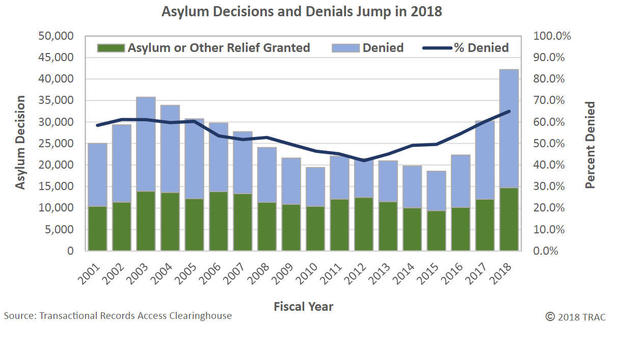
Immigration judges rejected a record-high number of asylum cases this year, refusing 65 percent of immigrants seeking the refugee status, according to a recent report published by Syracuse University’s Transactional Records Access Clearinghouse (TRAC). More than 42,000 asylum cases were decided in the fiscal year ending Sept. 30, 2018, the most since the group began tracking the data in 2001.

The rise marks the sixth consecutive year that the denial rate has increased, according to TRAC’s data. In 2012, the refusal rate was 42 percent; 2018’s rejection rate is nearly 50 percent larger, according to TRAC’s data. The group obtained data from the Department of Homeland Security through Freedom of Information Act requests.

TRAC pointed out the increase “largely reflects asylum applicants who had arrived well before President Trump assumed office.”

asylum-denials-fy2018-trac-syracuse-university-figure01.jpg

Immigration court asylum decisions, between fiscal years 2001 and 2018, shown in a graph provided by Syracuse University.

Immigration judges have been busier than ever before. Courts decided on 42,224 asylum cases this fiscal year, an 89 percent increase from two years ago, according to TRAC’s data. There is little relief in sight: as of Sept. 30, there were more than 1 million backlogged immigration cases, including those seeking asylum.

“I worry that people’s due process is at risk and that’s at play in the rise of denial rates,” said Aaron Reichlin-Melnick, policy analyst at the American Immigration Council, in a telephone interview with CBS News. “People’s claims are getting denied not because it wasn’t valid, but because there just wasn’t enough time to collect evidence and representation in an environment that’s seeking speed.”

Mr. Trump made immigration a key issue of the midterms, often tweeting about a migrant caravan traveling through Central America and Mexico and deploying thousands of troops to the southern border ahead of Election Day on Nov. 6. Days later, Mr. Trump signed an executive order barring asylum from anyone who illegally entered the country, a decree later blocked by a federal judge.

Asylum is a specific immigration process reserved for people of any nation fleeing persecution. Asylum seekers must establish they face “credible fear” in their home country, and – in a majority of cases – are allowed to live on U.S. soil while a judge determines the validity of their claim. Mr. Trump and other proponents of stricter immigration laws say the system has been abused by migrants, calling the practice “catch and release” and have made attempts to limit the system.

A change in immigration language from former Attorney General Jeff Sessionsearlier this year severely limited the ability for asylum seekers to establish persecution based domestic and gang-related violence, two forms of persecution that disproportionately impact migrants from Central America.

asylum-denials-fy2018-trac-syracuse-university-figure02.jpg

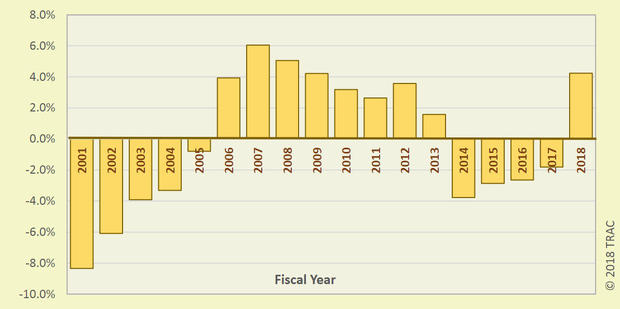
Change in representation rates compared with fiscal year 2001 through fiscal year 2018 (average).

Nearly 80 percent of last year’s asylum decisions were for immigrants from El Salvador, Honduras, Guatemala and Mexico, countries with already historically low asylum grant rates, according to Sarah Pierce, a policy analyst at the Migrant Policy Institute, a Washington, D.C.-based think tank.

“You’re dealing with an administration that’s putting a lot of pressure on immigration judges while looking skeptically at asylum and humanitarianism,” Pierce said in a telephone interview Monday evening with CBS News.

Immigration judge selection continued to play a major role in asylum decisions, according to TRAC. Asylum law can have wide-ranging interpretation, leaving immigration judges with more discretion than some other areas of law, said Reichlin-Melnick. For example in San Francisco’s immigration court, depending on the judge, asylum denial rates ranged from 10 percent to 97 percent.

“It’s refugee roulette,” Reichlin-Melnick said. “The single biggest factor on whether you win your case is just who you end up in front of.”

Source: Asylum denials hit record-high in 2018 as Trump administration tightens immigration policy

Citizenship query will not cause U.S. census undercount: official

Does not appear he was entirely comfortable in his testimony, but not to the extent he felt compelled to resign as happens with Statistics Canada when the then Chief Statistician, Munir Sheikh, resigned over his views on the change to the less methodologically sound National Household Survey were misrepresented:

The U.S. Census Bureau’s top scientist on Wednesday insisted the bureau can get a full count of American residents during the 2020 census, despite the Trump administration’s addition of a question on citizenship.

The agency’s chief scientist, John Abowd, made the comments in testimony in federal court in New York, where a group of U.S. states, cities and civil rights groups have sued the administration to remove the question, arguing it could dissuade non-citizens from participating in the decennial census.

Commerce Secretary Wilbur Ross, a Republican, announced the citizenship question in March, saying it was needed to enforce federal laws against voter discrimination.

But plaintiffs say that is a pretext, and they want U.S. District Judge Jesse Furman, who is hearing the case, to strike the question. They say Ross’ real motive is to scare immigrants into abstaining from the census, costing their mostly-Democratic communities political representation and federal aid.

Abowd’s testimony spanned two days and grew tense at times.

Closing arguments were tentatively set for Nov. 27.

On Wednesday, plaintiffs accused government lawyers of “ambushing” them with new evidence.

On Tuesday Abowd appeared to fight back tears when a plantiff lawyer said the Trump administration had decided to add the citizenship question well before asking him to study the matter.

Abowd admitted the question could lower the response rate and quality of data in the 2020 census, but said it will not cause an undercount because the bureau will follow up with non-responders. If that process requires more effort than expected, he said, enumerators can simply work harder.

“There is enough capacity in the current cost model” to “adjust their workloads,” Abowd said, citing a $1.7 billion contingency in the census budget.

He said the bureau will also rely on neighbors and existing government records to augment missing data.

Witnesses for the plaintiffs previously testified that such methods will not produce a full count.

An economist and Cornell University professor, Abowd is among the trial’s most compelling witnesses. Appointed to his Census role during the Obama administration, he advised against including the citizenship question earlier this year. But as a witness, he has had to defend it.

“CARRYING OUT OBLIGATIONS”

On Wednesday, when Abowd testified that the bureau was planning a new study on the impact of the citizenship question on the voluntary response rate of the census, an attorney for the American Civil Liberties Union objected.

“They’re trying to ambush us with new evidence,” attorney Dale Ho said, saying that the information should have been revealed during discovery.

The judge appeared to agree, saying he was “inclined to strike” Abowd’s testimony on the topic.

On Tuesday, Abowd appeared to hold back tears when Ho said Ross had withheld information from Abowd.

Abowd was asked to spend his holidays last December running an analysis on the pros and cons of adding the question. In fact, Ho said, Ross had decided months earlier that he supported its addition.

“From the beginning of the time I started my analysis through today, I’m just carrying out my obligations,” said an emotional Abowd.

Source: Citizenship query will not cause U.S. census undercount: official

Republicans’ hard-line stance on immigration may alienate millennials for years

Some interesting data:

In the run-up to the 2018 midterm elections, President Trump doubled down on the restrictive immigration positions that fueled his 2016 presidential campaign. The last few weeks of the campaign, he repeatedly warned Americans about the migrant caravan headed to the United States from Central America, and advocated for the repeal of birthright citizenship. Trump hoped to mobilize Republican voters, thereby helping to elect Republican candidates. Especially in the Senate, this may have helped Republicans gain two seats.

But in the long term, Trump’s anti-immigration approach may alienate millennial voters — and backfire on the Republican Party. The millennial generation, born between 1980 and 1997, is the largest and most diverse adult cohort.

In the midterms, majorities of millennials voted for Democrats. That’s a troubling sign for Republicans

Almost 7 in 10 voters (67 percent) ages 18 to 29, and nearly 6 in 10 (58 percent) of those ages 30 to 44, supported Democratic candidates. That’s mostly the millennial generation. Researchers who study party identification suggest that it’s “sticky” — that the party you vote for in your first few elections tends to harden and become your party for life.

And while a number of issues probably contributed to their votes, their liberal attitudes on immigration may be important.

Demographics are against the long-term success of hard-line immigration policies

The millennial generation is the most diverse adult generation in U.S. history. Hispanics make up 21 percent of all U.S. millennials. My research shows that this diversity contributes to their more progressive and tolerant attitudes toward immigration, compared with older adults.

In my book “The Politics of Millennials,” co-authored with Ashley Ross, we conducted a survey in late 2015 to gauge the generation’s attitudes toward immigrants. The online survey of 1,251 Americans (including an oversample of 621 millennials) was fielded by Qualtrics, with quotas used to make the sample nationally representative. The survey matched U.S. Census figures for gender, race/ethnicity and region, and a weight was employed to calibrate sample so that it equals the general population of age groups.

Across a variety of measures, we found millennials to be significantly more favorable toward immigrants and immigration than older Americans. For instance, one item asked respondents whether they thought immigrants “strengthened the diversity of the country” or “threatened traditional American values.” Among millennials, 52 percent said immigrants strengthened the country’s diversity, while 48 percent said they threatened the country’s values. Among non-millennials, those numbers were 41 and 59 percent, respectively.

We found similar divides when we asked respondents whether immigrants “only take jobs Americans do not want to do” or whether they “take jobs away from Americans.” Fifty-nine percent of millennials gave the pro-immigrant response, while just 49 percent of non-millennials did. Likewise, 45 percent of millennials said illegal immigrants did not threaten the nation’s security, compared with 33 percent of non-millennials.

Millennials, of course, are not monolithic, and differences on immigration attitudes exist across race and ethnic subgroups. To assess these differences, in the same Qualtrics survey, we asked white non-Hispanic, Hispanic and African American millennials to indicate how much they support or are likely to support four immigration policies:

  1. Require that all companies verify the legal status of workers before employing them — a policy known as E-Verify.
  2. Strengthen border security and extend wall or fencing along the U.S.-Mexico border.
  3. Allow undocumented childhood arrivals under age 30 to stay in the United States.
  4. Allow in-state tuition and fees at state universities for undocumented immigrants who arrived in the United States as children.

The figure below displays the mean values of millennial subgroups’ average support for the four immigration policies, from 0 (no support) to 4 (a lot of support).


Number of respondents for each subgroup: White non-Hispanic = 335, African Americans = 106, Hispanics = 158.

As you can see, these three racial/ethnic subgroups hold some different opinions on immigration policies. Hispanics are less likely to support E-Verify and border security measures than are white non-Hispanic and African American millennials.

What’s more, Hispanic millennials are significantly more likely than either white non-Hispanic or African American millennials to support allowing undocumented children to stay in the country. And while African American and Hispanic millennials convey similar levels of average support for in-state tuition for undocumented immigrants, white non-Hispanic millennials aren’t as supportive overall.

On every measure, millennials are more pro-immigrant than non-millennials

Ross and I also show that millennials were quite tolerant toward immigrants even in 2008, at the height of the Great Recession — despite the fact that this group was disproportionately hurt by the economic downturn and might have been expected to resent immigrants for allegedly taking “their’” jobs.

In 2016, Trump rode a hard-line immigration posture all the way to the White House. Since then, many Republican elected officials have embraced this stand as a winning platform.

However, if millennials continue to have more liberal and tolerant attitudes toward immigration, this stance may hurt the Republican Party over the long term.

Source: Republicans’ hard-line stance on immigration may alienate millennials for years

USA: Citizenship Question May Be ‘Major Barrier’ To 2020 Census Participation

Evidence-based:

The controversial new citizenship question the Trump administration added to the 2020 census may turn out to be a “major barrier” to the country’s full participation in the upcoming national head count, according to a national study commissioned by the Census Bureau.

The Constitution requires every person living in the U.S. — both citizens and noncitizens — to be counted once a decade. Those population numbers are used to determine how many congressional seats and Electoral College votes each state gets.

For the upcoming 2020 census, the Trump administration is planning to include a question it says the Justice Department needs to better enforce Voting Rights Act protections against racial discrimination. The question asks, “Is this person a citizen of the United States?”

In focus groups conducted in March and April to inform the government’s outreach efforts for the census, some participants identified that question as a significant reason why they would avoid taking part in the head count.

“They tended to both believe that the purpose of the question was to find undocumented immigrants and that the political discourse is targeting their ethnic group,” explained Sarah Evans, a lead researcher at PSB, a firm that is affiliated with census contractor Young & Rubicam. “This was an idea we heard across audiences,” she added.

The administration announced the addition of the question in late March, after the study had already begun. The 30 groups asked about the question represent populations the bureau consider to be among the hardest to count, including Spanish speakers, Vietnamese speakers and people of Middle Eastern or North African descent.

This preliminary finding of the 2020 Census Barriers, Attitudes and Motivators Studywas announced Thursday at a public meeting of the bureau’s National Advisory Committee on Racial, Ethnic, and Other Populations. It comes as the Trump administration is fighting six lawsuits from dozens of states, cities and other groups around the country over Commerce Secretary Wilbur Ross’ decision to add the citizenship question to forms for the upcoming head count. A trial for the two lead lawsuits in New York City is set to start on Nov. 5.

Federal law prohibits the Census Bureau from releasing any information it collects that identifies individuals until 72 years after it’s collected, although the agency can share information with the public about specific demographic groups at a level as detailed as a specific neighborhood. Census Bureau officials emphasize that individuals’ information cannot be shared with law enforcement agencies such as the FBI and Immigration and Customs Enforcement.

Still, the study, which also included a nationwide survey distributed between February and April, found that many participants did not believe that the government will keep that promise of confidentiality. The fear is particularly high among Asian and black participants, as well as those who do not have a high school diploma and those with low proficiency in English or the internet.

Close to half of the survey participants (47 percent), researchers noted, incorrectly answered a question about whether the census is used to find people living without documentation, including more than a third that responded with “don’t know.” Some U.S. citizens surveyed may feel “endangered” by the political discourse surrounding the citizenship question, the researchers’ presentation at the bureau’s headquarters in Suitland, Md., also highlighted.

Making people “panic”

Latino “participants worried that their participation in the census could harm them personally or others in their communities/households they care about,” the researchers wrote in their presentation’s slide deck.

During a focus group of Spanish speakers, a participant described the current climate as a “hunt” for Latinos.

“Latinos are going to be afraid to be counted because of the retaliation that could happen,” the participant reported. “It’s like giving the government information, saying, ‘Oh, there are more here.’ ”

During another focus group of people of Middle Eastern or North African ancestry, one participant said: “ICE is working with different groups on deportation sweeps, and it would make me feel like I’m aiding in that. They’re doing a lot of illegal stuff, and so I wouldn’t fill out any of the questions.”

The citizenship question’s purpose, a Vietnamese-speaking focus group participant said, was “to make people panic,” especially those who are afraid of deportation.

Asked by NPR how the Census Bureau plans to incorporate these findings into the communications plan for the 2020 census, spokesperson Naomi Evangelista did not provide any details but instead pointed to a blog post written by the agency’s acting director, Ron Jarmin.

“The extensive research effort yielded rich insights that will inform the subsequent stages of the communications campaign,” Jarmin wrote, adding that the study’s findings will guide advertising, social media and other efforts to encourage people to respond to the census.

The latest findings underline previously released research from the bureau that suggested that asking about citizenship status will discourage noncitizens, including immigrants living in the country illegally, from participating in the census. As a result, that could undermine the accuracy of the information gathered for the head count. Before Ross announced his decision to add the citizenship question, Census Bureau researchers advocated for a different way of producing citizenship information for the Justice Department that would generate data more accurate and less expensive than self-reported responses to a question on the census.

Source: Citizenship Question May Be ‘Major Barrier’ To 2020 Census Participation

USA: Why the Announcement of a Looming White Minority Makes Demographers Nervous

Always a challenge how to present data and trends in a manner that will not inflame debate. Even when presented with appropriate nuance, the risk remains.

Struggled a bit with this in my recent article, Hospital stats show birth tourism rising in major cities, and judging by the reaction on Twitter, appears I got the balance right, although of course there were critiques by those on the left and right:

The graphic was splashy by the Census Bureau’s standards and it showed an unmistakable moment in America’s future: the year 2044, when white Americans were projected to fall below half the population and lose their majority status.

The presentation of the data disturbed Kenneth Prewitt, a former Census Bureau director, who saw it while looking through a government report. The graphic made demographic change look like a zero-sum game that white Americans were losing, he thought, and could provoke a political backlash.

So after the report’s release three years ago, he organized a meeting with Katherine Wallman, at the time the chief statistician for the United States.

“I said ‘I’m really worried about this,’” said Dr. Prewitt, now a professor of public affairs at Columbia University. He added, “Statistics are powerful. They are a description of who we are as a country. If you say majority-minority, that becomes a huge fact in the national discourse.”

In a nation preoccupied by race, the moment when white Americans will make up less than half the country’s population has become an object of fascination.

For white nationalists, it signifies a kind of doomsday clock counting down to the end of racial and cultural dominance. For progressives who seek an end to Republican power, the year points to inevitable political triumph, when they imagine voters of color will rise up and hand victories to the Democratic Party.

But many academics have grown increasingly uneasy with the public fixation. They point to recent research demonstrating the data’s power to shape perceptions. Some are questioning the assumptions the Census Bureau is making about race, and whether projecting the American population even makes sense at a time of rapid demographic change when the categories themselves seem to be shifting.

Jennifer Richeson, a social psychologist at Yale University, spotted the risk immediately. As an analyst of group behavior, she knew that group size was a marker of dominance and that a group getting smaller could feel threatened. At first she thought the topic of a declining white majority was too obvious to study.

But she did, together with a colleague, Maureen Craig, a social psychologist at New York University, and they have been talking about the results ever since. Their findings, first published in 2014, showed that white Americans who were randomly assigned to read about the racial shift were more likely to report negative feelings toward racial minorities than those who were not. They were also more likely to support restrictive immigration policies and to say that whites would likely lose status and face discrimination in the future.

Mary Waters, a sociologist at Harvard University, remembered being stunned when she saw the research.

“It was like, ‘Oh wow, these nerdy projections are scaring the hell out of people,” she said.

Beyond concerns about the data’s repercussions, some researchers are also questioning whether the Census Bureau’s projections provide a true picture. At issue, they say, is whom the government counts as white.

In the Census Bureau’s projections, people of mixed race or ethnicity have been counted mostly as minority, demographers say. This has had the effect of understating the size of the white population, they say, because many Americans with one white parent may identify as white or partly white. On their census forms, Americans can choose more than one race and whether they are of Hispanic origin.

Among Asians and Hispanics, more than a quarter marry outside their race, according to the Pew Research Center. For American-born Asians, the share is nearly double that. It means that mixed-race people may be a small group now — around 7 percent of the population, according to Pew — but will steadily grow. Are those children white? Are they minority? Are they both? What about the grandchildren?

“The question really for us as a society is there are all these people who look white, act white, marry white and live white, so what does white even mean anymore?” Dr. Waters said. “We are in a really interesting time, an indeterminate time, when we are not policing the boundary very strongly.”

The Census Bureau has long produced projections of the American population, but they were rarely the topic of talk shows or newspaper headlines.

Then, in August 2008 at the height of Barack Obama’s campaign for president, the bureau projected that non-Hispanic whites would drop below half the population by 2042, far earlier than expected. (The projections, which change with birth, death and migration rates, have also placed the shift in 2050 and in 2044.)

“That’s what really lit the fuse,” said Dowell Myers, a demographer at the University of Southern California, referring to the 2008 projection. “People went crazy.”

It was not just white nationalists worried about losing racial dominance. Dr. Myers watched as progressives, envisioning political power, became enamored with the idea of a coming white minority. He said it was hard to interest them in his work on ways to make the change seem less threatening to fearful white Americans — for instance by emphasizing the good that could come from immigration.

“It was conquest, our day has come,” he said of their reaction. “They wanted to overpower them with numbers. It was demographic destiny.”

Dr. Myers and a colleague later found that presenting the data differently could produce a much less anxious reaction. In work published this spring, they found that the negative effects that came from reading about a white decline were largely erased when the same people read about how the white category was in fact getting bigger by absorbing multiracial young people through intermarriage.

It is unclear exactly when the idea of a majority-minority crossover first appeared, but several experts said it may have surfaced in connection with the 1965 Voting Rights Act.

Ms. Wallman, the chief statistician for the United States from 1992 to 2017, who helped develop the first governmentwide standard for data on race and ethnicity that came into use in the late 1970s, said she did not like having to categorize by race, but that the government had to for oversight.

“I wish we didn’t have to ask,” she said. “But to me, that’s the rock and the hard place.”

Race is difficult to count because, unlike income or employment, it is a social category that shifts with changes in culture, immigration, and ideas about genetics. So who counts as white has changed over time. In the 1910s and 1920s, the last time immigrants were such a large share of the American population, there were furious arguments over how to categorize newcomers from Europe.

But eventually, the immigrants from eastern and southern Europe came to be considered white.

That is because race is about power, not biology, said Charles King, a political science professor at Georgetown University.

“The closer you get to social power, the closer you get to whiteness,” said Dr. King, author of a coming book on Franz Boas, the early 20th-century anthropologist who argued against theories of racial difference. The one group that was never allowed to cross the line into whiteness was African-Americans, he said — the long-term legacy of slavery.

To Richard Alba, a sociologist at the City University of New York, the Census Bureau’s projections seemed stuck in an outdated classification system. The bureau assigns a nonwhite label to most people who are reported as having both white and minority ancestry, he said. He likened this to the one-drop rule, a 19th-century system of racial classification in which having even one African ancestor meant you were black.

“The census data is distorting the on-the-ground realities of ethnicity and race,” Dr. Alba said. “There might never be a majority-minority society; it’s unclear.”

Asked for a response to Dr. Alba’s critique, a Census Bureau spokesman said in an email that “we constantly consult with stakeholders, and scholars, including Richard Alba and other federal agencies to improve our techniques, methodologies, and testing of population projections.”

William Frey, a demographer at the Brookings Institution, argued that the Census Bureau was doing the best that it could at a time whensociety was changing quickly. He was skeptical that today’s Asians and Hispanics were analogous to the white ethnic Americans of the 20th century, and believed that a less conservative count would not do much to change the bigger picture. Besides, it is not the job of academics to protect people from demographic change, he said.

“Irrespective of the year, or the turning point, the message needs to come out about what the actual facts are,” Mr. Frey said. “We are becoming a much more racially diverse society among our young generation.”

Others say they are not sugarcoating statistics, but showing that the numbers have many interpretations, and that white-versus-everyone-else is only one. It not only reduces the American patchwork to a crude, divisive political formula, they say, but perhaps more important — with the categories in flux — it might not even be true.

The Census Bureau released new projections this year in March filled with data about the country’s future. In the coming decades, adults 65 and older will outnumber children for the first time in the country’s history. The share of mixed-race children is set to double.

But there was no mention of a year when white Americans would fall below half the population.

When asked about the change, a spokesman for the Bureau said: “It was just us getting back to sticking to data.”

Source: Why the Announcement of a Looming White Minority Makes Demographers NervousThe moment when white Americans will make up less than half the population has become an object of fascination. Some researchers question whether the projections provide a true picture.

Federal Judge Rules U.S. Ban on Female Genital Mutilation Is Unconstitutional

Disturbing although the case seems to hinge on federal vs state authority. Will see if leads to an appeal (hopefully it will, but not sure how the current more conservative Supreme Court would rule):

In a historic ruling that strikes a chilling blow to women’s rights, a federal judge in Michigan declared unconstitutional the U.S. law against female genital mutilations (FGM), and dropped charges against two doctors for carrying out the procedure on underage girls.

U.S. District Judge Bernard Friedman said Tuesday that Congress lacks the authority to outlaw the procedure, and insisted only states can make such a decision, the Detroit Free Press reports.

“As despicable as [FGM] may be,” Friedman said, Congress “overstepped its bounds” by banning the practice.

The trial was the first federal case to involve FGM, which is common religious practice in some cultures, but is internationally recognized as a human rights violation. The defendants, including three mothers, are all members of the Indian Muslim Dawoodi Bohra community.

Friedman dismissed the main charges against Jumana Nagarwala, a doctor who prosecutors said may have performed the procedure on up to 100 girls. Another doctor who allowed Nagarwala to use his clinic, that doctor’s wife and five others also saw their charges dropped. The doctors continue to face lengthy prison terms on conspiracy charges.

According to the court records, two of the mothers tricked their 7-year-olds into thinking they were going to Detroit for a girls’ trip. Instead, they had their genitals cut.

FGM typically involves cutting or even wholly removing the clitoris. The World Health Organization calls it “a violation of the human rights of girls and women” that “has no health benefits.”

In 2012, the U.N. General Assembly passed a resolution to ban the practice, which affects an estimated 200 million women and girls worldwide. It has also been outlawed in more than 30 countries, including the U.S., which passed a law in 1996 criminalizing FGM with a 5-year prison term.

Twenty-seven states separately passed similar measures, including Michigan in 2017. But the defendants in this case are not retroactively subject to the new law.

A spokesperson for the U.S. attorney in Detroit said the government would review the ruling before deciding whether to appeal.

Michigan State Senator Margaret O’Brien, who backed the state ban on FGM, said she was “appalled” by Tuesday’s ruling.

Yasmeen Hassan, executive global director for gender rights group Equality Now, warned the ruling sends the message to women and girls that “you are not important.”

Source: Federal Judge Rules U.S. Ban on Female Genital Mutilation Is Unconstitutional