Trump touts plan to change visas for skilled foreign workers

All those articles contrasting Canada vs US policies under Trump have provoked a reaction (factually incorrect as per usual practice):

U.S. President Donald Trump said on Friday he plans changes to the H-1B program that grants temporary visas for specialty occupations such as technology or medicine, but his administration said later he was referring to changes that were proposed last year.

“H1-B (sic) holders in the United States can rest assured that changes are soon coming which will bring both simplicity and certainty to your stay, including a potential path to citizenship,” Trump said on Twitter. “We want to encourage talented and highly skilled people to pursue career options in the U.S.”

It was unclear what Trump meant by a “potential path to citizenship” for H-1B visa holders, who already are eligible to be sponsored by employers for legal permanent residency, which would then make them eligible to become U.S. citizens.

When asked about Trump’s tweet, U.S. Citizenship and Immigration Services spokesman Michael Bars provided a statement about a formal proposal in December for changes to the H-1B process, which are likely to become final later this year.

The proposal is designed to increase by 5,340, or 16 percent, the number of H-1B beneficiaries who hold advanced degrees from American universities. It would also streamline the application process with a new electronic registration system.

“These proposed regulatory changes would help ensure more of the best and brightest workers from around the world come to America under the H-1B program,” Bars said.

Critics questioned why Trump tweeted about a month-old proposal at a time when he is battling with congressional Democrats over spending legislation to fund the federal government. Trump wants to include $5.6 billion for a wall along the border with Mexico, which he says will stem illegal immigration.

Democrats call the proposed wall expensive, ineffective and immoral. The dispute has led to a partial shutdown of the U.S. government that is now in its 21st day.

Doug Rand, a former White House official in the Obama administration who worked on immigration issues, said the proposed changes to the lottery selection process were at best modest and at worst could cause chaos. Some immigration experts do not believe the new registration system will be ready in time for the next lottery, which occurs in the spring.

“The odds that a complicated new electronic processing system will be effectively launched by DHS in time for the next lottery on April 1 is low probability and has nothing to do with a potential path to citizenship,” Rand said.

Trump backs off emergency declaration – for now

Throughout his presidency, Trump has sought to stem illegal immigration and to deport more immigrants living in the United States illegally. His administration has also worked to limit legal immigration, including through a proposal that would penalize aspiring immigrants who use public benefits.

Trump has also derided visas granted to family members of U.S. residents or citizens as “chain migration,” and backed a Republican proposal in 2017 that would have slashed legal immigration in half.

“The devil is in the details, said Todd Schulte, president of FWD.us, a nonprofit group which advocates for pro-immigration policies. He said his group, which was founded by tech executives including Facebook founder Mark Zuckerberg, remains “skeptical of vague pronouncements given the administration’s track record.”

U.S. companies often use H-1B visas to hire graduate-level workers in specialized fields including information technology, medicine, engineering and mathematics. But the visa program has also drawn criticism for being used heavily by foreign outsourcing companies that squeeze out American firms.

Source: Trump touts plan to change visas for skilled foreign workers

Trump’s immigration policy has foreign tech talent looking north of the border

These articles keep on coming in the US press (less so in conservative medias like Fox):

Over dinner at a noodle bar, a Canadian entrepreneur pitched a table of U.S. tech executives: Your foreign workers should trade sunny California for snowy Calgary, he told them. And they listened.

Highly skilled foreign workers and the American firms that employ them are in a bit of a visa panic. President Trump has vowed to crack down on the H-1B visa program, which allows 85,000 foreigners per year to work in “specialty occupations” in the United States. But there are no new rules yet, creating climate of uncertainty and fear, particularly in Silicon Valley.

Canadian businesses sense an opportunity. The Canadian tech scene has sought for years to compete with Silicon Valley, trying to lure talent north. In the early days of the Trump administration, “moving to Canada” talk surged among Americans, but most foreign workers waited.

Now some are making the move.

Though it is hard to track how many foreign nationals have moved from the United States — the Canadian government tracks newcomers by country of citizenship, not residence — immigration lawyers and recruiters on both sides of the border say the number of inquiries from nervous H-1B holders has skyrocketed since 2017.

A small group of Canadian entrepreneurs are dropping into Silicon Valley to persuade companies that rely on foreign tech workers to move them across the border.

Irfhan Rawji, the Canadian entrepreneur trying to sell U.S. tech executives on Canada over dinner, last year founded a company called MobSquad that helps tech companies move software engineers and other highly skilled workers to Canada. He travels regularly to Silicon Valley to promote his Canadian “solution.”

“Our turnaround to bring a foreign worker to Canada is under four weeks,” he said. “It’s typically longer for them to pack up their stuff.”

For Akshaya Murali, an Indian national who spent nearly a decade in the United States working for companies such as Microsoft and Expedia, moving to Toronto meant an end to living visa to visa.

She and her family applied for permanent residence in Canada and were approved.

Her employer, Remitly, then worked with MobSquad to move her job north. MobSquad signed a contract with Remitly and then hired her to do the same job — senior product manager — for Remitly from Toronto.

MobSquad’s cut is the difference between her total compensation in pricey San Francisco and the cost of the same work in Toronto, which is lower.

Remitly’s chief product officer, Karim Meghji, said the process went so smoothly that he will probably do it again. “My next step is thinking through, ‘What else can I do in Canada?’ ” he said.

Murali landed in Toronto in October and is settling in. “It’s a nice place to bring up our son, really family-friendly,” she said. “The only thing is the weather.”

Seeking stability

Silicon Valley’s visa anxiety did not start with Trump, but his policy moves and anti-immigrant rhetoric have compounded the problem, according to tech executives, immigration lawyers and people who have moved.

Months into his presidency, Trump issued a “Buy American and Hire American” executive order that ordered the Department of Homeland Security to review the H-1B visa program with the intention of more closely vetting applicants.

In the wake of the order, there were reports of an uptick in visa denials and requests by immigration officials for additional information, turning the issue into a topic of conversation for big U.S. companies and immigrant communities alike.

In August, chief executives from top U.S. firms including Apple, Cisco and IBM sent a letter to DHS expressing concern about the changes. “Inconsistent immigration policies are unfair and discourage talented and highly skilled individuals from pursuing career options in the United States,” it said.

Asked to comment on these reported changes, United States Citizenship and Immigration Services spokesman Michael Bars said, “Increasing our confidence in who receives benefits is a hallmark of this administration.”

Bars said proposed changes now under review would make the H-1B process more efficient and ensure the best applicants get visas.

Many have found the uncertainty over the changes to the H-1B program confusing and costly.

S. “Sundi” Sundaresh, the chief executive of Cinarra Systems, a start-up that provides location analytics based on mobile data to businesses, says getting U.S. work visas is a significant challenge.

His company employs 55 people worldwide, including 15 in the United States. He has three people on H-1Bs but would hire more if the process were easier.

Recently, an employee who was working remotely and waiting on a U.S. visa quit in frustration. When a second worker reached the same point, he started looking for options and is now talking to MobSquad about Canada. “We can’t lose a second one,” he said.

Michael Tippet, a Canadian entrepreneur who founded a company that helps U.S. firms set up satellite offices in Vancouver as a buffer against uncertainty in the United States, said highly skilled, foreign-born workers feel anxious and frustrated.

“From the company’s perspective, the primary motivation is that they can continue to attract top talent,” he said. “To have those people work for you, you have to show you’ve got their back.”

If you don’t have their back, they may leave.

Amogh Phadke, an Indian citizen with a master’s degree in computer science, an MBA and work experience at FedEx and Fannie Mae, wanted to build his life in the United States.

“I was struggling for 10 years with my immigration status,” he said. His breaking point was the Trump administration’s as-yet-unrealized threat to stop granting work visas for spouses of H-1B holders.

His wife, an Indian national who was studying in Canada, no longer wanted to join him stateside. “She said, ‘It’s here, or we are going back to India.’ ”

He decamped to Edmonton, the chilly capital of Alberta, last year.

The pitch for Canada

While the debate over immigration roils the United States, Canada’s major political parties are broadly supportive of increasing the number of immigrants, as long as they are skilled.

In 2017, Prime Minister Justin Trudeau’s government launched the Global Talent Stream, a program designed to fast-track work authorization for those with job offers in high-demand realms of science and tech.

Successful applicants can get a work permit in a matter of weeks. Spouses and children are eligible for work or study permits.

More than 2,000 companies have applied to hire Talent Stream workers, the department for Immigration, Refugees and Citizenship Canada said in an emailed statement.

With the door wide open, the Canadian government’s biggest challenge may be actually making the case for Canada.

Recent arrivals said the country is not really on the radar. When Phadke told Americans he was moving to Edmonton, they were shocked. “My colleagues were like, ‘Oh, my God, nobody lives in the middle of Canada. Are there going to be roads there?’ ”

When people heard how quickly he could move, he was met with more skepticism. “They asked, ‘Is it a scam?’ ”

“Canada is really bad at marketing itself,” said Vikram Rangnekar, a former software developer for LinkedIn who recently moved from the Bay Area to Toronto.

When he landed, he was so impressed with the city that he started writing about it. He later started Mov North, a site for people thinking about moving.

The site includes information on dressing for the cold — “The adage ‘There’s no such thing as bad weather, only bad clothes’ is entirely true” — and information about benefits like paid maternity leave. It also tries to connect software engineers with Canadian companies.

Hugo O’Doherty, an editor at Moving2Canada.com, a website catering to would-be immigrants and new arrivals, said Canada can’t often compete with Silicon Valley salaries, but that tech types make good money relative to the cost of living.

They also gain peace of mind. Noncitizens in the United States “don’t know if they will able to stay, if their spouse will be able to work, if their kids will have a pathway to citizenship,” he said. In his experience, Canada appeals to people who want stability.

For MobSquad’s Rawji, it is all about seeking out the best and brightest and putting them on a path to citizenship. “Our social mission is to change the Canadian economy,” he said.

To those wondering about their status in the United States, he says: Come north.
Source: Trump’s immigration policy has foreign tech talent looking north of the border

Immigrant kids in U.S. deliberately build STEM skills


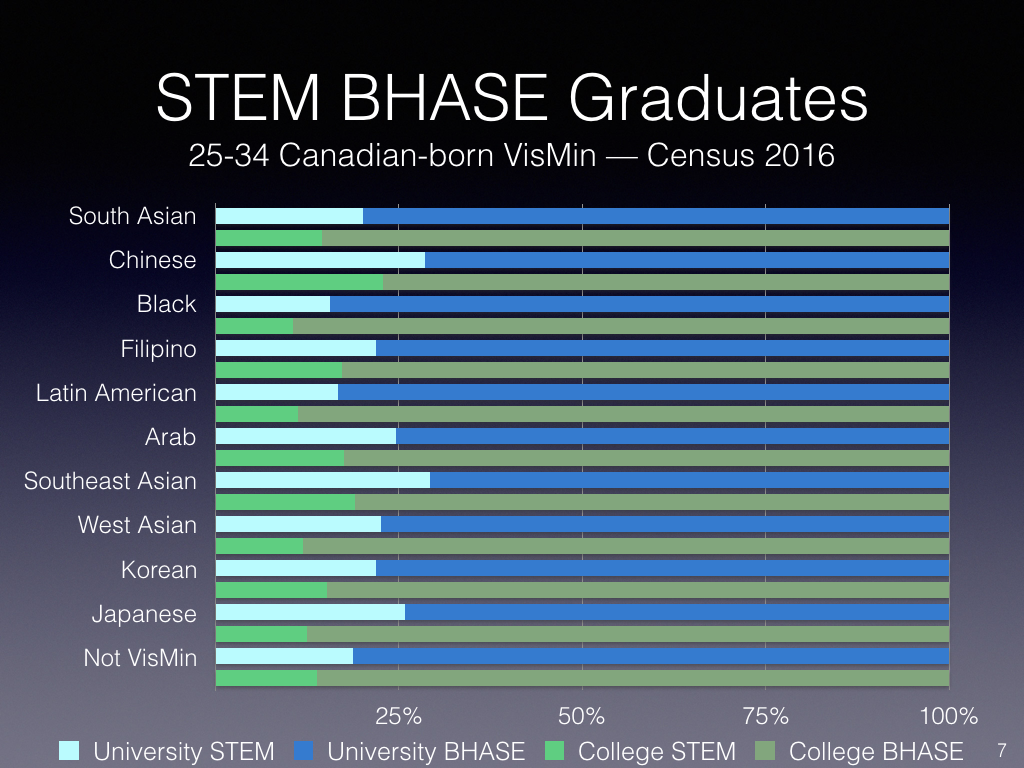
Similar pattern in Canada (chart above looks at Canadian-born visible minority university and college graduates compared to Not VisMin):

U.S. immigrant children study more math and science in high school and college, which leads to their greater presence in STEM careers, according to new findings from scholars at Duke University and Stanford University.

“Most studies on the assimilation of immigrants focus on the language disadvantage of non-English-speaking immigrants,” said Marcos Rangel, assistant professor at Duke’s Sanford School of Public Policy. “We focus instead on the comparative strength certain immigrant children develop in numerical subjects, and how that leads to majoring in STEM subjects in college.”

About 20 percent of U.S.-born college students major in STEM subjects. Yet those numbers are much higher among immigrants — particularly among who arrive the U.S. after age 10, and who come from countries whose native languages are dissimilar to English, Rangel said. Within that group, 36 percent major in STEM subjects.

“Some children who immigrate to the U.S., particularly older children from a country where the main language is very dissimilar to English, quite rationally decide to build on skills they are relatively more comfortable with, such as math and science,” said Rangel.

Those older immigrant children take more math and science courses in high school, the authors found. Immigrant children arriving after age 10 earn approximately 20 percent more credits in math-intensive courses than they do in English-intensive courses.

This focus continues in college, where immigrant children are more likely to pursue science, technology, engineering and math majors. Those majors, in turn, lead to careers in STEM fields. Previous research has shown that immigrants are more highly represented in many STEM careers.

“Meaningful differences in skill accumulation … shape the consequent contributions of childhood immigrants to the educated labor force,” the authors write.

Source: Immigrant kids in U.S. deliberately build STEM skills

USA demographic changes and political shifts: Asians, Latinos and Orange County

Good question regarding whether or not Asian Americans will be influenced by the Trump administration’s anti-immigration rhetoric and actions:

The same sort of panic that hit California’s Latinos after the 1994 passage of the anti-illegal immigrant Proposition 187 is now hitting many of this state’s almost 6 million ethnic-Asian residents.

Latino fears in the wake of Prop. 187, which sought to keep the undocumented immigrant out of public schools, hospital emergency rooms and seemingly any place its authors could imagine, led to citizenship applications and then voter registration by more than 2.5 million Hispanics over the next three years.

They caused a political revolution in California, which morphed from a swing state equally likely to elect Republicans or Democrats into one of the most staunchly Democratic states in the Union. Only one Republican has been elected to statewide office in the last 20 years, the almost non-partisan former Gov. Arnold Schwarzenegger, who won out in the 2003 recall of ex-Gov. Gray Davis.

Now Asian immigrants are feeling fearful because of President Trump’s ban on entry to this country by residents of several Muslim-majority countries and his attempts to restrict the number of political and humanitarian refugees allowed in, plus a drive to deport Vietnamese refugees with any kind of crime on their record, no matter how old or minor.

Asians also remember the Japanese internment during World War II, in which 120,000 Japanese-Americans were held in remote camps for several years.

“You hope things like that can’t happen again, but they really can,” said one green card holder from Thailand. “So I will become a citizen.”

Like her, thousands of Asians in California, from countries as diverse as China, the Philippines and India, see citizenship as the best protection from a potential future expulsion.

If they become citizens in anything like the proportions of Latinos who felt similarly in California after passage of Prop. 187, they could spur vast political changes well beyond this state’s borders. In fact, if both they and citizenship-eligible Latino immigrants ever register in large numbers, they could turn several once-solid Republican states into battlegrounds or cause them to lean Democratic.

And Asians here are applying, although there are impediments Latinos did not face in the late 1990s. Example: Of the 220,000 immigrants in Orange County now eligible for naturalization, nearly 30 percent are Asian. Of them, about 4,500 applied for naturalization through the first three quarters of 2017. If that trend continues statewide for the remainder of Trump’s current term, more than 150,000 Asians will be added to California’s voting rolls.

Because they’re registering largely for the same reasons as Latinos once did, they probably won’t change this state’s political composition. But what about other states? Taking Texas as an example, more than 680,000 Asians are now eligible for citizenship but have not applied. That could make for big change in a state that in November almost gave a Democrats their first statewide victory in more than 20 years.

Yes, the $725 naturalization application fee is a roadblock for many. So is the required blizzard of paperwork. But Texas saw more than 20,000 citizenship applications from Asians last year. If Latinos, many even more apprehensive about Trump’s policies than Asians, register in Texas in similar percentages – and they have not yet – they could combine with Asians to turn Texas Democratic. For that state contains more than 3 million Hispanics who have not sought naturalization despite being eligible.

For sure, the numbers indicate fear among both Latinos and Asians has not reached the same levels it did among California Hispanics after Prop. 187.

But what happens when and if Trump begins serious work on his long-advertised border wall? And what if he attempts mass deportations of illegal immigrants, as former Attorney General Jeff Sessions advocated during his days in the Senate?

For sure, hate crimes against immigrants of all kinds increased during Trump’s presidential campaign and his first year in office. If that trend accelerates, it may spur the kind of fears that pushed Latinos to get naturalized here.

Isaac Newton’s third law of motion tells us that for every action, there is an equal and opposite reaction. Just as former President Obama’s policies produced the backlash that elected Trump, so Trump’s policies may already have begun producing an even stronger national backlash against him and his party.

Source: Thomas D. Elias: Will Asians spur big new political changes?

And this analysis of the shift from solidly Republican to leaning Democratic in Orange Country is revealing:

To appreciate the vast cultural and political upheaval across Orange County over the last 40 years, look no further than Bolsa Avenue. The auto body shop, the tax preparer, a church, a food market, countless restaurants — all are marked by signs written in Vietnamese.

Or head seven miles west to Santa Ana, where Vietnamese makes way for Spanish along Calle Cuatro, a bustling enclave of stores and sidewalk stands serving an overwhelming Latino clientele.

The Democratic capture of four Republican-held congressional seats in Orange County in November — more than half the seven congressional seats Democrats won from Republicans in California — toppled what had long been a fortress of conservative Republicanism. The sweep stunned party leaders, among them Paul D. Ryan, the outgoing House speaker. Even Gavin Newsom, the Democratic governor-elect of California, won the county where Richard M. Nixon was born.

But the results reflected what has been a nearly 40-year rise in the number of immigrants, nonwhite residents and college graduates that has transformed this iconic American suburb into a Democratic outpost, highlighted in a Times analysis of demographic data going back to 1980, the year Ronald Reagan was elected president.

The ideological shift signaled by the most recent election results, on the heels of Hillary Clinton beating Donald J. Trump here in 2016, is viewed by leaders in both parties as a warning sign for national Republicans, as suburban communities like this one loom as central battle grounds in the 2020 elections and beyond.

Those new swing suburban counties were one of the central factors behind the 40-seat Democratic gain in the House in November. Many of them have been changed by an increase in educated and affluent voters who have been pushed toward the Democratic column by some of Mr. Trump’s policies. That partly accounts for what is happening here in Orange County, but the political shifts can also be explained by the rapidly changing cultural, political and economic face of the region and are on display in places like Bolsa Avenue, which is known as Little Saigon.

“There are so many of us here and that is what is contributing to these changes,” said Tracy La, 23, who is Vietnamese. Ms. La helped organize a rally in Westminster in mid-December to protest an attempt by the Trump administration to deport thousands of Vietnam War refugees. It drew hundreds of people to the Asian Garden Mall, one of the largest and oldest Vietnamese-operated malls in the nation.

“This is where the future is heading,” said Mark Baldassare, the president of the Public Policy Institute of California. “I don’t see anything that took place in these elections or the demographic trends that are ongoing, to make me think this is a one-time incident.”

That said, the critical question for Democrats — and for Republicans eager to get back in the game — is how much of the November outcome, and the large turnout of younger Latino and Asian-American voters, was because of Mr. Trump.

Kyle Layman, who ran the Southern California congressional campaigns for the Democratic Congressional Campaign Committee, said this election had apparently begun to cement long-term changes in voter behavior — an assessment that is not disputed by California Republican leaders.

“I think what we have done is built a foundation that is going to be sustainable,” he said. “These seats are going to be swing seats moving forward. They are going to be very, very tight. But this is part of a long-term trend.”

Indeed, even if the dramatic shift on display in 2018 was in reaction to Mr. Trump — and particularly the immigration policies he has embraced — analysts said that he had only accelerated political movements that were well underway.

“Because it’s becoming more diverse it’s becoming more Democratic, because the Democratic Party is more inclusive,” said Gil Cisneros, a Democrat from Yorba Linda who captured a House seat held by Representative Ed Royce, a Republican. “This is no fluke at all. It’s been this way for a long time and it’s going to continue to trend this way for a long time.”

There was a steady decrease in white voters in the seven congressional districts that are in and around Orange County between 1980 and 2017, according to census data. In 1980, whites made up 75 percent of the population in the district where Mr. Cisneros won. By 2017, that number dropped to 30 percent.

The county’s immigrant population grew five times as fast as the general population between 1980 and 2000, and while the pace of immigration has slowed, the Latino and Asian populations continues to increase, driven by the children of immigrant families born in the United States.

“The Republican Party in Orange County has been traditionally all white,” said Carlos Perea, 25, who moved to Santa Ana from Mexico to join his parents 11 years ago. “The party has pushed for policies that are very harmful to those communities: 2018 was a referendum on that old Orange County.”

Source: In Orange County, a Republican Fortress Turns Democratic

In contrast, Republican support among Latinos, although low at about one-third of voters, is holding steady:

The 55-year-old Colombian immigrant is a pastor at an evangelical church in suburban Denver. Initially repelled by Trump in 2016, he’s been heartened by the president’s steps to protect religious groups and appoint judges who oppose abortion rights. More important, Gonzalez sees Trump’s presidency as part of a divine plan.

“It doesn’t matter what I think,” Gonzalez said of the president. “He was put there.”

Though Latino voters are a key part of the Democratic coalition, there is a larger bloc of reliable Republican Latinos than many think. And the GOP’s position among Latinos has not weakened during the Trump administration, despite the president’s rhetoric against immigrants and the party’s shift to the right on immigration.

In November’s elections, 32 percent of Latinos voted for Republicans, according to AP VoteCast data. The survey of more than 115,000 midterm voters — including 7,738 Latino voters — was conducted for The Associated Press by NORC at the University of Chicago.

Other surveys also found roughly one-third of Latinos supporting the GOP. Data from the Pew Research Center and from exit polls suggests that a comparable share of about 3 in 10 Latino voters supported Trump in 2016. That tracks the share of Latinos supporting Republicans for the last decade.

The stability of Republicans’ share of the Latino vote frustrates Democrats, who say actions like Trump’s family separation policy and his demonization of an immigrant caravan should drive Latinos out of the GOP.

“The question is not are Democrats winning the Hispanic vote — it’s why aren’t Democrats winning the Hispanic vote 80-20 or 90-10 the way black voters are?” said Fernand Amandi, a Miami-based Democratic pollster. He argues Democrats must invest more in winning Latino voters.

The VoteCast data shows that, like white voters, Latinos are split by gender — 61 percent of men voted Democratic in November, while 69 percent of women did. And while Republican-leaning Latinos can be found everywhere in the country, two groups stand out as especially likely to back the GOP — evangelicals and veterans.

Evangelicals comprised about one-quarter of Latino voters, and veterans were 13 percent. Both groups were about evenly split between the two parties. Mike Madrid, a Republican strategist in California, said those groups have reliably provided the GOP with many Latino votes for years.

“They stick and they do not go away,” Madrid said. Much as with Trump’s own core white voters, attacks on the president and other Republicans for being anti-immigrant “just make them dig in even more,” he added.

Sacramento-based Rev. Sam Rodriguez, one of Trump’s spiritual advisers, said evangelical Latinos have a clear reason to vote Republican. “Why do 30 percent of Latinos still support Trump? Because of the Democratic Party’s obsession with abortion,” Rodriguez said. “It’s life and religious liberty and everything else follows.”

Some conservative Latinos say their political leanings make them feel more like a minority than their ethnicity does. Irina Vilariño, 43, a Miami restauranteur and Cuban immigrant, said she had presidential bumper stickers for Sen. John McCain, Mitt Romney and Trump scratched off her car. She said she never suffered from discrimination growing up in a predominantly white south Florida community, “but I remember during the McCain campaign being discriminated against because I supported him.”

The 2018 election was good to Democrats, but Florida disappointed them. They couldn’t convince enough of the state’s often right-leaning Cuban-American voters to support Sen. Bill Nelson, who was ousted by the GOP’s Spanish-speaking Gov. Rick Scott, or rally behind Democrats’ gubernatorial candidate, Tallahassee Mayor Andrew Gillum, who lost to Republican Rep. Ron DeSantis.

Still, in the rest of the country, there were signs that pleased Democrats. Latinos voted at high rates in an election that saw record-setting turnout among all demographic groups. Latinos normally have among the worst midterm turnout rates, and while official data won’t be available for months, a number of formerly-Republican congressional districts in California and New Mexico flipped Democratic.

That’s why Republicans shouldn’t take solace from being able to consistently win about one-third of Latinos, said Madrid. They’re still losing two-thirds of an electorate that’s being goaded into the voting booth by Trump.

“That is contributing to the death spiral of the Republican Party — even if it holds at 30 percent,” Madrid said. “That’s a route to death, it’s just a slower one.”

Gonzalez, the pastor, sees the trend in Colorado. He distributed literature across Spanish-speaking congregations supporting Republican gubernatorial candidate Walker Stapleton, who was crushed by Democratic Rep. Jared Polis as the GOP lost every race for statewide office.

Gonzalez understands the anger among some Latinos at the GOP and Trump for what he says is a false impression of a solely hardline immigration stance. “In the community that is not informed, that is following the rhetoric of the media, there’s a view that Donald Trump is a bad guy,” Gonzalez said. Evangelicals “understand that he’s there to defend values.”

Gonzalez’s church is Iglesia Embajada del Reino, or Church of the Kingdom’s Embassy. On a recent Saturday night, an eight-piece band played Spanish-language Christian rock before Gonzalez walked to the podium. Wearing a blue corduroy blazer, blue shirt and grey slacks, Gonzalez, a onetime member of a Marxist group in Colombia, told his congregants that they were ambassadors of a higher power — the kingdom of God.

“It’s important that your political opinions, your social opinions,” not enter into it, Gonzalez said. “We need to represent the position of ‘The Kingdom.’ ”

Gonzalez did not mention Trump in his sermon, though he spoke about the Bible as a book of governance.

Afterward the congregation gathered for bowls of posole, a traditional Mexican soup. When politics came up, church-goers struggled to balance their enthusiasm for some of Trump’s judicial appointments with their distaste at his rhetoric and actions.

“I think the president has good, Christian principles,” said Jose Larios, a parks worker. “But we feel as Latinos that he doesn’t embrace our community, and our community is good and hard-working.”

Oscar Murillo, a 37-year-old horse trainer, is not a fan of Trump’s. But he tries to stay open-minded about Republicans. He voted for the GOP candidate for state attorney general, who visited the congregation before the election. “He’s in the same party as Trump, but he seems different,” Murillo said.

Source: Latino support for GOP steady despite Trump immigration talk


Trump Is Making Americans More Immigrant-Friendly

The irony:

President Donald Trump may ultimately be a unifying force on one of the most divisive issues in U.S. politics: immigration.

That’s not Trump’s intent, of course. Having launched his presidential campaign in 2015 with a demagogic assault on immigrants, Trump has been a reliable fount of calumny ever since. His policies, from brutalizing children at the border — a 7-year-old girl died in U.S. custody last week — to terminating Temporary Protected Status for refugees, appear designed to convince his MAGAnauts that he can, and somehow will, forestall the further browning of America.

In public opinion, immigration is an imperfect substitute for “race.” However, Trump has succeeded in making it a more meaningful one. As numerous political science analyseshave determined, Trump’s racial animus is the sticky goo that binds him to his most enthusiastic followers. That goo may be a potent political force, but it’s not a boundless one. Trump appears to have found its limits.

The NBC/Wall Street Journal poll has been asking survey respondents since 2005 whether “immigration helps the United States more than it hurts it.” In December 2005, 37 percent said immigration helps more, while 53 percent said it hurts.

That anti-immigrant sentiment, regularly measured by the poll, largely prevailed until 2012, when opinions started gradually to shift. In the most recent poll, taken in September, the pro-immigration “helps” line reached a peak of 61 while the anti-immigration “hurts” side hit a new low at 28. Measured from December 2005 until September 2018, there is a 49-point swing in favor of immigration “helps.”

Likewise, in June this year, Gallup recorded a new high of 75 percent of Americans saying they believe immigration is a “good thing.”

In the 2018 midterm elections, Democratic pollster Stanley Greenberg wrote, Democrats ran as a “self-confident multicultural party” against a GOP running as an “anti-immigrant party.” The results were not good for the anti-immigrant side.

The greatest risk for Republicans is that Trump’s racial malice will energize nonwhite voters to be more politically engaged while also alienating them, long-term, from the GOP.

That’s what may have happened in California after the state GOP’s anti-immigrant turn under Republican Governor Pete Wilson, who won election in 1994 with a sharp anti-immigrant campaign. “The California GOP went from virtually splitting the Hispanic vote in 1990 to only capturing 17 percent of it in 1998,” wrote Alex Nowrasteh, an immigration expert at the Cato Institute, in an analysis of the electoral consequences. By contrast, during the same period Republicans in Texas continued to be competitive with Hispanic voters and in Florida, then-Governor Jeb Bush claimed to have won 60 percent of the Hispanic vote in his 2002 re-election.

I asked veteran Democratic consultant Bill Carrick, adviser to California Senator Dianne Feinstein, whether he sees Trump cultivating a California-style backlash. “Trump is doing for immigration nationwide what Pete Wilson did in 1994,” Carrick emailed. “The more we debate the immigration issue, the more supportive voters become of immigration reform.”

Political scientist Dan Hopkins of the University of Pennsylvania wrote in 2017 that “Americans became more liberal on immigration at exactly the time that Trump and the Republicans turned more hard-line.”

However, in an email last week, Hopkins said that his research, using a survey group that has been stable over several years, suggests that the pro-immigrant drift in the electorate has slowed. “The big-picture summary from my data,” he wrote, “is one of remarkable stability since Trump took office.”

That’s largely what Republican pollster David Winston sees as well. In a detailed report on the 2018 midterms, Winston concluded that the immigration debate did hurt Republican candidates. “The focus on the immigration/caravan issue instead of the positive jobs report in the last days of the campaign had a net result of late deciders breaking for Democrats by 12 points,” Winston wrote.

But Winston doesn’t think Democrats are necessarily gaining ground. The basic values debate between the parties, Winston said in a telephone interview, is that the U.S. is a “country of laws” (Republican) versus a “country of immigrants” (Democratic). “The public believes in both of these values,” Winston said. The job of politicians, he said, is to figure out how to make those values work together.

Making things work is not Trump’s strong suit. Consequently, there is a high probability that the immigration issue will fester until a new president is sworn in. But even if Trump doesn’t drive still more Americans into the pro-immigrant camp, the next president appears poised to have a stronger pro-immigrant constituency than Barack Obama had at any point during his presidency.

“There is a Trump effect,” said immigration advocate Frank Sharry, via email. “When it comes to the public’s view of immigrants and pro-immigration policies, Trump has made them more popular than ever.”

Source: Trump Is Making Americans More Immigrant-Friendly

Trump’s battle against H-4 visa holders

Spousal employment, another Canadian immigration advantage compared to the USA:

When Molika Gupta immigrated to the U.S. in 2013, after marrying her husband who was already working in the states, she had no idea she would be unable to work. In India, she had earned bachelor’s and master’s degrees and worked in patent licensing—but once she came to the U.S., she found she could not work on the H-4 visa, which is given to immediate family members of an H-1B worker. (The H-1B is a temporary visa awarded to highly skilled foreign workers, to fill specialized jobs for which there aren’t enough qualified American workers. An H-4 visa allows immediate family members to legally accompany H-1B holders to the U.S. and study here, but it does not authorize them to work.) She decided to get a second master’s degree, which put her on a student visa, but two years later, she was forced to switch back to the H-4 after striking out with the H-1B lottery. (There’s a cap of 85,000 H-1B visas per year—a lottery system is now used to determine which petitions will be approved.)

“That’s when the darkness and depression and loneliness started,” she says. “I was not expecting something like this would happen to me.” When her H-4 work authorization was finally granted in 2017, employers were wary of hiring someone with a gap in their employment history. “Hiring managers couldn’t understand what happened because they’re not really aware of the immigration process,” she says. Now, she works as a freelancer—and advocates for other H-1B spouses in her situation.

“IT’S JUST FUNDAMENTALLY WRONG”

Gupta is one of about 100,000 women who could lose the ability to work if the Trump administration follows through on yet another anti-immigration measure, which would revoke work permits for H-1B spouses—more formally known as the employment authorization document (EAD). Since 2015, when President Obama introduced EAD, H-4 visa holders have had the ability to work without a green card. At the moment, the green card wait time for highly skilled Indian immigrants—who account for more than 75% of H-1B holders—is decades long, which means that without being granted work authorization, their spouses could be barred from working for the foreseeable future.

An overwhelming majority of those spouses are women, for whom the ability to work secures their economic independence—and helps bolster the U.S. economy. In a survey of 2,411 H-4 holders, the advocacy group Gupta works with (which started as a Facebook page, “Save H4EAD“) found that 94% of respondents were women. Nearly 60% of the people surveyed have postgraduate or professional degrees, and about 57% have lived in the U.S. for more than five years and have U.S.-born children. The women who could be affected don’t just work in the tech industry; they are teachers and nurses and architects.

“These are people who are on a path to becoming permanent citizens,” says Todd Schulte, the president of immigration advocacy group FWD.us. “It’s just fundamentally wrong.”

The Trump administration already cracked down on the H-1B visa last year, when he issued an executive order that led to a more stringent review of H-1B petitions as well as increased scrutiny of compensation and why the job in question requires a foreign worker. Immigration lawyers have reported a higher rate of denials and delays issuing visas. But the decision on H-4 work authorization—which was first proposed over a year ago—has been delayed for months, leaving H-4 holders in a state of fearful anticipation. The EAD work authorization was initially introduced through an executive order by Obama, and Trump could similarly revoke it by executive order, although it could potentially be challenged in court.

According to Schulte, the White House has not made a move to revoke H-4 work permits in part because they don’t have a good reason to do so. “Take a step back and think about how unprecedented this move is,” he says. “This is a successful program. There is nobody saying this is somehow bad for the economy and country who can back it up with economic stats. They don’t actually have economic justification for it.”

WHAT IT MEANS FOR U.S. TECH JOBS

For tech companies, which have historically employed tens of thousands of H-1B workers, a decision to revoke work permits for spouses could compromise their ability to attract talent from countries like India and China. (Microsoft president Brad Smith has cautioned that the decision could force them to move jobs out of the U.S.) In Congress, there is bipartisan support for H-4 work authorization: Earlier this year, Pramila Jayapal (D-WA) and Mia Love (R-UT) penned a letter with the support of 130 bipartisan members of Congress, imploring Department of Homeland Security Secretary Kirstjen Nielsen to preserve the current regulation. Jayapal also has legislation drafted that can be introduced in the event of a decision.

“I think it’s absolutely ridiculous to welcome one person to contribute their considerable skills to our economy, but tell their spouse that they have to stay home,” she says. “Everyone—regardless of gender—deserves to be able to use and enhance their skills, be financially self-sufficient, thrive mentally and physically, and pursue their dreams. Moreover, it hurts our ability to attract and retain workers. Many of our peers, like Canada and Australia, provide work authorization for accompanying spouses. It’s simply the right thing to do.”

Congressman Ro Khanna, whose district falls within Silicon Valley, says that while people in his town halls sometimes express concerns over the H-1B visa, nobody ever speaks out against the H-4 work permit. “I’ve never had a single constituent in my two years of Congress say that the spouses of H-1B visa holders should not be able to work,” he says. “I think people view that as inhumane or cruel.” That economic independence is particularly important, he says, given there is higher incidence of domestic abuse or violence when a spouse can’t work. And in places with a high cost of living—such as the Bay Area—Khanna says the loss of a second income could significantly impact the livelihood of many families.

The one upside of Trump’s rhetoric is that it has raised awareness and shed light on the plight of H-1B spouses, many of whom only realize they can’t work without the EAD aftercoming to the U.S. And some people have a “distorted” image of the women who carry the H-4 visa, according to Gupta. “It’s not like I was waiting for someone to appear as a knight in shining armor and take me to the U.S.,” Gupta says. “That’s not the case for many women out there.”

Gupta and other advocates—the Save H4-EAD group is led by a group of about 20 people—have drawn more attention to their cause by meeting with lawmakers to share their stories. Raising awareness in the U.S. has also enlightened many women in India who may have to move to the U.S. (Though Gupta adds, “Nobody should be forced to choose between their freedom to work and marriage.”) The group is also preparing for a commenting period if and when the Trump administration makes a decision on work permits.

But Gupta says there is little she can do to brace herself for what could be her new reality. “Nobody can prepare for a situation that they don’t deserve to be in,” Gupta says. “Fighting for your work rights in a country that is the most developed in the world is ironic. I don’t know what should be my next action.”

Source: Trump’s battle against H-4 visa holders

Suspensions Are Down In U.S. Schools But Large Racial Gaps Remain

Not sure what the latest Canadian trends are but in Toronto, believe overall pattern similar:

Students in U.S. schools were less likely to be suspended in 2016 than they were in 2012. But the progress is incremental, and large gaps — by race and by special education status — remain.

This data comes from an analysis of federal data for NPR in partnership with the nonprofit organization Child Trends. And it comes as the Trump administration is preparing the final report from a school safety commission that is expected to back away from or rescind Obama-era guidance intended to reduce racial disparities in school discipline.

The commission, led by Education Secretary Betsy DeVos, is expected to release its final report in the coming days.

The Child Trends analysis highlights findings that when a student disrupts class, a school can disrupt that student’s education — and his or her entire life. Research suggests suspension and expulsion, arrests and referrals to law enforcement, is associated with dropping out of school and going to jail. All of these consequences happen more frequently to black students, even in preschool. Sometimes they are punished more harshly for the same behavior as white students; often for nonviolent offenses. Students with disabilities are also punished more often and more harshly.

In 2014, with this body of evidence growing, the U.S. Department of Education issued detailed guidance on “how to identify, avoid, and remedy” what they called “discriminatory discipline.” They promoted alternatives to suspension and expulsion, and opened investigations into school districts that had severely racially skewed numbers.

In the wake of that guidance, more than 50 of America’s largest school districts instituted discipline reform. More than half the states revised their laws to try and reduce suspensions and expulsions. And, our indicators are, they succeeded.

At NPR’s request, the nonprofit Child Trends analyzed the federal Civil Rights Data Collection, which includes reports from every public school in the nation, over three years — the 2011-2012, 2013-2014, and 2015-2016 school year. They caution that this analysis, which is based on numbers self-reported by schools, can’t cover every possibility — for example, if schools are calling parents to pick students up instead of putting an official suspension on the books. Or if they are suspending fewer students, but suspending them for longer periods of time.

Still, they documented some heartening changes between 2012 and 2016.

  • The proportion of all students suspended from school at least once during the year fell from 5.6 percent to 4.7 percent.
  • Among high school students, the percentage suspended fell even more, from 9.6 to 7.6 percent.
  • Suspension rates fell around the country, in each of the biggest-population states. Only one state, Mississippi, saw a persistent increase year by year.
  • Hispanic students experienced the largest decrease –a 30 percent drop in suspensions.
  • Suspension rates fell faster for those most often suspended — Black students and students with a disability.

But, on the flip side:

  • Black high school students are still twice as likely (12.8 percent) to be suspended as white (6.1 percent) or Hispanic (6.3 percent) high school students.
  • And students with a disability are also twice as likely (12.8 percent) to be suspended as those without a disability (6.9 percent).

“This progress is incremental and large gaps by race and disability still remain,” says Kristen Harper, who directs policy development for Child Trends. She says there’s “a long way to go” and a continuing need for federal leadership. “Any efforts that could suggest that these issues are not important could undermine the work of states and districts.”

We should note that NPR previously collaborated with Child Trends on a look at the Civil Rights Data Collection’s school shooting indicator. That analysis found serious problems with the data reported. But Harper says that the out of school suspensions indicator is far more robust and reliable, partly because the data has been collected for longer, and also because suspensions are more common than shootings, so a few data entry errors are less likely to skew the overall trend.

Source: Suspensions Are Down In U.S. Schools But Large Racial Gaps Remain

Saudi Arabia Declares War on America’s Muslim Congresswomen

Of note:

Ever since the midterm election, conservative media in the United States have targeted with special zeal Ilhan Omar, an incoming Somali-American Democratic congresswoman and a devout Muslim who wears hijab. In response to Democrats’ push to remove a headwear ban on the House floor to accommodate Omar, conservative commentator and pastor E.W. Jackson complained on a radio show that Muslims were transforming Congress into an “Islamic republic.”

The Democratic Party has several rising political stars with Arab or Muslim backgrounds, all of whom have become objects of such conspiracy theories. But it’s not only American conservatives who have been indulging in this culture war. The organized attacks have also been coming from abroad—specifically, from Saudi Arabia and the United Arab Emirates.

The midterm elections have amplified an existing suspicion in Middle Eastern media of Muslim political activism in the United States. Academics, media outlets, and commentators close to Persian Gulf governments have repeatedly accused Omar, Rashida Tlaib (another newly elected Muslim congresswoman), and Abdul El-Sayed (who made a failed bid to become governor of Michigan) of being secret members of the Muslim Brotherhood who are hostile to the governments of Saudi Arabia and the UAE. On Sunday, Saudi-owned Al Arabiya published a feature insinuating that Omar and Tlaib were part of an alliance between the Democratic Party and Islamist groups to control Congress. The article accused the two of being “anti-Trump and his political team and options, especially his foreign policy starting from the sanctions on Iran to the isolation of the Muslim Brotherhood and all movements of political Islam.”

In another example, a talk show on Saudi-owned station MBC discussed the Muslim congresswomen and more broadly the implications of Democrats taking the House. Prominent Arab anchor Amr Adib debated the matter with Egyptian political scientist Moataz Fattah, who suggested that Trump’s successful combating of Islamists would be undermined by the Democrats’ victory. The attacks have become so ubiquitous in the Persian Gulf that the trend itself is the subject of debate, both online and on television.

Occasionally these attacks have been made by officials of those governments, in apparent anxiety that their countries’ expensive public relations and lobbying efforts might be undermined. Just hours after Omar won her election, for example, a staffer at the Saudi Embassy in the United States accused her of following the ideology of the Muslim Brotherhood, which he said has permeated the Democratic Party. “She will be hostile to the Gulf and a supporter of the political Islam represented in the Brotherhood in the Middle East,” tweeted Faisal al-Shammeri, a cultural advisor at the Saudi Arabian Cultural Mission to the United States, which is part of the embassy, and a writer for Al Arabiya.

El-Sayed, an American born to Egyptian immigrants, noticed the attacks from the region during his campaign. Media in the Middle East amplified accusations by a Republican candidate for governor, Patrick Colbeck, that El-Sayed had links to the Brotherhood. Egyptian newspaper Youm7, for instance, reported that El-Sayed likely lost the election to his link to the “radical” Nation of Islam, and his relationship with Muslim-American activist Linda Sarsour, “known for her radical views.”

El-Sayed told me that political elites in places like Egypt, Saudi Arabia, and the UAE felt threatened by American politicians who are also Muslim. For average Middle Easterners, his story is inspiring. (The clearest instance of Middle Easterners drawing such inspiration, ironically, was the first presidential election victory of Barack Obama, who faced false accusations of being a Muslim.)

The rise of politicians like El-Sayed, Omar, and Tlaib also undermines a core argument advanced by dictators in the Middle East: that their people are not ready for democracy. “People would not have access to power in their countries but they would if they leave; this destroys the argument by Sisi or bin Salman,” El-Sayed said, referring to Egyptian President Abdel Fattah al-Sisi and Saudi Arabian Crown Prince Mohammed bin Salman. “What’s ironic is there is no way I would aspire to be in leadership in Egypt, the place of my fathers.”

American allies in the region also fear that the Democratic Party’s new Arab leaders will advocate for political change in their countries. Having spent millions of dollars for public relations campaigns in Western capitals, the Persian Gulf countries feel threatened by any policymakers with an independent interest in and knowledge of the region. They have thus framed these officials’ principled objections to regional violations of human rights and democratic norms as matters of personal bias. One commentator, who is known to echo government talking points and is frequently retweeted by government officials, recently spread the rumor that Omar is a descendent of a “Houthi Yemeni” to undermine her attacks on the Saudi-led war on Yemen.

The most common attack online by the Saudi-led bloc on the Muslim-American Democrats has been to label them as members of the Muslim Brotherhood, or more generally as ikhwanji, an extremist catch-all term. These attacks started long before this year’s elections. In 2014, the UAE even announced a terror list that included the Council on American-Islamic Relations (CAIR) for its alleged links to the Muslim Brotherhood.

The attacks attempting to tie Omar and Tlaib to the Muslim Brotherhood started in earnest after CAIR publicly welcomed their election to Congress. One UAE-based academic, Najat al-Saeed, criticized Arabic media for celebrating the two Muslim women’s victories at the midterms, and pointed to CAIR’s support for them as evidence of their ties to the Brotherhood.

The attacks on Omar have also indulged in racism. While Tlaib and Omar have both been the targets of smears, it’s been easier for Gulf Arabs to single out Omar for insults because of her African heritage. Negative stereotypes about Africans— who serve as poorly treated migrant workers in the Gulf’s oil economy— are widespread throughout the region.

This was evident in the social media campaign launched last month against Omar by Ahmad al-Farraj, a Saudi writer and researcher with UAE-based Trends Research and Advisory—a firm founded by a former Dubai police official and consultant. He attacked Omar for criticizing Trump’s muted response to the CIA assessment that Saudi Crown Prince Mohammed bin Salman likely directed the murder of former U.S.-based Saudi journalist Jamal Khashoggi at the Saudi Arabian consulate in Istanbul. “These miserable beings coming from the underdeveloped worlds are more hateful to their race and to you than any enemy,” Al Farraj tweeted to his more than 60,000 followers. A steady stream of racist attacks followed in response. One person tweeted a picture of Omar accompanied by the caption “whenever you buy a slave, buy a stick along with the slave. The slave is miserable filth.”

Other than the flurry of racist comments, Omar was trolled based on two false accusations: that she was a member of the Muslim Brotherhood and that she had married her brother. Hashtags also began trending with dozens of anonymous accounts tweeting slightly different variations of the same language, and echoing known government-affiliated accounts. The pattern is typical of Twitter troll armies that seem to be used regularly by Mohammed bin Salman to silence the kingdom’s critics.

It should be little surprise that America’s authoritarian allies have responded with panic and fear to voices like Tlaib and Omar. These regimes have always benefited from the false choice they present to policymakers in the West—in Muslim countries, they say, extremists are the only alternative to dictators. That argument is eloquently undermined by American politicians who share those regimes’ religion, but not their cynicism about democracy.

Source: Saudi Arabia Declares War on America’s Muslim Congresswomen

Dozens More Cambodian Immigrants to Be Deported From U.S., Officials Say

Sigh….

PHNOM PENH, Cambodia — The Trump administration is preparing to deport the largest group yet of legal Cambodian immigrants to the United States over the next few days, according to human rights groups and an American official, continuing a wave of deportation that has fallen heavily on refugees who fled the upheaval surrounding the Vietnam War.

The new deportations include an expected 46 people who are scheduled to arrive in Cambodia on Dec. 19, the American official said. The official spoke on condition of anonymity to discuss details of deportations that had not been officially announced.

Many of those being deported have few or no memories of Cambodia, as they were part of an exodus fleeing Khmer Rouge massacres and were granted refugee status in the United States. Some actually have green cards and have been convicted of a felony while in the United States, though often from many years ago.

“We are expecting more than 40 later this month,” Bill Herod, the founder of the Khmer Vulnerability Aid Organization, a Phnom Penh-based group that works to integrate Cambodian deportees into the country, said in an interview. Mr. Herod said that the exact number and arrival date of deportees often changes due to variables including last-minute legal challenges and weather complications.

Reached for comment, the United States Embassy in Phnom Penh referred The Times to the Department of Homeland Security, whose officials did not respond to requests for comment. The Cambodian government did not immediately respond to requests for comment.

President Trump has continued to place harsh limits on immigration and asylum at the center of his national policy, and over the past year, the White House has pushed to greatly expand the number of foreign residents of the United States who are eligible for deportation.

That effort has included what American officials describe as a renewed push by the White House this month to negotiate with Vietnam to take back a category of refugees in the United States — those who immigrated before 1995 — who had been considered protected under an earlier agreement.

In the case of Cambodians living in the United States, some deportations began in 2002 under a bilateral agreement signed by both countries. But the Trump White House has greatly stepped up the process, widening the numbers of Cambodians it considers deportable.

Rights groups have criticized the new deportation push because many of those designated for deportation will be separated from families who remain in the United States. Others are the children of Cambodians who fled torture and massacre by the Khmer Rouge regime and are being returned to a developing country in which they have never lived or of which they have little memory.

During the Vietnam War, the United States secretly bombarded Cambodia and dropped 2.7 million tons of explosives on the country in operations that some credit with partially enabling the Khmer Rouge’s rise to power.

“Virtually all are the children of Khmer Rouge refugees,” Mr. Herod said of those being deported from the United States. “Virtually all have a difficult time adjusting.”

Cambodia’s government began resisting the push for more deportations in 2017, citing human rights concerns and expressing an interest in negotiating a new agreement.

The Trump administration responded by classifying Cambodia as “recalcitrant” and imposing visa sanctions on some high-ranking government officials and their families. The American and Cambodian governments reached an agreement to resume deportations in February, and Cambodia has since accepted its nationals in increased numbers.

An Immigration and Customs Enforcement spokesman, Brendan Raedy, declined to confirm the new deportations set for Dec. 19, citing security concerns. He did, however, say that as of Sept. 17, “there were 56 Cambodian nationals in I.C.E. detention with a final order of removal, and 1,799 non-detained Cambodians with a final order of removal.”

Mr. Herod, of the Khmer Vulnerability Aid Organization, said that American officials alerted him in December 2017 “to prepare to receive 200 new arrivals each year for the next several years.”

Only 74 and 29 Cambodians were deported in 2016 and 2017, respectively, according to I.C.E. reports. Mr. Herod said he was aware of 94 Cambodians who had already been deported this year.

A Conservative Judge Torched Donald Trump’s Latest Illegal Assault on Immigrants

Canadian conservatives advocating simplistic solutions to asylum seekers should take note:

If there were any lingering doubt that Donald Trump’s latest plan to curb asylum is flatly unlawful, Judge Jay Bybee quashed it on Friday.

In a meticulous 65-page opinion, Bybee—a conservative George W. Bush appointee—explained that the president cannot rewrite a federal statute to deny asylum to immigrants who enter the country without authorization. His decision for the 9th U.S. Circuit Court of Appeals is a twofold rebuke to Trump, halting the president’s legal assault on asylum-seekers and undermining his claim that any judge who blocked the order is a Democratic hack. The reality is that anyone who understands the English language should recognize that Trump’s new rule is illegal. Like so many of Trump’s attention-grabbing proposals, this doomed policy should never have been treated as legitimate in the first place.

Friday’s ruling involves a proclamation that Trump signed on Nov. 9, ostensibly to address the “continuing and threatened mass migration of aliens with no basis for admission into the United States through our southern border.” The order alluded darkly to the caravan of asylum-seekers then approaching the border, which Trump tried and failed to exploit as a campaign issue. To remedy this “crisis” and protect “the integrity of our borders,” he directed the federal government to deny asylum to any immigrant who enters the United States unlawfully.

Ten days later, U.S. District Judge Jon S. Tigar halted the new rule, holding that it likely exceeded the president’s authority. Trump responded by dismissing Tigar, a Barack Obama appointee, as an “Obama judge.” The comment led to a rare rebuke from Chief Justice John Roberts, who told the AP: “We do not have Obama judges or Trump judges, Bush judges or Clinton judges. What we have is an extraordinary group of dedicated judges doing their level best to do equal right to those appearing before them.”

As Trump escalated his feud with Roberts, his Department of Justice appealed Tigar’s ruling to the 9th Circuit. It faced a seemingly propitious panel: Bybee, Judge Edward Leavy, and Judge Andrew D. Hurwitz. Bybee is a very conservative jurist who authored the original “torture memo,” justifying the Bush administration’s brutal interrogation of detainees. Leavy is a staunchly conservative Reagan appointee; only Hurwitz, an Obama appointee, leans to the left. Under Trump’s partisan vision of the judiciary, the DOJ would seem to have a good shot at reviving the asylum rule.

But Bybee didn’t bite. In a crisp and rigorous opinion for the court, he wrote that Tigar was correct to conclude that the policy almost certainly violates the law. The problem, Bybee explained, is that Congress expressly provided asylum-seekers with the right that Trump now seeks to revoke: an ability to apply for asylum regardless of how they came into the country. The Immigration and Nationality Act states that “[a]ny alien who is physically present in the United States or who arrives in the United States (whether or not at a designated port of arrival …), irrespective of such alien’s status, may apply for asylum in accordance with this section.” This provision implements the 1951 Convention Relating to the Status of Refugees, which the United States has ratified. It directs signatories not to “impose penalties [on refugees] on account of their illegal entry or presence.”

The plain text of the law couldn’t be clearer: Immigrants in the U.S. are eligible for asylum whether they arrived legally (through a “designated port of arrival”) or illegally. If the president wants to change that fact, he’ll have to convince Congress to break its treaty obligations and alter the law.

Obviously, the Trump administration has not persuaded Congress to overhaul asylum law. So it tried to work around the existing statute by allowing unauthorized immigrants to request asylum—then directing the government to deny their application. Bybee easily disposed of this semantical workaround. “It is the hollowest of rights,” he wrote, “that an alien must be allowed to apply for asylum regardless of whether she arrived through a port of entry if another rule makes her categorically ineligible for asylum based on precisely that fact. … The technical differences between applying for and eligibility for asylum are of no consequence to a refugee when the bottom line—no possibility of asylum—is the same.”

In light of the proclamation’s fundamental illegality, Bybee, joined by Hurwitz, affirmed Tigar’s nationwide restraining order. Leavy dissented in a curious five-page opinion insisting that the INA grants the executive branch power “to bring safety and fairness to the conditions at the southern border.” His anemic analysis is no match for Bybee’s thorough demolition of the DOJ’s illogical position. It seems quite likely that a lopsided majority of the Supreme Court will eventually agree with Bybee’s majority opinion.

It is satisfying to see a “Bush judge” (in Trumpian parlance) hand the president such a stinging legal defeat. Roberts overstated the case in totally dismissing the role of partisanship in the judiciary; of course some judges are political. But for now, a majority of the federal judiciary remains willing to stand up to the president, at least when he issues blatantly illegal orders. Judges like Roberts and Bybee may let Trump manipulate ambiguous laws to do some very bad things to immigrants. But they are not willing to let the president ignore a clear and constitutional directive from Congress.

The next time Trump floats a flagrantly lawless idea, then, it’s worth remembering that nativist bluster cannot transmogrify an illegitimate command into a permissible executive order. Just because the president considers ending citizenship for the children of unauthorized immigrants, for instance, does not mean he can actually get away with it. Like the INA, the Constitution grants certain rights that the president cannot unilaterally rescind—including birthright citizenship. Bybee felt no compunction to pretend that Trump’s illicit scheme has any legitimacy. Neither should the rest of us.

Source: A Conservative Judge Torched Donald Trump’s Latest Illegal Assault on Immigrants