Undocumented immigrants in the US are increasingly better educated

Always interesting how so much of the debate reflects the past, not the more current situation:

Not much has changed about Washington, DC’s decades-long fixation with illegal immigration—or its inability to do something about it. The profile of immigrants themselves, however, has shifted dramatically.

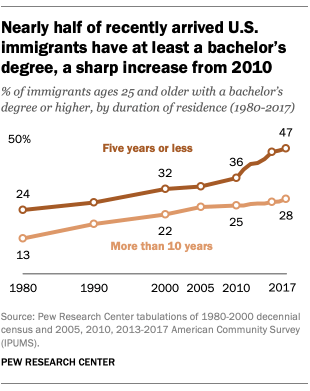
Consider their education levels. The share of recently arrived undocumented immigrants with a college degree has nearly doubled between 2007 and 2016, according to a recent analysis by the Pew Research Center. Here’s the share of college graduates who’ve been in the United States for five years or less compared with their more established counterparts.

At the same time, the share of recently arrived undocumented immigrants with no high school degree has shrunk, from 44% in 2007 to 31% in 2016. (Pew used government data for its calculations.)

These shifts reflect the changing nature of illegal immigration to the United States. For one, the number of new arrivals has plunged. In 2007, those who had been in the United States for five years or less made up 32% of all undocumented immigrants, according to Pew. By 2016, they accounted for 20%. And while in the past most undocumented immigrants crossed the border illegally, these days the majority are entering the country with legal visas and overstaying them.

The biggest change is the collapse in the number of Mexicans trekking north. Mexicans previously accounted for the lion’s share of undocumented immigrants in the United States. As their numbers have dwindled, the share of Asian immigrants, who tend to be better educated, has grown. In general, improvements in education around the world—including in places like Mexico—mean that immigrants from all regions are arriving to the United States with more schooling, Pew reports.

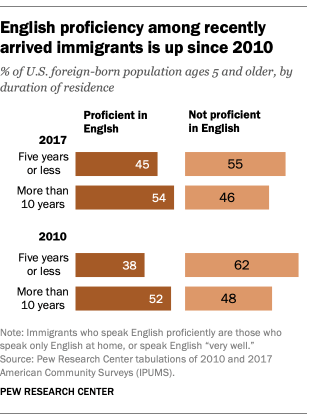
This new crop of undocumented immigrants is also more likely to speak English. In fact, despite the overall drop in new arrivals, the number of proficient English speakers grew to 3.4 million in 2016 from 2.8 million in 2007, Pew found. A look at Pew’s data on immigrants’ English proficiency and the shifts in their countries of origin help explain why:

Region of origin % English proficient Change in share of recent arrivals 2007-2016 (percentage points)
Mexico 25 -28
Northern Triangle 22 7
Asia 54 9
Other regions 69 12

To be sure, undocumented immigrants are still far less educated than people born in the United States. Only 8% of American adults lack a high school degree, compared with 44% of all undocumented immigrants, for example.

But the changes in undocumented immigration suggest that the gap will continue to shrink in coming years.

Source: Undocumented immigrants in the US are increasingly better educated

In a survey of American Muslims, 0% identified as lesbian or gay. Here’s the story behind that statistic

Interesting:

In the United States, you could count the number of mosques like Masjid al-Rabia on two hands. It’s a small community built on “five pillars of inclusivity,” including pledges to be “women-centered,” anti-racist LGBTQ-affirming and welcoming to a variety of Islamic traditions.

Mahdia Lynn, a transgender woman, helped found the mosque in Chicago in 2016.
For several years, Lynn attended a mosque in a small conservative Muslim community in Oklahoma, where people believed she was a straight, cisgender woman.

“There was always the risk of being outed,” said Lynn, a Shiite Muslim. “But at the time, I just wanted to focus on my faith.”

There are a few mosques like Masjid al-Rabia around the world, notably in Berlin and Toronto. But the number of LGBT-affirming mosques and Islamic centers in the United States remains small.

Muslims for Progressive Values has eight “inclusive communities” in the United States, from Atlanta to San Francisco. Berkeley’s Qal-bu Maryam Women’s Mosque, which calls itself “America’s first all-inclusive mosque,” opened in 2017. Other like-minded mosques have struggled to find consistent congregants in recent years and closed down.

Imam Daiyiee Abdullah, 65, is one of the few openly gay Muslim clerics. For four years, he labored to build a mosque for LGBT Muslims in Washington, DC.

Frustrated, tired and running out of money, Abdullah gave up and moved to the mountains of Colorado, where the nearest inclusive mosque is an eight-hour drive away.

Liberal Muslims say there are hints of change. The percentage of American Muslims who said society should accept homosexuality has doubled in the last decade, to 52%, and is even higher among Millennials.

Still, for many LGBT Muslims, coming out of the closet to their families and religious communities can be a fraught decision.

Ani Zonneveld says she receives calls regularly from young gay and lesbian Muslims who have been threatened by their family or are afraid to reveal their sexual identity.

“I tell them that, unless you have a fantastic relationship with your parents, keep it in the closet until you finish high school and can leave the house,” said Zonneveld, who heads Muslims for Progressive Values.

Religious spaces can be just as alienating, Zonneveld said. “What we have seen is that LGBT Muslims are not comfortable going to a mosque, and if they do, they definitely keep closeted.”

They may even be reluctant to tell anonymous pollsters. According to a recent survey of more than 800 American Muslims, 0% identified as gay or lesbian.

‘Islam is too important to leave anyone behind’

Muslims in the United States are among the most diverse religious communities in the world. While 82% are American citizens, nearly a third have been in the country for less than two decades. A plurality (41%) are white, but no racial or ethnic group makes up a majority of Muslim American adults.

That diversity also applies to attitudes towards gay, lesbian and transgender people. According to a recent survey by the Institute for Social Policy and Understanding, 31% of Muslim-Americans said they hold a favorable opinion of LGBT people, 23% said “unfavorable” and 45% said they had “no opinion.”

Among the Catholics, Jews and Protestants polled, only white evangelicals held less favorable views of LGBT people, the survey found.

Some Muslims have, like Lynn, hidden aspects of their identity for fear of being alienated or even endangered. But she said bigotry is no worse among American Muslims than in society at large.

“To act as if discrimination is unique to American Muslims is to buy into the Islamophobic narrative pushed by the right wing in this country, which is ironic, because it’s the right wing that is systematically erasing transgender people’s rights.”

Lynn transitioned as a teenager, and converted to Islam later on, during a particularly painful period. Islam’s spiritual regimens and rules for living offered a scaffolding on which to rebuild her life, the 31-year-old said.

“Islam saved my life, so I made the decision to give my life over to Islam.”

She founded Masjid al-Rabia with two other Muslims in 2016.

“Part of our role as a community center is to create a space for those healing from spiritual violence,” Lynn said.

This year, it’s celebrating its first Ramadan as a fully operational community center.

Lynn described her community as both idealistic and incremental. It’s small — Friday prayers draw about a dozen worshipers to its downtown Chicago space — but its very existence makes a radical statement.

While pushing for greater inclusivity in American mosques, she said it also provides a hospitable space where Muslims can practice their faith openly, regardless of race, gender, sect or sexual identity.

“We believe that everyone has a right to come to Islam as they are. Islam is too important to leave anyone behind.”

Support in society, but not in mosques

Muslims disagree on how to interpret the Pew survey that showed an increasing acceptance of homosexuality.

Some said it signals growing support for LGBT political rights, but not in religious spaces like mosques and Islamic centers.

LGBT activists have broadly supported Muslim-Americans, rallying to their side in recent years to protest Trump administration policies. Prominent Muslim activists have argued that they need all the political allies they can muster.

“I will fight for anyone who fights for our community,” activist Linda Sarsour said during a contentious panel discussion at an Islamic convention last year.

“And everybody is created by Allah and deserves to be treated with dignity and respect. That is how we Muslims have to show up in these United States of America.”

But Yasir Qadhi, an influential scholar and dean of academic affairs at the new Islamic Seminary of America in Dallas, said pro-LGBT-rights political activists are confusing young Muslims.

“You are sending a mixed message,” he said at the Islamic conference. “Because at the end of the day, we do not believe that it is morally healthy to engage in intercourse outside of the bonds of marriage.”

Contentious questions

In a recent interview, Qadhi said that he is grateful for LGBT Americans’ political support. While he hasn’t changed his theological views, he said he has softened his rhetoric.

“I will be the first to admit that we were overly harsh and perhaps we did marginalize people and make them feel as if they were not human or worthy of love,” the scholar said.

Now, Qadhi often prefaces his remarks about homosexuality by noting that “feelings and inclinations” are not themselves sinful, and that homosexual acts should not be singled out for special condemnation.

LGBTQ Muslims should be welcomed at mosques, he said, but should not push for changes in Islamic theology or practice on mosque grounds.

“Whatever anyone does in their private life is not our business,” Qadhi said. “I am never going to single out anyone in sermons for any sinful conduct. At the same time, in the mosque I am a part of, there is a clear red line: They cannot preach onto others that this is part of Islam, the same way I would not let a person sell liquor on our property.”

The Fiqh Council of North America, a body of scholars who issue legal opinions based on Islamic texts, will take up transgenderism this year, said Qadhi, a council-member. Sexual reassignment surgery is permitted in Shiite Islam, but not among Sunnis, who comprise the majority American Muslims.

In most mosques, the genders are separated, and there have been conflicts about where Muslims in the process of gender transition should sit, Qadhi said. “Gender identity issues will be the big questions for the next several years.”

But external and internal tensions can make it hard for Muslim-Americans to directly address contentious questions, said Dalia Mogahed, director of research for the Institute for Social Policy and Understanding.

“This is a huge source of division in the community right now,” she said. “There are a lot of different opinions and, frankly, there is a lack of space to discuss it.”

“When you have a community that is so under the microscope and being subjected to litmus tests for civility and tolerance, people become afraid and self-censoring”

Mogahed herself came under attack several years ago after a Gallup survey showed that no British Muslims — as in, 0% — said homosexuality was morally acceptable. Right wing provocateurs such as Milo Yiannopoulos seized on the survey to portray Muslims as a threat to gays and lesbians.

But Muslims in the United States and Britain have not mounted political or social campaigns against the LGBT community, Mogahed said.

“To conflate a religious belief with one community being a threat to another is unfair.”

Behind the 0%

Like a lot of pro-LGBT Muslims, Imam Abdullah has migrated to online projects. He now runs the Mecca Institute, an Internet-based program to train a new generation of likeminded clerics. The program has three part-time students.

Because of media attention on his life and work, he said he draws attention when he visits American mosques.

“Sometimes people make derogatory remarks, like: There’s that gay imam,” Abdullah said.

“I’ve been asked in different parts of the country to leave the mosque, which is fine. I’m not going in to any mosque to try to change them. I am going there to pray.”

In Washington, DC, weeks would go by without anyone showing up at his former mosque. Some closeted LGBT Muslims feared of being associated with “the gay mosque,” he said.

“The personal trauma that so many went through made it hard for them to be public about their identity,” Abdullah said.

The ISPU survey provides statistical backing for that sentiment. Of the 804 American Muslims polled, not one identified as gay or lesbian. Four percent identified as bisexual, 2% said they were “something else” and another 2% refused to answer the question.

Asked about the 0% statistic, Mogahed offered a nuanced interpretation. If 92% of American Muslims identified as straight, she said, then the remaining 8% may be lesbian or gay, even if they’re reluctant say so.

“The fact that there is a segment of Muslims who identify as something other than straight means that, even though they may not be acting on that inclination or orientation, they have negotiated a space where they can still be Muslim,” Mogahed said.

“There is enough space within the theology to be able to do that.”

More Evidence on Third-Generation Outcomes

While generally not a fan of the work of Centre for Immigration Studies, this study is nevertheless interesting.

There are similar variations among visible minority groups in Canada, admittedly from smaller numbers of third or more generations, younger cohort, for most groups save Black Canadians:

Will the children and grandchildren of low-skill immigrants eventually rise to the same socioeconomic level as natives? In a report published last fall, I investigated this question using the NLSY-97, a survey of people born between 1980 and 1984 that includes their grandparents’ places of birth. The grandparent information helps identify a true “third generation,” meaning U.S.-born people who have two U.S.-born parents but at least one foreign-born grandparent.

Because the largest and most consistently low-skill immigrant group has come from Mexico, my report compared the grandchildren of Mexican immigrants to a reference group of white Americans from the “fourth-plus generation” – meaning U.S. born with two U.S.-born parents and four U.S.-born grandparents. The results indicated that Americans with at least one Mexican-born grandparent lag significantly behind on measures of education and income. In other words, assimilation of this initially low-skill group is still not complete by the third generation.

After the Great Wave of immigration ended in the 1920s, Americans developed some romantic notions about assimilation. No matter where immigrants come from, no matter what skills they bring with them, no matter what circumstances they find themselves in upon arrival, their children and grandchildren will supposedly converge to the socioeconomic level of the pre-existing population. Desirable as that outcome may be, the convergence is often incomplete. The results for third-generation Mexican Americans described above are perhaps the starkest illustration.

Differential levels of assimilation are also evident when comparing the grandchildren of immigrant groups who arrived in the same time period. After the U.S. and Mexico, the most common grandparent place of birth in the NLSY-97 is Europe. (Unfortunately, no specific countries in Europe are identified in the data.) This post provides the results of a new analysis comparing two third-generation groups — the grandchildren of immigrants from Mexico, and the grandchildren of immigrants from Europe.

Based on parental data from the NLSY-97 and year-of-arrival data from the 1970 census, most grandparents of the NLSY-97’s European third generation arrived in the U.S. between 1910 and 1950. Unlike Mexican immigrants, who were almost uniformly low-skill, European immigrants in that time frame were more mixed. They include largely low-skill Southern and Eastern European immigrants who arrived before the 1924 restriction, but also some educated refugees from Central Europe during the Nazi period, along with both skilled and unskilled immigrants from the post-war era.

The table below compares the grandchildren of Mexican immigrants and the grandchildren of European immigrants on measures of educational attainment, test scores, work time, and income. Although the two groups graduated from high school at about the same rate, the grandchildren of European immigrants have more than double the rate of college completion. They also scored higher on the AFQT, which the military uses to assess math and verbal skills. Similarly, although weeks worked are roughly equivalent for both groups, the grandchildren of European immigrants significantly out-earn their counterparts with Mexican-born grandparents.

On most measures, the European third generation even slightly outperforms the reference group of fourth-plus generation whites. Clearly, not all immigrant groups end up in the same place by the third generation.

For details on the data set and the calculations, please see my report from last fall. Also note that for simplicity and sample size considerations, the ethnic and cross-sectional samples of the Mexican third generation are combined in the table above.

Source: More Evidence on Third-Generation Outcomes

The immigrant groups that make the most money

Neat chart:

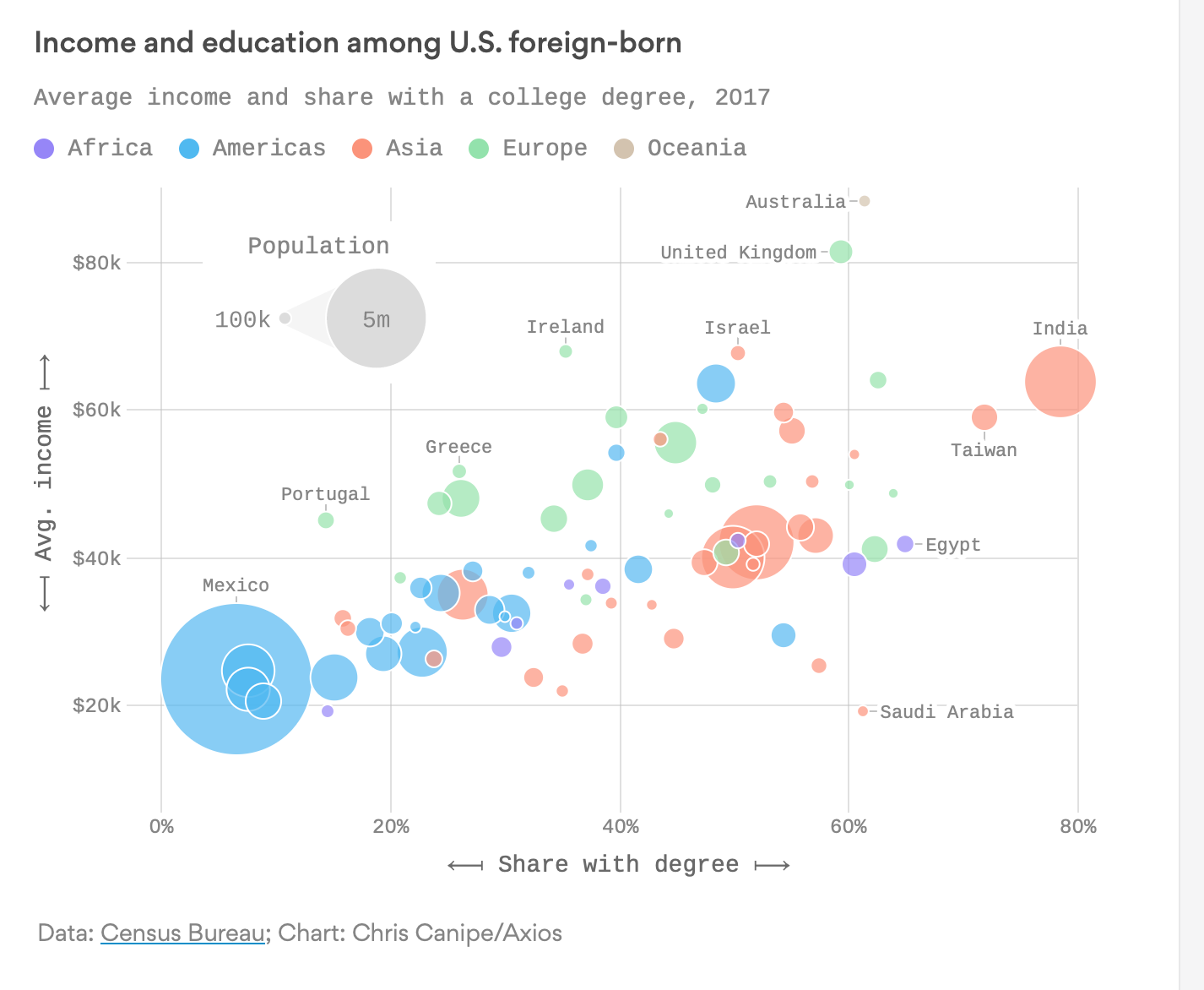
Asians tend to be among the best-educated immigrants to the U.S., and also land in some of the most lucrative careers. But, according to U.S. Census data, the image of privilege is true for only some Asians.

The bottom line: Data shows that income inequality is greater among Asian immigrants than for those arriving from anywhere else.

  • Indians on average earn $64,000 a year, and 78.6% have college degrees.
  • But but but … Compare that to Afghans ($22,000), Nepalis ($25,000) and Laotians ($32,000).

How to read the chart (above), via Axios visual journalist Chris Canipe: The circles represent each country’s population in the United States. Those on the lower left tend to have smaller average annual incomes and are less likely to have college degrees. Those in the upper right have the highest average incomes and are more likely to have degrees.

  • The red circles — representing Asian countries — are spread wider across the chart than circles of other colors, indicating higher inequality.

Source: The immigrant groups that make the most money

Huawei Temporarily Suspends Israeli Employees With US Citizenship

More fall-out expected:

The US boycott of Huawei is creating shockwaves in Israel as well. On Sunday, one of the company’s Israeli employees was turned away from the company’s local research and development subsidiary, after being told he was temporarily being barred due to his American citizenship, according to one person familiar with the matter who spoke to Calcalist on condition of anonymity. The employee in question is one of several Israeli employees with US citizenship, and all were temporarily suspended with pay while the Chinese telecom giant consulted legal sources on whether they could continue their employment.

By Monday, all were back at work.

According to information obtained by Calcalist, the policy was not Israel-specific but was implemented by Huawei globally wherever it has employees of American nationality.

On Thursday, the US stepped up its campaign against Huawei when the US Department of Commerce added the company to a list of companies considered a threat to national security. The new classification means Huawei will now need permission to acquire any US-made technology. Soon after, Google and chipmakers Intel, Qualcomm, and Broadcom announced they would stop providing services and selling products to Huawei.

Amid a wave of hot and dry weather, nine fires were caused in southern Israel on Wednesday by incendiary devices launched…

The move will prevent Huawei from providing security updates for its Android devices, and from selling devices with access to Google’s app store in the future. It will also limit Huawei’s ability to purchase processors and chips for its devices.

The US boycott, however, will affect more than just the Chinese telecom. Huawei is one of the three largest smartphone manufacturers in the world, and the only one of the three seeing accelerated growth. Losing Huawei as a customer will mean losing revenues of hundreds of millions of dollars a year. While it might be a temporary loss — as long as the American boycott lasts — it could turn permanent if Huawei manages to create alternative supply avenues.

Huawei has two separate operations in Israel. The first, under the name Toga Networks, is a research and development outpost operational since 2009. While the company has been reported to be a Huawei subsidiary since 2012, it ignored media reports and only admitted to its Chinese connections in 2016. Toga currently employs several dozen people, down from 200 at its peak, and develops telecom products such as switches and routers and also various applications for cloud-based databases.

Huawei also has a local marketing subsidiary under the name Huawei Israel, set up over the last year. The company previously operated via a local franchisee.

Source: Huawei Temporarily Suspends Israeli Employees With US Citizenship

How The Fight For Religious Freedom Has Fallen Victim To The Culture Wars

Yet another effect of increased polarization, even if issues related to the balance of religious freedom and other rights is often not straighforward:

The promotion of religious freedom in America, a cause that not long ago had near unanimous support on Capitol Hill, has fallen victim to the culture wars.

A high point came in 1993, when Congress overwhelmingly passed the Religious Freedom Restoration Act, meant to overturn a Supreme Court decision that limited Americans’ right to exercise their religion freely.

Those days are gone. The consensus surrounding religious freedom issues has been weakened by deep disputes over whether Americans should be free to exercise a religious objection to same sex marriage or artificial contraception and whether the U.S. Constitution mandates strict church-state separation.

“It is more difficult to get a broad coalition on religious freedom efforts now,” says Holly Hollman, general counsel at the Baptist Joint Committee for Religious Liberty. “People have a bad taste in their mouth about what they think the other side thinks of religious freedom.”

“It’s a divisive issue,” says Todd McFarland, associate general counsel at the General Conference of Seventh-day Adventists, a denomination historically known for its advocacy of religious freedom. “For a long time in the country we kept it down to a dull roar. When that’s no longer possible, it’s a problem.”

The religious freedom question could arise again in the months ahead, as the U.S. Supreme Court considers whether to take new cases that involve the limits on Americans’ religious rights.

In theory, the commitment to religious freedom is straightforward. The First Amendment to the U.S. Constitution bars Congress from making any law “respecting an establishment of religion or prohibiting the free exercise thereof.”

Most of the attention, especially in recent decades, has focused on the “free exercise” clause. An important case involved Adele Sherbet, a Seventh-day Adventist, who was fired for refusing to work on Saturdays and then denied unemployment benefits. In a 1963 decision, the U.S. Supreme Court ruled that Sherbet’s free exercise right had been violated.

In a 1990 decision, however, the Court significantly narrowed the Sherbet precedent, ruling against a Native American man, Alfred Smith, who was dismissed from his job because he had illegally ingested peyote as part of a religious ritual.

The Court’s Smith ruling met with bipartisan outrage in the U.S. Congress and led to passage of the RFRA legislation. Among the sponsors was a first-term liberal Democrat from New York, Jerrold Nadler.

“Unless the Smith decision is overturned,” Nadler argued on the House floor, “the fundamental right of all Americans to keep the Sabbath, observe religious dietary laws, to worship as their consciences dictate, will remain threatened.” The bill passed the House unanimously and was approved in the Senate by a vote of 97-3.

Religious freedom politicized

In the years since, however, the religious freedom cause has been politicized, with conservatives claiming it for their purposes and liberals shying away from it for reasons of their own.

When liberals started pushing for expanded protections for the LGBT population, conservatives grew alarmed, arguing that practices such as same-sex weddings go against biblical teaching. They’ve argued that religious freedom should mean they can’t be forced to accommodate something they don’t believe in. Liberals portrayed that stance simply as discriminatory and argued it should be illegal.

Sen. Ted Cruz, R-Texas, made the issue a major theme of his campaign when he ran for the 2016 Republican presidential nomination.

“We’re a nation that was founded on religious liberty,” Cruz told an interviewer, “and the liberal intolerance we see trying to persecute those who as a matter of faith follow a biblical definition of marriage is fundamentally wrong.”

When the conservative Heritage Foundation celebrated the 25th anniversary of the RFRA passage earlier this year, the organization’s president, Kay Cole James, blamed “the left” for the erosion of the original consensus.

“I wish we could get that kind of bipartisan support today,” she said. “The political left has actively worked to undercut our freedoms.”

Religious freedom and discrimination

As conservatives focused the religious freedom debate narrowly around issues of sexuality and marriage, progressives doubled down on the promotion of LGBT rights. The Democrat-controlled House this month approved the “Equality Act,” which would prohibit virtually all discrimination based on sexual orientation or gender identity. One provision actually singles out the RFRA law, prohibiting its use as a defense against discrimination allegations.

Rep. Nadler, having originally been a RFRA backer, co-sponsored the new “Equality” legislation as chairman of the House Judiciary Committee.

“Religion is no excuse for discrimination in the public sphere, as we have long recognized when it comes to race, color, sex, and national origin,” Nadler argued in a committee markup hearing, “and it should not be an excuse when it comes to sexual orientation or gender identity.”

When the bill came up on the House floor, another co-sponsor, Democrat Bobby Scott of Virginia, explained why it may seem that progressives have turned cool on the Religious Freedom act.

“RFRA was originally enacted to serve as a safeguard for religious freedom,” he said, “but recently it’s been used a sword, to cut down the civil rights of too many individuals.”

Some traditional advocates of religious freedom issues are dismayed by how the debate has evolved among both conservatives and liberals.

“When you [tell people] you work for the Baptist Joint Committee for Religious Liberty, they want to know, ‘What kind of religious liberty?'” says Hollman. She is evenhanded in her assessment of responsibility for the breakdown of bipartisan sentiment around the issue.

“It is unfortunate that some on the right will use religious freedom in order to advance a particular partisan issue,” she says. “I think it is problematic on the left to cede arguments about religious freedom, to just say, ‘Oh, people will use that now to advance an anti-LGBT perspective.’ These are tough issues to work on, and religious freedom should not take the fall.”

Fired for observing the Sabbath

One current religious freedom case, in fact, is similar to those that led to the court fights of the last century. In 2005, a Seventh-day Adventist named Darrell Patterson interviewed for a trainer job at Walgreens in Orlando, Fla.

“I was completely up front with them that I observed the Sabbath and that the Sabbath was important to me,” Patterson told NPR.

He got the job, and six years passed without a problem. But one Friday afternoon he was told to report to work the next morning.

“The Sabbath is a beautiful, beautiful day,” Patterson said, explaining why working Saturdays is for him unthinkable. “If you were to come to my house on the Sabbath, you would find that our house is in order. There is a peaceful, serene atmosphere. My wife and my family spend time in prayer. We sing hymns together.”

Patterson skipped work that Saturday. When he went in the following Monday, he was called into a supervisor’s office and told that he was fired.

He sued.

In a statement to NPR, Walgreens says it is “committed to respecting and accommodating the religious practices of its employees” and “reasonably accommodated” Patterson’s requested scheduling, but that doing more would have imposed “an undue hardship on our business.” The Eleventh Circuit court ruled in favor of Walgreens, but Patterson is appealing.

The U.S. Supreme Court is considering whether to hear the case and revisit, yet again, the question of what religious freedom means.

McFarland from the General Conference of Seventh-day Adventists is tracking the case closely. He expects Patterson to be broadly supported, but he also recognizes that the politics around religious freedom issues have shifted in recent decades.

“One of the most unfortunate things is that religious liberty has become the issue of one party,” he says. “For Democrats, it’s viewed as a divisive issue, especially in a primary context. [They say] ‘how is this going to help me?’ They used to feel that being on the right side of religious liberty was an important value, and they don’t anymore.”

Like the Baptist Joint Committee, however, the Seventh-day Adventists fault Republicans and Democrats alike for the politicization of religious freedom issues in recent years. The Adventists are bothered by the apparent reluctance of Republicans to embrace the “establishment’ clause in the First Amendment, barring government from endorsing a religion. Conservatives have pushed for prayer and Bible readings in public schools and government funding for some religious institutions. Some have even suggested the United States be identified as a Christian nation.

“We have a strong interest in having a vigorous establishment clause,” McFarland says. “That’s something evangelicals and other conservative churches historically have not been as interested in. We are not trying to see the U.S. government impose any type of ideology. We have concerns about that. We have long believed that government and church need to stay in their separate spheres.”

The Adventists’ support for the establishment clause has allied them on various occasions with the American Civil Liberties Union, an unlikely partnership for other conservative Christian denominations.

The two parts of the freedom of religion provision in the First Amendment are sometimes seen as conflicting: Is the government in favor of religion or against it? But traditional American religious freedom advocates say the two clauses can also be read as complementary: The free exercise of religion is guaranteed only if it applies to all faiths. That can happen only if government does not take sides.

In Orlando, Fla., Darrell Patterson went back to school after being fired from Walgreens. He is now working as a mental health therapist. His campaign for the right to rest on the Sabbath, now possibly headed to the U.S. Supreme Court, no longer has to do with his own work situation.

“It’s about other people that are going to come after me,” Patterson says “that deserve to be able to practice their religious faith and conviction without putting their livelihoods in jeopardy.”

Source: How The Fight For Religious Freedom Has Fallen Victim To The Culture Wars

Companies That Rely On US Census Data Worry Citizenship Question Will Hurt

Same issues arose from the Canadian business community with respect to the 2011 National Household Survey, given the adverse impact on demographic and other data, particularly in smaller geographic areas:

Some critics of the citizenship question the Trump administration wants to add to the 2020 census are coming from a group that tends to stay away from politically heated issues — business leaders.

From longtime corporations like Levi Strauss & Co. to upstarts like Warby Parker, some companies say that including the question — “Is this person a citizen of the United States?” — could harm not only next year’s national head count, but also their bottom line.

How governments use census data is a common refrain in the lead-up to a constitutionally mandated head count of every person living in the U.S. The new population counts, gathered once a decade, are used to determine how congressional seats and Electoral College votes are distributed among the states. They also guide how hundreds of billions in federal tax dollars are spread around the country to fund public services.

What is often less visible is how the census data undergird decisions made by large and small businesses across the country. The demographic information the census collects — including the age, sex, race, ethnicity and housing status of all U.S. residents — informs business owners about who their existing and future customers are, which new products and services those markets may want and where to build new locations.

Weeks before the Supreme Court heard oral arguments over the citizenship question last month, more than two dozen companies and business groups filed a friend-of-the-court brief against the question. Its potential impact on the accuracy of census data, especially about immigrants and people of color, is drawing concern from both Lyft and Uber, as well as Levi Strauss, Warby Parker and Univision.

“We don’t view this as a political situation at all,” says Christine Pierce, the senior vice president of data science at Nielsen — a major data analytics company in the business world that filed its own brief with the high court. “We see this as one that is around sound research and good science.”

Next year, the Trump administration wants to use the census to ask about the citizenship status of every person in every household in the country through a question approved by Commerce Secretary Wilbur Ross, who oversees the Census Bureau. The collected responses, the administration maintains, would be used to better enforce Voting Rights Act protections against discrimination of racial and language minorities.

Researchers at the Census Bureau, however, recommended against adding a question, which they said would produce citizenship information that’s less accurate and more expensive than existing government data. The question could bump up the cost of the 2020 census by at least $121 million, according to the bureau’s latest estimates.

Three federal judges have issued orders blocking the question, and the issue is now before the U.S. Supreme Court. The justices are expected to issue their ruling by the end of June.

“No substitute for a good census”

In the meantime, Nielsen and other companies are pushing back against the administration’s efforts.

Pierce says asking about a topic as sensitive as a person’s citizenship status is likely to discourage some people from participating in the head count. It’s also important, she adds, to test changes to a survey before implementing them.

The Census Bureau had not conducted a field test of a 2020 census form with a citizenship question before Ross decided to include the question.

Pierce emphasized these points last year in an affidavit for the New York-based lawsuits over the citizenship question. Through the court filing, she testified that Ross mischaracterized comments she made in a phone conversation they had that was later cited in Ross’ memo announcing his decision to add the question.

“If there is an undercount, that could carry through to our audience estimates and could mean that people will make decisions based on data that isn’t as accurate as it should be,” Pierce says, referring to the TV ratings that Nielsen produces using census data.

That data, Nielsen estimates, are tied to $90 billion in TV and video advertising.

“There’s just no substitute for a good census and having that count be as thorough as possible,” Pierce says.

Data that affect “our day-to-day lives”

The ride-hailing app Lyft is worried that an inaccurate census could mean that some communities may not get their fair share in federal funding for roads and public transportation over the next 10 years.

“That is a direct impact on our business because it means that those roads will end up being more clogged up and those people will have a harder time getting around,” says Anthony Foxx, a former U.S. secretary of transportation during the Obama administration who now serves as Lyft’s chief policy officer.

“This data that comes out of the census is not just some bureaucratic government data that sits in a vault somewhere that no one sees. It’s actually data that affects our day-to-day lives,” says Jessica Herrera-Flanigan, Univision’s executive vice president of government and corporate affairs.

Census Bureau research suggests including the question would discourage Latinos and Latinas from responding. Herrera-Flanigan is concerned that could lead to an undercount of Latinx residents.

“It’s a big lift”

Still, Univision is planning to talk up next year’s census on its TV programs. The children’s talent show Pequeños Gigantes recently featured a segment with kids attempting to explain what a census is.

“Regardless of what happens in the courts, we are going to be pushing people to know about the importance of the census and actually do it,” Herrera-Flanigan says. “It’s a big lift.”

It’s also tricky ground for businesses to navigate — especially after President Trump has tweeted his support of the citizenship question.

“The American people deserve to know who is in this Country,” Trump tweeted the day after the Supreme Court hearing.

At a public meeting earlier this month, Census Bureau official Burton Reist noted the bureau is running into hurdles trying to recruit businesses to promote the census.

“We had a meeting with McDonald’s, but that was a year ago. And we’ve had a hard time getting anything to come from it,” he explained to members of the bureau’s National Advisory Committee on Racial, Ethnic and Other Populations.

In response, Arturo Vargas — who leads the National Association of Latino Elected and Appointed Officials Educational Fund, a member of the committee — said business leaders have told him they’re reluctant to promote a census that has become so “politicized” by the Commerce Department’s efforts to get a citizenship question added.

“This is now something that, even though it’s such a fundamental aspect of our democracy, that they themselves are not willing to be associated with something that is so controversial now,” Vargas said.

Reist said, so far, a promotional partnership is “underway” between the bureau and the J.M. Smucker Company.

NPR has confirmed the bureau is also in discussions with Procter & Gamble, the company behind Pampers, Luvs and other brands.

Since speaking with the bureau early last year, McDonald’s has “not made any decisions on this at this time,” a spokesperson for the company, Lauren Altmin, said in an email.

Source: Companies That Rely On Census Data Worry Citizenship Question Will Hurt

USA: White Supremacy Beyond a White Majority

Quite a contrast with Canadian judicial appointments, currently over 50 percent women under the current government, about one-third under the previous Conservative government and the 80 percent males judges appointed under Trump.

Can only foreshadow further divergence between Canadian and US jurisprudence and representation:

The white male racist patriarchy will not be denied. It is having a moment. It has its own president.

According to a Pew Research Center analysis of race/ethnicity and sex among validated voters in the 2016 presidential election, white men were the only group in which a majority voted for Donald Trump — 62 percent — although a plurality of white women did also — 47 percent.

We are living through a flagrant display of a white male exertion of power, authority and privilege, a demonstration meant to underscore that they will forcefully fight any momentum toward demographic displacement, no matter how inevitable the math.

The fear of white male displacement is a powerful psychological motivator and keeps Trump’s base animated and active.

It keeps farmers holding out hope and making excuses for him, even as his trade war devastates their operations. It keeps coal country loyal, even as the promises of a revitalized coal industry ring hollow. It keeps white voters in the rust belt on the edge of their seats, waiting for the day that he will magically bring back manufacturing. It keeps white voters in the South heated over the issue of immigration and an “invasion” or “infestation” of Latin Americans.

Trump’s central promise as a politician has been the elevation, protection and promotion of whiteness, particularly white men who fear demographic changes and loss of status and privilege.

As Vox reported in 2017, white people of all ideologies, including liberals, become more conservative when confronted with the reality that a rising minority population means a loss of white dominance.

As the psychologist Jonathan Haidt recently told Vox:

“As multiculturalism is emphasized more and more, there emerges a reaction against it on the right, which is attractive to the authoritarian mind and also appeals to other conservatives. And this, I think, is what has happened, this is what Trump is about — not entirely, of course, but certainly this is a big factor.”

It is about stacking the courts, controlling the bodies of women (look no further than the raft of state abortion restrictions recently passed, including the outrageous new abortion law in Alabama), fighting the redefinition of gender as personified by the advances in liberty among people who are transgender, restricting the voting of nonwhite, less conservative groups, and controlling the flow of migrants into the country who do not bolster the white population.

While much of the country tries to contend with the unending stream of outrages in the White House, the Senate majority leader is pushing through a steady stream of Trump’s far-right federal judges, often breaking precedent and allowing for their confirmations over their home state’s senators’ objection.

The recent confirmation of Joseph Bianco to the U.S. Court of Appeals for the Second Circuit, based in New York, was Trump’s 38th confirmed circuit court judge, HuffPost reported last week, adding:

“That’s more circuit judges than any president has gotten by this point in a first term, and means that one in every six seats on the nation’s circuit courts is now filled by a Trump nominee.”

These are lifetime appointments. Even if demographics change over one’s lifetime, these judges will not.

As a recent Congressional Research Service report pointed out, 90 percent of Trump’s circuit court nominees have been white and 92 percent of those confirmed have been white. Among recent presidents, only Ronald Reagan — who opposed making Martin Luther King Jr. Day a federal holiday, but eventually reversed himself, and who vetoedthe Comprehensive Apartheid Act, which, with a congressional override, leveled sanctions against South Africa for its oppressive racist social architecture — appointed and confirmed a higher percentage of white judges.

Eighty percent of Trump’s judicial nominees have been men, and men have been 74 percent of those confirmed.

None of this can fully prevent change, but it can slow it.

The strategy is to find a way to maintain white supremacy, white dominance, without the necessity of a white majority in the U.S. population.

The point is that once white people become a minority in America, the country itself will move from a majority rule ideal to a minority rule one.

Immigrant service members are now denied US citizenship at a higher rate than civilians

Another illustration of the effects of the Trump administration hard-line immigration policies and practices:

Immigrants serving in the U.S. military are being denied citizenship at a higher rate than foreign-born civilians, according to new government data that has revealed the impact of stricter Trump administration immigration policies on service members.

According to the same data, the actual number of service members even applying for U.S. citizenship has also plummeted since President Donald Trump took office, the U.S. Citizenship and Immigration Services reported in its quarterly naturalization statistics.

“The U.S. has had a long-standing tradition of immigrants come to the U.S. and have military service provide a path to citizenship,” said retired U.S. Army Maj. Gen. Paul Eaton, a senior adviser to the liberal veterans advocacy group VoteVets.org. “To have this turnaround, where they are actually taking a back seat to the civilian population, strikes me as a bizarre turn of events.”

According to the most recent USCIS data available, the agency denied 16.6% of military applications for citizenship, compared to an 11.2% civilian denial rate in the first quarter of fiscal year 2019, a period that covers October to December 2018.

The fiscal year 2019 data is the eighth quarterly report of military naturalization rates since Trump took office. In six of the last eight reports, civilians had a higher rate of approval for citizenship than military applicants did, reversing the previous trend.

Attorneys for service members seeking to become citizens said new military immigration policies announced by the administration in 2017 and Trump’s overall anti-immigrant rhetoric are to blame.

“I think people are disheartened right now by the immigration climate,” said Elizabeth Ricci, an attorney who is representing immigrant service members. “We talk about a wall all the time. This is an invisible wall.”

Overall, the number of service members who apply to become naturalized citizens is just a fraction of the civilian applications, but both pools have shrunk over the last two years. In the first quarter of the Trump administration, January to March 2017 — which is the second quarter of fiscal year 2017 — there were 3,069 foreign-born members of the military who applied to become naturalized citizens. That same quarter, 286,892 foreign-born civilians applied.

In the first quarter of fiscal year 2019, USCIS reported it received only 648 military applications for citizenship, a 79% drop. For comparison, the agency received 189,410 civilian applications, a 34% drop.

The Defense Department was repeatedly asked for comment by McClatchy, but did not provide a response.

USCIS officials said the drop in applications is not due to any action by their agency, which processes the applications as it receives them.

“The fall in military naturalization applications is likely attributable in significant part to the Department of Defense’s decision not to renew the Military Accessions Vital to the National Interest (MAVNI) program after its expiration at the end of FY17,” USCIS said in a statement.

Deported To Mexico, US Veterans Are Pressed Into Service By Drug Cartels

Immigrants who wish to join the U.S. military fall into three categories: legal permanent U.S. residents, commonly known as “green card” holders; foreign-born recruits with key medical or language skills who came to the United States under student, work or asylum visas and enlisted through MAVNI; and special status non-immigrant enlistees, who are residents of the Federated States of Micronesia, Republic of the Marshall Islands, and Palau.

The Trump administration in 2017 announced major changes to the way the Pentagon would vet and clear foreign-born recruits and other overall changes to when a service member would qualify for naturalization.

Immigrant enlistees previously could join basic training once a background investigation had been initiated, and they could become eligible to start seeking citizenship after one day of military service. Under the new policy, enlistees do not go to basic training until their background investigation is complete, and they have to complete basic training and 180 days of service before they can seek citizenship.

In the months that followed, the Defense Department shut down naturalization offices at some of its basic training locations, citing the new policy.

7 Immigrant Service Members Who Perfectly Capture The Spirit Of Military Service

Other changes appeared procedural but had deep impact, such as the change that only higher-ranking officers, at colonel or above, were authorized to sign key USCIS forms verifying that an enlistee had served honorably. The signatures had to be original, too, which made it much more difficult for troops in outlier areas where the nearest colonel or higher-ranking officer may be hundreds of miles away, Stock said.

The new rules had a chilling effect, military immigration attorneys said. Unit leaders who previously would have shepherded naturalization paperwork through for their service members have stopped doing so, the attorneys said.

“People are telling them ‘wait until you get to your first unit.’ When they get to the unit they are told, ‘we don’t know anything about this anymore,'” Stock said.

The lack of guidance in units for immigrant soldiers “is all intentional,” Ricci said. “It’s part of this overall culture of ‘No.'”

The new rules have left some recruits waiting for years to serve.

Army recruit Ajay Kumar Jaina, 33, came to the United States from India in 2012 on an H-1B visa to work for Veritas Healthcare Solutions. He has a master’s degree in pharmaceutical analysis and wanted to become a military pharmacist. In May 2016 he enlisted under MAVNI for his medical skills.

He’s been in a holding pattern ever since. In the almost three years he’s waited to go to basic training, he’s reported for duty for more than 20 weekends with the 445th Quartermaster Company in Trenton, New Jersey.

He goes to New Jersey knowing that he will be unable to drill with the rest of the unit because he has not yet undergone basic training since the Defense Department has not completed his background check.

So his activities on base are limited to administration and inventory roles.

“When I registered in the Army, at that time I was told my basic training location. I was told within six months my background check would be verified, and then I could go to basic and then (advanced individual training) then I could be come apply for citizenship,” Jaina said.

Jaina said no determination has been made on his background check yet. “Which is actually good!” he said. “I can wait. I can keep my hopes high.”

Jaina’s H-1B visa expires next month and he said he may have to go back to India in order to be able to return to the United States under a new visa as he continues to wait.

Eaton questioned why the Defense Department would make it more difficult to pull from eligible immigrant recruits, particularly in light of the recruiting challenges the military faces overall.

“Only 25% of the U.S. population is eligible to serve, due to academic, health or behavioral issues,” Eaton said.

Last year the Army missed its annual recruiting goal by more than 6,500 personnel. In a statement, the Army would not say whether the immigration policies had impacted its ability to recruit last year.

“Our leaders remain confident that we have laid the foundation to improve recruiting for the Army while maintaining an emphasis on quality over quantity,” the Army said.

Source: Immigrant service members are now denied US citizenship at a higher rate than civilians

Immigration Form Denials Rise Every Quarter Except One Under Trump, Up 80% Overall

Source: Immigration Form Denials Rise Every Quarter Except One Under Trump, Up 80% Overall