Canadians are seeking asylum in US due to Trudeau’s Covid policies

Funny and sad that some think they can apply for asylum in the USA given COVID-related restrictions. At least the lawyer involved is reasonable honest about the likelihood of success (while pocketing his fees). “True” North is not exactly innocent in promoting such beliefs:

Buffalo immigration lawyer Matthew Kolken has filed asylum applications for at least half a dozen Canadians who hope to flee the country permanently due to Prime Minister Justin Trudeau’s pandemic policies. 

In an exclusive interview with True North, Kolken, who is a former director of the Board of Governors of the American Immigration Lawyers Association, explained that his clients fear being persecuted for being unvaccinated should they return to Canada.

“If you just don’t want to go back to Canada, you actually need to fear that you will be the victim of targeted persecution by the Government of Canada or by groups within the country that the government either can’t or won’t protect you from,” said Kolken. 

“(The application) says they’ve either expressed some sort of political speech or a member of a particular social group like unvaccinated individuals that have faced persecution before either through seizing of bank accounts, or loss of employment, or forced quarantines, things of that nature.”

According to US Citizenship and Immigration Services, those seeking asylum must apply within one year of arriving in the country. Groundsfor seeking asylum include suffering persecution due to race, religion, nationality, membership in a particular social group or political opinion. 

An application filed by Kolken in January for one client cited the Liberal government’s crackdown on the Freedom Convoy in February. To deal with the situation, Trudeau took the unprecedented step of invoking the Emergencies Act which enabled the government to freeze the bank accounts of protesters.

Kolken stated that his clients were also “scared to death” of being singled out by the Trudeau government for speaking out against vaccine mandates or have their employment opportunities limited. 

“They’re scared to death that if they go back to Canada they will be singled out and isolated by the Government of Canada, they will be unable to travel,” said Kolken.

“They’re afraid they wouldn’t get onto a plane in Canada and they will be trapped within their own country and that their abilities to obtain employment are limited there.”

Although the Liberals lifted travel mandates which prohibited unvaccinated Canadians from boarding a plane and train domestically or abroad, public health officials have not ruled out re-introducing restrictions in the future. 

“[If] COVID-19 takes a turn for the worst and we need to readjust and go back to a different regime, maybe similar to what we might have had before, we’re ready to do that,” said Deputy Chief Public Health Officer Dr. Howard Njoo in June. “We have no idea what the long term success rate is but I counsel my clients over the phone, the applications that clearly are justifiable under the law and regulations. They set forth a bonafide non-frivolous case.”

He also warned those seeking asylum that the Safe Third Country Agreement which dictates asylum applications between Canada and the US could be used against them. 

“The Safe Third Country Agreement cannot differentiate either country’s treaty obligations to accept asylees from one of the two contracting countries. You can’t say that because of the Safe Third Country Agreement that nobody who is a Canadian citizen can’t apply for asylum in the United States.”

Source: Canadians are seeking asylum in US due to Trudeau’s Covid policies

Computational analysis of 140 years of US political speeches reveals more positive but increasingly polarized framing of immigration | Proceedings of the National Academy of Sciences

Really interesting analysis on the shifts over time, both general and partisan, along with group specific attitudes. A comparable Canadian study would likely show some historical parallels, with less political polarization than in the USA, with a focus on different groups (e.g., contrasting Mexican and Chinese immigration makes sense for the USA while for Canada early attitudes towards Chinese immigration paralleled USA attitudes, a better comparator for later attitudes would be Middle Eastern immigrants):
Immigration is one of the most important and divisive topics in American public life. From the rise of vocal antiimmigrant politicians in recent years, it is tempting to conclude that attitudes toward immigration are more negative—or at least more polarized—than ever before. However, resistance to newcomers has always been a central part of our public discourse about immigration. From anti-Chinese fearmongering in the 1880s to concerns about Southern and Eastern European immigrants in the 1920s to the antiimmigration rhetoric of the Trump administration (2017 to 2020), claims that certain types of immigrants can never truly join American society have been a perennial part of our discourse. For example, Senator Henry Cabot Lodge, an architect of antiimmigrant legislation, declared a century ago, “[Immigration] is bringing to the country people whom it is very difficult to assimilate” (1, p. 35) because immigrants are from “races most alien to the body of the American people” (1, p. 32).
We seek to move beyond individual anecdotes to ask, how have attitudes toward immigrants in the United States changed over the past century? How does recent political debate over immigration compare to the long sweep of US history? This question is a challenge because public opinion polls that asked about attitudes toward immigration only began in the 1960s and were then only asked about immigration sporadically until recent years. We instead turn to the Congressional Record and other sources of political speech, using quantitative text analysis methods to systematically investigate the language used in congressional and presidential speeches about immigration over the past 140 y.
Our paper considers the full corpus of more than 17 million congressional speeches from 1880 to the present, of which we identify ∼200,000 speeches relevant to the topic of immigration. We also incorporate presidential communications from the same time period, making this a comprehensive quantitative analysis of American political speech about immigration at the federal level, covering the entire time period from the Chinese Exclusion Act of 1882 to the present day.
Numerous studies have analyzed the political history of US immigration using qualitative approaches and historical archives (27); quantitative work on immigration has also used data such as migration and census records (8, 9). Rhetorical aspects of immigration debates have been studied qualitatively—especially the use of dehumanizing language and metaphors such as “vermin” and “cargo” (1013)—but these authors have not rigorously quantified how common such language is over time. Last, other scholars have applied computational methods from natural language processing to study coverage of immigration in news media and Congress (1418), but none have used these tools to investigate such a long time span or comprehensive corpus of speeches about US immigration with a consistent methodology.
Our analysis is based on a combination of methods. To identify relevant speeches, along with a corresponding tone (proimmigration, antiimmigration, or neutral), we make use of automated text classification based on extensive human annotations. Using a semiautomated process, we also curate and apply a set of lexicons for analyzing relevant frames (i.e., ways of characterizing immigrants and immigration). Finally, to quantify implicit dehumanizing metaphors in speeches, we develop an approach using neural contextual embedding models to measure if references to immigrants are suggestive of various metaphorical categories (Materials and Methods).
We find that political speeches about immigration today are far more likely to be positive than in the past, with the shift from negative to positive mostly taking place between World War II (WWII) and the passage of the 1965 Immigration and Nationality Act, and being net positive on average in nearly all sessions of Congress since the early 1950s. Extending this analysis to presidential communications, we find President Trump to be a stark exception, as the first president in modern American history to express sentiment toward immigration that is more negative than the average member of his own party. As with many political issues, the two parties have become increasingly polarized over time, and we find a linear increase in polarization on immigration, beginning in the late 1970s under President Carter. Today, Democrats are unprecedentedly positive about immigration, whereas Republicans are as negative as the average legislator was in the 1920s during the push for strict immigration quotas. This divergence is clearly part of a broader trend toward polarization on many issues (Discussion); for immigration specifically, our analysis reveals the beginnings of this, predating the rise in generic political polarization observed in Gentzkow et al. (19) by more than a decade.
Along with the polarization by party, nationality of immigrants continues to matter greatly, with speeches mentioning Mexican immigration being consistently more negative than the average (dramatically so in comparison to European groups). Moreover, there is a striking similarity between how Mexican immigrants are framed today and how Chinese immigrants were framed during the period of Chinese exclusion in the 19th century: more negative in tone; greater explicit emphasis on frames such as “crime,” “labor,” and “legality”; and significantly greater use of implicit dehumanizing metaphors, in comparison to European groups.
Thus, while far more members of Congress today express favorable attitudes toward immigration than in the past, there remains a strong and growing strain of antiimmigration speech, especially among Republicans, along with perennial references to threats, legality, and crime. Despite the elimination of country-specific immigration quotas in the 1960s, expressed opinions toward immigrants still vary greatly by country of origin, and enduring rhetorical strategies continue to be deployed against more marginalized groups.

Results

Tone of Immigration Speeches.

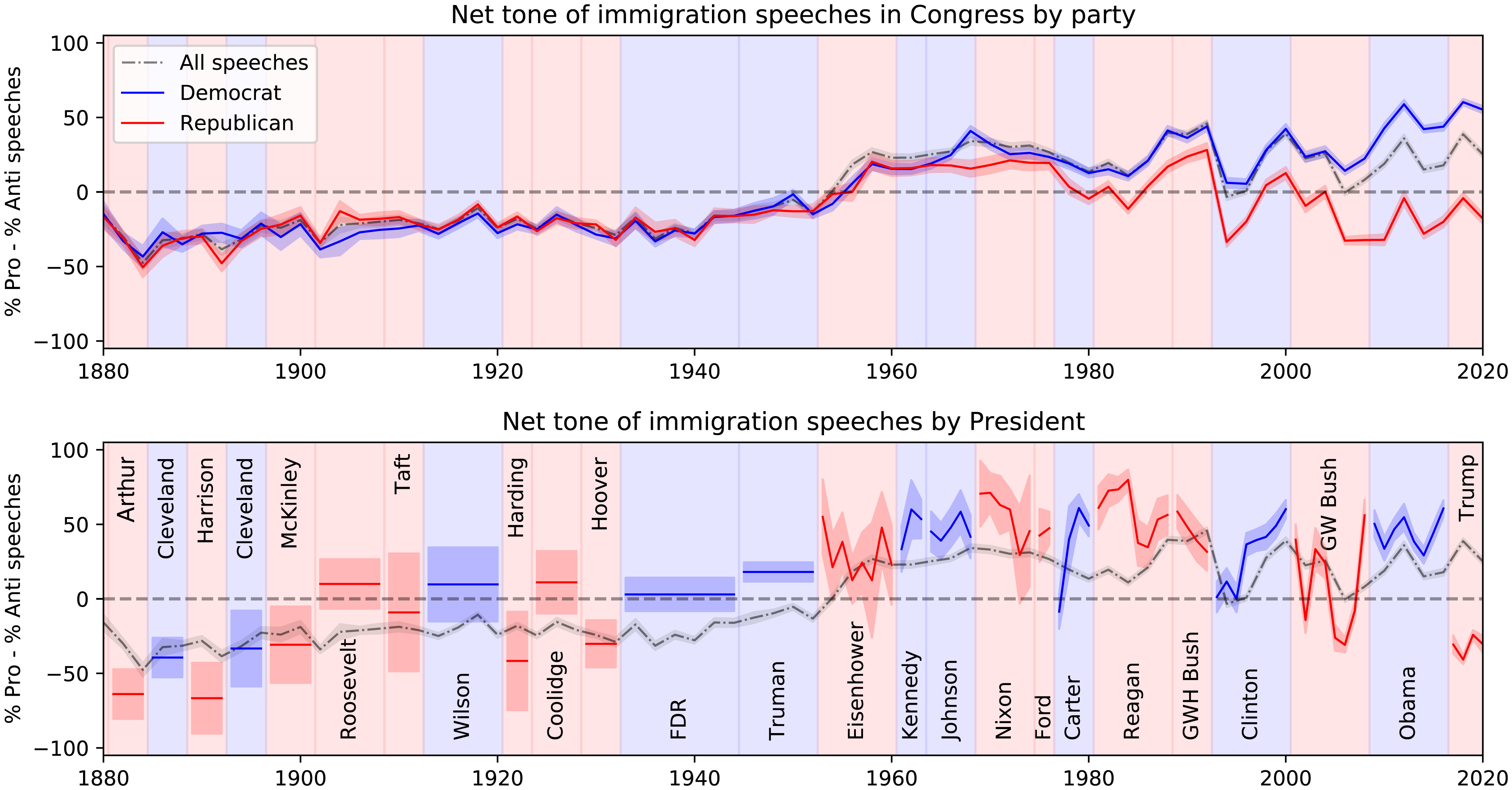
Starting with the complete record of 17 million congressional speeches from 1880 to 2020 (Data), we collected human annotations and trained machine learning classifiers to identify speeches relevant to immigration, along with an accompanying tone (proimmigration, antiimmigration, or neutral; Classification). Both panels of Fig. 1 show the average tone (percent proimmigration minus percent antiimmigration) expressed in congressional speeches over this time period (black line).* The trends for congressional speeches by Democrats and Republicans are also shown in Fig. 1, Top. A comparable time series for presidents is shown in Fig. 1, Bottom, by applying the same models to all presidential communications collected by the American Presidency Project (20). For alternative models, validity checks, and variation within parties, refer to SI Appendix.
Fig. 1.
Evolution of attitudes toward immigration expressed in congressional speeches and presidential communications. Average tone is computed as the percentage of proimmigration speeches minus the percentage of antiimmigration speeches, where proimmigration means valuing immigrants and favoring less restricted immigration and vice versa. Top and Bottom show the overall tone using all congressional speeches about immigration (black dashed line, with bands showing plus or minus two SDs based on the estimated proportions and number of speeches). Top also shows separate plots for speeches by Democrats and Republicans in Congress. (Due to limitations of the data, about 15% of speeches do not have a named speaker or party affiliation.) Bottom shows the corresponding estimates for each president, showing the overall average for a president’s tenure when there are insufficient data to show annual variation. Note that most modern presidents have been more favorable toward immigration than the average member of Congress. By contrast, Donald Trump appears to be the most antiimmigration president in nearly a century. Similarly, congressional Republicans over the past decade have framed immigration approximately as negatively as the average member of Congress did a century earlier.
OPEN IN VIEWEROPEN IN VIEWER
We begin by documenting a number of findings about political speech related to immigration. First, average sentiment toward immigration in Congress and the executive branch is negative throughout the late 19th and early 20th centuries, from the passage of the Chinese Exclusion Act (1882) through the advent of strict immigration quotas in the 1920s. The pervasiveness of negative sentiment can help make sense of the political context that gave rise to a suite of increasingly restrictive immigration regulations. It is particularly noteworthy that we do not find a rise in negative speeches leading up to the Emergency Quota Act of 1921. Rather, we find that political sentiment in Congress was staunchly antiimmigration for more than 4 decades, which is consistent with the political history that has recounted the many congressional attempts to pass antiimmigration legislation, all of which were struck down by the president, in the years before the successful passage of quotas (21). Second, attitudes toward immigration became more positive around the start of WWII, rising steadily from 1940 until the end of the Johnson administration (1969). The average tone in Congress has essentially been proimmigration since the beginning of the Eisenhower administration (1953), consistent with efforts by postwar presidents to reframe the public understanding of immigration as positive for the country.
Third, beginning about a decade after the reopening of the border with the 1965 Immigration and Nationality Act, there has been a growing partisan divide, larger year-to-year variations, and an overall decline in sentiment toward immigration among Republicans. Democrats, by contrast, have grown more positive about immigration over time, especially under Presidents Obama and Trump, with the exception of a temporary bipartisan drop in proimmigration speeches in the early 1990s, coinciding with the end of the Cold War and the passage of the North American Free Trade Agreement (NAFTA). By contrast, Republican legislators are now approximately as overtly antiimmigration in their speeches as the average legislator was during the Age of Mass Migration from Europe and the 1920s quota periods.
The trends for presidential attitudes toward immigration should be treated more cautiously as there is less text available from presidents overall and because these estimates involve a slight domain shift (from congressional speeches, on which our models were trained, to more varied types of presidential communications). Nevertheless, we document a similar pattern, whereby early presidents were more antiimmigration than modern presidents. In recent years, presidents have been uniformly more proimmigration than the average member of Congress, including both Republicans like Ronald Reagan and Democrats like Jimmy Carter. In historical comparison, President Trump was a stark exception: by his utterances, he was the most antiimmigration president to sit in office over the past 140 y, relative to the average attitude of the time expressed in Congress.
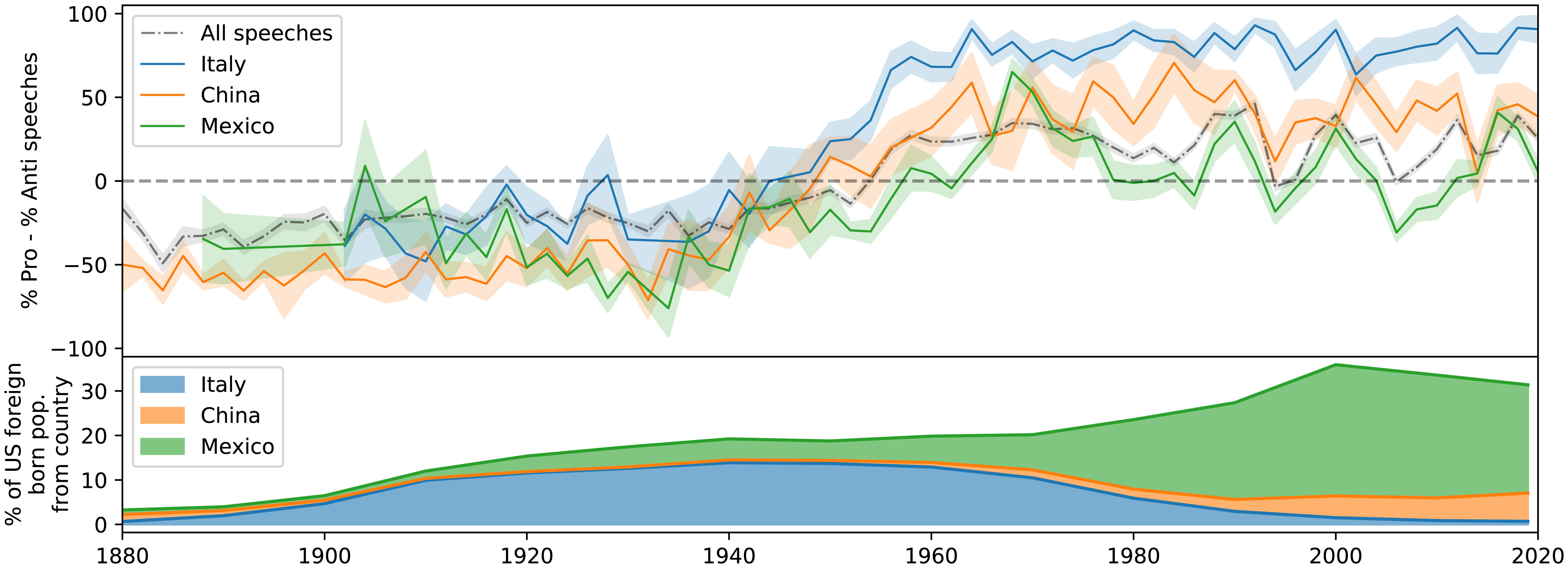
Although the difference in tone between the parties today is larger than at any point in the past, tone also varies dramatically depending on which groups of immigrants are being discussed. Fig. 2 shows the average tone when considering only those speeches that mention each of the three most commonly mentioned nationalities in immigration speeches—Mexican, Chinese, and Italian (Identifying Groups).
Fig. 2.
Average tone of immigration speeches when considering only those speeches that mention the country or nationality for each of the three most frequently mentioned nationalities (Top) and the percent of the US foreign-born population from each of these countries over time (Bottom). Despite the midcentury increase in proimmigration attitudes applying to all groups, a gap in tone by group persists to the present day, with Mexican immigrants being consistently framed more negatively than others and Italian immigrants being framed especially positively. These trends are mirrored in broader regional patterns for Europe, Asia, and Latin American and the Caribbean (SI Appendix).

Source: Computational analysis of 140 years of US political speeches reveals more positive but increasingly polarized framing of immigration | Proceedings of the National Academy of Sciences

New Clues On What Immigration Will Look Like In A Second Trump Term

Hopefully just a theoretical exercise:

What would it mean for U.S. immigration policy if, on January 20, 2025, Donald Trump was sworn in as president of the United States? Many people expect a crackdown on illegal immigration. However, recent clues and past actions indicate the more significant impact of a second Trump presidency would be on legal immigration, including the admission of refugees, family immigrants and high-skilled professionals.

Personnel Is Policy: “Former President Trump’s top allies are preparing to radically reshape the federal government if he is re-elected, purging potentially thousands of civil servants and filling career posts with loyalists to him and his ‘America First’ ideology . . . The heart of the plan is derived from an executive order known as “Schedule F,” according to Axios. The publication also reported American Moment, a pro-Trump group, wants to replace current federal workers with “applicants who want to cut not just illegal but also legal immigration into the U.S.”

It is easy to see how this would result in more restrictive immigration policies. After White House adviser Stephen Miller received pushback the first year he reduced the annual refugee cap, at least one career government employee was reassigned so the individual could not interfere in the future, according to Border Wars: Inside Trump’s Assault on Immigration by Julie Hirschfeld Davis and Michael D. Shear.

With the power to hire and fire civil servants, Trump officials could fill the federal government with anti-immigrant personnel. If immigrants, businesses and attorneys complain now about U.S. Citizenship and Immigration Services (USCIS), they should consider what agency processing would look like after an anti-immigrant litmus test is imposed on USCIS employees during a Trump-Miller second term.

Trump Likely To Fail Again To Reduce Illegal Immigration: In a second term, in the name of combating illegal immigration, Trump administration officials would attempt to enact nearly every restrictive immigration measure considered in recent years. This would include eliminating the practical ability to apply for asylum after crossing the southern border, building more of “the wall,” increasing the use of expedited removal and other policies.

Given that Donald Trump failed to reduce illegal immigration the first time around, there is no reason to believe similar policies would succeed if tried again. During the Trump administration, between FY 2016 and FY 2019, apprehensions at the Southwest border (a proxy for illegal entry) increasedfrom 408,870 to 851,508—a rise of more than 100 percent. While the Covid-19 pandemic caused apprehensions to decline for several months starting in March 2020, by August and September 2020, apprehensions had resumed at the approximate level of illegal entry seen during the same months in FY 2019. In short, Donald Trump’s policies failed to reduce illegal immigration and were enacted at a great human cost, particularly for parents and children separated at the border.

The Biden administration, in large measure, continued Trump’s border policies, namely Title 42, which allows individuals to be expelled without further processing. Title 42 is supposed to be a public health measure but has been used to prevent many people from applying for asylum. The policies have boosted Border Patrol apprehensions and encouraged people to enter unlawfully, often multiple times, likely making the border more problematic. A federal judge has ordered the Biden administration to keep Title 42 in place.

Department of Homeland Security reports show over the years tighter enforcement has significantly increased the number of immigrants who use human smugglers to cross the border (i.e., virtually everyone crossing now employs smugglers). The policies have also resulted in an increased loss of life. In July 2022, 53 immigrants suffocated inside a tractor-trailer in San Antonio.

Opposition To Legal Immigration: Ironically, the Trump administration is likely to try every measure to combat illegal entry but the one proven effective in reducing illegal entry: Making it easier to enter and work legally in the United States.

Research from the National Foundation for American Policy (NFAP) found that a significant increase in the lawful admission of farm workers during the 1950s under the Bracero Program dramatically reduced illegal entry to America. Based on apprehensions at the border, unlawful entry across the southwest border declined by 95% between 1953 and 1959, as farm workers entered legally in greater numbers.

Trump Immigration Policies Will Likely Decimate Long-Term U.S. Economic Growth: Labor force growth is a crucial part of economic growth, without which Americans grow poorer or see their standard of living stagnate.

Those who argued that Donald Trump was only concerned about limiting illegal immigration have a problem—it’s not true. Unlike any president before him, Trump made broad use of executive authority under section 212(f) to restrict legal immigration and suspend the entry of many categories of immigrants and temporary visa holders. In 2020, this prevented the entry of workers and professionals on temporary visas, and immigrants on family, employment-based and Diversity visas. He also set the lowest refugee admissions ceiling of any president.

Given another term, expect refugee admissions to be extremely low and for Trump to use section 212(f) to bypass Congress and block the entry of many immigrants and visa holders. The ban on immigration from a number of majority Muslim countries could return.

The impact of Trump’s policies would be devastating to the nation’s future economic growth. A National Foundation for American Policy analysis concluded if Trump’s policies had continued, legal immigration would have been reduced in half, and “average annual labor force growth would be approximately 59% lower than compared to a policy of no immigration reductions.”

In 2021 and 2022, America saw the negative results of Trump’s immigration policies, with an estimated 2 million immigrant workers missing from the U.S. labor force blamed for reducing U.S. economic output and contributing to inflation. Another four years of similar policies would likely produce more negative results, potentially longer term, if enacted by legislation.

Trump Likely To Push More International Students And High-Skilled Professionals Away From The U.S.:During the Trump administration, many international students diverted away from the United States, primarily to Canada, and employers saw denial rates for H-1B petitions skyrocket. Expect America to lose talent in even more significant numbers should the entire Trump immigration agenda against highly educated foreign nationals come to fruition.

Businesses and universities should expect every idea or regulation the Trump administration failed to implement to be tried again. That would mean:

– New limits on who qualifies for an H-1B petition and how (and where) an H-1B visa holder can work;

– Requiring employers to pay well above-market wages for H-1B visa holders and employees sponsored for permanent residence;

– New restrictions on international students and Optional Practical Training (OPT), and other policies.

There is no evidence such policies would help U.S. workers or American students—the evidence shows the opposite would be true. The harm to the U.S. economy and future innovation would be real.

Between 2017 and 2020, attorneys representing businesses, universities and immigrant rights organizations successfully blocked several Trump policies. That task would become much more difficult the second time around since former Trump officials would have learned from their mistakes and have a fresh four years to implement restrictive immigration policies.

What Would A Different Republican President Do? A different Republican president, such as Florida Governor Ron DeSantis, would likely adopt many of Trump’s policies on illegal immigration. However, DeSantis (or another Republican) might not allow Stephen Miller back in the White House. Without Miller, a different Republican president could adopt policies on legal immigration more consistent with the views of mainstream economists, particularly given the potential for Republican inroads with Asian and Latino voters.

New Limits On The Freedom Of Americans: Trump’s most significant policies will restrict legal immigration, which, economists note, will harm innovation and reduce economic growth in America. But the impact will be broader.

“An immigration restriction is a government ban on a wide variety of economic activities by natives,” according toeconomist Michael Clemens. By that standard, a second Trump term would mean less freedom for consumers who wish to enjoy products and services offered by immigrants, Americans who hope to sponsor family members and employers who want to hire foreign-born scientists and engineers to compete in the global economy.

Source: New Clues On What Immigration Will Look Like In A Second Trump Term

USA: How anti-immigrant groups are misrepresenting border data

Of note:

Recently, there has been increasing concern over the growing number of encounters (the number of people apprehended) reported on the southwest border. U.S. Custom and Border Protection (CBP) data show 207,416 encounters in June 2022 — a record high. Many anti-immigrant groups misinterpret — or purposefully misuse — this data, suggesting encounters are akin to admissions or arrests. But citing that number alone to demonstrate the need for more robust deterrence policies ignores the impacts of Title 42 expulsions and discounts historical migration trends.

CBP tracks the number of noncitizens apprehended each month, known as “encounters.” Anti-immigrant groups have cited the high number of encounters in June 2022, stating that it is a dramatic departure from the typical amount of migrants entering the U.S. in other years — but that’s not the case.

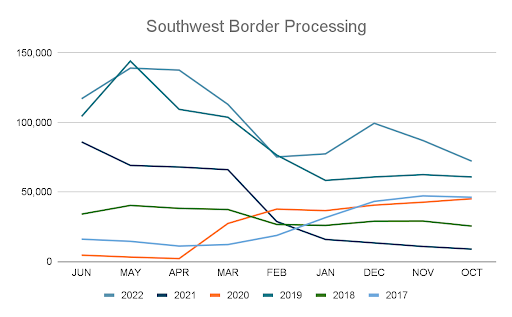
The number of migrants at the southwest border demonstrates a return to regular migration trends. In a study of migration trends over the last decade, researchers found that there is consistently an increasing number of encounters between January and May, with a sharp decrease after June.

The Covid pandemic significantly disrupted these patterns. As a result, between March and June of 2020 the U.S. saw the lowest rate of encounters in years. In 2021, that number steadily increased, but the overall was still drastically lower than average. This year, we have seen a return to regular patterns, with numbers increasing in the spring and decreasing starting June.

CBP Southwest Land Border Enforcement data for 2019-2022. Data prior to 2019 can be found here.

Since March 2020, a significant portion of migrants at the southwest border have been subjected to rapid expulsion under Title 42. Although the administration has attempted to terminate the health order, the courts blocked its termination. The result is a recidivism rate for border crossers that is more than triple what it was before the pandemic. Moreover, the encounter data alone does not account for the continued rapid expulsions nor the amount of people who repeatedly attempt to enter the U.S.

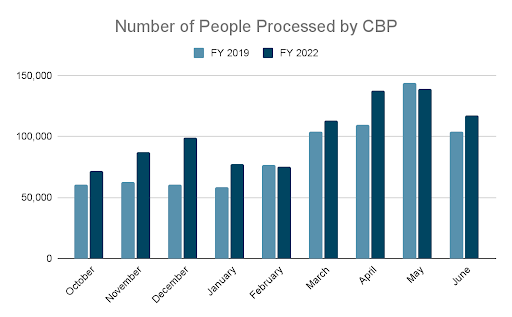
Indeed, the number of people that CBP is processing now is comparable to FY 2019, before the implementation of Title 42 in response to the pandemic. There is only an eight percent difference in the number of people processed in FY19 compared to FY22. In February and May, the Trump administration processed more people in FY19 than the Biden administration in FY22.

CBP Southwest Land Border Enforcement data for FY 2019-2022. CBP Title 42 Expulsions data for FY 2022.

Whenever there is a “surge” at the border, anti-immigrant groups use it as an excuse to call for and implement deterrence policies. Citing numbers of encounters without additional context has led to administrations repeating the mistake of using previously failed deterrence measures.

To counter this pattern, we should learn to anticipate when there will be higher numbers of people arriving at the border and improve processing capacity to efficiently and humanely process those seeking admittance to the U.S.

Source: How anti-immigrant groups are misrepresenting border data

New evidence disputes Trump administration’s citizenship question rationale

No suprise:

Previously unreleased internal communications indicate the Trump administration tried to add a citizenship question to the census with the goal of affecting congressional apportionment, according to a report issued Wednesday by the House Committee on Oversight and Reform.

The documents appear to contradict statements made under oath by then-Secretary of Commerce Wilbur Ross, who told the committee that the push for a citizenship question was unrelated to apportionment and the reason for adding it was to help enforce the Voting Rights Act.

The nearly 500 documents include several drafts of an August 2017 memorandum prepared by a Commerce Department lawyer and political appointee, James Uthmeier, in which he initially warned that using a citizenship question for apportionment would probably be illegal and violate the constitution, the report said.

Source: New evidence disputes Trump administration’s citizenship question rationale

Momani: Biden’s futile trip to Saudi Arabia

Of note. Pivoting to address new circumstances has consequences:

American President Joe Biden’s trip to Saudi Arabia this past weekend was bad theatre. At best it gave the impression of him addressing American consumers’ woes and at worst reaffirmed every skeptic’s view of hypocritical U.S. foreign policy. Make no mistake – this trip would not have happened were it not for Mr. Biden’s dwindling approval ratings at home, attributed in part to rising inflation and growing fears of a recession. Both economic woes are tied to high energy costs caused by Russia’s war on Ukraine.

Biden administration officials provided a laundry list of reasons for the President’s trip, from the long-time favourite of “promoting peace in the Middle East” to getting the Saudis to increase oil production to ease prices on American consumers. But geopolitical and oil market experts had rightly assessed that nothing substantive would come from this trip when it came to either issue. Despite Israeli-Saudi commercial, defence and intelligence ties being at an all-time high, the frail and elderly King Salman was not expected to sign a formal peace treaty with the Israelis. He will instead leave this to his son, Crown Prince Mohammed Bin Salman (MBS), to ink when he becomes king.

On oil, Saudi Arabia is already pumping crude at record levels and has very little spare capacity for export. Saudi Arabia’s scorching summer heat also means it has high energy needs of its own to power its air conditioners. Hence while Saudi officials paid lip service to providing the world with a stable supply of crude oil, few expected any substantive change to its output levels. Unsurprisingly, oil prices have not decreased since Biden’s Saudi trip.

Yet, this trip’s futility highlights a recurrent issue in U.S. foreign policy. It was only a few short years ago that Mr. Biden, then on the presidential campaign trail, said he would make Saudi Arabia “a pariah” for its involvement in the brutal murder of Washington Post journalist and Saudi democracy activist, Jamal Khashoggi. There has been little change in U.S. foreign policy toward Saudi Arabia during Biden’s time as President, but at minimum the soon-to-be ruler of the oil-rich kingdom was seen as persona non grata in international forums. At G20 meetings, most Western leaders went to great lengths to avoid being pictured with the ostracized monarch.

Of course, leaders of China and Russia have been quite happy to be seen with MBS. They have continued to make lucrative deals with the world’s largest oil exporter and weapons importer. For much of the world, business and realpolitik sadly eclipses any notion of a human rights-based foreign policy. While many may have scoffed at Donald Trump’s transactional foreign policy during his time in the presidential office, it can at least be said that he was transparent about courting Saudi Arabia for its money alone. He boasted at having encouraged them to buy more U.S. arms and to allow further American investment in the Kingdom.

Mr. Biden claimed U.S. foreign policy would change from the Trump era. Yet there was Mr. Biden this weekend giving MBS a fist-bump and proceeding to sit across the table from the man who, for ordering the dismemberment of Mr. Khashoggi’s body, was dubbed Mr. Bone Saw. Saudi media reported that MBS used the meeting with Biden to point out the U.S.’s own human rights failures, from the 2004 Abu Ghraib prison abuses when the U.S. occupied Iraq to the most recent whitewashing of the killing of Palestinian-American journalist Shireen Abu Akleh.

There are consequences to this U.S. hypocrisy. When the West asked for support in condemning Russia for its brutal war and occupation of Ukraine, it was no wonder that so many long-time U.S. allies declined to support a UN resolution condemning Russia. Across the world, states have rebuffed the U.S. and the West, instead choosing to continue to do business with Vladimir Putin’s regime despite the horrors it inflicts on Ukraine. They have rejected the West’s normative framing of the war on Ukraine as one of Western values of democracy versus autocracy.

After all, it only took Mr. Biden two years for an about-face on an autocratic Saudi Arabia. How long will it be before the West capitulates and imports Russian oil and grain, or calls the occupation of Ukraine’s Crimea and the Donbas “facts on the ground.” The consequences of Mr. Biden’s trip to Saudi Arabia is an affirmation of what has long been skeptics’ view of U.S. foreign policy: self-serving and hypocritical.

Bessma Momani is professor in the department of political science at the University of Waterloo and senior fellow at the Centre for International Governance Innovation.

Source: Biden’s futile trip to Saudi Arabia

Asian American Student Success Isn’t a Problem

Interesting study and analysis, suggesting that the dropping of SAT requirement reflects “white angst” that maintaining SAT requirements would disadvantage white students compared to Asians:

Over the past three years, as universities across the country have abandoned standardized test requirements and moved toward more holistic models for admission, a persistent yet largely unexamined question has arisen: Would these changes be happening if white students were at the top of the academic food chain? The performance gap between Asian American and white high school students on standardized tests has grown over the past decade. In 2018, for example, Asian American students, on average, scored 100 points higher on the SAT than white students. Just three years later, in 2021, that gap had risen by over 25 percent, to 127. Many of the universities that have dropped the SAT requirement have cited a desire for diversity and equity and a de-emphasis on hard-core academic competition. (This has always struck me as errant and, frankly, self-serving reasoning. If elite colleges actually want economically and racially diverse campuses free from the academic stressors that plague high school students, they should take their own advice and stop competing so fiercely to prove that they are the most exclusive places of higher learning in the world.)

All this appears to be a noble enough goal. But is it possible instead that the move toward greater diversity and away from academic competition might also be a way to ensure that students from white, wealthy families can still compete with high-achieving Asian American students? In other words, how much of these changes should we attribute to an evolution in the way we think about equality in education and how much should be chalked up to white parents who are now worried that their children are being outcompeted?

Natasha Warikoo, a sociology professor at Tufts, has published a fascinating and worthwhile book about this phenomenon, titled “Race at the Top: Asian Americans and Whites in Pursuit of the American Dream in Suburban Schools.” Warikoo details her findings from a three-year ethnography of an anonymized suburb that she calls Woodcrest. Like many other suburbs around major cities, Woodcrest has seen a browning of its population over the past 50 years. In 1970, the town was over 95 percent white, thanks to years of discriminatory zoning practices. Starting in the 1990s, well-educated Asian immigrants who came to the United States to work in the tech industry began to move to Woodcrest in search of better schools. Now roughly a third of Woodcrest’s population is Asian American.

So what happens when a big influx of wealthy Asian immigrants, mostly from China and India, come to a liberal, wealthy suburb that has always prided itself on its academic accomplishments? Warikoo correctly notes that for years, scholars and sociologists have simply assumed that these relatively privileged and upwardly mobile Asian Americans would simply melt into the upper middle class. What she found through her research is that the transition isn’t quite so smooth, in large part because many of the white families who live in these suburbs are worried that the new competition from Asian students will harm their own children’s chances of getting into elite colleges. As a result, some white parents in Woodcrest called for a de-emphasis on academics and a prioritization of mental health. Much like the moves away from the SAT, these changes sound worthwhile, but it’s worth examining the motives behind them.

I spoke to Dr. Warikoo about her book and the issues it explores, including her theories on why Asian American students in Woodcrest have done so well, the limits of assimilation, and what she thinks should be done about the scarcity mind-set that she believes drives all of this.

This interview has been edited for length and clarity.

First things first: We should acknowledge that Woodcrest is a pseudonym and you do not specify which state it’s in. But can you tell us where some of these upper middle class, Asian American and white suburbs are located?

To identify a site for this research, I looked at cities with median household income in the top 20 percent — above $100,000 in 2010 — and where the Asian American population was at least 20 percent by 2010 and had grown since 2000. There are 34 cities around the country that fit that description, including Cupertino and Saratoga in Northern California, Sugar Land in Texas (a Houston suburb), Syosset on Long Island and Lexington in Massachusetts. White and Asian parents alike move to many of these places to send their children to their top-rated public schools. Many are suburbs that grew during the era of school desegregation, as whites left cities in large numbers and passed laws designed to keep working-class people out, like minimum housing lot size requirements and bans on the building of multifamily homes.

Why are Asian families moving to these affluent, white suburbs?

For the same reason that white American families are moving to them — in pursuit of the public schools, because of the school system, strong reputation, high levels of achievement, and in part because the community is so well educated. Some of the Asian immigrant families are also drawn to this town because there is a quorum of people from their home country, particularly Indians and Chinese immigrants, so they like the diversity.

How are these families received by the people who already live there? You note in your book that a lot of these communities are like Woodcrest in that they’re filled with affluent, white progressives with Black Lives Matter signs in their yards.

On one hand, I think there’s appreciation for the diversity that these immigrant families bring. They enable those white families to say, “We live in a diverse town.” And they do. Some kinds of diversity are glaringly missing — for example, there are not very many Black or Latinx families — but it’s not an exclusively white town.

On the other hand, I think over time, as the Asian American population grows and their kids are doing quite well academically, there’s — among some white families — a little bit of unease about these new Asian families. Those white families might think, These Asian families do things a little differently, they focus on academics more than a lot of the white families, they prioritize different things. That brings concern about how the community is changing.

This only really happens when the immigrant population there reaches a certain number. When there’s only a few of them, the culture doesn’t really change, but as they grow, concerns start to emerge, like: Is the high school becoming too competitive? Are too many people putting their kids in extracurricular math classes so that now you can’t get into honors unless you do these classes? Or is it impossible for my child now to become class valedictorian?

In the book, you describe what some white parents in Woodcrest see as a loss of status. How does this manifest itself?

There’s two responses that I talked about in the book. One is that there’s a small minority of white families who pull their kids out of the public schools and send them to private school so they can have a less competitive, less intensive environment.

The other thing is that they push for policies to reduce academic competition. The school had already ended class rankings, they don’t name a valedictorian — that all had happened before I started this research. Then they reduced homework. And this was something that a lot of the white parents talked about is important to them. A lot of the Asian families didn’t agree with that. The district actually ended up ending homework in the elementary schools. And a lot of the Asian families didn’t agree with that either.

Interestingly, there was never any talk of limiting how many extracurriculars kids can participate in or the number of hours on the field that sports can require, or anything like that.

How much of some of today’s educational policy shifts — whether it’s getting rid of the SAT or the push to eliminate test-in magnet schools with large Asian populations — comes from this anxiety over a loss of status?

It’s true that Black activists have been talking for decades about how the SAT is problematic; the way that students are admitted to these exam schools is problematic. The N.A.A.C.P. has done a lot of work on this for decades and has not made much headway. And is it a coincidence that whites are listening now? I don’t think it’s entirely coincidental.

Still, I see that shift as positive. If we are going to have elite colleges and high schools, then they must be truly accessible to children of all races and from all neighborhoods. Currently, the exams seem to make elite colleges and especially exam schools much less accessible to Black and Latinx youth, especially those living in neighborhoods and attending middle schools from which very few students historically have attended the exam schools.

One of the questions the book raises is about how much we should ascribe Asian success to cultural differences. This is a very contentious topic for the understandable reason that if you say that there are Asian American cultural norms that help them to perform well academically, the question then turns to why other populations don’t do as well. What did your research find on this question?

What I reject is this idea that Asians value education any more than the white families or Black families. The school did a survey, and one of the questions they asked kids was to what extent your parents pressure you to get good grades. And the group that reported the highest level of pressure was the Black kids. Most of those kids are actually kids who are part of the busing program, so they’re coming from the urban center; they’re not living in Woodcrest.

So I think this idea that Asian parents pressure their kids and that’s why they’re doing well in school is not true. What I do see is this: I use this idea of “cultural repertoires” in the book. The idea is that we all have a tool kit for how to get ahead. We get these tools from our parents, from our neighbors, from our cousins and aunts and uncles.

So, the bulk of these immigrant parents went to school and did well in China and India. That’s how they ended up in Woodcrest. And almost all of these people would have gone to supplementary academic classes after school when they were children because that’s just what you do in those countries, right? And so that’s the tool kit they bring with them. And because they come from countries where these decisions are made by evaluating their scores on standardized tests, that’s what they prepare for. And then they impart that on their children.

The American-born, mostly white parents in this town also went to selective colleges. They get that those colleges want a more well-rounded student; they understand the pathway to sports through recruiting and having a talent that’s beyond academics. So that’s something that becomes important to them. Again, different tool kits.

When I think about families who are not in this community — mostly Black and Latinx families — they have their own strategies, and they are trying as well, but they may not have a supplementary education class center in their neighborhood. They may not have relatives who went to a residential four-year college who can explain: What does it take? What does that look like? What do you need?

And so it’s not that they want it any less, it’s just that those strategies are not there. For me, those cultural repertoires are a way to think about what people do that’s different.

Source: Asian American Student Success Isn’t a Problem

Confucius Institutes reappear under new names – Report

Not that surprising, unfortunately:

Chinese government-funded language and culture centres known as Confucius Institutes have rapidly closed down across the United States over the past four years amid pressure from the Federal Bureau of Investigation, the US Department of State, the US Congress, and state legislatures, concerned about China’s influence on universities. 

Of 118 Confucius Institutes that existed in the US, 104 closed by the end of 2021 or are in the process of doing so. 

Many institutions were forced to refund money to the Chinese government – sometimes in excess of US$1 million – according to a new wide-ranging report on Confucius Institutes (CIs) in the US by the National Association of Scholars, which was among the first to call for the closure of all Confucius Institutes on US campusesbefore the US Senate in 2019 called for greater transparency or closure.

However, “many once-defunct Confucius Institutes have since reappeared in other forms”, according to the association’s just-released reportAfter Confucius Institutes: China’s enduring influence on American higher education. It adds: “The single most popular reason institutions give when they close a CI is to replace it with a new Chinese partnership programme.”

US institutions “have entered new sister university agreements with Chinese universities, established ‘new’ centres closely modelled on defunct Confucius Institutes, and even continued to receive funding from the same Chinese government agencies that funded the Confucius Institutes,” it said. 

“In no cases (out of the 104 institutions) are we sufficiently confident to classify any university as having fully closed its Confucius Institute.” 

Rebranding and replacing

“Overall, we find that the Chinese government has carefully courted American colleges and universities, seeking to persuade them to keep their Confucius Institutes or, failing that, to reopen similar programmes under other names,” the report said.

American colleges and universities, too, appear eager to replace their Confucius Institutes with other forms of engagement with China, “frequently in ways that mimic the major problems with Confucius Institutes,” the report said. “Among its most successful tactics has been the effort to rebrand Confucius Institute-like programmes under other names.”

Some 28 institutions have replaced (and 12 have sought to replace) their closed Confucius Institute with a similar programme. Around 58 have maintained (and five may have maintained) close relationships with their former CI partner. About five have (and three may have) transferred their Confucius Institute to a new host, “thereby keeping the CI alive”.

Hanban, the Chinese government agency that launched Confucius Institutes, renamed itself the Ministry of Education Center for Language Education and Cooperation (CLEC) and spun off a separate organisation, the Chinese International Education Foundation (CIEF), that now funds and oversees Confucius Institutes and many of their replacements as part of a rebranding exercise in July 2020, designed to counter negative perceptions about CIs abroad. 

“In reality, the line between the Chinese government and its offshoot organisations is paper-thin. CIEF is under the supervision of the Chinese Ministry of Education and is funded by the Chinese government,” the report noted. 

Many CI staff migrated to CI-replacement programmes at the same university, according to the report which scrutinised a large number of contracts between CIs and US universities. It added that some CI textbooks and materials remain on the campuses of institutions that closed CIs.

The Chinese government has reacted by defending Confucius Institutes outright, but the report notes it has also “relied on the art of subterfuge, rebranding Confucius Institutes under different names and massaging their outlines to be less obvious to the public, and better camouflaged within the university”.

Three types of action were identified in the report: replacing the CI, maintaining a partnership in some way with the CI, or transferring the CI to a new home. 

Replacing the CI

Many universities are eager to ditch the now-toxic name ‘Confucius Institute’ but retain funding and close relationships with Chinese institutions, the report noted. 

“At least 28 universities replaced their Confucius Institute with a similar programme, and another 12 may have done so. Sometimes these replacement programmes are so closely modelled on CIs that we are tempted to call them renamed Confucius Institutes.”

Replacing the CI means the US institution “retained, on its own campus and as part of its own programming, substantial pieces of its Confucius Institute under a different name. This includes institutions that formed new replacement programmes with the Chinese university that had partnered in the Confucius Institute,” the report said. 

It also includes institutions that formed new China-focused centres that took on Confucius Institute staff, Confucius Institute programmes, or funding from the CLEC or CIEF, the successors to Hanban.

For example, the University of Michigan, among others, sought to retain Hanban funding even after the closure of the Confucius Institute. Federal disclosures cited by the report show the university received more than US$300,000 from Hanban in May and June 2019, just as the Confucius Institute was closing in June 2019, though the report notes these disclosures have since been deleted from the Department of Education’s website.

Maintaining a partnership

While some Chinese partners reacted with shock at the notification to close the CI, and even threatened to sever all other connection between them and the US university host, setting up a new partnership with a Chinese institution is the single most frequently cited reason given by US institutions for closing a Confucius Institute, the report found.

Forty of 104 institutions (38%) say they are replacing the Confucius Institute with a new partnership, often one that is quite similar to the Confucius Institute. “Many others do in practice arrange for alternative engagement with China, even if they do not say this in the same statement in which they announce the closure of the Confucius Institute,” the report said. 

The Chinese government often encouraged US universities, when they applied for a Confucius Institute, to first establish a sister university relationship with a Chinese university. For example, Arizona State University (ASU) became sister universities with Sichuan University, “having been led to believe that doing so would aid its bid to host a CI,” the report noted, adding that ASU did in fact establish a CI with Sichuan University, and the sister university relationship has survived the CI closure.

Upon closing a Confucius Institute, some US universities developed new partnerships with their Chinese partner universities, or maintained pre-existing partnerships outside the CI. Others transferred the CI to another institution, ensuring that the Confucius Institute did not really close but changed locations. Some universities engaged in several of these strategies at once.

The report tracked information for 75 of the 104 CIs that closed in the US. Of the 75, 28 replaced the CI with a similar programme, and another 12 sought to replace it, while 58 maintained relationships with their Chinese partner universities.

Many created something substantially similar to a Confucius Institute under a different name, as did Georgia State University, the College of William and Mary, Michigan State University and Northern State University.

The College of William and Mary replaced its CI with the W&M-BNU Collaborative Partnership in partnership with Beijing Normal University, its former CI partner. One day after the CI closed on 30 June 2021, the two universities signed a new ‘sister university’ agreement establishing the programme. 

Chinese universities have also proposed programmes similar to Confucius Institutes but funded by the Chinese university itself. For example, Jinlin Li, president of South-Central University for Nationalities (SCUN), wrote to University of Wisconsin-Platteville Chancellor Dennis J Shields, suggesting that “we work together on a university level to continue to offer Chinese language credit courses and Chinese Kungfu programmes”. He added that “SCUN will gladly continue funding this operation”. 

Replacing with another university programme

On being informed of CI closures, responses from Hanban “were initially characterised by shock and indignation, then by mere regret, and finally by well-coordinated efforts to woo colleges and universities into new partnerships”, the report said. 

Richard Benson, president of the University of Texas at Dallas, wrote in a letter cited by the report: “We will be arranging a new bilateral agreement with Southeast University to continue our mutually beneficial engagements.”

Benson went on to describe the “newly created UT Dallas Centre for Chinese Studies” which would house many of the programmes the Confucius Institute once ran – the former director of the Confucius Institute heads this new centre. 

Twenty-three universities said they would replace the Confucius Institute with their own, in-house programmes. However, 13 of these also said the CI would be replaced by a new partnership with a Chinese entity.

Ten of the 23 institutions announced plans to develop their own replacement programmes. Yet, at least four – University of Idaho, University of Illinois Urbana-Champaign, University of Montana and Purdue University – did in fact operate these programmes in partnership with their former CI partner. 

Six universities–- Pfeiffer University, San Diego State University, the University of Maryland, the University of Arizona, the University of Washington and Western Kentucky University – said they intended to find a new home for the CI by transferring it elsewhere.

Reasons for winding down CIs

Most of the criticisms surrounding Confucius Institutes involve threats to national security, infringements of academic freedom, and the problem of censorship. But these are rarely the reasons colleges and universities give when they announce plans to close a Confucius Institute. The report found the most frequently cited reasons are the development of alternative partnerships with China, and changes in US public policy.

Only five of 104 institutions cited concerns regarding the Chinese government’s relationship to Confucius Institutes ¬– and two of these five proclaimed that all national alarm was due to the mismanagement of Confucius Institutes by other universities.

Citing letters that the institutions sent to the Chinese government or their Chinese partner university; letters sent to a US government body, internal announcements to the staff, faculty and campus community; and statements published on the institutions’ own websites or published by the media, the report found that replacing the Confucius Institute with a new Chinese partnership was the most popular reason given for closure, while the second most popular was US policy. Many gave no reason whatsoever. 

Of the 33 colleges and universities that cite public policy as a reason for the Confucius Institute’s closure, 19 cite the potential loss of federal funds, and 11 specifically cite the National Defense Authorization Act, which barred certain grants from the Department of Defense to colleges and universities with Confucius Institutes. Three universities cited warnings they received from the US State Department. 

Despite widespread public concern about the Chinese government’s ulterior motives for supporting Confucius Institutes, only five universities referenced these concerns. Two laid out possible problems with Chinese government interference but concluded this had not been the case at their university.

University of Wisconsin-Platteville Chancellor Dennis J Shields in a letter to CLEC and CIEF said: “Over the past two years, the United States of America and its Department of State have raised serious concerns as to the scope of the People’s Republic of China and Beijing’s influence over higher education institutions, both nationally and globally…

“Unfortunately, due to these recent and continued concerns raised by the United States federal government and public officials as well as the recently enacted legislation, I have reached the difficult decision to end the UW-Platteville Confucius Institute.” 

Shields stressed though, that the University of Wisconsin had good experiences with Hanban.

Seven institutions said the Confucius Institute attracted too few students and others cited scarcity of funds as reasons for closure.

Source: Confucius Institutes reappear under new names – Report

Ali-Khan: Finding the American Dream in Canada

Of note, getting some coverage in major US media:

This is a festive period for Muslims around the world. One Eid, or Muslim celebration, has just passed, and another is coming up in July. I’ve left strings of starry lights in the tall windows of our family room, where they can be seen twinkling from the street in our neighborhood outside of Toronto. There’s a shadowbox-like window by the front door, where I’d hung a colorful garland of star ornaments at the start of Ramadan in April.

I wasn’t always willing to mark my family publicly as Muslim. In fact, we were three years in to becoming Canadian when I first realized that I could put up lights for our celebrations without any of the trepidation I’d felt in my hometown in Pennsylvania. There is a huge contrast between being Muslim in Canada and being Muslim in America today and it has a lot to do with Canada’s decision to tell the truth about its history, while America buries its own.
[time-brightcove not-tgx=”true”]

We left America in 2017, eight months into Donald Trump’s term in office. That was not a coincidence. There was something malignant about the leap from ordinary, private Islamophobia to a state sponsored anti-Muslim agenda that made leaving feel urgent, for me and for my husband, but especially for our children. We worried for their physical safety, but also for the sense of themselves they were developing at four and six years old.

Recent studies and surveys by the Institute for Social Policy and Understanding (ISPU) tell us our concerns were justified. ISPU has been a boon to American Muslims, who had previously lacked good data about themselves, helping us see more clearly how we’re faring. In 2020, half of all Muslim parents reported having a school aged child who experienced bullying related to their religious identity in the previous year. In almost a third of those cases, the perpetrator was a teacher or school official. In 2021, Muslims reported experiencing institutional discrimination at levels much higher than other religious groups, for example 25% of Muslims vs. 5% among those of other religious affiliations reported religious discrimination while receiving health care. At the airport, those figures are 44% for Muslims contrasted with 5% of the general public, applying for jobs, it’s 33% for Muslims and 8% for the general public. It’s increasingly clear that the appropriate comparison for the rate at which American Muslims are experiencing discrimination is not with other religious groups, but other racialized groups. It is also increasingly clear that anti-Muslim attitudes in America are durable, as attitudes towards other racialized groups have also been.

All of the myriad ways in which American Muslims experience anti-Muslim bias, threats, and discrimination appear to be having serious impacts on our mental health. A study published in JAMA Psychiatry in 2021 found that American Muslims are now twice as likely to have attempted suicide than Americans of other religious affiliations. It attributes this spike to religious discrimination and a reluctance among American Muslims to seek mental health treatment.

I first noticed the uptick in these trends after 9/11 and then again in 2015, when my kindergarten-aged daughter was told not to say she was Muslim at school. The teacher who told her this was Muslim herself, the only other Muslim at the school in any capacity. While it was likely the instruction was meant to be protective, it was nonetheless worrying. Unwilling to navigate a landscape in which it was dangerous for my six-year-old to be openly Muslim at school and seeing that this sentiment was increasingly normative in our nation’s culture, we began to plan our departure.

It’s not that Canada is utopian for Muslims. Even non-Canadians likely remember the Quebec City mosque shooting of 2017, in which 6 men were killed and 5 others injured by a 27-year-old named Alexandre Bissonnette. The number of anti-Muslim hate crimes in Quebec tripled that year.

There was another mosque shooting just last week in Toronto. In 2019, Quebec passed Bill 21, banning certain public workers from wearing visibly religious symbols, widely understood as an attempt to prevent Muslim women in such positions from wearing hijab, though also affecting those who wear turbans, for example, or kippas.

Nor is Canada utopian for other racialized groups. Recent surveys and reports all suggest that Black and Indigenous Canadians continue to experience widespread discrimination in jobs, education, and social services, health disparities, and disproportionate rates of incarceration and violence. Like America, Canada has a legacy of Black enslavement and Indigenous genocide, as well as a long history of residential schools and police brutality. Like America, Canada interned ethnically Japanese people during World War II. When I was a child visiting cousins in Toronto, the epithet “Paki,” for South Asians, was ubiquitous. These aspects of Canadian history have driven modern racist attitudes and continuing disparities in wealth, land ownership, and political power.

So why move our children here? Why not make our stand where we have a large, layered community of friends and family? There is a specific element of Canadian governance that made us hopeful that our American dreams might be better realized in Canada. If you go to Canada’s Department of Justice website today, you’ll find this remarkable statement: “The Government recognizes that Indigenous self-government and laws are critical to Canada’s future, and that Indigenous perspectives and rights must be incorporated in all aspects of this relationship. In doing so, we will continue the process of decolonization and hasten the end of its legacy wherever it remains in our laws and policies.”

The Canadian government’s acknowledgement of itself as a colonial project that must be actively undone is a dramatic contrast to political discourse in America today. Americans rarely acknowledge the essential thefts of land and labor from Native and Black people that have made America possible. Certainly, America’s government has never articulated an intention to decolonize. Americans are taught that their country has already had its revolution, freeing its people from colonial domination.

Years ago, in preschool, my children brought home a flyer about how to make an apology. The first step, the flyer said, is to acknowledge wrongdoing. With its history of slavery and colonial genocide, Americans yet find this step so controversial that, today, we cannot even agree to teach our own history in public schools. In the years since my family moved to Canada, we find that while imperfect, this nation’s fundamental intention towards justice does, in fact, make it a better place for our children to live. Their elementary school curriculum, for example, includes a discussion of what it means to be a settler on land that was promised to First Nations peoples in treaties. It challenges our children to reckon with what human rights for all of us, newcomers from many waves of immigration, descendants of those trafficked in slavery, and Indigenous peoples, might look like.

The children know whose traditional land they live and study on. They think about where the descendants of those people are, and what debt they might owe to them. In the process they are developing the capacity to navigate competing interests, diverse identities, and unfamiliar traditions. They are building the tools for a better future through honest study of their nation’s past. They recognize that this model secures space for them, too. Recently, their teachers applied the same principles to create a meditation space in the gym for fasting children to use over lunch during Ramadan.

I don’t fully understand why Canada has chosen to confront its colonial legacy while America continues to minimize and deny its own. I continue to hope that America will eventually unite around a plain telling of its own history in choosing a path forward. It is, after all, the only path that is wide enough for us all.

Source: Finding the American Dream in Canada

Roe vs Wade: How Disenfranchised Americans Can Immigrate to Canada

No surprise that various sites are highlighting this option, whether as clickbait or seriously.

The same happened during the Trump presidency but while interest was high, the actual numbers, while increased, were still relatively small:

The highly controversial move by the US Supreme Court to end women’s right to abortion is the latest example of how the country is lurching to the right on a number of important issues.

With the decision leaving many Americans feeling disenfranchised and frightened about the direction their country is headed, Canada could be an ideal destination for those who have simply had enough of the US.

Overturning Roe vs Wade triggered the closure of abortion clinics across the country, with some states already having laws in place to ban abortion in anticipation of the Supreme Court’s decision.

In the same week, as Democrat President Joe Biden celebrated the successful passing of mild gun control measures, the Supreme Court moved to make it easier to carry firearms by overturning a 1913 New York licensing law.

This came despite 225 mass shootings in the US in 2022 (or more than one a day), including the bloody massacre of 19 school children and two teachers in Uvalde, Texas on May 24.

Same sex marriage and contraception could be next, with Justice Clarence Thomas suggesting the Supreme Court could reconsider a slew of decisions, placing further constitutional rights under threat.

The controversy dates back to the presidency of Donald Trump, when he was able to nominate three new Supreme Court justices – namely Neil Gorsuch, Brett Kavanaugh and Amy Coney Barrett – and significantly shift the balance of the bench to the right with Associate Justice Clarence Thomas, appointed amid controversy in 1992, leading the conservative bench.

The Trump appointees left many Americans fearful of the consequences, and now those fears are being realised.

Even before Trump’s Supreme Court picks, Americans were already considering their options to move north. His election victory over Hillary Clinton triggered a huge surge in the number of Americans researching how to move to Canada.

The number of American citizens becoming Canadian permanent residents rose in every year of the Trump presidency except the last, from 7,655 in pre-Trump 2015, to a peak of 10,900 in 2018, his third year in power.

After dropping off in 2020 due to COVID-19, the figure surges again in 2021 to 11,950, and is on pace in 2022 to exceed 12,000 for the first time.


Roe vs Wade: How Disenfranchised Americans Can Immigrate to Canada


Canada has a plethora of options for American citizens who wish to immigrate here.

In addition to economic programs, Canada also has an established family sponsorship immigration program, which include options for LGBTQ couples and common law partners.

With provincial programs also welcoming newcomers under a wide variety of criteria, American citizens interested in moving to Canada have many pathways open to them.

Source: Roe vs Wade: How Disenfranchised Americans Can Immigrate to Canada