As the U.S. Unauthorized Population Expands, It Is Also Diversifying, New Fact Sheet Shows

Another informative MPI fact sheet. Would be nice to have an equally informative fact sheet or analysis for Canada rather than just a general number:

The unauthorized immigrant population has grown sharply, from 10.7 million in 2019 to 13.7 million as of mid-2023, MPI analysts find. Still, even as the unauthorized immigrant population has experienced the sharpest growth since the early 2000s, a full 80 percent have at least five years of U.S. residence—with 45 percent living 20 or more years in the United States. 

Unauthorized immigrants made up 26 percent of the overall immigrant population in the United States in mid-2023. 

The fact sheet, Changing Origins, Rising Numbers: Unauthorized Immigrants in the United States, draws from a unique methodology that MPI created with leading demographers at The Pennsylvania State University and Temple University that allows the assignment of legal status in data from the U.S. Census Bureau’s American Community Survey (ACS). Given that the Census Bureau does not ask survey respondents if they are in the country without authorization, the resulting dataset offers a rare ability to study characteristics of the unauthorized population. 

The fact sheet is accompanied by detailed data profiles of the unauthorized immigrant population at U.S., state and top county levels. The profiles include countries/regions of birth, ages, years of U.S. residence, top job sectors, workforce participation, educational enrollment and attainment, English proficiency, income, homeownership and access to health insurance, among other characteristics. 

Among the key findings, all as of mid-2023: 

  • A growing share of the unauthorized immigrant population—as many as 4 million people, or 29 percent of the total—held a liminal (also known as “twilight”) status granting temporary relief from deportation and work authorization, through Temporary Protected Status (TPS), humanitarian parole, a pending asylum application or Deferred Action for Childhood Arrivals (DACA). 
  • Nearly 4.2 million unauthorized immigrants were married to a U.S. citizen or lawful permanent resident (aka green-card holder). While marriage typically conveys the right to apply for legal permanent residence, most unauthorized immigrant spouses are unable to apply due to a 1996 immigration law. 
  • 6.3 million children under age 18 live with at least one unauthorized immigrant parent. All but 1 million of those children are U.S. citizens. 
  • 14 million U.S. citizens, green‑card holders or temporary visa holders share a household with an unauthorized immigrant.  
  • Mexicans accounted for 40 percent of all unauthorized immigrants—down significantly from their 62 percent share in 2010. 
  • 21 percent of all unauthorized immigrants lived in California; overall, half lived in California, Texas, Florida or New York. 

Source: As the U.S. Unauthorized Population Expands, It Is Also Diversifying, New Fact Sheet Shows

The Unauthorized Immigrant Population Expands amid Record U.S.-Mexico Border Arrivals

Helps explain some of the Trump administration concerns with the Southern border (but not the Northern one). Good series of explanatory charts:

Amid record encounters of migrants at the U.S.-Mexico border in fiscal years (FY) 2021 and 2022 and wide use of humanitarian parole to allow entry of migrants arriving without visas, the size of the unauthorized immigrant population has reached its highest level yet. The Migration Policy Institute (MPI) estimates that approximately 13.7 million unauthorized immigrants lived in the United States as of mid-2023, up from 12.8 million the year prior. MPI revised upwards its estimates for 2022 and prior years, using an updated methodology that permits better addressing the Census Bureau’s undercount of new immigrants.

Between 2019 and 2023, the unauthorized immigrant population grew by 3 million, or an average of 6 percent per year (see Figure 1). The nation had not seen yearly increases this large since the early 2000s.

This growth is partially explained by increased irregular arrivals at the U.S.-Mexico border, with a rising mix of nationalities from across the Western Hemisphere from countries such as Venezuela, Colombia, Cuba, Ecuador, and Nicaragua, as well as hundreds of thousands of people who entered with humanitarian parole from Ukraine, Mexico, Haiti, and other countries. And it also stems from sizable numbers of Europeans and others who overstayed their nonimmigrant visa.

Most of the changes are expected continuations of trends that started several years ago. For example, the unauthorized immigrant population from Venezuela started to grow quickly following the severe economic and political turbulence that began there in 2015. Likewise, the unauthorized populations from Honduras and Guatemala grew rapidly starting around 2019….

Source: The Unauthorized Immigrant Population Expands amid Record U.S.-Mexico Border Arrivals

Key facts about the changing U.S. unauthorized immigrant population

Useful information and context:

Border Patrol apprehensions of migrants at the U.S.-Mexico border are on the rise again. Although the majority of people attempting to enter the United States illegally are stopped, this trend could foreshadow an increase in the U.S. unauthorized immigrant population after years of relative stability. Yet the activity at the southwestern U.S. border is only one part of the overall story of unauthorized immigration, as a growing share of this population came from regions other than Mexico or Central America and entered the U.S. legally but overstayed their visas.

The unauthorized immigrant population is always changing and churning. The total number in the country can remain stable or decline even as new immigrants enter illegally or overstay a visa, because some voluntarily leave the country, are deported, die or become lawful residents. In short, the dynamic nature and pace of migration patterns has resulted in an unauthorized immigrant population whose size and composition has ebbed and flowed significantly over the past 30 years.

Here are key facts about this population and its dynamics.

How we did this
Number of unauthorized immigrants in the U.S. has declined since 2007

The U.S. unauthorized immigrant population rose rapidly from 1990 to 2007 before declining sharply for two years and stabilizing at 10.5 million in 2017.Pew Research Center’s most recent estimate is well below a peak of 12.2 million in 2007, but roughly triple the estimated 3.5 million in 1990. The estimate includes 1.5 million or more people who have temporary permission to stay in the U.S. through programs such as Deferred Action for Childhood Arrivals (DACA) and Temporary Protected Status (TPS), as well as people awaiting decisions on their asylum applications; most could be subject to deportation if government policy changed.

U.S. unauthorized immigrant populations declined or held steady for most regions of birth since 2007

Mexican unauthorized immigrants are no longer the majority of those living illegally in the U.S. As of 2017, 4.9 million unauthorized immigrants in the U.S. were born in Mexico, while 5.5 million were from other countries, the first time since at least 1990 that those from Mexico (47% in 2017) were not a majority of the total. In 2007, an estimated 6.9 million unauthorized immigrants were Mexican, and 5.3 million were born in other countries. The population of Mexican-born unauthorized immigrants declined after 2007 because the number of newly arrived unauthorized immigrants from Mexico fell dramatically – and as a result, more left the U.S. than arrived.

The number of unauthorized immigrants from nations other than Mexico ticked up between 2007 and 2017, from 5.3 million to 5.5 million. The population of unauthorized immigrants born in Central America and Asia increased during this time, while birth regions of South America and Europe saw declines. There was not a statistically significant change among other large regions, including the Caribbean, Middle East-North Africa and sub-Saharan Africa.

A rising share of U.S. unauthorized immigrants apparently arrived in the country legally but overstayed their visas. Nearly all people apprehended while attempting to enter the country illegally at the U.S.-Mexico border are from either Mexico or Central America. This stands in contrast to the origins of visa overstays.

In recent years, immigrants from countries outside of Mexico and Central America accounted for almost 90% of overstays, and in 2017, there were more than 30 overstays for every border apprehension for these countries. Although the Census Bureau data Pew Research Center uses to estimate the size of the unauthorized immigrant population does not indicate directly whether someone arrived with legal status, the origin countries of immigrants in these sources provide indirect evidence. From 2007 to 2017, the share of newly arrived unauthorized immigrants (those in the U.S. five years or less) from regions other than Central America and Mexico – the vast majority of whom are overstays – increased from 37% to 63%. At the same time, the share of new unauthorized immigrants from Mexico fell from 52% to 20%.

Short-term residents decline and long-term residents rise as share of U.S. unauthorized immigrants

The decline in the arrival of new unauthorized immigrants in recent years has resulted in a population that is increasingly settled in the U.S. About two-thirds of unauthorized immigrants (66%) had lived in the U.S. for more than 10 years as of 2017, up from 41% 10 years earlier. Conversely, newly arrived unauthorized immigrants (those in the U.S. five years or less) accounted for 20% of the unauthorized immigrant population in 2017 versus 30% in 2007. For Mexicans, the pattern is even more pronounced. The vast majority (83%) of unauthorized immigrants from Mexico have been in the country more than 10 years, while only 8% have lived in the U.S. for five years or less.

Source: Key facts about the changing U.S. unauthorized immigrant population

Immigration Hard-Liner Files Reveal 40-Year Bid Behind Trump’s Census Obsession

Good long read of the history behind undercounting the US population in the census:

Even before taking office, former President Donald Trump’s administration obsessed over the U.S. census.

From a failed bid for a citizenship question to a presidential memo about unauthorized immigrants that was fast-tracked to the Supreme Court, its moves over the past four years followed a playbook first drawn up more than four decades ago by the Federation for American Immigration Reform.

In 1979, the hard-line group that became the most influential advocate for extreme restrictions on immigration launched a campaign that has held onto one consistent goal — obtaining an official count of unauthorized immigrants through the census to radically reshape Congress, the Electoral College and public policy.

Starting with a lawsuit filed weeks before the official start of the 1980 census, FAIR documented its strategy in a paper trail that NPR has reviewed in the organization’s archives at the George Washington University, as well as those of FAIR’s founder at the University of Michigan.

“It’s always been on the agenda,” Dan Stein, FAIR’s president, tells NPR, noting that it’s “very possible” that, as early as November 2016, the group discussed with Trump officials the possibility of excluding unauthorized immigrants from a key set of 2020 census results.

To some, it may seem curious that part of Trump’s agenda zeroed in on an often overlooked government tally of every person living in the U.S.

But census numbers hold what Trump has always wanted — power.

That power comes in the form of 435 votes in the House of Representatives and the Electoral College. Once a decade, those votes are up for grabs among the states based on new census numbers. The more residents included in a state’s population count, the more of a say it has for the next 10 years in how federal laws are made and how the next occupant of the White House is chosen.

The Constitution has spelled out specific instructions for the census. Not just citizens or voters, but “persons” who reside in the states are supposed to be counted. Congress eventually codified the 14th Amendment’s language into federal law that calls for the “whole number of persons” living in each state and the “tabulation of total population” to be used when reapportioning House seats and electoral votes.

Census counting does have a thorny history. Before the Civil War, the fifth sentence of the country’s founding document required an enslaved person to be counted as “three fifths” of a free person. And it was just before the 1940 census that the Census Bureau determined the phrase “excluding Indians not taxed” could no longer omit some American Indians from the apportionment counts.

But since the first U.S. head count in 1790, this has been an unwavering truth: No resident has ever been left out because of immigration status.

Trump officials attempted to break with that 230-year precedent. The administration, like FAIR, wanted to subtract unauthorized immigrants from the apportionment counts, taking power away from those residents and the communities where they live.

One of President Biden’s first executive orders officially quashed the Trump memo that called for that extraordinary change.

But during the Trump years, FAIR came closer to getting that count of unauthorized immigrants than it has ever before.

A page out of an old playbook

The start of the Trump administration’s four-year census saga centered around a hotly contested question: Is this person a citizen of the United States?

Trump officials wanted to use the census to directly ask for the citizenship status of every person living in every household in the country for the first time in U.S. history. That proposal has long been considered anathema to best practices for a complete and accurate head count, and the administration was not up front about exactly why it wanted to add the question to the 2020 census.

Many opponents of that citizenship question argued it was originally intended to depress census participation. Under federal law, no government agency or court can use personal information collected by the Census Bureau against anyone. But a long history of distrust of the census has made many noncitizens, Latinos, Asian Americans, and other historically undercounted groups wary of telling the government their household’s citizenship status.

Some of the question’s critics also pointed to a scheme concocted by a GOP redistricting mastermind, Thomas Hofeller, to use the neighborhood block-level citizenship data the question would generate to politically benefit Republicans and “Non-Hispanic Whites” in state and local elections for years to come.

To Roger Conner, who led FAIR until 1988 as the group’s first executive director, it was clear that the Trump administration had another goal in mind — to change how congressional seats and electoral votes are reapportioned in order to curtail the political representation of areas where unauthorized immigrants live.

“I was saying to myself, ‘This is perfectly obvious. Why can’t someone figure out what’s going on?’ ” Conner says, recalling the Trump administration’s push for a citizenship question. “I assume that’s because they thought it was not in their interest to let everybody know what their strategy was.”

That strategy (which the administration never directly connected to apportionment until Trump’s memo was released years later) began percolating through Trump’s world even before he took office.

During the 2016 campaign, former Kansas Secretary of State Kris Kobach — an immigration hard-liner who has worked as a counsel to FAIR’s legal arm and was described by FAIR’s president as an “invaluable asset” to Trump’s immigration team — discussed a census citizenship question with campaign officials.

Shortly after the inauguration in 2017, Kobach talked about the question with Trump, then-chief strategist Steve Bannon and then-chief of staff Reince Priebus, according to Kobach’s testimony to congressional investigators.

Kobach later urged Wilbur Ross, the Trump-appointed commerce secretary overseeing the bureau, to add a specially-worded citizenship question to the census. It should also ask about immigration status, Kobach suggested in an email, so that the responses could address “the problem that aliens who do not actually ‘reside’ in the United States are still counted for congressional apportionment purposes.”

Other internal emails released for the lawsuits over the question show that the reapportionment of congressional seats was top of mind for Ross shortly after taking over the Commerce Department. In a March 2017 message from fellow Trump appointee Earl Comstock with the subject line “Your Question on the Census,” Ross received a link to a Census Bureau webpage that answered: “Are undocumented residents (aliens) in the 50 states included in the apportionment population counts?”

“Yes,” the bureau’s official response said.

But when Ross officially announced a citizenship question in 2018 as a late addition to the 2020 census form, it didn’t come with Kobach’s apportionment reasoning or checkboxes about immigration status. Instead, Ross used the Voting Rights Act to publicly justify the question, claiming the responses would help the Justice Department better enforce the civil rights era-law and protect “minority population voting rights.”

More than a year later, the Supreme Court rejected that justification for appearing to be “contrived” and blocked the question from appearing on the 2020 census.

After threatening to delay the census in the wake of his Supreme Court loss, Trump issued an executive order in July 2019 that directed other federal agencies to share their citizenship records with the Census Bureau, which was already under orders from Ross to use records to produce anonymized, block-level data about the U.S. citizenship status of every adult living in the U.S. that states could use for redistricting.

Buried within Trump’s order about citizenship data was a new policy of developing “complete and accurate” data on “illegal aliens in the country” that did not attract much attention at the time. Existing estimates by the Department of Homeland Security and academic researchers, the order said, are not reliable enough to “evaluate” policy proposals about enforcing immigration laws and changing eligibility rules for public benefits.

“Data tabulating both the overall population and the citizen population could be combined with records of aliens lawfully present in the country to generate an estimate of the aggregate number of aliens unlawfully present in each State,” said Trump’s order, which Biden reversed last month.

At the White House Rose Garden announcement for Trump’s directive, the then-head of the Justice Department, William Barr, made no direct mention of how the DOJ could use the data to enforce the Voting Rights Act. Instead, Barr made sure to highlight how the data “may be relevant” to a lawsuit filed in 2018 by the state of Alabama “over whether illegal aliens can be included for apportionment purposes.”

FAIR’s underground beginnings

These signals from the Trump administration echoed arguments FAIR first made more than 40 years ago.

Toward the end of the 1970s, FAIR was a fledgling advocacy group desperate to emerge from a windowless basement office in Washington, D.C., as a national voice.

The U.S. was more than a decade into major demographic shifts: A greater and greater share of people living inside the U.S. were born elsewhere, and a predominantly white population was becoming less so.

The Immigration and Nationality Act of 1965 had ended an earlier quota system that favored people from Northern and Western Europe, while also imposing the first caps on the number of people allowed to enter from Mexico and other countries in the Western Hemisphere. The landmark law, along with the end of a legal program for temporary farmworkers from Mexico, helped usher in a rise in immigration, both legal and illegal, from Latin America, Asia and other parts of the world.

That led John Tanton — an eye doctor from a mostly white resort town along Lake Michigan who held a particular interest in population control as a form of environmentalism — to start FAIR.

The group’s calls for an end to illegal immigration and fewer legal pathways for newcomers were not met with fanfare.

“We were obviously very small fish in a very big pond, and so got little attention,” Tanton later recalled in an oral history interview that touched on FAIR’s early days working underground with less than a handful of staffers.

To try to make a splash, FAIR went to court in December 1979.

Its federal lawsuit against former President Jimmy Carter’s administration called for a citizenship question to be included on both the long and short versions of the 1980 census form. The responses, FAIR argued, would generate a count of noncitizens that could eventually produce a state-by-state tally of unauthorized immigrants by matching noncitizens with green cards to government records.

Concerned about persistent undercounts, some census advocates at the time focused their energy on encouraging unauthorized immigrants to participate in the count.

Conner, FAIR’s first executive director, recalls reading a 1979 newspaper article about that effort and says FAIR sued partly out of concern that including unauthorized immigrants in the apportionment counts would increase the political power of “institutions that would favor the perpetuation, the expansion of immigration.”

Roger Conner, shown here in 1981, led the Federation for American Immigration Reform as its first executive director until 1988. Now a woodworker in Nashville, Tenn., Conner condemns Trump officials’ efforts to alter census apportionment counts. “I can only understand it as a pure expression of racism and evil,” Conner says. “And yet I have to own I took this same position 40 years ago.”

Still, in a 1980 statement to the House Judiciary subcommittee on immigation, Conner wrote that while FAIR wants unauthorized immigrants excluded from apportionment, it also “supports and encourages a full and accurate counting of illegal immigrants in the 1980 Census.”

“This is a difficult and perhaps impossible undertaking,” Conner added, “but it should nevertheless be worthwhile to attempt to gather more accurate information than we now possess about the number and characteristics of illegal immigrants within the United States.”

Finding lawyers in Washington willing to make FAIR’s arguments in court, though, was not easy.

“I had to explain to them why limiting immigration was the right thing, and FAIR wasn’t a racist group,” Conner explained in a 1989 oral history interview documented in the organization’s archives. “It was a lost cause.”

“The language of the Constitution is not ambiguous”

FAIR’s last-minute lawsuit eventually paid off in terms of media attention. It garnered a radio segment on NPR’s Morning Edition and a front-page, below-the-fold story in The New York Times, among other news coverage.

But the case was tossed out of a lower court, and the Supreme Court refused to hear an appeal. FAIR and the other plaintiffs did not have a right to sue, the three-judge panel of the lower court in D.C. ruled. And their case, the panel noted, appeared “very weak on the merits.”

“The language of the Constitution is not ambiguous,” the judges wrote in their opinion. “It requires the counting of the ‘whole number of persons’ for apportionment purposes, and while illegal aliens were not a component of the population at the time the Constitution was adopted, they are clearly ‘persons.’ ”

Going back to the 1920s, the judges pointed out, there have been multiple attempts to leave unauthorized immigrants and other noncitizens out of the apportionment counts. But with no change to the country’s founding document, they have all failed. Their opinion quotes the remarks of Rep. Emanuel Celler, a Democrat from New York, during a 1940 House debate over whether unauthorized immigrants could be omitted:

“The Constitution says that all persons shall be counted. I cannot quarrel with the founding fathers. They said that all should be counted. We count the convicts who are just as dangerous and just as bad as the Communists or as the Nazis, as those aliens here illegally, and I would not come here and have the temerity to say that the convicts shall be excluded, if the founding fathers say they shall be included. The only way we can exclude them would be to pass a constitutional amendment.”

Sen. David Reed, a Republican from Pennsylvania, came to the same conclusion more than a decade earlier in the 1920s.

After the 1920 census, reapportioning House seats was so heated, in fact, that for the first time in U.S. history the process didn’t happen at all that decade. The Republican majority of a mostly rural Congress stalled on the constitutional mandate, refusing to use numbers that confirmed the U.S. had become a predominantly urban nation.

Weeks before lawmakers passed the 1929 law that turned reapportionment into an automatic process after the 1930 count, Reed took part in a Senate debate over whether “aliens,” including unauthorized immigrants, could be excluded from the counts.

Reed was a namesake and architect of the Johnson-Reed Act, also known as the Immigration Act of 1924 that was designed to suppress people from Eastern and Southern Europe, and completely stop people from Asia, from immigrating to the U.S.

“I disagree to the bottom of my heart,” Reed emphasized on the Senate floor, with the Constitution’s original framers and the 14th Amendment’s drafters choosing to use the term “persons” in their apportionment instructions instead of “citizens” or “voters who actually have cast their votes at the last general election.”

But Reed could not support a bill amendment for excluding unauthorized immigrants and other noncitizens because, the senator said, “the oath which we take to support the Constitution includes the obligation to support it when we dislike its provisions as well as when we are in sympathy with them.”

“It is literally now or never”

Despite losing in the courts, FAIR tried to muster support for more legal action after its 1979 lawsuit.

Tanton, FAIR’s founder, looked for donors to stand up a $50,000 a year litigation program. In a 1980 letter written to a potential funder before FAIR’s appeal ended, Tanton said that if their census lawsuit failed, “illegals will have Representatives beholden to them, effectively foreclosing any chance of stemming their influx. It is literally now or never: the decision rests on those of us who understand the problem.”

The census lawsuit was a tool for getting “middle America” to support FAIR’s work, Tanton later explained in a 1981 letter to an attorney who helped start the group’s litigation program, by showing them that immigration was a “problem” not just for states like Texas, California and Florida.

In the same letter, Tanton floated the possibility of also pushing for the exclusion of green card holders, who are authorized to permanently stay in the U.S., and carrying out “citizen-only reapportionment,” which “would further sweeten FAIR’s prospects by shifting seats away from areas where politicians are compromised by an immigrant constituency.”

According to records in FAIR’s archives, though, the group stayed focused on the exclusion of unauthorized immigrants. One of FAIR’s attorneys tried to persuade the states of Indiana and Missouri, which each lost a vote in the House and Electoral College after the 1980 census, as well as Alabama and Georgia, to sue over the apportionment results, and Conner, FAIR’s first executive director, worked on selling the idea to the organization’s board of directors.

“This lawsuit, with a potential for altering the 1984 Presidential election, will garner an inordinate amount of publicity,” Conner wrote in an internal memo that year, suggesting the attention would be “extremely useful as a device to shift the news media focus” toward “the problems caused by illegal migration” and away from criticism of a FAIR-backed proposal for sanctions against employers who hire unauthorized immigrants.

Even so, it would take four more years before FAIR filed its second lawsuit over census apportionment counts. In 1988, it challenged the administration of former President Ronald Reagan over its plans for the 1990 census. This time, FAIR was joined by the states of Alabama, Kansas and Pennsylvania, as well as a more high-profile lead plaintiff — U.S. Rep. Tom Ridge, the Republican congressman from Pennsylvania who later became the state’s governor and the country’s first homeland security secretary.

In an attempt to recruit lawmakers to their cause, FAIR targeted delegations from states that were projected to lose House seats if the apportionment counts were altered to leave out unauthorized immigrants. FAIR emphasized that if successful, the lawsuit would not hurt states’ bottom lines. Unauthorized immigrants would still be counted in the census numbers used to guide the distribution of federal grants to states, just not in the counts for dividing up House seats and electoral votes.

But the outcome in court turned out the same: The case was dismissed without a trial.

Still, Tanton was not ready to give up. Months after that loss in 1989, Tanton wrote a letter to the head of FAIR’s legal arm, the Immigration Reform Law Institute, about a news report on the likelihood of Michigan losing two House seats after the 1990 census.

“This stirs the pot,” Tanton said, “and again makes me wonder about refiling the census suit[,] say from Michigan, after the results are announced and before apportionment takes place when the actual shift of seats will be known. How complex would this be?”

“Trying to stop” the “browning of America”

The year before FAIR lost its second attempt to exclude unauthorized immigrants through the courts, Tanton came under public scrutiny. A 1988 article in The Arizona Republic revealed that he had denigrated Latinos and warned of a “Latin onslaught” in a memo written for an immigration conference.

“How will we make the transition from a dominant non-Hispanic society with a Spanish influence to a dominant Spanish society with non-Hispanic influence?” asked Tanton, who, until he died in July 2019, was listed on FAIR’s website as a member of its national board of advisers. “As Whites see their power and control over their lives declining, will they simply go quietly into the night? Or will there be an explosion?”

“What they were trying to stop was the browning of America,” says Arnoldo Torres, who was a vocal critic of FAIR’s policies as the executive director of the League of United Latin American Citizens until 1985.

Among FAIR’s policy positions — which over the years have included opposing pathways to citizenship for unauthorized immigrants and ending the 14th Amendment’s guarantee of birthright citizenship — altering the census apportionment counts was “not the issue that they led off with,” but was “always an undercurrent,” Torres recalls. “This was not a passing fancy.”

“They were in for the long haul. They knew they were not going to get it right away,” Torres says. “They knew eventually that the tide would change.”

In the meantime, FAIR developed plans to change the apportionment process and get a count of unauthorized immigrants through the two other branches of government, having so far failed in the courts. An internal report prepared for FAIR’s board of directors in October 1987 called it a “three-pronged approach.”

One strategy included lobbying Congress to require the Census Bureau to “differentiate illegal aliens from citizens and legal residents on its questionnaire” for the head count, Simin Yazdgerdi, FAIR’s then-director of government relations, wrote in the report.

During an August 1987 strategy session, FAIR determined its legislative strategy “should be conducted quietly so that the courts would not be tempted to a) delay making a decision until Congress had acted; or b) use any negative legislative history (i.e., floor statements, testimony) against us,” according to an internal memo by Yazdgerdi.

“Emphasize how Republicans will be hurt most by inclusion of illegal aliens,” the memo specified about how to persuade the Reagan administration’s Justice Department and Office of Management and Budget to “influence” the Census Bureau.

While FAIR may have expected a more receptive audience among GOP members, support for omitting unauthorized immigrants from apportionment did not fall neatly along party lines in the 1980s.

In fact, among the plaintiffs joining Rep. Ridge in FAIR’s lawsuit before the 1990 census were House Democrats from Alabama, Connecticut, Kansas, North Carolina, Pennsylvania and West Virginia. Before the suit was filed, Ridge and Democratic Rep. Barbara Kennelly of Connecticut spearheaded a 1987 House bill that called for excluding unauthorized immigrants and including U.S. military and civilian Defense Department employees stationed abroad, who at the time were not expected to be counted for apportionment.

In 1988, the Justice Department told lawmakers that it opposed the bill because excluding unauthorized immigrants from the apportionment counts, it concluded, is unconstitutional. “If it were passed, we would recommend that the President veto it,” wrote then-Acting Assistant Attorney General Thomas Boyd, a Reagan appointee.

The House bill stayed stuck in committee, but it had bipartisan support, including from Democratic cosponsors from Georgia, Indiana, Maryland, Minnesota, Missouri, New Jersey, Ohio and Texas.

“It’s hard to explain to people. The Democrats were aligned with organized labor [and] didn’t want immigrants,” says Antonia Hernández, who opposed FAIR on immigration policy as president and general counsel of the Mexican American Legal Defense and Educational Fund for close to two decades beginning in 1985. MALDEF tried to intervene in FAIR’s 1988 lawsuit to defend the inclusion of unauthorized immigrants in apportionment counts.

As for the third prong of FAIR’s strategy, the group mapped out the possibility of a “favorable White House decision” that would instruct the Census Bureau to collect information on people’s immigration status, according to the group’s 1987 board report. But that path did not open until Trump became president 30 years later.

“The efforts have been clumsy”

After the 1990 census, FAIR shifted its focus toward Congress given its lack of headway in the courts and with presidential administrations.

“You don’t want to involve yourself in quixotic efforts that are doomed to fail,” says Stein, the group’s president who first joined FAIR in 1982.

But FAIR’s calculations changed after Trump won.

After entering office, the Trump administration put in place many hard-line immigration proposals long championed by FAIR and the network of organizations that grew from it — including cutting the number of refugees allowed to resettle in the U.S. down to historic lows. Former FAIR staffers, including Julie Kirchner, who became the ombudsman at U.S. Citizenship and Immigration Services after running FAIR for nearly a decade as its executive director, also joined the administration’s ranks.

Though Trump’s White House press office did not respond to NPR’s questions about whether the administration consulted with FAIR on its push to exclude unauthorized immigrants from apportionment counts, Stein says: “It was certainly part of our legislative plan for the new administration back in November of 2016.”

Hernández, MALDEF’s former president, says that the lack of comprehensive immigration reform helped thrust the apportionment issue front and center during the Trump administration. “It’s just gained steam and gained steam,” Hernández says.

In the decades since its basement beginnings, FAIR has expanded into a suite of offices near the U.S. Capitol, across the street from the office of the USCIS director. FAIR’s staff, including its legal arm, now totals 36, according to spokesperson Matthew Tragesser.

With the Trump administration in power, FAIR gained an invaluable advantage — a ready and willing partner inside the federal government during the final 2020 census planning stages.

“What they haven’t been yet able to do through the courts, they’ve been able to do through the executive branch,” Hernández says. “And they’ve been in such a hurry to do something, the efforts have been clumsy.”

The administration’s inconsistency was on full display during the citizenship question lawsuits. Public statements about Voting Rights Act enforcement fronted behind-the-scenes discussions about altering census numbers for House seat reapportionment.

A redacted August 2017 email appeared to foreshadow what became the administration’s ultimate strategy — citing a 1992 Supreme Court rulingto argue that the president has the discretion to decide whether to include unauthorized immigrants in the apportionment counts.

“Ultimately, we do not make decisions on how the data should be used for apportionment, that is for Congress (or possibly the President) to decide,” wrote then-Commerce Department attorney James Uthmeier. “I think that’s our hook here.”

Then, while testifying under oath about the citizenship question in 2018, Trump officials could not avoid bringing up apportionment.

John Gore — a Justice Department appointee at the time who testified that adding the citizenship question to census forms was not necessary for enforcing the Voting Rights Act — confirmed that when Jeff Sessions was U.S. attorney general, there was discussion at the highest levels of the DOJ about reapportioning House seats using “some other measure” than the total number of residents in each state.

Trump himself tied the push for a citizenship question to apportionment the same day the White House released the July 2020 presidential memo about excluding unauthorized immigrants. In a written statement, Trump said:

“Last summer in the Rose Garden, I told the American people that I would not back down in my effort to determine the citizenship status of the United States population. Today, I am following through on that commitment by directing the Secretary of Commerce to exclude illegal aliens from the apportionment base following the 2020 census.”

Some career Census Bureau officials suspected that Trump’s memo helped drive the administration to suddenly direct the bureau to rush counting last summer and cut back on quality checks for the 2020 census results, a report by the Commerce inspector general’s officerevealed. The administration appeared desperate to get a hold of census results before the end of Trump’s term in case Biden won the election.

Practical challenges

Despite posing serious threats to the count’s accuracy and the bureau’s credibility as a statistical agency, Trump’s memo, like the administration’s other census efforts, largely flew under the radar, frequently sidelined by other controversies.

At a press conference in July, hours after the release of a memo calling for the unprecedented exclusion of unauthorized immigrants from the apportionment counts, not a single reporter asked Trump a question about the directive.

Weeks later, federal courts began declaring the memo unlawful and in some of the cases, unconstitutional as well. After the Supreme Court agreed to squeeze in a hearing for the Trump administration’s appeal last fall, though, the high court’s conservative majority ruled it was too early to weigh in.

In the end, timing and bureaucracy thwarted Trump’s plans to alter the latest state population counts. The administration tried to pressure the Census Bureau to prematurely end quality checks, which were delayed by the coronavirus pandemic. But career civil servants postponed releasing the first set of census results after unearthing incomplete and duplicate responses.

As the inauguration of President Biden drew closer, another reality was setting in that made Trump’s apportionment plan practically impossible. The Census Bureau could only come up with reliable numbers for a fraction of the unauthorized immigrant population in the U.S.

Still, even during its final days in office, the administration did not give up on trying to get state-by-state figures of unauthorized immigrants and other noncitizens. A last-minute push by the Trump-appointed Census Bureau director, Steven Dillingham — as well as two controversial appointees, Nathaniel Cogley and Benjamin Overholtsparked whistleblower complaints about demands to produce “statistically indefensible” data, and Dillingham ultimately resigned.

Without a citizenship or immigration status question on the 2020 census forms, government records the Trump administration directed the bureau to use could only generate a state-by-state count of unauthorized immigrants in detention centers.

For the rest of the population, the bureau could produce estimates. But the methods it would have to use are saddled with “difficult-to-verify assumptions” and could “introduce substantial imprecision” to the census results, top career officials warned in a March 2020 memo.

“It is our professional judgement that these methods produce estimates of the undocumented foreign-born population at the state level that could inform policy makers,” but they may not be usable when reapportioning House seats because they require the use of statistical sampling, which is not allowed, wrote John Abowd, the bureau’s chief scientist, and Victoria Velkoff, associate director of the bureau’s demographic programs.

The bureau has also warned, for decades, that using the national head count to identify unauthorized immigrants could undermine public trust in the federal statistical agency. That, in turn, could exacerbate historical undercounts of immigrants and people of color and reduce their areas’ share of census-guided federal funding.

“We realize that our job would be made still harder … if we had an image of being an investigative unit,” Leo Estrada, who was serving as a special assistant to the bureau’s deputy director, told NPR in 1980 in response to FAIR’s first apportionment lawsuit.

Producing figures of unauthorized immigrants should be a “job for some other agency,” Estrada said.

The bureau has shelved the Trump administration’s project for creating unauthorized immigrant counts. But that work could play a role in the ongoing lawsuit by the state of Alabama and U.S. Rep. Mo Brooks, a Republican from that state who voted against certifying Biden’s victory in the 2020 election and told crowds at a rally before the Jan. 6 attack on the U.S. Capitol that it was the day for “taking down names and kicking ass.”

Biden’s executive order has restored the longstanding policy of including all residents regardless of immigration status in apportionment counts. But Brooks and the office of Alabama State Attorney General Steve Marshall are still trying to convince U.S. District Judge R. David Proctor to order unauthorized immigrants to be left out.

The future of “we the people”

For Conner, FAIR’s first executive director, it’s long past time to end this fight.

More than four decades after helping to launch FAIR’s campaign, Conner says he has since come to recognize the long ties many unauthorized immigrants have to the U.S.

“When you say ‘we the people of the United States,’ you have to include them,” Conner says.

Now a woodworker based in Nashville, Tenn., Conner condemns the Trump administration’s immigration enforcement for not focusing on deterring employers from hiring unauthorized workers.

“For this administration to take up the census lawsuit after they have subverted any effort to recognize the implicit invitation for immigrants to come undocumented to this country to work, to live,” Conner says, “I can only understand it as a pure expression of racism and evil. And yet I have to own I took this same position 40 years ago.”

FAIR, however, remains committed to changing who is counted in apportionment and obtaining numbers of unauthorized immigrants in the U.S.

“You want to have as much data as possible about the fiscal, environmental and societal impacts of immigration,” says Stein, FAIR’s president.

Stein acknowledges the stakes of bringing this issue before the highest court in the land. If the justices declared that reapportioning House seats and electoral votes without unauthorized immigrants is unconstitutional, FAIR would have to resort to advocating for a constitutional amendment, which Stein calls a “very heavy lift.”

But the Trump administration left office with no definitive Supreme Court ruling on its plan to alter counts that, according to the Constitution, must include the “whole number of persons in each state.”

That leaves the door open for Alabama’s lawsuit and any future legal challenges to test their limits in the courts. And as planning ramps up for the 2030 census, it leaves behind a lingering question: How much further could FAIR’s campaign go if another president in line with its ambitions enters the White House?

Source: Immigration Hard-Liner Files Reveal 40-Year Bid Behind Trump’s Census Obsession

Far fewer unauthorized immigrants living in Arizona cities than 10 years ago, Pew says

Interesting mix of factors, ranging from increased enforcement to improved economic circumstances in Mexico:

There are a lot fewer unauthorized immigrants living in key Arizona metropolitan areas than a decade ago, the Pew Research Center says.

New figures Monday show there were about 210,000 undocumented immigrants in the Phoenix metro area in 2016, the most recent estimates available. That compares with about 400,000 in 2007, though there is a margin for error.

Only the New York City and Los Angeles areas had a larger drop, though both decreases were smaller on a percentage basis.

It’s not just Phoenix reflecting the decline.

Tucson’s unauthorized immigrant population dropped about 25 percent, from 50,000 to 35,000.

The latest estimate for Yuma is 15,000 immigrants without documents, which may be a drop of about 5,000, though with the smaller numbers Pew reports the margin of error makes the accuracy less clear.

For the Prescott area, Pew reports that the number of unauthorized immigrants in 2016 may have been anywhere from 25 to 50 percent smaller than the 10,000 living there in 2007.

Pew researcher Jeff Passel said the reductions may partly be due to the change in immigration patterns from other countries.

“We know there’s been a significant drop in Mexican unauthorized immigrants over that decade,” he said.

“And Arizona’s unauthorized immigrant population is largely Mexicans,” Passel continued. “The fact that many fewer Mexican immigrants are coming into the country and more are leaving than coming is a big factor behind this.”

Some research suggests policies adopted by Arizona lawmakers also may be a factor, Passel said.

For example, Pia Orrenius, vice president and senior economist with the Federal Reserve Bank in Dallas, looked at the requirement for employers here to use the federal E-Verify system.

That requirement is part of a 2007 law, formally known as the Legal Arizona Worker Act.

It allows a state judge to suspend all business licenses of any firm found guilty of knowingly hiring those not in the country legally. A second offense within three years puts the company out of business.

Another part of that law spells out that employers must use the online system to determine whether new employees are legally entitled to work here.

There is no penalty for failing to make the checks. But those who use E-Verify have a legal defense against charges they knowingly broke the law.

The U.S. Supreme Court, in a 5-3 decision in 2011, upheld the Arizona law, rejecting arguments by the business community, Hispanic-rights organizations and the Obama administration that it infringes on the exclusive right of the federal government to regulate immigration.

“The work that we found on E-Verify found that it actually has a significant impact on the wages of likely undocumented workers,” Orrenius said, with a specific finding of an 8 percent reduction in hourly wages.

But Orrenius said there also are larger issues at work, including an improved economy in Mexico and the changing demographics there.

Orrenius said the age of most migrants for economic purposes is between 18 and 24. As the number of people in that age segment decreases, she said, there are fewer to emigrate to the United States.

She had no specific studies on the effect that Arizona’s SB 1070 had in reducing the number of unauthorized immigrants living in the state.

That 2010 law contained several provisions aimed at illegal immigration. While some were struck down by federal courts, the U.S. Supreme Court did give the go-ahead for Arizona to require that police ask the immigration status of those they stop if they have reason to suspect they are undocumented.

The Pew study also finds mixed results across the country.

Overall, the report says the unauthorized population in the United States dropped from about 12.2 million in 2007 to 10.7 million in 2016.

While most of the metro areas showed a decline or no significant change, there were a few areas with increases.

Most notable is the Washington, D.C., area where the number of people not in this country legally is estimated to have increased by 100,000 between 2007 and 2016, to 425,000.

Source: Far fewer unauthorized immigrants living in Arizona cities than 10 years ago, Pew says

How America’s Idea Of Illegal Immigration Doesn’t Always Match Reality : NPR

A very good analysis with sound data that provide context to US immigration debates and policies:

When you think of illegal immigration in the U.S., do you picture a border crosser or a visa overstayer? A family or a single person? A farmworker or a waiter?

People living in the U.S. without legal status are frequently invoked in American politics — especially in recent months. But the conversation is often short on facts about the millions of people who fall into this category.

There are, however, outdated beliefs: A Pew Research Center survey in 2015 found that very few Americans are aware of recent changes in immigration patterns.

Here’s a look at the actual statistics about people living in the U.S. illegally.

We should note that there are a few caveats about this data. Different research groups use different methodologies, and in some cases, they rely on estimates. We’ve included links to all our data sources so you can read about their methods in more detail.

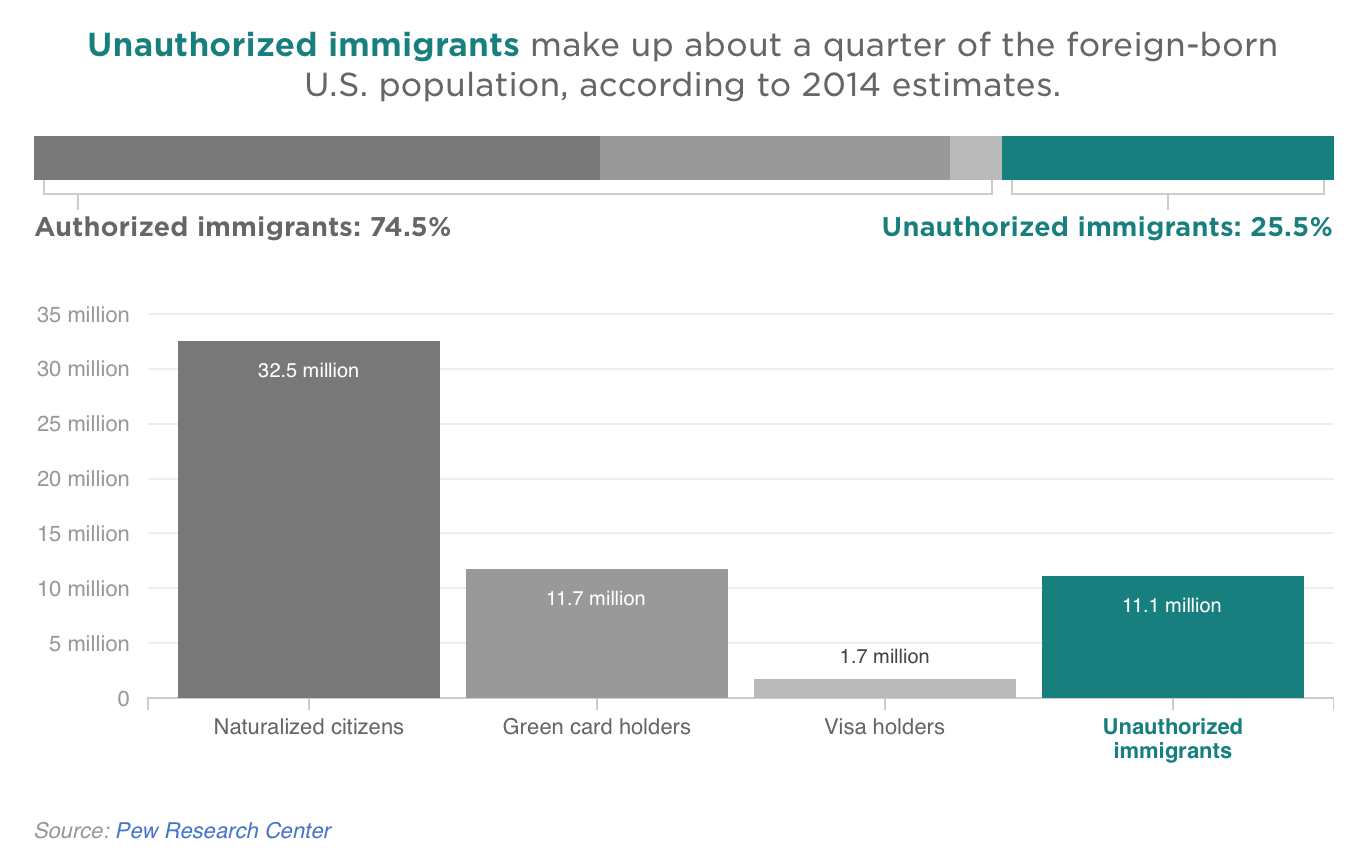
About 11 million people live in the U.S. without authorization

There are far more naturalized citizens than unauthorized immigrants in the U.S., and slightly more green card holders, according to the Pew Research Center.

The total number of people living in the country illegally — about 11 million — has made headlines recently, because immigration advocates suggest that under the Trump administration’s immigration enforcement policies, almost all of them could be targeted for deportation. (More than 700,000 “DREAMers” — immigrants who were brought into the U.S. illegally or overstayed their visas as children — are still temporarily protected from deportation through the Deferred Action for Childhood Arrivals, or DACA, program.)

Longtime residents outnumber new arrivals

A large majority of those people currently living in the U.S. illegally have been here for a decade or longer, which is a major shift from the situation at the turn of the millennium.

About two-thirds of unauthorized immigrants have lived in the U.S. for 10 years or more, Pew says. Only 14 percent arrived within the past five years.

In the late 1990s, the number of new arrivals was far higher, and the share of longtime residents far lower.

Mexicans make up a dominant — but declining — share of this population

Mexico is “the leading nation of origin for U.S. unauthorized immigrants,” Pew writes, but the share of immigrants from Mexico is also declining.

That is to say, Mexican immigrants are a shrinking majority of the population living in the country through illegal immigration.

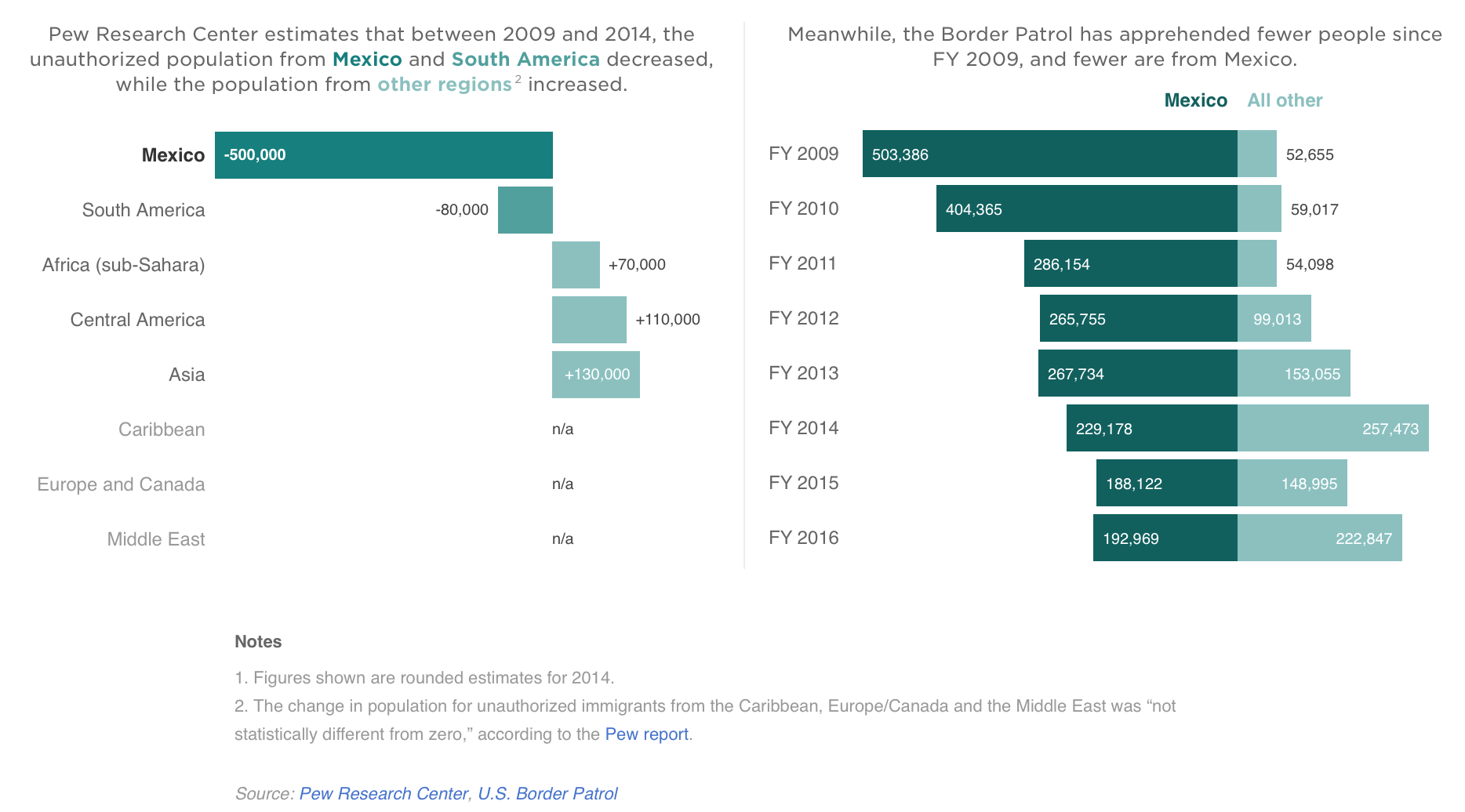
Of people living in the U.S. illegally, more than half are from Mexico. The population from that one country far outnumbers the population from entire continents. But there are fewer people of Mexican origin living in the U.S. now than there were a decade ago.

You can see the trend lines clearly if you look just at people arriving in the U.S. illegally, instead of the millions who live here. The percentage arriving from Mexico has dropped markedly, while more immigrants are coming from Africa, Central America and Asia.

The reasons for the shifting immigration patterns are complex. For Central American immigrants, conflicts in their home countries certainly play a role. The Migration Policy Institute suggests that there might be similar reasons for increased migration from Asia and Africa.

Source: How America’s Idea Of Illegal Immigration Doesn’t Always Match Reality : The Two-Way : NPR