Interesting analysis of Gresham’s law as applied to immigration debates in the UK and the challenges (and opportunity) facing the new Home Secretary:
Amber Rudd’s departure has not eased the pressure on the government over the Windrush scandal. The questions keep on coming. This afternoon Labour is urging the Commons to ask ministers to publish all the government documents relating to the affair since 2010, which could shed new light on Theresa May’s involvement as home secretary.
Sajid Javid, Rudd’s successor, must answer claims that senior officials were paid bonuses for hitting targets for deporting illegal immigrants and that foreign students were wrongly deported over language tests. There are also suggestions May blocked moves to lift a cap on visas for foreign doctors that the NHS needed.
Javid must design a new system for EU migration post-Brexit which does not repeat the Windrush mistakes. That’s before he turns his attention to the rise in violent crime, the terrorist threat and other nasties lurking in the woodwork that we don’t know about.
Javid made an encouraging start by ditching May’s rhetoric about a “hostile environment” for illegal immigrants, which indirectly caused the Windrush scandal. But his move has worried right-wing Conservative MPs, who fear he is going soft on “illegals”. In fact, Javid has not changed the policy, merely its label. Some Tories, including May, are convinced the public are on their side on “illegals” and therefore bring the conversation back to this topic at every opportunity.
Of course, people are against illegal activity. The UK does have a problem regarding illegal immigration. But talking about that to the exclusion of everything else risks repeating the mistakes of both Tory and Labour politicians for the past 20 years. They have assumed the worst on public opinion and pandered to it. Labour talked tough to prevent the Tories exploiting immigration. The Tories ramped up the rhetoric to combat Ukip’s threat. The party which trumpets providing the first BAME home secretary ran a disgraceful campaign to stop Sadiq Khan becoming London Mayor, only to find the capital’s voters much more tolerant.
I recall being told by a Tony Blair aide that a forthcoming Queen’s speech would include an immigration bill. But the Home Office knew nothing about it – an example of the “do something” culture. Blair got his bill.
The Tories set their arbitrary target to reduce annual net migration below 100,000, which depends as much on the number of people leaving as coming in. Immigration figures were published every three months, showing the target was never going to be hit, which fuelled public scepticism about politicians. So did Labour’s woeful underestimation of the number who would come to Britain after Eastern European countries joined the EU in 2004.
The ever-tougher rhetoric created a vicious circle, as politicians shouted louder to cover their failure to meet public expectations, which they created but could never deliver on. It was rare to talk up the benefits of immigration. As Sir Oliver Letwin, David Cameron’s policy chief, admitted on Monday: “All of us over the past 20, 30 years in British politics have underplayed the advantages to our country of migration, so the argument has become unbalanced.”
If this story sounds familiar, it’s because the same happened on Europe. After 30 years of criticising the EU, promising to slay the dragon of an imaginary superstate and never talking about the benefits of membership, it was hardly surprising the public voted to leave.
On immigration, public opinion is more nuanced than many politicians believe. Some 120 group discussions in 60 places held by the British Future think tank found that most people are “balancers” who recognise the benefits of migration but worry about the impact locally.
In an open letter to Javid, Sunder Katwala, the think tank’s director, said its “national conversation” had found much scope for consensus. He added: “A balanced policy can square this circle: ensuring that Britain controls the large-scale movement of lower-skilled workers that fuelled the Brexit vote while remaining open to the skills and energy that generations of new arrivals have contributed to our economy and society.”
British Future found that two thirds of people would support an annual cap on low-skilled workers; it enjoys majority support among Labour and Tory supporters and Remainers and Leavers. Nick Boles, a former Tory minister, has also proposed replacing the current target with an annual cap reflecting the economy’s needs. Javid might be sympathetic, but feels hemmed in by last year’s Tory manifesto “objective” to reduce net migration to “the tens of thousands”.
A similar conclusion was reached by the Commons Home Affairs Committee, which said in January: “Treating different kinds of migration differently would reflect most people’s views of immigration, and allow for much greater consensus to be built into the debate, as well as for greater transparency over immigration policy in general.”
Javid has a lot of speed reading to do. But he should read the British Future and select committee reports on the scope for consensus. He has a unique opportunity to break the vicious circle, and end our polarising and toxic debate on immigration. The question is: will May let him?
Good overview with some polling data regarding UK attitudes towards immigration:
The resignation of U.K. Home Secretary Amber Rudd on Sunday is bad news for the Conservative government on several fronts. A close ally of British Prime Minister Theresa May who had her boss’s back on a number of occasions, Rudd was seen as a rising star in the Conservative Party, a potential prime minister herself and the most articulate opponent of Brexitin the cabinet.
The real problem her resignation raises, though, isn’t the damage to May’s already weakened government or the shifting cabinet balance toward more euroskeptic members. It is yet more confirmation that the Conservative Party’s immigration policy is a mess. It embraces a “target culture” that not only hurts Britain’s economic interests but damages its global reputation.
For most of the last decade Conservative immigration policy has been populist and ineffective. Officially and unofficially, the name of the game was keepy-outy. Rudd’s attempts to uphold the policies of her predecessors descended into the grotesque.
The first sign of serious trouble concerned a generation of immigrants who were invited between 1948 and 1971 to help rebuild Britain after World War II during a time of labor shortage. Members of the so-called Windrush generation (named for one ship on which many arrived) came from Caribbean countries and were told they could stay indefinitely. But the Home Office didn’t keep records of those granted a right to stay — by some estimates, about 500,000 people. And in 2010 the Windrush landing cards, proving arrival for many, were destroyed as part of a cull of old paperwork.
This shoddy management became a more serious problem when landmark changes to immigration law — overseen by May herself when she was home secretary — made the lives of the Windrush generation untenable.
Immigrants, even those who had been there decades, faced new requirements for detailed documentation in order to access employment or benefits and health care. May’s “hostile environment” for illegal immigrants was meant to encourage self-deportations. (Remember that idea, Americans?)
It didn’t seem to result in many self-deportations, but it did lead to widespread injustices. Migrants faced demands that they prove their immigration status; landlords and employers risked large fines for renting to or employing illegal immigrants. A Law Society report found “clear evidence of serious flaws in the way visa and asylum applications are being dealt with.”
Some Windrush immigrants faced inhumane treatment by the country that had been their home for decades. They were denied re-entry into the U.K., health care and other rights. A media and public opinion outcry in recent weeks forced by both May and Rudd to apologize and promise justice and compensation.
They looked likely to ride out the Windrush storm until it emerged that the Home Office had set targets for illegal deportations. Rudd denied the existence of targets to a parliamentary committee, before leaked Home Office documents confirmed them. Five public apologies in a week were too many. Either she wasn’t in command (something many suspected) or she simply misled Parliament.
In immigration control, when officials are ordered to meet deportation targets, ugly things happen. Asylum case workers have described a system that is arbitrary and rushed, in which workers are trained to find ways to say no.
British Conservatives may be more socially minded than their American counterparts — nobody questions universal health care here, for example — but they ostensibly stand for innovation, entrepreneurship, individual freedom and opportunity. And yet for years, dating back to David Cameron’s government in 2010, this party has made it harder — sometimes with just the sheer expense and bureaucratic hassle — for foreign workers, students and family members to settle in the U.K. with increasingly stringent immigration policy and populist rhetoric. In the race for global talent, Britain has slowed its pace to a languid walk.
It was left to Labour’s Diane Abbott to make the case for a more reasonable migration policy: “In trade negotiations our priorities favor growth, jobs and prosperity. We make no apologies for putting these aims before bogus immigration targets.”
Meanwhile, the government’s target to reduce net immigration to the “tens of thousands” is so unrealistic that very few Britons are under any illusion that it will be met. Net immigration has declined — but the biggest declineshave come from European Union citizens, without whom the health service and other parts of the economy couldn’t function. Migration from non-EU countries has continued to rise.
Sadly the government seems to be responding to a crude reading of public sentiment. Ask Britons if they want to see less immigration, and most will say yes — though notably views have softened somewhat since the Brexit referendum and the trend is toward greater acceptance.
But ask them about particular classes of immigrants — students, nurses, the Windrush generation — and their replies are far more magnanimous. They want border control and fewer immigrants, but also a system that is fair and humane and welcomes people who will contribute.
By many accounts Rudd, along with some other leading Conservatives, had been uncomfortable with the immigration targets; and yet she placed loyalty to her boss and the party first. Other Conservatives have challenged May over aspects of the Conservative immigration policy from the targets to the indefinite detention of immigrants that has led to appalling conditions.
The good news is that it’s never too late: The Conservatives now have an opportunity to clean up the mess. The new home secretary, Sajid Javid, is the son of a Pakistani immigrant and a Muslim; his father arrived in Britain with 1 pound in his pocket in the 1960s, according to Javid.
In his first remarks Monday, he promised to look into injustices at the Home Office and promised a full review of the policies that led to Rudd’s embarrassment. That review shouldn’t end with the Windrush scandal. An honest review will mean changing the policies that May and her party have been so closely associated with for years. That will not be easy, but the country will be better off if neither of them flinch. It just might save the Conservative Party from the embarrassment of more such scandals.
Taking one for the team. This happened when PM May was Home Secretary:
Britain’s interior minister resigned on Sunday after Prime Minister Theresa May’s government faced an outpouring of indignation over its treatment of some long-term Caribbean residents who were wrongly labeled illegal immigrants.
The loss of one of May’s closest allies is a blow as she navigates the final year of negotiations ahead of Britain’s exit from the European Union in March 2019. It also deprives the cabinet of one of its most outspoken pro-European members.
In a resignation letter to May, Amber Rudd said she had inadvertently misled a parliamentary committee last Wednesday by denying the government had targets for the deportation of illegal migrants. May accepted her resignation.
For two weeks, British ministers have been struggling to explain why some descendants of the so-called “Windrush generation”, invited to Britain to plug labor shortfalls between 1948 and 1971, had been denied basic rights.
The Windrush scandal overshadowed the Commonwealth summit in London and has raised questions about May’s six-year stint as interior minister before she became prime minister in the wake of the 2016 Brexit referendum.
“The Windrush scandal has rightly shone a light on an important issue for our country,” Rudd said in a resignation letter to May.
Rudd, who was appointed Home Secretary in 2016, said voters wanted those who had the right to reside in Britain to be treated fairly and humanely but also that illegal immigrants be removed.
May to blame?
The opposition Labour Party, which had repeatedly called on Rudd to resign, said May was responsible and should explain her own role in the government’s immigration policies.
“The architect of this crisis, Theresa May, must now step forward to give an immediate, full and honest account of how this inexcusable situation happened on her watch,” said Diane Abbott, Labour’s spokeswoman on interior affairs.
Abbott called on May to give a statement to the House of Commons explaining whether she knew that Rudd was misleading parliament about the deportation targets.
Facing questions over the Windrush scandal, Rudd, 54, told lawmakers on Wednesday that Britain did not have targets for the removal of immigrants, but was forced to clarify her words after leaked documents showed some targets did exist.
The Guardian newspaper on Sunday reported a letter from Rudd to May last year in which she stated an “ambitious but deliverable” aim for an increase in the enforced deportation of immigrants.
After repeated challenges to her testimony on the deportation of immigrants, Rudd telephoned May on Sunday and offered her resignation.
“I feel it is necessary to do so because I inadvertently misled the Home Affairs Select Committee over targets for removal of illegal immigrants,” Rudd told May.
With her Conservative Party split over Brexit, May will have to be careful to preserve the uneasy balance in the cabinet after the loss of such a senior pro-EU minister.
Possible contenders who could replace Rudd include Environment Secretary Michael Gove, Health Secretary Jeremy Hunt, Communities Secretary Sajid Javid, Northern Irish Secretary Karen Bradley and former Northern Irish Secretary James Brokenshire.
Windrush crisis
The government has apologized for the fiasco, promised citizenship and compensation to those affected, including to people who have lost their jobs, been threatened with deportation and denied benefits because of the errors.
But the controversy over policies which May is closely associated with has raised awkward questions about how the pursuit of lower immigration after Brexit sits alongside the desire to be an outward-looking global economy.
The immigrants are named after the Empire Windrush, one of the first ships to bring Caribbean migrants to Britain in 1948, when Commonwealth citizens were invited to fill labor shortages and help rebuild the economy after World War Two.
Almost half a million people left their homes in the West Indies to live in Britain between 1948 and 1970, according to Britain’s National Archives.
A week before local elections, May apologized to the black community on Thursday in a letter to The Voice, Britain’s national Afro-Caribbean newspaper.
“We have let you down and I am deeply sorry,” she said. “But apologies alone are not good enough. We must urgently right this historic wrong.”
The crisis has focused attention on May, who as interior minister set out to create a “really hostile environment” for illegal immigrants, imposing tough new requirements in 2012 for people to prove their legal status.
Rudd’s resignation comes four months after another close ally and her then most senior minister, Damian Green, was forced out of his job for lying about whether he knew pornography had been found on computers in his parliamentary office.
Anna Soubry, a Conservative lawmaker, predicted Rudd may one day return to a senior job in government.
“She is a woman of great courage and immense ability,” Soubry said. “If there is any justice she will soon return to the highest of office.”
One of the advantages of having a break from blogging (not tweeting) is that one can gather the various news items and commentary together to have a more complete picture. Here is what caught my eye over the past few weeks.
UK
An interesting looking back at Enoch Powell’s ‘rivers of blood’ speech, how elements remain today (An Anti-Immigration Speech Divided Britain 50 Years Ago. It Still Echoes Today) and how these perhaps help explain the inexplicable treatment of long-term immigrants and others as exemplified by Windrush immigrants (post World War II immigrants from former British Caribbean colonies).
During my own long battle with the Home Office to secure residency, I spent many hours in Croydon. I went on one occasion to withdraw my passport, which had languished unprocessed for months, to travel to see my sick mother. Driven wild with fear that I would not be able to see her if the unthinkable happened, I was ready to risk not being allowed back in the country. The waiting room was a holding pen of quiet individual tragedies, full of people whose personal and professional lives had been thrown into turmoil by loss of documents, technical glitches and glacial incompetence. The cruelty we all experienced was not a bug, it was a feature.
The scandal of the Windrush generation is the kind of thing that happens when this rot sets in so deep that the infrastructure of a civilised society begins to fall apart. The rise in the number of the persecuted is analogous to the doubling in deaths of homeless people. There is only so much austerity an economy can take before the human toll rises. And there is only so much ideological fixation on “sending people home” before we are deporting grandmothers who arrived in this country when they were children.
And make no mistake, it is ideological. The Conservative party has been consistent in its aggressive immigration policy since 2010, when David Cameron decided that a tough stance on immigration was a flagship party offering to its base supporters. No ifs, no buts, he said. Detention, deportation and NHS treatment refusal is the culmination of the party’s most lucid positions. It is not incompetence, it is not even malice. It is an enthusiastic strategy that over the past decade has become a cornerstone, a defining element of Conservative governments. An immigration policy, very much like austerity, unafraid to be brutal if the deserving, whether they are the “indigenous population” of the country or hardworking taxpayers, are to be protected from those who are after a “free ride”.
There has been no bureaucratic snafu. The only miscalculation was that everyone got a little bit cocky, and who can blame them. The error was that the dragnet picked up some people who fall into a popular sympathy sweet spot. The elderly ones who came here from the Commonwealth to rebuild Britain and who even the Daily Mail can look kindly upon. They appeal to a patrician nostalgia and have a humanising narrative that others who come to this country in different circumstances do not enjoy. An apology and exceptions made for Windrush cases alone is not enough. If we are to be content with only this, then the government’s furtive shimmy away from the crime scene will be successful, and the Home Office’s daily violations of human rights will continue. If we are to prevent the assaults against those we can relate to, we must also be angry for those we cannot.
The UK government was forced to reverse its policy given the public backlash.
A surprising survey by Envoy Global suggests that while San Francisco is not giving up on the H-1B, companies there need it less than they have professed to need it. Call it an adjustment to the immigration policies of the new President. But despite a historical reliance on highly skilled foreign-born talent, most San Francisco employers say they do not consider sourcing foreign national workers as a top talent acquisition priority.
The San Francisco Insights on Immigration Report, conducted by Harris Poll on behalf of Envoy, aggregated the responses of 171 San Francisco-based HR professionals and hiring managers regarding global hiring practices. Key takeaways from the survey showed that local companies view hiring foreign talent is still very much a business norm, but today only 8% of San Francisco tech companies say they proactively seek out foreign employees compared with 24% of tech companies in other tech hubs who say they are looking abroad for talent. Some 54% of San Francisco tech companies said sourcing foreign national employees is not very important to their company’s talent acquisition strategy at the moment.
The de-emphasis on immigrant workers this year is the fact that the H-1B application process has become more cumbersome under Trump. Trump has promised to make it harder for tech firms to hire foreign workers, though the companies all still insist they need them.
In response to changes in immigration regulations, 33% of San Francisco employers say they are hiring fewer foreign nationals compared to 26% of employers nationwide.
Based on the 2016 Census data on ancestry, we estimate about 58 per cent of Australians have an Anglo-Celtic background, 18 per cent have a European background, 21 per cent have a non-European background, and 3 per cent have an Indigenous background.
However, our examination of almost 2500 senior leaders in business, politics, government and higher education shows only very limited cultural diversity. Almost 95 per cent of senior leaders at the chief executive or “c-suite” levels have an Anglo-Celtic or European background. Of the 372 chief executives and equivalents we identified, 97 per cent have an Anglo-Celtic or European background.
Here’s a breakdown. Within the ASX 200 companies, there appears only to be eight chief executives who have a non-European background – enough to squeeze into a Tarago. Of the 30 members of the federal ministry, there is no one who has a non-European background, and one who has an Indigenous background. It is similarly bleak within the public service, where 99 per cent of the heads of federal and state government departments have an Anglo-Celtic or European background (that’s one of 103). Universities don’t fare much better: just one of the 39 vice-chancellors of Australian universities has a non-European background.
All up there are 11 of the 372 chief executives and equivalents who have a non-European or Indigenous background. A mere cricket team’s worth of diversity.
These are dismal statistics for a society that prides itself on its multiculturalism. They challenge our egalitarian self-image. And they challenge our future prosperity as a nation. If we aren’t making the most of our multicultural talents, we may be squandering opportunities.
I often hear from people that it will only be a matter of time before cultural diversity is better represented. We should be encouraged, for example, that there doesn’t appear to be any lack of European backgrounds among senior leaders. Just as it took time before we saw Australian chief executives from Italian or Greek backgrounds, we may have to wait a little longer before we see more from Asian, Middle-Eastern, or African backgrounds.
Time alone may not resolve the problem. Economists at the University of Sydney, in a recent study involving resumes, found those with an Anglo name are three times more likely to be invited for interview, compared to candidates with a Chinese name. (The study also found that those with Chinese names who had an Anglicised first name doubled their chances of receiving a job interview.)
If we are serious about shifting numbers, it may be necessary to consider targets for cultural diversity – if not quotas. Such measures don’t stand in opposition to a principle of merit. After all, meritocracy presumes a level playing field. Yet do we seriously believe that a perfectly level playing field exists, when there is such dramatic under-representation of cultural diversity within leadership positions?
Multiculturalism can be as superficial as food and festivals. But if we’re serious about our diversity, we must be prepared to hold up a mirror to ourselves – and ask if what we see looks right for an egalitarian and multicultural Australia.
The recipe is a familiar one by now. In a society where social mores, especially in the big cities, appear to be changing very fast, there is a classic reaction. More traditional voters in the heartland begin to feel left behind, and their long-held values spurned. At the same time, a wave of unlawful migrants, fleeing terror and deprivation, appear to threaten the demographic and cultural balance still further, and seem to be encouraged by international post-national entities such as the European Union. A leftist ruling party in disarray gives a right-wing demagogue an opening, and he seizes it. And so in 2010, Orbán was able to exploit a political crisis triggered by an imploding and scandal-ridden Socialist government, and, alongside coalition partners, win a supermajority for the right in parliament.
Once in power, that supermajority allowed Orbán to amend the constitution in 2011, reducing the number of seats in the parliament from 386 to 199, gerrymandering them brutally to shore up his party’s standing in future elections, barring gay marriage in perpetuity, and mandating that in election campaigns, state media would take precedence over independent sources. He also forced a wave of early retirements in the judiciary in order to pack the courts with loyalists.
As Mounk notes, Orbán also tapped into deep grievances rooted in Hungary’s loss of territory in the 20th century, by giving the vote to ethnic Hungarians in neighboring Romania and removing it from more culturally progressive expats. But it was in response to the migration crisis in 2015, that Orbán truly galvanized public opinion behind him. Hungary, as Paul Lendvai noted in The Atlantic, had been deluged with asylum claims: 174,000 in 2015 alone, the highest per capita in the EU. Orbán responded by spreading fears of an influx of terrorists and criminals, of a poisoning of Hungarian culture, and expressing visceral nationalist hostility to the diktats of the European Union. Added to all that, of course, was a generous salting of classic central European anti-Semitism. Voters especially in rural areas flocked to him.
He further shifted the public discourse by creating and advancing new media outlets that amplified his propaganda, while attacking, harassing, and undermining all the others. He erected a huge fence to keep Muslim immigrants out, and refused to accept any of the 50,000 refugees the EU wanted to settle in his country. His political allies began to get very rich, as crony capitalism spread. By last year, Orbán had turned George Soros into a version of 1984’s Emmanuel Goldstein — an “enemy of the state” — with billboards and endless speeches, demonizing the Jewish billionaire and philanthropist, and vowing to protect the nation from external, malignant forces.
It was a potent formula, especially when backed up by the rigging of the parliamentary seats. Last week, in a surge of voter turnout, Orban won almost 50 percent of the vote, but two-thirds of the seats, giving him another supermajority (this time without coalition partners) in parliament, with further chances to amend the constitution in his favor. His voters in the heartland swamped a majority for the opposition in Budapest. One of two remaining opposition newspapers, Magyar Nemzet, shut down on Wednesday after 80 years in print. Orbán had withdrawn all government advertising in it. Some wonder whether there will ever be a free election again.
If you find many of these themes familiar, you’ve been paying attention. In the middle of a reaction against massive social change and a wave of illegal immigration, a right-wing party decides to huff some populism. A charismatic figure emerges, defined by hostility to immigration, becomes an iconic figure, and even though he doesn’t win a majority of votes, comes to office. His party is further shored up by gerrymandering, giving it a structural advantage in gaining and keeping power, including a seven percentage-point head start in the House of Representatives. That party does what it can to further suppress the vote of its opponents, especially ethnic minorities, and focuses on packing the courts, even rupturing long-standing precedents to deny a president of the opposing party his right to fill a vacant Supreme Court seat.
Openly propagandist media companies emerge, fake news surges, while the president uses the powers of his office to attack, delegitimize, and discredit other media sources, even to the point of threatening a company like Amazon. A mighty wall is proposed against immigrants on the border, alongside fears of a mass “invasion” from the South. Social conservatives are embraced tightly. The census is altered to ensure one party’s advantage in future district-drawing. Courts are disparaged and the justice system derided as rigged by political opponents.
The difference, of course, is that Orbán is an experienced politician, and knows exactly what he’s doing. Trump is a fool, an incompetent, and incapable of forming any kind of strategy, or sticking to one. The forces arrayed against the populist right, moreover, are much stronger in the U.S. than in Hungary; our institutions more robust; our culture much more diverse. Our democracy is far, far older.
And yet almost every single trend in Hungary is apparent here as well. The party of the left has deep divisions, and no unifying leader, while the ruling party is a loyalist leader-cult. The president’s party is a machine that refuses to share power, and seeks total control of all branches of government. It is propelled by powerful currents of reaction, seems indifferent to constitutional norms, and dedicated to incendiary but extremely potent populist rhetoric. The president’s supporters now support a purge in the Department of Justice and the FBI, to protect the president from being investigated.
The president himself has repeatedly demonstrated contempt for liberal norms; and despite a chaotic first year and a half, is still supported by a solid and slightly growing 42 percent of the public. Meanwhile, the immigration issue continues to press down, the culture wars are intensifying again, and the broad reasons for Trump’s election in the first place remain in place: soaring social and economic inequality, cultural insecurity, intensifying globalization, and a racially fraught period when white Americans will, for the first time, not form a majority of citizens.
History is not over; and real, profound political choices are here again. My hope is that the descent into illiberalism across the West might shake up the rest of us in defending core liberal democratic principles, wherever they are threatened, bringing us to the ballot box in huge numbers this fall, and abandoning the complacency so many have lapsed into.
Tone matters. If this were only a pro forma note, Harper is more than capable, as anyone who followed him in Canadian politics can attest, of draining any message of liveliness or affect. And, by his own stated standard, he would have had grounds for keeping any hint of enthusiasm out of this one. After all, Harper has said that his aim as IDU chair is partly “ensuring that we address the concerns of frustrated conservatives and that they do not drift to extreme options.”
If we’re talking extreme options, Orban looks like a prime example these days. Numerous credible critics charge that he has coopted Hungary’s courts and schools, skewed its electoral system to his advantage, all while voicing admiration for Turkey and China, and criticizing Western European tolerance for Muslim immigration. Still, political science professor Achim Hurrelmann, director of Carleton University’s Institute of European, Russian and Eurasian Studies, says Orban’s core message—beyond his destructive domestic tactics—is being heard by conservatives outside Hungary. “[Fidesz] has primarily been anti-migration, emphasizing the Christian roots of Europe, and being very much against diversity,” Hurrelmann told me in an interview. “In that position, they find common ground with some other mainstream conservative parties.”
I can’t guess if Harper’s calculation in issuing that tweet took into account an awareness that Orban, dangerous as he may be, isn’t irrelevant beyond Hungary. Whatever Harper’s reasoning, he has undoubtedly damaged his reputation among many who view Orban with justifiable distaste and alarm. I’m reminded again of the steep learning curve Harper had to climb after barely travelling outside Canada, and concentrating almost entirely on domestic issues, rather than foreign policy, before his 2006 election win. “Since coming to office,” he told Maclean’s in 2011, “the thing that’s probably struck me the most in terms of my previous expectations—I don’t even know what my expectations were—is not just how important foreign affairs/foreign relations is, but, in fact, that it’s become almost everything.”
It’s worth noting that Andrew Scheer seems to be on his own version of that learning curve now. In this recent interview with my colleague Paul Wells, the Conservative leader surprised me by going on at some length about his reasons for supporting Brexit. Scheer spoke about how staying in the EU impinged on British sovereignty and embroiled Britain in the Brussels bureaucracy. He scoffed at “this notion that somehow they would lose access to the European market.” He repeated the debunked canard that EU rules required a certain curvature on bananas.
To my ear, all this pro-Brexit blather was by far the least convincing part of Scheer’s performance in that interesting conversation. Conservatism’s most treacherous currents are global, especially in the age of Donald Trump. In Harper’s congratulatory message to Orban, and Scheer’s laudatory position on Brexit, the difficulty finding a solidly respectable place to stand in that international discourse becomes glaringly obvious. These issues might not seem central to Canadian voters in any federal election, but, as Harper reminded us, they soon are to whoever wins one.
Maybe it was intrusive use of big data. A mistrust of Eurocracy and foreign judges.
Maybe it depended on undeliverable promises and the big red bus. Perhaps it was the complacency of the remainers, and of intransigence in Brussels.
But there’s little doubt that none of these factors would have made much difference to the Brexit vote without the big issue that people on all sides tend to speak about nervously – immigration.
So when the Migration Advisory Committee (MAC) speaks, it needs close attention. Amid all the claims, counter-claims, petty prejudices about Johnny Foreigner and justifiable concerns about jobs and wages, this is the outfit that feeds real hard evidence into government thinking – or so you would hope.
It was commissioned last July by the Home Secretary, Amber Rudd, to take an in-depth and wide-ranging look at the UK’s continuing economic and demographic requirement to attract a continued flow of European Union immigrants after Brexiting.
This is to help shape the UK’s new immigration policy from 2021, though being commissioned by Ms Rudd it could also be seen as a helpful source of evidence to back up the soft Brexit end of Cabinet divisions on Brexit.
Hard-nosed
The interim report, published on Tuesday, is big on the opinion of business, acknowledging that the final report will have to balance that with other voices.
“What is best for an employer is not necessarily what is best for the resident population, which is the criterion the MAC uses when evaluating migration policy,” it states.
In general, but particularly in London and Scotland, business told the MAC that it likes to recruit from the biggest possible pool of labour. No surprise there.
They shared with the MAC employer concerns, with which we are becoming familiar, of being unable to staff businesses after the Brexit portcullis falls. Without access to migrant labour, firms may not grow, and some may disappear.
The committee seems to have listened carefully, agreeing that growth will be slowed, but without much sympathy for UK plc. The hard-nosed response is: if you’ve built your business model on migrant labour, you need to be prepared for when it isn’t there.
This is not just about Brexit, goes the argument: this is about trends towards migrant workers choosing to go elsewhere, if for instance, sterling isn’t so valuable to them.
Earnings in their home countries can be expected to rise over time, so they will eventually choose to make their money in their more prosperous homelands. What does migrant-dependent British business do then?
Reliable and flexible
The interim report also dips a toe into the controversial question of whether migrant workers depress wages.
They’ve got more work to do on that, says the MAC. But for now, they note very different stories for those born in older EU members (such as France and Germany), who on average earn 12% above the British-born average. They tend to do more highly skilled jobs.
Those born in the newer EU members (from the Baltic states to Bulgaria) are typically in lower skilled, lower-paid roles and paid 27% less than the British-born average (note: that is not for the same work).
The evidence is patchy, but suggests that average pay has not been much depressed by migrant workers. It may even have been enhanced among higher earners.
But among lower-paid workers, the financial crisis and long haul back to recovery offer a more compelling explanation for poor wage growth than competition from foreign workers.
What they’re clearer about is that employers are getting a higher level of skill and qualification for the same money that will buy an hour of native British worker’s time.
And that might help explain one of the headline findings – that employers like the work ethic, reliability and flexibility that they get from migrants. That’s hard to prove with hard evidence, but plausible.
When employers say they simply can’t get home-grown Brits to come and work at some jobs, the Committee has another unsympathetic response: of course they will – you just have to offer them enough pay to make it worthwhile. Employers seem unwilling to use wages as a lever to solve their labour and skill shortages.
Dependency
A lot of this interim report is dedicated to examining the case for migration being encouraged into some parts of the UK more than others.
It highlights the huge differences between most of the country and London. The capital’s population is 37% foreign-born. Some 11% of the total are from EU countries.
The West Midlands has the next highest share, at one in eight, and for Scotland, it’s one in 12. For north-east England and Wales, it is one in 18.
The sector where Scotland has a relatively high reliance on foreign workers is in hospitality – that’s apart from London, which at 33% foreign, is three times as reliant..
This is where the Scottish government weighs in. It set out for the MAC a case that will be familiar to those who follow Holyrood’s rhetoric:
Scotland has more need of immigrants because its population would fall otherwise. All its recent population growth has come from immigration.
Scotland has a special long-term problem with having enough working age, tax-paying people to fund pensions and services for retirees (‘the dependency ratio’), and
Scotland has a particular need for migrants to counter the outflow of people from remoter communities.
Again, the hard evidence is examined, and the response is far from sympathetic. The Scottish government’s sense of exceptionalism takes a battering.
Work longer
It is concluded that:
Scotland doesn’t have more need of migrants to stop population decline. Other parts of the UK have similar challenges, including north-east England and Wales.
Following the trajectory of the dependency ratio for the next two decades, it rises for Scotland, but it doesn’t look significantly different to other parts of the UK. In Northern Ireland, it rises fastest. A much more effective way of addressing the problem, it is argued, is raising the pension age and having people work longer.
And the rural question? Why look to migrants to fill the gaps as people leave these areas? Why not address the reasons why people leave, and find ways to encourage residents to stay? (There’s no suggestion what these might be.)
“Migration is rarely the only policy available to deal with a problem and always needs to be compared with alternatives,” writes the MAC chairman, Sir Alan Manning.
The final report will have more to say on those alternative. It is set to have a very significant influence on the future shape of the British economy and of British society.
Certain blindness to have let this issue fester for so long:
Jeremy Corbyn has issued his strongest condemnation of antisemitism so far as he came under intense pressure from his own backbenchers and the wider Jewish community over his failure to tackle antisemitism in the Labour party.
He was forced to step up his response during the day after an extraordinary open letter was published on Sunday night by the Board of Deputies of British Jews and the Jewish Leadership Council (JLC), accusing him of “siding with antisemites” and calling for supporters to stage a show of solidarity outside parliament as the parliamentary Labour party held its weekly meeting on Monday evening.
At the PLP meeting, backbenchers denied there was any kind of coup attempt. Wes Streeting MP, often a critic of Corbyn’s, said: “No one’s calling for a leadership election. We just want leadership.”
The pressure from backbench MPs began building on Friday when Luciana Berger challenged Corbyn over supportive comments he posted to the artist behind an antisemitic mural. It came to a head on Monday morning when John Mann, chair of the all-party antisemitism group, tweeted that the Labour party “ceases to have a reason for existence if it cannot stand up against discrimination and racism”. He said the party was “rotten to the core”.
His criticism was backed by the veteran former minister Dame Margaret Hodge, who said Corbyn had allowed himself to become “the poster boy of antisemites everywhere”.
As hundreds gathered at Westminster, including dozens of Labour MPs and peers, and a small group of rival demonstrators from Jewish Votes for Labour, Corbyn issued a “sincere apology” that acknowledged that his previous responses had been inadequate.
“I recognise that antisemitism has surfaced within the Labour party, and has too often been dismissed as simply a matter of a few bad apples,” he said on Twitter.
“This has caused pain and hurt to Jewish members of our party and to the wider Jewish community in Britain. I am sincerely sorry for the pain which has been caused, and pledge to redouble my efforts to bring this anxiety to an end.”
Corbyn’s previous apology merely recognised that there were “pockets” of antisemitism in the party. That was rejected as inadequate by Jonathan Goldstein of the JLC, who said the Labour leader had become a figurehead for antisemitism.
Speaking at the solidarity protest outside parliament, the former Labour MP Gillian Merron, who is now chief executive of the Board of Deputies, said Corbyn had only made concessions because he had been forced into it by their actions.
“People here are angry and sad,” she said. “Nobody dreamt they would be in this position. The Jewish community has had enough and we are joined in that feeling by many many people inside and out of the Labour party.”
Later, Louise Ellman, who is a former chair of the Jewish Labour Movement, told BBC Newsnight it was “unprecedented” that the mainstream Jewish community had to take to the streets to protest at antisemitism in a mainstream political party.
In the second letter, Corbyn expressly apologised for failing to study the content of the antisemitic mural in the East End of London before posting supportive comments to its artist.
Jewish leaders claimed in their letter, released on Sunday night, that the controversy proved the Labour leader “cannot seriously contemplate antisemitism, because he is so ideologically fixed within a far-left worldview that is instinctively hostile to mainstream Jewish communities”.
Countering the charge, Corbyn says in his letter: “While the forms of antisemitism expressed on the far right of politics are easily detectable, such as Holocaust denial, there needs to be a deeper understanding of what constitutes antisemitism in the labour movement. Sometimes this evil takes familiar forms – the east London mural which has caused such understandable controversy is an example.
“The idea of Jewish bankers and capitalists exploiting the workers of the world is an old antisemitic conspiracy theory … I am sorry for not having studied the content of the mural more closely before wrongly questioning its removal in 2012.”
In a much more nuanced recognition of the forms that antisemitism can take, the letter also accepts that anti-Zionism and antisemitism have become conflated.
“Criticism of Israel, particularly in relation to the continuing dispossession of the Palestinian people, cannot be avoided. Nevertheless, comparing Israel or the actions of Israeli governments to the Nazis… and using abusive phraseology about supporters of Israel such as ‘Zio’ all constitute aspects of contemporary antisemitism.”
He also promises that the party will implement in full the “overdue” recommendations of the Chakrabarti report,which was published nearly two years ago.
Andy McDonald, the shadow transport minister, insisted that action would be taken. He pledged to speed up the “far too slow” complaints process. He was unable to say how many complaints had been successfully dealt with.
A related article on the extent of antisemitism in the UK (CST report):
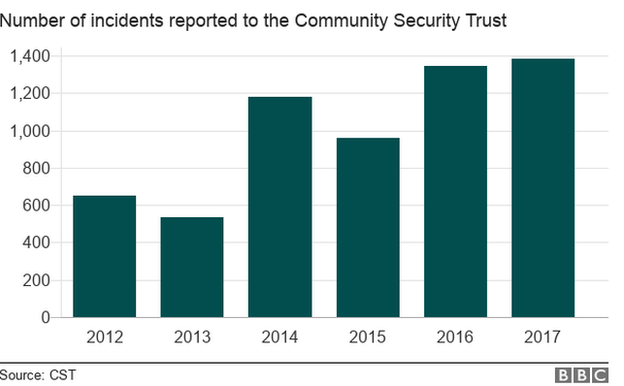
The Community Security Trust (CST), a charity that works with Jewish community organisations and police forces, recorded 1,382 anti-Semitic incidents in 2017 – the highest total ever.
Of these, 145 incidents were classed as “assaults” – up from 108 the year before. But the most common type of incident was “verbal abuse directed at random Jewish people in public” – being shouted at in the street.
Meanwhile, almost one in five incidents involved the use of social media.
One tweet sent to a Jewish charity appeared to show a rollercoaster above a concentration camp. Another social media user posted messages saying “Hitler was right”.
The CST said there had been three incidents involving damage to, or desecration of, a Jewish cemetery; eight involving stones or bricks being thrown; and eight involving eggs being thrown at property.
The charity also cited improvements in the reporting of anti-Semitic incidents – but said it believed there was still “significant under-reporting”.
Earlier this month, the former Chief Rabbi Lord Sacks told the Jewish News newspaper: “Any political party has to adopt a zero-tolerance to anti-Semitism. If they fail to do so, they are a danger not only to themselves but to the country and all inhabitants.”
Lord Sacks has previously said that anti-Semitism is an ancient hatred and a contemporary warning sign that community relations within a culture are endangered.
It is why the Jewish community is inviting members of other faiths, and of none, to join in the chorus: “Enough is Enough.”
An example of how inheriting Canadian citizenship (first generation) leads to consular demands even in cases where a person has never lived in Canada:
John Letts, the father of a young British-Canadian man accused of belonging to ISIS and being held in a Kurdish jail in Syria, is hoping to lobby the Canadian government in person next week for help securing his son’s transfer to Canada.
Letts and his wife, Sally Lane, insist the allegations against their son Jack are false but say he has the right to answer any charges against him in a British or Canadian court.
Letts say he would have travelled to Canada long before now had he been allowed.
He and Lane have been subject to a travel ban since being charged in 2016 under British terrorism legislation for trying to send money to their son, who they say was desperate to leave ISIS-held territory in the Middle East.
On Thursday, a British judge eased the restrictions on Letts, giving him permission to travel abroad with the court’s prior approval.
“We were just given the ruling this morning, so we haven’t had really much of a chance to digest it,” Letts said in an interview after the hearing.
“But I’m hoping that next week, I’d like to think I could be in Canada having meetings with appropriate people.”
Family holds dual citizenship
Jack Letts was 18 when he left his family’s home in Oxford to travel to Jordan and then Syria in 2014.
Last spring, Kurdish militias controlling parts of northern Syria stopped him as he was trying to leave ISIS-held territory and jailed him in the town of Qamishli.
Canadian consular officials spoke with him by telephone in January. In audio recordings of the call obtained by CBC News, Jack Letts said he had tried to commit suicide and asked to be sent to Canada.
The British media have dubbed him Jihadi Jack, a label his parents say has made their ordeal all the more difficult. Public opinion in the U.K. tends not to favour allowing people suspected of fighting for ISIS to return.
The parents turned to Ottawa for help, they say, in the face of an indifferent response from the British Foreign Office. Letts, Lane and their two children, including Jack, hold dual citizenship. When asked about the Letts case in the past, U.K. authorities have said they cannot help British citizens in places where the U.K. has no consular support.
Letts, seen in Facebook photo at age 20, went to Syria and Iraq in 2014, and is now in a Kurdish jail in northern Syria. He was dubbed Jihadi Jack in British media, a label his parents feel has hurt his case. (Facebook)
Lane is optimistic that Canada will help see her son extricated from the Kurdish prison.
“I think we’re in a different time frame now,” she said. “Jack’s in detention. There’s an opportunity to get him out of detention, and those questions about what he was doing can now be answered in a trial.”
Parents could face 14 years in prison
Lane says she has been focused on how to help her son rather than on the charges laid against her in Britain, with a trial set to begin in September.
But if found guilty, she and her husband could face up to 14 years in prison, an outcome supporters say would be ludicrous for parents trying to help a child.
John Letts says living under bail conditions and being blackballed by some in the community has been an ordeal, harming the couple’s ability to make a living.
“We’ve been living like this for three and a half years, waiting under this sword of Damocles and under this view that we’re somehow terrorists and aiding and abetting ISIS, and it just makes you very angry and upset. And here’s a breakthrough.”
In his decision Thursday at the Central Criminal Court in London, known as the Old Bailey, Judge Nicholas Hilliard did not lift the travel ban on Lane.
Impact of anti-immigration rhetoric and on the UK:
Anti-immigration rhetoric coming from the White House is deterring software developers from going to the US.
That’s according to the world’s youngest self-made billionaire, 27-year-old Irishman John Collison.
Stripe, the company he founded with his brother Patrick, provides the payments plumbing for hundreds of thousands of online businesses.
Collison said that his fast-growing business had noticed the difficulty in luring top talent to Silicon Valley.
In an exclusive interview with the BBC, the Limerick man said he feared the same may prove true for the UK because of Brexit.
“People are less willing to move to the US,” Collison said. “They don’t even want to enter the visa process because of the perceived political climate here and how welcoming it is to immigrants and I think the perception (of the UK) will also make it harder to recruit in the UK”
He said the stakes were high as it ultimately risked the UK’s ability to produce a vibrant and successful technology sector.
‘The brightest and the best’
Collison has accepted there is no going back but says the government should be a sending a clear message that international talent was welcome in the UK.
“What’s done is done but what I think we can now affect is the perception of the UK as an attractive place to live, work and do business, ” he said.
“It’s something we are screwing up in the US and I think there is a very clear opportunity to send a message that the UK is a good place to emigrate to.”
Collison’s frustration is compounded by the fact that these perceived forces of deterrence fly in the opposite direction to the way the world of commerce and technology are evolving.
He says: “There is a juxtaposition between an outward, global, technology and export-based economy on the one hand and the anti-immigrant signals from the US and Brexit.”
The UK government insists that it understands the need to lure the “brightest and best” from around the world – it recently doubled the number of visas available for exceptionally talented individuals from outside the EU who show promise in technology, science, art and creative industries from 1,000 to 2,000.
But the long-term position of EU nationals who arrive after Brexit is less clear.
Stripe is has just signed a deal with Amazon
That is perhaps one reason why Collison and his older brother are betting big on Dublin as their European headquarters.
“There are a few reasons. First, it’s in the European Union, second, it’s a real international melting pot with the skills we need and third it’s a nice vibrant city to live in – there’s more of a craic (more fun) in Dublin.”
Good long read and reminder of how attitudes and processes can hamper, not foster, integration:
I first landed in England in September 2004. I took the underground from Heathrow and sat in the carriage with my luggage, face plastered to the window, as the train made its way through the late summer greenery of west London. Culture shock blended with a counterintuitive sense of ease and familiarity with a country – in fact, a whole hemisphere – that I had never visited. I had lived my entire life in Sudan, Egypt and Saudi Arabia, and had come to the UK to study for a postgraduate degree at the University of London. Over the next weeks, I found the city and its people both bewilderingly cool and enthusiastically welcoming. That duality would go on to be the central theme of my life in the UK – confusing impenetrability accompanied by a yielding accommodation.
I settled in quickly, squatting in a relative’s spare bedroom until I could make arrangements. But I had severely underestimated the expense of London and, already impoverished by the high overseas student tuition fees, I began working while I was studying, my student visa allowing for 20 hours a week. I temped in offices across London, using an A–Z to find my way around. My topography of London is still anchored in the locations of those anonymous office blocks across the city. At the end of my course I extended my student visa in order to finish my dissertation and meanwhile was offered a contract as a research assistant at an investment bank where I had been temping. I went into the interview with precisely £15 to my name. Had the position not paid by the end of the week, I would not have been able to get through the first month.
A few weeks into the job and with a little disposable income for the first time in my life, I rented a room on a Bethnal Green council estate. Standing on the balcony, looking out at east London, I remember thinking that it was a sort of Valhalla. After a year or so, in 2007, a combination of student visa extensions and a partner visa by virtue of a relationship I was in at the time meant that I was granted limited leave to remain (ie with no recourse to public funds). After five years, I would be eligible for permanent residency.
My problems with the Home Office began in 2012. What should have been a routine application for permanent residency was turned down. I don’t remember the exact wording of the letter because my concentration shattered while trying to process what my lawyer was saying. The reason seemed to be that the right to permanent–after-temporary residency had been circumscribed. The laws had changed. “We’ll need to appeal immediately,” she said. “You don’t have to leave right away.”
It is hard to describe what it feels like to confront the possibility of leaving a country in which you are settled. I had by then been living, working (in emerging markets private equity) and paying taxes in the UK for nine years and enjoyed all the natural extensions of that investment – a career, close friends, a deep attachment to the place, a whole life. It is almost as if the laws of nature change, like gravity disappears and all the things that root you to your existence lose their shape and float away. I remember thinking, “I can’t leave, I’ve just bought a sofa.” It was a ridiculous thought, but that secondhand sofa from the local flea market was the first item of furniture I had ever bought. Suddenly, it signified the folly of nesting in a country that had no intention of letting me make a home.
In January 2010 David Cameron, backed into a tough stance by the looming election, announced a “no ifs no buts” pledge to bring immigration down to the tens of thousands. Theresa May took the helm at the Home Office in May and immediately set about making as big a dent in the net migration number, then about 244,000, as possible. Despite the Liberal Democrats making an attempt to dilute some of the crueller aspects of immigration law, condemning the “Go home” billboard vans May sent through the streets of London and publicly challenging Cameron on the tens of thousands figure, immigration policies continued to harden. They culminated in the 2013 immigration bill that declared the country would become a “hostile environment” for illegal immigrants.
The resulting legislation represented a fundamental dismantling of the means by which all migrants could challenge Home Office decisions, despite around half of appeals ultimately being successful. By the time the 2015 immigration bill was introduced, the Conservatives, unfettered by coalition, introduced a host of measures that meant a hostile environment policy was surreptitiously rolled out against legal migrants as well.
Unable to tackle EU migration due to freedom of movement, the Home Office, while cutting its numbers of immigration case-workers, focused on non-EU migrants and their families, even when they were legal. “Discretion” – a word that sends chills down the spine of many a Home Office application veteran – became the governing principle. As with Nadir Farsani, a 27-year-old Saudi engineer who has lived in the UK most of his adult life and whose parents have British citizenship. He nevertheless had his student visa rejected by a case worker who decided a quirk of Arabic naming convention meant Nadir’s father’s supporting financial documents were not legitimate. Nadir was not informed nor asked to provide additional evidence and was asked to leave the country. While waiting for his application to be processed, his grandmother in Saudi Arabia fell ill and died. He could not travel to say goodbye.
Since 2010 I have experienced a constant attrition in the ranks of friends who did not have the means or the time to challenge often unfair decisions. Damned by discretion, rather than the law, they left.
The right to appeal decisions was curbed. The tier-1 visa, which had allowed for highly skilled migrants looking for a job or wishing to become self-employed, was abolished. Students’ right to work after graduation was limited and the Life in the UK test became a residency requirement. And British citizens began to be affected. In 2012 May announced rules that allowed only those British citizens earning more than £18,600 to bring their spouse to live with them in the UK. The figure is higher where visa applications are also made for children. She also made it all but impossible for people to bring their non-European elderly relatives to the UK. “Skype families” can spend years on opposite sides of the world, watching their children grow up on video.
Incentivised to reject, the Home Office grew ever more brutal and incompetent. Satbir Singh, CEO of the Joint Council for the Welfare of Immigrants, is one of many British citizens whose application for his spouse to join him in the UK was rejected. They had satisfied all the requirements, but the Home Office lost their documents. In one of JCWI’s cases, a British citizen on a zero hours contract had a nervous breakdown due to the long hours he had to work in order to satisfy the income requirement. He needed hospitalisation but refused – two weeks off would mean that his income would fall under the threshold.
The principle of reject and hope no questions are asked has given rise to instances of unfathomable cruelty. In one case, reported in February, an interviewee began hallucinating. When her rejected case went to the supreme court, the judge said, “Reading that interview, it is apparent that the claimant was very unwell at the time … She appeared to be talking to people who were not there and the interview nonetheless continued, including beyond a time when she asked whether or not she had wet herself.”
The hostile environment also began to chew up those who had lived their entire lives in the UK. Commonwealth citizens who arrived in the country decades ago have discovered that in a hardened immigration climate they are without the necessary papers. So Paulette Wilson, a 61-year-old former cook in the House of Commons, was sent to Yarl’s Wood immigration removal centre last October and taken to Heathrow for deportation to Jamaica, a country she had not visited since she was 10. A last-minute legal intervention prevented her removal, and, following media coverage in the Guardian, she was granted a residency permit.
In most cases, the speed with which the Home Office capitulates when challenged is a clear giveaway that decisions were made in the hope they would not be appealed. In my case, I appealed my residency extension and prepared a case with a litigation lawyer – only for permanent residency to be granted days before my appearance in court. There was no explanation and we had not provided, yet, any new information. My joy was followed by a nausea of fury. I had bankrupted myself trying to pay the £30,000 legal fees and lived in a constant anguish of instability, paralysed and yet tensed for action, only for the decision to be overturned because it was wrong in the first place, and because the Home Office couldn’t be bothered to fight it.
Forty per cent of cases brought before a judge on appeal are overturned. Consider that this applies only to the small number of individuals who have the means to appeal, and the scale of the wider miscarriage of justice becomes apparent. At one point, the government was proposing that the rule of “deport first, appeal later” that currently applies only to foreign national criminals be applied across the board; thankfully, this was eventually overturned by the supreme court, which declared it unfair and unlawful.
The original sin, the motivation for so much of the inhumanity being visited on applicants, is the “tens of thousands” target, an unrealistic and arbitrary number, backed by no intelligence or research. But the heart of the dysfunction throughout the past eight years isn’t that immigration laws have tightened, it is that they have become unpredictable, as new rules are introduced or scrapped. There have been 45,000 changes to immigration rules since May took over at the Home Office. Both applicants and immigration officials are navigating the system using a map whose contours and geology shift constantly. Farsani compares the process to “climbing a crumbling staircase”.
At the same time, the public tone, led by the Tory populism on immigration, became sharper and the idea that the UK had a soft-touch immigration system grew stronger. By the time the Brexit referendum campaign was under way, the national perception of the country’s immigration rules was in fantasyland. It was surreal to watch when, at the same time, I was unable to secure a residency, let alone a passport.
And the ignorance culminated in Brexit. The mainstreaming of lies was complete. A points-based system? We already have one. It’s called a tier-2 visa and to avail yourself of it you have to have sponsorship and a job offer from a UK employer, as well as sufficient funds to sustain you until your first salary. An NHS surcharge? We already have one. Every non-EU citizen who takes up a job or student position in the UK pays £150-200 before the visa is issued. They also pay national insurance, taxes that go towards the Home Office, plus high and escalating fees to process routine applications – in addition to fees paid to all the outsourced affiliated agencies that administer peripheral processes such as English tests and interviews.
Sometimes, going through that third-party machinery was like being in some dark comedy. The £150 English language test I had to book last-minute (or my naturalisation application would have been refused) took place in a lugubrious, privately run testing centre in Holborn, in London. Examinees were kept apart by a complicated, completely over-the top system. The examiner and I chatted amiably for a few minutes before she started the test. Then the frequency changed. Loudly and very slowly, she began: “Have. You. Been. To. Any. Festivals. Recently?” I said no and then she began to painfully explain what a festival was. I assured her that I knew, but just hadn’t been to any recently. She looked down at the subject notes where we had been asked to pick a topic we would like to speak about. I’d written down “Canada” as I had just arrived back in London that morning after delivering a keynote speech at a labour union event in Toronto. “Canada!” She said. “What. Can. You. Tell. Me. About. Canada?”
The really dirty secret is that the government can stop non-EU migration dead whenever it wants. Of the 170,000 non-EU migrants who came to the UK in 2016, about 90,000 were granted tier-2 employment. These are visas that we can simply stop issuing. But the economy needs the labour, something the government will not admit, instead choosing to treat applicants as people who somehow manage to come to the country against its will. If anything, the UK needs more non-EU migrants to plug skills gaps, particularly in the NHS – yet doctors offered jobs in hospitals are being blocked from coming to Britain because monthly quotas for skilled worker visas have been oversubscribed.
And, if Brexit finally goes through, into this inflexible immigration system will march three million EU citizens whose status will need to be registered and regularised. It is simply, for those of us who have been through it, a terrifying prospect. And May still doubles down, running the Home Office from Downing Street. In mid-February she overruled the Home Office in order to insist that EU citizens who arrived during a Brexit transition period would not have the automatic right to remain in the country. The move has caused alarm in the Home Office, with government sources admitting that work on a separate registration scheme had “barely begun” and “almost certainly” would not be ready in time. May then backed down.
The cavalier detachment with which these big decisions are made cannot be isolated from the general corporate cheapening of human life that has set in over the past decade. Satbir Singh sees immigration policy as indivisible from this environment. “If you look at what has happened in Britain over the last eight years,” he says, “there’s a thread of institutional degradation that runs through it all. Whether you are waiting for medical treatment, a welfare payment or an immigration decision, we are all clients, standing behind a glass window.” And we were the lucky ones. We weren’t in detention, which almost 28,000 people entered in 2016-17. We weren’t the ones being interviewed while hallucinating and wetting ourselves. We weren’t being handcuffed as we left burning buses.
And still the plight of migrants and their families doesn’t resonate with the British public as loudly as it should. I have heard the argument that no one has a right to settlement in a country that is not their country of birth many times. But other than in asylum cases or when people are joining family members, it is often the case that a life in the UK just develops organically. Sudan, where I am from, is in my bones, but the UK is where I had built a life just by virtue of the time I spent here. Via study and work, relationships and just the day-to-day of living, an investment is made in the country that you do not wish to unwind. Is that not, at its heart, what integration is? Is that not, allegedly, the Holy Grail? Satbir Singh, having won the right to bring his wife to the UK after the Home Office admitted its mistake, reflects on what is now, effectively and deliberately, an alienating process. “The first interaction you have with the state is suspicion, that you are a liar, a cheat and a fraud. This is an enormous roadblock to integration.”
In 2017, the permanent residency that was granted on appeal qualified me for British citizenship. More than a decade after that moment of pregnant possibility on a balcony in Bethnal Green, and 14 years after excitedly taking in the view of London’s parks on a train from the airport, I was making my way towards my naturalisation with leaden feet. The citizenship had been so shorn of its significance, so stripped of its essential meaning, that the ceremony felt like a formality. And when it was over it felt hollow. My relief was dulled by exhaustion and sadness that becoming the citizen of a country in which I had invested so much had been marred by an extractive, dishonest and punitive system. I now looked forward to only one thing – to never have to think about any of it again.
But the day after the ceremony I was crossing a bridge I had crossed thousands of times before, absentmindedly listening to Talking Heads’ This Must Be the Place. It was one of those cinematic London winter dusks, when the rich colours in the sky cast a benign, almost otherworldly light on the water. And I heard the lyrics – “Home is where I want to be” – for the first time. Every grain in the scene around me sharpened as a welling of belonging stung my eyes.
“They don’t want you to integrate,” Farsani had told me. “They want you to fail so they can point their fingers at you and say, ‘Look, immigrants do not integrate’.” But we do, because the country, in spite of its broken immigration system, slowly, organically, casually, naturalises you in ways that cannot be validated by a Life in the UK test, citizenship ceremony or exhaustive application dossier. But daily this natural, healthy process is being violated, via administrative incompetence and politically instructed cruelty, to fulfil a soundbite “tens of thousands” target the government cannot meet, and is too proud to jettison.
Good pointed commentary – better to have tests that are more general civic knowledge-based, as in Canada, than ones that try to capture obscure facts. A written test, of course, is more administratively efficient and consistent than individual interviews, the main reason it was introduced in Canada in the early 90s:
Meghan Markle is on a fast track from Hollywood to British royalty. She’ll certainly be joining the royal family from the moment of her marriage to Harry in May. And yet, if she wants to remain permanently in the UK, even the wife of the Queen’s grandson must pass a citizenship test.
The test has been sat more than 2m times since its launch in 2005. Anyone applying must correctly answer 18 or more of 24 multiple choice questions to pass – and the test costs £50 for every attempt.
It’s like a bad pub quiz: the test for British citizenship that few Brits could pass. One candidate failed 64 times before finally passing the test, and if you look at what the government’s quiz asks, it’s easy to see why. How many of us know the height of the London Eye, the age of Big Ben’s clock tower, or that Sake Dean Mahomed introduced curry to the UK in opening the Hindoostane Coffee House on George Street, London? These are some of the nearly 3,000 facts in the 180-page test handbook anyone wanting to stay in Britain is expected to know.
The absurdity doesn’t stop there. The test requires knowledge of the numbers of elected representatives in each regional assembly, but not in the House of Commons. Candidates need not know how to report a crime or register with a GP, but must know the approximate size of the Lake District and about 278 historical dates including when the Roman emperor Claudius invaded Britain.
If the citizenship test is meant to help migrants “integrate into society and play a full role in your local community”, there is little evidence to show it succeeds. The test has appeared in three editions and been used for more than a decade, but there has never been a formal consultation on whether its aims are being achieved. So I did it for them.
My 2013 report exposed serious failings, including the test’s impracticality and the many mistakes and omissions. My report made a dozen recommendations for how these problems might be fixed. Despite being raised in parliament, the test remains unchanged.
If left unreformed the test is damaging integration more than it’s enabling it
For my book Becoming British, I interviewed citizens across the UK about the citizenship test. Almost no one believed it helped their integration into a British society where few had even heard of the test. Instead of building bridges, most saw the test as another barrier whose main purpose was to extract additional fees. The lesson to learn here is that the test is currently damaging integration more than it’s enabling it.
There is an opportunity now to get this right as Britain changes its immigration policies after Brexit. Either the test is substantially modified to become a less trivial and fairer test of knowledge required for citizenship, or it should be thrown on the scrap heap.
A citizenship test is not obviously necessary to demonstrate a knowledge of life in the UK or British values. People could instead be tested informally without an exam, for instance by satisfying existing requirements for lawful residency, avoiding a criminal record, paying taxes owed and the like. These are ways in which people do show an understanding of living in this country in harmony with others.
But if the test is kept, change is needed – and a first step would be to make the answers freely available. Displaying knowledge about living in Britain shouldn’t require buying a book with the information in. And rather than the test remaining a block, it should be relaunched as something that is primarily of symbolic importance. In the US, the test is the last step to citizenship with zealously non-partisan questions about who was the first president or which side won the American civil war.
By contrast, half the UK’s test information on education is about setting up the government’s then flagship programme of free schools, but without any mention of a national curriculum, A-levels and more. Such partisanship needs to go. A test aimed at formally recognising the belonging someone has already earned is clearly preferable to what we have.
And if it is revised, it’s critical that there is a public dialogue about what is included. The government imposes this test of Britishness in the public’s name, but it is so alien as to render it absurd. People need to have confidence in our immigration system again, and imposing arbitrary knowledge tests won’t solve it.
Finally, migrants shouldn’t have a veto, but they deserve to have a voice. If the test doesn’t support integration, this needs to be fixed. Second-guessing the experience of migrants like me – who have passed the test and become British citizens – only continues the problem.



 Multicultural Meanderings