What Was Revealed When British Officials Calculated How Much a Colonial Subject’s Life Was Worth

A reminder:

One hundred and five years ago, in April 1919, Mani Ram, a middle-aged dental surgeon, frantically ran to one of his son’s favorite play areas. His son, Madan Mohan, enjoyed playing at Jallianwalla Bagh, an empty plot of land in the center of Amritsar, Punjab, but had not come home. Mani Ram was worried because British officer General Reginald Dyer had just ordered his troops to cordon off Jallianwalla Bagh and open fire on all Indian subjects without warning. His officers fired 1,650 bullets at Indians, killing and injuring hundreds, including children at play.

Mani Ram found his son’s lifeless body, among hundreds of others at Jallianwalla Bagh, and carried it home.

Two years later, Mani Ram filed a claim with the imperial government for compensation for the loss of his son. The colonial government had long provided compensation payments to European families when their property was destroyed, or family members were injured or killed. For example, the British government compensated British Loyalists after the American Revolution, British enslavers after the abolition of slavery, and British subjects in India after a large wave of rebellions in 1857.

But 1921 was likely the first and only large-scale compensation for Indian families under British imperial control. British officials were adamant that the payments did not set a precedent and were eager to make them discreetly, burying the procedure, at times, in misclassified files in the archive. These files across London, Delhi, and Chandigarh show a deep racialized and gendered disparity in the value attributed to Indian and European lives, as well as the care distributed to their surviving family members or maimed subjects making such claims. Today, practices of compensation and reparations are still sorted through similar legal structures that echo those very racial disparities.

Dyer’s instruction to shoot Indians at Jallianwalla Bagh was not the only form of imperial violence Indian subjects experienced in 1919. In the early months of 1919, Indians had assembled to protest draconian British policies such as the Rowlatt Act, which granted British officials emergency powers to detain Indian subjects indefinitely without any opportunity for judicial review. In protest, some Indians resorted to attacking the colonial government’s infrastructure, such as railway lines, telegraph wires, and local banks.

British officials responded with great force. They caned, flogged, and detained Indian men and male children without warrant. British officials also declared martial law and opened fire on protesting Indians in Delhi, Bombay, Lahore, Amritsar, Kasur, and Gujrat. British pilots also air bombed parts of Gujranwala.

In the aftermath of the violence, local district magistrates utilized their discretion to allocate ₹523,571 to widows and children of five Europeans who lost their lives in Amritsar and Kasur, as well as to Europeans who were injured, shocked, or attacked during the protests. The compensation funds came from taxes and indemnities leveraged on Indians rather than British funds.

In stark contrast, state officials “distribut[ed] quietly” a sum of ₹14,050 to a handful of Indian subjects “through confidential enquiries,” fearing they should offer at least some reprieve for Indian subjects. Imperial officials hoped that this covert distribution of payments would discourage new requests and limit any precedents for compensation for state violence in the future. Most Indian families who suffered death or injury received no compensation. Those few families who did receive payment received low sums, far less than their European counterparts, and had to rebuild their lives with few resources.

The racial disparity in payments reflected the significant difference in the value placed on a European life compared to that of an Indian, with the former being valued at almost 200 times higher.

Facing global criticism for the violence in 1919, British officials in London instructed the central government in Delhi to investigate the actions of its British officers against Indians while simultaneously guaranteeing amnesty for all imperial officers. In 1920, a committee, mandated by the India Office and Government of India, delivered its final report on the wide array of violence used against Indian subjects. The committee’s four European members justified the widespread violence and brutal tactics employed by British officers in Punjab, while its three Indian members fervently disagreed.

The Government of India argued that its officers were legally permitted to use violence in all situations, including whipping, caning, forced crawling, and indefinite detainment, with only two exceptions. The first exception was Jallianwalla Bagh, where Dyer had ordered troops to fire on the gathering of Indians. The second exception was Gujranwala, a Punjabi locality where British pilots dropped bombs on colonial subjects from planes without warning.

Over the following months, Indian legislators became aware of the significant difference in compensation payments between Indians and Europeans in 1919. They demanded equal compensation for Indian families, political reforms, and an official statement of regret from the British government.

While British officials refused to issue a statement or implement substantial political reforms, they reluctantly approved limited compensation for Indians. However, they restricted the scope and amount of these payments. The decision was driven more by concerns for political stability in colonial India and Punjab than by any commitment to racial equality or justice.

Over the next two years, the Government of India and Punjab worked together to establish a compensation process for Punjabi families who had lost family members or were maimed at Jallianwalla Bagh and Gujranwala. Although the government encouraged families to come forward and file claims, many hesitated due to fears that the compensation process was merely a ploy by the imperial government to target the family members of Indians who were involved in the protests during the early months of 1919.

To determine the value of a person’s life, the Compensation Committee was instructed to utilize a method similar to actuarial science. This involved considering the individual’s annual income or projected income, as well as their life expectancy. After deducting one share for the deceased individual, the remaining payment was divided among his dependents. This process was much more limited in its scope compared to the compensation claims of European subjects in 1919.

The colonial government initially failed to include provisions for Indian women and children, believing their lives had little to no economic impact or worth to the livelihoods of families. Officials eventually agreed to assign a fixed nominal amount to account for their lives. In contrast, calculations for European women in 1919 not only considered life expectancy and annual income, but also took into account nearly all injuries and trauma they experienced.

The formal process of compensation implemented by the imperial government sometimes exacerbated the trauma experienced by Indian subjects. The Compensation Committee asked Mani Ram what the value of his 10-year-old son was. Mani Ram testified that his son was an intelligent student with ambitions that could have led him to achieve any position within the government, even that of a governor. The details of the subsequent conversation between colonial officials and Mani Ram are unknown, but we know that Mani Ram pleaded with the government not to “add insult to injury.”

The allocation given to Indians reflected the significant racial inequality that the imperial government placed on the value of its subjects’ lives. After completing their work, the Viceroy’s Council provided ₹226,000 to over 700 Indian individuals as compensation for the excessive violence inflicted by the colonial government in 1919. This sum, supported through funds collected from indemnities, fines, and taxes imposed on Indians, was less than half of what was distributed among almost a dozen European subjects.

This history, carefully uncovered from governmental records, provides us with a deeper understanding of the past, particularly how legal procedures and bureaucratic systems supported British imperial rule and marginalized the value of Indian claims and lives. But this history is also significant in our present time, as it sheds light on modern practices of compensation as demands for restitution, reparations, and reparative justice, continue.

Hardeep Dhillon is an educator and historian at the University of Pennsylvania. She recently authored “Imperial Violence, Law, and Compensation in the Age of Empire, 1919–1922,” which is open access to all readers through The Historical Journal.

Source: What Was Revealed When British Officials Calculated How Much a Colonial Subject’s Life Was Worth

UK: Say one thing, do another? The government’s record rise in net migration

Highlights the difficulties and how parties get captured by their political promises, and then later pay the political price:

Think back to the 2019 election campaign. Quite reasonably, you may not remember every detail of the Conservatives’ manifesto – but perhaps you do recall one promise: to reduce immigration.

Think back further, to 2016 and the Brexit referendum. Then there was a promise to “take back control” of the UK immigration system. And since it left the EU in 2020, the UK does have more control.

But the numbers of people who’ve moved here didn’t go down, they went up.

Since the Brexit vote and the Conservatives’ victory in 2019, the 12 months to June 2022 saw the fastest population growth since the 1960s. Current projections from the Office for National Statistics put the UK on course for 74 million people by 2036 – six million more than there are today.

You’d be well within your rights to ask how that could be? The answer, according to the ONS, is largely immigration.

And one aspect of immigration has received huge amounts of attention from the government and the media. Statement after statement, story after story, has focused on migrants crossing the Channel in small boats – and the government’s efforts to stop them.

Indeed you’d be forgiven for thinking small boats are a major part of why immigration is up. But they aren’t.

No doubt, small boats are an important issue – on a human and national level. Prime Minister Rishi Sunak has made “stopping the boats” one of his five priorities.

His government’s flagship Rwanda plan aims to send some asylum seekers who arrive on small boats there – and Mr Sunak is still trying to get the bill through parliament.

But it’s not small boats that are driving an increase in immigration – it’s choices made by the government.

Almost 30,000 people arrived in the UK on small boats last year – something the prime minister has vowed to crack down on

There are a number of ways to measure immigration.

Let’s start with one: net migration. That’s the difference between the number of people arriving and leaving the UK each year.

In 2022, it’s estimated to have reached an all-time record of 745,000.

Then, there’s the number of visas issued to people relocating to the UK. Last year there were more than 1.4 million.

For context, last year almost 30,000 people arrived by small boat.

After the UK left the European Union, the government launched a new visa scheme for most people who don’t have a UK passport.

The government decides the criteria for the different visas it issues – these can be for studying, for working, for humanitarian reasons – and other purposes too.

In the words of Prof Brian Bell, who chairs the government’s independent Migration Advisory Committee, the rise in immigration is “the inevitable consequence of government policy”.

We can see how this is the case by breaking down that 1.4 million figure.

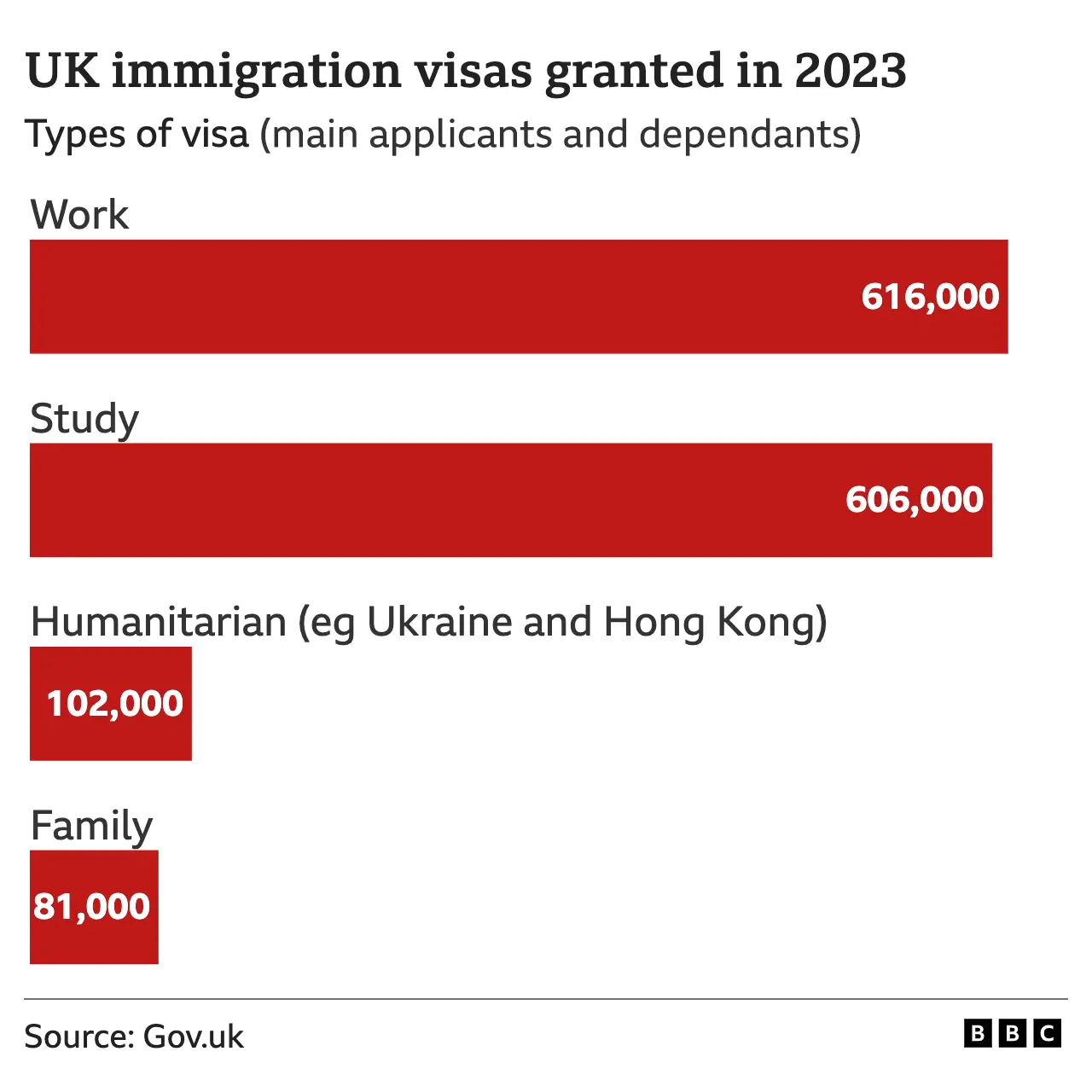
UK immigration visas granted in 2023

In 2022, the government issued almost 300,000 humanitarian visas. But last year the number was 102,000 – that’s just 7% of the 1.4 million visas issued.

The government has been consistent in its response when asked about the record levels of net migration.

Tom Pursglove MP, the Legal Migration Minister, told me: “We’ve seen incredible generosity in our country to people from Ukraine, people from Afghanistan, people from Syria, and other conflict zones. That is an important part of why we’ve seen the figures as they are.”

It is important, no doubt. And there was political consensus that issuing visas to people from Hong Kong, Ukraine and elsewhere was the right thing to do.

But the numbers show that this isn’t the full story.

The government has made other choices that have pushed up immigration.

Brexit and the pandemic added to existing recruitment problems in the social care sector. Care home owners responded by asking the government to make it easier to employ overseas care workers.

Those calls were echoed by the Migration Advisory Committee, which also suggested the government should fund higher wages to attract more British workers into the sector.

The Westminster government agreed more visas could be issued but did not raise wages.

A number of consequences followed.

For care home owners like Raj Sehgal, the changes helped. He filled almost all vacancies in his five Norfolk care homes, with 40% of staff coming from abroad.

“If we didn’t have international recruitment, I think we would probably be closed by now,” he told me.

More overseas staff arrived to work across the sector. But more may be needed. Last year, there were around 150,000 vacancies in England, and recruiting British workers remains difficult.

Let’s look at that 1.4 million figure again. Of all of those visas, more than 146,000 went to health and social care workers, another 203,000 went to their dependants.

This month, the government stopped overseas care workers from bringing dependants, describing the numbers as “disproportionate”. Mr Sehgal says this has already reduced the number of applications he is receiving.

This seems certain to reduce net migration numbers, but it’s not certain how the care sector will find the staff it needs.

If the government’s decisions on social care have driven up immigration, then so have its decisions on overseas students.

First of all, let’s consider the context here.

Tuition fees for domestic undergraduates at English universities are capped at £9,250 a year. That hasn’t risen for seven years – but during the same period, costs have. That has left universities facing financial challenges.

Some of them, like Coventry University, have targeted higher-paying overseas students to help cross-subsidise UK undergraduates. Forty per cent of the students at its campuses across the UK are from overseas.

If domestic tuition fees were raised, it could reduce the need for overseas students. But that would cost a lot. And it hasn’t happened.

Prof Brian Bell argues “that’s a choice of the government not to fund education in a particular way. The inevitable consequence is more immigration.”

The government couldn’t have been clearer about its ambition to attract more overseas students.

In 2019, it even set a target to increase the UK’s overseas student population to 600,000 – by 2030. It achieved that goal nine years early.

On top of that, in 2021, the government reintroduced a post-study work visa which allows overseas postgraduate students to work for two years after their courses finish – or three years if studying for a PhD.

It took the decision despite the Migration Advisory Committee suggesting that it shouldn’t.

All of this did what it was designed to do – attract lots more students. Last year the government issued almost 458,000 sponsored study visas. And almost 144,000 for dependants of postgraduate students.

Together, they made up almost 42% of the more than 1.4 million visas issued last year.

Again, the government was choosing immigration.

Now at this point, we should emphasise that while the government was putting in place policies that promoted immigration, knowing their precise impact was hard.

Dr Madeleine Sumption leads the Oxford Migration Observatory at the University of Oxford. She also sits on the Migration Advisory Committee that advises the government.

Predicting immigration numbers is “incredibly difficult”, Dr Sumption says. “Sometimes it’s much larger than the government expects.”

As the consequences of the government’s own policies became clear, it slammed on the brakes.

In May last year it announced that, from January 2024, most overseas postgraduate students would no longer be able to bring dependants.

This March, the government took further action – it ordered a review of the visa that allows overseas students to stay on and work. This, let’s remember, is the scheme the government had introduced only three years ago.

Legal Migration Minister Tom Pursglove explains: “The government took a view that we thought that that was the right thing to do to support the university sector. But when you consider the dependant numbers that have come with students, that has been very, very challenging.”

The government’s measures appear to be making a difference already. According to Universities UK, some universities are seeing a sharp drop in applications from overseas students for postgraduate courses.

But there’s a risk that as applications go down, so does the income of some universities.

A British Future poll suggests 69% of respondents are dissatisfied with the government on immigration

All of these government decisions have contributed to the record rise in net migration, and along with the rise we’re also seeing a shift in public opinion.

The think tank British Future, which tracks UK attitudes to immigration and describes itself as non-partisan, has shared its latest opinion poll with Panorama.

For the first time in four years, the poll suggests a majority of 3,000 respondents – 52% – want overall immigration to fall.

On top of that, 69% of those polled say they are dissatisfied with the government on immigration – that’s the highest since its polling began in 2015.

And this is where we come back to where we started – to the government’s emphasis on the issue of small boats.

The opinion poll also suggests that a little over half of those who say they are dissatisfied with the government’s handling of immigration pointed to small boats – and those concerns are coinciding with concerns about overall immigration.

Dr Sumption told me the media’s focus on small boats has probably created the impression that almost all migration comes that way, “which obviously it doesn’t”.

To reiterate – almost 30,000 people came by small boats last year and 1.4 million visas were issued by the government for people to come to the UK legally.

Some argue that the government has overemphasised the issue of small boats.

When I put that to Tom Pursglove, he countered that the government has a “moral imperative” to “grip that issue”. But he said that shouldn’t stop them, “delivering on the mission around legal migration, which is to get a better balance to bring those numbers down”.

At the moment, by the prime minister’s admission, that balance is off. In November, Rishi Sunak acknowledged, “immigration is too high and needs to come down”.

But his former Home Secretary Suella Braverman made a series of striking claims when I talked to her about Mr Sunak’s approach.

“I think the prime minister has not necessarily assumed that it’s an important issue for the British people,” Ms Braverman says.

“‘I struggled myself as home secretary, even to have a meaningful conversation with him about it. I was left to written correspondence on several occasions throughout a period of 12 months, putting forward policy proposals. But he refused to talk to me.”

I was taken aback by this. I know there is little political love lost since Mr Sunak sacked Ms Braverman last year – but this is the home secretary during the time of one of the sharpest rises in net migration in the UK’s history – claiming the prime minister wouldn’t talk to her about it – at all – for a year.

I double-checked I had heard right. I had.

“We talked about the boats every week, twice a week. We talked to each other a lot about policing and security. On legal migration, I was unable to get a hearing with the prime minister for 12 months.”

Given the importance of this issue to so many people, it is an extraordinary claim.

When we asked No 10 about this, it did not comment.

At the end of last year, the government announced plans to cut net migration by reducing the number of people coming to the UK by 300,000.

Remember, the latest estimate for net migration is 672,000 for the year to June 2023.

The estimate published just before the Brexit referendum – and which, at the time, Boris Johnson called “scandalous” – was 333,000. That estimate has now been revised down to 303,000.

So if the government meets its new target, that would take the numbers back towards where they were… just before the Brexit vote.

The government emphasises that Brexit has given the UK greater control and flexibility to adapt immigration policy to circumstance

Some observers watching the government’s statements and actions on immigration are gently raising their eyebrows.

Prof Anand Menon, who leads the independent think-tank UK in a Changing Europe, told us: “I think there is an element of dishonesty in the government at one and the same time implementing these policies and bemoaning them. Or bemoaning their impact.”

There seems little doubt the government’s latest measures will make a difference. Net migration is expected to fall. But if it does, the longer-term challenges that immigration has been easing may come into sharper focus.

Paul Johnson of the Institute for Fiscal Studies, which says it operates on a “non-political basis”, has an uncompromising message on this.

“If you want universities to have as much money as they have at the moment without these foreign students, you need to find some money from British students or the British taxpayer. If you want care homes to be staffed without bringing people in from elsewhere, you’re going to have to pay more. You have to make choices here.”

I’d hoped to ask Labour some questions about how it would approach these choices, but it declined.

This month, the Shadow Home Secretary Yvette Cooper said, “We are very clear that net migration needs to come down” and that a practical plan to tackle skills shortages in the UK is needed.

But are politicians of all parties being straight with us about what these choices involve?

For this government, for any government, these choices will involve difficult and sometimes expensive trade-offs.

Legal Migration Minister Tom Pursglove argues “issues have arisen” and it has “responded to those issues”. It emphasises that Brexit has given the UK greater control and flexibility to adapt immigration policy to circumstance.

Others point to recent data showing that one in five working-age adults are off work in the long-term, with record numbers recorded with long-term sickness.

In the Spring Budget, the Chancellor Jeremy Hunt said it would be easy to fill the 900,000 job vacancies with higher migration, but with 10 million adults not in work, it would be “economically and morally wrong”.

It’s inescapable though, that while the UK now has more control of its immigration system, the government has used that control to allow more people to come to the UK.

To come back to the question I posed earlier: how did that happen?

We can answer that by listing the government’s decisions and by acknowledging that there are powerful long-term factors that appear to encourage higher immigration. Our population is ageing, our birth rate is falling and our economy is struggling to grow.

The government though still insists the numbers will and must come down.

However, despite all the promises, this government chose more immigration. It is unlikely to be the last to do so.

Source: Say one thing, do another? The government’s record rise in net migration

UK: Shadow minister says Labour will investigate allegations as antisemitism row deepens

Of note:

The shadow defence secretary has said Labour will “follow the hard evidence” to ensure anyone who does not meet the standards of the party will be investigated.

His remarks come as Keir Starmer’s party was plunged into a damaging row about the handling of antisemitism allegations, with parliamentary candidate Graham Jones suspended on Tuesday, only a day after Labour was forced to suspend and withdraw its backing for Rochdale by-election candidate Azhar Ali.

Mr Starmer was forced to act after audio, obtained by website Guido Fawkes, appeared to capture Mr Jones using the words “f****** Israel” at the same meeting Mr Ali attended, while also allegedly suggesting that British people who volunteer to fight with the Israel Defence Forces should be “locked up”.

John Healey today urged anyone else at the meeting who witnessed antisemitism or unacceptable comments to report it to the party.

Speaking to Sky News, the shadow minister said: “Anyone at that meeting, if there is evidence that they have, that people acted or spoke in a way that doesn’t meet the standards, or is incompatible with the values of our Labour Party, they need to report it, provide it and the Labour Party will take it seriously and investigate it.

He added: “It’s what we do with every case.”

Pushed on whether Mr Ali was properly vetted, Mr Healey said the Rochdale candidate was “widely respected” and “widely supported across communities, including the Jewish community in the North West”.

He also said that there are “strong checks” and “due diligence” in the process. “But you can’t see everything everywhere. What’s important is that if new information comes to light, as in this case, we will act to investigate, we will act to block those who are not fit to serve as MPs,” he added.

It is too late now to replace Mr Ali as the Labour candidate so he will still appear on the ballot paper as the party’s choice.

On Tuesday the Labour leader Sir Keir Starmer addressed the controversy for the first time since the allegations broke.

“Information came to light over the weekend in relation to the candidate [and] there was a fulsome apology. Further information came to light yesterday calling for decisive action, so I took decisive action,” he said.

The Labour leader added: “It is a huge thing to withdraw support for a Labour candidate during the course of a byelection. It’s a tough decision, a necessary decision, but when I say the Labour party has changed under my leadership I mean it.”

Labour has been criticised for not taking tougher action sooner, with some suggesting Mr Ali was given favourable treatment because he was an ally of the leadership.

Source: Shadow minister says Labour will investigate allegations as antisemitism row deepens

Le Devoir Éditorial | L’immigration et les petits calculs politiciens

Malheureusement:

Si les enjeux d’immigration présentent des défis planétaires de plus en plus aigus et compliqués, ces défis gagneraient indubitablement en clarté si les gouvernements de tout acabit évitaient d’en instrumentaliser les côtés sombres à des fins politiques et électorales. Prenons seulement l’actualité récente en Grande-Bretagne, en France et aux États-Unis. Trois pays dont les gouvernements embrument le débat et cultivent les méfiances xénophobes en cédant aux sirènes du populisme.

Au premier ministre britannique, Rishi Sunak, armé d’un slogan alarmiste (« Stop the boats »), revient la palme de la déshumanisation des migrants pour son projet de transfert de demandeurs d’asile vers le Rwanda. Fondé sur un accord signé avec l’autoritaire Paul Kagame il y a près de deux ans, le projet de loi adopté le 18 janvier dernier par la majorité conservatrice aux Communes vise à décourager les migrants de traverser la Manche — ils ont été environ 30 000 à le faire en 2023, au péril de leur vie. Sunak entend procéder bien que la Cour suprême britannique ait désavoué le projet en estimant que le Rwanda peut difficilement être considéré comme un « pays sûr ». 

Outre qu’il est loin d’être acquis que les expulsions ralentiraient les arrivées par « petits bateaux », les chiffres montrent noir sur blanc que la croisade de M. Sunak, qui est largement menotté par l’aile droite du parti, tient du délire. Le fait est qu’entre juin 2022 et juin 2023, la migration a été essentiellement légale au Royaume-Uni, répondant aux besoins urgents du marché de l’emploi, particulièrement en santé. Les migrants en situation irrégulière ont représenté 7,7 % de la totalité des  682 000 entrées. Qu’à cela ne tienne : à la traîne dans les sondages face aux travaillistes, M. Sunak n’a pas seulement décidé de faire de son « projet Rwanda » le socle de sa politique contre l’immigration clandestine, il compte aussi en faire l’un des ressorts principaux de sa stratégie de campagne aux législatives de janvier 2025.

En France, des mois de controverse autour de la nouvelle loi sur l’immigration ont obéi à de semblables petits calculs, permettant in fine à Marine Le Pen, cheffe du Rassemblement national, de crier à une « grande victoire idéologique » — du moins jusqu’à ce que le Conseil constitutionnel ne censure une grande partie de la législation la semaine dernière. C’est ainsi qu’en cheval de Troie, le concept de « préférence nationale », si cher à l’extrême droite, s’est imposé de façon inédite dans un texte législatif français, avec le soutien de la droite traditionnelle (Les Républicains) et de la majorité macroniste. Résultat : les Français auront vécu une saga où Emmanuel Macron aura moins cherché à penser une politique migratoire réformée avec clairvoyance, à l’abri des dérives, qu’à enregistrer un succès législatif à n’importe quel prix, lui dont la présidence ne va nulle part à six mois du rendez-vous des élections européennes.

Aux États-Unis, Donald Trump s’emploie ces temps-ci à saboter un projet d’accord migratoire entre sénateurs démocrates et républicains pour empêcher coûte que coûte que sa conclusion ne fasse bien paraître le président Joe Biden en cette année de scrutin présidentiel. Sur le fond, le projet repose pourtant sur des mesures étroitement punitives et tout à fait au goût des républicains. Seraient sensiblement élargis, en vertu de cette entente, les pouvoirs d’expulsion manu militari dont disposent les agents frontaliers. Dans l’espoir à courte vue de raplomber sa popularité, M. Biden se trouve ainsi à jouer le jeu de la droite dure anti-immigration. Il est d’autant plus piégé par cette dynamique que le clan trumpiste au Congrès lie l’augmentation de l’aide militaire à l’Ukraine, pièce maîtresse de sa politique étrangère, à l’adoption de mesures radicales de refoulement à la frontière mexico-américaine.

En Europe comme aux États-Unis, sur fond de stagnation législative, la « pression migratoire » ne diminue pas. Ils ont été 267 000 migrants à débarquer aux frontières méridionales de l’Union européenne l’année dernière et 2800 à se noyer en Méditerranée ; ils ont été 300 000 pendant le seul mois de décembre dernier à cogner à la porte des États-Unis. Des nombres records. Des années de politiques d’endiguement et d’externalisation des contrôles n’y ont rien changé, bien au contraire, de la même manière que la fermeture du chemin Roxham — c’était écrit dans le ciel — n’a rien réglé.

À prétendre qu’il y a des réponses simples à des problèmes compliqués ; à faire l’économie des faits et à laisser prospérer les faussetés ; à trop peu investir, en amont des mouvements de migration, dans le développement des pays du Sud ; à faire depuis toujours, aux États-Unis, l’impasse sur une réforme du système d’immigration, on se trouve trop souvent à laisser la réflexion autour des enjeux de géopolitique migratoire, d’une portée pourtant capitale sur la vie des sociétés partout dans le monde, à se conclure sur des décisions politiciennes prises à la petite semaine.

Source: Éditorial | L’immigration et les petits calculs politiciens

How mass immigration is worsening the housing crisis – The Spectator

Similar but harsher debate to that in Canada with of course UK particularities, particularly with respect to social housing:

…In England, to put this in context, it means that last year we only built around one-third of the homes that we now need to build because of immigration. We should be able to talk about this openly. We should be able to talk about how immigration is fuelling the housing crisis, driving up house prices and making many homes unaffordable for British families and British workers.

Don’t believe me? Here’s what researchers at the University of Oxford recently said:

‘ … there is some evidence that migration is likely to have increased house prices in the UK. For example, the Migration Advisory Committee (2018) found that a 1-percentage point increase in the UK’s population due to migration increased house prices by 1% … Their finding was broadly consistent with other modelling by the former MHCLG (2018) and the Office for Budget Responsibility (Auterson, 2014).’

In fact, there’s more evidence than people like to think. In Spain, for example, a recent study found that a 1-point increase in the rate of immigration increases average house sale prices by 3.3 per cent (as did this one). And, while in Britain, one (older) study suggested immigration lowers house prices, this was only because more affluent locals ended up selling their homes and leaving their communities altogether, no doubt alarmed at what was unfolding.

Record immigration has not only been driving up house prices; it’s also been pushing up rents in the private rental market, something that becomes immediately obvious to anybody who has had to attend a viewing with some two dozen other applicants.

The fact that, in 2022, net migration is estimated to have added at least half a million people to England’s already absurd rental market is something most pro-immigration lobbyists, MPs, academics, and columnists, who usually live in their own homes, made possible by privileged parents, are unlikely to ever encounter.

…Mass immigration is also piling enormous pressure on Britain’s social housing sector, which used to be reserved for impoverished British nationals who had been paying into the collective pot for years and who had long roots in their local communities.

Today, however, things are very different. Nationally, as the Migration Observatory points out, between 2019 and 2021, 16 per cent of UK-born people were living in social housing compared to 17 per cent of the foreign-born. That figure then climbs to 19 per cent among people born in Pakistan or elsewhere in South Asia, and then to a striking 30 per cent among the rising number of typically low-skilled migrants who were born in sub-Saharan Africa, many of whom have also been shown to be a net fiscal cost, rather than benefit, to the British economy.

In London, almost half (48 per cent) of all social housing is now occupied by households that are headed by somebody who was not born in Britain. The most common households are headed by somebody who was born in Africa (18.4 per cent), the Middle East and Asia (11.7 per cent), or elsewhere in Europe (8.7 per cent).

…All of which raises a number of important questions that you would ordinarily expect to be addressed and answered by our political leaders: Why are so many young British people, workers, and their families forced to pay half their monthly income if not more to live out in the periphery, in places like London’s Zone 4 or beyond, sitting on expensive, packed and dirty commuter trains while wondering why they and other Brits are having to subsidise newcomers, who are frequently economically inactive?

Source: How mass immigration is worsening the housing crisis – The Spectator

Articles of interest: Immigration

Additional polling on souring of public mood on current high levels, related commentary on links to housing availability and affordability among other issues:

‘There’s going to be friction’: Two-thirds of Canadians say immigration target is too high, poll says

Worrisome trend but understandable:

Two-thirds of Canadians say this country’s immigration target is too high, suggests a new poll that points to how opinions on the issue are taking shape along political lines — a shift that could turn immigration into a wedge issue in the next federal election.

A poll by Abacus Data has found the percentage of people who say they oppose the country’s current immigration level has increased six points since July, with 67 per cent of Canadians now saying that taking in 500,000 permanent residents a year is too much.

“The public opinion has shifted in Canada to a point where if a political leader wanted to make this an issue, they could,” said Abacus chair and CEO David Coletto.

“We’re headed into a period where there’s going to be friction.”

Source: ‘There’s going to be friction’: Two-thirds of Canadians say immigration target is too high, poll says

Affordability crisis putting Canadian dream at risk: poll

Yet another poll, focussed on immigrants:

The Leger-OMNI poll, one of the largest polling samples of immigrants in recent years, surveyed 1,522 immigrants across Canada between Oct. 18 and 25. It is one of the few polls specifically surveying immigrants.  

The research finds the cost-of-living crisis is hitting immigrants hard. Eighty-three per cent polled feel affordability has made settling more difficult. While financial or career opportunities were the motivating factor for 55 per cent of immigrants’ journey to Canada, just under half surveyed think there are enough jobs to support those coming in. 

A quarter (24 per cent) feel their experience in Canada has fallen short of expectations.

Source: Affordability crisis putting Canadian dream at risk: poll

Kalil: We simply don’t have enough money to solve Canada’s housing crisis 

Reality:

Housing does not magically appear when there is demand for it. It takes time, infrastructure needs to be built to support it, the construction industry needs to have the capacity to deliver it, and our housing economy needs to hold enough money to fund it – which it does not.

Source: We simply don’t have enough money to solve Canada’s housing crisis

Burney: Trudeau, please take a walk in the snow

Burney on immigration and his take on the public service:

A rapid increase in immigration numbers was touted until it was seen simply as a numbers game, lacking analyses of social consequences, notably inadequate housing, and unwelcome pressures on our crumbling health system. Meritocracy is not really part of the equation, so we are not attracting people with needed skills. Instead, we risk intensifying ethnic, religious and cultural enclaves in Canada that will contribute more division than unity to the country.

The policy on immigration needs a complete rethink. But do not expect constructive reform to come from the public service, 40 per cent larger now than it was in 2015 and generously paid, many of whom only show up for office work one or two days per week. Suggestions that they are more productive or creative at home are absurd.

Source: Trudeau, please take a walk in the snow

Keller: The Trudeau government has a cure for your housing depression

Here’s what Stéfane Marion, chief economist with National Bank, wrote on Tuesday. It’s worth quoting at length.

“Canada’s record housing supply imbalance, caused by an unprecedented increase in the working-age population (874,000 people over the past twelve months), means that there is currently only one housing start for every 4.2 people entering the working-age population … Under these circumstances, people have no choice but to bid up the price of a dwindling inventory of rental units. The current divergence between rental inflation (8.2 per cent) and CPI inflation (3.1 per cent) is the highest in over 60 years … There is no precedent for the peak in rental inflation to exceed the peak in headline inflation. Unless Ottawa revises its immigration quotas downward, we don’t expect much relief for the 37 per cent of Canadian households that rent.”

What are the odds of the Trudeau government taking that advice?

Source: The Trudeau government has a cure for your housing depression

Conference Board: Don’t blame immigration for inflation and high interest rates – Financial Post

Weak argumentation and overall discounting of the externalities and wishful thinking for the long-term:

Of course, immigration has also added to demand. Strong hiring supported income growth, and immigrants coming to Canada need places to live and spend money on all the necessities of life. This adds to demand pressures and is especially concerning for rental housing affordability. Such strength in underlying demographic demand is inflationary when there is so little slack in the economy. Taking in so many in such a short period of time has stretched our ability to provide settlement services, affordable housing  and other necessities. But there is also no doubt that the surge in migrants has alleviated massive labour market pressure and is thus deflationary. Without immigration, Canada’s labour force would be in decline, especially over the next five years as Canada’s baby boomers retire in growing numbers. Steady immigration adds to our productive capacity, our GDP and our tax take — enough to offset public-sector costs and modestly improve government finances.

One thing is certain, if immigration is aligned with our capacity to welcome those who are arriving, it will continue to drive economic growth and enrich our society through diversity, as it has through most of our history.

Mike Burt is vice president of The Conference Board of Canada and Pedro Antunes is the organization’s chief economist.  

Source: Opinion: Don’t blame immigration for inflation and high interest rates – Financial Post

More international students are seeking asylum in Canada, numbers reveal

Another signal that our selection criteria and vetting have gaps:

The number of international students who seek asylum in Canada has more than doubled in the past five years, according to government data obtained under an access-to-information request.

The number of refugee claims made by study permit holders has gone up about 2.7 times to 4,880 cases last year from 1,835 in 2018, as the international student population also surged by approximately 1.4 times to 807,750 from 567,065 in the same period.

Over the five years, a total of 15,935 international students filed refugee claims in the country.

While less than one per cent of international students ended up seeking protection in Canada, the annual rate of study permit holders seeking asylum doubled from 0.3 per cent to 0.6 per cent between 2018 and 2022.

Source: More international students are seeking asylum in Canada, numbers revea

‘It’s unfair’: Haitians in Quebec upset province has opted out of federal family reunification program

Well, Quebec has the right to opt-out and face any resulting political pressure:

The federal program, announced in October by Canadian Immigration Minister Marc Miller, will open the door to 11,000 people from Colombia, Haiti and Venezuela who have immediate family members living in Canada either as citizens or permanent residents.

But when it launched on Nov. 17, it made clear that only those who “reside in Canada, outside the province of Quebec,” would be eligible to sponsor relatives.

The province of Quebec had opted out of the program.

Source: ‘It’s unfair’: Haitians in Quebec upset province has opted out of federal family reunification program

Douglas Todd: Californians taken aback by vast gap between wages and housing costs in Vancouver

More evidence of the disconnect between housing affordability, income and population:

Last month, scholars at the University of California, Berkeley invited a Canadian expert to offer his analysis of the riddle that is crushing the dreams of an entire generation.

“What really surprised them in California was the sharp decoupling there is in Metro Vancouver between incomes and housing prices,” said Andy Yan, an associate professor of professional practice at Simon Fraser University who also heads its City Program.

It’s relevant that Yan was invited to speak to about 75 urban design specialists in the San Francisco Bay area, since it also has prices in the same range (adjusted to Canadian dollars) as super-expensive Metro Vancouver.

But there is a big difference. Unlike Metro Vancouver, the San Francisco region also has the fourth-highest median household incomes in North America.

Indeed, median wages in the California city come in at the equivalent of about $145,000 Cdn., 61 per cent higher than $90,000 in Vancouver.

In other words, while things are rough for would-be homeowners in the San Francisco area, they are horrible for those squeezed out of the Metro Vancouver market.

Why is that? In his California presentation, Yan talked, quite sensibly, about the three big factors that normally determine housing costs: supply, demand and finance.

Source: Douglas Todd: Californians taken aback by vast gap between wages and housing costs in Vancouver

Glavin: Is there a triumphant Geert Wilders in Canada’s future? Not yet, but …

The risk exists but overstated:

….To object to this state of affairs doesn’t make Canada a racist country, and state-sanctioned rejection of the very idea of mainstream Canadian values, coupled with the catastrophic mismatch between immigration levels and Canada’s capacity to accommodate them all, doesn’t mean there’s some hard-right turn just around the corner with a Geert Wilders figure coming out of nowhere.

But it does mean that Canada is barrelling towards a brick wall, and we should stop and turn around.

Source: Glavin: Is there a triumphant Geert Wilders in Canada’s future? Not yet, but …

Antiquated U.S. Immigration System Ambles into the Digital World

Similar challenges as Canada:

Notorious for its reliance on antiquated paper files and persistent backlogs, the U.S. immigration system has made some under-the-radar tweaks to crawl into the 21st century, with the COVID-19 pandemic serving as a catalyst. Increased high-tech and streamlined operations—including allowing more applications to be completed online, holding remote hearings, issuing documents with longer validity periods, and waiving interview requirements—have resulted in faster approvals of temporary and permanent visas, easier access to work permits, and record numbers of cases completed in immigration courts.

While backlogs have stubbornly persisted and even grown, the steps toward modernization at U.S. Citizenship and Immigration Services (USCIS) and the State Department have nonetheless led to a better experience for many applicants seeking immigration benefits and helped legal immigration rebound after the drop-off during the COVID-19 pandemic. Swifter processes in the immigration courts have provided faster protection to asylum seekers and others who are eligible for it, while also resulting in issuance of more removal orders to those who are not.

Yet some of these gains may be short-lived. Some short-term policy changes that were implemented during the pandemic have ended and others are about to expire, raising the prospect of longer wait times for countless would-be migrants and loss of employment authorization for tens of thousands of immigrant workers. Millions of temporary visa applications may once again require interviews starting in December, making the process slower and more laborious for would-be visitors. This reversion to prior operations could lead to major disruptions in tourism, harm U.S. companies’ ability to retain workers and immigrants’ ability to support themselves, and create barriers for asylum seekers with limited proficiency in English.

Source: Antiquated U.S. Immigration System Ambles into the Digital World

Thousands of Canada’s permanent residents are afraid to leave the country. Here’s why

Another policy and service delivery fail:

According to an email from Immigration, Refugees, and Citizenship Canada (IRCC), there are over 70,000 Ahmad Omars out there, waiting on their first PR cards. This situation has left them trapped in a travel limbo, unable to leave the country or make future plans.

“Initially, the estimated waiting time for the PR card was 30 days. However, 30 days later, it extended to 45 days, and then, 45 days after that, it became 61 days. Now, I find myself significantly beyond the expected waiting time,” Omar said.

“It doesn’t feel like I am actually a permanent resident until I get the card.”

Source: Thousands of Canada’s permanent residents are afraid to leave the country. Here’s why

Saunders: How the push for border security created an illegal-immigration surge

Agree, but likelihood low:

If we wanted to reduce legal immigration numbers, as Mr. de Haas argues, we’d need to change the underlying economy: fund universities and colleges so they don’t rely on overseas student fees; incentivize farms to rely on technology rather than cheap labour (at the cost of higher food prices); make domestic housecleaners and child-minders a strictly upper-class thing again; and settle for lower levels of competitiveness and economic growth.

What doesn’t work is the entire false economy of border security – as years of expensive, dangerous experiments show, it actually amplifies the problem it’s meant to solve.

Source: How the push for border security created an illegal-immigration surge

Rise in net migration threatens to undermine Rishi Sunak’s tough talk – The Guardian

Leaving others to clean up the mess:

Of Boris Johnson’s many broken promises, his failure to “take back control” of post-Brexit immigration is the one that Tory MPs believe matters most to their voters.

Johnson has long fled the scene – Rishi Sunak is instead getting the blame from his New Conservative backbenchers who predict they will be punished at the ballot box in the “red wall” of the north and Midlands.

The former prime minister’s battlecry of “getting Brexit done” at the 2019 election went hand-in-hand with a manifesto promise to reduce levels of net migration from what was about 245,000 a year.

A tough “points-based immigration system” was going to be brought in by the then home secretary, Priti Patel, and supposedly allow the UK rather than Brussels to have control of the numbers.

And yet the latest net migration figures of almost 750,000 for 2022 show that far from decreasing, net migration has gone up threefold. Many economists believe this level of migration is necessary and the natural consequence of a country facing staff shortages and high domestic wages.

Source: Rise in net migration threatens to undermine Rishi Sunak’s tough talk – The Guardian

The Provincial Nominee Program: Retention in province of landing

Good analysis of retention rates by province:

“The Provincial Nominee Program (PNP) is designed to contribute to the more equitable distribution of new immigrants across Canada. A related objective is the retention and integration of provincial nominees in the nominating province or territory. This article examines the retention of PNP immigrants at both the national and provincial or territorial levels. The analysis uses data from the Immigrant Landing File and tax records, along with three indicators of retention, to measure the propensity of a province or territory to retain immigrants. Results showed that the retention of PNP immigrants in the province or territory of landing was generally high. Overall, 89% of the provincial nominees who landed in 2019 had stayed in their intended province or territory at the end of the landing year. However, there was large variation by province or territory, ranging from 69% to 97%. Of those nominees located in a province at the end of the landing year, a large proportion (in the mid-80% range) remained in that province five years later. Again, there was significant variation by province, ranging from 39% to 94%. At the national level, both short- and longer-term provincial and territorial retention rates were lower among provincial nominees than among other economic immigrants. However, after adjusting for differences in the province of residence, sociodemographic characteristics and economic conditions, the provincial nominee retention rate was marginally higher than that among federal skilled workers during the first three years in Canada, and there was little difference after five years. Ontario, Alberta and British Columbia had the highest PNP retention rates, and Newfoundland and Labrador, Prince Edward Island, and New Brunswick, the lowest. This gap among provinces tended to increase significantly with years since immigration. Accounting for the provincial unemployment rate explained some of the differences in retention rates between the Atlantic provinces and Ontario, Alberta and British Columbia. However, even after adjusting for a rich set of control variables, a significant retention rate difference among provinces persisted. Provinces and territories can benefit from the PNP not only through the nominees retained in the province or territory, but also from those migrating from other provinces or territories. Ontario was a magnet for the secondary migration of provincial nominees. After accounting for both outflows and inflows of provincial nominees, Ontario was the only province or territory that had a large net gain from this process, with significant inflows of provincial nominees from other provinces. Overall, long-term retention of provincial nominees tended to be quite high in Ontario, Alberta and British Columbia, particularly when considering inflows, as well as outflows. Manitoba, Saskatchewan and Nova Scotia tended to have an intermediate level, but still relatively high longer-term retention rates. Prince Edward Island, New Brunswick, and Newfoundland and Labrador had the lowest retention.”

Read the full report: https://www150.statcan.gc.ca/n1/pub/36-28-0001/2023011/article/00002-eng.htm

Keller: Why are our schools addicted to foreign student tuition? Because government was the pusher

Unfortunately, a large part of the visa system has been diverted to other purposes. We’re basically selling citizenship on the cheap, with the funds backfilling for provincial governments’ underfunding of higher education.

Source: Why are our schools addicted to foreign student tuition? Because government was the pusher

International students, advocates say Canada should permanently lift 20-hour work cap

Advocates underline point that international students have become a back-door immigration worker stream:

Advocacy group Migrant Workers Alliance for Change has been calling for this change since 2017 and has been fielding increasing calls from concerned students.

The alliance’s organizer, Sarom Rho, said it has been organizing against the 20-hour work limit since international student Jobandeep Singh Sandhu was arrested for working too many hours outside school in 2019.

“This is a question about whether we want to live in a society where everybody has equal rights and protections, or if we’re going to allow a system that sections off a group of people on the basis of their immigration status and denies them the same rights,” she said.

“There are six weeks left until the end of this temporary policy. Every day matters and the clock is ticking. We’re calling on Prime Minister Trudeau and Immigration Minister Mark Miller to do the right thing and permanently remove the 20-hour work limit.”

Source: International students, advocates say Canada should permanently lift 20-hour work cap

‘Canadian experience’ requirements are not just discriminatory – they harm the economy

Change happening but too often Canadian experience applied unevenly. That being said, during my experience during cancer treatment, there were some cultural differences in patient care, reminding me that immigrants would encounter also encounter differences:

In 2021, immigrants made up nearly a quarter of the Canadian population, a historic high. As Canada ages, immigration is projected to fuel the country’s entire population growth by 2032.

It is often said that immigrants help drive Canada’s prosperity. But if “Canadian experience” remains a stumbling block for newcomers to enter the job market, that vision will be nothing but a pipe dream.

Fortunately, I am now employed, working in a field where my past skills are highly relevant and respected. In hindsight, I would have answered that recruiter’s question differently.

There is nothing alien about my “foreign experience,” I would have emphasized. What I learned in China – skills like collaboration, research, empathy and writing – still applies. And I say this as a writer and communicator: a skill is a skill, regardless of where I call home.

Owen Guo is a freelance writer in Toronto. He is a former reporter for the New York Times in Beijing and a graduate of the University of Toronto.

Source: ‘Canadian experience’ requirements are not just discriminatory – they harm the economy

Australia’s political opportunists have stoked hysteria and robbed refugees of their humanity – The Guardian
By former Minister of Immigration 1079-82:

There was a time in Australia when refugees were heroes. In the late 1970s, when thousands of Vietnamese refugees settled in Australia, the then Fraser government publicised their “stories of hardship and courage”. They were presented as individuals with names and faces, possessing great resilience and ordinary human needs. Giving these brave people – nurses, teachers, engineers among them – and their children sanctuary made sense. When we are humane and welcome refugees, we assist them and ourselves.

Much has changed since then. As Fraser’s former minister for immigration and ethnic affairs, I have watched with dismay the shift in Australian public attitudes to refugees over the past two decades, since the Howard government began to pedal hard on the issue, depicting people seeking asylum as a threat to the Australian way of life. The humanity and individuality of refugees has been lost in political opportunism, as dog-whistling slogans stoked the hysterical, sometimes racist elements of public discourse. Yet this politics proved a winner and over the past two decades both major parties came to share the same dehumanising asylum policies. This is evident in the recent ugly, bitter parliamentary debate following the high court’s decision that it is unlawful for the Australian government to indefinitely detain people in immigration detention and the hasty legislative response.

Ian Macphee AO was minister for immigration and ethnic affairs in the Fraser government (1979-1982)

Source: Australia’s political opportunists have stoked hysteria and robbed refugees of their humanity – The Guardian

Hinsliff: The British hard right will exploit this war to claim multiculturalism has failed. They are wrong

Of note:

It is many years since I heard Hatikvah, the Israeli national anthem, sung. But the haunting sound of British Jews singing it inside a synagogue at the weekend stopped me in my tracks. Not everyone on the video clip that popped up on my phone seemed to know all the words. But perhaps that partly reflects who is seeking the comfort of collective worship in these frightened days.

Secular Jewish friends who once barely thought about their Jewish identity talk of feeling jolted into doing so now, while profound differences of opinion over the current Israeli government are momentarily bridged. The terrorists who murdered and abducted teenagers at a peace rave, or idealists drawn to live in kibbutzim near Gaza because of their support for cross-border peace projects, didn’t care after all how they voted or what they believed.

But neither, of course, will the fire raining down on Gaza now necessarily be able to distinguish between the views of Palestinian civilians caught beneath it; whether they full-bloodedly supported Hamas or had their reservations, or whether they were only in the strip visiting relatives (like the trapped and terrified parents-in-law of the Scottish first minister, Humza Yousaf). In peace you may choose a side but in war it chooses you. And now the consequences of those choices reverberate across a world that has never been more intimately connected.

War enters all our living rooms more than it once did for many reasons, from the unfiltered immediacy of social media – where images of headless bodies too graphic for mainstream publication are now ubiquitous – to the explosion of travel, work and study overseas that means a surprising number of Britons will feel their memories stirred by names or places in the headlines. But perhaps most intimately of all, the heightened emotions of war cascade down through diaspora communities, tied via family and friends to what is happening thousands of miles away but also fearful now of reprisals at home. Domestic tensions can arise in any conflict, of course. But the added risk in this one is that they could be actively stoked for cynical ends.

Already the British hard right is seizing on images of pro-Palestinian rallies across Europe, or diatribes by wannabe student politicians to proclaim the supposed grand failure of multiculturalism, or the idea that society is enriched by different groups being able to maintain their own religious and cultural traditions (within the confines of the law). What price that richness now, they sneer? To see anyone celebrating murder is obviously horrifying. Yet so, in its way, is some of what this ghoulishness unleashes in return.

“This is where multiculturalism leads – civil war. We cannot have different people, with different cultures living side by side without conflict,” tweeted Nick Buckley, self-styled independent candidate for Manchester’s next mayor. Britain First, an extreme rightwing party banned from Twitter until Elon Musk took over the platform, put it more bluntly: “Enoch Powell was right #riversofblood.” Where mainstream critics of multiculturalism used to argue that there were better ways of living alongside each other in a pluralistic world, its new opponents bellow that no such world is possible; that mass immigration has broken the west, and that citizenship should be revoked from those already here if they express unacceptable views. The twisted irony of this argument that Islamic and non-Islamic worlds cannot peacefully cohabit is that it’s the one jihadis make, too.

What happened in Israel feels like another 9/11 not just because of the terrifying death toll but because these unspeakable acts seem calculated to destabilise and confound wider society. The beheadings and the burnings, the sadistic atrocities filmed and uploaded for the world to see, are Islamic State-style tactics used as IS once used them, not only to project this conflict worldwide but to trigger the kind of primal emotions that make it hard to reason or think straight. But since that is the reaction Hamas wants, it is the one we must not give them.

Britain is, lord knows, not perfect. It struggles with the same challenges as every other liberal democracy, not always successfully. But it is still also a country where a Hindu prime minister can wear a kippah and join Hebrew prayers at a time of Jewish mourning, profoundly moving many who do not share his politics. It’s a country where a Muslim mayor of London who has managed these last days with exemplary grace can break bread in a kosher restaurant in Golders Green one day and visit the London office of a charity working in Gaza’s hospitals the next; where the wife of the Scottish first minister, Nadia El-Nakla, can speak emotionally of her fears for her parents’ lives while introducing a motion to the SNP’s conference that both unequivocally condemns the Hamas attacks and calls on Israel to respect international law in response.

These things too are multiculturalism in action; and so is the sound of British Jews singing another country’s anthem in their chosen place of worship, for reasons with which anyone can instinctively sympathise. The true richness of diversity is its capacity to build a new depth of understanding, a sensitivity to our neighbours, and an ability to hold sometimes painfully conflicting thoughts and feelings simultaneously in mind which helps us navigate a complex world. A politics that fuels division and hate leads ultimately only to fragmentation. But in our flexibility, our fluidity, lies Britain’s national strength. We will need it in the days to come.

  • Gaby Hinsliff is a Guardian columnist

Source: The British hard right will exploit this war to claim multiculturalism has failed. They are wrong – The Guardian

British government says controversial statues to stay — with ‘comprehensive’ explanations

More mature approach compared to Canada where the default appears to be take them down.

Explanations are a good approach as the goal should be to educate about the past, warts and all, not suppress it.

One should be able to distinguish between those cases “beyond the pail” (i.e., statues of tyrants and dictators) and those with more mixed records like Sir John A or who were progressive in their time, like Dundas and Ryerson:

The British government said Thursday that contested statues should be kept in place but complemented with a comprehensive explanation, in newly published guidance reacting to a spate of statue removals during anti-racism protests that swept the world in 2020.

What to do about statues of historical figures such as colonialists or slave traders became a divisive issue in Britain after one was toppled by Black Lives Matter protesters in the city of Bristol and others were removed by officials.

Then prime minister Boris Johnson and other ministers denounced this as censorship of history, while activists and some public figures said the glorification of such figures in public spaces had to end.

The culture ministry’s new guidance said custodians of contested statues and monuments should comply with the government’s policy to “retain and explain.”

They should put in place “a comprehensive explanation which provides the whole story of the person or event depicted, so that a fuller understanding of the historic context can be known, understood and debated,” the ministry said.

The guidance, which applies to structures in public spaces but not inside museums, said explanations could include alternative media and creative approaches, not just texts.

It also said that if, after careful deliberation, custodians wanted to relocate a statue, they had to submit a planning application, meaning that the local authority would decide.

“I want all our cultural institutions to resist being driven by any politics or agenda and to use their assets to educate and inform rather than to seek to erase the parts of our history that we are uncomfortable with,” Culture Secretary Lucy Frazer said in a statement.

Divisive debate

Critics of the Conservative government say it has seized on divisive issues to stoke culture wars in the hope of bolstering support from its electoral base at a time of economic hardship when it is trailing the opposition Labour Party in opinion polls.

The Conservatives say they are fighting a far-left agenda that seeks to denigrate Britain and its history.

In one of the defining moments of the Black Lives Matter movement in Britain, protesters tore down a statue of 17th century slave trader and local benefactor Edward Colston and threw it into Bristol harbour in June 2020.

The incident sparked a reckoning with the past in a range of British institutions, and some other monuments were removed in an orderly fashion, including a statue of 18th century slave trader Robert Milligan in London.

However, an attempt to have a statue of the colonialist Cecil Rhodes removed in Oxford failed.

The controversies echoed debates in other countries — notably the United States, where historic statues honouring leaders of Confederate States from the Civil War era have also been contested and removed, and Canada, where statues of individuals connected to colonialism, slavery and residential schools have been vandalized.

Source: British government says controversial statues to stay — with ‘comprehensive’ explanations

Colby Cosh: Multiculturalism takes some well-deserved criticism

As noted earlier, largely a repeat of 2011 criticisms in UK, France and Germany. Not a particularly insightful column and noteworthy that UK PM Sunak has already walked away from Braverman’s speech:

The concept of multiculturalism, whether you like it or not, is of acknowledged Canadian origin. So perhaps we should all flinch a little when it is grumblingly condemned by European leaders — an increasingly common phenomenon that may have reached a new pinnacle on Tuesday.

Suella Braverman, the United Kingdom’s Conservative home secretary, appeared at the Washington, D.C., headquarters of the American Enterprise Institute to deliver a resounding critique of the postwar framework for refugee protection and of the “misguided” and “toxic” multiculturalism doctrine that has bent it out of shape.

Braverman’s speech is meeting with an orgy of denunciation among British liberals and celebrities. On the other hand, the inevitable fate of the speech is to be laughed off by anti-immigration critics who have heard British and European politicians warn for decades that humanitarianism cannot be a suicide pact for Old World nation-states — without ever doing anything much themselves to change migration policy.

In Braverman’s account, European countries devised the United Nations Refugee Convention largely to sort out the continent’s own affairs in the aftermath of the Second World War. Refugees are defined in the text as those with a “well-founded fear of being persecuted,” but the treaty is now interpreted so as to permit ill-disguised economic migration, to encourage unlawful and risky crossings of seas and borders, and to facilitate prolonged shopping by migrants among desirable destination countries.

The result, for better or worse, is that refugee protections are now potentially available to nigh on a billion people, creating a “promissory note that the West cannot fulfill.” (Or, as French President Emmanuel Macron put it a few days ago, “We (Europeans) cannot accommodate all the misery in the world.”) Braverman enumerates four critiques of a period in which “there has been more migration to the U.K. and Europe … than in all the time that went before.”

The first is the conservative “civic” argument: integration of newcomers to a nation-state is desirable, but it takes time, and is bound to take even more time in places where a ruling philosophy of multiculturalism discourages complete assimilation and homogenizing patriotism. (This is a critique likely to land on deaf ears in Canada, where multiculturalism is popularly regarded as successful — but, then, Canada isn’t really a classic nation-state, and it doesn’t exist within walking or sailing distance of hundreds of millions of much poorer people.)

Braverman adds the “practical” argument that state services and housing markets can’t adapt quickly to mass uncontrolled immigration by asylum-seekers; the “national security” argument that some asylum-seekers are threats to public order, the public treasury and public safety; and the “democratic” argument that domestic voters almost everywhere in the West strongly favour, but rarely receive, tight control of national borders.

I’m not sure whether this enumerated list is the best way for Europeans to think about their immigration problems, but Braverman’s four points all deserve to be considered, even here in the original fastness of multiculturalism.

It’s certainly not a coincidence that the list format seems designed for future political campaigning: the U.K. Conservatives are still headed for an epic electoral disaster, and Braverman is obviously lining herself up to be a potential successor to British Prime Minister Rishi Sunak.

In any event, the critics seem determined to ignore the actual content of Braverman’s argument in favour of unsubtle ad hominem, asking how a half-Tamil, half-Goan child of (thoroughly legal 1960s) immigrants can possibly harbour such terrible views. The awkward implication is that only pur laine Brits are entitled to critique British immigration policy — or, in practice, that nobody at all is.

Source: Colby Cosh: Multiculturalism takes some well-deserved criticism

Braverman: Multiculturalism has ‘failed’ and threatens security – The Independent

Seems like a rinse and repeat from former PM Cameron comments in 2011 along with leaders of France and Germany. The Canadian variant has always stressed integration and participation as objectives, along with removing barriers:

Caricature of multiculturalism as properly understood is a variant of civic integration that balances identities and accommodation within a national context.

Suella Braverman has declared that multiculturalism has “failed” in Europeand threatens social cohesion in the nation state.

The Home Secretary, giving a speech on migration in the United States, said a “misguided dogma of multiculturalism” has allowed people to come to the UK with the aim of “undermining the stability and threatening the security of society”.

Setting out the “civic argument” against illegal migration, Ms Braverman said: “Uncontrolled immigration, inadequate integration and a misguided dogma of multiculturalism have proven a toxic combination for Europe over the last few decades.

Multiculturalism makes no demands of the incomer to integrate. It has failed because it allowed people to come to our society and live parallel lives in it. They could be in the society but not of the society.

“And, in extreme cases, they could pursue lives aimed at undermining the stability and threatening the security of society.”

She said “the consequence of that failure” are evident “on the streets of cities all over Europe,” pointing to clashes in Leicester as an example.

Migration to the UK and Europe in the last 25 years “has been too much, too quick, with too little thought given to integration and the impact on social cohesion”, she said.

“If cultural change is too rapid and too big, then what was already there is diluted. Eventually it will disappear.”

It “does not make one anti-immigrant” to say that the nation state must be protected, Ms Braverman added.

The senior Cabinet minister, a child of migrants from Mauritius and Kenya working under a Hindu Prime Minister, said: “It is no betrayal of my parents’ story to say that immigration must be controlled.”

She contrasted her parents migrating to the UK “lawfully” with those who “are coming here gaming the system”.

Source: Braverman: Multiculturalism has ‘failed’ and threatens security – The Independent