Supply and demand theory would suggest the higher costs will have an impact on the numbers and attractiveness of the UK as an immigration destination:
The UK’s “sky-high” visa fees could deter vital NHS staff and the “brightest and best” scientists that Boris Johnson wants to attract with his new immigration policy, experts have warned.
Nurses, lab technicians, engineers and tech experts who currently flock to the UK from the EU may not be able to afford to do so if the prime minister’s proposed immigration overhaul becomes law.
At £1,220 per person, or £900 for those on the shortage occupation list, the fees are among the highest in the world – and this is before charges for using the NHS and costs for sponsoring employers are taken into account.
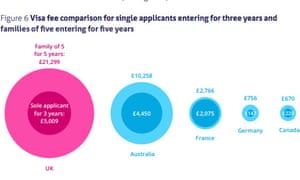
Comparisons with fee structures in other countries, published by the Institute for Government (IfG) thinktank, show that a family of five with a five-year work visa for one individual would have to pay £21,299 before they could enter in the country.
This includes the annual £400 health surcharge that must also be paid upfront per person. This is double the fee charged by Australia and about 30 times the amount charged by Canada, where it costs just over £10,000 for a family for five years. Germany charges £756 for entry for a family of that size.
The fee comparisons are equally stark for individuals. A single person who wants to come to the country will be charged up to £3,220 for five years. If they want to move to the UK with a spouse, the cost would rise to £6,500 for a five-year work stint.
UK visa fees compared with other countries Photograph: Institute for Government
This compares with Canada, which charges £220 for an individual visa for three years; Germany, which charges £147; and France, which charges £2,075, according to the data supplied to the IfG. Luxembourg charges €50 (£42) for a visa and€80 for a residents permit.
Lisa Roberts, an immigration lawyer at DLA Piper, said: “The UK fees are sky high. With this sort of outlay, are you going to attract the Spanish nurse or are they going to go to Germany which doesn’t charge anything?”
The government announced on Tuesday it was closing British borders to unskilled migrants who do not speak English and scrapping the cap on skilled migrants, marking the biggest shakeup of immigration laws for 40 years.
It means EU citizens seeking to work in the UK after January 2021 must also pay a minimum of £1,620 for the visa and the £400 health charge for one year.
Roberts said the fees could be a barrier to many, including the lab technicians, engineers and scientists on an entry-level salary of between £20,480 (the new floor for immigrants) and £25,000.
“It’s a question of whether the government wants to attract the ‘best and the brightest’ or just those with the deepest pockets,” she said.
“The fees are incredibly high and could be a big deterrent, especially for those who are looking at a range of countries such as Germany, the Netherlands, Luxembourg to relocate to, where the values and the lifestyle are similar.”
Data from the Office for National Statistics shows many key occupations pay between £25,600 – the proposed salary threshold for entry to the UK – and £30,000, including teachers, science technicians and chemical process operatives.
The government said the changes to the system were designed to reduce the overall levels of migration and give top priority to those with the “highest skills and the greatest talents”.
In IfG’s report on immigration after Brexit, which was published last year, the thinktank says there is not enough debate about visa fees in parliament.
“It could be that the purpose of such high costs is to put applicants off, as a deliberate Home Office policy to minimise the number who seek to become UK citizens and make it easiest for wealthy people,” it says.
“But if it is part of a public administration decision, that the system should pay for itself, then there has been too little discussion about the consequences of following that path.”
The immigration policy will place greater burdens on employers who rely on EU staff. They they will now incur visa fees, just as workers from third countries do.
From January this will include a skills-charge fee of £1,000 per person, an employer visa fee of £610 for a visa up to three years, as well as £1,220 for a visa of more than three years, along with a £199 certificate of sponsorship.
A Home Office spokesperson said fees were set at a level to provide the resources needed for border control but that a new fast track system would be introduced with “reduced fees for certain medical professionals”. A spokesman said: “In fairness to UK taxpayers, it is only right that those who directly benefit from our immigration system contribute to its funding.”
The new points-based system will give precedence to occupations in which women are underrepresented, favor male migrants over female and deepen gender inequality, according to the Women’s Budget Group, an independent network that promotes gender equality.
“The new immigration system roundly fails to understand the lived experience of women, many of whom are prevented from accessing paid work by the weight of unpaid work — caring for children, older people and those with disabilities — that successive governments rely upon them to do,” said Sophie Walker, the chief executive of the Young Women’s Trust, a British feminist organization.
Under the new rules, which will be implemented next January, applicants will be required to receive a job offer with a salary of at least 25,600 pounds, about $33,300. The salary threshold will be lower in special cases where there might be a shortage in skills, such as in nursing.
By and large, however, that requirement will work against women, who are more likely to work in sectors like home and senior care that are relatively poorly compensated, even though the skill levels of such women are relatively high, women’s advocates say.
“Care workers’ average annual salaries stand at just £17,000, not because care work is ‘low-skilled,’ but because the work force is 80 percent female and therefore undervalued and underpaid,” says Mandu Reid, the leader of the Women’s Equality Party.
Imposing the salary requirement would mean “shutting out care workers, piling pressure on women to take on yet more unpaid care, and widening the existing social care gap between need and provision,” she said.
Women are also four times more likely than men to leave paid work to shoulder unpaid caring responsibilities for children and older relatives. This is one cause of the gender pay gap and gender inequality, the Women’s Budget Group found.
As a result of these inequities, major industries like food production, hospitality, health and social care that rely on female migrant workers are likely to see staff shortages after the new measures are put into place.
In the points-based system, the government gives top priority to scientists, engineers, academics and graduates in science, technology, engineering and mathematics, or STEM, once again to the detriment of women because of the gender disparities in those professions.
“There is a great emphasis on wanting to attract scientists to the U.K. under the new system, but it is another well-known fact that women are underrepresented in the sciences,” said Adrienne Yong, a lecturer in law at the City Law School in London.
“That the U.K. will give a Ph.D. in STEM subjects 10 more points than Ph.D.s in other subjects already puts women on a back foot,” she said, “as there is already a problem with female students doing STEM subjects, much less continuing further education to a doctoral level with that specialism.”
On Wednesday, the cabinet minister responsible for migration policy, Priti Patel, suggested that around eight million “economically inactive” people in Britain could be trained to fill such shortages, but experts say that many of those people are women who are already providing full-time care for children and families.
“It feels like they just want us to fill the badly paid jobs while the men and foreigners will get the higher-paying jobs,” said Amy Pears, a mother of three who left her job as a professional caregiver and went on benefits in 2015 because she could not afford child care. “My mother is disabled, so between her and the three children I have my hands full.”
The Women’s Equality Party says that without substantial government investment in child and elder care, women are put into a position where they simply cannot work.
“These shortsighted plans are in fact more likely to exacerbate the shortages in formal care, leaving it to women to pick up unpaid and increase the number of ‘economically inactive’ full-time carers,” Ms. Reid said.
Women’s groups warned that shutting out foreign workers would put more pressure on women who are already in Britain, particularly caregivers.
“Without extra colleagues from abroad, U.K. carers are going to have even less time to do the job they’re employed to do and offer people the dignity they deserve,” Ms. Walker said. “This policy makes it an inevitability that this exhausted system will come under further strain, while female family members will increasingly be expected to pick up the pieces as the system continues to erode.”
Ms. Pears said that many of her European friends and former colleagues, who played important caregiving roles, would be locked out of the new system because they did not qualify for the salary threshold or education qualifications.
“These people are carrying a huge burden for our country, and the truth of the matter is we need them,” she said. “Without them we are putting our services at risk.”
Good overview of some of the key reactions (largely business-related):
The British government has outlined a new immigration system to manage the flow of workers into the country and replace existing rules from Jan. 1 2021, when Britain will no longer be subject to European Union regulations.
Here is some reaction to it.
Confederation of British Industry
“Several aspects of the new system will be welcomed by business, particularly abolishing the cap on skilled visas, introducing a new post-study work visa for overseas students, and reducing the minimum salary threshold from 30,000 pounds ($38,982),” said director general Carolyn Fairbairn.
“Nonetheless, in some sectors firms will be left wondering how they will recruit the people needed to run their businesses. With already low unemployment, firms in care, construction, hospitality, food and drink could be most affected.”
British Chambers of Commerce
“Companies are already investing heavily in home-grown talent across the UK, but critical labour shortages mean firms will still need access to overseas workers at all skill levels,” said BCC director general Adam Marshall.
“The new points system must be able to respond quickly to changing market needs, and the application process must be radically simplified.”
UKHospitality, which represents Britain’s hospitality sector.
“Ruling out a temporary, low-skilled route for migration in just 10 months’ time will be disastrous for the hospitality sector and the British people. Business must be given time to adapt,” said UKHospitality CEO Kate Nicholls.
“These proposals will cut off future growth and expansion and deter investment in Britain’s high streets. It will lead to reduced levels of service for customers and business closures.”
British Retail Consortium
“Although we welcome the reduction in the salary threshold, it is disappointing that the government has not understood the needs of the economy and the vital contribution of workers supporting the operation of warehouses, food factories and city centre stores,” said Tom Ironside, BRC director of business and regulation.
National Farmers Union
“We have said repeatedly that for farm businesses it is about having the full range of skills needed – from pickers and packers to meat processors and vets – if we are to continue to deliver high quality, affordable food for the public. Failure to provide an entry route for these jobs will severely impact the farming sector,” said NFU President Minette Batters.
Unison, the union which represents care workers.
“These plans spell absolute disaster for the care sector. Care doesn’t even get a mention in the home secretary’s plans,” said Unison assistant general secretary Christina McAnea.
Royal College of Nursing
“We are concerned that these proposals from the government will not meet the health and care needs of the population,” said Donna Kinnair, CEO and general secretary of the RCN.
“They close the door to lower-paid healthcare support workers and care assistants from overseas, who currently fill significant numbers of posts in the health and care workforce.”
Opposition Labour Party
“This isn’t an ‘Australian points-based system’, which is a meaningless government soundbite. It’s a salary threshold system, which will need to have so many exemptions, for the NHS, for social care and many parts of the private sector, that it will be meaningless,” said shadow home secretary Diane Abbott.
Food and Drink Federation
“We have concerns about access to those potential employees who won’t qualify through these ‘skilled’ routes such as bakery assistants, meat processors, and workers essential to the production of huge array of basic foodstuffs such as cheese, pasta, and sausages,” said FDF policy manager Mark Harrison.
Definitions can be helpful but can also be divisive as we have seen the shift from the IHRA antisemitism working definition to one that has been adopted by governments and institutions:
When anti-semitism still appeared to be the Labour membership’s most glaring problem with intra-party prejudice and related mudslinging, great importance attached to definitions. What might seem to some members a perfectly allowable comment on the Israeli state might to others, using the International Holocaust Remembrance Alliance (IHRA) definition of antisemitism, be manifestly hateful and targeted.
The party’s adoption of that definition was itself disputed. Labour took on the IHRA definition in 2016, then argued about adopting its examples of antisemitic behaviour. As ugly as this difficulty with internationally agreed terminology might look from outside, the interest in precise wording represented some common ground. On the definition of antisemitism, Labour’s factions were at least able to communicate.
More recently, the party has adopted a working definition of Islamophobia advanced by the all-party parliamentary group on British Muslims (after consultation with more than 750 British Muslim organisations, 80 academics and 50 MPs). The group’s co-chair Wes Streeting dismissed objections that free speech would suffer. “While our definition cannot prevent false-flag accusations of Islamophobia to shut down reasonable debate and discussion, it does not enable such accusations. In fact, it makes it easier to deal with such behaviour,” he said. “Our definition provides a framework for helping organisations to assess, understand and tackle real hatred, prejudice and discrimination.”
There could hardly be a better case for another considered definition – after a week in which its meaning has been both stretched and contested – of what should be understood by transphobia. Unless we want to leave that job to the courts. Is it allowed, for instance, to satirise self-ID, as in the case of Harry Miller? Yes, says Mr Justice Knowles. And in a passage that might have been inspired by Labour’s pledges: “Some… are readily willing to label those with different viewpoints as ‘transphobic’ or as displaying ‘hatred’ when they are not.”
There are obvious implications for the unprecedented debates prompted by a proposed reform to the Gender Recognition Act, facilitating gender self-identification (ID). Can it be damagingly transphobic – if Miller is not – for people to meet and discuss the possible implications for women-only spaces and safeguarding? Should people be able to meet, without fear of abusive crowds, to share concerns about early gender dysphoria diagnosis/affirmation? Is it actionably bigoted – unlike Miller – to question the fairness of male-bodied athletes competing in women’s elite sport?
The clear implication by prominent Labour leadership contenders is that all such debates are transphobic, even when the subject under discussion is, very often, female anxiety about the supremely non-trans threat posed – or not – by a minority of men. The principal threat to the safety of women, trans and not, is arguably identical. Somehow, as the Fawcett Society’s Sam Smethers said, we need to “move this agenda forward”. But Rebecca Long-Bailey seemed to find more common ground with the activists outside against gender critical meetings. “We need to end the discussion [on self-ID],” she told Newsnight.
As with antisemitism, the identification of transphobic behaviour, at its insulting or threatening worst, requires no laboriously agreed or court-won description. For further clarity, the Crown Prosecution Service offers guidance on the kind of behaviour that might make an incident or crime transphobic. Such as: “Was there any use of derogatory language that referred to sexual orientation or transgender identity?”
The Labour Campaign for Trans Rights was plainly referring to a different order of offences in the statement and pledges now endorsed by Lisa Nandy, Emily Thornberry, Dawn Butler, Angela Rayner and Long-Bailey. “There are still transphobes in our ranks,” it states, “and we have often failed to act as transphobia has gained ground within our party.” Transphobic views and policies are cited, without examples, along with allegedly transphobic activists, who are, however, identified.
Pledgers demand a “fight against transphobic organisations such as Woman’s Place UK, LGB Alliance and other trans-exclusionist hate groups”. Both groups have supporters – possibly news to people who may not previously have been gripped by the gender-critical debate – who are themselves trans, as well as many well-known and veteran campaigners for gay rights.
A legal response by a maligned group could yet yield, again in court, some embryonic definition of transphobia that, as with antisemitism and Islamophobia, could at least provoke dialogue, rather than shutting it down, and more Twitter wars. Given the lack of either examples or argument to justify the threat of mass expulsions, last week’s Labour pledges read – phobia-hunting aside – as disturbingly undemocratic. Without dialogue, opposed groups can only polarise further, with one result being, as Scott Aikin and Robert Talisse argue in their forthcoming book, Political Argument in a Polarized Age, that people become unwilling to regard their opponents as political equals. “Bye”, as unconcerned purists last week taunted the thousands tweeting #expelme in response to Labour’s pledges.
Leadership pledgers appeared similarly uncompromising on what level of disagreement, if they won, might be allowed. Nandy, observing that the debate “has descended into pitting people against each other”, offered, by way of improving it, that one organisation has been “wilfully trying to go after trans people” – evidence pending – also, “causing offence”.
In a Nandy-led world, then, the Islamophobia definition might need some more work. Its authors made clear, as does the Miller case, that human rights do not include the right not to be offended or to have your spiritual, or other non-negotiable private convictions, affirmed by fellow citizens. Perhaps a large body of opinion does expect public figures, such as Nandy and Long-Bailey, to denounce public conversation about self-ID and women’s sex-based rights, to prohibit mention of biology, and condemn as a “hate group” – categorised, then, with far-right terrorists – any disobedient voices. But the case for such unique protection must surely begin with something more reasoned – and democratic – than the 12 pledges.
The number of anti-Semitic incidents logged in Britain last year hit record levels yet again amid accusations the opposition Labour Party had failed to tackle the issue within its ranks, a Jewish advisory body said on Thursday.
The Community Security Trust (CST), which advises Britain’s estimated 280,000 Jews on security matters, said there had been 1,805 incidents in 2019, a rise of 7% and the fourth consecutive year the figure had reached a new high.
CST chief executive David Delew said the record came as no surprise and the organization believed the real number was likely to be far higher.
“It is clear that both social media and mainstream politics are places where anti-Semitism and racism need to be driven out, if things are to improve in the future,” he said.
World leaders warned last month of a growing tide of anti-Jewish sentiment, driven both by far-right white supremacists and those from the far-left, as they commemorated victims of the Holocaust in World War Two.
In Britain, the CST said there was an increase in incidents in months when Labour’s problems with anti-Semitism were in the news.
Ever since veteran socialist Jeremy Corbyn, an ardent supporter of Palestinian rights, became leader in 2015, the party has faced accusations that it has failed to stem anti-Semitism among some members.
Corbyn, who is stepping down as leader in April, has said anti-Semitism is “vile and wrong” but the party is now under investigation by Britain’s Equality and Human Rights Commission.
Last February, a number of Labour lawmakers left the party citing the issue as a reason, while ahead of December’s national election, Britain’s chief rabbi said Corbyn was unfit to be prime minister.
Of the total number of incidents, 224 were connected to Labour, said the CST, which has collated such data since 1984.
“It is hard to precisely disaggregate the impact of the continuing Labour anti-Semitism controversy upon CST’s statistics, but it clearly has an important bearing,” the report said.
The charity said the main reason for the overall increase in incidents was a sharp rise in online anti-Semitism.
But there were also 157 assaults – a 27% increase on 2018 – with almost 50% of these occurring in just three areas of the country – Barnet and Hackney in London and Salford in northern England which are home to some of the largest Jewish communities.
A rise of intolerance after Britons voted in the 2016 referendum to leave the European Union and the Brexit discourse since, which brought nationalism and immigration to the fore, had also led an atmosphere where people might have felt able to express their “hatred of otherness”, the report said.
A planned deportation flight to Jamaica has taken off but with only around half of those due to have been on board after a court last night upheld a legal challenge.
As the government came under fire for proceeding with the flight, it was defended on Tuesday by the Chancellor, Sajid Javid, who said those onboard were not members of the Windrush generation but offenders who posed a risk to the public.
“These are all foreign national offenders – they have all received custodial sentences of 12 months or more. They are responsible for crimes like manslaughter, rape, dealing in class A drugs,” he told BBC Radio 5 live.
Asked how many people were onboard, he said he did not know the exact number but believed it was “around 20 – or above 20.” Around 56 people were originally thought to have been due to be deported.
On Monday night, a court of appeal judge ordered the Home Office not to carry out the scheduled deportation amid concerns mobile phone outages had prevented detainees from having access to legal advice.
Lady Justice Simler said those detainees should not be removed unless the Home Office was satisfied they “had access to a functioning, non-O2 Sim card on or before 3 February”.
The action had been brought because there has been a problem with the O2 phone network in the Heathrow detention centres since last month, meaning many detainees had been unable to exercise their legal right to contact their lawyers.
David Lammy, the Labour MP for Tottenham who called in the House of Commons on Monday for the flight to be halted amid concerns some onboard may have arrived in the UK as children and that more than 40 British children could be separated from their fathers, described the departure of the flight as an “outrage”.
“The government is deporting people who arrived in the UK as young as two, often for one-time drug offences,” he tweeted, linking to an article written by him for the Guardian.
“The lessons from Windrush have not been learned. Lives are being ruined because we don’t remember our history.”
On Sky News’s Kay Burley at Breakfast show, the chancellor had been asked if he was sorry about one of the cases being a 23-year-old who spent 15 months in jail after being convicted age 17 for drug offences. He had come to the UK age five years old.
“We’re not even saying sorry,” the chancellor said.
Bella Sankey of Detention Action said the campaign group believed that some of the people who were due for deportation were not on the flight because they were covered by a court of appeal order.
She said: “We understand that some, possibly all, of these individuals may have been ultimately removed from the flight but we are currently trying to clarify this.
“We are trying to ensure that all of those covered by the protection of the court were not removed and that the government did not breach the court order.
“We think that what is most likely is that people were taken from [immigration removal centre] Brook House and put on the flight and those are the people who have probably gone because that detention centre was not covered by the order.”
The Home Office had argued the flight was “specifically for deporting foreign national offenders”, adding that “those detained for removal include people convicted of manslaughter, rape, violent crime and dealing class A drugs”.
The Joint Council for the Welfare of Immigrants (JCWI) said: “Our thoughts are with the families who have just been forced apart by the government, with the children who have lost their fathers, with the women who’ve become single mothers overnight.
“It’s deeply unjust if people who grew up here, whose lives and families are here, can be exiled to a country which is totally foreign to them. They are British in every meaningful way and if the law allows those people to be exiled, it needs to change.”
Earlier, Sankey said removing those detainees would have meant the Home Office was breaking the law.
She tweeted: “We are speaking to individuals clearly covered by the court of appeal order prohibiting their deportation who have been removed to the airport and told they are being deported. ukhomeoffice are you really going to try and break the law tonight?”
Boris Johnson and Home Secretary Priti Patel are expected to set out their immigration reforms, including a drop in salary threshold for some migrants, at a cabinet meeting on Friday.
Currently, skilled migrants from outside the EU need to have a job offer with a minimum salary of £30,000.
The BBC understands ministers plan to lower this threshold to £25,600.
Workers from the EU will face the same rules once the transition period for leaving the EU ends on 31 December.
Workers earning less might be allowed to make up “points” elsewhere in order to be granted a visa if they work in a sector with a skills shortage.
Points will also be awarded for speaking good English or for having an outstanding educational background.
It comes after the independent Migration Advisory Committee (MAC) last month made a series of recommendations for a post-Brexit transition period immigration system, including lowering the salary threshold for skilled migrants to £25,600 in order to help recruit teachers and skilled NHS staff.
The committee also criticised the UK’s current complex immigration system, where non-EU workers can attempt to qualify for a range of visas.
The prime minister made it a key pledge during the election campaign to introduce a points-based immigration scheme, based on Australia’s, for when existing EU freedom of movement rules end.
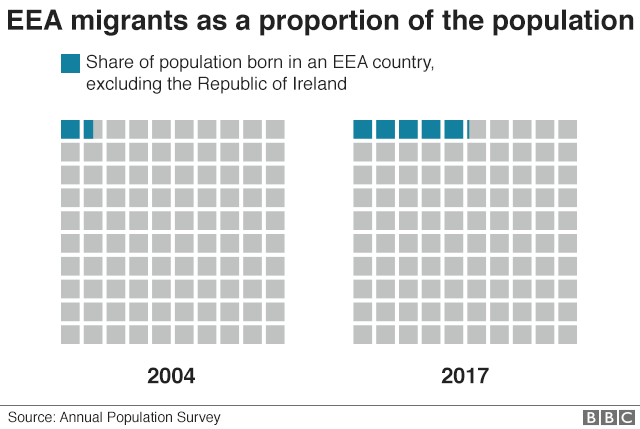
Under those rules, workers from the EU and European Economic Area countries can come to the UK to live or work without a visa.
The MAC has said there is no such thing as a “perfect” immigration system, with benefits and trade-offs in various parts of the economy.
It said whatever policies the government decides, it must work quickly to get something in place for after the transition period ends.
Will see what the final policy and program changes are and their likely impacts:
The independent migration advisory committee does not recommend a full shift to an Australian points-based system in research giving the first detailed insight into how a reformed immigration system might look after Brexit and the ending of freedom of movement for EU nationals.
In a report published on Tuesday, the independent committee, which provides research-based advice to the government, recommends a mixed system, which would rely on a minimum salary threshold for those people coming to the UK with a job offer, and a points-based system for those coming to the UK without a pre-arranged job.
“Talented individuals” would be able to apply for a work visa under the points-based system.
Its recommendations would reduce levels of immigration, the size of the UK population and total GDP. “We expect the changes to very slightly increase GDP per capita, productivity and improve public finances, though these estimates are more uncertain,” the report states.
“The changes are also expected to reduce pressures on the NHS, schools and on social housing, though they will increase pressure on social care.”
Downing Street indicated it was unlikely to notably change course on its immigration plans in the wake of the report.
The migration advisory committee (MAC) was asked by the home secretary, Priti Patel, last year to research how an Australian points-based system might work.
The government is not required to accept the committee’s recommendations, although it is likely to base future immigration policy on the committee’s research.
The government has alluded to the desirability of an Australian points-based system for months, without explaining how this might work. This report gives the first assessment of whether provides a desirable model for the UK economy.
If the government wants a points-based system it should only introduce it in the route for skilled workers without a job offer, the committee concludes.
Skilled migrants who come to the UK to take up a job would be allowed to earn £4,400 less than the current £30,000 threshold, under the proposals.
The committee has recommended reducing the existing salary threshold to £25,600 to make it easier for teachers, NHS employees and people at the start of their careers to qualify. The committee proposes different thresholds depending on the worker’s occupation, with more highly paid occupations having higher thresholds.
The committee also recommends supporting a pilot visa to attract people to work in remote parts of the UK, and improved monitoring of the immigration system to allow the UK to assess whether the new system is working.
Prof Alan Manning, chair of the migration advisory committee, said: “Our recommendations are likely to reduce future growth of the UK population and economy compared with freedom of movement, by using skill and salary thresholds. We estimate very small increases in GDP per capita and productivity, slightly improved public finances, slightly reduced pressures on the NHS, schools and on social housing, though slightly increased pressure on social care.
“No perfect system exists and there are unavoidable, difficult trade-offs. The largest impacts will be in low-wage sectors and the government needs to be clear about its plans for lower-skilled work migration.
“The government should ensure that the mistakes of previous UK points-based systems are not repeated.”
He noted that the UK did have something “pretty close to an Australian points based system from 2008 and the current system has evolved away from that because of perceived problems with it”.
A No 10 spokesman said: “The government will introduce a firmer and fairer points-based immigration system from 2021 that welcomes talent from around the world while reducing low-skilled migrants and bringing overall numbers down. We will carefully consider the report before setting out further details on the new system.”
Asked if this meant the plans for a primarily points-based system would stay, he said: “As the prime minister has been clear, we will introduce our points-based system from 2021.”
An Australian system is based on points being awarded for different characteristics, offsetting strengths in one area against weakness in other areas. Currently the main way in to the UK for non-EU migrants requires you to have a job.
“We base our recommendations on what we see as being in the interests of the resident population. So we try to focus on how immigration affects people’s lives, so we have never been particularly focused on numbers, it is more … do we think they provide a benefit to the UK resident,” Manning told the BBC’s Today programme before the launch of the report.
He said it was impossible to say whether the recommended system would increase the numbers of people migrating to the UK. “That depends on how many points you give and how many points are required for entry so there is no automatic connection between points and numbers. That would be a decision for the government,” he told Today.
Many moments have contributed to this transformation in net migration. Here are five key turning points.
1948: The Windrush Generation
In the aftermath of the war, the UK saw huge investment in public infrastructure. Bombed cities were rebuilt, transport systems expanded and new institutions, such as the NHS, had to be staffed.
Employment opportunities abounded, and people from all over the Commonwealth came to the UK to help fill the labour shortage.
Some of the first to arrive in 1948 were a group of 500 or so Caribbean migrants, who arrived on former troopship the Empire Windrush. Consequently, they and the 300,000 West Indians who followed them over the next 20 years, were known as the Windrush generation.
Alongside those from the Caribbean came some 300,000 people from India, 140,000 from Pakistan, and more than 170,000 from various parts of Africa.
Windrush in numbers
492passengers docked in Essex on the Empire Windrush in 1948
910,000 peoplefrom the West Indies, India, Pakistan and Africa followed
500,000current UK residents were born in the Commonwealth pre-1971
18were apologised to for being wrongfully deported or detained
Source: ONS, UK census, UK Government, BBC
Immigrants from the Republic of Ireland had the same rights, and also flocked to the UK. Between 1948 and 1971, one-third of 18 to 30-year-olds left the country in search of work, about half a million people. The overwhelming majority of them were bound for the UK.
In the 1940s and 50s, none of these people required visas; as “citizens of the United Kingdom and Colonies”, they were automatically given the right to reside in the UK.
However, the Home Office did not keep a record of those granted leave to remain. Despite living and working in the UK for decades, it emerged in 2018 that some Windrush migrants and their families had been threatened with deportation and even removed. The UK government was forced to apologise.
1956: The Hungarian Revolution
The end of World War Two also brought huge political changes in eastern and central Europe.
After liberating the region, the Soviet Union installed Communist regimes here that were deeply unpopular with many people. It also annexed the Baltic States and parts of Poland.
In reaction, hundreds of thousands of refugees fled to the West. The first to arrive in the UK were about 120,000 Poles, who arrived in 1945; the substantial Polish communities in Manchester, Bradford and west London date from this time. About 100,000 people from Ukraine and the Baltic States also came to the UK for similar reasons.
At the time, these population movements were considered the final consequences of World War Two. In fact, they were the symptom of a new Cold War.
This was confirmed in 1956, when the people of Hungary rose up against their Communist rulers. After Soviet tanks drove into Budapest to crush the uprising, almost 200,000 Hungarians fled the country.
Britain took in 30,000 of these political refugees, setting a precedent for the years to come. From 1956 onwards, political dissidents from eastern Europe were routinely accepted and integrated into British society.
Some of the data in this article is drawn from BBC Briefing, a mini-series of downloadable in-depth guides to the big issues in the news, with input from academics, researchers and journalists. It is the BBC’s response to audiences demanding better explanation of the facts behind the headlines.
The most important of these was the Immigration Act of 1971, which decreed Commonwealth immigrants did not have any more rights than those from other parts of the world. This effectively marked the end of the Windrush generation.
Prime Minister Edward Heath declared the country had a moral and legal responsibility to take in those who had UK passports. Of the 60,000 people expelled, a little under half came to the UK.
This highlighted a change of emphasis in immigration policy. The UK was now wary of people coming in search of jobs, but it would continue to welcome those coming in search of asylum.
Throughout the 1970s and 1980s, fewer than 5,000 asylum seekers came to the UK each year, on average. But in 1990, after the fall of the Berlin Wall, applications for asylum rose suddenly to more than 16,000 people. In the following two years this figure doubled, and then doubled again.
This trend would continue over the following decade, as instability in countries like Yugoslavia, Somalia and Iraq brought more refugees to the UK’s door.
1992: The EU expansion
In 1992, the UK joined other EU nations in signing the Maastricht Treaty on European integration. This granted all EU citizens equal rights, with freedom to live in any member state they chose.
In the following decade, tens of thousands of EU citizens came to live and work in Britain.
Few people protested, possibly because these newcomers were balanced out by the tens of thousands of British people who moved away to other parts of the EU.
Nevertheless a new principle had been set. Just as the country had once held an open door to the Commonwealth, so it now held an open door to the European Union.
In 2004, the EU was expanded to include seven nations from the Eastern Bloc- Estonia, Latvia, Lithuania, Poland, the Czech Republic, Slovakia, and Hungary – while Slovenia, Malta and Cyprus also joined at the same time.
Unlike Germany or France, the UK put no temporary restrictions on arrivals from these new member states.
Tony Blair’s Labour government had a positive stance on immigration: it argued a growing economy required a larger workforce and, as in the 1950s, people from other countries were considered a good source of new labour.
In any case, the government predicted that EU enlargement would only cause a rise of up to 13,000 people a year in immigration.
In the event, more than a million people from these countries arrived and stayed over the next decade. It was one of the biggest influxes in British history.
In the meantime, however, immigration from other parts of the world has increased to fill the gap. Despite government targets to reduce net migration to the “tens of thousands”, the UK’s net migration figures remain historically high in the context of the past century.
Across the world, there are fires burning and they are not only climate-change induced or climate threatening. The concept of who is a citizen of a nation and what are their rights has become a burning topic.
Under President Jair Bolsonaro, Brazilians who are Amazonian Indians are increasingly under threat. In Bolivia, the fall of leader Evo Morales has disenfranchised indigenous Bolivians. Many living under US President Donald Trump are worried about their lives and the well-being of their families, and fear deportation despite being an integral part of American socioeconomics.
As Brexit looms, there is trepidation among many Europeans who have made Britain their home. The Roma in many parts of Europe continue to face persecution from their governments.
There are upheavals in the middle economies of the world too, with millions in Hong Kong and tens of millions in India facing an uncertain future. The unfulfilled obligations in the 1984 Sino-British Joint Declaration and the Hong Kong government’s increasing coordination with Beijing has unsettled many citizens of the special administrative region.
In India, the right-wing Bharatiya Janata Party (BJP) government has decided to implement a two-pronged strategy which threatens the country’s secular ethos. This government’s amendment of a 1955 citizenship act grants citizenship to refugees from neighbouring countries belonging to religions other than Islam. This legislation has been amended in the past to limit citizenship to those having at least one Indian parent and, later, to the parent not being an illegal immigrant.
Simultaneously, there is a plan to conduct a biblically inspired National Register of Citizens which will be the arbiter on the citizenship of each Indian. Though the implementation of both or either is perceived as targeting Muslims, the collateral damage will be in the millions because many people do not have, or have insufficient, documents to prove their citizenship.
Through these initiatives, the BJP, as the political organ of the hard-core Hindu group Rashtriya Swayamsevak Sangh, is implementing the philosophy propounded by the organisation’s chief ideologue Madhav Sadashiv Golwalkar: that India needs to regain its ancient glory, that India is only for Hindus and Indian citizens of other religions should get a lower level of citizenship.
Many fear that, as part of the march to regain the land’s past glory, this right-wing government will convert non-Hindu citizens into second-class citizens.
Nearly 2 million Indians could be made stateless
Across the world, this crisis is highlighting that the rights, privileges and responsibilities of citizens and the responsibilities of the state towards them are no longer based on descent (jus sanguinis) or birth within the territory (jus soli) or a synthesis of both. What was a sacred covenant between individual and state enshrined in a nation’s constitution has been converted into weapons on the personal whims, or bigoted philosophies, of duplicitous leaders.
Unfortunately, there are precedents. European discoverers planted the flag of their kingdoms on what they believed to be the new world, ignoring the original inhabitants. As modern nations formed, these original inhabitants had citizenship thrust down their throats and were re-educated. Despite all these efforts, their rights as citizens of these new nations were given short shrift for economic profit.
The juggernaut of pillage has now been transubstantiated into a political ideology. Sure, the earlier greed and blind covetousness was so bad that it required a rereading of Christianity and other religions to give the plundering credence but there was a morality that eventually curtailed it.
The abolishing of the slave trade and the acceptance of human rights and its gradual implementation are cases in point. However, there is something sinister in a political ideology that views treating some as lesser humans or insufficient citizens as being nationally redemptive and virtuous, and/or a necessary process of nation building.
It is not preposterous to suggest that democratically elected governments have a lot in common with communist and authoritarian regimes. At the very basic level, such philosophies aid in ruling a nation because it translates into sociopolitical eugenics creating a monoculture of belief and behaviour.
That this is another version of promulgating and promoting a sonnenkinder mentality and the Lebensborn Nazi project cannot be ignored. Besides the administrative benefits, this philosophy is politically expedient in democratic countries as it spawns a favoured class. Thus, a ruling party’s bigoted motives are accepted and furthered because they are assured of unstinting support.
Despite allegations of corruption and nepotism, Bolsonaro retains support because many profit from his deregularisation of the Amazon. Many Indians back Prime Minister Narendra Modi and his BJP government’s Hindutva agenda despite their citizenship coming under threat, the abysmal condition of the economy and government reprisals because officials accept the bringing-back-India’s-ancient-glory tripe.
Trump’s alleged profiteering and culpability, incompetence and the pain his policies are causing millions of Americans are ignored by the evangelists because he is now anti-abortion and diluting environmental laws.
Though these leaders espouse similar philosophies, what differentiates Trump and Bolsonaro from Chinese President Xi Jinping, India’s Modi and others of their ilk is that the latter believe in their twisted philosophies.
Trump is an opportunist who found his market while Bolsonaro, an ineffectual hate-driven politician, filled a vacuum created by the failings of his socialist predecessors. Interestingly, the philosophies of Modi and Xi provide for re-education, giving individuals an opportunity, enforced or otherwise, to become citizens.
Today, in some countries, citizenship is being converted into a privilege to be lavished on a few at the cost of the many. In other nations, it is identified with loss of freedom and a way of life. The label “have-nots”, used to describe people without material wealth, may soon come to mean those whose citizenship has been stripped.
Will be interesting to see the results and program:
A “brave” new programme that tests a group of British children for unconscious racial bias will air later this year on Channel 4.
The two-part series will put a class of 11 and 12-year-old pupils through a series of tests at their London comprehensive school in a bid to discover why racial equality has yet to be achieved.
With the working title The Segregation Experiment, the multicultural class of year seven pupils will take part in games, exercises and activities, both inside and out of the classroom, that will challenge everything they thought they knew about race.
The programme is based on pioneering American schemes and the children will be led by leading multicultural education academics and scientists, Channel 4 said.
It will start with the pupils taking a bespoke version of the Harvard Implicit Association Test, considered a benchmark test for unconscious racial bias.
Social psychologist Professor Rhiannon Turner, Queens University Belfast, said that “tests have revealed that children as young as six are aware of racial differences but, as a society, we do not talk about them and often take a colour-blind approach to race.
“Is our failure to discuss race part of the problem?
“This ground-breaking experiment will look at if it is possible to eradicate bias.”
Channel 4’s head of factual entertainment Alf Lawrie said: “This brave series tackles head on the issue of unconscious racial bias.
“Its important findings apply beyond just schools, to society at large.”
The programme has been described as “gripping, shocking and funny in equal measure” by executive producer David DeHaney from production company Proper Content.
He added that “the kids really throw themselves in and attempt to tackle issues adults wouldn’t dare”.