Globe editorial: There can’t be two types of Canadian citizen [C-3 citizenship by descent]

Very good Globe editorial assessing Conservative and Bloc amendments to C-3 and correctly distinguishing between the sound amendments of having a time limit of five-years to meet the residency requirement of 1,095 days and the requirement to have annual reporting on the number of persons claiming citizenship under the Bill’s provisions and the less sound amendments to require language and knowledge assessment and criminality/security checks that apply to new citizens, not those entitled to citizenship.

The Liberals and NDP removed the amendments at third reading. We will now see how the Senate deals with the Bill shortly, and whether it passes the original bill or provides some sober second thought and reinstates these two amendments:

…Last month, the Conservatives, supported by the Bloc, added an amendment in committee to change the requirement that in order to pass on citizenship, a foreign-born Canadian needs to spend 1,095 cumulative days in Canada before the child is born or adopted. The Conservative change would require the parent to spend 1,095 days in Canada within a five-year period. This revision makes sense, as it means these individuals have truly lived here, rather than just spent a few weeks at their grandparents’ cottage each summer. It demonstrates a more meaningful connection with Canada, and administratively, it will be easier to prove. 

The Conservative amendments would also require a report to Parliament annually on how many new citizens the bill creates. This is a sensible requirement. 

The problems lie with the Conservatives’ addition of an English or French language test, a security screening for criminal activity, and a citizenship test demonstrating knowledge of Canadian history. These requirements are similar to those needed by immigrants applying for citizenship, so it sounds logical – but it confuses the issue. 

Halt of ‘Lost Canadians’ bill could mean citizenship for thousands born to parents with no ties to Canada

Canadians by descent get their citizenship at birth based on their parents’ status. Presumably, under the Conservative rules, if these people applied as adults for citizenship certificates or passports and failed the tests, they could be stripped of their citizenship. Uyen Hoang, director-general of the citizenship branch at the Immigration Department, has warned that the tests would be “impossible to operationalize.” …

Source: There can’t be two types of Canadian citizen

New report outlines the biggest reasons immigrants stay in Canada, and it’s not just financial

From my friends at ICC. Courage and optimism are characteristic of immigrants:

As Canada risks losing more immigrants amid a rising cost of living, a new report finds the biggest factors in whether newcomers stay aren’t just financial.

While housing and affordability remain top concerns, a new survey of nearly 5,000 immigrants finds newcomers are far more likely to stay in Canada if they feel hopeful about their future and connected to the country, according to a report from the Institute for Canadian Citizenship on Tuesday.

Optimism about the future – measured by immigrants’ confidence in their personal and family prospects, plans for long-term life in Canada and belief that friends and family can succeed here – is the strongest driver of immigrant retention, with just a one per cent increase in optimism boosting the likelihood of staying by 28 per cent.

A one per cent increase in a sense of belonging – measured by identifying as Canadian, feeling accepted in Canada, trusting other Canadians and believing that the country provides good opportunities for one’s family – increases the likelihood to stay by 25 per cent.

The same increase in safety and stability raises the likelihood of a newcomer staying permanently by 16 per cent, and an uptick in economic optimism adds 15 per cent.

As Ottawa plans to slash the number of immigrants over the next three years, resulting in a 1.7 per cent drop in the country’s gross domestic product by 2027, it is crucial to retain talented immigrants who are already here, said Daniel Bernhard, CEO of the Institute for Canadian Citizenship.

New immigration targets are expected to cut Canada’s population growth by 1.4 million over the next three years, with permanent resident admissions dropping from 464,265 in 2024 to 365,000 in 2027, leading to 1.3 billion fewer hours worked, according to Canada’s parliamentary budget officer.

“Immigrants are hand-selected to address Canada’s most pressing needs and so each one that leaves is a great loss,” Bernhard said. “The needs they were brought here to fill do not leave with them.”

One in five immigrants who come to Canada ultimately leave the country within 25 years, with about one-third of those people moving on within the first five years, according to a November report from the ICC.

The report found that economic immigrants and francophones are the most likely to leave – the two categories of immigrants Canada prioritizes most.

The ICC is calling on policymakers to increase immigrant retention through targeted investments in domains that help build connection and optimism, including “initiatives that support newcomer skills development and labour market integration” and “activities that connect immigrant families and friends to each other and to other Canadians, building community, inclusion and belonging.”

“We know immigrants are leaving Canada, but until today, policymakers had very little evidence to guide investments in retention,” Bernhard said.

The survey shows that “making people feel at home, feel welcome, feel Canadian, feel attached to this place and to these people is more than just a nice thing we do for our newest neighbours,” he added.

“It’s a key growth and success strategy for the community.”

Source: New report outlines the biggest reasons immigrants stay in Canada, and it’s not just financial

Canada updates list of study programs that qualify international students for work permits

Further tightening:

To better align immigrant selection with Canada’s labour market needs, Ottawa is refining what academic programs are going to qualify international students for the coveted postgraduation work permit.

The Immigration Department has updated its eligibility list, adding 119 new fields of study and removing 178 others based on jobs with long-term shortages. A total of 920 coded programs remain eligible.

The Liberal government has been criticized for the soaring number of international students, who had increasingly used the international education program to come and work in Canada in order to ultimately earn permanent residence in the country.

Many international students enrolled in general programs at institutions that former immigration minister Marc Miller called “diploma mills,” studying in subjects that had no relevance to what’s needed in the labour market.

Last November, the Immigration Department started requiring international students in nondegree programs (programs other than bachelor’s, master’s or doctoral degrees) to complete a program in an eligible field of study to qualify for the postgraduation work permit.

As part of the plan to improve the integrity of the international education system, Miller not only capped the number of study permits issued, but also restricted the access to postgraduation work permits, which could be valid for up to three years and provided the incentive for people to study in Canada.

“It is not the intention of this program to have sham commerce degrees and business degrees that are sitting on top of a massage parlour,” Miller told reporters at a news conference last year. “This is something we need to rein in.” 

According to CIC News, an online media outlet on Canadian immigration, the additional qualifying programs cover health care and social services, education and trades.

However, it said, many of the agricultural and agri-food programs such as farm management and crop production were removed from the list, along with Indigenous education, student counselling and personnel services, environmental studies, building/property maintenance, drywall installation, solar energy technology, airframe mechanics and aircraft maintenance technology, among others.

The Immigration Department says students who applied for a study permit before June 25, 2025, will still be eligible for postgraduation work permits if their field of study was on the list when they applied for their study permit even if it has since been removed.

Source: Canada updates list of study programs that qualify international students for work permits

Mooney: I’m the Canadian who was detained by Ice for two weeks. It felt like I had been kidnapped

Horrific example of bureaucracy at work, implementing the cruel and flawed policies of the Trump administration:

There was no explanation, no warning. One minute, I was in an immigration office talking to an officer about my work visa, which had been approved months before and allowed me, a Canadian, to work in the US. The next, I was told to put my hands against the wall, and patted down like a criminal before being sent to an Ice detention center without the chance to talk to a lawyer….

And that’s when I made a decision: I would never allow myself to feel sorry for my situation again. No matter how hard this was, I had to be grateful. Because every woman I met was in an even more difficult position than mine.

There were around 140 of us in our unit. Many women had lived and worked in the US legally for years but had overstayed their visas – often after reapplying and being denied. They had all been detained without warning.

If someone is a criminal, I agree they should be taken off the streets. But not one of these women had a criminal record. These women acknowledged that they shouldn’t have overstayed and took responsibility for their actions. But their frustration wasn’t about being held accountable; it was about the endless, bureaucratic limbo they had been trapped in.

The real issue was how long it took to get out of the system, with no clear answers, no timeline and no way to move forward. Once deported, many have no choice but to abandon everything they own because the cost of shipping their belongings back is too high.

I met a woman who had been on a road trip with her husband. She said they had 10-year work visas. While driving near the San Diego border, they mistakenly got into a lane leading to Mexico. They stopped and told the agent they didn’t have their passports on them, expecting to be redirected. Instead, they were detained. They are both pastors.

I met a family of three who had been living in the US for 11 years with work authorizations. They paid taxes and were waiting for their green cards. Every year, the mother had to undergo a background check, but this time, she was told to bring her whole family. When they arrived, they were taken into custody and told their status would now be processed from within the detention center.

Another woman from Canada had been living in the US with her husband who was detained after a traffic stop. She admitted she had overstayed her visa and accepted that she would be deported. But she had been stuck in the system for almost six weeks because she hadn’t had her passport. Who runs casual errands with their passport?

One woman had a 10-year visa. When it expired, she moved back to her home country, Venezuela. She admitted she had overstayed by one month before leaving. Later, she returned for a vacation and entered the US without issue. But when she took a domestic flight from Miami to Los Angeles, she was picked up by Ice and detained. She couldn’t be deported because Venezuela wasn’t accepting deportees. She didn’t know when she was getting out.

There was a girl from India who had overstayed her student visa for three days before heading back home. She then came back to the US on a new, valid visa to finish her master’s degree and was handed over to Ice due to the three days she had overstayed on her previous visa.

There were women who had been picked up off the street, from outside their workplaces, from their homes. All of these women told me that they had been detained for time spans ranging from a few weeks to 10 months. One woman’s daughter was outside the detention center protesting for her release….

The reality became clear: Ice detention isn’t just a bureaucratic nightmare. It’s a business. These facilities are privately owned and run for profit.

Companies like CoreCivic and GEO Group receive government funding based on the number of people they detain, which is why they lobby for stricter immigration policies. It’s a lucrative business: CoreCivic made over $560m from Ice contracts in a single year. In 2024, GEO Group made more than $763m from Ice contracts.

The more detainees, the more money they make. It stands to reason that these companies have no incentive to release people quickly. What I had experienced was finally starting to make sense.

This is not just my story. It is the story of thousands and thousands of people still trapped in a system that profits from their suffering. I am writing in the hope that someone out there – someone with the power to change any of this – can help do something.

The strength I witnessed in those women, the love they gave despite their suffering, is what gives me faith. Faith that no matter how flawed the system, how cruel the circumstances, humanity will always shine through.

Even in the darkest places, within the most broken systems, humanity persists. Sometimes, it reveals itself in the smallest, most unexpected acts of kindness: a shared meal, a whispered prayer, a hand reaching out in the dark. We are defined by the love we extend, the courage we summon and the truths we are willing to tell.

Source: I’m the Canadian who was detained by Ice for two weeks. It felt like I had been kidnapped

Christopher Dummitt: Canadians need a proud, not guilt-ridden Canada

Ongoing arguments for a needed correction:

…The second key element of any national cultural policy ought to be a more realistic approach to pluralism. Canadians live in a country of different ethnic, linguistic, and religious groups. We aren’t unified. But the fundamental error of the last decade was to do diversity wrong — to engage in a downward spiral of national subtraction. Out of a well-intentioned, but horribly mistaken desire to protect certain historically marginalized groups, we kept demoting our national heroes out of a belief that they “harmed” people in the present.

A pragmatic pluralism would recognize that one people’s hero will be another’s villain. This absolutely should not mean dishonouring anyone because one group says they are hurt.

Heritage harm is a choice. No one has to be offended when they walk into a school named after someone whom they don’t respect. Conservatives aren’t psychologically damaged when they fly out of Pearson airport. Nor do Liberals suffer when they tour the Diefenbunker. Francophones don’t need to avert their gaze as they drive through Durham region just because Lord Durham once advocated for their assimilation. And a Wendat/Huron Canadian doesn’t need to feel threatened when driving past Tyendinaga Mohawk Territory just because the Mohawk people once wiped out Huronia.

Any Canadian party that wants to be seriously considered as a defender of the nation should promise a pragmatic pluralism which builds up and doesn’t tear down our country. Each group of Canadians should be allowed to keep their historical heroes. Instead of tearing down John A. Macdonald statues, a new federal government should promise to raise statues of figures like Tecumseh or Big Bear. Canada is a diverse country. We can have a diverse set of historical heroes. No one gets a veto. Individual Canadians can choose to be harmed by a name if they want — but our national government needs to be bigger than this — stronger and more resilient.

What’s more, a third key promise ought to be the adoption of a culturally mature notion of diversity. Canada hasn’t always looked the way it does today. People in the past didn’t think the same or act the same. A responsible national government would take pride and celebrate this diversity.

Canada’s prehistory was dominated by Indigenous peoples who have fascinating histories that long-predate the origins of Canada itself. We ought to celebrate these histories. And this shouldn’t mean just pretending that pre-contact Indigenous peoples were benign environmental-loving hippies. We should tell the more accurate and much more fascinating stories of conflict and war and struggle.

From the time of New France up to the 1960s, most Canadians could trace their ancestors back to two places — France and the British Isles. This is just a fact of history and demography. We don’t need to apologize for it. We were an overwhelming white western European colony. We shouldn’t expect our historical figures for much of our history to represent the diversity of multicultural Canada in 2025. They didn’t, and they don’t.

We could instead celebrate the amazing fact of Canadian governments in the 1960s — first under Diefenbaker and then under Lester Pearson — to remove racism from our immigration system. This was an astounding decision. Most groups, for almost all of human history, have wanted homogeneity — to insist on sameness. It’s not odd that Canada was similar before the 1960s, but it is quite amazing that Canada changed its tune. A build-it-up national cultural policy would celebrate this fact, and the Canadians who came before. It doesn’t have to be one or the other. Our heritage should be about building up and adding on, not deleting.

Finally, a more mature approach to diversity would acknowledge that Canadians are sophisticated and not bigoted. They don’t have to share the same identity characteristics of our heroes to appreciate Canadian history. That kind of racial in-group thinking is a barrier to true national belonging. You don’t have to be Black to admire Viola Desmond. You certainly don’t need to be white or German-Canadian to be proud of Diefenbaker’s “One Canada vision” and his championing of a Bill of Rights.

Who will offer this proud Canadian vision? Which party will turn its back on the subtraction-heritage distraction of the last decade?

The way ahead ought to be clear: a vision of the country where pride and dignity comes first; a proud pluralism that allows every Canadian group to have its heroes and its stories; and a mature approach to diversity that assumes a resilient Canadian population, one that sees and celebrates our differences over time, and assumes that any Canadian, regardless of their background or when their ancestors arrived here, can share in the story.

Source: Christopher Dummitt: Canadians need a proud, not guilt-ridden Canada

Misleading Canadians: The Flawed Assumption Behind the Government’s Planned Reduction in Temporary Residents

This analysis was prompted by questions regarding the projected numbers of departures with no methodology mentioned, and the suspicion, subsequently confirmed, that it was based on the false assumption that all temporary residents would leave upon expiry of their visa

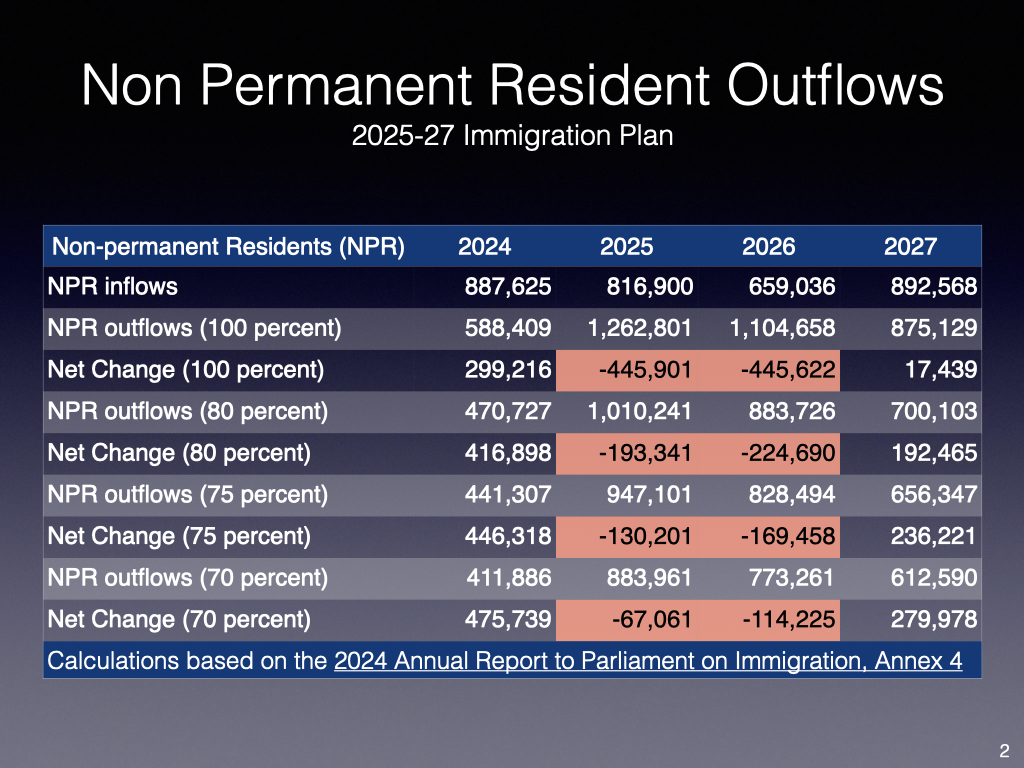
When IRCC released its annual immigration plan last month, eyebrows were raised over the plan’s prediction of large outflows of temporary residents upon expiry of their visas. The Parliamentary Budget Office noted that “there is significant risk to the demographic projection presented in the Government’s new immigration plan—particularly to the projected outflow of non-permanent residents.” The plan included a table covering projected outflows without indicating the methodology and assumptions behind the table. Subsequently, IRCC has confirmed that the calculations assumed that all temporary residents would leave when their visa expired, save for those who transitioned to permanent residency.

This assumption is just wrong as many temporary residents may well remain in Canada and appears aimed at misleading the public. For illustrative purposes, I revised the plan table to include four assumptions: 100 percent of temporary residents leave (the plan’s assumption), and three alternatives where 80, 75 and 70 percent leave. Should 60 percent or less leave, there would not be any net reduction in the temporary resident population.

The overly precise nature of the numbers—down to individual persons—highlights that the government adapted a purely mathematical approach in its estimates. In the case of permanent resident levels, the government more sensibly uses ranges rather than precise numbers which reflect more accurately operational realities. While politically difficult to admit that some non permanent residents will remain, by not doing so the government attracts more scepticism regarding its plans.

Moreover, as Canada does not track outflows systematically, we will not have accurate data on how many actually leave. The government should explore coordination of flight and CBSA data to obtain better anonymized information on outflows and those who overstay their visa.

The Prime Minister has stated that “Between the amount of people coming and going, we’ll effectively pause population growth for the next two years, then from 2027 onwards, it will balance out and slowly start increasing again at a sustainable pace.” However, this is based on the false assumption that all temporary residents will leave when their visa expires. Unfortunately, as we will not know how many people will stay versus how many people will leave, it will not be possible to verify the extent of errors and estimates.

In short, while inclusion of temporary residents in the annual immigration plan is both overdue and welcome, a more serious approach is needed that better reflects the reality and challenges.

Douglas Todd: Chinese travellers to Canada plunge. What does it mean?

Visitor visas from China have also plumeted, by close to 80 percent compared to pre-pandemic (January to August, 2022 compared to 2019):

Three years ago, 55 jumbo jets from China were touching down at Vancouver International Airport every week.

Now there are only eight flights a week from the world’s most-populous country.

There has been an almost similar plunge in the proportion of Chinese nationals applying for Canada’s 10-year visas. A related decline means fewer people from China are seeking student visas, and showing relatively modest interest in permanent-residence status.

China’s draconian pandemic lockdowns — which are more strict than anywhere in the world — have reduced travel in and out of the country, with the number of international air passengers across all of China’s airports falling from 74 million in 2019 to 1.5 million last year.

But that’s not the only reason for the decline.

With China’s Communist leaders poised this month to hand strongman Xi Jinping an almost unprecedented third five-year mandate, crackdowns are increasing on Chinese citizens, including through digital surveillance, censorship, arrest of dissenters, party infiltration of private businesses — and far less travel to other countries. Most observers believe obsessive control will be China’s new normal for a long time.

The drastic decline in the transnational mobility of the people of China feeds into the debate in the West over what it means to have far less engagement with China’s regime and its citizens, even while many are not necessarily tied to the authoritarian government.

In response to tighter controls in China, Canada has been shifting. While five years ago people from China made up the largest group of visitors and students, Indian nationals now comprise by far the largest group.

Two new books argue each side of the China engagement coin. In The United States vs. China: The Quest for Global Economic Leadership, economist Fred Bergsten argues corporate engagement has been a success, despite tragic failures on the human rights front.

Bergsten belongs to the camp that champions the free global movement of money and humans, saying Western countries should continue to offer a warm reception to entrepreneurs, students, workers and visitors from China. It’s good for business.

However, another book, by Princeton University professor Aaron Friedberg, titled Getting China Wrong, calls the West’s engagement with China a gamble that didn’t pay off. He says the challenge now is how to reduce ties to a threatening regime run on draconian Leninist principles.

Wherever one comes down on such arguments, the reality is the flow of people from China into the U.S., Canada and other Western countries has reduced dramatically.

Canada’s travel industry is among those hurting, especially in B.C. And that’s only partly because, as Destination B.C. official Kristen Learned says, visitors from China spent the most of any tourists: $2,021 each.

In 2019, more than 15,500 people were flying each week into Vancouver from China, now it’s just 2,600. That’s as airport officials say international flights from every other nation are almost back to pre-COVID levels.

Three years ago Canada brought in 712,000 visitors from China, who stayed an average of four weeks. Destination B.C. figures show 334,000 of them spent their days in B.C., which made them to the province’s second-largest international tourist market, after the U.S.

In 2019, travellers from China bought over $586 million worth of goods and services while on the West Coast, especially on hotels, luxury resorts and Airbnbs, as well as dining out while visiting relatives.

But by midsummer of this year, only 36,000 visitors from China had flown into Canada, with just 18,000 to B.C. That’s reflects a drastic overall rate of decline in three years of about 91 per cent.

Meanwhile, travellers into Canada from India, Britain and France are soaring.

Additional data reveal just a few years ago people from China were by far the biggest group applying for Canada’s popular 10-year visas.

Since the 10-year visa program began in 2014, allowing people to travel to the country for six months at a time as many times as they want, Chinese citizens have accounted for 3.2 million of the 13 million visas issued.

But a sharp drop in visa applications from China occurred even before the pandemic hit. At the same time, requests from India skyrocketed.

As a result, by midsummer of 2022 a relatively low number of people from China, 49,000, had applied this year for the 10-year visas. In the same period, applications from India skyrocketed to 355,000.

The highly valued multiple-entry visas are generally a benefit to Canada’s economy, say immigration lawyers. But they caution they can be abused by “shadow investors” in housing to avoid property and income taxes in Canada.

Educational relationships between China and Canada have also declined, although not as precipitously.

In 2017, study visa application rates from both China and India were equal — amounting to roughly 82,000 students a year from each giant nation, together accounting for almost half of all foreign students.

But in 2021, the second year of the pandemic, the numbers of Chinese international students seeking to come to Canada dropped to 56,000, while expanding from other countries — especially India, at 169,000.

The trend has continued into October of this year, with students from India accounting for 38 per cent of all study visa applicants and those from China just 11 per cent.

Meanwhile, the number of Chinese nationals gaining admission to Canada as permanent residents remains flat — at the rate of about 30,000 a year, compared to 127,000 from India.

The immigration path into Canada is not as strong an indicator of China’s internal politics as other measures — because anyone from China who becomes a Canadian citizen, technically, forgoes their Chinese citizenship and the ties that go with it.

What does it mean? As Xi tightens his hold on power, no one absolutely knows what’s on in his mind.

But even figures who advocate the unrestrained movement of financial and human capital realize Xi is dangerously bent on weakening democratic governments and further policing Chinese citizens in both his country and abroad.

This month, the pro-free-trade Economist magazine called on the West to continue to “welcome Chinese students, executives and scientists, rather than treat them as potential spies. Remember, always, that the beef should be with tyranny, not the Chinese people.”

That appears to sum up the federal government’s open approach, even while China’s autocrats are ensuring there will be fewer people-to-people connections between our two countries.
Source: Douglas Todd: Chinese travellers to Canada plunge. What does it mean?

#COVID-19: Comparing provinces with other countries 6 January Update

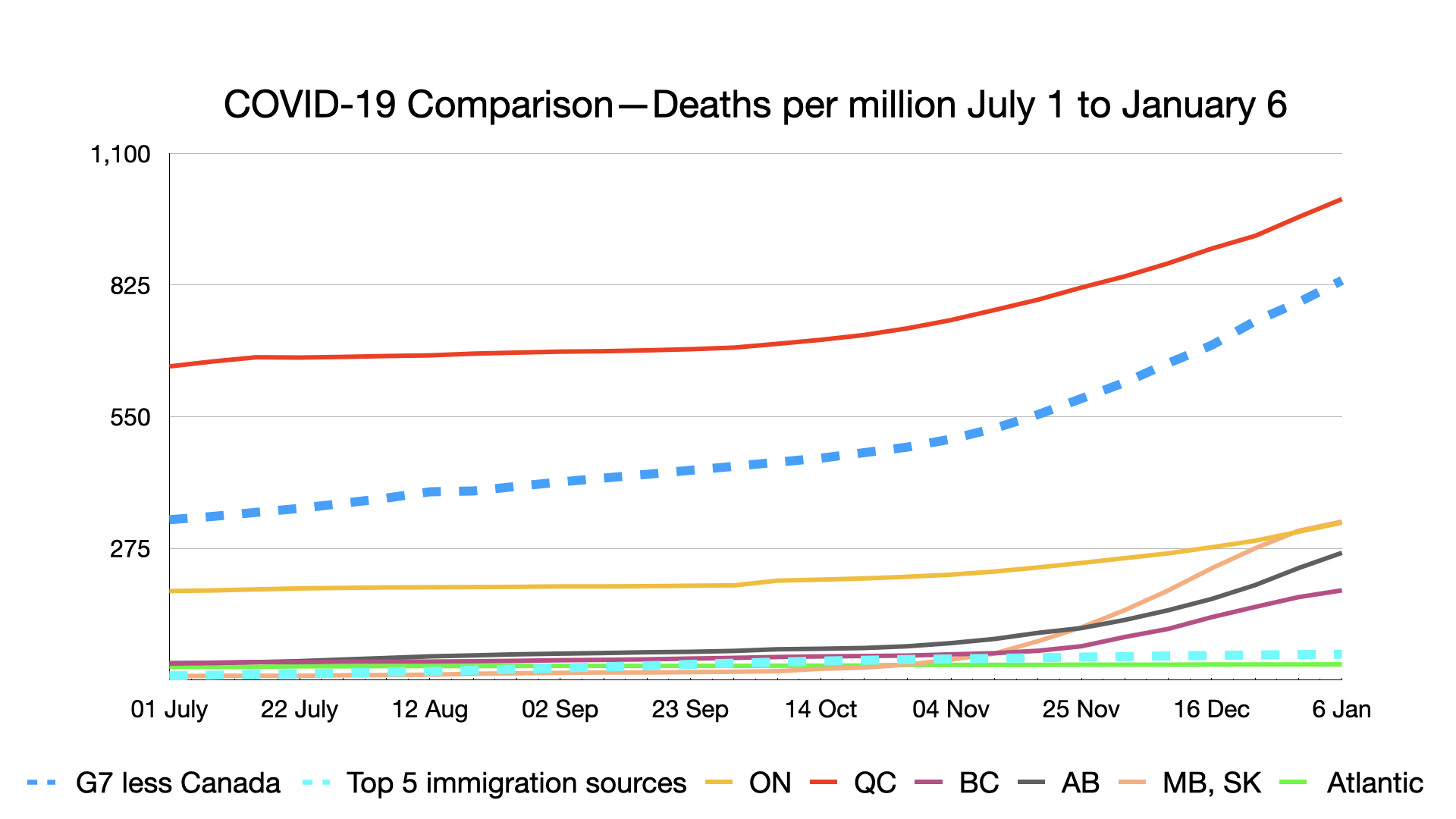
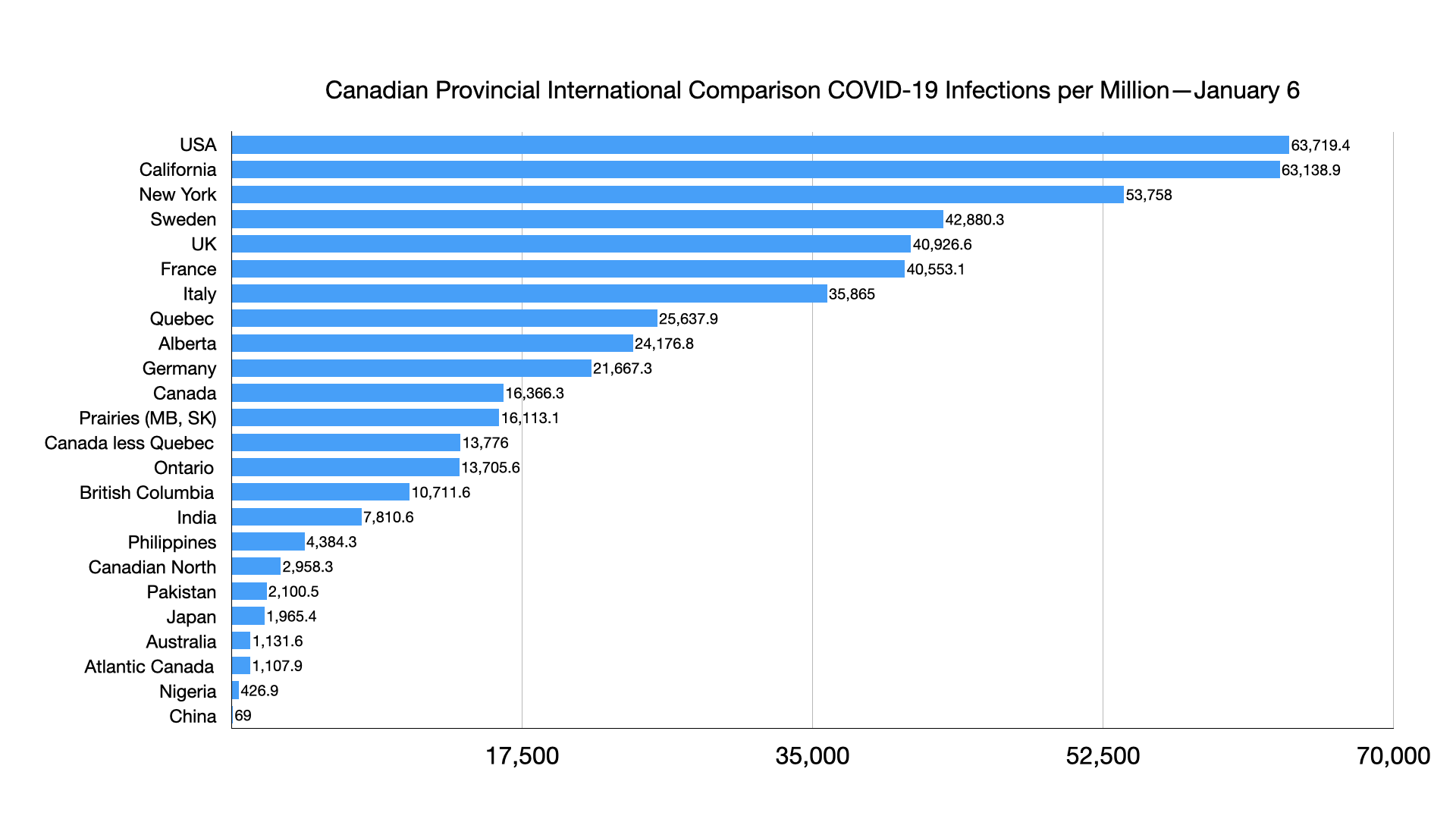
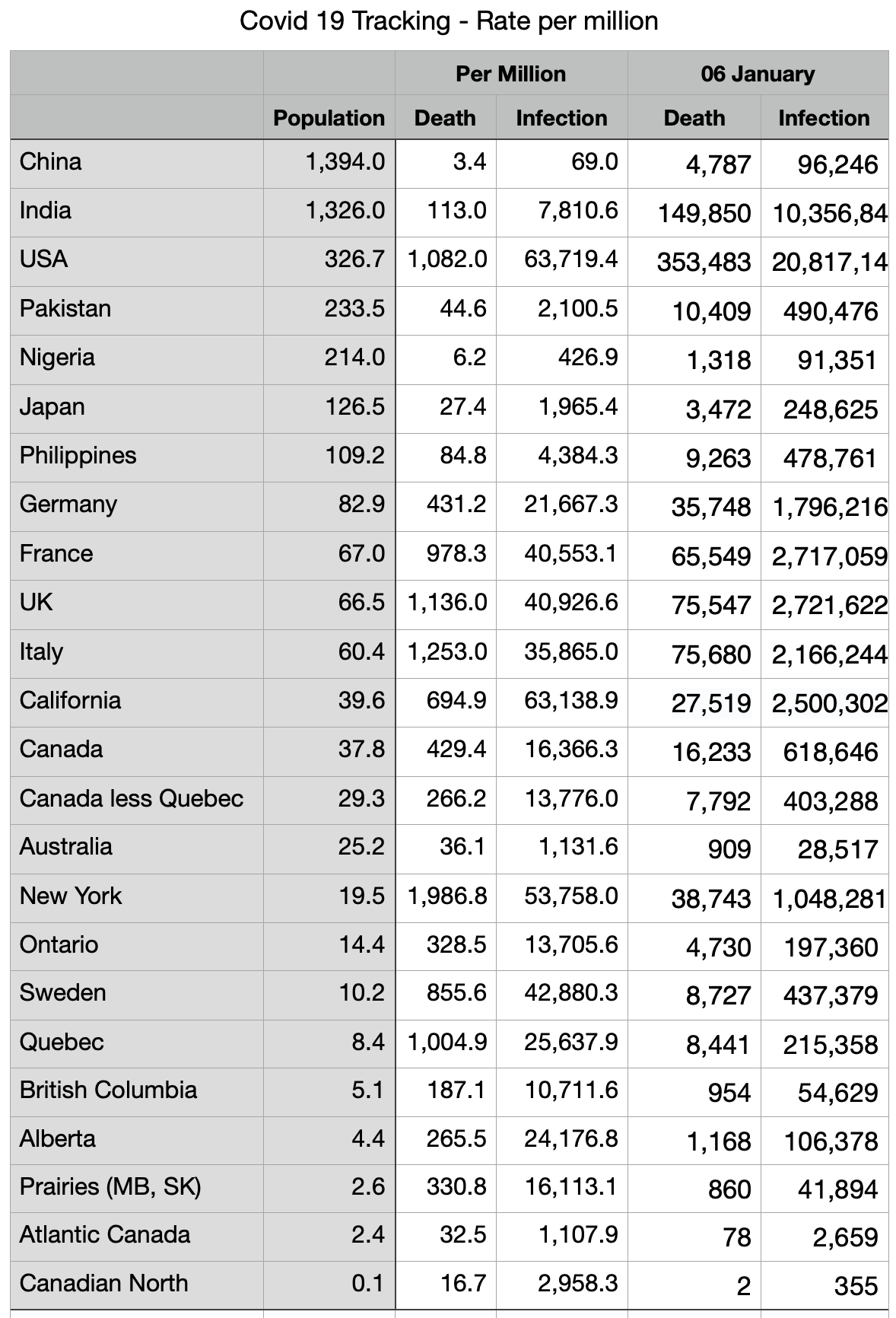
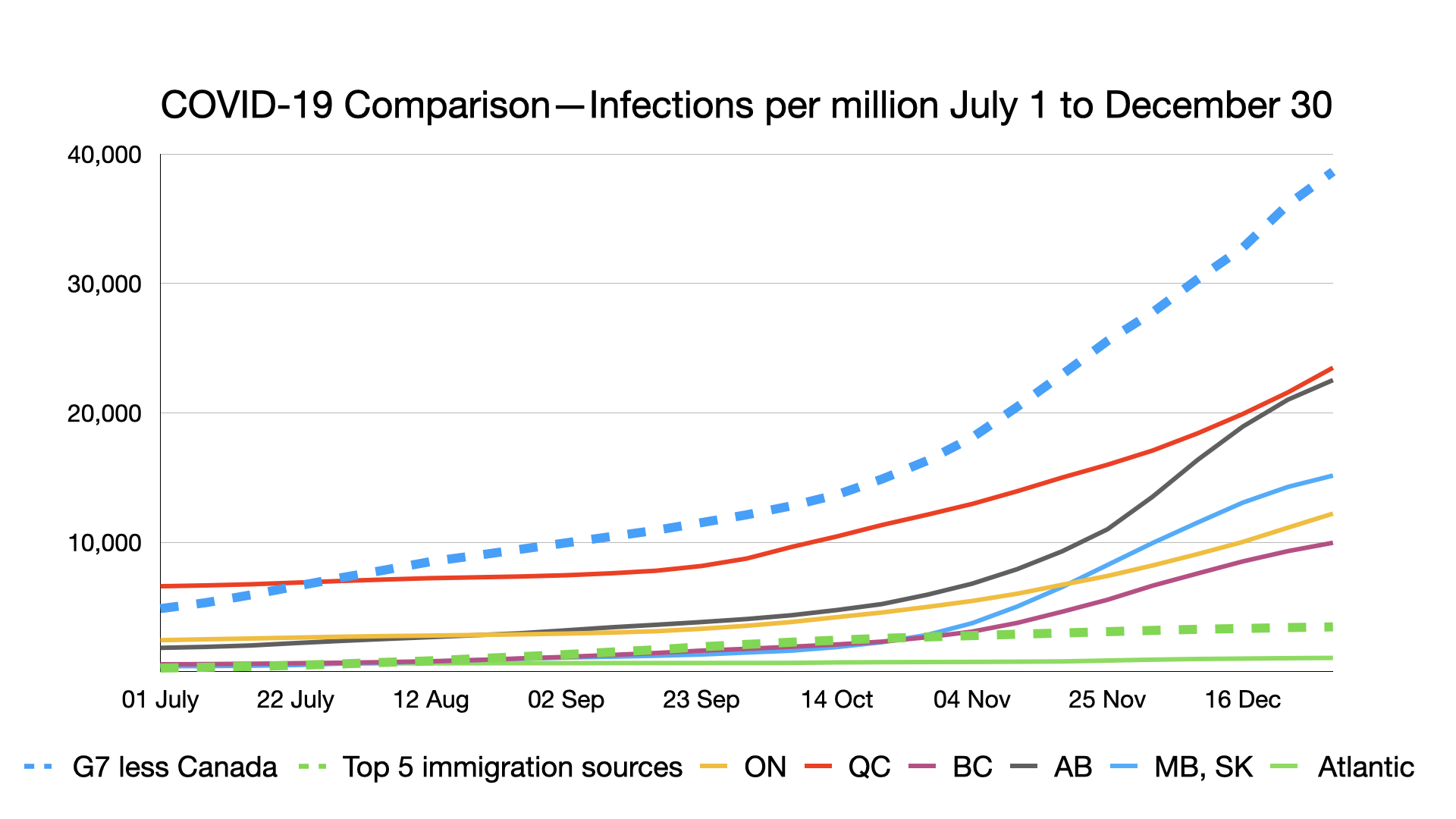
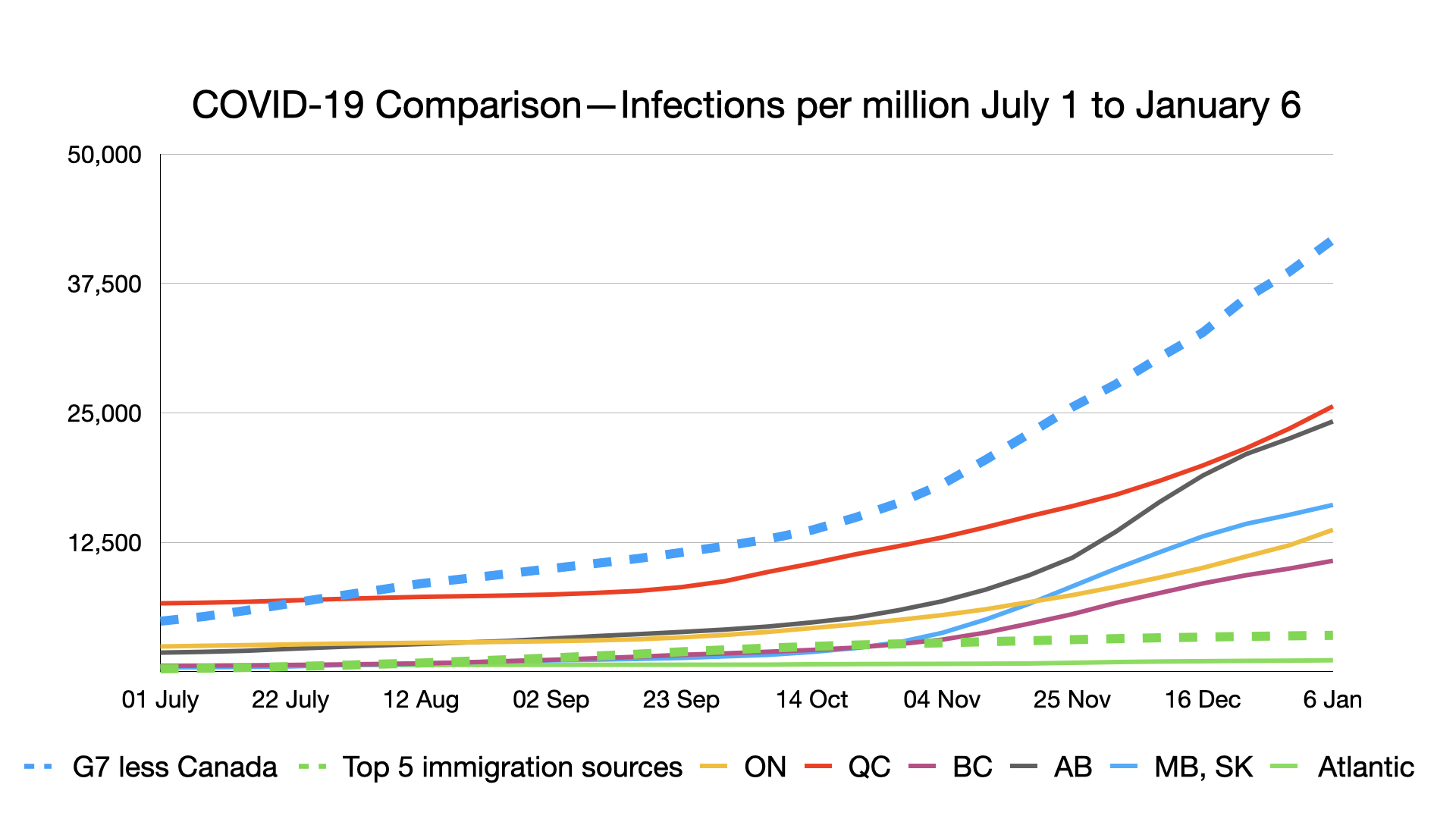
The standard charts can be found below.

There has understandably been a “feeding frenzy” regarding federal and provincial parliamentarians who have disregarded public health and their own government’s advice to forego travel, domestic or international, during the holidays.

In some cases, this has been to visit elderly family members (e.g., Sameer Zuberi and Kamal Khera of the Liberals, Niki Ashton of the NDP), in others for holidays (the various Alberta MLAs and Premier Kenney’s Chief of Staff, Quebec MNA Pierre Arcand) along with others.

Responsibility and accountability has been mixed. The federal NDP handled Ashton’s case the best, removing her quickly from her critic responsibilities, setting the tone for the federal liberals to follow sui. Ontario Premier Ford initially botched it being aware of his former finance minister Rod Phillips vacationing in St Barts but recovering quickly by accepting (insisting?) on his resignation. In rare tone deafness, Alberta Premier Kenney initial response not to sanction minister Allard, his Chief of Staff Huckabay and a number of MLAs, for travel during the holidays, that prompted outrage on all sides of the political spectrum and led to belated resignations and discipline.

Highly ironic given Kenney and the UCP reliance of “personal responsibility” and “good judgement” to reduce COVID risks when so many in the government have demonstrated neither.

Some good examples of Alberta commentary:

Rick Bell: Premier Kenney, it’s time to face the music

Don Braid: Kenney fires and demotes to spike scandal, but Albertans will decide if they forgive

And the contrary arguments from C2C’s editor George Koch:

In Alberta, Premier Jason Kenney first avoided meting out Ford-style punishment upon Allard and her fellow travellers. When the news broke, Kenney himself shouldered much of the blame and said he would provide new and crystal-clear “guidelines” covering ministers, MLAs and senior bureaucrats. The opposition, however, gleefully called for Allard’s headwhile the media republished tweets demanding Kenney’s own resignation. It has become fashionable to criticize nearly anything Kenney says or does; his handling of the pandemic is, according to one poll, approved of by just 30 percent of Albertans.

Personally, I found the Alberta premier’s initial response not only courageous but admirable and honourable. Unlike Ford and innumerable politicians, corporate leaders and heads of other organizations in countless analogous situations, Kenney declined to throw Allard under the bus. This is not the first time Kenney has gone to the mat for a subordinate, at considerable short-term political cost to himself. Who would you rather work for? Further, someone who clearly cares about the people who work for him might, just might, also be sincere in his concern for small businesspeople and voters at large.

Sadly, however, Kenney ultimately could not resist the stinking red tide of public opinion; on Monday, he accepted Allard’s resignation from cabinet, as well as that of his chief of staff, who had travelled to the UK, and demoted the other MLAs.

Source: https://c2cjournal.us19.list-manage.com/track/click?u=e8efce716429c34122979e2de&id=cb2f1e50a3&e=4174a59277

Minor week to week changes:

Infections per million: Sweden moves ahead of UK which in turn moves ahead of France, Canada total ahead of Prairies

Deaths per million: Germany moves ahead of Canada

And the standard weekly charts and table.

#COVID-19: Comparing provinces with other countries 30 December Update, including cumulative data

Will now provide the trend line and weekly data to provide a more complete picture. As the charts are self-explanatory (advise me if not), will continue to keep narrative to a minimum.

Alberta’s infection rate maintains its overall convergence with Quebec whereas the death rate of the Prairie provinces (Manitoba, Saskatchewan) have converged with Ontario’s.

The other related news, despite all the warnings and advice from political leaders, the Ontario finance minister was caught “off message” with a trip to the exclusive Caribbean of St Barts. Not the only one, Quebec MNA Pierre Arcand went to Barbados. Not to forget federal health minister Patty Hajdu’s repeated trips home to her riding during the first wave.

One expects better.

Lastly, may I wish you a happier new year.

Weekly updates below. Minor changes only:

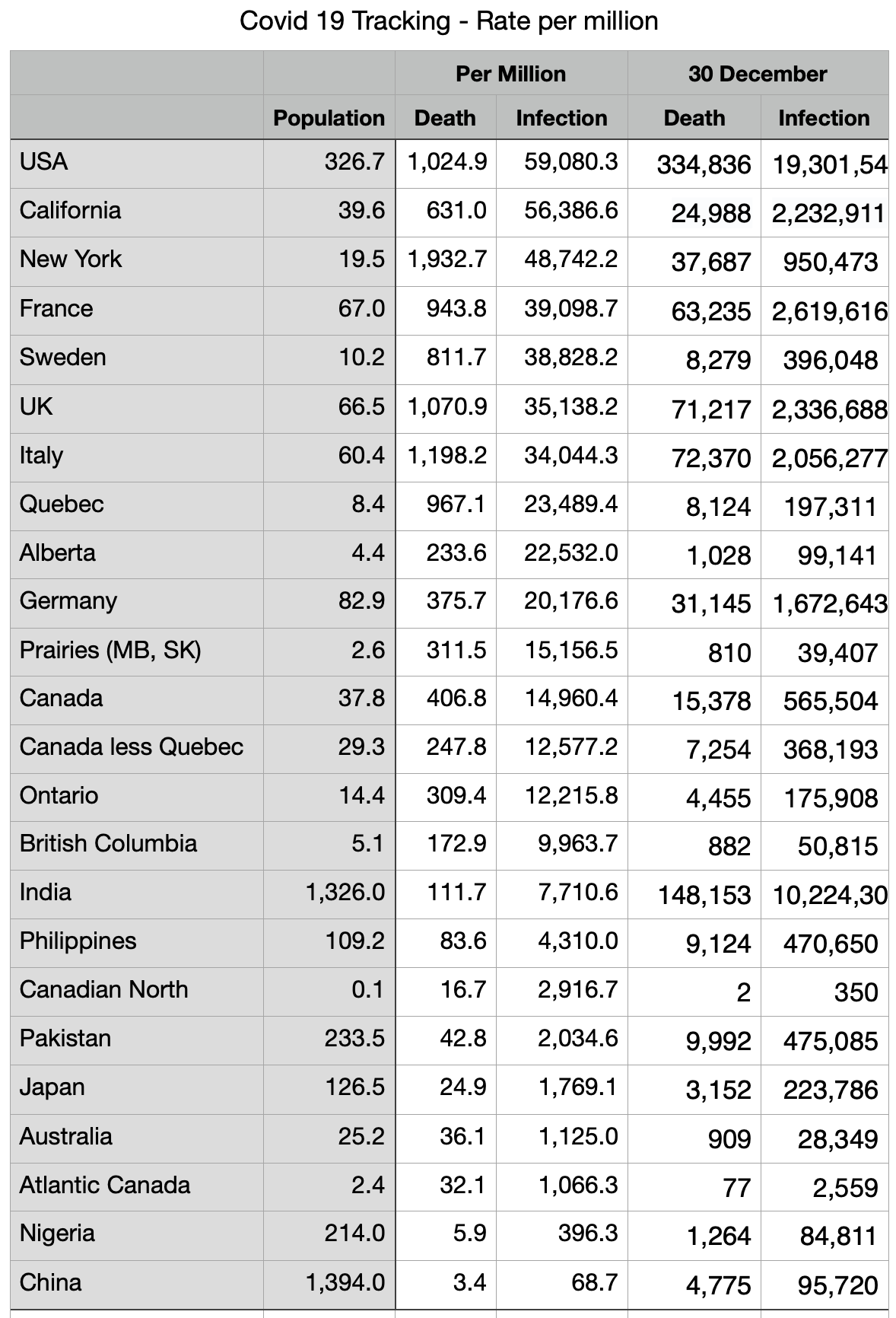
Infections per million: UK moves ahead of Italy

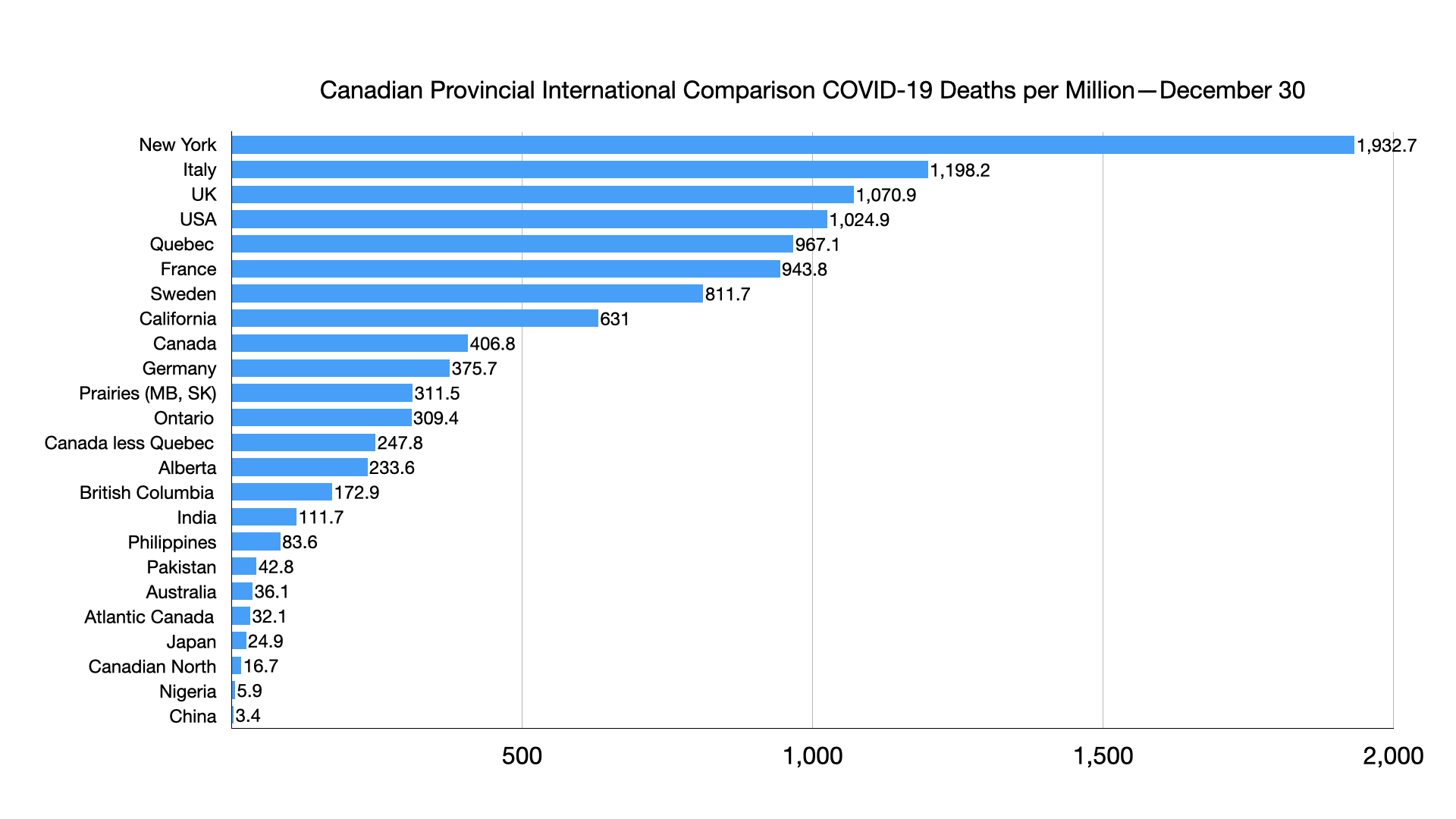
Deaths per million: Prairies (Manitoba, Saskatchewan) moves ahead of Ontario

And the standard weekly charts and table.