‘A new kind of slavery’: Skyrocketing use of temporary foreign workers in restaurants and fast food chains has advocates concerned
2024/08/12 Leave a comment
Alternate header: Restaurants rely on cheap foreign labour undermining wages:
Working site on citizenship and multiculturalism issues.
2024/08/12 Leave a comment
Alternate header: Restaurants rely on cheap foreign labour undermining wages:
2024/08/10 Leave a comment
Not exactly a bankable commitment. The devil will be in the details:
…Poilievre said he will consider permanent status for migrant workers under some specific conditions.
“I am open to it for people who have come legally, who have worked the entire time that they have been here (and) who have, or are learning one of the two official languages,” he said.
“In principle I have no problem with the idea of temporary foreign workers who have proven themselves to be strong, net contributors to our country staying permanently and becoming members of the Canadian family,” he added.
2024/08/09 Leave a comment
Waiting for the details of this needed corrective action:
…The federal government said these moves were aimed at easing labour shortages, although many economists criticized the policies over the potential for wage suppression and exploitation of foreign workers, who have weaker labour rights than permanent residents and Canadians.
Employers have subsequently ramped up their recruitment of foreign labour, particularly in the low-wage stream. Cooks, food counter attendants and construction workers are among the low-wage employees in high demand.
At the end of 2023, nearly 190,000 people held valid work permits through the TFW program, an increase of 157 per cent from 2019. The program accounts for a small portion of temporary foreign labour in the country; for example, international students and people with postgraduate work permits are a large and growing cohort of workers in the Canadian economy.
The country’s soaring population growth – largely fuelled by temporary immigration – is colliding with a weakening labour market. The unemployment rate has risen to 6.4 per cent, and it’s taking longer for recent immigrants and young people to find jobs.
Tuesday’s news release said the government is applying “a stricter and more rigorous oversight” of employer applications to use the TFW program and when conducting inspections of companies using such labour.
Source: Ottawa signals tougher rules for Temporary Foreign Worker Program
2024/08/03 Leave a comment
More on innovation, productivity and immigration:
….Back in 1891, it would have called for a large (and mostly poorly paid) work force. Progress since then has been remarkable, spurred by massive investments in labour-saving farming equipment and technology. The Conference Board study predicts more of the same.
All of which should be a reminder that labour shortages and rising wages have economic benefits. Yes, benefits. They are the mother of business innovation and investment, because they force businesses to chase ever greater labour productivity. Particularly when it comes to low-wage jobs, a tight labour market and upward pressure on pay should be the goal of government policy.
However, Canadian businesses in recent years persuaded Ottawa that, no matter the state of the economy or the level of unemployment, they can’t fill hundreds of thousands of low-wage jobs. But these alleged labour shortages are mostly just businesses facing the pressure to compete for workers by raising wages.
Those pressures have been alleviated by allowing businesses to recruit an effectively unlimited number of temporary foreign workers, at the lowest legal wage, or less. Absent that low-wage release valve, businesses would have to innovate and invest more in new technologies to use less labour, and get more out of each hour of (increasingly expensive) labour.
That’s how we raise productivity. That’s how we grow the economy….
Source: Canada is about to lose more than 100,000 farming jobs. That’s great economic news
2024/06/26 Leave a comment
Of note. More justifiable than fast food service workers and managers:
Persistent staffing shortages in the health-care sector across Canada in the wake of the pandemic have led some organizations, including some provincial government agencies, to increasingly call upon temporary foreign workers to fill positions in clinics, hospitals and senior care facilities across the country.
While health-care still represents a small fraction of the overall temporary foreign worker program, federal data analyzed by CBC News shows the government greenlighted the hiring of 4,336 health-care workers last year — up from 447 such positions in 2018. Health-care occupations represented roughly two per cent of the total temporary foreign worker positions that were approved in 2023.
A large share of that growth was driven by an uptick in approvals of nurse aides, orderlies and patient service associates. There were 2,514 such approvals last year, up from just 16 in 2018.
But employers have also turned to the program to fill other positions, such as nurses (612 positions approved, up from 65 in 2018) and family doctors (216 positions approved, up from 72 in 2018).
“I think this is another example of the overall health-care workforce crisis,” said Ivy Bourgeault, who leads the Canadian Health Workforce Network, a network of researchers who study issues facing health workers. She said staffing shortages driven by burnout and attrition have employers turning to increasingly novel means to bring in new workers.
The uptick in health-care hiring is reflected in the number of positions approved through labour market impact assessments (LMIAs), which employers need to prove there’s no one in Canada available to take a job before they can hire a temporary foreign worker. …
Source: Why the health-care sector is hiring temporary foreign workers like never before
2024/06/26 Leave a comment
Good comments by Kurland, Skuterud and Lee:
….Their plight is the direct fault of Ottawa, say migration specialists.
“Over the past four years the number of people with temporary status in Canada has skyrocketed” because of an executive decision from the office of Prime Minister Justin Trudeau, says Richard Kurland, a Vancouver immigration lawyer.
“So there is now a chicken in the python problem,” he said.
“People with study permits, and then post-graduate work permits, who can’t qualify for permanent resident status face taking an airplane ride home in shame and poverty. Or they’ll find a way to stay.”
Kurland expects to see “increasing trends of marriages of convenience, refugee claims and applications for humanitarian and compassionate relief.”
A sign of what’s to come might have already arisen at Seneca College in Toronto, where asylum claims from international students increased from 300 in 2022 to almost 700 in 2023. At Kitchener’s Conestoga College, claims jumped from 106 to 450 during that same period.
University of Waterloo economics professor Mikal Skuterud, a specialist in labour, said “lots of non-permanent residents in Canada are seeing their permits expire and the government is worried that large numbers have no intention of leaving the country.”
The Liberal government created the predicament a few years ago, said Skuterud, when it signalled to the world, particularly those with low skills, the easiest way to become a citizen of Canada is to show up as a temporary resident.
“For migrants, Canada’s immigrant selection system now looks like a lottery, in which a work or study permit is the ticket. That’s a big problem. And it wasn’t like this before 2021.”
The Liberal government made the mistake of dismantling the country’s skills-based immigration system because of a “post-pandemic obsession with labour shortages, which is economic nonsense fuelled by corporate Canada,” Skuterud said.
George Lee, an immigration lawyer in Burnaby, said the “federal government created this problem: They’ve brought in too many people. The government wanted to address labour shortages. But now they say, ‘It’s too much!’ In effect the government is blaming itself.”
Last week, StatCan reported 2.8 million temporary residents in Canada, comprising a record 6.8 per cent of the population. That’s up from 3.5 per cent two years ago.
More than one million are foreign students, most with work permits. Others are classified as “temporary foreign workers” or “international mobility” workers. Another 360,000 are asylum claimants.
In light of Immigration Minister Marc Miller promising this spring to reduce the number of study visas, partly in response to the pressure on housing prices and social services, Kurland said Canada should warn would-be migrants they’re taking a big gamble.
“They now face a loss of their significant investment in time and money. The problem is that the majority of people are unaware that every (newcomer) takes the risk that Canada’s immigration regulations may be changed at any time,” said Kurland, who publishes the newsletter, Lexbase, which previously reported on how Canada’s border services are better tracking when people actually exit the country.
Canada’s problem with an influx of temporary residents is different from what’s facing the U.S. and Europe. Those regions have experienced waves of millions of undocumented migrants. But, for the most part, Canada has explicitly welcomed the record flow of newcomers, most of whom are unskilled.
Skuterud questions the immigration minister’s May announcement that he would like to reduce the number of temporary residents in Canada simply by turning them into permanent residents, particularly through the provinces’ so-called nominee programs.
“The irony of all this is that the government is providing more ad hoc openings to permanent residency to relieve the bulging non-permanent population.” It’s thereby “inadvertently” encouraging more people to start in Canada on a temporary basis with the dream of staying forever, he said.
The surge of temporary residents has not only exacerbated Canada’s housing crisis, Skuterud said rapid population growth, almost entirely from international migration, correlates with Canadian wages staying stagnant.
Lee, who came to Canada on a study visa from China in 1992, supports Canada’s efforts to bring high numbers of international students to the country, saying they’re primed to become engaged citizens since they have learned the culture, to speak English or French, and have developed Canadian-based job skills.
The problem, Lee said, is that when Ottawa tried to address a perceived labour shortage, it went too far and embraced too many newcomers at once. “We need a more balanced approach.”
Kurland suggests Ottawa adopt a “consumer protection” model to more honestly process people who want to move to Canada.
Canada’s immigration department, he said, should ask people who apply online for temporary residency: “If you are planning to possibly immigrate to Canada, do you acknowledge that your plan may fail if Canada immigration law and regulations were to change?”
Skuterud offers a different way forward. He says Ottawa has recently been over-promoting a “two-step immigration” scheme that pushes aspiring immigrants to first enter the country on a temporary basis.
He would like the government to return to emphasizing the more traditional economic-class pathway to permanent resident status, which relied on a transparent, above-board ranking system to select candidates.
Source: Douglas Todd: Canada should warn guest worker, student applicants they’re taking a big gamble
2024/06/25 Leave a comment
Of note:
…Mr. Miller said there hasn’t yet been agreement within government on the program and it could take months to introduce.
He said what is causing him to pause are “views that I respect, people that care about these issues that are radically opposed and diametrically opposed, and not necessarily from people that [you] would necessarily think would have that thought process.”
Under the plan, migrants without documents, including people with Canadian children who have lived here for several years, would be able to apply for permanent residence.
The Prime Minister issued a mandate to former immigration minister Sean Fraser in 2021 that asked him to “further explore ways of regularizing status for undocumented workers who are contributing to Canadian communities.” A decision by cabinet was expected this spring.
But Mr. Miller said the program “is not something that is going to get rolled out soon” adding that polling is showing that Canadians are divided on the issue.
“If there is a clear conclusion, I will be quite clear to Canadians about it, but there isn’t one right now,” he said. “What I do know is that given the ongoing discussions, and they are ongoing – they have not come to an end – it isn’t something that I have any confidence will be rolled out in the short term.”…
2024/06/25 Leave a comment
Yet another example of how the government has mishandled immigration:
…Taking orders and flipping burgers
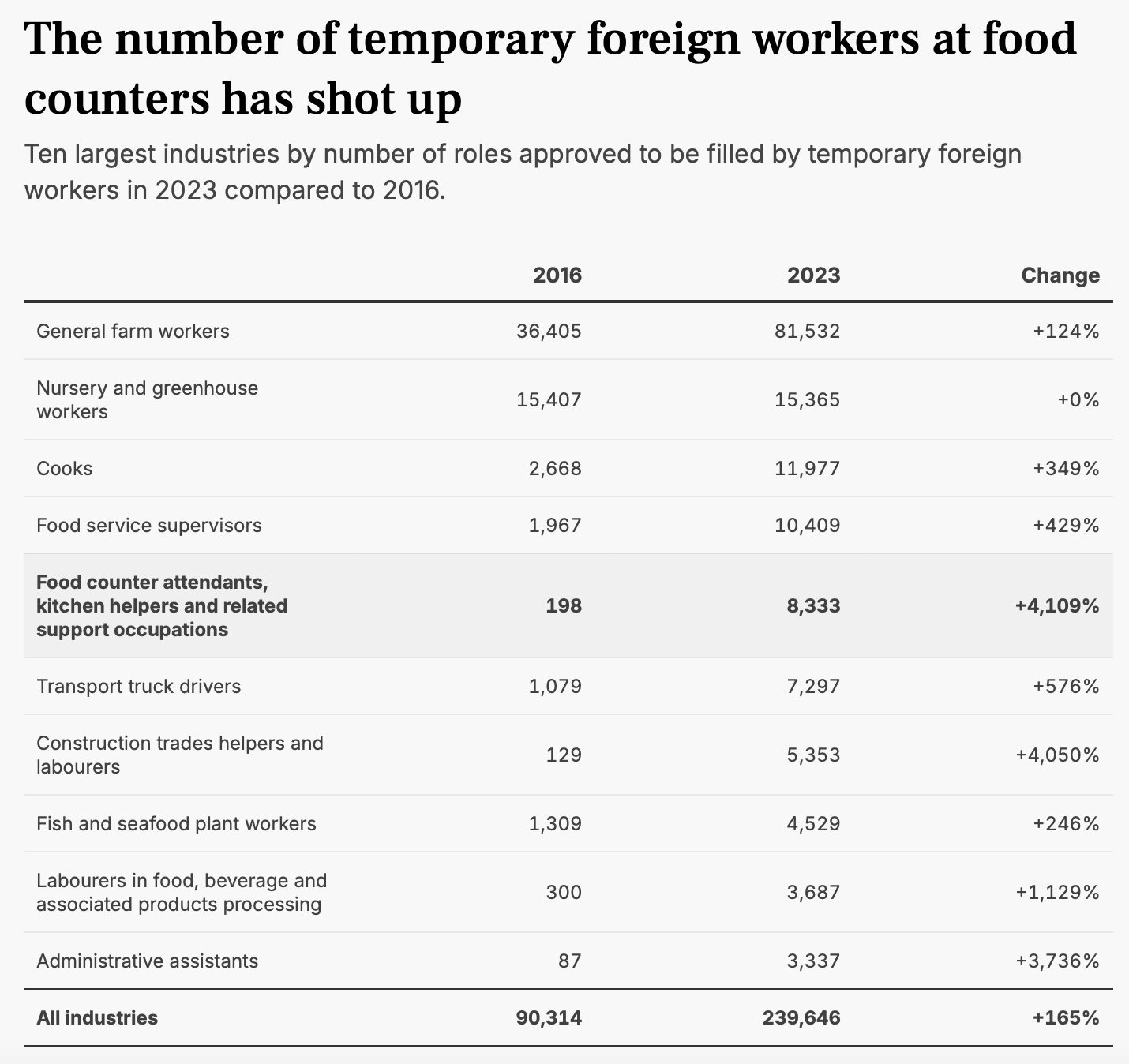
Fast food chains and restaurants are a major source of demand for temporary foreign workers. After farm and greenhouse workers, the roles with the most approvals last year were cooks, food service supervisors, food counter attendants and kitchen helpers.
Food counter attendants, in particular, increased from 170 jobs in 2018 to 8,333 in 2023. The top 10 employers cleared to hire the highest number of them last year were all fast food operators.
The relationship between the food service industry and the temporary foreign worker program has at times been fraught. Roughly a decade ago, controversy around the industry’s use of the program led the federal government to impose a temporary moratorium on that sector.
But times have changed along with labour markets.
Citing significant labour shortages, in 2022 the federal government doubled the proportion of low-wage workers businesses could hire through the program, from 10 per cent of their workforce to 20 per cent.
Certain sectors hit particularly hard by the pandemic, including food service, were greenlighted to hire as much as 30 per cent of low-wage staff through the program.
For businesses, a major benefit is stability, as the workers’ permits are tied to their employer, meaning they can’t easily quit to work for a rival business down the street.
“It guarantees a worker will stay employed with them for the term of the agreement,” says the Canadian Franchise Association on its website.
CBC News reached out to 14 restaurants and franchise groups cleared to hire the most cooks, food service supervisors and food counter attendants last year.
None agreed to an interview, although a spokesperson for Franchise Management Inc., which operates Pizza Hut, KFC and Taco Bell franchises, said the program has allowed it to keep operating in rural and northern areas.
“Unfortunately, some of these communities often lack the population base to meet the demand for labour,” said Dana Myshrall in an emailed statement.
The company was cleared to hire 140 food counter attendants last year, though Myshrall said it expects to hire far fewer this year….
Source: From fast food to construction, employers turn more and more to temporary foreign workers
2024/05/27 Leave a comment
A start:
The federal government must modernize its archaic temporary foreign worker program by allowing migrant workers to change employers within their industry and overhauling the complicated enforcement system, says a Senate report.
To better support both workers and employers, a Migrant Work Commission should be established to oversee the program, advocate for migrant workers in Canada and serve as a single point of contact for reports of abuse and mistreatment as part of its mandate, says the study released on Tuesday.
“With so many cooks in the kitchen, it is only logical to have a head chef,” Ontario Sen. Ratna Omidvar, chair of the Senate social affairs, science and technology committee, told a news conference.
“This commission would serve as a one-stop shop for migrants who need help in asserting their rights and for employers seeking support in navigating the labyrinth of red tape, and even for government departments seeking to make their operations more efficient.”
The recommendations, however, have received a cold reception by advocates, who criticized the Senate for failing to address the structural issues of the temporary worker program.
“The fundamental power imbalance is the temporary migration system itself,” said Syed Hussan of Migrant Workers Alliance for Change. “So long we have a system of temporariness, there’s going to be inequality, injustice, abuse and exploitation.”
The Senate launched the study in late 2022 into Canada’s temporary foreign work program, which was introduced in 1973 as a stopgap measure to address the country’s labour shortages but has since grown to be an indispensable part of the Canadian labour market….
Source: Canada’s temporary foreign worker program is archaic. Here’s how the Senate wants to change it
2024/05/24 Leave a comment
Of note:
…Ottawa has made the choice to select lower-scoring immigrants who fit into specialized niches in the economy rather than those who, according to Canada’s own immigration system, have a better chance of long-term success.
… But it would be a serious policy blunder to carve out even more exceptions and further squeeze the general pool of permanent resident spots. Such an action would cement the trend toward a low-wage economy largely populated by immigrants.
A better, if tougher, approach would be to allow temporary migrants to compete for a spot in the general pool. Some will undoubtedly qualify, and will help to build Canada in the coming decades. Others won’t and will have to leave.
The Liberals need to keep in mind two imperatives in sorting out economic migration policy: the needs of Canadians come first – and magical thinking won’t get the country’s economy back on track.
Source: Sorry, Ottawa, but magical thinking won’t fix the economy

Click image for book purchase
 Multicultural Meanderings