Ottawa allows seasonal exemption to temporary foreign worker rules

Not surprising, given the regional politics:

The Liberal government has quietly approved changes aimed at helping Atlantic Canadian seafood processors that will allow them to bring in unlimited numbers of low-skilled temporary foreign workers to fill seasonal jobs this year.

Ottawa approved the foreign-worker exemption in response to lobbying from Atlantic seafood processors and Liberal MPs, who warned that recent restrictions to the temporary foreign worker program were hampering business. New Brunswick Fisheries Minister Rick Doucet recently said the labour shortage in his province is so bad that some lobster processing plants have had to throw lobsters in the trash.

The Liberals – who swept all 32 ridings in Atlantic Canada in last year’s federal election – are justifying the exemption as a short-term measure to buy time until a full review of the foreign worker program can be conducted later this year.

Other industry groups – such as Restaurants Canada – are questioning why exemptions are being allowed for some sectors and not others, and why they were never told of the change.

The House of Commons finance committee recently heard from a wide range of industry associations, including the Canadian Cattlemen’s Association, that requested a loosening of restrictions to the program.

The temporary exemption comes as Finance Minister Bill Morneau prepares to deliver a budget on Tuesday that will outline the federal government’s response to rising unemployment caused by the decline in Canada’s energy sector in Western Canada and Newfoundland and Labrador, which has long been a source of work for thousands of Atlantic Canadians.

Source: Ottawa allows seasonal exemption to temporary foreign worker rules – The Globe and Mail

Temporary foreign workers program faces federal review

Not unexpected to see political pressure from Atlantic Canada.

Will be interesting to watch the political debate, given that former Minister Kenney sees one of his legacies threatened (after reversing earlier Conservative policies than made it easier for businesses to hire Temporary Foreign Workers) and the degree to which the Government responds:

While the Liberals criticized the Conservative government’s handling of the program, the party did not propose reforms in its 2015 election platform.

All seats in Atlantic Canada went to Liberals, and MPs from the region are pressing hard for changes, saying the restrictions hurt seasonal businesses and the service sector.

Nova Scotia Liberal MP Rodger Cuzner, who is also Ms. Mihychuk’s parliamentary secretary, said the program needs to be overhauled to take into account the demands of seasonal businesses.

“Changes over the last couple of years have impacted seasonal industries. We still generate over 50 per cent of the regional GDP through seasonal industries. The work force is getting older. The out-migration is significant,” he said.

Yvonne Jones, the Liberal MP from Labrador, said the changes to the TFW program hurt her province’s tourism and fish processing industries, making it difficult to get seasonal labour.

“Because of the fact we are unable to recruit under the temporary foreign worker program, we have seen a lot of businesses having to close or scale back their hours and days of operations. This is really affecting services to communities that need that service,” Ms. Jones said.

Conservative MP Jason Kenney, the former minister who overhauled the program, said it would be dumb economic policy to exempt fish plant workers from the terms of the temporary workers program when so many Atlantic Canadians are unemployed and many jobless oil workers are returning from Alberta and Saskatchewan.

“This is classic Liberal position. Make it easy for local fish plant workers to go on unemployment insurance and make it easier for the employers to bring in fish plant workers from overseas,” he said.

Mr. Kenney said one of the reasons his government tightened the rules for employment insurance and temporary foreign workers was that communities in Atlantic Canada had local fish plant workers collecting employment insurance while foreigners were doing their jobs.

Ms. Mihychuk said the review by the Commons employment committee needs to encompass every sector of the economy, including the impact of the collapse in oil prices.

“You look at the massive layoffs in Alberta, it’s really changing the labour market,” she said. “A lot of indigenous people are strongly opposed to [TFW], saying it’s time for indigenous people to be given a chance. So there are a lot of different angles to the whole program.”

Unemployment among aboriginal people is more than twice the rate for non-aboriginals, according to the 2011 National Household Survey.

The Liberals also believe a credible pathway to citizenship for foreign workers is needed.

“It’s a situation that is complicated. These are people – excellent people – and a lot of them want to stay in the country,” Ms. Mihychuk added.

The Liberals say the Conservatives mismanaged the 2014 reforms and based many of their regional employment assumptions on inaccurate labour market data.

“Under the temporary workers program, basically, they connected it to data around employment statistics, but those employment statistics were not completely accurate,” Ms. Jones said. “They looked at large regions as opposed to individual areas where the problem was most sensitive. And because they didn’t go with the [mandatory] long-form census, a lot of the data was incomplete,” she added.

Mr. Kenney said the review is unnecessary, saying the reforms he brought in were balanced and well thought-out.

“I think our changes have turned out to be prescient given the downturn in the western economy, in particular where the most skilled part [of TFW] was being overused. With over 100,000 Albertans having lost their jobs in the past few months, and if more people were pouring into the Alberta labour market from abroad as de facto indentured workers while many Canadians are facing unemployment, that would be totally unacceptable,” he said.
Source: Temporary foreign workers program faces federal review – The Globe and Mail

Express entry, foreign worker reforms attract ‘fewer’ skilled workers: chamber report

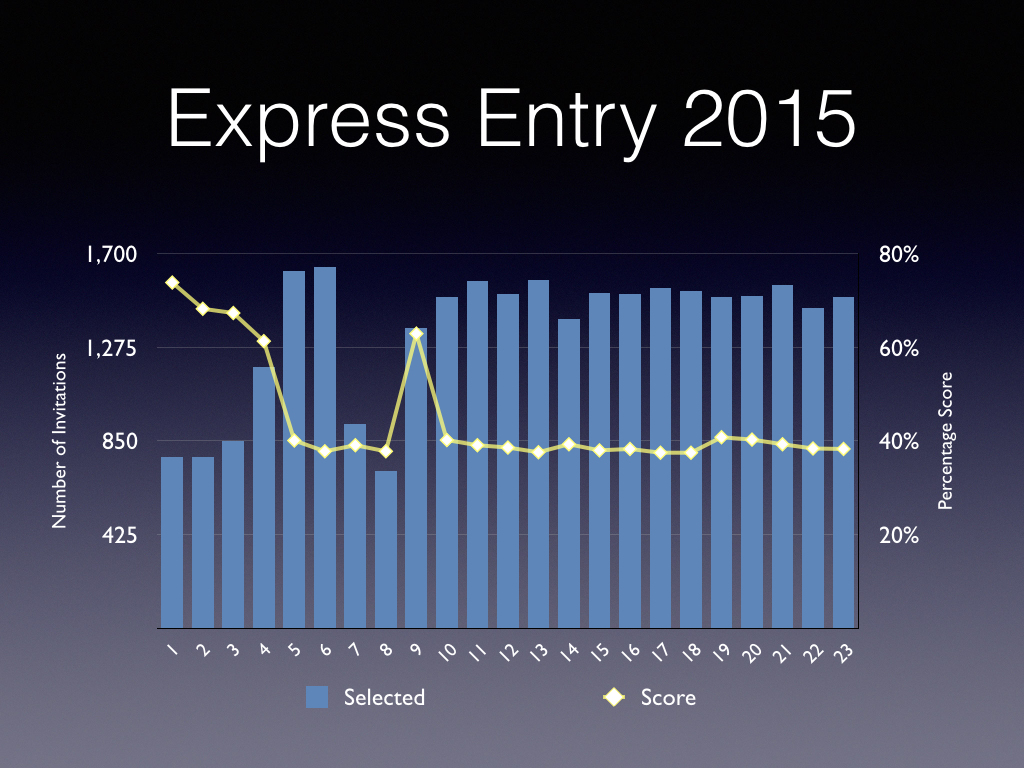
Express Entry Draws 2015.001Another item on Minister McCallum’s to do (or at least consider) list, passage below on Express Entry (the above chart shows the 23 rounds in 2015, and how the program has settled at around 1,500 invitations per draw, with a minimum score of about 40 percent of the total possible 1,200 points):

“The concept of attracting ‘the best and the brightest’ is missing in action,” says the new report, “as the competitive model of Express Entry is currently undermined by the protectionist policy embodied in the labour market impact assessment tool.”

As CBC reported in September, businesses say the labour market impact assessment (LMIA) — a new requirement borrowed from the newly reformed Temporary Foreign Worker Program — is the biggest flaw with Express Entry.

Under Canada’s new immigration system, highly-skilled foreign workers not only have to line up a job before applying to come to Canada but their job offer has to be backed by what the government calls a positive LMIA. That assessment is a document all employers now need to hire a foreign worker over a Canadian one.

The chamber calls the introduction of this new requirement a “misstep” that has made it “extremely challenging” for businesses to attract highly-skilled workers such as video game developers, top-flight researchers and workers in the trades.

Chamber calls for ‘sober, thoughtful review’

The 32-page report titled “Immigration for a Competitive Canada: Why Highly Skilled International Talent Is at Risk” lays out what Canadian businesses see as “missteps” with the immigration changes and offers 20 recommendations.

The recommendations include:

  • Removing the new requirement of a labour market impact assessment from the Express Entry system.

  • Tweak the points system under Express Entry to benefit high skilled workers applying under the International Mobility Program.

  • Reduce processing times for study permits and visas.

Source: Express entry, foreign worker reforms attract ‘fewer’ skilled workers: chamber report – Politics – CBC News

Temporary foreign workers get first dibs under express entry

More teething pains or more substantive problems? Early results or signalling a trend?

Jason Kenney, who was responsible for the Harper government’s transformation of Canada’s immigration system during his time as immigration minister, on Friday touted express entry as “a system that’s fast, that connects people to the labour market so they can realize their dreams and fulfil their potential upon arrival in Canada.”

“New economic immigrants are arriving in Canada in months rather than years,” Kenney said during a news conference in Vancouver.

“A growing percentage have jobs lined up before they get to Canada rather than being stuck in survival jobs for years following their arrival.”

While that may be the goal, express entry has opened the door to very few new economic immigrants. To date, it has favoured a large number of temporary foreign workers and other foreign nationals already in the country.

Over 85 per cent of the foreign nationals who were selected for admission under express entry in the first six months of the year — 11,047 out of 12,304 — were already in Canada, according to a report published by the Department of Citizenship and Immigration in July.

The report shows that three per cent were living in India, followed by two per cent in the U.S. and one per cent in the Philippines. Even smaller percentages resided in other countries.

As of July 6, Canada had issued 844 visas to foreign nationals and their dependents resulting in only 411 admissions being fast tracked for permanency residency.

“Implementing the express entry system was a significant undertaking and we continue to monitor it closely,” the government report said, cautioning it is only “a snapshot” intended to capture “one moment in time.”

While immigration officials are working tirelessly to iron the kinks out of the system, the report said Canada will meet its immigration quota not through express entry but by drawing from a backlog of applications submitted under the old system.

The majority of new economic immigrants to Canada will not be drawn using the new system until it’s in full flight in 2017.

‘Unusable’ for businesses

Businesses say the system’s biggest flaw is a new requirement borrowed from the newly reformed temporary foreign worker program, which Kenney and Chris Alexander announced last year following a series of stories published by CBC’s Go Public team alleging abuse of the program.

Under express entry, it isn’t enough that economic immigrants have to line up a job before applying to come to Canada — that offer must also be backed by a positive labour market impact assessment. That assessment, or LMIA, is a document all employers now need to hire a foreign worker over a Canadian one.

This is a new requirement under an economic stream that sees upwards of 250,000 new permanent residents admitted each year.

“It’s made it unusable for many employers that we hear from and for small and medium businesses,” said Sarah Anson-Cartwright, the director of skills policy at the Canadian Chamber of Commerce, the largest business association in the country representing some 200,000 employers

Members of the Chamber, she said, are disillusioned with a process that has become too “onerous.” Employers are complaining that their assessment forms are being rejected due to inadvertent omissions or typos.

Source: Temporary foreign workers get first dibs under express entry – Politics – CBC News

Guest column: Canada’s migrant worker program a model for the world | Windsor Star

Ken Enns, owner of Enns Plant Farm, on the need for Temporary Foreign Workers in the agriculture sector:

Our workers are here on eight-month contracts, can leave and go home at any time they want, must be paid minimum wage plus whatever bonus is negotiated, full health care coverage when they step off the plane, full workman’s compensation, free weekly transport to town for shopping and supplied living accommodations.

They go home after eight months with a very large amount of money to put their children through university, they support their families, send home generators, tools to start machine shops, home appliances and all the things they cannot get at home.

We have many workers who have applied to return now for 25 and 30 years in a row. They continually ask if they can bring more of their family members for the next year — hardly the request from a person who is a “slave,” as described in the article.

We have the finest labour program in the world and we should be holding it up as a model for the world to follow. This is how you treat and protect your migrant workers.

Instead of trashing the program, we should be increasing it. Instead of giving foreign aid to impoverished nations, we should have their people come here and we could get some benefit for all that aid.

Our industry is one of a very few that can compete with and do better than the Americans. Our labour program is one of the reasons.

Guest column: Canada’s migrant worker program a model for the world | Windsor Star.

Foreign students left behind in new Express Entry immigration program | Toronto Star

Oversight or by design? Metropolis Panel on Temporary Foreign Workers March 27 will have opportunity to discuss:

International graduates from Canadian universities and colleges say Ottawa’s new skilled immigration system actually hinders their access to permanent residency instead of promoting it.

The scholars say their once-prized assets — Canadian education credentials and post-graduate work experience — have little to no value under the new Express Entry program, which came into effect Jan. 1.

The problem, which the federal government denies, lies in the significance given to a certificate called the Labour Market Impact Assessment (LMIA). It is issued by Ottawa to ensure a candidate’s skills are sufficiently in demand to warrant hiring an immigrant.

Ottawa says applicants for Express Entry, such as international graduates, do not need an LMIA to qualify. But Express Entry acceptance is based on a point system and it’s not possible to earn enough points without an LMIA, immigration experts say.

“The new system is flawed,” said Toronto immigration lawyer Shoshana Green. “We want people who went to school and have work experience in Canada. These people are already fully integrated. And now we are ignoring them. It is just bizarre.”

Under the Express Entry system, an applicant may earn a maximum of 1,200 points. An LMIA automatically earns applicants 600 points. The other 600 possible points are awarded for personal attributes such as education, language skills and work experience.

How many points does it take to qualify for Express Entry? It changes. So far it has been as high as 886, and has dropped to 735 points. Regardless, the qualifying level is more than 600, so an LMIA is necessary.

Foreign students left behind in new Express Entry immigration program | Toronto Star.

Also covered in the Globe:

International students in limbo under immigration system changes – The Globe and Mail

John Williamson apologizes for ‘offensive’ comment on temporary workers program

Bit surprising that a former PMO director of Comms would make such a faux pas but to his credit, he made a quick and full apology (not the usual mealy mouthed “to those who I may have offended”):

Media outlet iPolitics is reporting that New Brunswick MP John Williamson told delegates at a conference in Ottawa that it makes no sense to pay “whities” to stay home while companies bring in “brown people” as temporary foreign workers.

Williamson posted a series of tweets Saturday to apologize for language he used in reference to the controversial federal program, but he did not elaborate on what he said.

“Today I used offensive and inappropriate language regarding the Temporary Foreign Workers Program,” he wrote on Twitter.

“For this I apologize unreservedly.”

In terms of the substance, of course, he is right: it makes no sense to facilitate Temporary Foreign Workers in a province with high levels of unemployment.

John Williamson apologizes for ‘offensive’ comment on temporary workers program – CBC News – Latest Canada, World, Entertainment and Business News.

Kenney says changes to temporary foreign worker program in Alberta not exemptions

Seems a reasonable transitional adjustment (others may disagree), responding to employer pressure:

In a letter to Conservative MPs last week, Kenney says the federal government is giving a one-time exemption to temporary foreign workers in Alberta from being counted under the cap on low-wage workers, provided they meet strict criteria.

Kenney says this will allow employers to apply for renewed Labour Market Impact Assessments while their existing temporary foreign workers pursue permanent immigration.

As well, Kenney says in the letter that Citizenship and Immigration Canada will provide a one-year bridging work permit to TFWs who are subject to the four-year limit.

The letter says this should provide some relief to employers who have TFWs that have already applied for immigration and are in the queue waiting for their applications to be assessed.

The Alberta Federation of Labour says the Conservative government has caved in to pressure from low-wage employers who want to hold on to “exploitable” temporary foreign workers for a longer period of time.

“Last June, the Harper government promised to limit the number of TFWs that low-wage employers could use. But now, they’ve quietly broken their promise and changed the rules,” AFL president Gil McGowan said in a news release Tuesday.

Kenney says changes to temporary foreign worker program in Alberta not exemptions

Ottawa to limit number of foreign youth working in Canada

Further to my earlier post (Foreign youth TFW program a risk to youth employment, documents say), appears the Government has decided to cut the program in 2016 both for the valid reason given concern over bilateral irritants and how to manage them, along with further efforts to increase Canadian uptake for foreign opportunities, and likely also to punt and controversies post-2015 election:

Ottawa has reciprocal agreements with 32 countries, but is concerned that Canada accepts far more young workers each year than the number of young Canadians accepted by partner countries.

A Dec. 12 document reveals that Mr. Harper decided partner nations should be warned that quotas will be “reduced significantly” for 2016 unless they take steps to accept more Canadians.

An earlier document dated Oct. 27 shows the government was preparing to manage the fallout from foreign countries that would likely object to quota reductions in the program.

The Oct. 27 document specifically states that any reforms were to be delayed until after Canada and South Korea ratified a long-sought free-trade agreement, a development that occurred in early December.

“Of note is that 24 of the 32 countries’ programs (predominantly in the EU) are slated to be cut between 50 and 99 per cent,” states the Oct. 27 document, which describes a letter from Mr. Alexander to Mr. Harper outlining the minister’s “optimal approach” for reforming the program.

“The letter notes that the cuts will present bilateral irritants in many cases, however consideration has been given to deferring any changes to the quota for South Korea until the [free trade agreement] has been ratified,” it states.

The letter goes on to say that the Prime Minister would respond to the minister in the next few weeks. The Dec. 12 document describes Mr. Harper’s decision.

“The PM indicated that 2015 quotas will be maintained at the 2014 levels but reductions will be implemented in 2016, based on a detailed assessment to be conducted by [Citizenship and Immigration] in consultation with [Foreign Affairs],” the document states.

Ottawa to limit number of foreign youth working in Canada – The Globe and Mail.

Foreign youth TFW program a risk to youth employment, documents say – The Globe and Mail

More on the TFWP and the youth working holiday program:

David Wright, who was senior policy adviser at the department’s headquarters, noted in an e-mail in August, 2013, what he described as “interesting” results from an Australian survey of a similar program.

“It is young local workers who are the main losers in the competition for employment. This is especially the case for those without post-school education, who are seeking less skilled, entry-level jobs,” the e-mail stated, quoting a report from Australia’s Centre for Population and Urban Research.

The government documents were obtained by immigration lawyer Richard Kurland. The Citizenship and Immigration department did not respond to questions about the documents by late Tuesday.

Mr. Kenney has insisted “these nice young people on their working holiday programs” are not a threat to Canada’s labour market.“I think it’s a pretty benign subset of the temporary foreign worker program,” he said during a 2013 debate in the House of Commons.

… International Experience Canada, the much larger category, was left largely untouched. Canadian employers can hire participants without going through a screening process called Labour Market Opinions that is meant to ensure efforts are made to hire Canadians.

The government has noted that working holiday programs are reciprocal deals that allow Canadians to work in 32 other countries, but it has acknowledged few Canadian youth have taken advantage of it, noting at the time of last year’s reforms that the imbalance “is the most serious concern for this initiative.”

The number of people working in Canada as of Dec. 1 of each year under the program has grown from 25,891 in 2006 to a high of 58,933 in 2012. The numbers dropped in 2013 to 56,313. In contrast, only 17,731 Canadians worked abroad under the program in 2012. Most programs have age limits of 30 or 35.

Youth exchange programs have many benefits for participants and surprised that more Canadian youth aren’t taking advantage of the opportunities.

Foreign youth TFW program a risk to youth employment, documents say – The Globe and Mail.