Trudeau on Trump: Not ‘smug’, Mr. Kenney — just sensibly alarmed: Kheiriddin

Tasha Kheiriddin on Trudeau’s comments and Jason Kenney’s reaction:

Some criticized Trudeau’s remarks as ungracious. “Regrettably smug comment by PM Trudeau,” sniffed Jason Kenney on Twitter, “re our American friends, who help to defend Canada & our interests globally.” The American Spectator’s Aaron Goldstein called Justin Trudeau “smug and condescending just like Obama.”

But Trudeau wasn’t being smug. He was speaking truth to power, or power-in-waiting — at a time when many in the U.S. would do well to listen. Like his father, Trudeau pointed out something about Americans that Americans are seldom going to notice themselves — that they are all too often oblivious of the interests and experiences of the people with whom they share the planet. The elephant won’t crush the mouse out of malice — but he might do it out of ignorance.

In Trump’s case, the ignorance is wilful — even celebrated by those who profess it. Anti-elitism has combined with racism to fuel Trump’s rise. Malicious verbal — or physical — attacks are visited on those who disagree with him. The ends aren’t justifying the means this time, because the ends have nothing to do with protecting American values or interests. They’re all about Donald Trump — what he wants, the lies he’s willing to tell to get what he wants.

Trump’s campaign carries all the hallmarks of tyranny — towards other nations, towards the American people themselves. And it won’t help Americans defend themselves … or us.

Trudeau on Trump: Not ‘smug’, Mr. Kenney — just sensibly alarmed

Various Commentary on Citizenship Act Changes

Commentary on the Liberal government’s planned changes to citizenship (Bill C-6), from those advocating a more facultative approach (including myself) and former Minister Alexander:

“We are very pleased with the government’s decision to rescind the previous government’s Bill C-24 that made it far more difficult to obtain citizenship and far easier to lose,” said Debbie Douglas of the Ontario Council for Agencies Serving Immigrants.

“We are particularly pleased that we are moving away from two-tier citizenship where dual citizens could have their citizenship revoked. We commend the Liberal government for taking this principled decision.”

The new citizenship bill also makes some new changes by extending immigration authorities’ power to seize documents suspected of fraud and barring those serving conditional sentences from seeking citizenship or counting the time toward the residency eligibility.

Andrew Griffith, a former director-general with the immigration department, said the proposed legislation surprisingly retained many of the provisions passed by the previous government to improve enforcement and integrity of the citizenship system while reducing unreasonable hurdles for would-be citizens.

“They are removing some of the worst abuses the Conservatives did, promoting its diversity and inclusive agenda, without changing the fundamental value of real and meaningful commitment to Canadian citizenship,” Griffith said.

“These proposed changes reflect, apart from revocation, relatively modest changes, in line with the Liberals’ public commitments, and that retain virtually all of the previous government’s integrity measures.”

While he is pleased with the proposed citizenship changes, veteran immigration lawyer Lorne Waldman said those who face citizenship revocation on the grounds of misrepresentation are still not entitled to a hearing – a practice that is under a legal challenge in the federal court.

“Why are we keeping this Harper legacy?” Waldman asked.

Under the Harper government, the citizenship application backlog had ballooned with processing time significantly lengthened. New resources were brought in last year to reduce the wait time.

McCallum said new citizenship applications are now being processed in 12 months and the backlog is expected to be cleared by the end of this year.

In an email to The Canadian Press ahead of the announcement, former Conservative immigration minister Chris Alexander said the changes his government made were in keeping with Canadian values.

“Terrorism, espionage and treason are serious crimes, representing gross acts of disloyalty. They are far more serious violations than covering up minor crimes from one’s past — a common form of misrepresentation,” he said.

The Conservative bill was attacked as setting a dangerous precedent and even challenged, unsuccessfully, as unconstitutional.

In the National Post, John Ivison harshly criticizes the repeal of the revocation provisions (as well as pandering to ethnic voters):

It’s true, as Immigration Minister John McCallum pointed out, that this fulfils an election pledge, made to drive a wedge between the Tories and the ethnic communities that supported them in three elections.

The Conservatives signed their own death warrant by tightening up the family reunification criteria, raising the income threshold necessary for new immigrants to bring in parents and grandparents.

The Liberals campaigned hard on easing those restrictions and on their intention to revoke the Conservative citizenship bill, exploiting fears in ethnic communities that they could be stripped of their citizenship and deported if convicted of a crime.

…. the central failing of this bill. Dual nationals can now be convicted of terrorism, high treason or spying and retain their Canadian citizenship.

You can be supportive of civility, tolerance and inclusion and still believe this move is dangerous and misguided.

Loyalty is the measure of good citizenship.

When you betray that trust, you should forfeit the rights, privileges and duties of being a member of Canadian society.

Dual nationals convicted of terrorism, high treason or spying don’t deserve to keep Canadian citizenship

I am waiting for Ivison’s colleague, Chris Selley, to weigh in given his previous strong criticism of revocation (National Post | Chris Selley: Stripping jihadis’ citizenship feels good. But what good does it do?)

Tasha Kheiriddin in iPolitics starts from the same place but ends with a more nuanced criticism, making a distinction between those who became citizens as children, which should be treated no differently from Canadian-born, and those who became citizens as adults:

But the fear of losing one’s citizenship struck a deep chord with immigrants and native-born Canadians alike. Trudeau’s impassioned defence of citizenship was widely seen as a highlight of that debate — that rare sort of knockout punch pundits and audiences yearn for. The Liberals carried that punch from the debate to the doorstep, where it — coupled with their defence of the niqab and opposition to the Conservatives’ barbaric cultural practices tip line — helped cement the Liberals’ reputation as pro-New Canadian, and the Conservatives’ image as anti-immigrant.
This week, Immigration Minister John McCallum announced that the government would be reversing Bill C-24. “Canadian citizens are equal under the law, whether they were born in Canada or were naturalized in Canada or hold dual citizenship,” McCallum said in a statement. …

The bill also will restore Canadian citizenship to anyone stripped of it under Bill C-24. As a result, Amara will have his citizenship reinstated once the Liberals’ new bill becomes law.

Opponents of the Conservative law decried the creation of two different “classes” of citizens — those born in Canada and those who have dual nationalities. But those individuals are arguably already in two different classes — in fact, more than two, depending on how they obtained their citizenships. Some did so by birth, some due to a parent’s move to Canada, and some by their own choice as an adult. And the implications of revocation for each group can be very, very different.

In Amara’s case, he came to Canada as a 13-year-old. While he arguably took his oath as a child, nothing would have prevented him from renouncing his Jordanian citizenship as an adult. Maintaining it, however, gave him certain advantages, including freedom to live, work and travel in Jordan, where he was born. Those advantages are not available to other Canadians. Should they complain that they’re second-class citizens, because they don’t have the same privileges? Should he complain that he received unequal treatment, when he himself maintains an unequal status?

In the case of dual citizens born in Canada, who hold dual citizenship by virtue of their parents, the situation is somewhat different. Saad Gaya, also one of the Toronto 18, was deemed to have Pakistani citizenship retroactively, due to his parents’ possessing Pakistani nationality. Unlike Amara, Gaya had no connection to his parents’ country, and claimed that he didn’t even have said citizenship. Furthermore, as a child born here, he did not choose Canada. Because of this, he claimed that sending him to Pakistan would constitute “cruel and unusual treatment”.

A better version of the law would be one that allows the state to cancel the Canadian citizenship of a person convicted of treason who obtained that citizenship consciously and deliberately as an adult. This would deter those seeking citizenship for no other reason than to enable them to strike back at their adopted country, or who used their ability to move freely in Canada to facilitate terrorist acts.

While there is no doubt that withdrawal of citizenship should not be subject to the whim of the state, neither should citizenship be completely taken for granted. For citizenship to have value, it must not just be a passport of convenience — or worse, a cover for crime.

Dual nationals convicted of terrorism don’t deserve to keep Canadian citizenship

Comparatively little to no coverage or commentary in Quebec media, unless I missed it.

The Liberals are blowing up the citizenship system again. Why? Kheriddin

While I agree with Kheiriddin on the importance of language, she ignores that language and knowledge were assessed by previous Liberal governments, albeit with significant integrity and consistency problems which Conservative reforms largely addressed.

While political considerations play a role (as they did with the previous government), Liberal MPs are also likely responding to constituent and supporter representation from those ridings with significant numbers of immigrants and visible minorities – which the Liberals won overwhelmingly.

But the Conservative reforms created another problem: a declining rate of citizenship take-up and a dramatic fall of some 30 percent in the number of immigrants applying for citizenship over the past three years.

We do not yet know what will be in those ‘radical changes’ (my ‘transition advice,’ drafted before the election, Citizenship: Getting the Balance Right (October 2015) highlights possible changes).

So the question for the current Government, is to find the right balance between facilitating citizenship (making it accessible) and making it more meaningful in terms of language, knowledge and residency, and in so doing, consult, engage and listen to the range of views of what that balance should be:

Lack of language proficiency also hurts elderly immigrants. It makes them dependent on family and isolates them from the wider community. Immigrant women in abusive relationships often have nowhere to turn because they lack the language skills to get help from police, a shelter or social workers. Language barriers are a frequent problem cited by immigrant women’s rights advocates — and it doesn’t stop being a problem at age 54.

The solution is not to have every government worker learn every minority language, as some might suggest. It’s to empower immigrants with the basic language skills they need to live, thrive and participate in Canadian society.

The Liberal proposal ignores another very basic truth, one which Quebecers know all too well. Language amounts to more than words. Language is culture. Learning a language brings with it knowledge of the culture that produced it, and engenders an appreciation for that culture. It allows the speaker to connect to that culture, to feel part of it. It’ll be interesting to see how Quebec reacts to any such changes, as the province has maintained its own immigration requirements for years — including French proficiency.

So why are the Liberals doing this, and why now? The likeliest explanation is the crass one: They’re doing it for the votes. Just as the Conservatives avidly courted immigrants’ support over the last decade, the Liberals are determined to take it back. Chen represents Scarborough North, the riding with the highest percentage of visible minorities in the country, at 90.1 per cent. McCallum represents Markham-Thornhill, which has the third-highest number (82 per cent) of visible minorities in the country, and where 50.1 per cent of residents were born in Asia as of the 2011 census. The second-highest visible minority population (87.6 per cent) is in the riding of Brampton East, Ont., which is also represented by a Liberal, MP Raj Grewal.

McCallum is right in saying that these would be “radical” changes; they surely are, for all the wrong reasons. They do nothing to strengthen immigrants’ sense of belonging to Canada, or the linguistic duality of our country.

In fact, in their zeal to erase every single vestige of Conservative policy, the Liberals are actually betraying the legacy of their own party. Prime Minister Pierre Elliott Trudeau championed bilingualism and enshrined English and French minority rights in the Charter of Rights and Freedoms. While he also supported multiculturalism, he made sure his children became fluently bilingual. One would hope all Canadian kids — and their parents — would have that same chance under the Liberal party in 2016.

The Liberals are blowing up the immigration system again. Why?

Highlights of Media Coverage of the Politics of the Syrian Refugee Crisis

Canadians_divided_along_political_lines_over_whether_to_accept_thousands_of_refugees_in_current_crisis_-_Angus_Reid_InstituteMuch of the focus has been on Minister Alexander’s handling of the crisis. Starting with Calgary Mayor Nahid Nenshi:

“Minister Alexander should have been a star. He was an incredible diplomat. By all accounts he’s a brilliant man, but he’s also the minister behind Bill C-24, which I remind you means that me — born at St. Mike’s hospital in downtown Toronto — could have my Canadian citizenship stripped,” he said.

Calgary mayor lashes out at immigration minister on refugee crisis

Both Robin Sears and Scott Reid attribute his approach to the numbing effect of the overall Conservative party approach:

As one friend put it, he must have been given a Pierre Poilievre blood replacement treatment, so thoroughly have they crushed his humanity. Since becoming minister he has spoken in a wooden, angry snarl in interview after interview. Perhaps frustrated at the nonsense he has been instructed to deliver, he repeats it in a surlier tone. Few of us are able to be smiling, convincing liars in public. It is perhaps a testament to the angst he feels about the role he has been ordered to play that he does it so woefully.
The refugee story looks as if it might now become the pivot issue of the campaign. It speaks to the deep humiliation that many Canadians have come to feel about the harsh vision of Canada the Harper government flaunts to the world. (Alexander’s TV meltdown made the BBC’s front page online.) It speaks to their ferocious defensive attack in response to any criticism from any quarter. And it underlines how far their mean-spirited response to this crisis is from the values of a majority of Canadians.

Sears: The cost of mindless, heartless message control

But it’s not the first time he’s played the part of the unthinking partisan. Watching Wednesday night’s spectacle, one had to wonder what’s gone wrong. Where did that original Chris Alexander go? Up there on the screen that might as well have been Paul Calandra or Pierre Poilievre, government spokespersons that we’ve come to associate with transparent posturing.

That’s the really troubling thing. Alexander, a knowledgeable, talented and presumably well-motivated person, someone whose history and abilities once inspired sincere hopes for great things has allowed himself to become just another one of “them.” A snapping, snarling partisan.

Not because he’s a bad person. Not because he’s taken this particular stand on this particular issue. But because that’s what politics – specifically politics as it’s currently practiced on Parliament Hill – does to people. It brings them low.

If the Conservatives lose this election, don’t underestimate how much this sort of thing contributes to their downfall. When even the likes of Chris Alexander can be so diminished people can see that something about our politics simply has to change.

Reid: Chris Alexander the latest example of how politics debases even the best of us

Both Sears and Reid’s commentary recalls an early piece by Konrad Yakabuski on the almost Faustian bargain Alexander appears to have made (Chris Alexander balances his portfolio and power).

Turning to commentary on the Government and party leaders as a whole), Andrew Coyne calls for a combined non-partisan response by the three main parties (which has been echoed by Liberal leader Trudeau):

Into the void have stepped the country’s mayors. Toronto Mayor John Tory, in particular, has been attempting to organize some sort of coordinated municipal campaign, nationwide. The emphasis, it would appear, would be on encouraging private sponsorship. “I believe we should mobilize to sponsor Syrian refugees. This is who we are as Canadians,” he said Friday. “This will not happen by itself. It will happen when Torontonians step up.” Indeed, the mayor had reportedly already personally sponsored a refugee family, even before the events of recent days.

The thought occurs: what if our national leaders were to put themselves on the line in the same way? What if they were all to get behind the same campaign? What if they were to put politics aside, even for one day, and appear together on the same stage, exhorting the whole country to “step up”? What might we do then?

Andrew Coyne : It took a photo of a dead child to capture our attention. What matters is what we do next

One of the few to defend the PM and Government (silent on Minister Alexander) was Christie Blatchford:

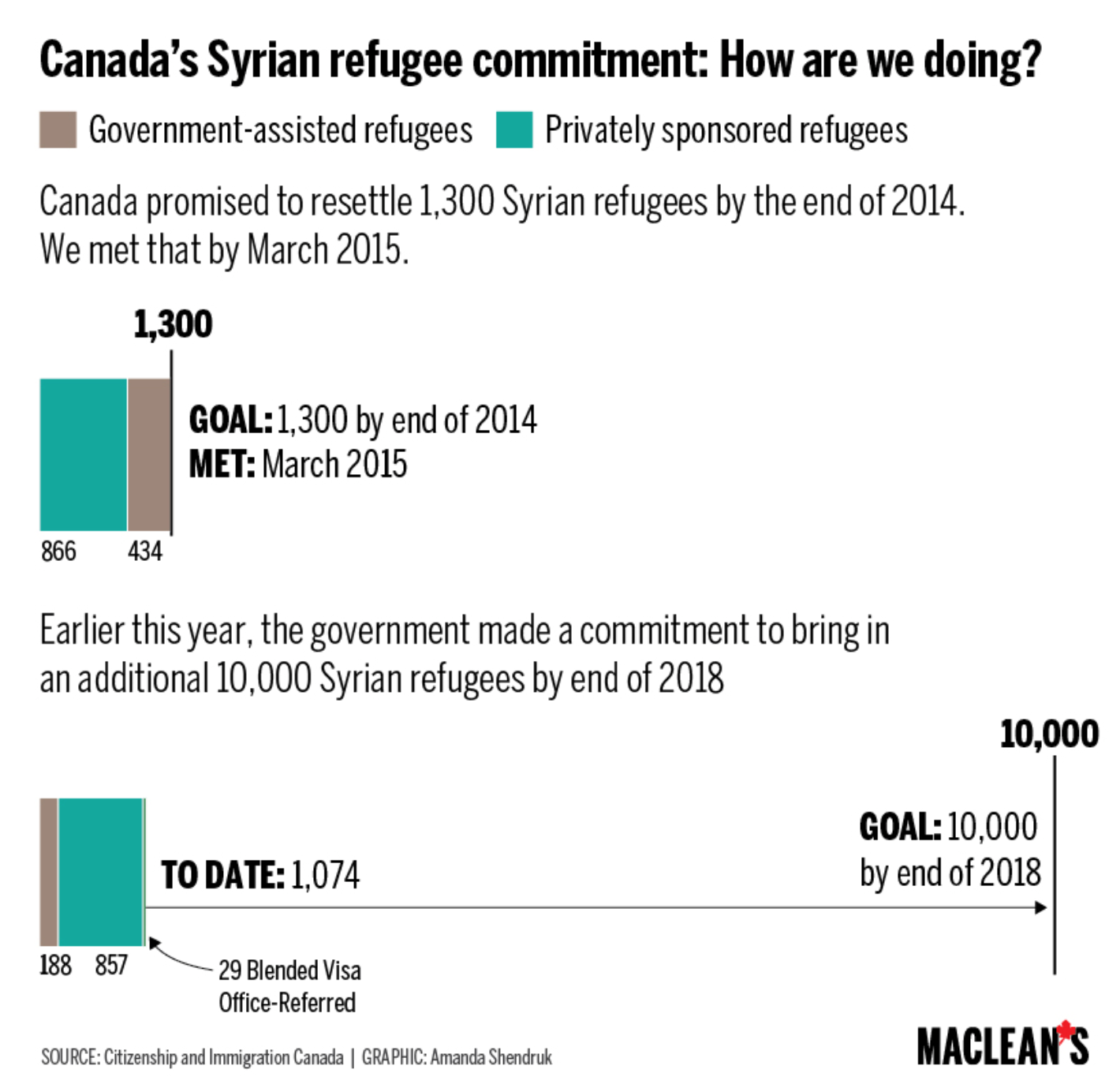
Harper’s view is that only a three-pronged effort has a chance in Syria: accept more refugees and do it faster; give more humanitarian aid; continue to participate in the military campaign.

As he said once, “Laureen and I had the same reaction, but it doesn’t lead to the same conclusion. Our message is (also) we need to help people who are actually there, who can’t get away, and stop the violence being directed at them. I do not know for the life of me how you can look at that picture and say ‘Yeah, I want to help that family’ and say walk away from the military coalition. … It’s incomprehensible to me to see an image like that and conclude you do more of one thing and less of another.”

It wasn’t perfect, but it was a responsible, intelligent and reasoned response to that picture, and on a day when others took an easier path, the one strewn with flowers, teddy bears, balloons and sentiment. Alan Kurdi’s story certainly should galvanize the world, not only to be stricken and weepy, but to fury.

Blatchford: Alan Kurdi’s story should galvanize the world — but Harper can’t be blamed for this tragedy

Tasha Kheiriddin explains a likely factor in the Government’s reluctance:

Harper’s words reveal the unspoken subtext of fear in the Syrian refugee crisis: this new wave of migrants and refugees come from a country where the West is not only directly involved in a war, but in a war with an organization that threatens to take the fight beyond its borders, to our own shores. The fear isn’t simply that these refugees pose a security threat because there could be terrorists among them. The fear is that they pose a social threat — by bringing with them a worldview that could be at odds with the pluralist, secular and socially-liberal societies in which they seek sanctuary.
The fear is that even though the refugees are fleeing the depredations of ISIS, they will not integrate, but seek to change the fabric of their new societies against the will of the current citizenry. It’s a fear grounded in the experiences of European nations like Great Britain, France, the Netherlands and Sweden, which have witnessed social problems ranging from demands for gender-segregated swimming pools, to Islamic “takeovers” of local public schools in Birmingham, to riots in the banlieues of Paris.
It is grounded here at home in the debate over the former PQ government’s Charter of Values in Quebec, incidents of segregation at a Toronto public school and the federal government’s opposition to the wearing of niqabs during citizenship ceremonies.
No one wants to acknowledge the elephant in the room, but if the Syrian refugees are to be saved, someone must. It would be fallacious to deny that practices such as gender segregation, the wearing of the niqab and the subordination of man-made law to that of the divine would make it difficult for any immigrant to integrate into mainstream western society. But it’s just as wrong-headed to assume that all Muslims live this way, or that other religious groups already established in our country, such as the polygamous sect members of Bountiful, B.C., don’t also hold beliefs that conflict with those of the majority.
The answer is not to turn our backs on refugees from Syria, or refugees from any Islamic country, but to impress upon them and on all immigrants that immigration is a two-way street. Newcomers have the rights to their religion, beliefs and practices — but not if those practices violate the norms of the societies to which they must adapt. Values such as equality of the sexes, equal treatment for persons of different sexual orientation, freedom of association, and separation of church and state are not up for negotiation. Any “reasonable accommodation” must be just that: reasonable.
It’s the task of a mature democracy — and compassionate leadership — to find a way forward in this and future refugee crises, and to re-establish Canada’s reputation as a haven for those who need our help.

What’s holding us back from helping the Syrians? Fear.

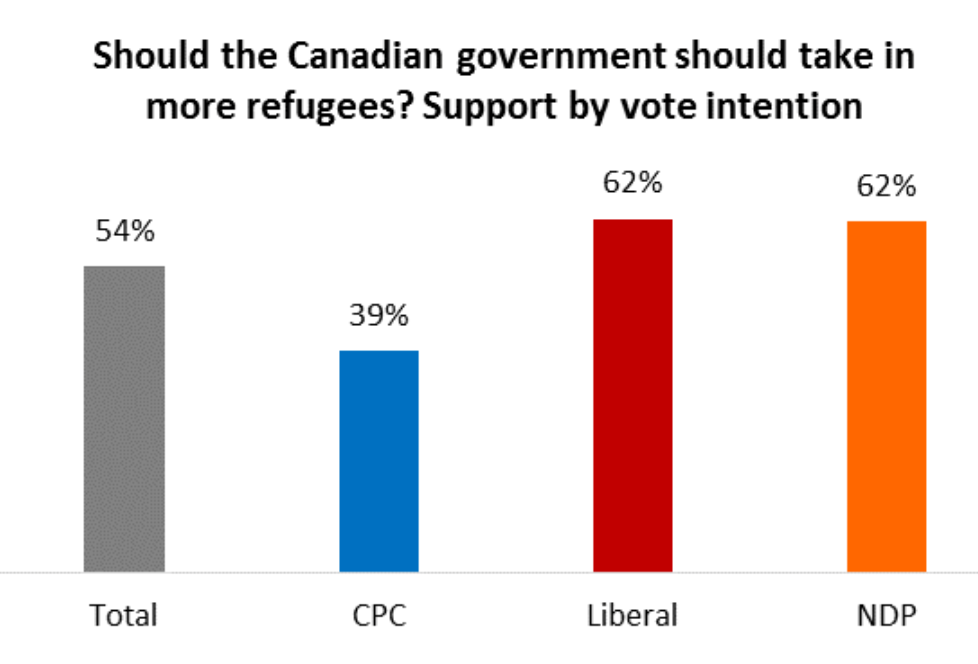
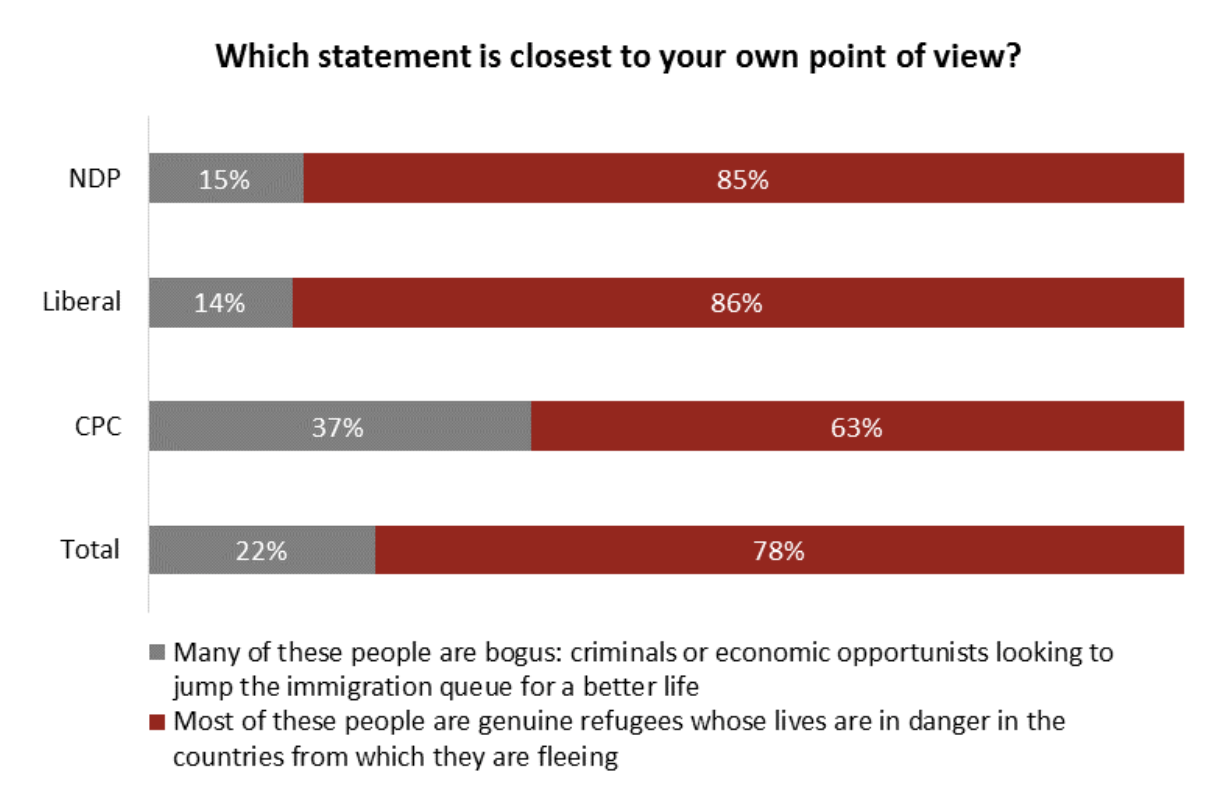
Public opinion polling helps explain the different party positions.
Bogus_refugees_or_notAngus-Reid conducted a useful poll, breaking down opinion by party affiliation, showing the Government’s position is aligned to the Conservative party base and messaging of “bogus refugees”, with the overall key findings being (all parties):

  • Overall, most Canadians (70%) say Canada has a role to play in the migrant crisis, but are divided on increasing the number of refugees the government sponsors and resettles here, and on seeing government spend more to make it happen. (54% and 51% support each, respectively)
  • A significant gender difference exists on whether the people fleeing to Europe from the Middle East are seen as “genuine”: Canadian men are twice as likely as women to say the migrants are “bogus”
  • As to what exactly this country should do, Canadians are most supportive of sending medical and armed forces professionals into the affected European countries areas to assist refugees, divided on taking more refugees and least supportive of “doing nothing”

Canadians divided along political lines over whether to accept thousands of refugees in current crisis
Is Harper’s terror bill terrifying — or just redundant? – Kheiriddin

On the remarkable political cynicism of the Government with respect to security according to Tasha Kheiriddin:

So why have the Tories chosen to create new offences instead? Three words: the 2015 election. Enforcing existing legislation isn’t sexy. You can’t take ownership of Section 46 of the Criminal Code — it’s been there for years. But you can talk ad nauseum about the new tough anti-terror laws you’ve created. It’s perfect fodder for the doorstep and a great distraction from the dismal economy — and the Conservatives know it.

And public opinion polls suggest enough Canadians are on board to make this a winning issue. A recent Nanos survey found that 66 per cent of Canadians agree with the PM that we are at war with terrorists. Sixty-five per cent of respondents agreed that the “government should have the power to remove websites or posts on the Internet that it believes support the proliferation of terrorism in Canada.” Forty-eight per cent of Canadians feel the system is not up to the task at the moment, vs. 44 per cent who believe the situation is satisfactory.

Bill C-51 neatly taps into all these concerns, while leaving a major issue unadressed: Who will be watching the watchers? According to Ottawa, there’s enough oversight already. On CTV`s Question Period, Parliamentary Secretary to the Minister of Public Safety Roxanne James said, “We are not interested in creating needless red tape.”

That’s a slap in the face to our Five Eyes allies, all of whom have more extensive oversight mechanisms in place. Creating such measures in Canada would not be a waste of money or admission of weakness. It would be a nod to common sense — especially since C-51 does not have a sunset clause, as previous anti-terror legislation did.

Bottom line: The new bill represents electioneering at its finest. While it improves intelligence-sharing and gives authorities more powers to detain suspected terrorists, it presents privacy concerns, curbs freedom of speech, and duplicates existing offences, while foregoing any increase in oversight.

Canada’s existing treason law — the one the Crown used to hang Louis Riel