Tasha Kheiriddin: Re-election is more important to Trudeau than supporting Canadian Jews

A bit over the top but yes, diaspora communities influence all parties and governments. But I fully expect the PM will visit Café Landwer and his initial messaging was strong. But of course the changing demographics have an impact. That 23 Liberal MPs called for an immediate ceasefire, along with recent mixed messaging, reflects, in part, that there are 114 ridings where Muslims form more than 5 percent of the population, compared to 13 ridings where Jews form more than 5 percent:

The Israel-Hamas War has shocked the world on many levels: the brutality of the Oct. 7 attacks against Israeli civilians, the propagation of disinformation by supposedly reputable news outlets, and the overt antisemitism on display in academia, politics and public demonstrations. The concept of decolonization, so fashionable in left-wing circles, has been turned against a people who for over a millennium have been persecuted, stateless, and the victim of racial hatred. Yet today, Jews are being cast as villains, in a manner that would make even Shakespeare blush.

In Canada, the conflict has also done something else. It has definitively exposed the true motivations for Liberal government’s seemingly incoherent and milquetoast foreign policy. Instead of standing for principle and the interests of our nation and its allies, the Trudeau Doctrine is dictated by diaspora politics and his party’s re-election prospects. This is true not only of its positioning on the current conflict, but on every major foreign policy issue in the past year.

It began with the Liberals trying at all costs to avoid a public inquiry into Chinese electoral interference. In February 2023, the Globe and Mail broke the story of how China implemented a sophisticated strategy to engineer the return of a Liberal minority government and defeat opposition Conservative politicians in the 2021 election. Allegations about this had been swirling for months, including reports on Chinese interference in the previous 2019 election.

But instead of seeking answers, Trudeau sought cover. He appointed “special rapporteur” David Johnston to examine the issue, effectively kicking the can down the road. Months later, Johnston quit in disgrace when the House of Commons demanded he resign after he had conveniently concluded that interference claims were based on “limited and partial intelligence” and thus did not warrant an inquiry.

Yet months later, when Trudeau was given information by CSIS that the agency was “actively pursuing credible allegations of a potential link”  between India and the killing of a Canadian Sikh separatist gunned down in the parking lot of a temple in Surrey, the government leapt into action.

Trudeau first raised the issue privately with Indian Prime Minister Narendra Modi at a G20 meeting in New Delhi. When that didn’t achieve the desired result, Trudeau publicly accused India of involvement in the crime in September, setting off a diplomatic firestorm that continues to burn. Canada’s trade mission to India was cancelled, 41 of our diplomats in India have been recalled, and our Indo-Pacific Strategy lies in ashes less than a year after it was unveiled.

Why did Trudeau act in such an incoherent way on these issues? Well, it’s math. A glance at the Canadian electoral map shows the importance of the Sikh and Chinese diaspora vote in both British Columbia and Ontario. There’s also the matter of Trudeau’s supply and confidence agreement with the NDP, led by Jagmeet Singh, who was strongly supportive of Trudeau’s stance.

And now, as war rages once again in the Middle East, there’s the Muslim vote to worry about, in electoral districts in Scarborough and the 905 belt around Toronto, as well as in Montreal. With the Conservatives soaring in the polls, ridings like Mississauga-Lakeshore, which the Liberals kept in the past byelection, could be in jeopardy if Muslim voters switch allegiances or stay home.

So once again, Trudeau is letting domestic policy dictate foreign policy. And this time, he’s not only throwing the Jewish community under the bus, but the values Canadians cherish, including the protection of minorities from hatred. And this weekend provided yet another example of that.

On Oct. 21, Trudeau visited a mosque and tweeted, “As members of the Palestinian, Arab, and Black Muslim communities gathered for prayer yesterday, I wanted them to know this: We know you’re worried and hurting. We’re here for you. We will not stop advocating for civilians to be protected and for international law to be upheld.”

Yet on the same day, a Jewish-owned business in Toronto was targeted by protesters waving Palestinian flags and screaming to boycott the “Zionist café.” Social media was flooded with images of hundreds of people mobbing the windows of Cafe Landwer while frightened patrons sat helplessly inside.

Trudeau’s response? We’re still waiting.

Source: Tasha Kheiriddin: Re-election is more important to Trudeau than supporting Canadian Jews

Kheiriddin: The ‘decolonization’ movement will condemn us to the brutality of our past

Valid commentary on the limits of “settler colonial” and decolonization language. Assume NDP MPP Jama is not going to leave Canada despite being “a politician who is participating in this settler colonial system.”

While history is always being reviewed and revised, that it is different from being erased, as we have to know the past in order to bring about a better present and future:

After 24 hours of outrage, Ontario NDP MPP Sarah Jama has apologized.

On Tuesday, Jama posted on Twitter that she was “reflecting on my role as a politician who is participating in this settler colonial system, and I ask that all politicians do the same. #FreePalastine (sic).” This was followed by a lengthy statement in which she condemned Israel, where, she said, “For 75 years, violence and retaliation rooted in settler colonialism have taken the lives of far too many innocent people.”

This earned her a rebuke — but not a demand for resignation — from NDP Leader Marit Stiles. Jama now says that she understands “the pain that many Jewish and Israeli Canadians, including my own constituents, must be feeling.” But as of Thursday morning, her original post remains up, and Jama remains in caucus.

Jama’s statement illustrates the absurd lengths to which the “decolonization” movement has been taken. Today, the word “decolonization” has lost all meaning. It has become a trope for overthrowing whatever order someone finds offensive.

Decolonize Palestine of Jews. Decolonize Canada of white people. Decolonize language of words that might cause offence. Decolonize the math curriculum of Eurocentric “ways of knowing.” Never mind that much of modern mathematics was developed by Arabic mathematicians — history doesn’t matter, only dogma does.

But history does matter. And in modern times, a lot of it is revisionist. It fails to note that many of the colonized people of today were once colonizers themselves, and vice versa. Jews may be considered settlers in Israel by some people in 2023, but they were subject to thousands of years of oppression there, including by the Roman Empire, the Crusaders and the Ottoman Empire.

As a result, the Jewish people became scattered throughout the world, and had no haven to flee to when Adolf Hitler dragged six million to the gas chambers, before finally being allowed to return to their ancestral homeland.

In North America, the descendants of Irish Catholics would be considered “settlers” by Indigenous people. But Catholics in Ireland were displaced by British and Scottish settlers in the 1600s, setting off centuries of conflict, the partition of Ireland and Northern Ireland and the Troubles, which claimed over 3,500 lives at the end of the last century.

In Canada, Quebec francophones would also be considered “settlers” today, despite themselves having been conquered by the British at the Battle of the Plains of Abraham and spending 200 years seeking to become “maître chez nous” (masters in our own house), mostly but not exclusively by political means.

Canada’s First Nations were also both conquered and conquerors. Over the past 500 years, Indigenous people were systematically colonized by Europeans, who moved into their territories, waged war on them and eradicated their traditional way of life through the reserve system, the pass system, residential schools and other means.

But before the Europeans arrived, Indigenous nations made war on each other, engaging in both guerrilla tactics and sophisticated battles. The Haida Nation routinely conducted slave raids down the West Coast. The Iroquois Confederacy warred with the Huron-Wendat. War was as much a part of Indigenous societies as it was in other parts of the world.

Today, few people talk of these things: Indigenous peoples are portrayed as harmonious and peace-loving, while non-Indigenous people are seen as aggressive and violent. But we should talk about them, and in light of what’s happened in Israel, maybe we finally will.

Human history is a miserable river of blood, and all our ancestors bathed in it. We will never erase the sins of the past. All we can do now is move forward and decide what we will and will not tolerate today and in the future.

We can choose to stand for the principles of human rights and dignity. We can stand for equality of races and sexes. We can stand for the rule of law and democracy. We can say never again will we force children into slavery, or “re-education,” or murder them in their beds.

These concepts, it should be noted, are not “colonial.” As African political philosopher Olúfẹ́mi Táíwò writes in his brilliant work, “Against Decolonization: Taking African Agency Seriously”: “The problem is that many of our decolonizers too easily conflate modernity and westernization.”

For example, he rejects the argument that capitalism is colonial and discusses how colonialism actually blocked the economic aspirations of millions of Africans. Táíwò does not reject things such as western legal systems and the scientific method simply because they were not derived from African thought. He argues that to do so implies that colonized people have no agency and cannot decide for themselves what path to follow.

The colonization lens has become a trap that pits group against group, nation against nation. It ignores the common principles that led to the recognition after the Holocaust that war was not “a continuation of politics by other means,” as Carl von Clausewitz famously put it, but something to be avoided. If we’re ever going to put a stop to the cycle of violence, we must first stop dividing ourselves into “colonizers” and “colonized” and recognize that we are all just one thing: human beings condemned to sharing space with each other.

Terrorism, such as the atrocities perpetrated by Hamas last weekend, doesn’t make the world a better place. It won’t create an independent Palestine. It won’t lead to progress of any kind, for anyone. All it does is drag us back to the brutal past from which humanity has striven for centuries to escape.

Source: The ‘decolonihttps://apple.news/AjKtDEd9rQ0qMsa39ekIv5Qzation’ movement will condemn us to the brutality of our past

Kheiriddin: Pierre Poilievre’s path to victory could run through the culture wars

She may well be right given that most of these resolutions were carefully crafted and reflect issues that many may feel activists and advocates have been excessive in their demands and approaches. And her point on that voters may have different views on each of these resolutions appears likely:

The Conservative policy convention has come and gone amid a hail of plaudits, photo-ops, and favourable polls. Leader Pierre Poilievre has managed to unite the party faithful and win over Canadian voters, by tapping into their economic angst and fatigue with Prime Minister Justin Trudeau, who is increasingly seen as out of touch, and out of time.

But the convention also opened a new political fault line: the culture wars. Delegates voted that children should be prohibited from gender-related “life-altering medicinal or surgical interventions,” upheld women’s rights to single-sex spaces and sports, and rejected mandatory diversity, equity, and inclusion training and race-based hiring practices. A majority also supported allowing Canadians to refuse vaccines on the grounds of “bodily autonomy.”

Pushback was swift. A former Conservative candidate who is trans said a vote against gender-affirming care could cause some children to commit suicide. A local riding president warned against reopening the vaccine debate. But most of the criticism came from the media and analysts who say the culture wars are a distraction that will hurt the Tories at the polls, like the “barbaric practices” tip line did in the 2015 election. Poilievre has a huge lead, based mostly on economic issues: why blow it? People only care about the rent and the grocery bill; these other concerns will not inform their political choices.

For some voters, however, these issues are highly motivating. Research firm Angus Reid Institute recently asked Canadians what they think about the culture wars, and identified two groups of voters who strongly engage on them: “zealous activists” who favour “progressive” policies like pronoun use and represent 17 per cent of voters, and “defiant objectors” who reject such changes and constitute 20 per cent of the electorate. Broken down by party affiliation, a clear pattern emerges: 47 per cent of Canadians who voted Conservative in 2021 are defiant objectors, while only three per cent of Liberal and NDP voters are.

But while 44 per cent of NDP voters are zealous activists, only 22 per cent of Liberal voters are, suggesting that there is much less dogmatism in this group.

For the parties, this means picking their battles and carefully choosing their bedfellows. The culture wars are not intersectional. Parents who object to the medical transitioning of children do not necessarily support restrictions on abortion. Advocates for women’s only spaces don’t necessarily believe people should be able to refuse vaccines. They may also be uncomfortable lining up with people who do.

Angus Reid will be publishing more data in the weeks to come on specific issues, but their findings on gender identity align with the results of the Conservative convention: 43 per cent of Canadians say parents should both be informed and give consent if a child wants to change how they identify at school, while 35 per cent believe that parents should be informed but consent is not required. Those who supported the Conservative Party of Canada in the 2021 federal election are twice as likely as past Liberal voters (64 per cent to 30 per cent) and three times as likely as past NDP voters (20 per cent) to say parents’ consent is needed. At the Conservative convention, the resolution outlawing medical transition passed on the convention floor with 69 per cent.

Perhaps unsurprisingly, the three words that came up most often in the survey to describe the culture wars were divisive (60 per cent), exhausting (59 per cent), and unnecessary (40 per cent). Pundits who say they are a side issue are wrong: they have seeped into Canadians’ daily lives. Their kids go to school and are told to state their preferred pronouns on the first day of class. Their grandmother goes to an aquafit program and is uncomfortable changing alongside men in an all-gender locker room. They attend DEI sessions where they are shamed for their skin color and just “go along” so as not to get cancelled.

As pollster Nik Nanos observed, although some may see risk on the social-policy front, the reality is that the Conservatives don’t need every voter: they need about 36 per cent. “A majority could oppose their social conservative agenda and they can still win an election.” And a silent majority could guarantee it.

Source: Pierre Poilievre’s path to victory could run through the culture wars

Tasha Kheiriddin: Principal’s death shows that schools are focusing on the wrong things

While I wouldn’t make the same generalizations about all DEI courses and programs, this case highlights the risk of an overly aggressive and ideological approach, one that the Board and administrators failed to address. No need to “throw the baby out with the bathwater” but clear need to vet and monitor consultants to ensure respectful and balanced approaches:

By now, you have probably heard the tragic story of former Toronto District School Board (TDSB) principal Richard Bilkszto, an esteemed educator with 24 years’ experience. In 2021, he attended two TDSB-mandated diversity, equity and inclusion (DEI) sessions, led by the KOJO Institute, during which the facilitator, Kike Ojo-Thompson, berated him for challenging her statement that Canada was a more racist place than the United States.

“We are here to talk about anti-Black racism, but you in your whiteness think that you can tell me what’s really going on for Black people,” she allegedly said, and then reportedly proceeded to berate him in a second session as a “real life” example of someone supporting white supremacy.

Bilkszto, who himself had spoken out against racism during his career, was devastated. Bilkszto went on stress leave and sought support from Ontario’s Workplace Safety and Insurance Board, which found he had been subject to workplace harassment. When he got back from leave, the board refused to reinstate his contract. He then filed a civil suit against the TDSB, seeking additional damages and an apology.

But Bilkszto never fully recovered from the pain caused by the damage to his reputation and his soul. On July 13, he ended his life. According to a statement authorized by his family, “The stress and effects of these incidents continued to plague Richard. Last week he succumbed to this distress.”

Bilkszto’s heart-rending story made headlines across Canada and around the globe. A petition has been started, demanding an inquiry into his death. The Toronto School Administrators’ Association also requested a review. And on Monday night, Ontario Education Minister Stephen Lecce asked officials to “bring me options to reform professional training and strengthen accountability on school boards so this never happens again.”

Bilkszto’s story resonates so deeply because it is an indictment of the failure of DEI training to achieve one of its stated goals: inclusion. Instead of making space for all voices, Bilkszto was shut down because of his race. Worse yet, in our schools, this type of “training” is now competing for scarce resources with priorities such as safety and academic performance.

Recently in Winnipeg, a school administrator defended his district’s annual spending of nearly $850,000 on DEI programs , saying, “We want our children to be anti-racist because you’re either a racist, or you’re an anti-racist.” In British Columbia, a government official stated that the province’s anti-racism plan for K-12 “is an important part of our work to decolonize our institutions and build a better B.C. for everyone.”

But is this “decolonization” and anti-racism education improving interpersonal relations between teachers and students? In B.C., nine in 10 teachers report experiencing violence or bullying on the job. The aforementioned school district in Manitoba, Louis Riel, saw a 263 per cent increase in unsafe behaviour by students last year.

In Nova Scotia, 87 per cent of teachers say that school violence has increased since 2018 and over half have been victims of violence or threats. And in Toronto, the TDSB is projected to have its most violent year since it started collecting data in 2000.

Meanwhile, student performance is declining. While Canada continues to perform well compared to other OECD countries, between 2000 and 2018, Canada recorded a 14-point decline in standardized reading scores, as well as declines in math and science scores classified as “steadily negative.”

Inequity is rooted in poverty, which has many factors, including race. But correcting for it comes down to resources, not words, applied in the right places.

Instead of hosting DEI sessions to berate their staff, school boards should redirect funds to tutoring low-income students who need extra help. They should fund food programs for kids who are hungry so they can concentrate and learn. Physical education, which has been directly correlated with improving educational scores, should increase. Self-esteem is rooted in achievement, and that should be the goal for every student.

Telling a principal that his whiteness is the problem does not help a single Black kid graduate. What it does do is divide, bully and shame. And sometimes, worse.

Source: Tasha Kheiriddin: Principal’s death shows that schools are focusing on the wrong things

Kheiriddin: Abortion policy is the tool. Authoritarianism is the goal.

Of note and interesting parallels among disparate countries:

This week, Mike Pence made it clear: he would ban abortions when pregnancies aren’t viable. The former Vice President, now candidate for the 2024 Republican nomination, expanded on his anti-abortion position, which includes a federal ban at six weeks gestation, such as Iowa has now imposed, and outlawing the sale of mifepristone, an abortion pill that the FDA approved twenty years ago.

“I want to always err on the side of life,” Pence told AP News. “I would hold that view in these matters because … I honestly believe that we got this extraordinary opportunity in the country today to restore the sanctity of life to the center of American law.”

It seems illogical, not to mention inhumane, to outlaw abortion when there is no chance a fetus can be born alive.  One is not saving a life, because that life will end before it comes to term. And one may be taking a life: a non-viable pregnancy can kill the woman carrying it, as evidenced in a recent lawsuit challenging an abortion ban in the state of Texas.

Forcing a woman to carry a fetus fated to die is also psychological torture of the highest order. Every time a stranger asks about her pregnancy, every time she catches a glimpse of her swollen abdomen in the mirror, every time she thinks of the child she wanted but who is not to be, she is made to suffer. There’s nothing Christian about that.

But that does not matter to Pence. He needs to mobilize the votes of the religious right to win the GOP nomination. He has the pedigree: he championed their issues in the White House during the Trump administration and since then only hardened his stance. “I am pro-life and I don’t apologize for it,” Pence told Face the Nation in April. He argued this week that restricting abortion is “more important than politics” and calls it the “cause of our time.”

Share

That’s where the clothes come off the emperor. Pence is no defender of the American Constitution, nor is he a conservative. He is a religious autocrat. Founding father Thomas Jefferson famously declared that when the American people adopted the First Amendment, they built a “wall of separation between the church and state.” Christian autocracy flies in the face of this dictate, basing policy not on evidence, reason, or debate, but on the tenets of a specific faith. It violates the United States Supreme Court’s neutrality test that requires that government be neither the ally nor the adversary of religion.

But the American religious right isn’t concerned about this. It has friends in high places. Domestically, it now has the Supreme Court on its side, as evidenced by its overturning of Roe v. Wade. And internationally, it has a lot of disturbing company.

One of those is Hungary’s Fidesz Party, that came to power in 2010 under Viktor Orban. In 2022, the European Union Parliament condemned Orban for creating an “electoral autocracy” that restricts the rights of the judiciary, LGBT individuals, the press and ethnic minorities.  That same year, Orban set his sights on Hungary’s abortion law. It currently permits terminations up to twelve weeks in cases of rape, risks to the mother’s health, serious personal crisis, or a severe foetal disability. But by decree, the Hungarian government now requires that pregnant women must listen to the foetal heartbeat prior to making their decision, similar to laws enacted in Texas and Kentucky.

This is no coincidence. In 2022, Orban addressed the American Conservative Political Action Conference, proclaimed his nation “the Lone Star State of Europe” and said, “The globalists can all go to hell. I have come to Texas.” (Note to my Canadian readers: Orban’s fandom is not just limited to American Conservatives. Just this month, former Prime Minister Stephen Harper, who now heads the International Democrat Union, called for greater ties between conservative parties worldwide, including the Canadian Conservative Party and Fidesz.)

Iran’s Islamic theocracy is another regime infamously hostile to human rights, including those of women. In September 2022, 22-year-old student Jina Masa Amini was killed while in police custody. Her “crime” was not wearing her hijab tightly enough, in contravention of Iran’s strict religious dress codes. Amini’s death sparked nationwide and then worldwide demonstrations under the motto “Woman, Life, Freedom”. In her home country, more than 500 Iranians were killed in the protests and five sentenced to death between September 2022 and April 2023.

As for abortion, it is illegal in Iran unless a fetus is diagnosed with a genetic disorder or the mother’s life is endangered.  But the government has now upped the ante. In May 2023, Iran’s Center for Population Rejuvenation created a volunteer militia called Nafs (life) to identify doctors and clinics performing abortions, and shut them down. Iranian media have dubbed the group the “[Anti] Abortion patrols analogous to the same type of hijab enforcement units that arrested Amini.

Then, there’s China. In 1980, faced with a rising birth rate, China imposed a one-child policy. Millions of women were forced to terminate additional pregnancies, and due to a cultural preference for male children, hundreds of thousands of girls were aborted, abandoned or killed. In 2016, China repealed the policy due to an imbalance of the sexes and low birth rate, resulting in an aging population and demographic decline.

At first glance, China’s policy appears to be the polar opposite of religious pro-life policies that restrict abortion, but it’s driven by the same principle: removing bodily autonomy from women in the name of the state. China’s goal isn’t religious, but secular: the manipulation of the birth rate to ensure a steady supply of workers and soldiers to carry out the nation’s ambitions. And to ensure that the “right” children are conceived, namely, ethnic Han Chinese.

What all three nations have in common is not piety, but ethnic nationalism. The real drivers for their abortion and fertility policies are low birth rates among “desired” groups, coupled with aging populations.

Iran’s Supreme Leader Ali Khameni has described population growth as one of the “most urgent duties and essential policies of the Islamic Republic as the leading Shia country in the Muslim world.” Pregnancies are being documented to prevent abortion “so that the population of the country could grow.” Hungary is not only making access to abortion more difficult, but decreeing that women with four children will be exempt from paying income tax for life. In China, whose population shrank this year and was surpassed by that of India, companies are paying employees to have children. But according to an Associated Press investigation, China continues to limit births – including by forced sterilizations — among ethnic minorities including the Muslim Uyghur population of Xinjiang. It further seeks to assimilate these cultures to achieve its policy of “ethnic fusion”.

Pence’s anti-abortion policies are right in step with those of these authoritarian regimes. They meld religious belief with white nationalism and state power. It is no secret that a majority of the Christian right in the United States subscribes to the Great Replacement theory, a conspiracy which claims that white America is being deliberately replaced by non-white immigrants.

Theocracies are not pluralist. They favour believers and condemn those who dissent to second class status, or worse. If Americans think Pence would stop at abortion, they are deluded. Any minority – defined by race, belief, gender or country of origin – would be in his administration’s sights.

If the Republican party is to truly preserve the Constitution, if it is to offer a truly conservative political option, it must reject authoritarianism, including Pence’s Christian autocracy. Otherwise, it will become just as statist as the Left that it condemns.

Source: Abortion policy is the tool. Authoritarianism is the goal.

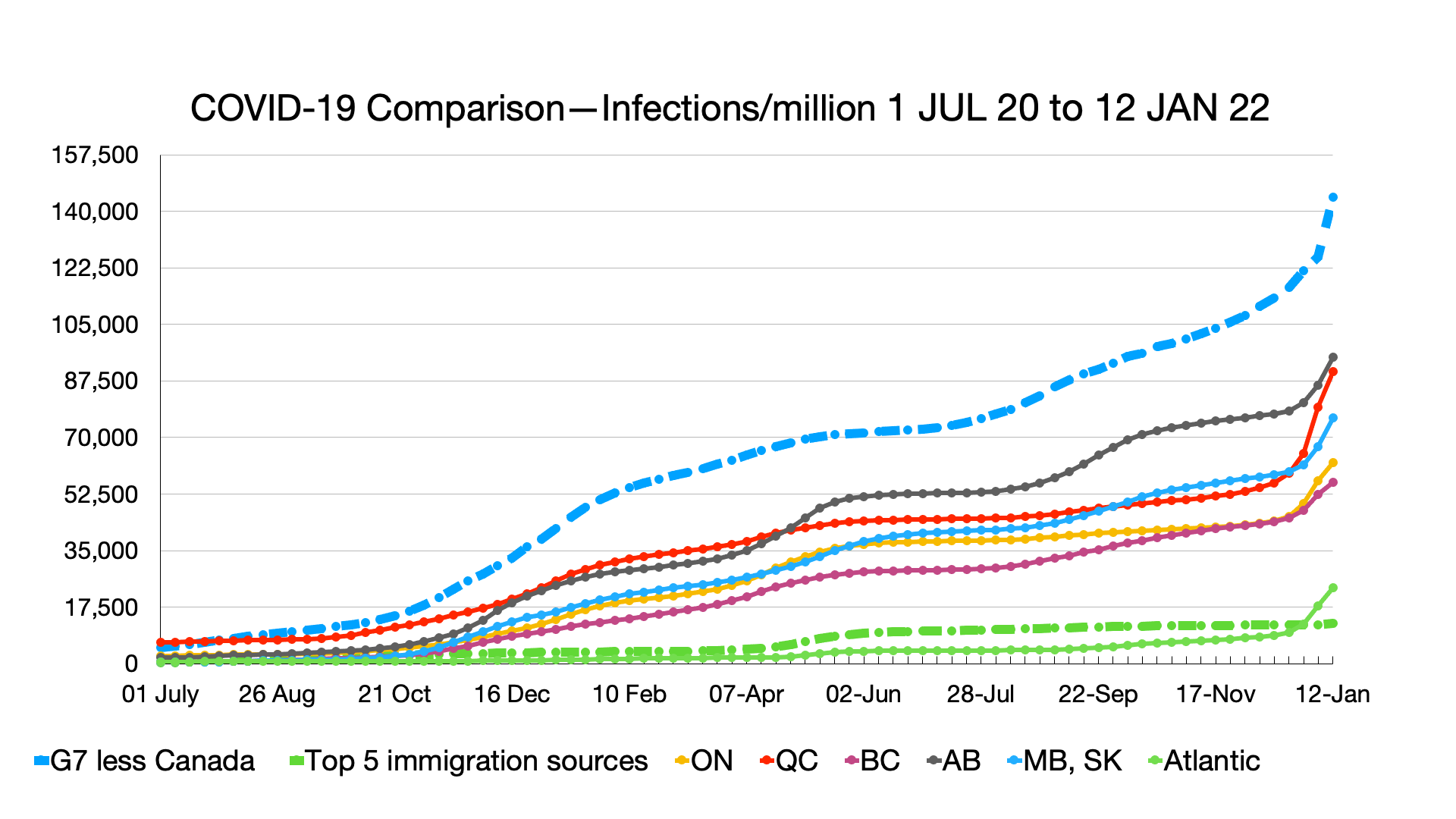
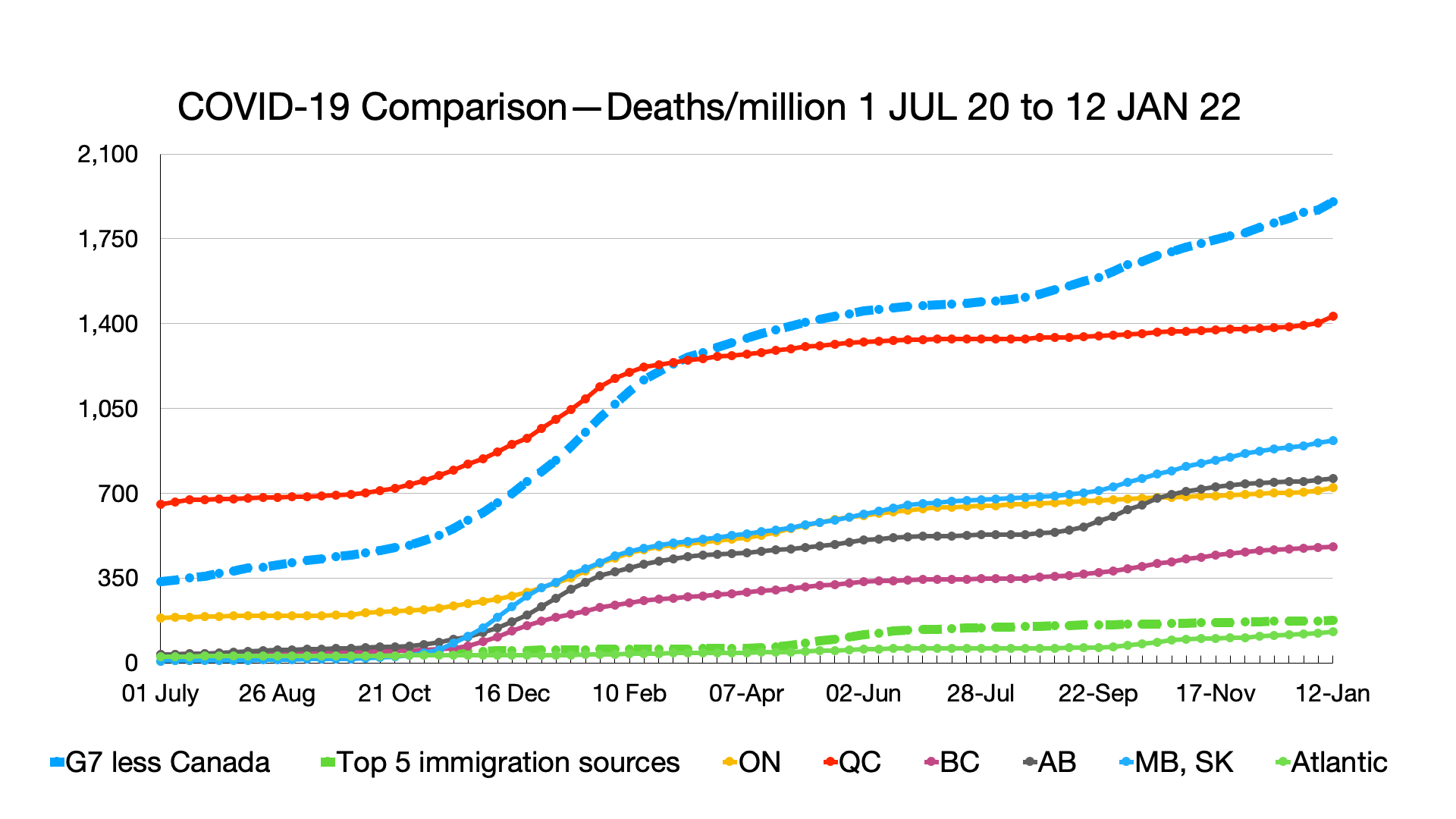
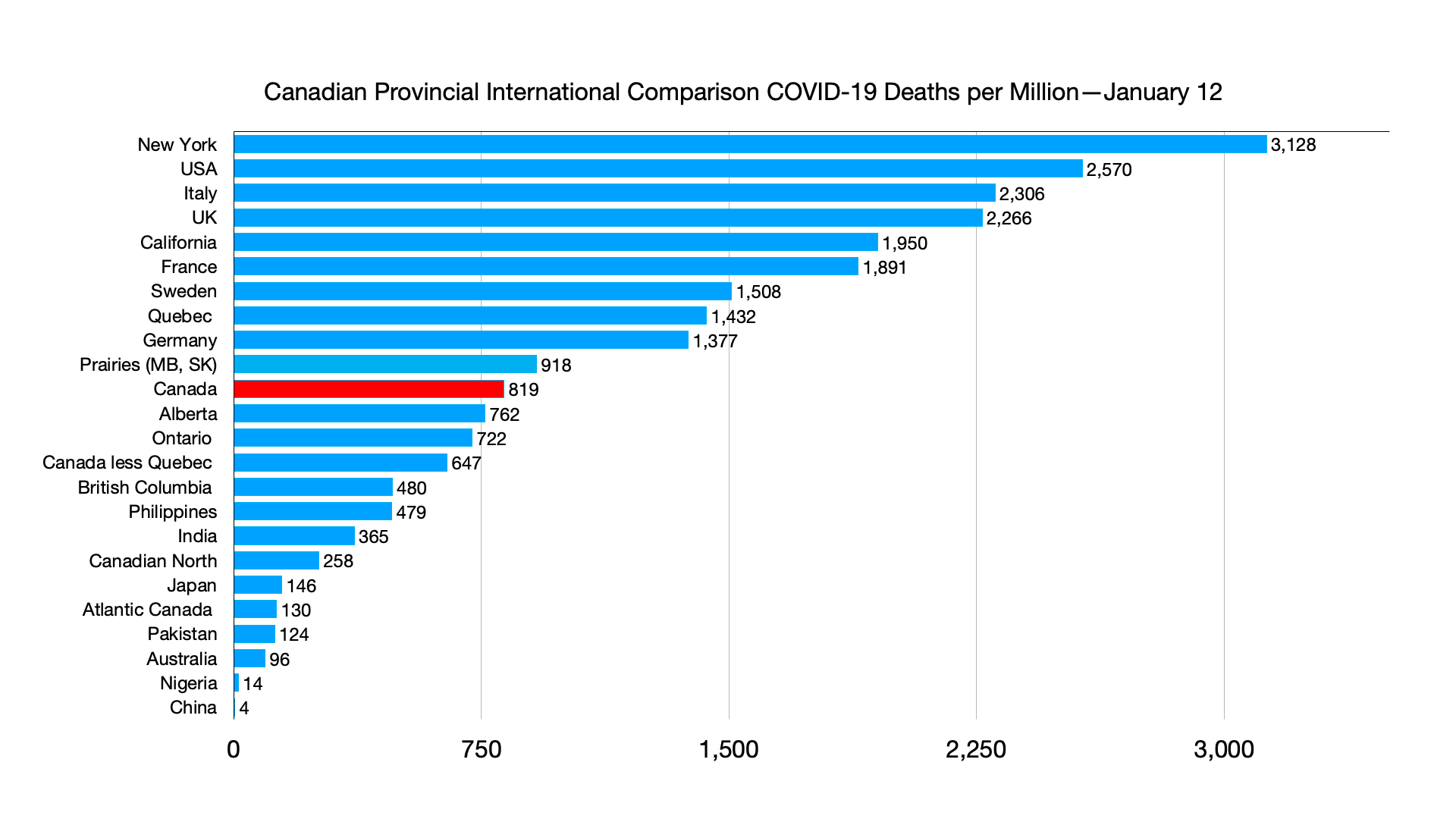
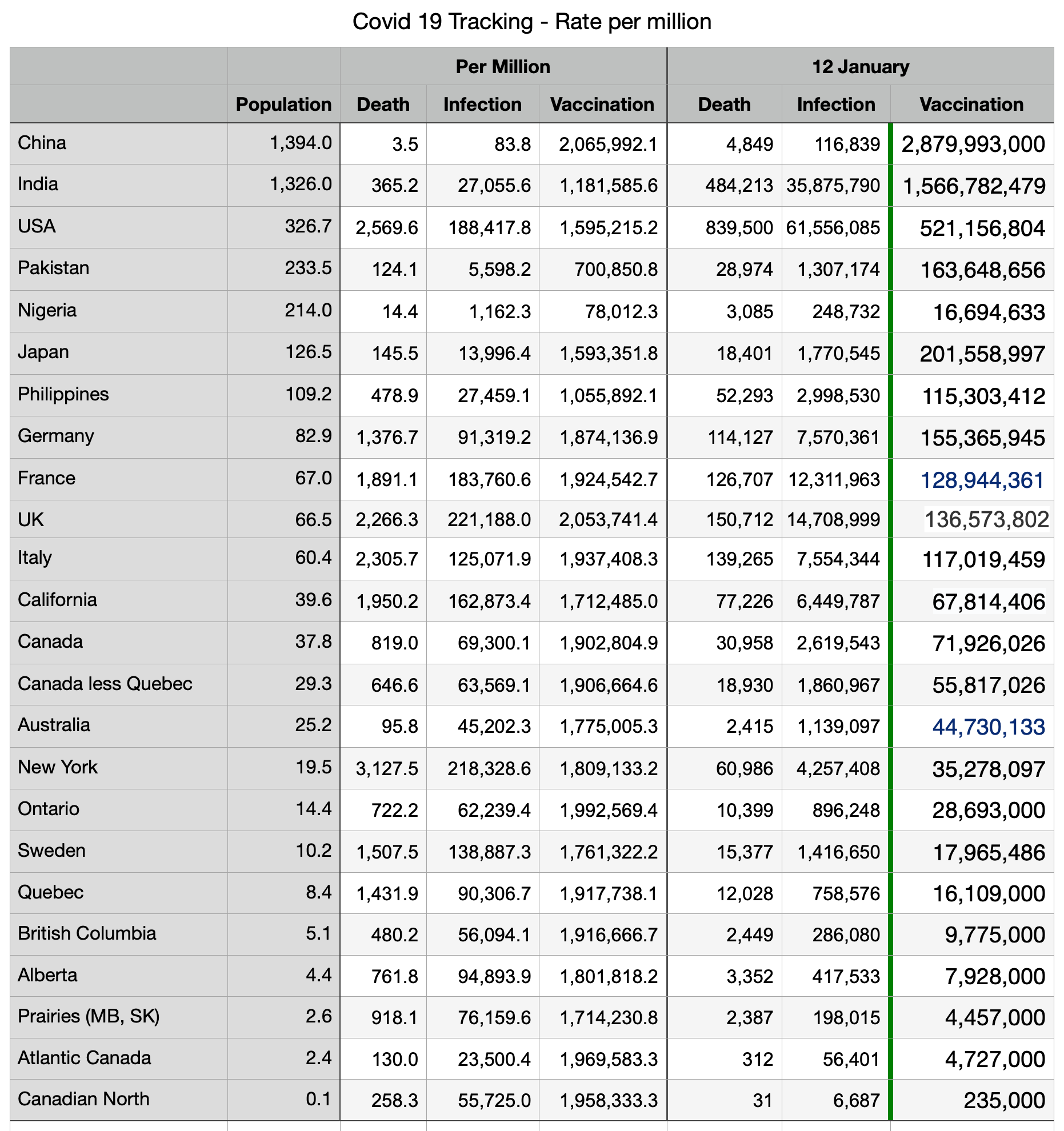
#COVID-19: Comparing provinces with other countries 12 January Update

Steep rise of infections remains the main story, along with resulting increases in hospitalizations and ICUs.

Vaccinations: Some minor shifts but general convergence among provinces and countries. Canadians fully vaccinated 78.7 percent, compared to Japan 78.8 percent, UK 71.4 percent and USA 63.4 percent.

Immigration source countries are also converging: China fully vaccinated 87 percent, India 46.8 percent, Nigeria 2.4 percent (the outlier), Pakistan 34.7 percent, Philippines 49.4 percent.

Trendline Charts:

Infections: Effects of Omicron seen in steep curve in all G7 countries and provinces. No such effect in immigration source countries

Deaths: No relative changes but slight uptick in Quebec.

Vaccinations: Ongoing convergence among provinces and G7 less Canada and narrowing gap with immigration source countries. Nigeria remains the laggard.

Weekly

Infections: Alberta ahead of Germany, Australia and Philippines ahead of India, India ahead of Atlantic Canada. 

Deaths: Atlantic Canada ahead of Pakistan.

Fair amount of commentary on Quebec’s announcement of a health tax on the unvaccinated, with most commentary opposed to the idea. A notable exception on the right side of the political spectrum, Tasha Kheiriddin:

What to do about the unvaccinated? As Omicron tears through Canadian society, this public health question has become a political wedge issue. The Liberals and Conservatives have chosen sides, ramped up the rhetoric, and polarized the debate, each playing to the base they think is most likely to support their point of view.

With 88 per cent of Canadians over the age of 12 fully vaccinated , the Liberals figure they’re pretty safe siding with the crowd that favours the jab. Regrettably, they have chosen the strategy of demonization. On Friday, Health Minister Jean-Yves Duclos speculated provincial governments would make vaccination mandatory, which he said could be needed to get “rid” of the virus.

During the election campaign Prime Minister Justin Trudeau called the unvaccinated “misogynists and racists.” He dialled that down a bit last week when he said that Canadians are angry at the unvaccinated who take up hospital beds, but his remarks caused a furor that has yet to subside. This is not accidental.

The sad reality is that there is a subset of the unvaccinated who fit Trudeau’s description; since September, for example, some have been using the hashtag “Pureblood” on social media to self-identify as unvaccinated. You don’t have to scroll far to find tagged images peppered with shots of white supremacy gestures or MAGA hats.

The Liberals’ dogwhistle is designed to conflate these people with mainstream Conservatives — and turn people off Conservative Leader Erin O’Toole’s call for “reasonable accommodation.” O’Toole is asking for “acceptance” of the fact that up to 15 per cent of the population will not get vaccinated. He favours using rapid tests to keep unvaccinated workers on the job, as opposed to shutting down to stop the spread of the virus.

“In a population that is now largely fully vaccinated, in fact the action and inaction by the Trudeau government is normalizing lockdowns and restrictions as the primary tool to fight the latest COVID-19 variant.”

But this approach is also wrong. First, it relies on unreliable technology. Rapid tests are not good at detecting Omicron infections, particularly in the early stage when a person is infectious but shows no symptoms. Second, it sends a double message. On the one hand, the Tories encourage people to “get vaccinated.” On the other, they make allowances for those who eschew the jab. It’s like saying “wear your seatbelt, but if you don’t, that’s OK.” Well guess what — it’s not. If you get in an accident, it will cost up to three times more to treat you in hospital than if you were buckled up. Sound familiar?

The reality is that we restrict plenty of behaviours where we judge the harm to others, including economic harm, outweighs the limits to individual liberty. We don’t allow people to smoke in workplaces or public buildings. We forbid drinking and driving. And we mandate vaccination for contagious diseases such as measles if children are to attend public school. Why? Because otherwise your actions, or inaction, present a real risk of harm to someone else. They can cause quantifiable loss, in the form of sickness, suffering, even death (yes, last year 200,000 people worldwide died of measles , mostly children under five). People don’t live in a vacuum.

A liberal would cite Jean-Jacques Rousseau’s Social Contract, which called for government by popular consent; a conservative would point to Edmund Burke, who rightly observed, “Men are never in a state of total independence of each other.” In other words, there is no freedom without responsibility, no liberty without duty.

When it comes to vaccination, we should protect those who understand this truth from those who disdain it. Vaccine passports, restrictions on interaction and withdrawal of privileges are preferable to calling people names, forcing them to get the shot, or conversely accommodating a choice that puts others in harm’s way. Obliging those who opt out of vaccination to pay a penalty, such as the Quebec government is suggesting, is also a possibility. Such measures are not about cajoling or compelling, though if they do result in more vaccinations, that’s a good thing. They are meant to protect all of us who just want to move on from this once-in-a-century public emergency and get back to living our lives

Source: The unvaccinated must be deterred from harming others

Kheiriddin: Rebuilding the Tories’ ‘big tent’ starts with new Canadians

Somewhat bloated commentary, where Kheiriddin picks up on earlier arguments made by Tom Flanagan regarding the “fourth sister” of Canadian politics but broadens her arguments to include other issues:
In the aftermath of Canada’s 44th federal election, the Conservative party is at a crossroads. Under two successive leaders, Andrew Scheer and Erin O’Toole, it has attempted to rebuild its fabled “big tent,” and failed.
That tent has taken different forms over the years. From 1984 to 1993, with party leader Brian Mulroney in the Prime Minister’s Office, it was composed of an amalgam of Quebec nationalists, Ontario Red Tories and Western fiscal hawks. From 2006 to 2015, with Stephen Harper at the helm and in power, it comprised a microtargeted mix of suburban and exurban Ontario families, “bleu Québécois,” and the Western remains of the Reform Party.

Source: Rebuilding the Tories’ ‘big tent’ starts with new Canadians

Kheiriddin: Boycotting Beijing 2022 may not change China, but it will spoil its glory

Of note and agree:

As the countdown continues to the 2022 Olympic Winter Games in Beijing, human rights groups called this week for a full-blown boycott, given accusations of China committing genocide against its minority Uyghur Muslim population and its recent suppression of basic freedoms in Hong Kong.

According to a coalition that includes Uyghurs, Tibetans and Hong Kong residents, “The time for talking with the IOC (International Olympic Committee) is over.” The statement comes the same week that the U.S. Congress is holding hearings on the issue, and days after the United States Olympic and Paralympic Committee said boycotts are ineffective and only hurt athletes.

Source: Boycotting Beijing 2022 may not change China, but it will spoil its glory

Conservatives, race and the chicken-and-egg question

Good column by Tasha Kheiriddin:

Are Conservatives more biased than other Canadian voters? They are, apparently — at least according to a recent Forum research poll on attitudes towards minorities.

The pollster asked 1,300 Canadians whether they had “favourable or unfavourable feelings” about a range of religious and racial groups, including Muslims, Jews, First Nations, South Asians and blacks. Respondents had a choice of three responses: “favourable feelings,” “unfavourable feelings” or “don’t know”. While four in 10 respondents overall expressed unfavourable feelings towards at least one group, that number rose to six in ten Conservative supporters, versus three in ten New Democrat, Liberal or Green voters.

Fifty-five per cent of Bloc Quebecois supporters also expressed these “unfavourable feelings”; 57 per cent of Quebecers did as well.

With regard to Quebec, the numbers are, unfortunately, not a surprise. The province’s long-standing fight to protect French culture from erosion by English and immigrant influences has long been tainted by expressions of xenophobia. In 1995, Premier Jacques Parizeau blamed “money and the ethnic vote” when his party lost its second referendum on separation. In 2007 the town of Hérouxville made international headlines for its “code of conduct”, which discouraged would-be immigrants from smelly cooking and helpfully reminded them that the “stoning of women in public” was unacceptable.

And in 2013, the PQ proposed a Charter of Values which would have banned the wearing of religious symbols by state employees, and which went so far as to include pictograms of verboten items, including kippas, turbans, crosses and headscarves.

When it comes to the expressions of bias by Conservative voters, however, the explanation seems somewhat murkier. Lorne Bozinoff, president of Forum research, suggested to the Toronto Star that the poll results might be linked to the party’s “dabbling” in identity politics, such as proposals by candidates Kellie Leitch and Stephen Blaney to screen immigrants for “Canadian values” or prevent them from voting while wearing a veil. “Whether they’re reacting to their base (of supporters) or they’re leading their base, there are those feelings,” Bozinoff said.

And that is the chicken-and-egg question. Are candidates like Leitch reacting to pre-existing opinion within the Conservative base, or fanning the flames to even greater heights? Are they trying to capture a ready base of support, or are they building one by rallying voters through identity politics?

open quote 761b1bWhile there exists a base of Conservative voters who hold anti-immigrant or anti-minority views, there aren’t enough of those voters to win power. But within the Conservative party itself, there might be enough of those voters to win the party leadership.

It’s a little of both. The Forum poll echoes sentiments expressed in previous research — such as an Ekos poll published last year which found that 41 per cent of Canadians thought “too many minorities” were immigrating to Canada. Broken down by party, 51 per cent of Conservative supporters held that view against 35 per cent of NDP voters and 32 per cent of Liberal voters holding that view — a clear difference that a candidate for the Conservative leadership mightchoose to target for political advantage.

And philosophical conservatives, as their name implies, traditionally seek to preserve the established order. Since the days of Edmund Burke, conservatives have been wary of rapid change and ‘progress’ for progress’ sake. So they tend to be more skeptical of immigration, particularly when immigrants come from faiths or ethnicities different from those of the majority population.

But conservatives also believe in liberty, the right to self-determination and freedom from tyranny and overbearing governments — something many immigrants are fleeing when they seek a better life on foreign shores. The challenge for the right is always in reconciling these beliefs while reining in xenophobic tendencies — which, when allowed to run amok in other places, have led to horrors such as the Holocaust, an evil even greater than the many left-wing revolutions conservatives condemn.

Here in multicultural Canada, it’s the responsibility of leaders of all party stripes to encourage cohesion rather than sow division. The 2015 federal election campaign revealed that doing so is also a surer path to government. While there exists a base of Conservative voters who hold anti-immigrant or anti-minority views, there aren’t enough of those voters to win power.

But within the Conservative party itself, there might be enough of those voters to win the party leadership. Which explains what we are seeing in the current Conservative race.

In the case of Leitch, this rhetoric rings particularly hollow for anyone who has followed her career. For decades — since her student politics days, in fact — Leitch was seen as hailing from the Red Tory wing of the then-Progressive Conservative party. People who have known and respected her a long time (this writer included) are mystified by her values pitch and sudden praise for Donald Trump — stuff that the Kellie we remember would never have said. Previous supporters and long-time friends, including former Senator Hugh Segal and head of the IRPP Graham Fox, have even distanced themselves from her campaign over her remarks.

The only way to explain Leitch’s abrupt U-turn into identity politics is that polls — and her campaign manager, Nick Kouvalis — encouraged her to go that route. But targeting anti-immigrant voters also means promoting their attitudes – and that is the truly objectionable part of the equation.

Sensible immigration policy does not mean demonizing differences, nor does it mean talking in code about “values”. It means correlating Canada’s labour needs with immigrants’ skills, ensuring that people who come here are equipped to succeed, not depend on the state, and showing compassion for those fleeing oppression and discrimination.

We already “screen” immigrants for those things. Calling for more is not sound policy. It’s just self-serving politics.

Source: Conservatives, race and the chicken-and-egg question

It’s a good year to be a racist creep: Note to Leitch: Maybe now is not the time to be sucking up to Trump – Kheiriddin

 Good column:

Is Donald Trump’s presidency paving the way for the ascent of the alt-right around the world — including Canada?

From French politician Marine LePen to British leader Nigel Farage, to a host of far-right European parties in between, the jubilation in certain circles is palpable. Le Pen, leader of the French far-right National Front (FN), told the BBC that Trump had “made possible what had previously been presented as impossible.”

“A new world is emerging,” she tweeted. “The global balance of power is being redefined because of Trump’s election.”

Farage, whose UKIP party exploited anti-immigrant sentiment to push the United Kingdom out of the European Union, met privately with Trump in New York on Saturday — to the great consternation of British Prime Minister Theresa May, whom Farage accused of “betraying the national interest” by not giving him an official go-between role.

Here at home, Conservative leadership candidate Kellie Leitch swiftly congratulated Trump on his victory. “Tonight, our American cousins threw out the elites and elected Donald Trump as their next president … It’s an exciting message and one that we need delivered in Canada as well.”

Trump’s message wasn’t simply anti-elitist, of course. It was anti-minority, anti-women and anti-democratic. Fast forward a few days, and Leitch was reduced to insisting she’s “not a racist” when defending her position to CTV News.

Not exactly the sound bite of the year, Kellie — and not an easy one to walk away from. Leitch might want to reconsider her vocal support for Trump’s message just as it’s being so wholeheartedly embraced by the American white supremacist movement.

However one describes Trump’s style of government (populist? fascist?) one thing is clear: It’s notconservative.

Andrew Anglin, proprietor of the Daily Stormer, a leading far-right website popular with neo-Nazis, said of Trump: “Our Glorious Leader has ascended to God Emperor. Make no mistake about it: we did this.” In a similar vein, former Klu Klux Klan leader David Duke said, “We won it for Donald Trump.” The KKK is planning a victory parade in North Carolina to celebrate Trump’s victory.

Trump himself is doing little to allay concerns that extremist views will animate his government. Instead, he appears to have swung the White House doors wide open to the alt-right. On Monday, Trump appointed Stephen K. Bannon as his senior advisor, to work “as equal partners” with new Chief of Staff Reince Priebus. Bannon was executive chairman of the Breitbart news website, which featured a headline that called conservative commentator Bill Kristol a “Republican spoiler, renegade Jew” and publishes a columnist named “Milo” who claims that feminism makes women ugly and birth control makes them “Unattractive and Crazy”.

However one describes Trump’s style of government (populist? fascist?) one thing is clear: It’s notconservative. Conservatism — of the Edmund Burke, William F. Buckley and Ronald Reagan variety — is dead. Those who condemned the French Revolution for its murderous rampages, championed the cause of individual liberty and decried the dictatorial regime of the former Soviet Union would be permitted to say little in the new Trump universe. The Republican party is now headed by a narcissistic demagogue who talks of reinstating the Assad regime in Syria, tearing up free trade agreements and teaming up with Russian President Vladimir Putin on foreign policy.

Buckley, considered the philosophical godfather of American conservatism, actually wrote about Donald Trump in 1990:

“What about the aspirant who has a private vision to offer to the public and has the means, personal or contrived, to finance a campaign? … Look for the narcissist. The most obvious target in today’s lineup is, of course, Donald Trump. When he looks at a glass, he is mesmerized by its reflection. If Donald Trump were shaped a little differently, he would compete for Miss America. But whatever the depths of self-enchantment, the demagogue has to say something. So what does Trump say? That he is a successful businessman and that that is what America needs in the Oval Office. There is some plausibility in this, though not much. The greatest deeds of American Presidents — midwifing the new republic; freeing the slaves; harnessing the energies and vision needed to win the Cold War — had little to do with a bottom line.”

It is wrenching to contemplate how the party of those great achievements, from Abraham Lincoln to Ronald Reagan, has come to be the party of a bottom feeder like Trump.

Source: It’s a good year to be a racist creep