More people should engage in politics so ‘no party gets to run against Muslim Canadians,’ Justin Trudeau says

Pitch perfect:

Galloway asked the prime minister for his reaction to the proposal to screen immigrants for “anti-Canadian values” put forward by federal Conservative leadership candidate Kellie Leitch.

Trudeau did not address Leitch by name. He said he told a group of Muslim-Canadians during a recent meeting that he was happy to have them as supporters. However, he said he suggested they encourage family members and friends to also get involved in politics, whether on behalf of the Liberals or another party that aligns with their values.

Media placeholder

“The other two political parties have leadership races on now. I’d like to see more Canadians of diverse backgrounds engaging with parties that line up with their convictions and ideologies to make sure that no party gets to run against Muslim Canadians or any other group of Canadians and demonize them,” Trudeau said.

“And I think the way we do that is getting involved in the whole breadth of the political spectrum in Canada. I’m happy when people decide they are more aligned with me and my party, but they should also think about being active and aligned with parties that disagree with me on certain issues.”

Galloway also asked the prime minister about how his policy, which has brought more than 35,000 Syrian refugees to Canada in just over a year, contrasts with that of U.S. president-elect Donald Trump and some politicians across Europe, who advocate for a more closed approach on refugees.

“I’m not going to answer whys,” he said. “I’m just going to continue to point out the facts that the way Canada is benefiting from welcoming in people who are so deeply committed to living up to the opportunity given to them.”

He added, “I challenge any one of those governments or those citizens to sit down around a table like this and break bread and not be afraid of the other.”
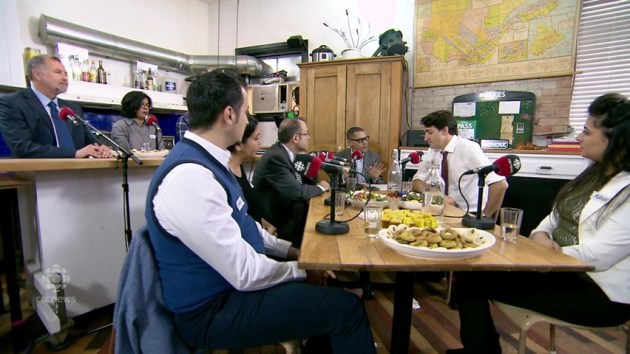
Source: More people should engage in politics so ‘no party gets to run against Muslim Canadians,’ Justin Trudeau says – CBC.ca | Metro Morning

Syrian exodus to Canada: One year later, a look at who the refugees are and where they went

Really good analysis and charts in the Globe regarding Syrian refugees (sample below):

Across the country, Syrians have arrived in new neighbourhoods and schools and, as with so many waves of immigrants before them, both the refugees and the communities that receive them will be changed by the experience. As Canada marks the first year of this initiative, we take a closer look at Syrian refugees through the demographic data.

syrian_exodus_to_canada__one_year_later__a_look_at_who_the_refugees_are_and_where_they-went_-_the_globe_and_mailOther charts highlight family size (larger than expected), education (most high school or less), aged (most under 18), knowledge of an official language (about 40 percent, mainly English).

Source: Syrian exodus to Canada: One year later, a look at who the refugees are and where they went – The Globe and Mail

Getting Syrians here was easy. Now comes the hard part.

Good long read by Michael Friscolanti:

But as accurate as that may be, the Trudeau government has no firm statistics on how many Syrian refugees are actually earning a paycheque. This much is certain, though: to expect that every family will be self-sufficient after 12 months is wishful thinking.

“Some will do better than others,” says Carolyn Davis, executive director of Catholic Crosscultural Services, a settlement agency that also provides training courses for private sponsors. “Some will probably be independent and no longer requiring assistance before month 13, some will be independent by month 13, and some will not be independent by month 13. It would be very hard for me to put any numbers or proportions on that, but there will be people in every single one of those circumstances.”

That some government-assisted refugees end up on social assistance is hardly new. Departmental figures show that in 2009 (the latest stats available), 49 per cent of government-sponsored refugees who had arrived two years earlier were collecting welfare (compared to 19 per cent of privately sponsored refugees). Although most gradually wean off (50 per cent after the second year, 75 per cent by the fourth), a proportion stay dependent on welfare for the rest of the their lives.

“I think, as Canadians, we need to wrap our heads around that,” Douglas says. “These are refugees. These are not people who made a choice to come to Canada. These are folks who have been running for their lives, who have experienced things we can’t even begin to imagine, and as a country, we absolutely have to understand that we will always have refugees who will never be able to work.”

Indeed, it’s important to remember that government-assisted refugees are specifically flagged by the UNHCR because they are considered the most vulnerable of the vulnerable. They aren’t chosen because of job skills.

“In general, people are going to need to have a realistic viewpoint of the maximum you can expect,” Desloges says. “There is so much hopefulness and joy around the program right now, which is wonderful, but not everyone is going to succeed. You’re going to have some superstars who are going to grab this opportunity with two hands and become something wonderful, but we have to be realistic in our expectation. Just be grateful that we were able to save some lives.”

In the meantime, though, cities are bracing for month 13, well aware that a significant number of Syrians will soon transfer from federal to provincial assistance, at least temporarily. “It’s a big challenge, there is no way around it,” says Qaqish, the city councillor in Ottawa, which has welcomed more than 1,500 Syrians. “The province pays for social assistance but the municipalities administer it. We’ve asked the feds if they are open to the idea of extending federal assistance, maybe for another six months.”

Like others, Qaqish worries that some refugees will no longer be able to afford their rent because many landlords initially lowered prices in a show of solidarity with the Syrian program. Some stakeholders also fear the optics: a refugee collecting a welfare cheque is hardly the stuff of photo-ops.

“One refugee that fails resettlement is not acceptable, because it means we as a society failed to make sure those people integrated,” says Rabea Allos, director of the Catholic Refugee Sponsors Council, an umbrella organization for private sponsorship groups. “You don’t want, a year or two down the road, for Canadians to become upset with the refugee program and believe that some people are abusing the system. They will say: ‘You know what? Let’s stop getting refugees in.’ This is the concern. We want the program to work so Canadians will continue this compassion toward bringing more refugees.”

Source: Getting Syrians here was easy. Now comes the hard part. – Macleans.ca

Not enough resources for Syrian refugees in Canada: poll

Encouraging high level of overall support despite funding concerns:

Canadians generally support the Liberal government’s response to the Syrian refugee crisis, but many think there are not enough resources in communities to support their resettlement, according to a new Nanos Research/Globe and Mail poll.

The poll of 1,000 Canadians found that 68 per cent support or somewhat support the government’s overall response to the Syrian refugee crisis, while 30 per cent oppose or somewhat oppose it. The government has resettled nearly 27,000 Syrian refugees since December of last year, with plans of welcoming thousands more throughout 2016.

“Canadians have given the Trudeau government a green light on this Syrian refugee crisis,” said pollster Nik Nanos. “The one thing that they are concerned about is whether we have the necessary resources to resettle these refugees in our communities.”

When asked if communities have all of the resources they need, such as housing, language training or social services, to resettle Syrian refugees, 61 per cent of Canadians disagreed or somewhat disagreed. On the other hand, 33 per cent agreed or somewhat agreed.

Chris Friesen, settlement services director of the Immigrant Services Society of B.C., said he was not surprised by Canadians’ concerns about the lack of settlement resources at the local level.

“Here in British Columbia for example, we’ve had over the past two years a 15-per-cent cut in the immigrant settlement and language program funding,” said Mr. Friesen. “The types of programs and supports we are seeing that are in short supply range from settlement-informed trauma support programs, a diversity of language programs, [and] additional children and youth programming.”

Mr. Friesen said there is a particular need for youth support, as close to 60 per cent of recently arrived Syrian refugees are under the age of 18. He said many Syrians also have medical issues – physical and mental, including post-traumatic stress disorder – stemming from their experiences during the conflict that require support.

Previous housing problems appear to be nearly solved. For instance, Mr. Friesen said his organization knows of about only six or seven Syrian refugee families still in hotels. During the height of the government’s efforts to resettle 25,000 Syrians before the end of February, Toronto, Ottawa and Vancouver asked the government to stop sending more refugees there for a few days as they struggled to house the large number of people who had already arrived. As of this week, 97 per cent of government-assisted Syrian refugees had moved into permanent housing, according to a government official.

The official said refugees are using the government services available to them. For instance, language assessments have been done for close to 80 per cent of Syrian resettlement clients over the age of 18, and 34 per cent of those assessed have begun language training.

Settlement funding will be increasing for all jurisdictions this year, the official also said. In addition to a base settlement fund of $588.6-million this fiscal year (outside of Quebec), the federal government has provided $38.6-million as a supplement to help deal with the arrival of the Syrian refugees and will kick in another $19.3-million through the budget, for a total of $646.5-million.

Source: Not enough resources for Syrian refugees in Canada: poll – The Globe and Mail

John McCallum promises probe into immigration consultants’ fees for Syrian refugees

Unfortunately, there are always those who will seek to profit from these situations:

Immigration Minister John McCallum says he has ordered a three-part investigation into the practice of immigration consultants charging Syrian refugees thousands of dollars to process applications and possibly violating federal rules on private sponsorship by asking them to pay resettlement costs that should be paid by their sponsors.

“We are very concerned about this, and we want to explore all avenues as to possible wrongdoing,” McCallum told Rosemarie Barton on CBC’s Power & Politics Tuesday.

The minister was responding to a CBC News investigation that found that some immigration consultants are charging Syrians who want to come to Canada under the private sponsorship program between $3,000 to $6,400 per person to process their applications.

The investigation also found that some consultants are asking refugees to pay the cost of their resettlement in Canada up front before even arriving in the country. Under federal rules, these costs are supposed to be covered by private sponsors, not refugees, for a full year. Refugees can contribute to their settlement costs once they arrive in Canada but cannot be made to prepay or repay them, according to Immigration, Refugees and Citizenship Canada (IRCC).

McCallum said he has asked for investigations on three fronts:

  • Law-enforcement agencies will determine whether any laws have been broken.
  • The Immigration Consultants of Canada Regulatory Council (ICCRC), which oversees immigration consultants in Canada, will determine whether any of its rules have been broken.
  • Immigration, Refugees and Citizenship Canada will determine whether any sponsorship agreement holders have violated federal rules. If they did, those agreements could be nullified.

“I do think it’s a serious allegation. Given how generous the vast majority of Canadians have been, it leaves a bad taste in the mouth,” McCallum said. “With this three-front investigation, we should get some answers.”

McCallum said the investigation will also look into why immigration consultants are getting involved in the refugee sponsorship process at all.

“I don’t see why they’re there,” he said.

Source: John McCallum promises probe into immigration consultants’ fees for Syrian refugees – Politics – CBC News

Canadians’ response to refugee crisis, niqab debate showed ‘who we really are,’ GG says

Although the Twitterverse correctly noted that the political aspect of these remarks is inappropriate for a Governor General, nevertheless hard to disagree with the substance:

Gov. Gen. David Johnston says he was initially worried that the niqab debate and the tone of the discussion about the Syrian refugee crisis during the election would hurt Canada’s reputation as a fair and inclusive society.

Johnston made the comments in an exclusive interview with CBC chief correspondent Peter Mansbridge for The National, explaining that ultimately he was reassured by the way Canadians responded.

“Look at the outcome of those two, quote, crises,” Johnston said. “Look at how Canada has managed the Syrian refugee crisis in an exemplary way.

“And look at the debate with respect to the niqab. I think Canada showed its strength, that that should not be, should not sidetrack us from who we really are.”

Johnston added that even though the niqab debate has passed he remains concerned about the possible introduction of ideas that would hurt Canada’s reputation.

“I continue to worry about any initiatives that would cause us to be small-minded, and to lose that sense of A, inclusiveness, B, fairness, C, equality of opportunity,” Johnston said, while warning against any sense of complacency.

“I think we must work constantly to overcome that and to have the larger view, but I’m very optimistic that those voices, those ideas are by no means scarce in Canada. I find them abundant,” he said in the interview airing tonight on The National.

Source: Canadians’ response to refugee crisis, niqab debate showed ‘who we really are,’ GG says – Politics – CBC News

ICYMI: Ankara’s citizenship plan for Syrian refugees raises Kurdish worries

The politics of citizenship:

Turkey’s Kurdish lawmakers say the government’s decision to gradually grant citizenship to over 3 million Syrian refugees in the country’s Kurdish cities can disturb the population makeup of the area and incite ethnic tensions.

“We support efforts to embrace and help the refugees but the government’s plan is not assistance, it is part of a wider political game to strengthen its roots here,” said Mahmoud Togrul, a member of parliament from the pro-Kurdish Peoples’ Democratic Party (HDP) in the city of Entab.

Togrul believes Ankara is exploiting the refugee crisis, and by giving voting rights to the Syrian migrants it plans to secure votes ahead of the 2019 elections.

“Most of the Syrians will choose to stay in Turkey and that will be decisive in the coming elections,” he said.

According to the Turkish law, applicants will be granted citizenship after five years of residence in the country. This makes the bulk of the Syrian refugees eligible candidates for Turkish citizenship in the coming years, and able to vote in the next elections.

Official data also show that nearly 152,000 children have been born in Turkey whose parents came as refugees from Syria.

Ankara has said by getting citizenship, the refugees will have brighter prospects in the labor market and reduce the overall migration to Europe.

As part of an agreement with the European Union, called the Facility for Refugees in Turkey, Ankara will be receiving 6 billion euros over the next three years and resume the EU membership talks that stalled in late 2000.

Critics say giving millions of refugees citizen status will serve the strategic plans of the ruling Justice and Development Party (AKP).

“There will be over 1 million new voters in the 2019 elections if the government goes through with the proposal, which will in turn change the outcome of the elections,” said lawmaker Erdogan Toprak from the opposition Republican Peoples’ Party (CHP), quoted by Turkish daily Hurriyet.

Toprak said the government plans to create settlements for the refugees with the financial help it will receive from the EU, influencing the demographic development in the southeast where Kurds are in the majority.

The majority of the Syrian refugees in Turkey are of Arab origin, along with large numbers of Kurdish and Turkmen asylum seekers.

“What is strategically important for the government is the bordering areas connecting Kurdish lands in Syria, Iraq and Turkey, which Ankara wants to influence by placing the refugees’ families there,” said Kurdish author Fehim Ashiq.

Source: Ankara’s citizenship plan for Syrian refugees raises Kurdish wor

McCallum reverses changes for intake of privately sponsored Syrian refugees

More flexible approach and response to criticism than the previous government:

Immigration Minister John McCallum is reversing changes to the private sponsorship of Syrian refugees program after a public outcry.

The Canadian Press has learned that the immigration department will now process all applications for Syrians received as of today with an eye towards getting a further 10,000 Syrians to Canada by the end of this year or early 2017.

Private groups were caught off guard after the government scaled back efforts to resettle Syrians once the Liberals achieved their goal of resettling 25,000 people by the end of last month.

In addition to cutting staff processing Syrian applications, the government decided to limit the number of cases it would accept this year.

The move prompted some sponsorship groups to question whether the Liberal government was truly committed to refugees and left many disappointed that it could take as long as a year to welcome Syrians to Canada.

In an interview with The Canadian Press, McCallum says the government is doing all it can to respond to a surge in demand that he called historic and unlikely to be repeated.

Source: McCallum reverses changes for intake of privately sponsored Syrian refugees – The Globe and Mail

Religious institutions [temple and mosque] form unlikely partnership to aid Syrian refugees

Good to see initiatives like this:

For years, the Temple Har Zion and the Imam Mahdi Islamic Centre (IMIC) have been neighbours, even sharing a parking lot, in Thornhill, Ont. Now, the unlikely partners are about to share a major responsibility – sponsoring a group of Syrian refugees.

The religious institutions have united to privately sponsor Syrian refugees to resettle in Canada. Together, they are pooling their resources to raise a target of $60,000 in the next couple of months.

Temple Har Zion Rabbi Cory Weiss says the co-operation is “groundbreaking” for both organizations.

“It brought us together in a way that nothing else has,” Mr. Weiss told The Globe. “The more we learn about each other’s religion, the more we realize we have in common.”

Alireza Torabian, who is leading the sponsorship efforts at the mosque, says the partnership sets a good example for other Canadians.

“We are very proud that we can start a project and show Canadians that different cultural groups and religions can work together in Canada on the same common cause,” he said.

Given their proximity to one another, there has always been a relationship between the synagogue and the mosque, but last fall, Mr. Weiss and the imam of the IMIC, Seyed Reza Hosseini-Nasab, met to get to know one another better.

In December, the synagogue decided it wanted to sponsor Syrian refugees and reached out to the mosque, which happened to be considering refugee sponsorship too.

The organizations teamed up and are now working with their refugee sponsorship agreement holder, Jewish Immigrant Aid Services (JIAS) in Toronto, which will help with the process once enough money is raised.

JIAS language and settlement director Lia Kisel said this is the first time she has worked with two religious institutions on refugee sponsorship.

“It makes you feel very proud because bridges are being built,” Ms. Kisel said.

Source: Religious institutions form unlikely partnership to aid Syrian refugees – The Globe and Mail

25,000 Syrian refugees in four months: How did Canada do it?

Rob Vineberg’s good summary of the mechanics of the Syrian refugee intake, in The Interpreter of Australia’s Lowy Institute for International Policy.

His conclusion is noteworthy:

How did Canada manage to meet such an ambitious goal? Ironically, it was the ambitious goal itself that galvanised the Public Service and the Armed Forces to develop innovative approaches. A smaller goal would have resulted in ‘more of the same’ and disappointing results. As Minister McCallum said: ‘One definition of real change is you’re doing something you’ve never done before.’

Source: 25,000 Syrian refugees in four months: How did Canada do it?