After the terror: A time for calm reflection, not policy on the fly – The Globe and Mail

Paul Heinbecker, in his call for reflection, notes an important aspect of Canada’s strength:

Fifth, as for Canada, we, like others, cannot be defeated by terrorists but we can grievously harm ourselves if we scare ourselves into sacrificing too much liberty and dignity for security.

In a world rent by xenophobia, Canada has stood out as a successful society that has profited from refugee flows and immigration better than any other country has done. We can do it again this time with Syrian refugees. We are rare in our capacity to integrate foreigners into our society and to make the consequent diversity a strength.

The example we set is heartening to many people abroad who admire what we achieve and who aspire to the same for their own societies. Our cosmopolitanism is an extraordinary strength that anchors our well-being in a global sea of instability. We should take the time to ensure that our domestic- and foreign-policy choices do not put it at risk.

Source: After the terror: A time for calm reflection, not policy on the fly – The Globe and Mail

Syria warns 2,000-year-old city is in danger of being ISIL’s next cultural atrocity

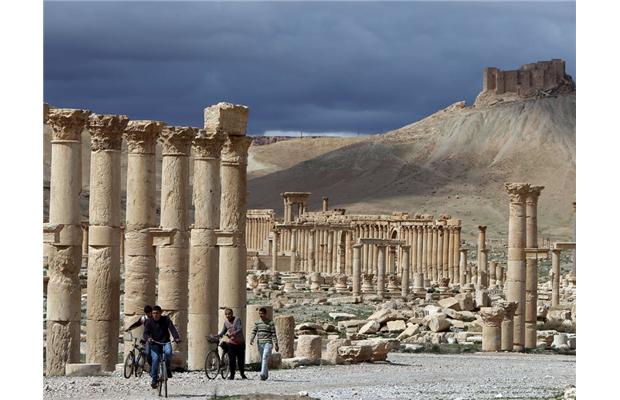
PalmyraSad. Another one of the places I visited many years ago and is a world cultural and historical treasure:

A Syrian official called on the international community Thursday to protect the 2,000-year-old ruins of the ancient city of Palmyra, now threatened by the advance of the Islamic State of Iraq and the Levant. Fighting between ISIL and Syrian government forces has come within 2 km of the 2,000-year-old UNESCO World Heritage Site, which once attracted thousands of tourists to its towering Roman colonnades and temple to the god Baal. If Palmyra falls into ISIL’s hands,

Syria warns 2,000-year-old city is in danger of being ISIL’s next cultural atrocity.

UNHCR counting on Canada to increase commitment to Syrian refugees

Will Canada respond? Will Canada meet its existing commitment?:

“Canada is a very important country to the UNHCR not only for the support it gives to refugee programs but also for the leadership that it provides in terms of international standards of global protection,” De Angelis said.

“This is another occasion for countries who have a leading role in global refugee protection to really show their strength.

”The UNHCR is making a pitch at meetings in Geneva on Tuesday for countries to help resettle more than 100,000 refugees from the Syrian civil war over the next two years.

The plea follows formal requests that began in 2013 for direct help getting some of the most vulnerable people out of refugee camps in Turkey, Lebanon, Jordan, Iraq and Egypt.

That year, Canada agreed to take in 1,300 refugees.

Private sponsorship groups were allotted 1,100 spots and the government agreed to directly resettle the rest.

While the government’s promise to settle 200 people has been met and exceeded, only 163 people being sponsored by private groups have made it to Canada as of the middle of November.

UNHCR counting on Canada to increase commitment to Syrian refugees – The Globe and Mail.

457 Syrian refugees resettled in Canada, but pledge was for 1,300

Sharp contrast between the Minister’s statements and the reality. Other countries (e.g., Sweden, with over 30,000) have done much better.

Not exactly inspiring and in keeping with best of the Canadian tradition (e.g. the Vietnamese boat people):

The document says that as of Nov. 13, 457 Syrian refugees have landed in Canada. That number includes 163 refugees sponsored by private groups and 294 sponsored by the government.

Alexander has repeatedly said more than 1,150 Syrians “have received Canada’s protection” in response to questions both inside and outside the House of Commons.

Groups working with refugees in Canada have said that figure is misleading as it likely includes Syrians who have arrived in Canada on their own and claimed asylum.

They have urged Alexander to do more to increase the number of refugees being resettled in Canada. So far, the government has only committed to 1,300 by the end of 2014.

That promise was made in July 2013 by Jason Kenney, who was then the immigration minister. Refugee sponsorship groups have warned for months the promise would be difficult to keep, given delays that already existed in processing applications.

The newly released document says the first privately sponsored refugee to land in Canada under the government’s promise only arrived in March of this year.   Another figure though, suggests there is a large number of Syrians who want to come to Canada as refugees.  It states that the immigration department received 2,343 applications for privately sponsored refugees from October 2013 to September 2014.

“It is important to note that the scale and scope of the Syrian refugee crisis will not be solved by resettlement alone,” the document said, echoing statements made by Alexander.

457 Syrian refugees resettled in Canada, but pledge was for 1,300 – Politics – CBC News.

Minister knew Canada wouldn’t meet Syrian refugee commitment

Caught out. At best, misleading the House and Canadians.

Four days later [March 25, 2014], C.I.C. officials told Alexander in a briefing note that the government “will not meet its Syrian private sponsorship commitment by the end of 2014” because “it takes time for private sponsors to organize and raise the funds to welcome a refugee to Canada.”

Highlighting the point, officials provided Alexander an update on June 10 that showed just 58 private sponsorship applications had been approved since January.

The update, which did not say how many, if any, had actually arrived in Canada, was provided the day before Alexander hung up on CBC’s As It Happens when he was being asked about the government’s response to the Syrian refugee crisis.

The minister later said he hung up because he was late getting to question period. But the incident prompted suspicions the government was lagging in its promise to resettle 1,300 Syrian refugees.

Alexander had repeatedly said more than 1,150 Syrians had received “Canada’s protection,” a figure he also cited in the House of Commons throughout the spring.

However, the documents show that number refers to all Syrian refugees accepted since 2011, including 942 who had travelled to Canada on their own before applying for asylum in the country.

Only 219 had actually been resettled from overseas, of which 93 had arrived in 2014 and would count toward the commitment to take in 1,300.

Liberal immigration critic John McCallum says the fact the Conservative government won’t meet its own “pathetically, ridiculously small” commitment demonstrates it has no real interest in accepting Syrians into Canada.

“They don’t care,” he said Friday. “It’s not a priority. If they cared, they could get the United Nations and people out in the field to give them huge numbers. There’s no shortage of needy people out there.”

NDP immigration critic Lysane Blanchette-Lamothe said the documents could explain why Alexander has been extremely evasive when asked to provide concrete numbers about how many Syrian refugees have arrived in Canada as part of its commitment to the UN.

“I would be very ashamed if I was the minister and I wasn’t able to fulfil such a small commitment in that massive crisis,” she said. “There’s nothing to be proud of in how the government has answered the international call.”

Always safer to stick to the truth, provide an explanation for some of the difficulties, rather than being ‘clever’ and  evasive. Eventually, the truth will come out.

Minister knew Canada wouldn’t meet Syrian refugee commitment | Ottawa Citizen.

ICYMI: Getting information on the ground on the Islamic State

Fascinating reporting in the Globe of some of the efforts to collect information on war crimes and other human rights violations:

There are risks, however, that come with sending investigators into a combat zone with armed opposition groups. Some outside observers worry about the reliability of the embedded investigators, in part because there is always a risk they could become involved in wartime atrocities themselves.

Documentation collected now could be dismissed by a future war crimes tribunal for multiple reasons. Questions about the investigators’ methods, issues with the way witnesses are interrogated, and errors in tracking custody of documents that are retrieved are all issues that could be picked apart by a defence team.

But many observers seem to believe the benefits of running an investigation now – rather than waiting until the conflict is over – far outweigh the risks.

Independent groups like the one investigating Islamic State also have a higher tolerance for risk than the more formal investigation by the United Nations commission of inquiry on Syria, which has produced reports on atrocities but is not focused on linking specific crimes to the individuals who may have ordered them.

“There is going to be an immense security challenge once the conflict ends,” one investigator said. “If the Syrians don’t want to endure a decade or more of terrorism, as experienced by Iraq, they’re going to need a security foundation, and that foundation will be built on information derived from investigations now.”

Getting information on the ground on the Islamic State – The Globe and Mail.

Canada’s true role in the Mideast conflict – Former PM Chrétien

Amazing op-ed and criticism of a current PM by a former PM: Jean Chrétien’s biting commentary on PM Harper:

For example, all the war in Iraq did was to make the region and the world a much more dangerous place. The legacy of colonialism in the Middle East had not been forgotten and was only exacerbated by the Western military intervention in Iraq in 2003, with the consequences we face today. Unfortunately, Mr. Harper did not understand that history in 2003, and he does not understand it today.

He basically articulates Liberal leader Trudeau’s dismissal of the military option but in a more sophisticated way, not incorrectly, and advocates, in concrete terms, what a meaningful humanitarian response would be ($100 m for the World Food Program for refugees, and accepting 50,000 refugees from those fleeing the Islamic State).

His defence of his government’s decision to participate in Afghanistan and assume the responsibility for Kandahar doesn’t quite jive with the excellent account by Janice Stein and Gene Lang in The Unexpected War: Canada in Kandahar, which, if I recall correctly, was led by DND advocacy, not the political level.

Canada’s true role in the Mideast conflict – The Globe and Mail.

Fowler: Half measures in fight against Islamic State will only make matters worse

Former Canadian Ambassador to the UN,  foreign policy advisor to Canadian prime ministers,  and kidnapping victim of an al-Qaeda offshoot in Mali, Robert Fowler essentially answers the question he poses at the end of his long and thoughtful commentary in the Globe.

Well worth reading:

Were we, though, to seriously seek to excise the jihadi malignancy – to stop those who are so clearly bent on destroying the underpinnings of our civilization – we would have to engage far more thoroughly than we seem willing to do. We would have to convince our so-called friends in Saudi Arabia and the Gulf States to stop – really stop – financing jihadi preaching and terror networks throughout the world. At home, we would need to make very clear that we will not abide jihadi teaching, jihadi recruiting, or the dissemination of jihadi propaganda.

Should we seriously seek to damage the barbarous IS, we would have to prepare for and then commit to a long and ugly war against an implacable enemy who is genuinely anxious to die in battle with us. In addition, we would have to abandon the inane restrictions we have so hurriedly and complacently put in place arbitrary time frames, no-boots-on-the-ground, and accept that it will take some up-close and personal combat to get the job done and that there will be casualties, among them a full share of innocents.

Finally, and however improbably in today’s politically correct context, we would have to “maintain the aim” – the removal of an existential threat to our way of life through the crippling degradation of al-Qaeda and its clones – and make it abundantly clear that until that mission were truly accomplished, such a struggle would not be about those nice, distracting things politicians would much rather talk about when they talk about such engagements: development, jobs, democracy, corruption, individual rights, gender equality, faith.

We would also have to accept that, to achieve such an objective, it would take vast budgets and clear-eyed focus over the long haul to convince Muslims in the West and throughout the world that such an engagement had nothing to do with jihadi allegations about crusades; indeed, little to do with religion of any stripe, but rather that global jihad was simply inimical to a peaceful world. Once such a mission were truly accomplished, then and only then could we turn our attention to reconstruction and development.

Short of all this, it’s not worth attempting, and we should walk away, right now: A flaccid attempt, such as that upon which we now seem to be embarked, will undoubtedly make matters worse.

Half measures in fight against Islamic State will only make matters worse – The Globe and Mail.

Roger Cohen Sees Hitler In The Desert « The Dish

The debate between Andrew Sullivan and Roger Cohen, starting with Sullivan:

Well, we all see mirages, I guess. But it says something about the hysteria about the latest incarnation of the Sunni insurgency in Iraq that we’re suddenly comparing them to Nazis and to non-humans. Even as Cohen himself acknowledges that “the Nazi death machine was unique. Facile invocation of it is too frequent, belittling the phenomenon and its victims.

”So why break Godwin’s Law so egregiously? Cohen wants us to believe, channeling Martin Amis and Primo Levi, that there was no “why” in the unconscionable unique act of the Holocaust.

And yet, mountains of evidence explain exactly why: it was a function of a vile racism that regarded the Jewish people as vermin that needed to be exterminated in order to allow the master race to flourish. It was not some random act of mass murder; it had a grotesque but clear and constantly trumpeted rationale. Then Cohen seems to endorse the idea that the Nazis were somehow unhumans or “counter-humans”, in Levi’s words. But that too, it seems to me, lets them off the hook. The Holocaust was a deeply human act – a function of humankind’s capacity, revealed throughout history, of extraordinary levels of hatred and violence, brought to new and unfathomable evil in the age of the industrialized state.

And equally, it is absurd to argue that “there is no why to the barbarism of ISIS.”This is after Cohen actually produces a long litany of reasons for ISIS’s brutality and evil, mind you, none of which he deems sufficient to explain the ISIS propaganda beheadings he watched on video. But why should we not take the Islamists’ word for it? They are committing slaughter and rape and attempted genocide for one core reason: because God demands that they slaughter infidels. Their mandate is beyond any human one but results in so-very-human evil.

Roger Cohen Sees Hitler In The Desert « The Dish.

From Cohen:

It is human to seek for reasons. Perhaps the rise of ISIS may be seen as the culmination of decades of Arab resentment at perceived Western domination, drawing support from the same anger as the Muslim Brotherhood and al-Qaeda before it; or as an expression of the abject failure of Arab societies; or as an armed Sunni response to the Shia-bolstering American invasion of Iraq; or as brutal payback for Abu Ghraib and Guantánamo (where, it must be said, there was scant “why” for prisoners detained for years and guilty of no crime); or as a well-funded offshoot of Saudi Wahhabism interpreted in its most literal form; or as a heady alternative for disaffected young Muslims to the moral void of Western civilization; or as evidence of the crisis of Islam and the inevitable Thirty Years War of its Sunni and Shia branches; or simply as a call to arms to drive out the United States the way the infidel Crusaders were ousted from the Levant.

Yet, in the end, there is no why to the barbarism of ISIS. There is no why in Raqqa. Evil may adduce reasons; they fall short. The Nazi death machine was unique. Facile invocation of it is too frequent, belittling the phenomenon and its victims. But I was given pause by Martin Amis’ afterword to his powerful new novel, The Zone of Interest, where he probes the “why” of Hitler and quotes both the icicle passage and another from Levi:

“Perhaps one cannot, what is more one must not, understand what happened, because to understand is almost to justify. Let me explain: ‘Understanding’ a proposal or human behavior means to ‘contain’ it, contain its author, put oneself in his place, identify with him.” Levi, referring to Hitler, Himmler and the rest, goes on: “Perhaps it is desirable that their words (and also, unfortunately, their deeds) cannot be comprehensible to us. They are non-human words and deeds, really counter-human.”

Roger Cohen: For ISIS, slaughter is an end in itself
UK: British Muslims right to fight in Syria backed by ex-adviser on radicalisation

A very different view from a former regional manager of the Prevent strategy (former anti-radicalization and extremism strategy):

A former senior government adviser on tackling radicalisation and extremism has defended the right of British Muslims to travel to Syria and fight.

Farooq Siddiqui, a former regional manager for the governments controversial Prevent strategy, said it was acceptable for Britons to “walk the walk” and travel to Syria to fight the forces of President Bashar al-Assad.

As part of a Facebook conversation Siddiqui, 45, defended the right of an individual to be called a martyr if he took up arms against Assad, and questioned whether those who fought against the Syrian president should face arrest upon return to the UK.

Former senior intelligence officials consider jihadists battling Assads government forces in Syria to be a potential threat. They estimate that up to 300 fighters have already returned to the UK from Syria. Scotland Yard has warned that Britain will live with the terror legacy of the Syrian conflict for years to come.

The foreign secretary, William Hague, believes as many as 400 British citizens may be fighting in Syria, recently confirming that security measures are in place such as the option of withdrawing leave to remain, cancelling passports and arresting UK jihadists who have been fighting in Syria or for terrorist group Islamic State in Iraq and the Levant (Isis), which has seized control of swaths of northern Iraq.

Siddiqui, who ran Prevent in the south-west until 2012, pointed out that Britons were free to join the Israeli Defence Force and return to the UK without censure, while those taking up arms against what they viewed as a tyrannical dictator, Assad, faced arrest. He says he knew “nothing about” Isis at the time of the online conversation in February. He does not support the group.

“One man’s terrorist is another man’s freedom fighter’ as the cliché goes, but one has to look at the nature, activities and goals of the organization and affiliation, not to mention potential longer-term implications (e.g., supporting the Mujahideen in Afghanistan which led to Taliban control and a base for Bin Laden).

But the worries regarding returning jihadists are legitimate. Their extreme views are incompatible with living in a diverse, open and democratic society.

British Muslims right to fight in Syria backed by ex-adviser on radicalisation | UK news | The Observer.