Discrepancy between Elections Canada, StatsCan reports likely due to social desirability bias

Of note. The limits of self-reporting and social bias:

Despite an 11-percentage-point discrepancy between self-reported and actual voter turnout, a recent Statistics Canada survey still provides valuable information on the electorate and voting trends, experts say.

The StatsCan survey, which relies on self-reporting, collected data by adding five election-related questions to the 2019 Labour Force Survey, which is distributed to approximately 56,000 households. The survey does not include Indigenous people living on reserve, full-time members of the Canadian armed forces, prisoners, and households in remote areas with very low population density.

Because the survey misses certain groups, it actually looks more like the electorate than the entire population, Richard Johnston, professor at the University of British Columbia and Canada Research Chair in public opinion, elections, and representation.

“The people who are missed by the survey tend to be the sort of people who are generally socially disconnected and are least likely to be subject to kinds of social pressure that get people to the polls,” Prof. Johnston said.

There was a similar gap between the reported turnout numbers after the 2015 election. Actual turnout in 2015, as reported by Elections Canada, was 68 per cent. The StatsCan post-2015 election report had self-reported turnout at 77 per cent, a difference of nine percentage points.

The data in the Elections Canada post-election survey is more accurate, said Lydia Miljan, University of Windsor political science professor, as the StatsCan survey relies on self-reporting. Prof. Miljan said the social desirability bias explains much of the discrepancy between the StatsCan survey and Elections Canada report.

“It’s not socially desirable to say, ‘I don’t vote’, so that’s why you always end up having a higher rate of self-reporting as opposed to what’s actually happening,” Prof. Miljan said.

Despite the discrepancy, Prof. Miljan said StatsCan’s report is valuable for the details it offers on demographic splits, which can “give a good trend analysis from one election to another.”

“If you’re trying to get inside the guts of social, psychological, or political differences in turnouts, these surveys are pretty good. It’s just that the baseline is too high,” Prof. Johnston said.

No interest in politics still top reason

A disinterest in politics was the top reason voters, in every age group except non-voters 75 years and older, cited for skipping out on the 2019 federal election, at 35 per cent, StatsCan’s report suggested. The same reason topped the list in the 2015 and 2011 federal elections. No data exists for prior elections, according to the agency, as the survey was inaugurated after the 2011 election. In 2019, the surveyed showed 23 per cent of Canadians did not vote.

Non-voters between 55 and 64 were the most likely to cite no interest in politics as the reason for not voting, at 38 per cent. Non-voters between 18 and 24, and 25 and 34, commonly thought of as the least-engaged age groups, were actually less likely than older voters to cite no interest.

Interest in politics appears to sharply increase between those who are 65 to 74 years old and those 75 years old and older. For voters between 65 and 74, 34 per cent said they lack sufficient interest, but that number drops to 21 per cent for voters 75 and up.

Women also appear to be generally more interested in politics than men, with 32 per cent of women and 37 per cent of men reporting a lack of interest as the prime reason for staying home.

Among the provinces, voters in Newfoundland and Labrador, Nova Scotia, and Quebec were the most likely to say they lack an interest in politics. Quebecers appear to be the most disengaged, with 41 per cent lacking an interest, compared to 40 per cent in Nova Scotia and 39 per cent in Newfoundland and Labrador.

Other voters reported they were too busy to vote, making it the second most-common reason at 22 per cent, which is also consistent across the three elections surveyed.

Younger voters were much more likely to cite being too busy than older voters. Voters between 25 and 34 years old were the most likely to be too busy, with 30 per cent reporting it as their reason. As voters get older, it drops precipitously. Just 16 per cent of voters between 55 and 64, seven per cent between 65 and 74, and four per cent older than 75 report being too busy to vote. Discrepancies in gender are virtually nonexistent, with 22 per cent of men and 21 per cent of women reporting being too busy.

The third most-common reason was suffering from an illness or disability. In 2019, 13 per cent of non-voters said an illness or disability prevented them from voting, up from 12 per cent in 2015 and nine per cent in 2011.

In a supplementary post-2015 report from Elections Canada that broke down turnout by demographics, youth voter turnout was actually 57 per cent. A similar supplementary report for the 2019 election has not yet been released.

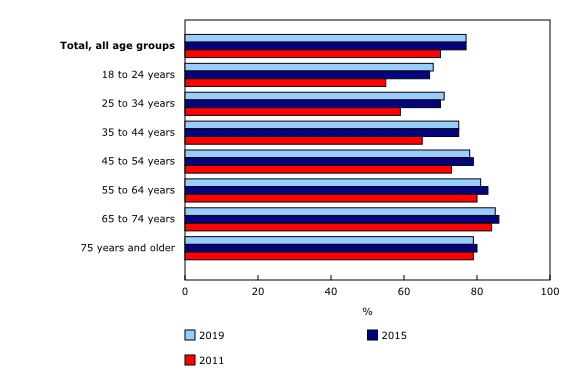
Self-reported turnout amongst voters aged 55 and up has held steady around 80 per cent over the past three elections, but self-reported turnout amongst those 44 and younger jumped at least 10 points between 2011 and 2015, and remained high for the 2019 election.

“In 2015, there was a sort of social movement quality to the Trudeau victory, and the evidence suggests that the turnout surge in 2015 was a surge of younger people looking for a new kind of politics. And a lot of those younger people stuck around in 2019,” Prof. Johnston said.

Newfoundland and Labrador had the lowest self-reported turnout in the 2011, 2015, and 2019 general elections. In 2019, provincial turnout was 68 per cent, seven points lower than Manitoba at 75 per cent, the province with the second lowest turnout rate in 2019. Manitoba faced severe storms during advance polling time, causing evacuations, power outages, road closures, flooding, and some polling stations to close. Elections Canada set up an additional polling station at the University of Winnipeg for voters from four electoral districts, and teamed up with the Canadian Red Cross to transport voters. Elections Canada reported that 270 people used this option. Emergency workers helping with disaster response were also provided with additional polling stations, and 592 voted at the additional stations.

Prince Edward Island had the highest turnout in the 2011, 2015, and 2019 elections, topping 80 per cent each time. In 2019, turnout was 82 per cent, down from 86 per cent in 2015. Prof. Miljan and Prof. Johnston said P.E.I is usually the most turnout-heavy province in both federal and provincial elections.

Despite P.E.I.’s high turnout, the rate actually decreased the most between the 2015 and 2019 elections, from 86 to 22 per cent. Quebec, from 78 to 76 per cent, and British Columbia, from 79 to 76 per cent, also had turnout drops. Turnout largely remained the same in the remaining provinces.

Prof. Johnston provided an anecdotal explanation for the Atlantic provinces turnout numbers. He said the social pressure to vote in P.E.I is potentially higher given the population density, 25.1 people per square kilometre, which is the highest in the country. Newfoundland and Labrador is the province with the lowest population density, at 1.4 people per square kilometre.

“There’s a sense in which someone from P.E.I is going to feel social pressure to turn out because they see each other more regularly and they know each other. There are social networks that reinforce participation,” Prof. Johnston said.

Turnout increased the most between 2015 and 2019 in Alberta and Saskatchewan. Alberta turnout rose from 77 to 80 per cent, and Saskatchewan from 77 to 81 per cent. 

Prof. Miljan suggested one reason for increased turnout in Western Canada was due to frustration with the Trudeau government.

“When people don’t vote, it means they’re pretty happy with the regime and they don’t feel it [their vote] matters one way or another,” she said. This theory suggests that Western voters are “not happy with the regime and they really wanted to make sure their voices were heard.”

Source: Discrepancy between Elections Canada, StatsCan reports likely due to social desirability bias

New StatCan data shows how Canada is failing new generations of Black youth

Looking forward to seeing future StatsCan work to see if this pattern is common to both recent and long-term immigrants and region of origin, given that recent Black economic immigrants tend to be more highly skilled/educated than earlier waves. As there are few third generation immigrants for recent immigrants, will take some time to see but second generation outcomes will likely be illustrative:

If statistical data tell us stories in numerical form, new information from StatCan depicts Canada as a nation that’s continuing to fail its Black youth. It also shows that the commonly accepted narrative that immigrants fare better with successive generations simply may not hold true for all immigrant groups.

While these outcomes will not come as a surprise to those who have long observed and studied Black experiences, they make the implications of Statistics Canada’s conclusions inescapable.

“The persistent gaps between the Black population and the rest of the population suggest that other factors not measured by the data used, including discrimination, could have an effect,” concludes Martin Turcotte in the study, titled “Education and Labour Market Integration of Black Youth in Canada.” It was published this week in the journal Insights on Canadian Society and is based on information from the 2006 and 2016 censuses.

The study compares Black Canadian youth with non-Black youth as they transition from childhood or adolescence to adulthood.

StatCan also released what it called a booklet, “Canada’s Black Population: Education, Labour and Resilience.”

Two key data sets show why this latest snapshot has significant implications for the Black community, said York University professor Carl James, who, as a member of the Working Group on Black Communities, offered advice and guidance for this project.

First, the Black population is young and growing. Canada’s Black population doubled between 1996 and 2016, from 600,000 to 1.2 million. In 2016, more than a quarter of the Black population was less than 15 years of age, compared with 16.9 per cent of the total population. Its median age is about 30, while it is 40 years for the total population.

“This means you can understand how the concerns of the Black community are weighted around ‘What’s happening to our young population,’” James said.

Second, about nine per cent of Black people in Canada are at least the third generation to be born in this country — a rate that is higher, he said, than for other racialized minorities.

“There needs to be a serious concern about this generation,” James said. “We’re responsible for their welfare in the Canadian state.”

Because the modern wave of Black immigration to Canada dates back to the 1960s, the outcomes for Black people could serve as a bellwether for minorities who arrived later.

“This is what we see for Black youth now. It is possible as other groups become third-generation you’re going to see more similar patterns,” he said.

The unique experiences of Black people also mean they should be disaggregated from the more general “visible minority” category, he said.

Some of the key StatCan findings include:

  • Most Black youth aspire to a university degree but are less likely to think they will obtain it. In 2016, although 94 per cent of Black youth aged 15 to 25 said that they would like to get a bachelor’s degree or higher, only 60 per cent thought that they could.
  • There persists a gap in post-secondary graduation rates between Black youth and their counterparts who are not Black. About half (51 per cent) of Black men aged 23 to 27 in 2016 had a post-secondary qualification, compared with 62 per cent of other men.
  • There persists a gap in employment rates between Black and non-Black youth. Young Black males were nearly twice as likely as other young males not to have a job in 2016.

Reasons for not voting in the federal election, October 21, 2019

StatsCan analysis of the 2019 election. Some interesting variations between immigrant and Canadian-born voters in terms of reasons for not voting (would be interesting to see if these variations continue into the section generation):

Voter turnout among youth holds steady for the October 21, 2019, federal election

Just over three-quarters (77%) of Canadians reported voting in the 2019 federal election, unchanged from the 2015 election.

In particular, following notable increases of more than 10 percentage points between the 2011 and 2015 elections, voter turnout among younger people aged 18 to 24, and 25 to 34, remained at similar levels in 2019.

Chart 1  Chart 1: Voter turnout by age group, 2011, 2015 and 2019 federal elections
Voter turnout by age group, 2011, 2015 and 2019 federal elections

Chart 1: Voter turnout by age group, 2011, 2015 and 2019 federal elections

Voter turnout increases in Saskatchewan, Alberta and Ontario

Compared with the 2015 federal election, the proportion of Canadians who reported voting in 2019 increased in Saskatchewan (+4 percentage points), Alberta (+3 percentage points), and Ontario (+2 percentage points). These are more modest increases than those observed in most provinces between the 2011 and 2015 elections.

While Prince Edward Island had the highest proportion (82%) of people who reported voting in the 2019 election, voter turnout in the province decreased by 4 percentage points compared with 2015. Declines were also recorded in British Columbia (-3 percentage points) and Quebec (-2 percentage points). There was little change in the remaining provinces.

Chart 2  Chart 2: Voter turnout by province, 2011, 2015 and 2019 federal elections
Voter turnout by province, 2011, 2015 and 2019 federal elections

Chart 2: Voter turnout by province, 2011, 2015 and 2019 federal elections

“Not interested in politics” remains top reason for not voting

Among the 23% of eligible Canadians who did not vote, the top reason for not voting in the federal election was “not interested in politics,” cited by 35% of non-voters in 2019. This was the most common reason for all age groups, with the exception of those aged 75 and older, who were most likely to indicate that they did not vote due to an illness or disability (49%).

Non-voters who were Canadian citizens by birth were more likely to report a lack of interest in politics as the reason for not casting a ballot (37%), compared with citizens by naturalization—both those who had been in Canada for 10 years or less (26%) and those who immigrated more than 10 years earlier (also 26%).

One in five non-voters report being too busy

Collectively, everyday life reasons were cited by nearly half of all non-voters (46%); these include being too busy (22%), having an illness or disability (13%), or being out of town (11%).

Everyday life issues were the most common reasons cited by non-voters in British Columbia, while political issues (including not interested in politics) were most prevalent in Nova Scotia.

Women more likely to report illness or disability

Female non-voters (48%) were more likely than their male counterparts (44%) to cite one of the everyday life issues as the reason for not voting, most notably having an illness or disability (16% versus 10%). This is partly related to the fact that a higher proportion of women were in the older age groups compared with men. One in ten female non-voters was aged 75 or older.

In contrast, men (37%) were more likely to report not being interested in politics compared with women (32%).

Some electors not voting for reasons related to the electoral process

Among Canadians who did not vote in the 2019 federal election, 5% identified issues with the electoral process as the reason for not voting, including not being able to prove their identity or address, a lack of information about the voting process, or issues with the voter information card.

Non-voters aged 75 and older (9%) and aged 18 to 24 (8%) were most likely to report electoral process issues as the reason for not voting. However, the proportion of youth citing this reason declined by 3 percentage points compared with the 2015 election.

Source: Reasons for not voting in the federal election , October 21, 2019 

Diversity of the Black population in Canada: An overview Text – Selected

The booklet provides a good overview of the diverse demographics of Canada’s Black population. Look forward to future work looking at the socioeconomic characteristics of the different Black communities in Canada, in particular with respect to whether how well the more highly skilled recent Black immigrants and their children in relation to earlier waves of Black immigrants, as well as with respect to other immigrant and non-immigrant groups:

There were almost 1.2 million Black people living in Canada in 2016. The Black population is diverse and has a long and rich history in the country. More than 4 in 10 Black people were born in Canada.

Among the Black population born outside of Canada, the source countries of immigration have changed over time. More than half of this population who immigrated before 1981 were born in Jamaica and Haiti. Black newcomers now come from about 125 different countries, mainly from Africa.

The vast majority of the Black population live in large urban areas. In 2016, 94.3% of Black people lived in Canada’s census metropolitan areas, compared with 71.2% of the country’s total population. Toronto had the largest Black population in the country, with 442,015 people or 36.9% of Canada’s Black population. It was followed by Montréal, Ottawa–Gatineau, Edmonton and Calgary, each home to at least 50,000 Black people.

To illustrate the growth and the diversity of the Black population, a first infographic was released on February 6, 2019. A booklet is now available to provide more information about the richness of diversity among the Black population in Canada. A number of topics are covered in this booklet including population growth, age and sex structure, place of birth, generation status, immigration, ethnic and cultural origins, languages and a few geographical highlights.

Diversity of the Black population in Canada: An overview

Statistics are great unless they measure the wrong things: Don Pittis

Always a risk, particularly in today’s economy:

If prices are rising by about two per cent, as inflation data is likely to show this week, why did one of my newspaper subscriptions just go up by 17 per cent?

And if wages are rising at about four per cent, as recent jobs data has shown, why are some provincial governments insisting that wage increases be held below one per cent?

As house prices go through the roof, the fact that the price of the biggest purchase Canadians make in their lives is not included in our inflation statistics makes it easy to see why many young people have expressed doubts about the accuracy of those figures.

It is a struggle that Statistics Canada faces every day as it tries to sketch out with numbers an authentic picture of the reality Canadians experience. But Oxford fellow and bestselling author of Age of Discovery Chris Kutarna says the task is far more complicated than many statisticians like to admit.

Kutarna worries that Statistics Canada’s plan to plunge into the ocean of “Big Data” so beloved of retailers and credit card companies — described last week by chief statistician Anil Arora — will inevitably create bias in the results simply because we are measuring the wrong things.

“One of the terrifying and most fundamental sources of risk is that we only consider what we’re now measuring as real,” said Kutarna, on the phone from London, England.

For example, long-standing data sets built on debt, spending, prices and gross domestic product simply close the door on values such as family, respect, happiness and species extinction.

“There is far more that is real and not being measured than there is that is real and we are measuring it,” said Kutarna.

One practical example from his book is the failure of modern statistics to measure the value of the online encyclopedia Wikipedia which, despite providing value to billions, adds less to GDP figures than the old Encyclopedia Britannica which reached far fewer people.

In a recent speech, Stephen Poloz, governor of the Bank of Canada, described an economy changing so fast that our statistical models fail to grasp it.

Poloz paraphrased the Solow Paradox, the observation by economist Robert Solow that computers had led to an increase in productivity everywhere but in the statistics. Poloz suggested GDP is being understated by as much as two per cent.

One example he offered was the way so many companies are distributing computer services to the cloud, turning whole computer divisions into a budget line item.

“How does StatCan deal with that?” asked Poloz.

Last week, Arora boasted to a gathering of the Empire Club that Statistics Canada was respected everywhere as a global leader, but he acknowledges it is constantly struggling to keep up with changing technology and the shifting understanding of how the world works.

“Look, that’s what statistics is, right? To take what are evolving concepts, nebulous concepts, things that haven’t even taken a lot of shape and then quickly try to turn them into numerics,” said Arora in an interview.

The statistics chief calls it a “team sport” where governments and individuals need to decide which of the millions and millions of things that could possibly be measured should be addressed by the some 5,000 employees at Statistics Canada. Their job, he says, is to bring scientific rigour to the process, so that the numbers are as accurate as possible.

“This is always going to be a journey,” said Arora, adding that finding and incorporating into our figures what have so far been labelled intangibles may be a never-ending task.

Part of that journey that those employees are now undertaking is the attempt to mine the immense bodies of information embedded in Big Data, those traces of activity we leave behind when we do almost anything on the internet from buying to searching. Not only are they readily available for quick analysis but they reduce the employee hours required in traditional surveys.

“Alternate sources of data are increasing exponentially and we have the technologies and the mechanisms to convert them to public good with high quality statistics,” said Arora in his speech.

When it comes to the inadequacies of GDP, a big part of the problem has less to do with Statistics Canada than how we continue to use familiar indicators that may be out of date.

Arora says the University of Waterloo’s Canadian Index of Wellbeing includes 200 indicators — from crime and safety to sustainable growth — most of which come from Statistics Canada data. But it’s GDP that gets the attention.

Statisticians are always groping to find the data sets that matter. But even in areas we think we know and understand, statistics are merely an indicator — an estimate, of reality. Things we don’t understand are, by definition, even harder to measure.

“We live in this culture where what is real is what we measure,” said Kutarna, “That the things we measure are reality.”

In which case, a certain amount of healthy skepticism, whether about this week’s inflation numbers, about GDP, productivity or the many other financial statistics that are often offered as solid immutable facts, may well be in order.

Source: Statistics are great unless they measure the wrong things: Don Pittis

Big Brother, Big Data and Statistics Canada

The ongoing challenge of better and more timely data that can be best achieved through linking data, and the privacy and consent concerns, where government is held to a much higher standard:

On December 9, 2019, the Office of the Privacy Commissioner of Canada published the results of an investigation into complaints that Statistics Canada had requested from a credit institution and Canadian banks the personal information on financial transactions of banking customers without notifying those customers. This clearly raises the issue of big-data mining by public authorities – the marriage of Big Brother and Big Data – with regard to the protection of privacy.

Let us recall the facts: Seeking to measure household debt more precisely, Statistics Canada reached an agreement with TransUnion, which agreed to forward files covering close to 24 million Canadians. The files included personal credit ratings along with identifying elements (name, address, date of birth, social insurance number, etc.). Statistics Canada was then able to link this data (600 pieces of information) with data from its own surveys, such as the census. In addition, Statistics Canada asked Canadian banks to provide it with information on all transactions carried out by a sample of 500,000 households.

The Canadian Bankers Association (CBA), which Statistics Canada first approached, said that it was reluctant to respond to such a request because of the burden it placed on banks, but mostly because complying meant that they would violate their privacy standards. A Global News report on October 26, 2018, blew the whistle. The chief statistician was called up before the Standing Committee on Industry, Science and Technology, and an investigation was launched by the Office of the Privacy Commissioner. The Financial Transactions project, for which no data had yet been transferred, was immediately suspended. TransUnion also stopped forwarding information.

According to the results of the investigation, those whose information had been shared had not been notified. In the first case, TransUnion put a note in people’s files, but nobody told them it was there. (Only if they asked to see their file for some other reason could they discover it.) In the case of the project with the banks, Statistics Canada had not planned to notify the selected households. In both projects, Statistics Canada claims to have complied with the Privacy Act. The organization also claims to have relied on section 13 of the Statistics Act, which requires any person responsible for documents or archives, public or private, to transmit them to Statistics Canada if such a request is made. The Commissioner concluded from his investigation that the Credit Information Project did comply with existing law and that the complaint on this subject was thus “not well founded.” In the case of the Financial Transactions Project, he concluded – against the opinion of Statistics Canada – that what was asked for went beyond the transmission of pre-existing documents or archives and involved the creation of new files. However, since no data had yet been transmitted, the Commissioner did not see fit to accept the complaint. That said, he expressed several concerns and made six recommendations, two of which call on Statistics Canada to refrain from going ahead with both projects as designed.

These two projects offer an example of linkage between big data as a by-product of transactions and interactions carried out for private purposes and information obtained through surveys to which citizens are obliged to answer. The scale of Statistics Canada’s projects is impressive and suggests that the revolution associated with Big Data is now affecting national statistical offices, hitherto hesitant to join it due to methodological scruples and ethical constraints. Section 13 of the Statistics Act, conceived of at a time when statistical treatment of documents and archives was limited by their physical nature, presents unforeseen potential. It is also clear from the results of the investigation that Statistics Canada’s requests rested upon a particularly broad interpretation of this section of the law. The Privacy Commissioner therefore considers that the legal framework applying to the collection of “big-data administrative data” from the private sector is outdated and suggests that the legislator review the Statistics Act respecting this matter.

On the other hand, the problems that the Statistics Act could pose would no doubt be lesser, according to the Commissioner, “if the Privacy Act were not so out of date.” In 2016, he proposed that it be amended “to explicitly require compliance with the criteria of necessity and proportionality in the context of any collection of personal information.” In fact, even if Statistics Canada agreed to demonstrate the “necessity” of the information sought in these and other projects and the “proportionality” of the means used to obtain these data, the agency is not legally required to do so.

Finally, beyond legal amendments, the Commissioner’s report presents recommendations that are inspired by European practices aimed at ensuring the consent of individuals or even at circumventing this problem. They include “civic data sharing,” which is based on prior consent, “algorithm-to-the-data,” which means only anonymized results are transferred by the private enterprise to public authorities, and “privacy-preserving computation,” which also amounts to anonymizing information at the source. The first method resembles in all respects the position of the Harper government with regard to the long-form census. The other two would interfere with the type of data linkage that Statistics Canada envisioned.

Much has been made in recent years of the necessary independence of Statistics Canada from government. If the Office of the Commissioner’s report presents a less-than-sympathetic and somewhat authoritarian image of the agency, it is at least reassuring that Statistics Canada is accountable to a parliamentary committee, that it had to collaborate with the Office of the Commissioner to improve its practices and that a report was made public. The whole affair illustrates how big-data mining poses new challenges for official statistics when it comes to the trade-off between privacy rights and evidence-based policy-making.

Source: Big Brother, Big Data and Statistics Canada

StatsCan Study: The long-term economic outcomes of refugee private sponsorship

Of note how the economic outcomes of privately and government-sponsored refugees become similar over time after an initially wide gap:

Canada was the first country to introduce private sponsorship for refugee resettlement. The program has played a key role in the country’s responses to international refugee crises over the last four decades. Private sponsors are responsible for providing financial, material and personal support to refugees during their first year in Canada.

A new Statistics Canada study compares the employment rate and earnings between privately sponsored refugees and government-assisted refugees who were admitted to Canada from 1980 to 2009.

This study is based on the Longitudinal Immigration Database and focuses on refugees who arrived between the ages of 20 and 54 under the two programs (privately sponsored refugees and government-assisted refugees). The analysis follows refugees up to 15 years after they first arrived in Canada.

Refugees are a diverse population with varying degrees of human capital and pre-migration circumstances. Privately sponsored refugees and government-assisted refugees differ in some key socio-demographic characteristics. Over the study period, privately sponsored refugees came more predominantly from Eastern Europe, whereas government-assisted refugees came more often from South and Central America and the Caribbean. Privately sponsored refugees had a higher level of education and tended to be more concentrated in Toronto than government-assisted refugees.

This study compares labour market outcomes of these two groups of refugees, while taking these socio-economic characteristics into account and recognizing that other possible unmeasured differences between the two groups of refugees—such as exposure to violence, duration of displacement, physical and mental health, and ethnic and family networks—could impact their economic outcomes.

This study found that privately sponsored refugees had much higher employment rates and earnings than government-assisted refugees in the initial years after arrival, but this difference diminished over time with government-assisted refugees steadily catching up.

In the first full year after arrival, privately sponsored refugees had higher employment rates than government-assisted refugees, by about 17 percentage points among men and 24 percentage points among women. Fifteen years after arrival, these differences decreased to 3 percentage points among men and 2 percentage points among women.

Similarly, privately sponsored refugees earned 28% more than government-assisted refugees among men and 34% more among women in the first full year after arrival. This gap narrowed to about 5% for both men and women 15 years after arrival.

Furthermore, the employment and earnings advantage of privately sponsored refugees over government-assisted refugees was greater among refugees with less than a high school education than among refugees with higher educational levels. Over half of refugees in the study had less than a high school education.

Source: PDF

Changes in outcomes of immigrants and non-permanent residents, 2017 Text – Selected

The latest. Some encouraging trends:

Immigrants admitted to Canada in 2016 reported a median entry wage of $25,900 in 2017, the highest recorded among immigrants admitted since 1981. Although the entry wages of recent immigrants have increased over the past few years, their income remains lower than that of the overall Canadian population. The Canadian Income Survey estimated the Canadian population’s median wage at $36,100 in 2017.

When immigrants arrive in Canada, they face a number of challenges, such as getting their credentials recognized, being able to speak one of the official languages and acquiring Canadian work experience. However, the longer immigrants live in Canada, the more their income increases and, for some, their income reaches the level of the overall Canadian population.

This analysis uses new data from the Longitudinal Immigration Database (IMDB), which comprises information on permanent and non-permanent (temporary) residents, including asylum claimants. It presents the type of information that can be extracted from the IMDB and its outputs to better understand how the socioeconomic situation of these individuals has evolved.

Recent immigrants have higher entry wages and more work experience prior to admission than before

Over the past 10 years, the median entry wage of immigrants, one year after admission, in 2017 constant dollars, has increased from $20,400 for the 2007 admission year to $25,900 for the 2016 admission year (+27%).

Not all immigrants face the same challenges after admission. Those who had work experience in Canada upon admission reported the highest median entry wages. For the 2016 admission year, income one year after arrival was $39,800 for study and work permit holders, and $38,100 for work permit holders only. These wages are comparable with those of the entire Canadian population. For immigrants who had no experience prior to admission, or who had a study permit only, incomes were $19,900 and $12,500, respectively.

In recent years, an increasing number of non-permanent resident permit holders are transitioning to permanent residence. The observed growth in entry wages can be partly accounted for by differences in income between immigrants with pre-admission work experience in Canada and immigrants without such work experience. From the 2007 admission year to the 2016 admission year, the number of immigrant taxfilers one year after arrival who had work experience in Canada increased by 166%, while the number of immigrants without work experience rose 2%.

Chart 1  Chart 1: Number of immigrant taxfilers one year after admission, by admission year and work experience in Canada prior to admission
Number of immigrant taxfilers one year after admission, by admission year and work experience in Canada prior to admission

Chart 1: Number of immigrant taxfilers one year after admission, by admission year and work experience in Canada prior to admission

Immigrants who hold at least a pre-admission study permit have stronger wage catch-up in the 10 years after admission

Overall, immigrants’ wages increase with the number of years since admission and, for some, their wages eventually reach that of the overall Canadian population ($36,100). For example, the median wage for immigrants admitted in 2007 increased from $20,400 in 2008 to $33,500 in 2017, an increase of 64%.

Wage catch-up factors include pre-admission work experience, which facilitates integration through increased knowledge of official languages and the development of professional networks in Canada, among other things. In 2017, immigrants admitted in 2007 who had held both a study permit and a work permit prior to admission had the highest median wage (up 81% to $63,800), and their wage exceeded that of immigrants who held only a work permit (up 36% to $48,100) and that of Canadians as a whole. The median wage of immigrants admitted in 2007 who held only a pre-admission study permit increased significantly over 10 years (up 163% to $37,600) and now exceeds the median wage of immigrants without pre-admission experience (up 72% to $30,700).

Chart 2  Chart 2: Median wage of immigrants admitted in 2007, 1 year and 10 years after admission, by pre-admission experience
Median wage of immigrants admitted in 2007, 1 year and 10 years after admission, by pre-admission experience

Chart 2: Median wage of immigrants admitted in 2007, 1 year and 10 years after admission, by pre-admission experience

The median wage for asylum claimants increases with length of residence in country

Asylum claimants are individuals who request refugee protection in Canada. Because of their situation, they face many challenges in terms of economic integration. Even after their refugee claim is accepted, asylum claimants have lower median wages than other immigrants with pre-admission experience.

According to a Statistics Canada article on asylum claimants published earlier this year, the number of claimants fluctuated from 2000 to 2018 and reached over 50,000 in 2017 and 2018. Asylum claimants are relatively young. Of those who arrived in 2017, 39% were younger than 25 years of age, while 14% were aged 45 or older.

The median entry wage for asylum claimant taxfilers refers to their income one year after they submitted their refugee claim. Among those who claimed refugee status from 2006 to 2016, the median wage fluctuated between $10,900 and $16,000. As with immigrants, the median wage of asylum claimants increases with each additional year spent in the country. Therefore, the median wage for those who submitted a refugee claim in 2006 was $14,100 in 2007 and $28,600 in 2017.

There are significant differences in income among the top 15 countries of origin for asylum claimants. Among asylum claimants in 2012 who filed taxes in 2017, the highest median wages were reported by claimants from Sri Lanka ($31,600), Somalia ($30,700) and Nigeria ($30,700). Claimants from Afghanistan ($18,200), Iraq ($17,300) and China ($14,300) reported the lowest median wages.

Economic immigrants and their dependants stay more frequently in their province of admission when they have pre-admission work experience

Reasons for immigrating to Canada can influence the likelihood of immigrants to remain in their province of admission over time. For example, family class immigrants come to Canada to be closer to their loved ones, while economic immigrants are selected based on their ability to contribute to the Canadian economy.

In 2017, 86% of immigrant taxfilers admitted in 2012 filed a tax return in their province of admission. The provincial retention rate was highest among family-sponsored immigrants (93%) and slightly lower among refugees (87%). For economic immigrants and their dependants, the retention rate was 82%. However, for these immigrants, the rate was higher among those with a pre-admission work permit only (90%) than among those with no pre-admission experience (81%).

Canadian immigrants more overeducated for jobs than U.S. counterparts: StatsCan

Good analysis of the data by StatsCan of both the comparatively large gap among recent immigrants and a minimal gap with respect to immigrants who have resided in Canada or USA for 10 years or more:

Recent immigrants in Canada with a university degree were more likely to be over-educated for their jobs compared to immigrants in the United States, a new study from Statistics Canada has found.

The Tuesday release from the federal agency found 35 per cent of working-age, university-educated immigrants who arrived in Canada within the last 10 years were over-educated for their jobs.

In comparison, only 21 per cent of their counterparts south of the border were deemed to be over-educated for their jobs.

Overeducation in the study refers to situations where workers with at least a bachelor’s degree hold a job that requires only a high school diploma or less.

Statistics Canada said the gap was little changed when difference in socio-demographic characteristics among recent immigrants in the two countries were factored in.

The findings raise questions about whether Canada’s immigration system can be better linked to its economic needs and is efficiently employing its highly-educated workforce.

While Canada’s economy in recent years has grown at a steady rate, much due to lockstep expansion of its labour force, the growth of productivity remains sluggish.

Labour productivity, which measures real GDP per hours worked, only increased 0.2 per cent in the second quarter of 2019 for Canadian businesses. The U.S., meanwhile, saw productivity grow by three times as much in the same period. Statistics Canada will release its third quarter figures on Wednesday.

“Overeducation leads to inefficient use of human capital and lost productivity,” Tuesday’s report reads.

While helping to sustain long-term economic growth, productivity gains can lead to wage increases that raise the standard of living.

Tuesday’s report noted that compared to the U.S., “Canada’s industrial structure is less knowledge-intensive and has a weaker demand for university-educated workers.”

As well, the study said up until the early 2010s, university-educated immigrants in Canada were mostly admitted through a points system that selected those based on their human capital characteristics, such as education, language, age and work experience.

Such factors have led to a large supply of university-educated immigrants “relative to labour market demand for skilled workers in Canada than in the United States.”

“The differences in supply–demand balance and how new immigrants are selected could affect immigrants’ relative performance in the labour market in the two countries,” the report read.

University-educated immigrants in the U.S. were generally selected and sponsored by employers.

Pedro Antunes, chief economist at the Conference Board of Canada, said better employing immigrants to their qualifications could improve Canada’s economic performance.

“What we’re talking about is bringing in qualified workers that aren’t being fully employed. So we certainly could improve our productivity if we fully utilise their skill sets and their credentials,” he said.

But Antunes said economic outcomes for highly-educated immigrants have improved in recent years, in part due to a tightening of the labour market. He said Canada has also done a better job in creating arrival streams that ensure there are opportunities for highly-skilled immigrants.

The report had observed that new immigrants admitted through the Canadian Experience Class had the lowest overeducation rate of 18 per cent among economic streams.

The entry stream introduced in 2008 allows immigrant to arrive as temporary foreign workers who can then apply for permanent residence after working for one year.

“I do think we’re doing some things right,” Antunes said. “I wouldn’t want to be too critical of the system.”

While new immigrants in Canada were more likely to be over-educated for their jobs compared to those in the U.S., the disparity for immigrants who arrived more than a decade ago was much smaller.

Twenty-one per cent of long-term immigrants in Canada were over-educated, compared to 18 per cent for similar immigrants in the U.S.

The report said this finding suggests immigrants to Canada are able to find jobs better aligned with their qualifications in the long run.

Among domestic-born workers, the overeducation rate for also slightly lower in Canada than in the U.S.

Antunes added that more could be done for highly-skilled immigants to support arriving spouses and by reducing employer bias.

Source: Canadian immigrants more overeducated for jobs than U.S. counterparts: StatsCan

Douglas Todd: Up to 1 in 3 study-visa holders in Canada not in school

More on international students and some of the abuses of the program:

One in three people who entered Canada on student visas do not appear to have been enrolled at educational institutions in the country, Statistics Canada reports.

A recent StatsCan analysis could not find indications that 30.5 per cent of people in the country on post-secondary study permits in 2015 were signed up that year at a Canadian college or university.

The StatsCan study, by Marc Frenette, Yuquian Lu and Winnie Chan, echoes the findings of an internal Immigration Department report that revealed 25 per cent of would-be foreign students in Canada in 2018 were likely not complying with the conditions of their visa or were just not being monitored by school administrators.

The high no-show rate comes as there is a rising trend toward “edu-immigration” to Canada. Many foreign nationals are being encouraged by immigration agents to use Canada’s study permits to gain a relatively easy foothold in the country to find work, through which they can try to obtain permanent resident status.

Canada has a reputation as an unusually open country for international students, especially in the way it allows newcomers to study part-time and hold down an almost unlimited range of jobs. Compared to Britain, the U.S. and Australia, Canada is known for having a poor record of tracking study-visa holders once they’re in the country.

Vancouver immigration consultant Laleh Sahba and immigration lawyer Sam Hyman say it’s an unfortunate reality that many international students are being told by dubious agents they can bypass school to work. But the immigration specialists say such misuses shouldn’t overshadow that most international students are using the system responsibly.

The number of study-visa holders in Canada has shot up by 73 per cent in four years, to 573,000 in 2018, with the highest concentration in Metro Vancouver.

Many officials welcome the hike in high-fee-paying offshore students. They maintain they enhance cultural diversity on campuses and boost the budgets of public educational institutions, which are not being funded by governments as well as in the past.

In addition to articles published by Postmedia on loopholes in Canada’s study-visa program, The Toronto Star reported in November that many would-be international students are routinely fail to pursue their studies, instead looking for work and applying for permanent residency.

Some get caught. Canadian officials revoked 5,502 study visas last year, an almost-four-fold increase from 2016.

The Globe and Mail also reported last month that many trucking companies, primarily in Surrey, are taking large illegal cash payments from foreign students in exchange for truck-driver jobs that might help them qualify for permanent residency. The trucking companies send many of the study-visa holders out on the road with no training, leading to deadly accidents.

Visa officials appear to be starting to respond to flaws in Canada’s burgeoning program: A growing number of study-visa applications, two out of five, are now being rejected, Postmedia reported this month.

Immigration department officials have acknowledged a tenth of all study-visa applications are fraudulent, often because they use faked acceptance letters from Canadian institutions.

One of the disquieting findings in the StatsCan report is that 2015’s rate was an improvement over previous years: In 2009, only half of study-permit holders were signed up with a school.

When Postmedia asked Statistics Canada why such a large proportion of would-be foreign students appear to be avoiding studying, officials said the authors of the report were not permitted to directly answer Postmedia’s questions.

Although the report said statistical “noise” made it hard to precisely determine the ratio of study-visa holders who were not enrolled at the time researchers did their calculations, a Statistics Canada official also acknowledged: “We did not ask respondents their motivation for coming to Canada on a student visa. We only observed their work patterns.”

The study concluded that about one in four study-visa holders in Canada eventually gain permanent resident status. But beyond such data, the authors said, “Little is known about international students in Canada.”

Hyman, the immigration lawyer, says there is no doubt many study-permit holders come to Canada essentially to work and not to study.

“Some work full-time in contravention of the terms of their study permit, which limits them to working no more than 20 hours a week when school is in session, plus full-time during scheduled school vacations.” Some, Hyman said, obtain work “off the books for cash.”

Ottawa has failed to hire staff dedicated to enforcing the evolving rules about what it requires to be a genuine international student, said Hyman. “Still, sometimes detection occurs when the student goes to renew the initial student permit and has to demonstrate academic progress, or try to explain the lack of it.”

An Ottawa immigration official said that up until 2014, a prospective international student did not have to enrol in an educational program. He or she only needed to demonstrate an “intent” to study. It took until this year for Immigration Canada to more clearly define what it really means to “actively pursue” an academic program.

Canada’s more than 650 institutes of higher education are allowed to follow the honour system in informing authorities about study-visa infractions. And even though Canadian schools have been required since 2016 to report on their total international-student enrolment, 68 schools failed to do even that last year.

There can be legitimate reasons for not complying with study-visa requirements, including illness, running out of money or switching schools, says Sahba, the immigration consultant. But she’s convinced Canada’s institutes of higher learning should make it a higher priority to report on absent foreign students.

Sahba is disturbed by the dubious migration agents in Canada and abroad who increasingly tell young would-be migrants the easiest way to get permanent resident status in Canada is by obtaining a study visa, largely avoiding school and getting access to employers, some of whom exploit the workers in exchange for providing a crucial sponsorship letter.

While this is an “unfortunate reality” for some study-permit holders, Sahba said “there are also many responsible, ambitious and self-motivated international students currently studying in Canada. And many more waiting in the queue for their visas.”

Source: Douglas Todd: Up to 1 in 3 study-visa holders in Canada not in school

For the StatCan study: The Postsecondary Experience and Early Labour Market Outcomes of International Study Permit Holders