StatsCan Study: The contribution of foreign-born mothers to Canadian births from 1997 to 2024

Of interest:

Since 2009, Canada has been experiencing a decline in fertility, which accelerated in 2017. In addition, the country saw unprecedented annual population growth from 2022 to 2024 on account of strong international migration. In this context, the study “The contribution of foreign-born mothers to Canadian births from 1997 to 2024” sheds new light on the contribution of foreign-born women (i.e., those born outside Canada) to births in Canada over the period from 1997 to 2024 using vital statistics data on births.

In 2024, more than two in five newborns (42.3%) had a foreign-born mother, a proportion that nearly doubled in just over 25 years. Also, nearly three in five babies (57.0%) born to mothers over the age of 40 years had a foreign-born mother in 2024. In contrast, among babies born to mothers aged 19 years and younger, just over 1 in 10 (12.8%) had a foreign-born mother.

Among all births in Canada, the proportion attributable to mothers born in India increased nearly fivefold from 1997 to 2024, rising from 2.1% to 10.3%. As a result, India was the leading country of origin for new foreign-born mothers in 2024, followed by the Philippines (3.1% of all births) and China (2.0% of all births).

In 2024, Ontario and British Columbia (48.7% each) had the highest proportion of births to foreign-born mothers, while the lowest proportion was observed in the Atlantic provinces (23.6%).

From 1997 to 2024, the largest increases in the number of births to foreign-born mothers were observed in Saskatchewan (+437%), the Atlantic provinces (+298%), Alberta (+264%) and Manitoba (+206%).

According to the 2021 Census of Population, the adjusted proportion of foreign-born women among women of childbearing age was estimated at 32.3%. This is slightly lower than the proportion of births to foreign-born mothers that year (33.0%), a trend that has been observed in the last five censuses of population. This suggests that foreign-born women are overrepresented among mothers who give birth in Canada compared with their proportion of the Canadian population.

From 2022 to 2024, 96% to 98% of Canada’s annual population growth was due to international migration (new immigrants and non-permanent residents), while the remainder was due to natural increase (births minus deaths). However, without the contribution of foreign-born individuals to births and deaths, the natural increase in Canada would have been negative since 2022.

Source: Study: The contribution of foreign-born mothers to Canadian births from 1997 to 2024

StatsCan Study: Portrait of the Arab populations in Canada

Another useful demographic portrait from StatsCan:

The Arab populations in Canada are growing

Arab populations in Canada more than tripled from 2001 to 2021 because of immigration and the growth of the Canadian-born Arab population. In 2021, Arab populations reached 795,665 people and made up 2.2% of the total population of Canada. According to the latest demographic projections, Arab populations in Canada could number 1.4 million to 1.9 million people by 2041, constituting 3.1% to 3.6% of the population of Canada.

Arabs in Canada have many different places of birth, with Canada being the most common

Based on 2021 data, about 3 in 10 Arabs were born in Canada (30.3%). The next most common places of birth included Lebanon (10.3%), Syria (10.0%), Iraq (7.0%) and the Arabian Peninsula (6.8%) in Southwest Asia and Morocco (9.4%), Egypt (7.4%) and Algeria (6.4%) in Northern Africa. The proportion of Arabs in Canada who were born in Lebanon declined from 1 in 5 in 2001 to 1 in 10 in 2021, as immigration from other places of birth increased. The peak of Arab immigration from Lebanon was in the late 1980s and early 1990s. 

Just over half of Arabs who immigrated to Canada from 1980 to 2021 are economic immigrants

In 2021, just over half (51.3%) of Arabs in Canada who had immigrated from 1980 to 2021 were economic immigrants (selected for their ability to contribute to Canada’s economy), while close to 2 in 10 (18.4%) were sponsored by family members and 3 in 10 (29.5%) were refugees. More than 70% of Arab immigrants born in Egypt, Algeria or Morocco were economic immigrants. Most Arab immigrants born in Lebanon were either economic immigrants (52.1%) or sponsored by family members (32.2%). Refugees made up the majority of Arab immigrants born in Syria (78.3%) or Iraq (67.6%)….

Source: Study: Portrait of the Arab populations in Canada

StatsCan: Temporary foreign workers in health care: Characteristics, transition to permanent residency and industry retention

Points of interest:

  • Numbers of healthcare workers increased dramatically during COVID
  • Similar numbers under the TFWP and IMP but IMP growth greater than TFWP
  • Provincial average of 2.7 percent of temporary workers in healthcare sector
  • Country shift from Philippines to India
  • Almost 60 percent have transitioned to permanent residency
  • Women form about three quarters of TFWs in healthcare that transitioned to permanent residency

…Using an integrated administrative database, this study examines the number of TFWs who worked in Canada’s health care sector from 2000 to 2022, their distribution by permit type, their transition to PR and their retention in the sector.

The number of TFWs working in the health care sector has increased considerably since the new millennium, from 3,200 in 2000 to 57,500 in 2022. The composition of program types among TFWs in the health care sector has also changed over time. In the early 2000s, most TFWs held health-occupation-specific work permits, but other IMP work permit holders have become more prominent over time. In addition, TFWs’ distribution across health care subsectors also shifted over time. In the 2000s, nearly 40% of TFWs in the health care sector were in hospitals, but since 2019, more than 40% of TFWshave been employed in nursing and residential care facilities.

It is important to note that some TFWs without a health-occupation-specific work permit may work in health occupations. Furthermore, not all TFWs in the health care sector worked in health occupations. Therefore, restricting the analysis to work permit holders with specified health occupations would underestimate the overall impact of TFWs on the health care sector. 

TFWs from India have gradually replaced Filipino workers as the largest foreign workforce in Canada’s health care sector, and the role of some traditional source countries has diminished. Meanwhile, the geographic concentration of TFWs in health care became more pronounced over time, with the majority located in the largest provinces: Ontario, British Columbia and Quebec.

The long-term viability of TFWs as a stable labour source depends on two factors: the number of workers who transition to PR and the percentage of those who continue to work in the sector after obtaining PR. This study found that recent TFW cohorts had higher rates of transition to PR compared with earlier cohorts, whereas recent PR policy changes may have had a positive impact on the transition rate. After transitioning to PR, TFWs holding health-occupation-specific work permits had higher industry retention rates in the sector than those who did not have health-occupation-specific work permits.

Source: Temporary foreign workers in health care: Characteristics, transition to permanent residency and industry retention

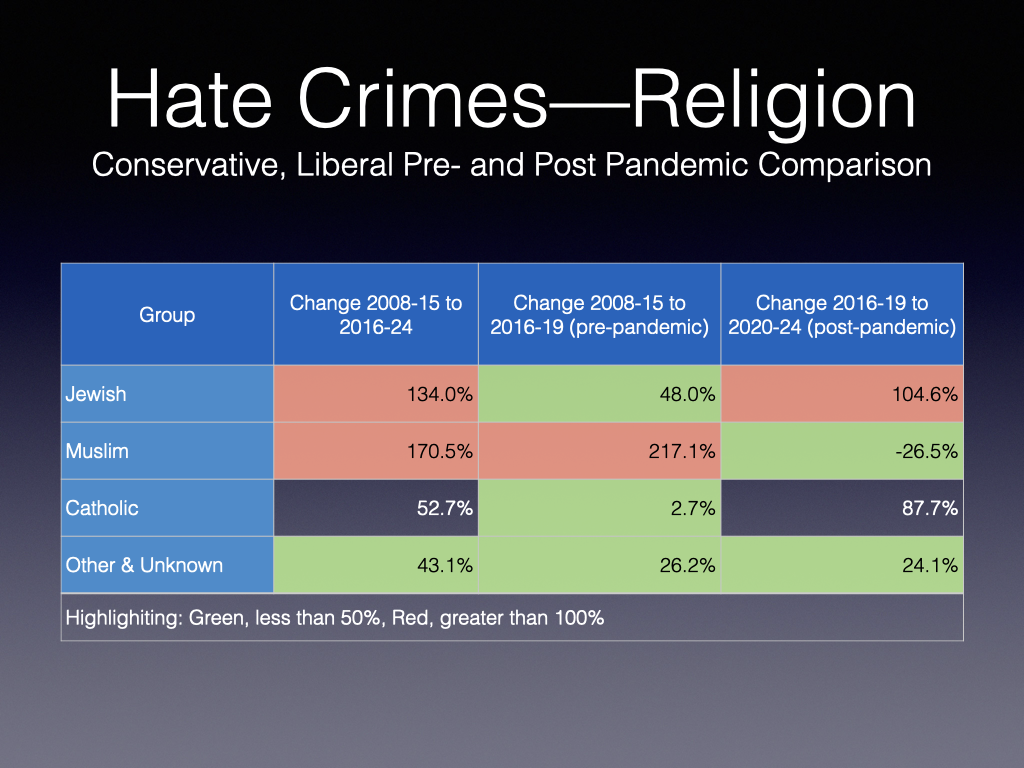
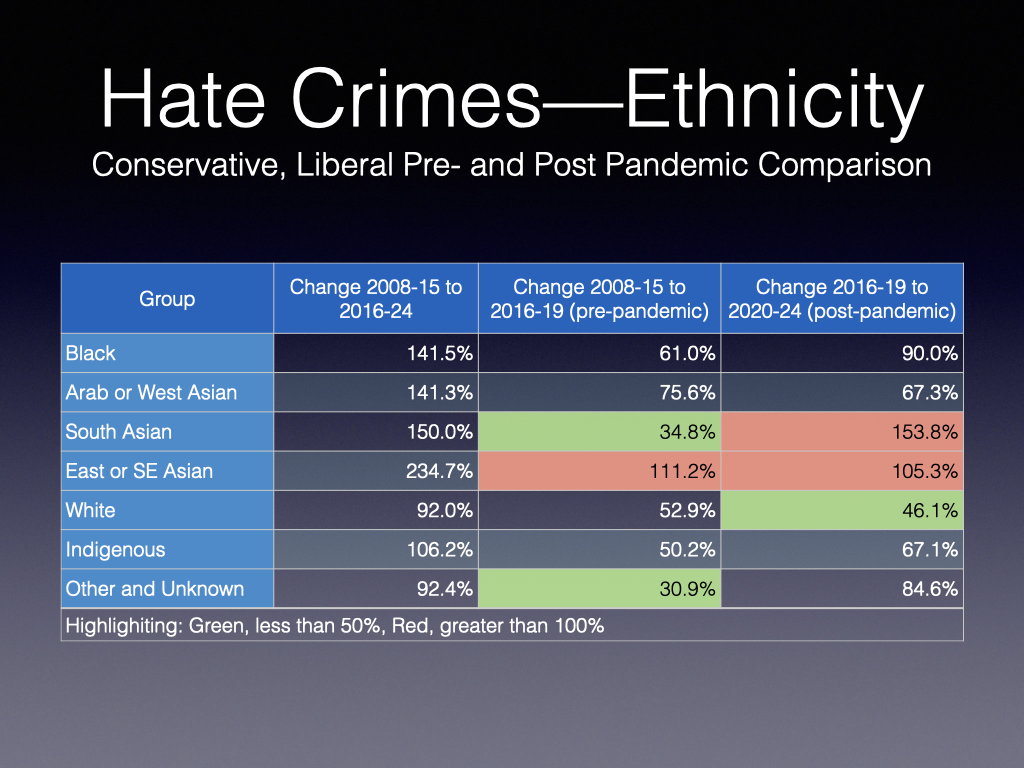
Hate crimes 2024

My latest analysis of the data, 2008-24. This year I have broken the data into three periods: Harper government, Trudeau government pre-pandemic, and Trudeau government post-pandemic and the ongoing increases save for anti-Muslim hate crimes post-pandemic.

The two key comparison slides are below:

StatsCan link: https://www150.statcan.gc.ca/n1/pub/71-607-x/71-607-x2023026-eng.htm?utm_source=mstatcan&utm_medium=eml&utm_campaign=statcan-statcan-mstatcan

StatsCan: Recent trends in immigration from Canada to the United States

Important study highlighting retention issues for high skilled immigrants to Canada:

….In recent decades, a significant decline in permanent migration from Canada to the United States has been observed. The average number of Canadian-born individuals granted U.S. permanent residency fell by 30% from the late 2000s to the late 2010s. In contrast, the number of U.S.-born immigrants to Canada has increased. Overall, Canada experienced a net loss in the exchange of permanent residents from the early 1990s to the mid-2010s. However, since 2018, the difference in permanent resident flows between the two countries has become relatively small.

Data from U.S. labour certification applications reveal that Canadian temporary workers seeking permanent employment in the United States were highly educated and concentrated in computer, mathematical, architecture and engineering occupations, though the overall educational attainment of these applicants has declined over time. By 2024, foreign-born Canadian citizens made up 60% of all Canadian citizen applicants for U.S. labour certification, and the median wage offers for these positions remained high, though slightly lower than a decade earlier.

The continued movement of highly skilled Canadians—both Canadian-born and foreign-born—into the U.S. labour market has important implications for both countries. For Canada, these findings highlight retention issues for skilled immigrants. In the United States, the influx of highly skilled Canadian workers continues to bolster key sectors, but the overall decline in Canadian immigration suggests tightening competition for global talent.

Source: StatsCan: Recent trends in immigration from Canada to the United States

StatsCan: The role of social connections in mitigating the harms associated with discrimination, 2023/2024

Makes intuitive sense that social connections mitigate impacts of discrimination:

In 2023/2024, 45% of all racialized Canadians reported experiencing discrimination over the previous five years. While discrimination has been related to negative mental and physical health, lower levels of life satisfaction and reduced hopefulness about the future, these outcomes become less pronounced when victims of discriminatory acts have strong personal support networks.

Among racialized Canadians who reported experiencing discrimination in the previous five years, one-third (33%) reported having a high level of life satisfaction (scoring 8 or higher on a 10-point scale). This proportion increased to 47% among victims with strong family connections and to 49% for those with strong friend connections. Mental health outcomes and future outlook also fared better when victims had personal support networks.

These results are based on the new study released today, “Softening the blow of discrimination: The role of social connections in mitigating the harms associated with racism and discrimination,” which used the Survey Series on People and their Communities to look at the role of family and friends in mitigating the harms associated with discrimination among racialized Canadians. The study also examined how family and friend relationships can influence discrimination victims’ perceptions of other Canadians and broader Canadian society.

Source: Study: The role of social connections in mitigating the harms associated with discrimination, 2023/2024

Immigration caps are contributing to lower asking rents in Canada, CMHC says

Just after a webinar with the Diversity Institute minimizing the link (StatsCan notes greater correlation, albeit relatively small, in larger cities than smaller centres, with interest rates being greater factor):

Canada’s caps on foreign students and new residents have contributed to reduced demand for rental housing and lower average asking rents in Vancouver, Calgary, Toronto and Halifax, according to a new study from the national housing agency.

Over the past year, the average asking monthly rent fell between 2 per cent and 8 per cent in condos and rental-only apartments – also known as purpose-built rentals – said the report released Tuesday by Canada Mortgage and Housing Corp (CMHC).

The drop was due to a surge in new condos and apartment buildings hitting the market along with limits on temporary foreign residents such as students and new permanent residents.

As of April, temporary residents accounted for 7.1 per cent of the country’s total population, according to Statistics Canada. That compared with the peak of 7.4 per cent in October of last year. 

“It is quite evident on the demand side that there have been signs of weakening,” said Tania Bourassa-Ochoa, CMHC’s deputy chief economist, adding that there were stronger rental declines in regions with slower population growth….

Source: Immigration caps are contributing to lower asking rents in Canada, CMHC says

Emigration up, immigration down: Trends contributing to slower population growth, says StatCan

Of note:

The number of people leaving the country has been slowly increasing in recent years, according to recent data from Statistics Canada. Meanwhile, immigration levels are down in the wake of federal reductions. Both these trends are contributing to a larger picture of significantly slowing population growth, according to StatCan analysis.


StatCan includes Canadian citizens and permanent residents when it refers to emigration or emigrants — folks who leave Canada to reestablish their permanent residence in another country. Immigrants, people who come to live in Canada, include permanent residents and landed immigrants.

How many people have been leaving Canada?


During the first quarter of this year, 27,086 people emigrated from Canada. It was 25,394 in the first quarter of 2022, then 25,536 in the first quarter of 2023 and up to 26,293 in the same quarter of 2024. The number of emigrants peaked at more than 31,000 in the third quarter of 2017, and hit over 30K midway through 2018 and 2019.

The number of emigrants peaked at more than 31,000 in the third quarter of 2017, and hit over 30K midway through 2018 and 2019.


The lowest emigration level in recent years was in the second quarter of 2020 — at just 7,431. Though, that’s unsurprising considering it is when the COVID-19 pandemic hit. After that, emigration started ramping up again.


What are the predictors of likely emigration?


A 2024 StatCan report looked at the likelihood of departure by folks who had previously immigrated to Canada.


It showed that 5.1 per cent  of immigrants admitted between 1982 and 2017 emigrated within five years of arriving. That number jumped to 17.5 per cent 20 years after entering Canada.

The report did not present data on eventual destinations as “emigrants are not required to report their departure from Canada or their destination,” Jada Cormier a communications officer with Statistics Canada told National Post in an email….

Source: Emigration up, immigration down: Trends contributing to slower population growth, says StatCan

Canadians optimistic about national unity regardless of political differences, data show

Some interesting attitude research:

In the leadup to recent political disruptions, including tensions with the U.S. and growing discussion of Western separatism, most Canadians were hopeful about the future of national unity and appeared to harbour positive or neutral feelings toward each other, regardless of differences in political views, according to newly released data.

Two Statistics Canada reports published Wednesday delve into measures of national unity and social cohesion, a relatively new area of exploration for the federal statistics agency.

As the research was conducted in April, 2024, it does not capture recent shifts in sentiment in response to more recent developments such as the trade war with the U.S. However, one of the reports says, the data “serve as a useful baseline for Canadians’ sense of national unity and their societal outlook prior to these events and future comparisons.”

Most respondents were hopeful about the future of Canadian society. More than eight out of 10 said they were hopeful about unity, and a similar proportion said so about democracy.

A slightly lower proportion – 75 per cent – said they were hopeful about the economic opportunities. However, difficulty meeting financial obligations and poor health conditions were linked to relatively lower hopefulness about unity….

Source: Canadians optimistic about national unity regardless of political differences, data show, Unity in Canada: Experimental measures of feelings towards people with similar or different views

Recording of Research Matters event: Exploring citizenship trends and immigrant engagement in Canada and Australia 

ICYMI: Good webinar on recent trends in citizenship by Fung Hou of StatsCan (decline in naturalization along with “citizens of convenience” evidence showing little difference between citizen immigrants and non-citizen immigrants who leave Canada) and a Canada-Australia comparison by Li Xu of IRCC.

Source: Recording of Research Matters event: Exploring citizenship trends and immigrant engagement in Canada and Australia