Trump Cut Muslim Refugees 91%, Immigrants 30%, Visitors by 18%

Stats are revealing:

On December 7, 2015, President Trump called for a Muslim ban. This ban later turned into “extreme vetting” policies, which—according to Trump—had the same goal. Now nearing the 2-year mark of his administration, an accurate assessment of these policies is now possible. All the major categories of entries to the United States—refugees, immigrants, and visitors—are significantly down under the Trump administration for Muslims or applicants from Muslim majority countries.

91% fewer Muslim refugees

President Trump has dramatically reduced the number of Muslim refugees. According to data from the U.S. Department of State—which records the religions of refugees—Muslim refugees peaked at 38,555 in fiscal year (FY) 2016, fell to 22,629 in FY 2017, and reached just 3,312 in FY 2018—a 91 percent decline from 2016 to 2018. Refugees of other faiths have also seen their numbers cut, though not to the same extent as Muslims. The share of refugees who were Muslims dropped from 45 percent in FY 2016 to 44 percent in FY 2017, and then again to 15 percent in FY 2018. President Trump has reversed the earlier trend under President Obama, where Muslim refugee admissions increased.

30% fewer immigrants from majority Muslim countries

Approvals for immigrant visas—that is, for permanent residents—for nationals of the 48 majority Muslim countries have fallen from 117,444 in FY 2016 to 104,228 in FY 2017 to 82,260 in FY 2018—a 30 percent drop overall. The share of new immigrants entering from abroad from majority Muslim countries has fallen as well, from 19 percent in FY 2016 to 18 percent in FY 2017 to 15 percent in FY 2018. This also reflects a change in the prior trend. From 2009 to 2016, immigrants from Muslim majority countries increased from 80,435 to 117,444.

The decline in immigrant visas occurred primarily in the family reunification categories, which President Trump refers to as “chain migrants.” From FY 2016 to FY 2018, the number of family-sponsored immigrants declined by 29,607—a 36 percent decline. Special immigrants—interpreters and other partners of the U.S. military mainly from Iraq and Afghanistan—accounted for the rest of the reduction. In FY 2018, there were 45 percent fewer immigrant visas for special immigrants than in FY 2016.

18% fewer visitors from majority Muslim countries

Though they were already relatively low to begin with, nonimmigrant visa approvals—temporary visas for workers, students, and tourists—from Muslim majority have also declined 18 percent from 2016 to 2018. In 2016, the Obama administration issued 856,886 nonimmigrant visas to nationals of Muslim majority countries. In 2017, this number fell to 718,535. By 2018, it had dropped to 702,375—154,511 fewer than 2016. The declines occurred among both tourist visas and other visa categories.

Explanations for the Decline in Visas and Refugees

Since President Trump establishes the refugee quotas for each region of the world and for each fiscal year, his decision to cut the quota and distribute the cap away from the Muslim world explains the drop in Muslim refugee issuances. For FY 2017, President Trump established the lowest refugee quota in the history of the refugee program.

The primary cause of the decline in the immigrant visa approvals is the travel ban that has singled out for exclusion eight majority Muslim countries since January 2017: Chad, Iran, Iraq, Libya, Syria, Somalia, Sudan, and Yemen. Chad and Sudan have been completely removed from the list, and while Iraq is not officially designated, the latest proclamation from September 2017 singles Iraqis out for additional scrutiny.

The eight travel ban countries explain 65 percent of the decline in immigrant visa issuances for Muslim majority countries. Immigrant visa issuances for these countries have fallen 72 percent from FY 2016 to FY 2018. The travel ban explains only 28 percent of the decline in nonimmigrant visa issuances from Muslim majority countries. Nationals of the travel ban countries received 62 percent fewer nonimmigrant visas in 2018 than in 2016.

Beyond the travel ban, President Trump has imposed “extreme vetting” policies that make immigrating more bureaucratic and costly for everyone. He has massively increased the length of immigration forms, adding new subjective “security” questions. According to the American Immigration Lawyers Association, more applications for Muslims are disappearing into an “administrative processing” hole, where applications are held up for security screening. Undoubtedly, some Muslims simply want to avoid the United States where storiesof profiling and discrimination abound.

Conclusion

The bottom line is that the Trump administration is leading a major overhaul in the types of travelers, immigrants, and visitors who are coming to the United States. His administration reduced Muslim refugees by 91 percent and has overseen a 30 percent cut to immigrant visas for majority Muslim countries and an 18 percent cut to temporary visas. These policies lack a valid national security justification, but they are nonetheless having a significant effect. President Trump is certainly following through on his promise to limit Muslim immigration, even if a “total and complete shutdown” has not happened.

Source: Trump Cut Muslim Refugees 91%, Immigrants 30%, Visitors by 18%

L’Institut du Québec remet les pendules à l’heure en immigration

Good initiative in presenting the data:

Parce que plusieurs données sur l’immigrationsont semées à tort et à travers en cette campagne électorale, l’Institut du Québec (IdQ) a cru bon de remettre les pendules à l’heure en publiant une « mise à jour » pour clarifier certaines informations. Car si certains politiciens confondent encore des statistiques, d’autres ne prennent pas le soin de les mettre en contexte.

L’IdQ travaille sur les thèmes de l’intégration des immigrants au marché du travail depuis un certain temps, mais a senti une certaine urgence à préciser certaines données. « En voyant à quel point c’est devenu important dans les élections, surtout la question des seuils migratoires et la rétention, […] on a senti que notre mission était de sortir rapidement », a dit Mia Homsy, directrice de l’IdQ, auquel s’associent le Conference Board du Canada et HEC Montréal. « Je ne suis pas certaine des chiffres que [les chefs de partis] utilisent. Je vois aussi qu’ils essaient d’en éviter certains… ce n’est pas toujours clair. »

Le taux de rétention

Mme Homsy invite à ne pas confondre « solde migratoire net », qui est la somme de la migration internationale (entrées et sorties) et de la migration interprovinciale (entrées et sorties) qu’on soit immigrant ou natif, et taux de rétention, qui mesure le nombre d’immigrants encore au Québec plusieurs années après leur arrivée. Ce que pourrait avoir fait le chef de la Coalition avenir Québec, François Legault, qui se plaît à répéter que, des 50 000 immigrants qu’il accueille, le Québec en perd 13 000. Parle-t-il du solde migratoire net, qui est de 12 600 ?

M. Legault pourrait avoir plutôt fait allusion aux 26 % d’immigrants qui ont quitté le Québec, mais, dans ce cas, il omet de préciser que c’est entre 2006 et 2015 (soit sur 9 ans). Ce qu’il ne dit pas non plus, c’est que ces chiffres sont du ministère de l’Immigration et se basent sur les renouvellements de la carte d’assurance maladie, qui ne tiennent pas compte des décès et des non-renouvellements volontaires.

Les chiffres publiés par l’Institut du Québec, qui se basent sur les déclarations de revenus, ont une connotation beaucoup plus positive : seulement 18 % des immigrants arrivés entre 2005 et 2015 auraient quitté la province. Et le Québec se classe 4e au Canada pour son taux de rétention. « J’avais en tête que c’était catastrophique, mais on n’est quand même pas si loin de l’Ontario », a déclaré Mme Homsy. Selon le rapport, le taux de rétention sur cinq ans est encore plus encourageant, soit 84,3 %, et il constituerait une nette amélioration par rapport à il y a 15 ans.

Peu de francophones

Le chef de la CAQ et celui du Parti québécois, Jean-François Lisée, ont aussi répété que trop peu d’immigrants (42 %) parlent français à leur arrivée au Québec. Or, ils omettent souvent de préciser que cette donnée est pour 2017 seulement, année où le Québec a reçu beaucoup de réfugiés. En 2016, 48 % des personnes qui arrivaient ici parlaient le français, et en 2015, 56 %.

Brahim Boudarbat, professeur à l’École des relations industrielles de l’Université de Montréal, fait remarquer que, pour avoir l’heure juste, il faudrait uniquement s’intéresser à la catégorie des immigrants économiques, car ce sont eux qui sont sélectionnés avec, notamment, le critère de la langue française. Et là, toutefois, les politiciens n’auraient pas tort de s’alarmer sur la proportion d’immigrants francophones, qui sont en diminution constante depuis ces dernières années, passant de 67 % en 2012 à 53 % en 2016. « Ça, c’est un problème, puisqu’on voit que ça baisse », dit-il. Le ministère de l’Immigration a reconnu qu’elle avait admis un plus grand nombre de personnes déclarant uniquement connaître l’anglais, notamment parce que l’adéquation entre les besoins du Québec dans certains secteurs d’emploi et les compétences des travailleurs migrants était devenue plus importante que le seul critère de la langue.
Seuils et chômage

M. Boudarbat fait remarquer que les partis parlent peu de régionalisation, mais débattent beaucoup des seuils d’immigration. « On s’attendrait à ce que les libéraux, qui ont un discours de pénurie de main-d’oeuvre, parlent d’augmenter les seuils, mais ils ne le font pas. Moi, j’interprète ça comme une réduction », indique le professeur. « Dans sa tête, [le chef Philippe Couillard] pense sans doute à 60 000-65 000, mais il ne le dit pas, parce qu’il serait obligé de le justifier, comme le font les autres partis. »

Pour sa part, le chef de la CAQ justifie son intention d’accueillir moins d’immigrants en répétant que le taux de chômage parmi cette population est de 15 % dans les cinq premières années. Or, s’il est effectivement de 14,1 %, comparativement à 9,1 % en Ontario, ce taux a tendance à diminuer, étant donné la conjoncture économique favorable. Après avoir oscillé entre 10 % et 13 % depuis 2007, le taux de chômage des immigrants âgés de 25 à 54 ans atteignait 8,7 % l’an dernier. « Les employeurs vont désormais considérer un CV d’immigrant qu’ils auraient peut-être mis sous la pile il y a 15 ans, voyant que leur production est compromise », avance Mia Homsy.

Pour un portrait plus juste de la situation, les politiciens devraient toutefois s’intéresser de plus près à certaines données qui ne ressortent pas souvent, soit le taux de surqualification et la provenance des immigrants. « Les gens des pays musulmans ont un taux de chômage plus élevé », rappelle M. Boudarbat.

Source: L’Institut du Québec remet les pendules à l’heure en immigration

Citizenship Statistics January-June 2016: 64 Percent Drop in Applications

The release of IRCC citizenship and other statistics for the first half of the year provides an indication of what the overall 2016 numbers of permanent residents and new citizens will likely be.

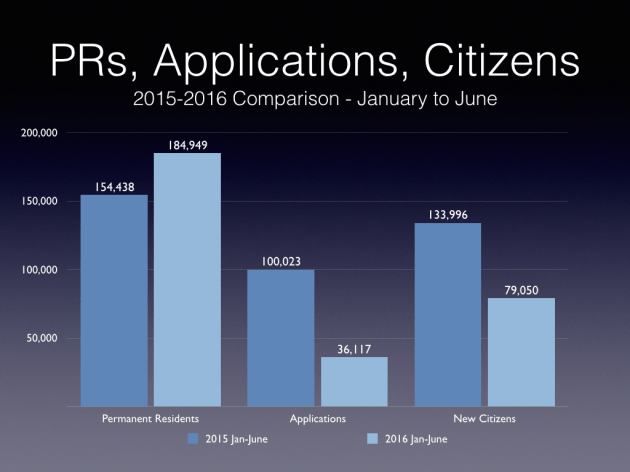
citizenship-data-slides-2015-008The chart above, year-to-year comparison, shows the expected drop (41 percent) in the number of new citizens following IRCC’s success in 2014 and 2015 in eliminating the backlog (from a high of  323,000 in 2012 to 59,000 on 30 June 2016).

The more significant news is the dramatic drop in the number of people applying for citizenship (63.9 percent), mainly reflecting the sharp increase in citizenship fees from $100 (plus $100 right of citizenship fee) before February 2014  to $530 in 2015 (the right of citizenship fee remained unchanged).

To a lessor extent, some of the 2014 changes to the Citizenship Act in C-24, such as the extension of language and knowledge testing to 55 to 64 year olds, also played a role.

If this trend continues, there will only be about 70,000 applications in 2016, compared to about 130,000 in 2015.

Of concern is that IRCC did not appear to have seriously considered the possible impact of this increase in fees when advocating successfully for an exemption to the User Fees Act and its requirements for full public consultations.

In the Canada Gazette announcement announcing the increase to $530 (Regulations Amending the Citizenship Regulations P.C. 2014-1453 December 12, 2014), IRCC stated:

“An important assumption made in the monetized analysis is that the fee increases are not anticipated to affect the demand for citizenship. The last census (2006) reports that 85% of eligible immigrants received Canadian citizenship, or approximately 228,000 individuals. The CBA assumes that the fee increase will not impact the naturalization rate as the value placed on obtaining citizenship is very high and the benefits associated with obtaining citizenship far outweigh the fee increases. Thus, the number of applications expected per year is not anticipated to fall following an increase in the fees.”

Hard to believe that such a categorical assumption could be made, in contravention of basic economics and the realities of many low-income and refugee immigrants. Pure assertion, no real evidence. It mischaracterizes the Census number, which includes all the foreign-born (about six million), not just recent immigrants whose naturalization rate is significantly less.

Approval rates increased slightly to 92.1 percent from 91.4 percent.

Processing time continues to decline from 21 months during FY 2015-16 to 18 months in the latest quarter (April-June 2016), helped by the declining number of applications.

A cynic might suggest that the previous government, in addition to implementing many of the administrative changes and business process simplification needed to reduce future backlogs, put into place a number of measures that effectively reduced demand for citizenship as part of the their objective of making citizenship “harder to get and easier to lose.”

The increase in the number of new permanent residents reflects the increase in levels for 2016.

The datasets used are from Opendata: Citizenship Application ProcessingImmigration, Refugees and Citizenship Canada Overview.

One minor irritation with the datasets of Opendata: for citizenship, IRCC has moved from calendar to fiscal year reporting unlike for permanent and temporary residents, where it remains on a calendar year basis.

While it is possible to correlate the calendar and fiscal years, IRCC should be consistent for all its data sets. While I prefer the calendar year basis given that it allows to track longer term trends consistently, I can also understand the rationale for fiscal years, given the linkage to planning, budgeting, and reporting.

But please pick one or the other and stick to it!

Note: Revisions to application numbers can occur given incomplete applications are returned to the applicant without being entered into the database. When these are subsequently resubmitted with the missing information, they are dated and counted from the date of the original application. It is unlikely, however, that any revisions will alter significantly this trend.

Garbage in, garbage out: Canada’s big data problem

A reminder that despite the restoration of the Census, there still remain significant gaps in the collection, methodologies and dissemination of statistical data by the government:

In a recent article in the Toronto Star, Paul Wells lays out what he sees as Prime Minister Trudeau’s game plan for slowing Canada’s brain drain and making science pay. “Over the next year,” he writes, “the Trudeau government will seek to reinforce or shore up Canada’s advantage in three emerging fields: quantum tech, artificial intelligence and big data and analytics.”

As he should. If that’s the plan, it’s a good one. Canada’s future prosperity depends on our ability to innovate and retain the best talent in those three fields.

What we call “big data analytics” works by finding previously unknown patterns in the huge blocks of data that very large organizations — governments, for example — grow around themselves constantly, like coral. Finding those patterns can point the way to new efficiencies, new ways to fight crime and disease, new trends in business. But as with any complex system, what you get depends on what you put in. If the inputs aren’t accurate, the results won’t be, either. So before we embrace the “big data revolution”, we may want to look first at the worsening quality of the data our federal government produces, and that businesses, activists and social planners use.

Take something as basic as divorce. Statistics Canada first started reported marriage rates in 1921, divorce rates in 1972; it stopped collecting both data streams in 2011, citing “cost” concerns.

Marriage and divorce rates are exactly the kinds of data streams consumers of big data want collected, because they affect so many things: government policies, job markets, the service sector, housing starts — you name it. Having abandoned the field now for five years, StatsCan’s data volume on marital status isn’t nearly as useful as it might have been.

Take wildlife conservation. Recently an Ontario provincial backbencher proposed a private members bill to allow for unlimited hunting of cormorants. The bill’s proponent says the species is experiencing a population explosion. And we don’t know if he’s right or wrong — because the feds stopped collecting that data in 2011.

open quote 761b1bCanada used to publish statistical reports that were every bit as good as the Americans’ — in some cases, better. Then we stopped.

Here’s another big data blind spot: gasoline imports. After having reported data on gasoline imports regularly since 1973, StatsCan has been suppressing the numbers since 2013 due to what it calls “privacy” concerns. In the last reporting year, 2012, a staggering amount of imported gasoline came into the country — almost 4 billion litres.

Now, if you were thinking of expanding your oil refinery, or wanted to know more about how dependent this country is on foreign fuel, this would be pretty precious data — the kind you’d probably pay for. But the data aren’t reliable — any more than the StatsCan data on gasoline demand by province, which we use to work out whether carbon taxes are actually reducing demand for gasoline. It’s bad data; it has been for years. You’d think someone in the higher echelons of the federal or provincial governments would get annoyed.

Combing through StatsCan’s archive of reports can be a bewildering experience, even for experts. Its online database, CANSIM, is easy enough to use. It’s the reports themselves that sometimes fail you.

Say you want to understand trends in Ontario’s demand for natural gas. You’d start by looking at CANSIM table 129-0003, which shows an increase in sales of natural gas in 2007 over 2006 of 85 per cent. “Ah,” you think to yourself, “that must be because of the conversion of coal-burning plants to gas.” But no, that change occurred years later. Ask StatsCan and they’ll tell you that they changed their methodology that year — but didn’t bother re-stating the previous years’ numbers under the same methodology. Individually, the numbers are accurate — but the trend stops making sense.

StatsCan changed its methodology again this year; it now warns researchers to take care when comparing current and historical data. That’s an improvement over changing the methodology without telling anyone but it isn’t very helpful for understanding long-term trends.

And this isn’t just StatsCan’s problem. The National Energy Board published an excellent report showing where Canada’s crude ends up in the United States. Industry analysts use the numbers to understand the reasons why light and heavy crude are selling for what they’re selling for south of the border.

The NEB stopped reporting the data after September 2015. Ask why, and this is the response you get: “The Board has decided to discontinue publication of this data while we re-evaluate our statistical products.” That, of course, was a year ago.

Source: Garbage in, garbage out: Canada’s big data problem

2015 in review – My WordPress blog stats

For those interested, and in the spirit of openness and transparency, please find the WordPress 2015 annual report for my Multicultural Meanderings blog.

Here’s an excerpt:

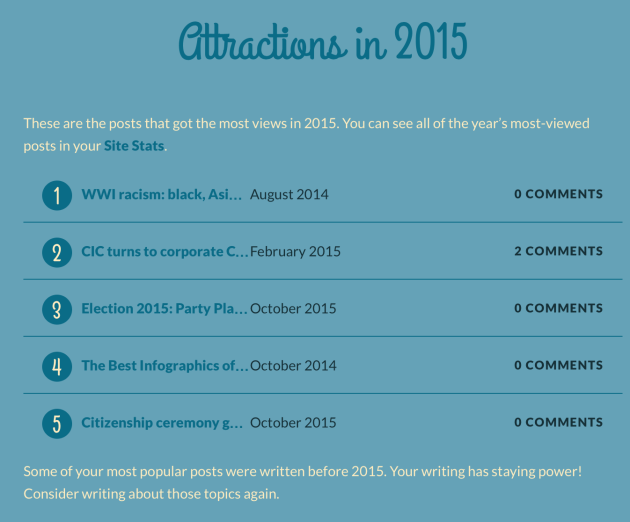
The concert hall at the Sydney Opera House holds 2,700 people. This blog was viewed about 27,000 times in 2015. If it were a concert at Sydney Opera House, it would take about 10 sold-out performances for that many people to see it.

The top posts:

Your_2015_year_in_blogging

Click here to see the complete report.

Québec désapprouve l’abolition de la banque de données des statistiques officielles

Quebec’s cancellation of the census moment?

La décision a été vivement dénoncée mercredi, notamment par des chercheurs qui y avaient recours. « La banque de données fait partie de ces coupes dont on s’évertue à faire croire qu’elles n’auront pas d’impacts sur les usagers. Mais elles en auront », s’est indigné André Lemelin. Ce professeur d’économie à l’Institut national de recherche scientifique (INRS) s’intéresse de près aux statistiques régionales et utilise régulièrement les données de l’ISQ, dont celles de la BDSO.

« Les chercheurs devront dorénavant courir à droite et à gauche, trouver quel ministère et qui est responsable de quoi pour pouvoir obtenir des données. C’est décidément une perte déplorable », décrit-il. L’ISQ effectuait en effet un travail de sélection, de préparation et de mise en forme des données pour les rendre « intelligibles, conviviales et accessibles », mentionne Patricia Caris, directrice générale adjointe aux statistiques et à l’analyse sociales. Des compilations statistiques sur mesure, un service déjà offert moyennant plusieurs centaines de dollars, pourront être obtenues. M. Lemelin doute toutefois que les chercheurs soient prêts à assumer ce fardeau supplémentaire pour leurs fonds de recherche qui fondent aussi.

Le président du Syndicat de professionnelles et professionnels du gouvernement du Québec, Robert Perron, s’inquiète aussi vivement : « C’est une “ harpérisation ” de l’État qui rendra plus difficile la dénonciation de ce qui se passe », croit-il.

« La transparence est l’un des outils de la démocratie, l’information nous permet de comprendre la société dans laquelle on vit », renchérit Lise Millette, présidente de la Fédération professionnelle des journalistes du Québec. Elle déplore le fait que les journalistes devront « reprendre le bâton du pèlerin et cogner à la porte de chacun des ministères quand notre coffre à outils n’est déjà pas très garni ».

Québec désapprouve l’abolition de la banque de données des statistiques officielles | Le Devoir.

All the World’s Believers & Unbelievers in one Handy Info-graphic | Graphics | News | National Post

All the World’s Believers & Unbelievers in one Handy Info-graphic | Graphics | News | National Post.