The day Time magazine published its report on a photo of Justin Trudeau wearing blackface, discussion exploded online. But less than a week later, online posts about the scandal had all but disappeared, according to new research from McGill University.
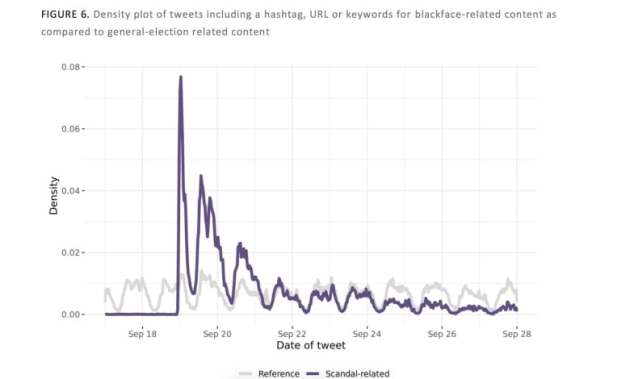
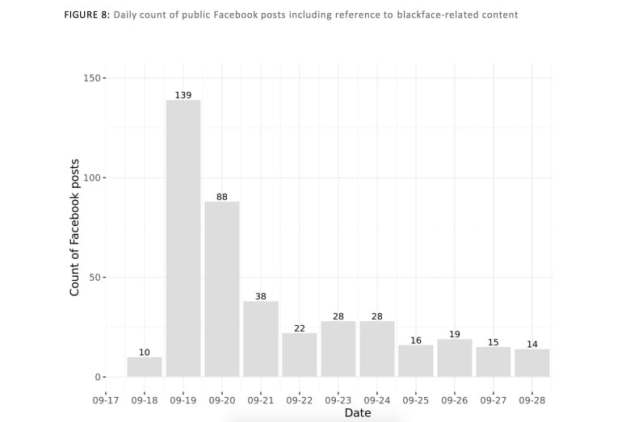
In fact, the online discourse around Trudeau’s history of wearing blackface dropped off dramatically within three days, according to an analysis of social media posts published today by the Digital Democracy Project, an effort led by the Public Policy Forum and the Max Bell School of Public Policy at McGill University.
“The story breaks and within a couple hours is trending on Twitter, there’s a massive amount of coverage,” said lead data analyst Aengus Bridgman. “By the next day, it’s about half. By the third day, it’s about a quarter and it goes down from there to very little discussion by the end of the week.”
The findings are based on a dataset of 3 million tweets from the general public from Sept.17 to Sept. 28. A separate dataset of Facebook posts that mention Trudeau and blackface or link to a story covering the issue showed a similar sharp decline in just a few days.
Journalists and politicians on Twitter also followed a similar pattern, with a high amount of tweets about blackface in the first few days that dropped off significantly toward the end of the week.
“We think that the brownface/blackface story offers a pretty unique research moment in an election where an unexpected discourse emerges that nobody could have planned for,” said Taylor Owen, the director of the Digital Democracy Project.
The researchers also took a look at accounts that are likely partisan based on the politicians they follow from each party. This showed that, while partisans of all stripes tweeted about the story, it was largely pushed by Conservative supporters.
An analysis of the hashtags used by accounts from these groups, however, show that most likely they were circulating among like-minded people: most of the blackface-related tweets coming from Conservative partisan accounts, for example, were only seen by other Conservative partisans, the report found.
“Among partisan Twitter users, Conservatives are driving the conversation about the controversy,” the report found. “The blackface-related hashtags are disproportionately populated by right-leaning partisans who are largely speaking among themselves.”
For better or worse, I’ve developed a deep expertise of what he has tweeted about in the last two years. Over the last 11 months, my colleague Jasmine C. Lee and I have read, tagged and sorted more than 14,000 tweets. We’ve found that about one in every nine was an insult of some kind.
This work, mundane as it sometimes is, has helped reveal a clear pattern – one that has not changed much in the weeks since Mr. Trump’s victory.
First, Mr. Trump likes to identify a couple of chief enemies and attack them until they are no longer threatening enough to interest him. He hurls insults at these foils relentlessly, for sustained periods – weeks or months. Jeb Bush, Marco Rubio, Ted Cruz and Hillary Clinton have all held Mr. Trump’s attention in this way; nearly one in every three insults in the last two years has been directed at them.
If Mr. Trump continues to use Twitter as president the way he did as a candidate, we may see new chief antagonists: probably Democratic leaders, perhaps Republican leaders in Congress and possibly even foreign countries and their leaders. For now, the news media – like CNN and The New York Times – is starting to fill that role. The chart at the top of this page illustrates this story very clearly.
That’s not to say that the media is necessarily becoming his next full-time target. Rather, it suggests that one has not yet presented itself. The chart below, which shows the total number of insults per day, shows how these targets have come and gone in absolute terms. An increasing number of insults are indeed being directed at the media, but, for now, those insults are still at relatively normal levels.
Insults per day
Second, there’s a nearly constant stream of insults in the background directed at a wider range of subjects. These insults can be a response to a news event, unfavorable media coverage or criticism, or they can simply be a random thought. These subjects receive short bursts of attention, and inevitably Mr. Trump turns to other things in a day or two. Mr. Trump’s brief feuds with Macy’s, Elizabeth Warren, John McCain and The New Hampshire Union Leader fit this bucket well. The election has not changed this pattern either.


 Multicultural Meanderings