Not much new but useful to have this overview, which again highlights the disproportionate share allocated to Quebec:
…IRCC settlement funding by province and territory
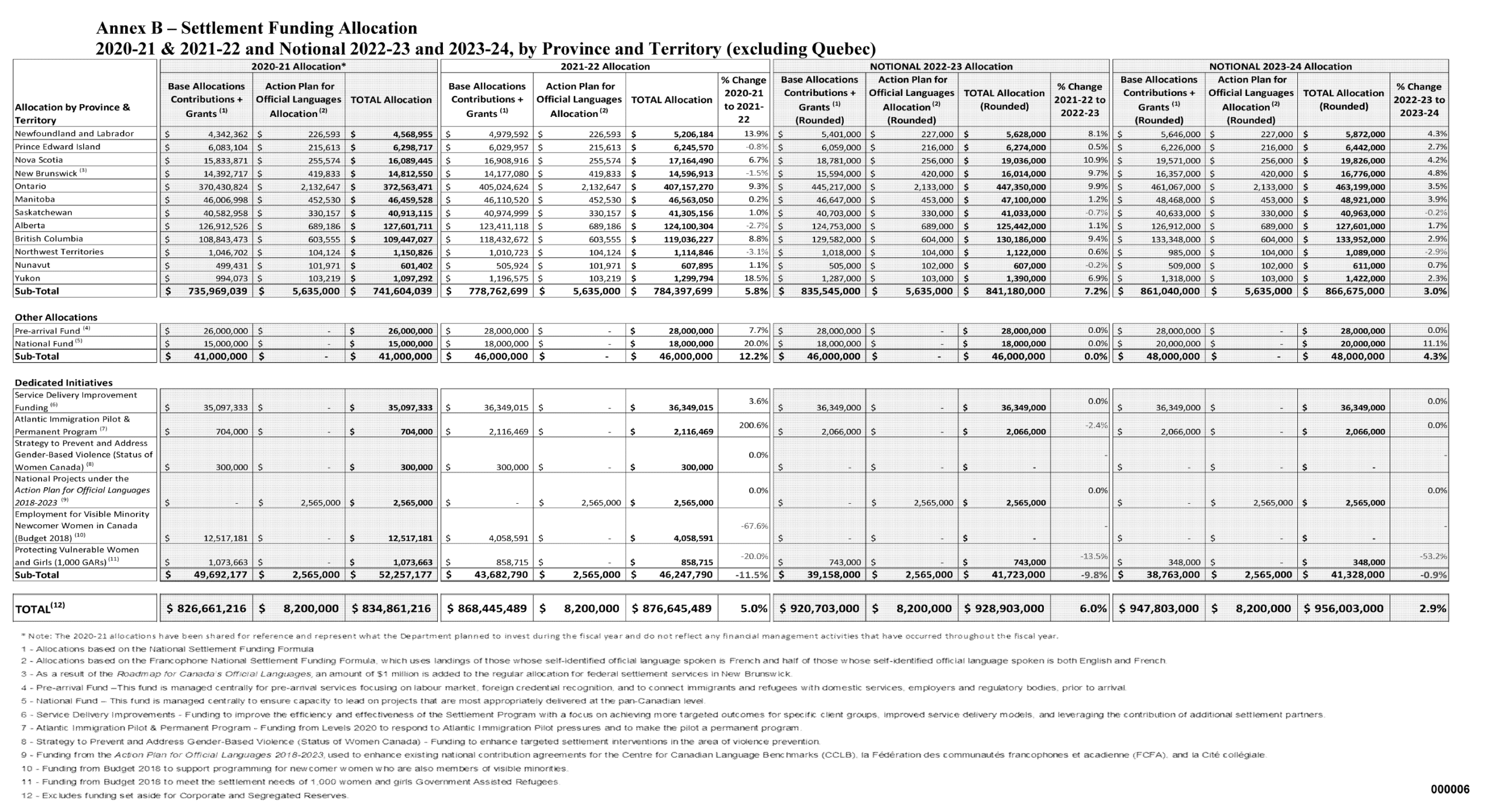
The memo shows that Mendicino approved the following 2021-22 allocation by province and territory (except Quebec). Note that all figures are rounded and also include spending projections obtained from IRCC’s publicly available 2021-2022 departmental plan:
- Ontario: $407.2 million
- Alberta: $124.1 million
- British Columbia: $119 million
- Manitoba: $46.6 million
- Saskatchewan: $41.3 million
- Nova Scotia: $17.2 million
- New Brunswick: $14.6 million
- Prince Edward Island: $6.2 million
- Newfoundland and Labrador: $5.2 million
- Yukon: $1.3 million
- Northwest Territories: $1.1 million
- Nunavut: $608,000
- Sub total: $784.4 million
- Other allocations: $46 million
- Dedicated IRCC Initiatives: $46.2 million
- Quebec (Not included in the memo): $650.3 million via the separate annual grant it receives from IRCC
- Resettlement services (Not included in the memo): $145.7 million
- Grand total (Not included in the memo): $1,672.6 billion
Sources: IRCC memo and IRCC’s Departmental Plan 2021-22.
Screenshot 1: Settlement Funding Allocation (Click on image to enlarge):

Source: IRCC
IRCC’s settlement funding formula
One possible reason IRCC has stopped sharing this information publicly is due to the controversy it garners among provinces, territories, and the service provider organizations. These stakeholders are in constant negotiations with IRCC on identifying the most appropriate funding levels for their respective jurisdictions. IRCC acknowledges the controversial nature of this process in the memo.
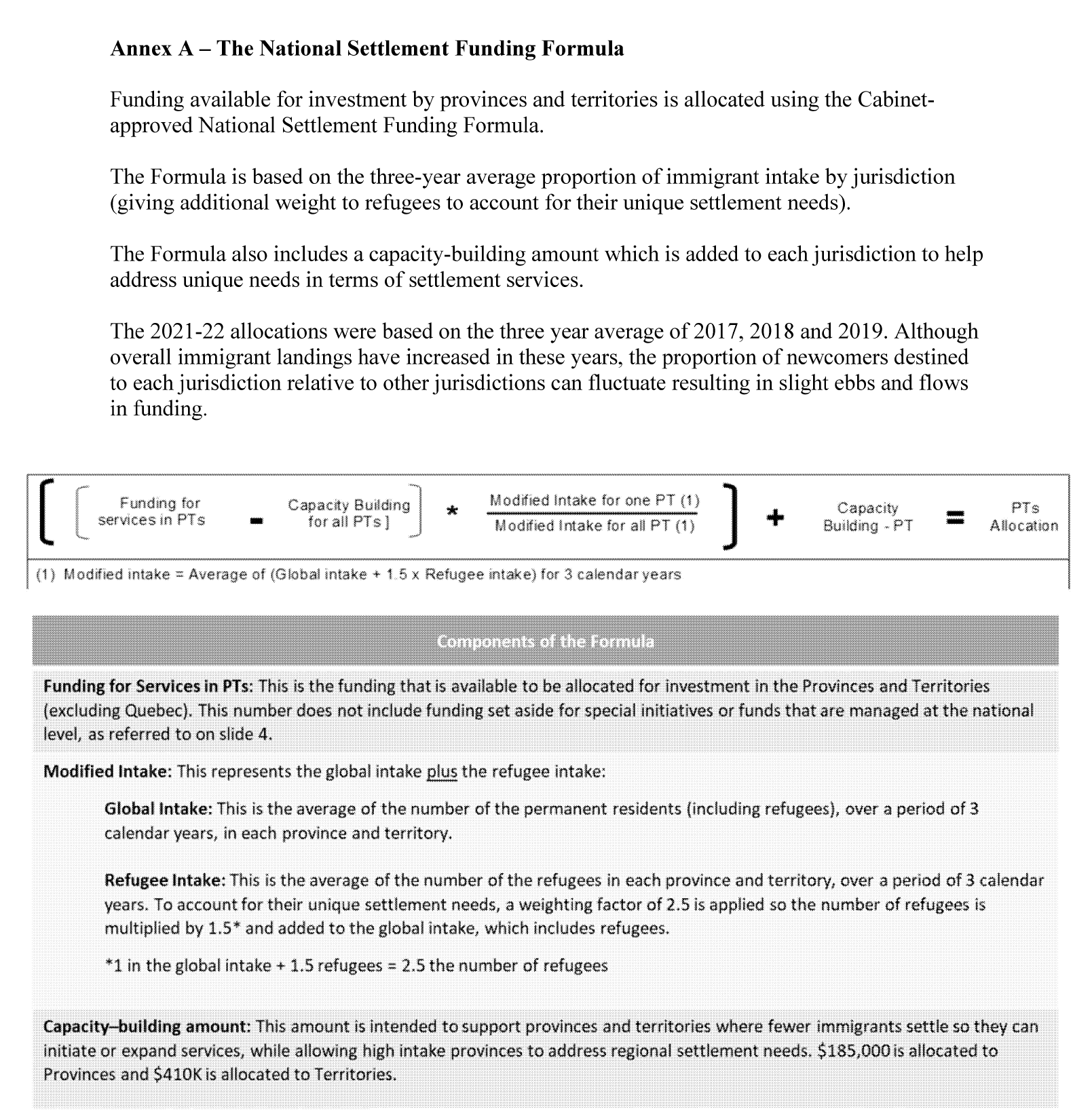
The memo outlines that the allocation of funding by province and territory is based on a federal Cabinet approved National Settlement Funding Formula. The formula allocates funding for each jurisdiction based on the three-year average proportion of immigrant landings by jurisdiction. It also gives additional weight to refugees to account for their unique settlement needs (refugees tend to require more settlement services than economic and family class immigrants). Quebec is not subject to this formula since its grant is calculated based on the formula outlined in the Canada-Quebec Accord relating to Immigration and Temporary Admission of Aliens signed in 1991. Due to Quebec’s special status as Canada’s only French-speaking province, it has more authority than any other jurisdiction to select immigrants. It also receives more IRCC settlement funding than any jurisdiction and has more flexibility to use the funding.
Screenshot 2: The National Settlement Funding Formula (Click on image to enlarge):

Source: IRCC.
Settlement funding per capita
As indicated in Screenshot 2, IRCC determined the 2021-22 allocations based on immigrant landings in each province and territory in 2017, 2018, and 2019. This results in the following settlement funding amounts per capita:
- Nunavut: $16,432
- Quebec: $13,541
- Northwest Territories: $4,622
- Yukon: $4,194
- Newfoundland and Labrador: $3,428
- New Brunswick: $3,072
- Ontario: $3,033
- Alberta: $2,913
- Manitoba: $2,862
- Nova Scotia: $2,857
- Saskatchewan: $2,691
- Prince Edward Island: $2,684
- British Columbia: $2,671
Sources: IRCC; Author’s calculations. The methodology is: Allocations for each province and territory divided by annual average of each province/territory’s immigrant intake between 2017-2019.
IRCC’s memo states that smaller jurisdictions receive capacity building funding to allow them to increase the scale of their services. This may explain why jurisdictions with low newcomer intakes including Nunavut, the Northwest Territories, Yukon, Newfoundland and Labrador, and New Brunswick are at the top of the list. Ontario gets more than the provinces west of it due to it having the highest refugee intake in the country.
Quebec leads all provinces due to the generous settlement formula identified in the Canada-Quebec Accord. Among its provisions, the formula dictates the grant amount can only increase over time.
What does this all mean?
IRCC goes to great lengths to help immigrants succeed. This is demonstrated by its settlement program accounting for nearly half of the department’s annual $3.6 billion budget. Canada is the largest funder of immigrant settlement services in the world.
At the same time, IRCC has the difficult task of identifying how to distribute its settlement funding across the country in a manner that takes into consideration the needs of each jurisdiction. This results in an imperfect process that is subject to intense scrutiny and debate among Canada’s governments, settlement provider organizations, researchers, and the media.
Quebec enjoys the most funding in absolute terms as well as the second most per capita even though its provincial government was elected in 2018 on a mandate to reduce immigration. The province’s settlement funding formula was agreed to in 1991 based on the expectation that Quebec’s immigration levels would increase over time to help compensate for its aging population and low birth rate. However the election of the Coalition Avenir Quebec (CAQ) party in 2018 highlighted a flaw in the formula, as Quebec has since seen its annual grant from IRCC continue to rise as its newcomer intake declined by 22 per cent in 2019 compared to 2018.
Conversely, Alberta, New Brunswick, Prince Edward Island (PEI) and the Northwest Territories have each seen their settlement allocations decline this federal fiscal year due to recent declines in their newcomer arrivals. Decreasing allocations to jurisdictions when their newcomer levels decline may seem fair, but it also creates operational challenges. Namely, lower IRCC funding to a province or territory could come at a time when that jurisdiction sees an increase in their newcomers (and hence, strains their ability to deliver settlement supports to newcomers). In addition, decreased funding means that service provider organizations may need to scale back their operations which sometimes entails laying off staff.
IRCC recognizes such challenges, which is why the memo notes that IRCC will make a one-time transfer to their Western Canada operations to top-up the funding provided to Alberta. The purpose of the top up is to ensure that Alberta can continue to provide high quality settlement supports to its newcomers.
Finally, IRCC recognizes that further investments will be needed to support future newcomers. The memo states the department anticipates more settlement funding to become available as it looks to welcome more newcomers through its Immigration Levels Plan. The 2021-2023 levels plan is the most ambitious in Canadian history as it seeks to welcome over 400,000 new immigrants per year. Since its founding in 1867, Canada has welcomed 400,000 immigrants in a year just once, in 1913. As such, the memo indicates an expectation the allocation for all provinces and territories (excluding Quebec) will increase by another $100 million for the 2023-24 federal fiscal year. This suggests the department’s total settlement spending will reach some $2 billion annually within the next few years.

 Multicultural Meanderings