More than 2,700 Canadians applied to be senators – diversity analysis

senate-working-deck-016For those interested in employment equity and diversity reporting, this first report provides a model for future reporting on judicial and other GiC appointments.

While I have some quibbles – the reference number for visible minorities should be the percentage of those who are also Canadian citizens (15 percent), not the age adjusted workforce population as they have appeared to use (17.8 percent), a breakdown of the ethnic/cultural groups self-identified would be helpful, along with some methodology notes – this is really a good and comprehensive report.

Of course, this report does not include other aspects of diversity such as education, work and the like.

By way of comparison, the 28 Senate appointments of PM Trudeau were comprised of 16 women (57 percent, higher than the 40 percent of applications), six visible minorities (21 percent, slightly lower than the 25 percent who applied) and two Indigenous persons (7 percent, twice that percentage of those that applied).

Hopefully, this will serve as a template for future reporting on the diversity of GiC appointments, including judges:

The independent board that advised Prime Minister Justin Trudeau on a recent round of Senate appointments says 2,757 people applied to be senators when the Liberal government went looking to fill vacancies for seven provinces.

Canadians were invited to apply when nominations were opened in July to fill 21 spots in the upper chamber. The independent advisory board that reviewed the applications is part of Trudeau’s plan to reform the Senate.

According to the advisory board’s first report, 60 per cent of applicants were male and 68 per cent selected English as their first language.

Twenty-five per cent identified as a visible minority, 13.6 per cent described themselves as indigenous and four per cent as LGBT.

“We were very pleased with the number of applications received, as well as with the calibre of individuals who put their names forward as part of the open application process,” the board writes.

The board says that “nearly 750 national, provincial and local organizations” were also contacted to encourage applications.

Applicants were screened by board members to identify “a list of priority candidates who … best met the merit-based criteria.” The prime minister was then provided with a list of five candidates for each of 20 vacancies, with additional names passed along to fill an unexpected opening for Manitoba.

“Recommended candidates were not prioritized; the proposed candidates were listed in alphabetical order,” the board explains. “The advice to the prime minister included a short synopsis to highlight the merits of each of the recommended candidates, as well as more detailed information from their candidacy submission.”

The board also clarifies that the prime minister’s choices for appointment came from their recommendations.

“We were very pleased that the prime minister made his recommendations to the Governor General from the list of candidates that we had provided to him,” they write.

The total cost for the advisory process so far is estimated to be approximately $900,000.

Maryam Monsef, minister of democratic institutions, also announced on Wednesday that the federal government has opened applications to fill another six vacancies: three in Nova Scotia, two in Ontario and one in New Brunswick.

Source: More than 2,700 Canadians applied to be senators – Politics – CBC News
Report of the Independent Advisory Board for Senate Appointments – Permanent Process (July to November 2016)

‘We can’t abandon them’: Senators urge more language, mental health supports for Syrian refugees

Sensible set of recommendations:

One year after the first wave of Syrian refugees arrived in Canada, the Senate’s committee on human rights is urging the federal government to boost language training, mental health services and financial supports to ease the next phase of the resettlement process.

Releasing a report called “Finding Refuge in Canada: A Syrian Resettlement Story,” committee chair Jim Munson said while the program has been a Canadian success story, the government and citizens must not be complacent.

“We can’t abandon them. We can’t let indifference set in. We need to do more to help them in their next resettlement steps,” he said during a news conference in Ottawa Tuesday.

The report recommends:

  • The minister of immigration, refugees and citizenship set and meet specific standards for processing times.

  • Improving the flow of information to refugees on the status of applications.

  • Connecting refugees with networks of supportive individuals in their communities.

  • Ensuring the Canada Revenue Agency (CRA) maintain timely processing for disbursement of the Canada Child Benefit.

  • Replacing immigration loans for transportation expenses with a grant.

  • Increasing funds for language training, and providing accompanying child care to improve access for women.

  • Working with provinces, territories and community groups to enhance programming for youth.

  • Improving culturally appropriate mental health programs.

  • Identifying possible changes to facilitate timely family reunification.

Source: ‘We can’t abandon them’: Senators urge more language, mental health supports for Syrian refugees – Politics – CBC News

And The Globe has a good profile of how some schools are integrating Syrian refugee kids:

 Finding sanctuary: Why education is challenging but crucial for Syrian refugees 

Senate could get rid of law threatening to strip Maryam Monsef’s citizenship

Needed: the removal of the previous procedural protections for citizenship fraud and misrepresentation without any effective replacement was over-reach:

The Senate could come to the rescue of Canadians who are being stripped of their citizenship without a hearing.

Independent Sen. Ratna Omidvar, who is sponsoring another citizenship-related bill in the upper house, says she’s hopeful the Senate will amend the bill to do away with a law that allows the government to revoke the citizenship of anyone deemed to have misrepresented themselves.

It’s a law that could potentially ensnare Democratic Institutions Minister Maryam Monsef, who revealed last week that she was born in Iran, not Afghanistan as she’d always believed.

The law, part of a citizenship bill passed by the previous Conservative government, was denounced by the Liberals when they were in opposition but lawyers say they’ve been aggressively enforcing it since forming government.

The British Columbia Civil Liberties Association and the Canadian Association of Refugee Lawyers on Monday launched a constitutional challenge of the law, which they argue violates the Charter of Rights and Freedoms.

The Liberal government chose not to deal with the issue in Bill C-6, which repeals other aspects of the Conservatives’ citizenship regime, including a provision empowering the government to revoke the citizenship of dual nationals who are convicted of high treason or terrorism.

During study of C-6 at a House of Commons committee, the NDP attempted to amend the bill to repeal the power to revoke citizenship without a hearing. But that was ruled by the committee chair to be outside the scope of the bill.

Omidvar, who moved the second reading of C-6 on Tuesday in the upper chamber, said Senate procedural rules are different and she’s hopeful the upper house will be able to do what the Commons could not.

“I would like to see this question addressed,” said Omidvar, a longtime advocate for immigrant and refugee rights.

“I think it’s a very important question because, as BCCLA has pointed out, even if you get a traffic ticket, you get a hearing or an appeal and here your citizenship is being revoked and you have no avenue for a hearing and appeal.”

Omidvar said she’s spoken about the matter with Immigration Minister John McCallum and “he’s open to an amendment” from the Senate.

“He understands that this was an oversight.”

Source: Senate could get rid of law threatening to strip Maryam Monsef’s citizenship | Toronto Star

Extremist literature common in many mosques and Islamic school libraries in Canada, study says

Old story, but one that raises interesting issues:

One year ago, the Senate defence and security committee issued a report saying some foreign-trained imams had been spreading extremist religious ideology and messages that are not in keeping with Canadian values, contributing to radicalization.

The committee has urged the government to explore imam training and certification in an effort help curb radicalization, one of 25 recommendations it made in the interim anti-terrorism report.

When the report was released, an Ottawa imam, Mohamad Jebara, raised questions about its key recommendation.

“Who is going to do the certifying?” asked Jebara. “Islam is so diverse, like many religions. So what sect or school of thought are you going to certify?

“It is extremely complex,” he said. “It’s like having certification for Christian clergy. The question is: Would the Catholics, Protestants, Jehovah’s Witnesses and Mormons agree on requirements for certification? Obviously not.”

Targeting Muslim clergy exclusively could backfire, said Jebara, and result in further marginalizing Muslims.

The committee report called on the government to work with the provinces and Muslim communities to “investigate the options that are available for the training and certification of imams in Canada.”

The report was not supported by Liberal senators on the committee. It was denounced by the National Council of Canadian Muslims as stigmatizing and failing to offer effective solutions to the challenge of violent extremism.

Source: Extremist literature common in many mosques and Islamic school libraries in Canada, study says

Liberals edge closer to repealing Conservative citizenship changes, though Senate remains a wildcard

Will indeed be interesting to see how the Senate handles C-6, as will also be for C-14 (assisted dying):

The House Immigration Committee completed its study of Bill C-6, sending it back to the House with a pair amendments on May 5. The committee heard from 27 witnesses during five meetings devoted to studying the bill.

Liberal MP Borys Wrzesnewskyj (Etobicoke Centre, Ont.), who chairs the committee, said in an interview that while it was “hard to predict” what would happen once the bill reached the Senate, he was “cautiously optimistic” that “by the time we rise for the summer…we’ll be able to say that once again in Canada, ‘A Canadian is a Canadian is a Canadian.’”

The office of Government House Leader Dominic LeBlanc (Beauséjour, N.B.), who shepherds government legislation through the House, did not respond to a request for comment by press time.

Mr. McCallum told the House Immigration Committee last month that the implementation of C-6 would likely be delayed once it passed into law, “in order to prevent the buildup in [citizenship application] backlogs resulting from this change.”

Mr. McCallum also said that it would be “difficult to predict” how the Senate would handle the bill. There are more Conservatives in the Senate than either Liberals or independents, though Liberal and independent Senators have a narrow majority if they vote as a bloc.

The Senate Social Affairs, Science, and Technology Committee typically handles immigration-related legislation, and in the previous Parliament reviewed Bill C-24. The Conservatives currently have a majority on that committee.

None of the six Conservative Senators on the Senate Social Affairs Committee agreed or were available to be interviewed about Bill C-6. Conservative Senator Kelvin Ogilvie, the committee chair, declined through an office staff member, citing his role as chair.

Conservative Senator and committee member Judith Seidman also declined through a staff member on the grounds that the bill was still before the House.

Conservative Senator and committee member Carolyn Stewart Olsen wrote in an emailed statement that she would not comment on Bill C-6 or make up her mind about it before it was put before the Social Affairs Committee.

Source: Liberals edge closer to repealing Conservative citizenship changes, though Senate remains a wildcard |

Trudeau picked some smart people for the Senate. That could be a problem. – Christopher Waddell

Valid questions regarding the impact of the new Senate appointees (I believe, however, better to have accomplished and capable individuals than not):

It would be foolish to question the calibre of the people Prime Minister Justin Trudeau has appointed to the Senate. They’re all highly accomplished in their fields.

But their backgrounds and accomplishments shouldn’t obscure two fundamental questions:

Now that they’re there, what are they supposed to do? And who do they represent in doing that?

There is, of course, the old chestnut about the Senate being the chamber of “sober second thought”, reviewing legislation that comes from the elected members of Parliament. Is that the sort of work these new senators — and the others who have recently declared themselves to be ‘independent’ — will content themselves with for the rest of their days in the upper house?

Sober second thought has its value — but this is a particularly accomplished group. No washed-up politicians or party bagmen getting a taskless thanks here; Trudeau’s appointments include a prominent judge, a champion paralympian, a former university president and the former editor-in-chief of La Presse. How long will they be satisfied with a job that requires them to think without acting? Is the Senate to become a glorified think tank?

The logical outcome of sober second thought is action — amending or rejecting legislation. Is that what Trudeau wants these senators to do? And who does the government believe the senators should represent in the event they do decide to overrule the elected members of Parliament?

Do Canadians want a more activist Senate composed of people who, while accomplished, have no democratic mandate to act? Do we want to see anyone who was not elected to office regularly rejecting or amending legislation passed by elected representatives? If so, on what basis should they do that? Their personal opinions? The views of others? If so, whose views?

Source: Trudeau picked some smart people for the Senate. That could be a problem. – iPolitics

Kelly McParland: Trudeau’s first senate appointees are exactly the sort of people you’d expect Liberals to appoint

Valid points by McParland but one can have general values and experience ‘alignment’ while also having a measure of independence. And notably, he criticizes the general orientation of the appointees rather than taking issue with their individual qualifications.

But the degree with which they may or may not exercise their independence may be seen not just in their review of Government legislation but on the nature and tone of debates in the Senate and its committees:

Still, you’d think there would be at least a smidgen of curiosity about the latest appointees. They’re the first by the new prime minister, the first in three years (since former prime minister Harper gave up in disgust and quit appointing anyone at all), the first under the Liberals’ heralded new arm’s-length advisory council, the first to be appointed entirely as independents, and the opening wave in the Liberals’ proclaimed plan to de-partisan the benighted second chamber.

Surveying the names on the Liberal list of appointees, two thoughts spring to mind. 1. The Liberals appear to have concluded that the best way to escape the sort of Senate controversy that engulfed the Tories is to make the process as boring as humanly possible. 2. Having achieved that, they’ve used public ennui to appoint exactly the sort of people you’d expect Liberals to appoint.

To get the apathy ball rolling, Trudeau’s government announced in January it had appointed a three-member committee to advise it on potential appointees. It had three permanent members: a federal bureaucrat and two academics, plus “ad hoc” members from provinces with vacancies. The first ad hoc advisers included another bureaucrat, the head of a native women’s group, the head of a Quebec doctor’s organization, an athlete, a singer and the head of a charity.

It duly sent some names to Ottawa, from which Trudeau picked his chosen seven: the head of his transition team, a former Ontario NDP cabinet minister, an academic, an “expert on migration and diversity”, a Paralympic athlete, a federalist journalist from Quebec and the head of the Truth and Reconciliation Commission into residential schools.

Since the Liberals claim all new senators have to be non-partisan, we’ll have to assume all these people assured the prime minister of their independence, though, looking at the list, it’s not hard to guess they skew pretty much to the left. Not a lot of closet Tories in that group. As my colleague John Robson put it, the list is so predictable of a Liberal government it might have been selected by an affirmative action random-elite-candidate-generator.

And what else would you expect? Examine the membership of the advisory committee and you notice it’s heavy with people paid from the public purse, or dependent on government for grace and favour. Who else would they put forward but Canadians who reflect their own background: public servants, academics, friendly faces, administrators, reliable interest groups and members of other Liberal-friendly operations. They don’t reflect Canada so much as they reflect the Liberals’ view of Canada: people like them; people you see in the salons of Ottawa, people who will be sympathetic to Liberal aspirations and the Liberal way of doing things. Even if, under Trudeau’s directive, they have to promise not to call themselves Liberals.

Source: Kelly McParland: Trudeau’s first senate appointees are exactly the sort of people you’d expect Liberals to appoint

Trudeau appoints seven new senators: Diversity and inclusion in this first batch

The first batch of Senate appointments provide initial confirmation of the Government’s intent to diversity and inclusion in appointments. The chart above contrasts appointments by previous Prime Ministers with those made Friday (former PM Martin made no appointments during his short tenure).

Prime Minister Harper made many visible minority Senate appointments, partially as part of its engagement strategy with new Canadian voters and to address representation gaps elsewhere.

In addition to the large share of women appointed, the presence of one visible minority, one Indigenous person, and one person with disability (although given her accomplishments, hard to consider Chantal Petitclerc as such), the regional balance of these initial appointments include three from Ontario and two each from Quebec and Manitoba.

The real challenge for the Government will be less with respect to these high profile announcements but the more mundane Governor-in-Council appointments that will be made over coming years (about 1,500 positions, currently just over 1,300 filled) and the range of judicial appointments that will emerge in coming years:

Prime Minister Justin Trudeau is appointing the head of his transition team and six other Canadians to the Senate in the first injection of fresh blood to the scandal-plagued institution in three years, sources said.

Mr. Trudeau is set to announce on Friday that he is calling on Peter Harder, a retired senior bureaucrat and high-level corporate adviser, to be the Liberal government’s leader in the Senate. In addition to Mr. Harder, the six new senators will be:

  • Raymonde Gagné, former president of Manitoba’s Université de Saint-Boniface;
  • Frances Lankin, a minister in the former Ontario NDP government and a national security expert;
  • Ratna Omidvar, an expert on migration and diversity, and executive director at Ryerson University’s Global Diversity Exchange;
  • Chantal Petitclerc, a champion Paralympic wheelchair racer and Team Canada chef de mission at the Rio Paralympic Games;
  • André Pratte, an award-winning editorial writer and federalist thinker from Quebec;
  • Murray Sinclair, a retired Manitoba judge and former chair of the Truth and Reconciliation Commission into residential schools.

Mr. Harder will face the tough task of moving government legislation through a fractious Senate in which the Liberal Party has no control over any other members. Still stinging from a recent spending scandal, the institution is also set to release on Monday a final report on the expenses claims of 14 senators who challenged the Auditor-General’s call for reimbursements.

Mr. Trudeau’s six other appointees will be expected to act as independent-minded legislators, as the Prime Minister aims to eliminate partisanship in the upper chamber and improve its reputation.

The Senate is currently composed of 42 Conservative senators, 26 Liberal senators (who are not part of the Liberal caucus of MPs) and 13 non-aligned senators.

Source: Trudeau set to appoint seven new senators – The Globe and Mail

Diversity of Senate Appointments – Comparing Chrétien and Harper

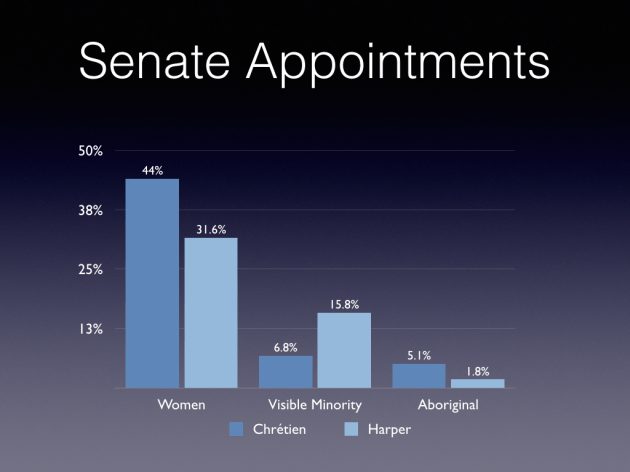
Senate Appointments.001Given the push for gender parity and greater diversity in upcoming Senate appointments (see Trudeau urged to create gender-balanced Senate), I thought it might be interesting to compare the Chrétien and Harper records with respect to diversity.

Chrétien, with his 75 appointments, achieved close to parity for women, with aboriginal peoples slightly over-represented. Visible minorities were under-represented, however.

Harper with his 57 appointments, in contrast, slightly over-represented visible minorities while under-representing women and aboriginal peoples (the fewer number of appointments over a comparable time period reflects his decision to stop appointing senators in response to the Duffy and other scandals).

Will see what PM Trudeau and the advisory body come up with.

John Ibbitson’s take on how gender parity would result in a more ‘progressive’ Senate:

 The other reason Trudeau would want gender parity in the Senate 

Trudeau urged to create gender-balanced Senate

Holding the Government to the spirit of the common wording in the mandate letters (“You are expected to do your part to fulfill our government’s commitment to transparent, merit-based appointments, to help ensure gender parity and that Indigenous Canadians and minority groups are better reflected in positions of leadership.”).

The previous Conservative government appointed 18 women out of 57 appointments (32 percent) and 9 visible minorities (16 percent – in line with the percentage of visible minorities who are Canadian citizens) by my rough count.

Good that this group has appropriately broadened their focus beyond gender parity:

The federal government is facing pressure to create gender parity in Canada’s upper chamber, two months after Prime Minister Justin Trudeau attracted global attention by forming a cabinet whose membership is half female.

A group of prominent women from across the country has seized on Mr. Trudeau’s move to achieve gender equality in the cabinet and his promise of Senate reform, and is now calling on him to fill the 22 current vacancies in the Senate with women – which would create gender balance for the first time in the chamber’s history.

In addition, the group – led by Donna Dasko, co-founder and former national chair of Equal Voice, a non-partisan organization advocating for women in politics – is asking that the female appointees be from diverse backgrounds, such as indigenous women and those from minority linguistic, racial and ethnic communities. This, they point out in a letter sent late last month to the Prime Minister, is in keeping with the Senate’s mandate to represent minorities.

“This is an historic opportunity,” Ms. Dasko wrote in the letter that is signed by more than 80 women, including former Progressive Conservative prime minister Kim Campbell, former Liberal deputy prime minister Sheila Copps, actress Sonja Smits and Vancouver’s deputy mayor, Andrea Reimer.

Currently there are 83 senators, 30 of which are women – representing 36 per cent of the Senate. Appointing 22 women immediately would make the chamber 50-per-cent female. The group says in the letter that “future appointees could include both men and women in equal numbers.”

Paul Duchesne, a spokesman for Democratic Institutions Minister Maryam Monsef, told The Globe and Mail in an e-mail on Sunday that “we share the desire of the signatories to achieve gender balance in the Senate.”

Source: Trudeau urged to create gender-balanced Senate – The Globe and Mail