Sean Speer: Canadian universities have lost their social licence. They shouldn’t be surprised if they lose their funding too

Interesting how concepts originating from the left can be turned against them. And yes, the risk is real:

The Canadian Left introduced the notion of “social licence” into our policy and political lexicon during the Harper era to describe the expectation that oil and gas companies act, consult, and operate in ways that secured public buy-in for individual projects and the sector as a whole. 

Conservatives were mostly critical of the concept at the time. It seemed elusive, woolly, and conceived of to block projects rather than ultimately enable them. I’ve wondered in recent weeks, however, if in hindsight it has utility for thinking and talking about the place of institutions in a democratic society. 

In particular, Canadian universities should ask themselves hard questions about their own social licence. The growing gap between the culture and ideas on campus and the rest of the population ought to be a major cause for concern. Universities’ alienation from the society in which they inhabit represents a threat to their social licence. 

The shocking reaction of many university faculty members and students to Hamas’s terrorist attacks against Israel has exposed this gap for the rest of us to see. One gets the sense (as others such as Tyler Harper have noted) that the consequences will be lasting. The incentives for politicians to seriously take on universities have changed. 

Academic freedom isn’t a get-out-of-jail-free card from democratic accountability—particularly in Canada where we still heavily rely on public dollars (even if the relative share has fallen) to finance universities. Scholars don’t have a positive right to publicly-subsidized employment or research funding. Universities don’t have a positive right to their current funding levels. 

There’s nothing stopping provincial governments, for instance, from cutting core institutional funding (especially in a zero-sum world in which health care is consuming roughly half of program spending) or even reducing public subsidies for particular fields or disciplines (which might come in the form of policy reforms that require universities to charge the full cost of certain programs). 

The upshot: if you’re a university president, you need to stop spending so much time and attention on managing your internal politics and start dedicating more to your external politics. Placating the most radical voices on your campus isn’t worth it if the cost is the public’s support for your institution’s basic mission. In fact, the opposite is true: a firm stand against radicalism is arguably the best means to protect your institution’s long-run interests.

Source: Sean Speer: Canadian universities have lost their social licence. They shouldn’t be surprised if they lose their funding too

Sean Speer: The Left has a self-policing problem

Yep:

A key feature of a political movement’s health is its ability to self-police against ideological excesses or reactionary forms of politics. It’s not easy to do. There are powerful incentives that tilt against it, including the risk of alienating prospective supporters, harming personal relationships, and granting political ammunition to one’s opponents. There are also practical limits in a distributive democracy where there are rarely points of authority that can plausibly claim to speak for a political movement as a whole. 

Yet just because it’s hard doesn’t mean that there isn’t some onus—particularly among elite actors—to call out and, where necessary, isolate radicalism within their ranks. 

At its apogee in the second half of the twentieth century, National Reviewmagazine played this role on the American Right. Its founder, William F. Buckley Jr., famously wrote the John Birch Society out of the mainstream conservative movement that he was assiduously building. He similarly published a scathing review of Ayn Rand’s book, Atlas Shrugged, by one of the magazine’s editors, Whittaker Chambers, that signaled to the world that Rand’s objectivism didn’t have a home in it either.

In the ensuing decades, the American Right has ceased to self-police. At this point, not only are its political leaders merely trying to stay ahead of their most radical voices, but within the adjacent world of conservative ideas and thought, it can at times be hard to distinguish between the elites and the fringe. 

Canadian conservatism has generally had less of a reactionary problem. There are doubtless various factors including the Westminster model’s emphasis on top-down leadership and party discipline, the country’s more moderate political culture, and its lower racial salience. 

The Hub has nevertheless, in the two-and-a-half-years since its launch, taken seriously a sense of responsibility for calling out conservative excesses including the reactionary parts of the movement that disposed Jason Kenney as Alberta’s United Conservative Party leader, the conspiratorial impulsesbehind some of the conservative criticism of the World Economic Forum, and the growing trend of online ideas and voices radicalizing young men. 

We know that these instances have antagonized some conservatives who believe that it’s a tactical mistake to cede any ground to the Left. They’ve probably cost us some number of donors and subscribers. We also recognize that there are inherent limits to our ability to neutralize some of these excesses. No one is asking our permission before tweeting or driving their transport truck onto Parliament Hill for that matter. But we still think it’s ultimately healthy for The Hub as an institution and conservatism as a whole to speak out when we feel it’s called for. 

This notion of self-policing is something that I’ve thought a lot about in recent years. I wonder what I would have done if I had been a Republican in 2015 and 2016. I don’t know. It’s easy to look the other way or rationalize bad ideas on one’s own side. 

But the lesson of the past several years in the United States is that even if there are downsides for those who are prepared to be self-critical, there’s not a lot of upside for those who aren’t. Ask Republican congressional leaders like Kevin McCarthy or Jim Jordan. Do their choices in hindsight look better or shrewder than Liz Cheney’s? The answer is self-evidently no. 

I share this context because the reaction of the Canadian Left to Hamas’s terrorist attacks against Israel has revealed a self-policing problem. It’s become clear that the movement’s intellectual and political leaders have permitted radical ideas and voices to occupy an outsized place in today’s progressivism. The consequences have alarmingly played themselves out in recent weeks on university campuses, the streets of the country’s major cities, and even inside our mainstream politics. Put bluntly: the Left has an antisemitism problem. 

Even that however doesn’t seem to fully capture the magnitude and nature of the problem. It’s not merely the fringe expressions of outright Jew-hatred that we’ve witnessed. It’s actually something far deeper and more mainstream that may be the bigger cause for concern.

The Left’s strong attachment to radical ideas such as “decolonisation”, “oppressor versus oppressed” frameworks, and the so-called “right to resist” has created an intellectual context in which acts of terrorism and violence can find affirmation and support. 

There are different factors that have contributed to the problem. One is that progressives have so convinced themselves that the rise of the so-called “far right” represents an existential threat that they’ve been prepared to make alliances with radical political figures and organizations (“no enemies to the Left”) or opted to overlook the rise of radicalism within their movement. To the extent that they may acknowledge it, there’s been a tendency to minimize these intellectual trends as merely a form of campus politics or faculty lounge theorizing. 

Another is that the problem on the Left is essentially the opposite of the one on the Right. For conservatives, self-policing is mainly about conservative elites trying to constrain the excesses of the right-wing masses. For progressives, the excesses are among left-wing elites themselves. Radicalism finds its strongest expression among university faculty, law school students, and the panoply of non-profit organizations that comprise the modern Left. It’s not obvious therefore who’s supposed to be doing the policing. 

But it needs to happen. North American scenes of anti-Jewish rallies and full-throated defences of Hamas’s horrific terrorist attacks rooted in left-wing theories of anti-colonialism and anti-settler resistance are signs that radicalism has spilled out from university seminar rooms into the streets. 

These protests and rallies—including ones that have targeted Jewish restaurants and cultural centres—have exposed these problems for everyone to see. They’ve forced us to confront the interrelationship between these Manichean ideas about identity and power promulgated by left-wing voices and antisemitism. This should lead to a reassessment of the public good case for subsidizing various forms of critical theory education and scholarship which often seem like a thin veneer of academic rigour for what is otherwise a set of retrograde intellectual propositions about race, gender, sexuality, and society. 

But that’s probably a necessary yet insufficient response to what has played out in recent weeks. This is in large part a progressivism problem that progressives themselves must address. Progressive elites who lament the rise of the far right need to reckon with the rise of the far left and their own role in galvanizing it. Self-policing is hard—especially when it requires serious introspection—but it’s necessary. It’s time for the Left to police its own side. 

Source: Sean Speer: The Left has a self-policing problem

Sean Speer: Shocking pro-Hamas, anti-Israel rallies lay bare the limits of Canadian pluralism

Expect to see more similar commentary. The formal limits are essentially our laws and regulations with informal limits even harder to enforce consistently. Without getting into “both side-ism,” the Israeli occupation of the West Bank and repression of Palestinians draws insufficient coverage and commentary. But the barbarism of Hamas needs to be condemned without reservation:

As Palestine supporters continue to organize themselves in different Canadian cities to effectively demonstrate in favour of Hamas’s abhorrent attacks on the State of Israel, the inherent tensions and limits of pluralism have been laid bare for everyone to see. 

Pluralism is a key part—arguably the key part—of Canada’s conception of itself and our common citizenship. The country’s basic promise is one of peaceful co-existence. Our institutions, norms, and practices are set up to accommodate a multiplicity of viewpoints and persuasions concerning the most fundamental questions about justice, human flourishing, and what constitutes the good life. 

Pluralism is also a key—arguably the key part—of my own worldview. Although, as I’ve grown older, I’ve become more comfortable in my own thinking about these questions, I’ve also grown less comfortable with the idea of imposing my answers on others. Our own limitations (what Kant referred to as our “crooked timber”) invariably constrain the individual pursuit of truth. The public square should therefore be a crowded, complicated, and contentious marketplace of ideas. The state must resist imposing a singular conception of truth on the society. 

Yet pluralism cannot be an open-ended promise either. Just because our ability to discern the truth may be imperfect and incomplete doesn’t mean that we should give into an empty relativism. Some ideas are bad and wrong. We cannot permit our pluralistic commitments to provide license for those who reject our society’s basic values or even wish to do it harm. Pluralism cannot be a one-sided surrender to illiberal and reactionary forces. 

We’ve witnessed in recent days these tensions and limits inherent to Canadian pluralism. While most of us mourned and lamented the inhumanity of Hamas’s terrorist attacks on Israel, a small minority among us have defended and even celebrated them. These individuals and organizations have relied on Canada’s promise of freedom to countenance and glorify the indiscriminate violence of a group designated as a terrorist organization by our own government. 

There have been pro-Palestinian demonstrations across the country that have effectively affirmed Hamas’s terrorism. The videos from these pro-Hamas rallies in cities such as Mississauga and Montreal have been shocking. It must be said that rallies in support of a terrorist organization that has carried out a systematic campaign of killing women and children are incompatible with Canadian values.

Meanwhile, groups such as the Muslim Association of Canada and National Council of Canadian Muslims (which according to online records have received more than $1.34 million in federal funding between them since 2018) may be more careful in their messaging, but they’re still ultimately equivocal about what the world has witnessed. Their tendency towards “two-sideism” and other prevaricating devices have obscured the extent to which they implicitly affirm Hamas’ narrative. If in the face of overwhelming evidence of brutality and cruelty against Israelis your first instinct is to lament “the tyranny and terrorism of the Zionists” or criticize Israel’s democratic leadership, you’ve for all intents and purposes exposed your true character. 

Which it must be said is fair enough as far as some pluralistic protections go. One can oppose the current Israeli government or even critique the State of Israel itself and of course still find him or herself able to avail Canada’s protections of freedom of conscience or expression. We cannot and should not police one’s thoughts per se. But it certainly doesn’t mean that radical groups are entitled to taxpayer dollars or that individuals who cross the line from reasonable disagreements to the promotion and glorification of violence shouldn’t face sanction. 

These basic observations shouldn’t in and of themselves be controversial. Our commitment to pluralism must be uncompromising up and until it comes to undermine the basic security and stability of our own society. As my former boss Brian Lee Crowley has often said: “[we cannot permit] our list of freedoms to become our suicide note.”

Drawing these lines is of course complicated. Our default assumption must be highly permissive. Just because an idea is controversial or at odds with the majority’s views isn’t a reason to exclude it from the public square. The health of our society is measured in part by our willingness to protect ample space for such views. Imposing parameters around the public square therefore comes with great risk. Those parameters can be misapplied, misread, or even wielded by those whose primary goal is to constrain ideas that don’t match their own preferences. Just because it’s hard, however, doesn’t mean that it’s a task that we should shrink from. 

There are perspectives that should rightly be denounced, marginalized, and precluded from receiving public dollars. Even if one is squeamish about laws and policies that criminalize acts like the glorification of terrorism, there ought to be a minimum agreement that we have a collective responsibility to condemn such behaviour in order to effectively raise its social costs and signal to those inside and outside of our society that our pluralism isn’t a license for depravity or violence. 

Canada has essentially bet its future on pluralism. As our population gets more and more diverse, the multiplicity of views will grow and pluralism will be crucial for managing our diversity. I think it’s a good bet. Unlike some conservatives, I’ve tended to disagree with the instinct to mock Prime Minister Trudeau’s assertion that “diversity is our strength.” I think it’s broadly true. But if our pluralism isn’t principled, if it doesn’t involve some limits, then diversity will cease to be our strength and may eventually become the source of our undoing. 

Source: Sean Speer: Shocking pro-Hamas, anti-Israel rallies lay bare the limits of Canadian pluralism

Sean Speer: Not all population growth is created equal

An odd and unclear column.

The first two points are factual: that immigrants are older than people born in Canada (even if many come with young children or have children once in Canada), and that it tends to be more concentrated in out urban areas.

But conclusion seems deliberately opaque, suggesting a concern over composition and change of Canada’s population, that can be read as either a dog whistle or flirting with a variant of the “great replacement theory,” even if not his intent.

“A prudent position would be to recognize the benefits of large-scale immigration without assuming that it can be raised to unprecedented levels or become solely responsible for the country’s population growth free from consequence. Maximalist ends without due consideration of the consequences of maximalist means is rarely the basis of good public policy. Immigration is no exception.”

Last week the popular American economics blogger Noah Smith publishedan essay entitled “Maximum Canada” in which he outlined the success of Canadian immigration policy and the benefits of a bigger national population. 

His observations follow similar commentary in recent months in favour of the so-called “Century Initiative” in which Canada aspires to reach 100 million residents by 2100. The basic premise is that a much larger population would boost Canada’s economic and geopolitical influence around the world, lessen its asymmetry vis-à-vis the United States, and create a bigger domestic market for trade and commerce.

These arguments are generally compelling. There’s certainly something of a correlation between population size and global influence. The exceptions are far outweighed by the rule. 

The main problem with this analysis however is that it’s too focused on population growth as an end and fails to properly scrutinize the means. Globe and Mail columnist Andrew Coyne recently argued for instance that the target of 100 million Canadians by 2100 isn’t even that ambitious because it broadly tracks population growth patterns over the past several decades. As he explained: 

To get to 100 million in 77 years—two and a half times our current level—implies an annual growth rate of 1.2 per cent. By comparison, over the last 77 years, our population more than tripled, from 12.3 million in 1946. That works out to 1.5 per cent annually. To be sure, birth rates were higher in the 1950s and 1960s; population growth today comes almost exclusively from immigration. Fine: let’s take 1970 as our starting point. Average annual population growth: 1.2 per cent. The Century Initiative proposal is essentially a continuation of the status quo.

Yet there’s something qualitatively different about population growth that’s driven by a combination of natural growth (births minus deaths) and immigration and growth that solely comes from immigration. Smith, Coyne, and others fail to grapple with these key differences. 

It doesn’t mean that Canada shouldn’t aspire to have a larger population or even necessarily that we shouldn’t pursue an immigration policy that ultimately gets us there. But before fully signing onto “maximum Canada”, we need to account for the fact that all forms of population growth aren’t the same. (This isn’t, by the way, a normative judgement. It’s merely an observation about the practical differences between a society that draws on immigration to supplement its own natural growth and one that relies on it entirely.)

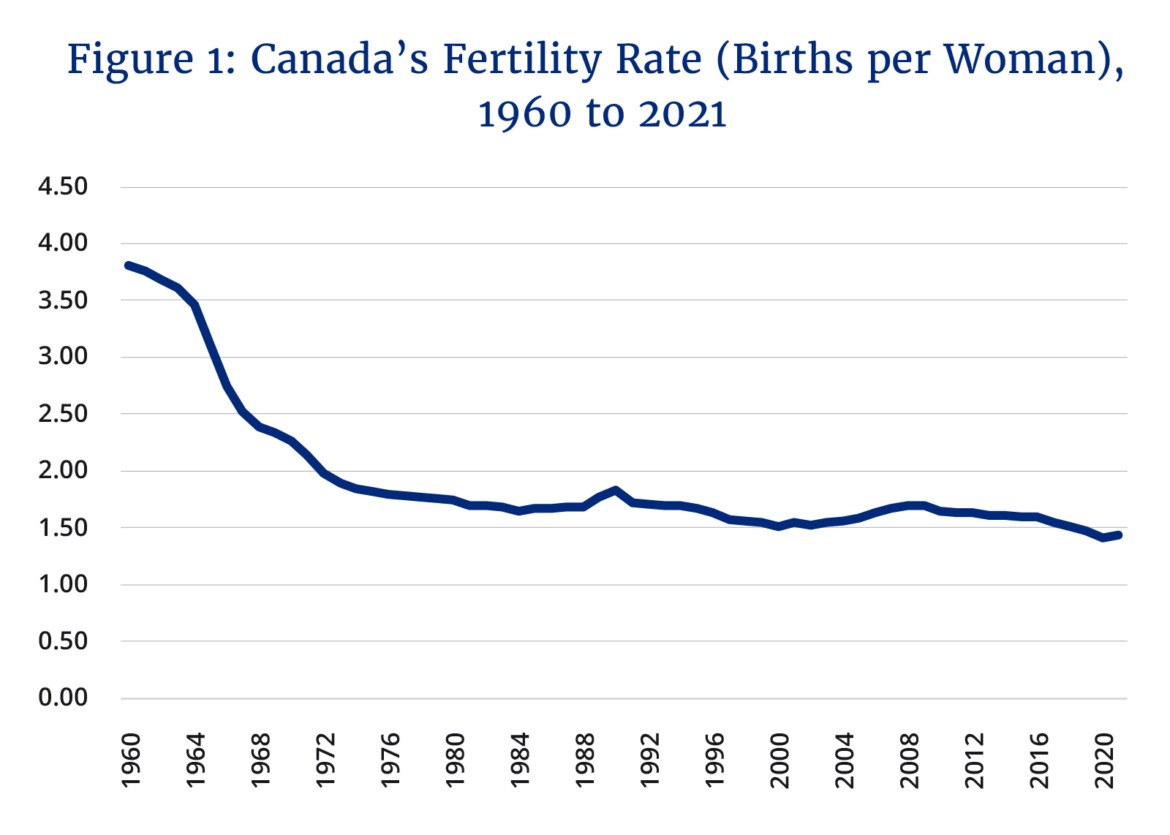
Let’s start with the data. Replacement level fertility is an average of 2.1 children per woman. As Coyne notes, Canada’s fertility rate dipped below replacement level beginning in the early 1970s. It’s now just 1.4 children per woman (see Figure 1).

Although the country’s fertility rate has been below the replacement rate for the past half century, its current rate represents an unprecedented low. As Figure 1 shows, it has steadily fallen to now below the G-7 average and is increasingly one of the lowest rates in the world.

Graphic credit: Janice Nelson

That means that immigration isn’t just doing most of the heavy lifting when it comes to population growth. It’s now nearly solely responsible. Take 2022 for instance. Canada’s population grew by more than 1 million people—the largest single-year growth since 1957—and immigration was responsible for roughly 96 percent. 

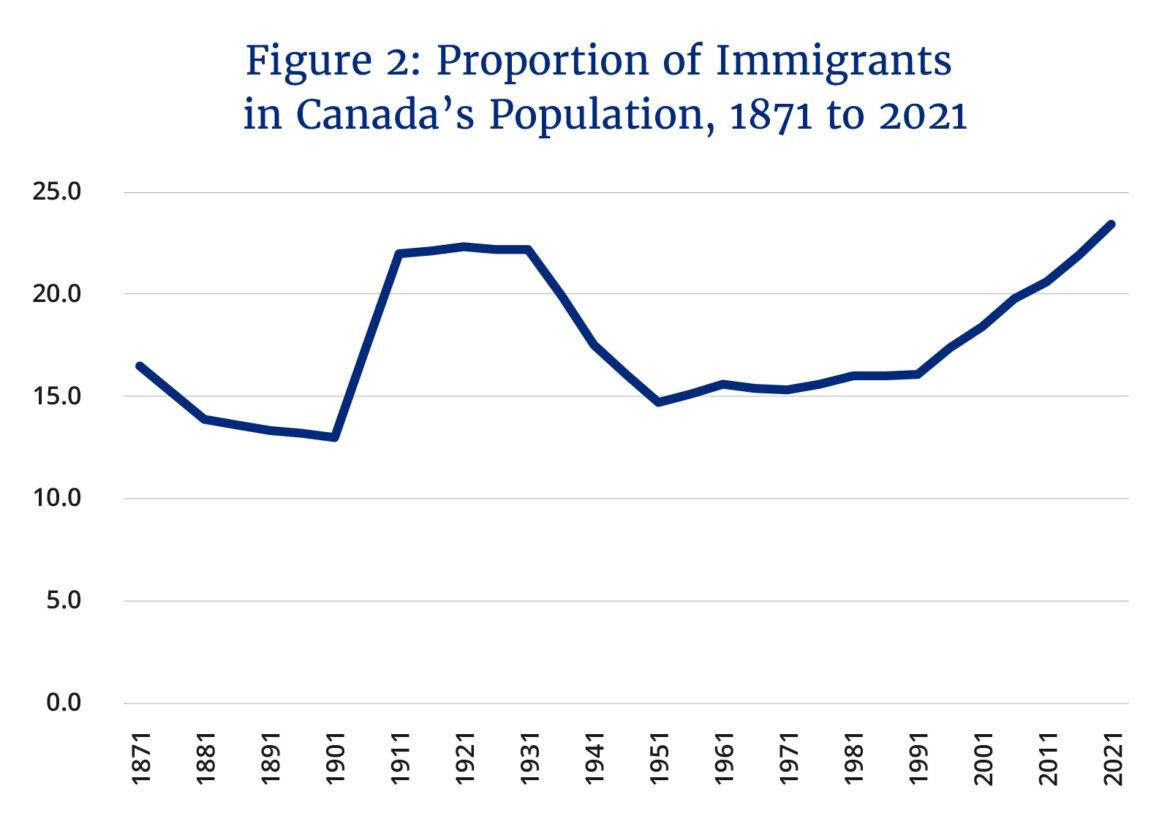
Estimates are that immigration will reach 100 percent of population growth by 2032 and will remain the main driver for the coming decades. As a result, Statistics Canada projects that the overall share of Canada’s immigrant population (which consists of landed immigrants) will rise from 23.4 percent in 2021 (see Figure 2) to as high as 34 percent in 2041. 

Graphic credit: Janice Nelson

There are various ways in which immigration-driven population growth is different than natural growth. These differences will ostensibly produce outcomes that are distinct from past experiences and therefore may limit the utility of historical instruction. There’s an onus on proponents of the Century Initiative to account for them in their analysis and advocacy. 

The first is that it’s older. Although the immigrant population is generally younger than the average age of non-immigrant residents, it’s still self-evidently older than babies. The majority of immigrants fall within the core working age group (25 to 54). Just over one quarter are aged 15 and younger. Immigration-driven population growth may slow the rise of (and even temporarily lower) the country’s average age but it won’t, according to leading economist David Green, “substantially alter Canada’s age structure and impending increase in the dependency ratio.”

The second is that it’s far less geographically distributed. More than half of recent immigrants settle in Montreal, Toronto, and Vancouver and nine of ten settle in a census metropolitan area. Natural growth by contrast would presumably more closely reflect the general distribution of population across the country. Immigration-driven population growth should therefore be expected to impose even greater pressure on housing and other infrastructure in our major cities and contribute to a growing urban-rural divide in our economic and political outcomes. 

The third is that it will reshape the country’s culture. That may not be a bad development—particularly in the eyes of those who value diversity—but it still represents a qualitative difference relative to natural growth that requires a bit more attention. 

Consider two scenarios. First, there’s a strong possibility that it erodes the place of the French language and francophone culture in our national life as Quebec’s share of the total population declines and its conception of binationalism is fully consumed by multiculturalism. Second, it’s also possible that it could at times conflict with the goal of Indigenous reconciliation to the extent that immigration-driven growth produces a growing share of the population that can plausibly argue that it has no role or responsibility for the historic injustices faced by Indigenous peoples. (There are growing calls—including from the Truth and Reconciliation Commission—to expand newcomer education about the Indigenous experience presumably to mitigate this risk.)

These considerations don’t challenge the case that immigration has been a net positive for the country or that we should maintain high immigration levels in the face of aging demographics or even that we should aspire to a bigger population. They do however dispute the idea that the source of population growth is irrelevant. Natural growth and immigration-driven growth may produce the same number but their effects are necessarily different. 

What is envisioned by the Century Initiative and others is essentially without precedent. Immigration has never been solely responsible for such a run-up of Canada’s population. History cannot provide much of a guide. Only prudence can. 

A prudent position would be to recognize the benefits of large-scale immigration without assuming that it can be raised to unprecedented levels or become solely responsible for the country’s population growth free from consequence. Maximalist ends without due consideration of the consequences of maximalist means is rarely the basis of good public policy. Immigration is no exception.

Source: Sean Speer: Not all population growth is created equal

Sean Speer: Canada’s ‘big sort’ is breaking down—and the political consequences could be monumental

Interesting analysis:

In 2009, American journalist Bill Bishop wrote the influential bookThe Big Sort, to describe the growing cultural and political bifurcation of American society based on a process of self-selection which, in broad terms, saw educated professionals with progressive political preferences increasingly concentrated in cities and those in non-professional jobs with more conservative politics disproportionately inhabited in rural and peripheral communities. 

As he explained

“What’s happened, however, is that ways of life now have a distinct politics and a distinct geography. Feminist synchronized swimmers belong to one political party and live over here, and calf ropers belong to another party and live over there. As people seek out the social settings they prefer—as they choose the group that makes them feel the most comfortable—the nation grows more politically segregated—and the benefit that ought to come with having a variety of opinions is lost to the righteousness that is the special entitlement of homogeneous groups. We all live with the results: balkanized communities whose inhabitants find other Americans to be culturally incomprehensible; a growing intolerance for political differences that has made national consensus impossible; and politics so polarized that Congress is stymied and elections are no longer just contests over policies, but bitter choices between ways of life.”

Bishop’s thesis had a powerful influence on academic and popular discussions about the cultural and political life of countries like Canada and the United States. It seemed to offer a conceptually and empirically-rooted explanation for contemporary sociological trends, including, for instance, the growing partisan divide rooted in place. 

A few years ago, American public intellectual Will Wilkinson took up the thesis in a must-read, think-tank paper entitled, “The density divide”, in which he elaborated on the “big sort” in the context of the rise of right-wing populism and Donald Trump’s surprise election. His basic argument was that “spatial sorting” based on a mix of ethnicity, cultural preferences, human capital, and even personality traits had driven a “polarizing wedge between dense diverse populations and white sparse populations.”

As Wilkinson elaborated: 

“By concentrating diversity, human capital, innovation and national economic output in enormous cities, the sorting logic of long-term urbanization has slowly converted the culturally liberalizing power of economic growth into a morally and politically polarizing wedge, driving town and country further apart and feeding the mutual contempt and vitriolic division of negative, affective partisanship.”

Although both Bishop and Wilkinson were writing primarily about the United States, there’s an argument that their thesis also broadly applies to Canada. In recent decades, our economy has similarly come to reflect the rise of so-called “superstar cities” and the growing concentration of economic output in a small number of major cities. 

Consider, for instance, that in the five years prior to the pandemic, Montreal, Toronto, and Vancouver were responsible for two-thirds of the country’s net new jobs. That share surpasses three-quarters if Ottawa-Gatineau, Calgary, and Edmonton are accounted for. In some rural and remote parts of the country, by contrast, communities still have not even fully recovered the jobs that were lost during the 2008-09 global recession. 

The economic dominance of these major cities has been matched by their political power. That the Conservative Party has won the national popular vote in successive federal elections but failed to ultimately win due to their lack of seats in the country’s major cities is itself an expression of the density divide. 

More than twenty years ago, University of Toronto political scientist David Cameron anticipated the manifestation of “the big sort” in Canadian life: 

“Without quite realizing it, we Canadians are in the process of building a new country within the old one. The new country is composed of the large cities, especially the great metropolitan centres of Montreal, Toronto and Vancouver; the old country is all the rest. Life in the former bears little resemblance to life in the latter, whether it is a question of cultural expression, crime, the sense of neighbourhood, price and income levels, traffic or the pace of life.”

The upshot here is that the prevailing narrative about the interplay between culture, politics, and place in Canada and the United States has tended to reflect a widening divide between the metropole and the hinterland. There’s been a powerful sense that sensibilities, priorities, and lived experiences across the density divide are diverging at an inexorable pace. 

Yet an alternative case has emerged in the past few years that “the big sort” is being undone. New economic and social forces are possibly breaking down the density divide by pushing back against the inexorability of urban agglomeration. The cultural and political consequences of these trends are too difficult to predict at this point. But there’s a strong argument that they could be as significant as the ones that they’re ostensibly replacing. 

Let’s start with the data. University of Ottawa economist Mike Moffatt has documented the growing flight of urban professionals from major cities like Toronto to peripheral communities. In 2022, for instance, although Toronto added 138,240 net residents relative to the previous year, it added 159,679 immigrants which means that approximately 78,000 people actually left over the course of the year.

These developments started in about 2015 as a response to high housing prices. City residents, particularly those with young families, have been forced to “drive until they qualify” to purchase homes that can accommodate their needs and expectations.  

The pandemic and its effects on workplace arrangements—including the rise of remote work (or at least hybrid work)—have reinforced these trends. Each year since the pandemic began, Toronto has lost population on a net outflow of residents—the most in a generation. 

These people are relocating to peripheral communities in the Greater Toronto Area as well as increasingly more broadly across the country. Moffatt has in fact argued that what makes these recent migration trends different than in the past is that new workplace arrangements are enabling individuals and households to relocate outside of the economic region of their employers. 

As he set out in a virtual event that I moderated for the Public Policy Forum in March 2023: 

“Before the pandemic, people were still somewhat constrained by commuting distance. So they might end up in a Brantford or a Woodstock or a Kitchener-Waterloo…The places that people moved out of Toronto to were within about 100 or 200 kilometres. That’s changed during the pandemic…As young families are able to work using home-type arrangements, instead of moving to Brantford, they’re moving to Calgary, Halifax, or Moncton. Over the last year, for instance, Ontario has lost more population to other provinces than it has in any time that we have recorded data. Work-from-home so far seems to be allowing people to still have jobs in Toronto, Montreal, or Vancouver but live in a completely different geography.”

His data and analysis resonate with my own experience. We had close friends move from Toronto to Cobourg during the pandemic, for instance, based on the hedged bet that they’ll never have to return to the office on a full-time basis. 

It prompts the question: If “the big sort” is indeed being undone, what are its consequences? They’re multi-faceted and fascinating to think about.

One potential consequence concerns basic politics. Keep in mind, based on Toronto’s voting patterns, that there’s a decent probability that those leaving the city for Cobourg or elsewhere are probably more progressive than the median voter in their new communities. The interplay between their political preferences and the politics of their adopted homes is therefore hard to predict. 

Do urban progressives export their preferences to their new homes? If so, it could possibly, depending on the scale of migration patterns, change the political character of these more conservative communities. The net result could be to put some Conservative ridings on the periphery of the country’s major cities into electoral play. 

Or does the opposite happen: do these communities come to imprint their own cultures and politics on their new inhabitants? If so, it could, in theory, deagglomerate the political power of our major cities and strengthen the relative voice of faster-growing mid-sized and peripheral communities. 

I asked Moffatt to speculate on these political implications at our Public Policy Forum event. Here’s his response: 

“Are the people who are coming into those areas changing the politics of those areas or are those areas changing the politics of the people who move in? Is Tillsonburg becoming more like Toronto or are the Torontonians who will move to Tillsonburg becoming more like the locals? 

I suspect it’s somewhere in between. But I actually do think it’s probably positive overall for society because I think it can develop a better understanding [across the divide]. There may be less polarization in a world in which  you could live in the Tillsonburg, but work in Toronto and you kind of have one foot in both worlds. You talk to your neighbour who might work at the CAMI plant or whatever…I think it can foster more understanding. So I’m cautiously optimistic.”

I put the same question to leading pollster Darrell Bricker in a recent episode of Hub Dialogues. His response was broadly similar: 

“That’s a really interesting question. If you look at the past as prologue, what tends to happen is that the downtown sensibilities tend to find a way to move out. We were talking about Mississauga before. Mississauga never used to vote Liberal. They now vote Liberal pretty overwhelmingly, or NDP where Jagmeet Singh is from. That never was the case before.

Yes, there’s going to be a push-out into the newer suburbs in which that’s the case, but then you see what also happens is when people leave downtown and they move to a place like say further car-commuting suburbs, what tends to happen is the people move there. What we’ve seen is that, actually, the place changes them. They develop the same values as the people who are living around them. This even is new Canadians who do the same kind of thing, which is what makes the 905, we’ll just use Toronto as the example, so volatile. They can vote one way or the other. It’s really in flux. 

Downtown is always going to be orange or red in most major cities, but those commuting suburbs, they’re the ones that tend to flip.”

Setting aside the particularities of feminist synchronized swimmers, rural calf ropers, or Tillsonburg CAMI workers, the main point here is that the neat and tidy geographic segregation reflected in “the big sort” seems to be breaking down. 

The cultural and political consequences may be hard to judge at this point. But the presumptive takeaway is far from nothing—in fact, quite the opposite. If Bishop, Wilkinson, and Cameron are right and “the big sort” has been a defining feature of the past few decades, then its undoing ought to have an oversized influence over the coming years. 

Source: Sean Speer: Canada’s ‘big sort’ is breaking down—and the political consequences could be monumental
Speer: I was wrong about Canada’s state capacity

Good reflections. The other point I would make is that the political and bureaucratic levels need more policy “modesty” and need to consider, and value, input from the operational side (where “truth to power” may need to be strengthened). More focus, not necessarily more or less resources. Money quote:

“The key takeaway then is that our politics ought to dedicate more energy and attention to the question of state capacity. Our political debates need to go beyond bigger versus smaller government and address good versus bad government. Everyone should be able to ultimately agree that the former is better than the latter.” 

The idea of “state capacity” has attracted considerable intellectual and political attention in recent years. It started with a blog post in early 2020 by leading public intellectual Tyler Cowen about what he called “state-capacity libertarianism” to describe a policy framework for a limited yet effective government to provide basic public goods and solve for market failures. His influential essay has since spawned dozens of articlescommentaries, and papers on the topic. 

State capacity broadly refers to a government’s functional ability to carry out its market-supporting activities in an efficient and effective manner. The key insight here is that while debates about the proper size and scope of government are highly important, we ought to dedicate similar energy and attention to questions of state capacity and competency. 

Cowen’s chief contribution was to catalyse a renewed intellectual movement focused on “better or worse government” rather than merely “bigger or smaller government.” The timing couldn’t have been more apposite. His essay was published mere months before the COVID-19 pandemic. 

The pandemic experience brought the ensuing conceptual debate about state capacity into practical focus. It necessarily put governments in Canada and elsewhere around the world to the test. The results were mixed, to say the least. 

Prior to the pandemic, it was something of an axiom that Canada is home to strong public institutions, a professional public service, and high-quality public administration. It has, in other words, high levels of state capacity. 

I subscribed to this view. I’ve even authored and co-authored articlespapers, and newspaper columns in favour of a larger role for government in supporting science and technology and industrial development. It may be a reach to say that I was fully wrong. But in hindsight, I now concede that my analysis probably overstated Canada’s state capacity. 

The pandemic exposed that our governments are slower and more sclerotic than many of us fully understood. It turns out that Canada has a state capacity problem. 

Start with the federal government. The pandemic revealed that Ottawa’s state capacity has been hollowed out in recent decades. It still proved capable of creating new cash transfer programs like the Canada Emergency Relief Benefit and distributing cheques to households with minimal scrutiny or oversight, but otherwise the federal capacity for procurement, logistics, and service delivery was shockingly weak. The federal government has effectively been reduced to a revenue collection entity that exists to transfer dollars to seniors, families with children, First Nations, and other levels of government. 

This state capacity weakness manifested itself in a series of federal pandemic failures that’s quite long, including its confusing and often contradictory public health diktats, its initial vaccine procurement (including a bizarre contract with a Chinese state-owned enterprise), and the $25 million spent on the ArriveCan app. 

The post-pandemic period has similarly been marked by high-profile cases of government failure. The most obvious example is the country’s passport backlog which has led to lengthy delays, long line-ups at Service Canada offices, and canceled summer vacations. 

This case is particularly salient because it is so basic. How can a government that cannot issue passports on a timely basis reasonably expect to reduce poverty by 50 percent in 2030 or engineer an energy transition by 2050 or fulfill any other major policy ambition over the coming years? 

The provinces aren’t much better. Their collective failure to reform their health-care systems prior to the pandemic in spite of mounting evidence of limited capacity and poor outcomes was a major factor behind the country’s lengthy and stringent lockdowns. The risk of hospitals collapsing essentially held us held hostage for more than two years. 

This point cannot be overstated: we now know that children suffered long-term learning loss and others forewent diagnostic tests, surgeries, and treatments in large part because a generation of provincial bureaucrats, politicians, and special interests chose to protect the failed health-care status quo. 

These recent examples raise legitimate questions about our governments’ ability to deliver on their core functions and responsibilities. Lines of people in front of their local Passport Canada offices with lawn chairs like they’re waiting for a concert or playoff tickets is a powerful rebuttal to the pre-pandemic narrative about Canada’s world-class state capacity. 

It’s important to emphasize that these observations are neither partisan nor necessarily arguments in favour of a smaller government. Governmental failings have been broadly distributed on the Left and Right and, in any case, research tells us that the correlation between state capacity and size of government is imprecise. Denmark, Finland, and Israel have governments that are similarly sized or even bigger and yet seem able to deliver more effective and expeditious public services than we can. 

The factors behind our state capacity weaknesses are complex and would doubtless be the subject of ideological and political debate. The Left would ostensibly argue that it’s a consequence of so-called “austerity” including previous rounds of privatization and spending cuts. The Right would instead point to Public Choice explanations including institutionalized risk aversion, perverse incentives, and union-protected mediocrity that undermine effective and efficient collective action. 

The key point here though is that the pandemic exposed that Canadians shouldn’t be self-congratulatory about our country’s state capacity to deliver on whatever we collectively ask of it through our politics. 

Which brings me to my mea culpa. My research in recent years on innovation policy has highlighted the rise of the intangible economy (which has been described as the shift from an “economy of things” to an “economy of thoughts”) and its unique characteristics and properties including its geopolitical and strategic consequences. This has led me to rethink the role of the state to support science and technology and cultivate sectors, sub-sectors, and technologies that may have high-value, strategic upside for the Canadian economy. 

As part of this work, we’ve considered the creation of new public sector organizations to better support breakthrough technologies and even grappled with the potential for a modern industrial policy. I have tried to root my analysis in a clear-eyed understanding of the limits of state action and other political economy risks. In a late 2021 paper, for instance, we argued for a new science and technology agency with a specialized staff and a high degree of autonomy so as to minimize the risks of bureaucratic inertia and political capture.  

But even with these political economy caveats (which were unfairly ignored by some critics), there’s probably an argument that my work has overestimated Canada’s state capacity. That is to say, I spent so much time worrying about the twin risks of bureaucratization and politicization that I failed to ask more basic questions like “can the government reasonably do this?”. The passport mess has provided a useful corrective. 

I stand behind most or all of my work on these topics. We do need to recommit ourselves to a more ambitious science and technology strategy and the market uncertainty of breakthrough technologies will invariably involve a role for government. But I now better appreciate how improving (or at least accounting for) the country’s state capacity is a crucial first step to greater progress on these issues. I admit that I was wrong—or at least a bit incomplete in my analysis. One consequence is I’m now probably more of an economic libertarian than I was prior to the pandemic. 

The key takeaway then is that our politics ought to dedicate more energy and attention to the question of state capacity. Our political debates need to go beyond bigger versus smaller government and address good versus bad government. Everyone should be able to ultimately agree that the former is better than the latter. 

Source: I was wrong about Canada’s state capacity

Speer: Let’s not prolong this pandemic for the sake of the expert class

An uncomfortable insight and a reminder how we all need to be aware of the incentives and motivations that affect our behaviour and positions:

I saw a fascinating tweet last week that reflected something that I’ve been thinking about a lot lately. University of Waterloo labour economist Mikal Skuterud wondered aloud whether the experts whose influence and profile have risen over the past twenty-four months or so may be consciously or subconsciously inclined to prolong the pandemic. 

Skuterud’s question doesn’t attribute malice or ill-intent. He’s not questioning whether academics or public servants would purposefully manipulate data or intentionally provide misleading advice. He’s making a far more subtle yet important point.  

He’s asking if our pandemic-induced emphasis on expertise may inadvertently create a powerful set of incentives in which these same experts may eventually find it challenging to surrender the sense of power and purpose that they’ve been given over the past two years. It’s a question worth asking.

As he rightly notes, the pandemic has necessarily elevated certain experts in our society. We’ve seen doctors, epidemiologists, and other public health experts come to have unprecedented influence over government policymaking and uncharacteristic prominence in the mainstream media and on social media. 

That’s somewhat natural in light of the circumstances. It’s to be expected that policymakers, the media, and the general population would come to value infectious disease experts in the face of a novel coronavirus. 

The result though is that a number of hitherto obscure academics and bureaucrats have never mattered this much before and probably never will again. It’s not normal for them to appear on television each day or increase their Twitter followings tenfold. 

Such a surge of influence and profile can bring with it a powerful set of incentives. It can contribute to a loss of perspective and an inflation of one’s ego. It can encourage individuals who may usually be scholarly and taciturn to be more quarrelsome and vehement. It can preference 280 characters over nuance. It can turn little-known academics into political actors. 

Skuterud’s question is therefore a good and honest one. How might this extraordinary yet temporary increase in the role of certain experts influence how they think about the pandemic and advise on pandemic-related policies including the continuation of public-health restrictions?   

The answer may lie in Public Choice theory, which the Nobel Prize-winning economist James Buchanan famously defined as “politics without romance.” Public Choice came about in the second half of the twentieth century under the intellectual influence of Buchanan, his regular collaborator, Gordon Tullock, political economist Mancur Olson, and various others. 

The basic idea is that our understanding of one’s motivations in the private economy ought to extend to his or her involvement in government, politics, and public policy. As economist Pierre Lemieux has succinctly put it: “He does not metamorphose into an altruist angel.” 

Most economic analysis starts with a basic premise: the market is comprised of rational actors pursuing their own self-interest. Yet these same assumptions about human behaviour aren’t always applied in the political sphere. The underlying presumption can be that activists, bureaucrats, and politicians are somehow beyond self-interest and are instead capable of making judgments about government policy without accounting for their own personal interests. 

Public Choice theory challenges this notion. It uses modern economics to analyse politics and political decision-making. It starts from the premise that different actors in the political process are self-interested agents who will seek to maximize their own utility function just like individuals do in the marketplace. 

In practice, it means that politicians may offer voters popular measures to get elected, public servants might conceive of new programs to obtain more funding and greater resources for their departments, and special interest groups—including unions and corporations—invariably lobby government to obtain new benefits such as tariffs to protect their businesses or laws or regulations that advance their own interests. 

This hardly seems like a revolutionary idea now. Public Choice theory has become a well-respected school of economic thought with a number of prolific exponents and a wide range of applications. But, at its infancy, it was seen as a radical proposition that brought into question the capacity of government to make collective decisions in the public interest.  

The consequence of Public Choice isn’t to challenge government’s basic legitimacy or reject it altogether. It’s instead a call for a clear-eyed assessment of the impulses and motivations behind different actors involved in politics and public administration. This extends to the experts and journalists who form part of the overall system and must be similarly understood as influenced by a broadly defined notion of self-interest. It’s not narrowly about monetary reward either—though financial gain may be a factor for some. It can extend to other rewards including influence, profile, or the sense of meaning and purpose that the pandemic’s emphasis on expertise has granted. 

It’s important to emphasize that this isn’t a description of moral failing. Recognizing the pull of self-interest isn’t a judgement of particular people in positions of authority. It’s an observation about human nature and the fact that government and politics are fundamentally comprised of humans and their inherent fallibilities. 

Which brings us back to Skuterud’s question. There’s no reason to think that most experts haven’t acted in good faith during the pandemic and sought to make a positive contribution to solving the extraordinary public health crisis. But, as Public Choice tells us, it’s also quite possible that at some level these incentives are shaping the questions that they’re asking, the data that they’re collecting, the analysis that they’re bringing to bear, or how they’re engaging in the public sphere.

The risk, of course, is that these forces come to obtrude collective decision-making and in turn prolong the pandemic. It’s hard to know the magnitude of the risk. But it’s presumably not zero. It must be something that we are cognizant of—especially as the policy choices become more complex and the subject of greater debate. 

The ultimate solution to the COVID-19 pandemic is imperfect: it will require a combination of critical thinking and judgement calls without any altruistic angels. This pandemic’s end will necessarily involve a series of trade-offs, calculated choices, and second-best options. It must in short be an exercise in a politics without romance. 

Source: https://thehub.ca/2022-01-20/lets-not-prolong-this-pandemic-for-the-sake-of-the-expert-class/?utm_source=The%20Hub&utm_campaign=dd5b5eb714-EMAIL_CAMPAIGN_2022_01_19_06_47&utm_medium=email&utm_term=0_429d51ea5d-dd5b5eb714-475403886&mc_cid=dd5b5eb714&mc_eid=7832dd2817

Forgotten working class could trigger populist backlash in Canada, says report by ex-Harper advisor

One difference between the US and Canada is that Canada has a stronger  social safety net (e.g., healthcare, more equitable public education etc) but then, of course, so did the UK). Populism in Canada tends to be more economic (e.g., Doug Ford, Jason Kenney) than immigration-based as it is in the US and elsewhere:

Canada risks a populist backlash if politicians fail to focus on the most economically vulnerable people, a new report says, as rosy economic data continues to overshadow the plight of many rural and non-educated workers.

A report by Sean Speer of the Macdonald-Laurier Institute, released Tuesday, argues that politicians across the political spectrum have broadly ignored pockets of working class Canadians who have failed to thrive in an increasingly globalized and technological economy. Resentments among those people, if left unchecked, could feed the same sort of reprisal that led to the election of U.S. President Donald Trump, Speer says.

“Over the long term, an economy that has nothing to offer people is going to create not just economic consequences, but political ones that can possibly cut much deeper,” he said in an interview with the National Post.

Speer, who previously served as senior economic advisor to Stephen Harper, stopped short of suggesting Canada was at immediate risk of encountering a towering, populist wave. But the report nonetheless emphasizes some of the current and deepening divides that are set to define the upcoming federal election: resentments in the oil-rich West toward eastern “elites”, anxieties among less educated working men who have been increasingly displaced by university-educated women, and a widening divide between urban and rural political values.

Both the Conservatives and Liberals have looked to tap into economic anxieties ahead of the looming federal election.

Conservative leader Andrew Scheer has centred his campaign around worries over the rising cost of living, criticizing the Liberals for their carbon tax and promising to help Canadians “get ahead,” according to the party’s official slogan. Prime Minister Justin Trudeau, meanwhile, has been touting policies like a promised boost to a tax credit that will support “those hoping to join” the middle class.

Speer is among a number of conservative-minded analysts who decided, after the election of Trump, to adjust their long-held beliefs about the specific role governments should play in the economy, and the degree to which they need to consider the least advantaged voters.

Trump won the U.S. election by a narrow margin, carried in part by working class voters who felt threatened by shifts in the global economy that have led to a deterioration in classic American jobs, like automotive manufacturing and coal mining. Maxime Bernier, head of the People’s Party of Canada, has taken on policy positions that partly resemble Trump’s, blaming political insiders for creating an inherently unfair economic system.

Much of the failure by the media, economists and policymakers to predict the Trumpian shift, Speer argues, was an obsessive focus on the so-called “headline” economic data. Strong GDP growth and falling unemployment in recent years has given the appearance of economic strength while failing to account for those “left behind” amid a shift toward a more globalized and technological economy.

Political turmoil in the U.S. and U.K. is “partly a consequence of this economic myopia,” Speer writes.

“The so-called ‘forgotten men and women’ grew tired of neglect and have since been the political backbones of these new, disruptive populist movements.”

Anxieties over job security and changing economic norms are mostly felt among workers from natural resource sectors like oil and gas, or in the manufacturing sector, many observers have said. It’s also widely visible in women’s growing share in the workforce.

Employment rates among working-age Canadian men has grown by an average 0.9 per cent between 1990 and 2018, according to public data, while female employment has increased 1.4 per cent over the same period. The trend is especially pronounced in struggling natural resource economies: male employment in Alberta shrunk by 0.5 per cent between 2014 and 2019, while female employment in the province has increased nearly one per cent.

Meanwhile, labour participation rates have fallen among men; where non-educated men outperformed women in the workforce by 5.7 per cent in 1990, they now underperform them by 5.8 per cent today. And the fallout applies to a wide swathe of people: Canada currently boasts 6.7 million working-age non-educated workers .

“If we just look at the headline numbers, we miss that there’s a lot more going on there, that there is a bifurcation occurring between women with post-secondary educations and men without them,” Speer said.

In a separate report released earlier this year, Speer teamed up with Robert Asselin, a former top advisor to Finance Minister Bill Morneau, to address Canada’s failure to boost its competitiveness compared with other countries amid an increasingly technology-driven economy.

Digital behemoths like Apple, Amazon and Google have created a concentration of wealth that has hurt smaller firms or companies in weaker industries, leaving Canada with a challenge that “transcends partisanship and political ideology,” the pair wrote. “Whichever political party wins the next federal election will be faced with these questions and challenges,” they said.

Even so, Speer himself is the first to admit that there are few obvious answers when it comes to stemming the tide of populism in Canada. But he said a failure to better understand the issue will only deepen resentments.

“I think it’s going to create a higher and higher level of inequality of opportunity.”

Source: Forgotten working class could trigger populist backlash in Canada, says report by ex-Harper advisor