Speer: As Canada’s diversity increases, anti-racialism becomes essential

We are more than individuals and outcomes reflect a mixture of individual and group characteristics and experience, along with intersectionality within and between groups. Not one or the other, but need to consider both aspects as the various datasets indicated:

…As an epistemological framework, it represents a way of thinking that systematically organizes individuals into group categories based on race and then grants it explanatory power for virtually everything.

I don’t think it’s a coincidence that every “pretendian” cited in Pete’s article is a progressive. As the principal purveyors of identity politics, progressives are distinctly predisposed to racialist thinking. They’re more inclined to think in terms of racial identity and attribute value to membership in certain racial groups.

It’s logical therefore that within progressive circles claiming a particular group identity has greater upside than among conservatives who are more instinctively anti-racialist. Does anyone for instance doubt that progressive figures like Turpel-Lanford or Boissonnault realized status gains from adopting fake Indigenous identities?

Which brings us back to Pete’s case against affirmative action and its perverse incentives. His argument is well taken—but one can argue that we actually need to go deeper. We should aim to address the racialist thinking that underpins those policies and the political culture that enables them. Herein lies Salam’s case for anti-racialism.

The good news is that he believes that in the U.S. context, anti-racialism may represent a powerful political proposition across a multi-ethnic coalition. Donald Trump’s election victory is evidence that he’s right.

There’s a strong case to think that the same is true in Canada—particularly in the coming years. As the country becomes more diverse, the distinction between majority and minority populations will necessarily become far weaker. Defining one’s identity in contradistinction to the so-called “white mainstream” will presumably have less resonance in a world in which “racialized” Canadians represent as much as half of the population as early as 2041. Racial salience may counterintuitively decline in a polity composed of a growing multiplicity of racial identities.

If so, we may look back at this era of identity politics and the “pretendians” that it has produced as a regrettable yet temporary waystation on the path to the meritocratic culture that Pete envisions.

Source: As Canada’s diversity increases, anti-racialism becomes essential

Sean Speer: Pierre Poilievre should follow Elon Musk’s lead and bring his own Department of Government Efficiency to Ottawa 

While I get the attraction of the Citizen Musk approach, the lack of rigour in assessing its practicality in both the US and Canadian contexts is disappointing. The most effective exercise I have seen was the Chretien-Martin program review in the 1990s that addressed some structural issues and had a major impact, more so arguably than the Harper government exercise.

The risk of course of the Citizen Musk approach is that his cuts will be so ideologically driven and so drastic that worthwhile programs and capacity will be cut, with significant impact on the more vulnerable and core expertise (e.g., CDC, FDA and other necessary regulatory bodies).

The other question is what has Canada learned in the IT space, having a number of high level private sector interchanges (e.g., Alex Benay: the public service’s disruptor-in-chief). To what extent have they succeeded, and how effective were they in removing barriers etc. Some case studies here would be helpful in terms of what worked, what didn’t, and why:

…The D.O.G.E. exercise may therefore represent something of an inspiration. Its mandate to go beyond immediate-term savings and ask more structural questions about the operations and role of government is precisely the type of exercise that Ottawa needs. It should be understood as an effort to get out of counterproductive activities and boost federal state capacity where necessary. The Trudeau government has been a renewed education of the old conservative adage: limited government is better government.

As for who ought to lead such an exercise, my former colleague Rachel Curran has rightly argued that you probably don’t want to fully outsource it. Information asymmetries and the need for bureaucratic and political buy-in require that ministers and their departments be actively involved.

But there is something to the idea that entrepreneurs and technologists can bring a different perspective to the ones represented within the government or the management firms that are typically tapped to advise it. They bring a creativity and energy that’s often undersupplied in government. They’re unconstrained by bureaucratic assumptions and thinking. And they tend to have better track records of successfully overseeing structural reform.

Put simply: Outsiders like Musk and Ramaswamy may come with risks but they may also be more likely to overcome the public choice barriers (including confirmation bias and sunk-cost fallacy) to serious public administration reform.

Who then should lead the Canadian version of D.O.G.E.? How about Shopify’s co-founder and CEO Tobi Lutke?

Not only is he arguably the country’s most successful technologist and is increasingly commenting on Canadian public policy, including its state capacity and poor productivity performance, but Lutke’s background and experience make him an ideal candidate to deliver on a D.O.G.E.-like mandate in time for the 160th birthday of Canadian Confederation.

Source: Sean Speer: Pierre Poilievre should follow Elon Musk’s lead and bring his own Department of Government Efficiency to Ottawa 

There’s a values-based case against Canada’s immigration policy. Conservatives should make it

While the header conjures images of value tests and “barbaric cultural practices”, the main argument is in favour of permanent rather than temporary immigration, with “a vision of mutual obligation, not temporary expediency,” as much about citizenship as immigration:

As former federal deputy minister Tim Sargent set out this week in a DeepDive for The Hub, Canada’s immigration policy has undergone a fundamental shift over the past decade or so. It’s not just that the number of newcomers has significantly increased, but the composition of who is entering the country has changed too.

Our self-image of Canada’s immigration system as being hyper-focused on skills and human capital is no longer supported by the evidence. Among the more than 470,000 newcomers who came through the permanent resident stream last year, only about 40 percent were selected according to economic criteria. The majority were the immediate family members of economic immigrants, family members of those who have already immigrated, or refugees.

And even that only tells part of the story. Non-permanent residents—including temporary foreign workers and international students—are now a bigger share of Canada’s annual population growth. In 2023 alone, nearly 805,000 non-permanent residents were added to the population. Sargent estimates that there are now 2.8 million non-permanent residents in the country—of which just under 2 million are entitled to work.

What’s the upshot here? Less than half of those entering Canada’s much-vaunted permanent resident stream are being selected based on economic criteria and more than two-thirds of the total annual intake aren’t even entering as permanent residents. We increasingly have an immigration system that’s shifted away from the country’s long-term economic interests and towards temporary migration to fill low-skilled jobs and subsidize post-secondary institutions.

The Left and Right have begun to talk about these developments in different ways. Conservatives have rightly tended to focus on the basic economics of an influx of low-skilled labour and its downward pressures—including on employment and wages—on Canadian workers. Progressives, by contrast, have played up the poor conditions and risk of exploitation for temporary migrants themselves.

Conservatives shouldn’t limit themselves to economic critiques here. They should be prepared to make values-based arguments too.

Large-scale temporary migration is incompatible with how conservatives think about society as a web of reciprocal relations between neighbours and family. The late British rabbi Jonathan Sacks frequently referred to society as a “home that we build together.” Former Canadian Prime Minister Stephen Harper used to describecitizenship ceremonies as “joining the Canadian family.”

These metaphors of family and home convey something much richer than a mere transactional relationship between migrants and a society in which the former sells his or her labour to the latter. They reflect a Burkean conception of society in which we’re equal parts of a multi-generational partnership. The Canadian family can and should welcome new people to join it. But it shouldn’t really be in the business of temporarily hiring people to do its landscaping or deliver its food or care for its children.

This richer, more textured understanding of immigration is reflected in Canada’s birth-on-soil policy. We grant citizenship based on birthright rather than blood because we envision making long-term commitments to newcomers and their families and expect them to make similar commitments to our society. It’s a vision of mutual obligation, not temporary expediency.

The Trudeau government’s abandonment of this vision has done serious harm to Canadian immigration policy. It’s probably the government’s single biggest policy failure. The Conservatives are right therefore to criticize it. But they shouldn’t merely rely on numbers and facts to prosecute their case. They can draw on the conservative traditions of family and home to present a better image of immigration and its relationship to our society.

Source: There’s a values-based case against Canada’s immigration policy. Conservatives should make it

‘Our current government hasn’t been heeding national security advice’: Former immigration minister Chris Alexander on how Canada vets immigrants—and how ISIS operatives may have slipped through the cracks 

Worth reading, both as an explainer as well as the political commentary:

Significant questions are being asked of Canada’s security and immigrant vetting processes following the arrests last month of Ahmed Fouad Mostafa Eldidi, 62, and Mostafa Eldidi, 26, a father and son facing charges that include conspiracy to commit murder for the benefit or at the direction of a terrorist group—in this case, ISIS.

Reports have emerged that the pair were able to immigrate to Canada despite the elder Eldidi having participated in violence, including torture and dismemberment, against an ISIS prisoner. The assault was recorded on video and released by ISIS prior to the pair’s immigration to Canada.

Ahmed Fouad Mostafa Eldidi is a Canadian citizen while his son, Mostafa, is not.

Police claimed the father and son were “in the advanced stages of planning a serious, violent attack in Toronto,” before their arrest.

To better understand Canada’s immigration vetting process, Sean Speer, The Hub’s editor-at-large, exchanged with Chris Alexander, Canada’s minister of Citizenship and Immigration from 2013 to 2015, who offered his expert insight on how the pair may have slipped through the cracks without raising alarm.

SEAN SPEER: How does the Department of Immigration, Refugees and Citizenship draw on intelligence and national security analysis when judging the admissibility of an immigration applicant? Does the department have its own capacity or does it draw on the capacity concentrated in CSIS and other national security agencies? If the latter, what’s the mechanism or process for such analysis to be pulled into the department’s decision-making?

CHRIS ALEXANDER: The Department of Immigration, Refugees and Citizenship uses national security-related information to make decisions, but this information invariably originates with CSIS, the RCMP, or our trusted allies and partners that share such information with us. When an applicant has never before been flagged for national security-related concerns, then IRCC is relying on CSIS, relevant police services, and their international partners to ensure nothing new has come to light. Timelines are often short; resources are invariably stretched; and matching applicants to data generated by national security review across languages, alphabets, and administrative systems can pose challenges.

SEAN SPEER: What type of national security review is typically used for immigration applicants compared to more extraordinary cases? What’s the triage process for determining the level of national security review?

CHRIS ALEXANDER: Applicants for permanent residence receive a more thorough review than say, international students or temporary workers. Anyone with a background in police, the military, or security services will receive additional vetting, especially if they come from a country with a less-than-stellar human rights record. The country of origin and any other places where the applicant lived, studied, or worked are also taken into account: if any of these countries are theatres where significant terrorist or extremist groups operate, where wars, civil wars or other armed conflicts are underway, or where hostile intelligence services may be recruiting assets, then there will be additional vetting as well. The parameters for Canada’s national security vetting are always shifting as the threat environment evolves, and our assessments catch up (or fail to catch up) to fast-changing realities on the ground around the world.

SEAN SPEER: Based on what we know about this particular case, what might have happened such that this individual’s participation in an ISIS-related execution was not factored into his admissibility?

CHRIS ALEXANDER: The information on the file might have been incomplete. For sound operational reasons, those monitoring ISIS comms and participants in ISIS war crimes may not have made their information fully available to national security databases. Stove-piping still happens; delays happen. Names also get garbled: “credible” sources may have claimed this was not the same person. Mistakes are human nature. In addition, our national security machinery has shifted gears in recent years away from terrorist threats to focus more on China, Russia, and homegrown extremism—the flames of which are often fanned online by state actors that engage in large-scale disinformation and active measures, such as Russia.i

SEAN SPEER: Is this a widespread problem in your view? To what extent does it suggest that there are others—perhaps many others—in the country with broadly similar backgrounds or past actions?

CHRIS ALEXANDER: Our system is not prone to widespread, systemic failures—it’s quite solid. But over the decades we have failed on several fronts. One example is the number of Iranian and Syrian regime officials—some with allegations of having committed terrible crimes in those countries—who somehow slipped through our vetting system. But the main challenge today is that the number of threats—from terrorist and criminal groups, as well as hostile foreign states—has grown significantly while our national security capabilities have failed to keep pace.

Add to this tension the unprecedented numbers of immigrants, temporary workers, international students, asylum claimants, and other visitors flowing into Canada over the past two years—roughly double the usual levels, with asylum backlogs rising rapidly—and you have a recipe for more frequent failures. For instance, over the period when Mexicans were coming to Canada visa-free, how many drug cartel operatives eager to open new routes into the U.S. came to Canada? We may never know. The same may be true for ISIS, representatives of China’s United Front Work Department, Iran’s Revolutionary Guards (IRGC) or Ministry of Intelligence and Security (MOIS), and even Hamas or Hezbollah, which have historically had quite robust networks in Canada.

As we have all observed to our dismay, our current government has not been heeding national security advice and, to put it very mildly, has not been vigilant on these issues over the past nine years. Our allies (particularly in the Five Eyes intelligence-sharing community) have noticed, and our reputation has been tarnished as a result.

SEAN SPEER: What, if any reforms, do you think should be undertaken to strengthen the process for assessing immigration applicants through an intelligence and national security lens?

CHRIS ALEXANDER: The key to successful national security review is rapid, continuous, skillful integration of available information. The right insights are out there, but they only shape immigration outcomes in the right ways when the data is well-organized, easily accessible, and properly brought to bear on decision-making. My guess is that those responsible for these issues have been run ragged in recent years: they need backup, a full review of our procedures, and (where necessary) modernization and integration of the relevant secure communication systems and databases.

We need to put sound national security practices back at the centre of our immigration policy—as well as our policy across government. In a world where all categories of threat actors are looking for the line of least resistance worldwide to launder money, move operatives, recruit new supporters, and disrupt democracy, Canada has become an easy mark in recent years. We need to restore our reputation for a best-in-class immigration and refugee programmes rooted in sound, reliable national security vetting. We also need to harden our defences, increase our military spending, and upgrade and broaden our national security capabilities to protect Canadians in general as well as the integrity of our immigration and refugee determination system at a time when hostile state and non-state actors have become more hostile almost across the board.

Source: ‘Our current government hasn’t been heeding national security advice’: Former immigration minister Chris Alexander on how Canada vets immigrants—and how ISIS operatives may have slipped through the cracks 


May: Building a culture of public service on hybrid work, Speer: It’s time for public servants to return to the office

Some good comments by those interviewed:

….Spicer, who teaches values and ethics, expects the government will face clashes between “individual values and organizational values.”

“There hasn’t been a lot of weight put behind ethics … and we now have a lot of younger folks coming in who don’t have the same kind of understanding of what it means to be a public servant, what it means to act purely within the public interest,” he says.

Spicer says many have a weaker connection to the notion of public service. Some still have the “spark” and see it as a calling. Others, however, see it as little more than a secure and steady job with benefits. Then there are advocates who want to advance a cause, such as climate change or sustainability.

The last group is more likely to quit if they don’t see progress, if their advice isn’t taken or if a change in government takes policy in a different direction or undoes policies, Spicer says.

New recruits are also more culturally diverse. Many have experience in the private sector, other levels of government or are transitioning between sectors. They tend to be professionals, bring expertise from their respective fields and often identify more closely with their profession’s code of conduct than with traditional public service norms.

The era of social media and gig employment

Spicer says they grew up on social media and juggling different jobs. Many see no reason why they can’t voice their opinions on social media or pursue a side hustle while working in government – both of which were traditionally frowned upon and are still controversial.

Public servants claim to be more productive since they began working from home, but a consensus that government needs fixing has emerged. It is too big, slow and risk-averse to deliver its basic services, let alone get ready for the world’s crises. On top of that, trust in government is dropping.

Turnbull says the political timeline “is already so much faster than the public service timeline” and working from home slows that down. The “values-transmission question” is urgent, especially with so many new public servants, she argues.

Fox says the government is committed to a hybrid work model, but departments must be more deliberate about creating a workplace culture that reflects “who we are.”

“We’ve got to have more emphasis on our environment and our learning within so people feel that they’re part of something larger and they understand the responsibilities that come with that.”

Linda Duxbury, a professor of management at Carleton University and expert on work-life balance and remote work, counters that both the unions and the government are misguided in the battle over hybrid work.

She argues there is no one-size-fits-all solution and that people need to be where the jobs can be done. A meat inspector must go to a processing plant and a customs officer must go to the border, but many other public service jobs can be done from anywhere.

However, she added that public servants’ complaints about time and money spent commuting and on lunches and child care are not the employer’s problem. These gripes also don’t fly with Canadians.

“Your job is to serve the public. So, are you serving them? Are you serving yourself?” she asks.

Duxbury says both the government and unions need to “stop with the stupid rhetoric” and start designing jobs to get the best work done. “There is not a simple solution here, so stop talking as if there is.”

Source: Building a culture of public service on hybrid work

And from Sean Speer on the politics and perceptions:

It’s time for Canada’s public servants to return to the office

On last week’s Roundtable podcast, Rudyard Griffiths and I were critical of the public sector unions’ over-the-top reaction to the federal government’s new policy that public servants must be in the office three days per week beginning in September. 

Our weekly exchange generated a bigger reaction than normal. Most of the response was positive. But some were critical of our comments, including those who support remote work in general and those who believed we were wrong to single out public sector workers in particular. 

I thought it might be useful to elaborate on our objections to the union reaction to Ottawa’s back-to-work plan. 

Although we generally think that the negative effects of remote work are underestimated and that all things being equal, workers benefit, individually and collectively, from being in physical proximity with their colleagues, we believe that it’s reasonable to have asymmetric expectations of public sector workers. 

That is to say, while our personal belief is that people should generally be back in the office, we recognize that in the private sector those decisions will be made by employers based on their understanding of the interests of their respective companies. 

Government workers, by contrast, should, in our view, be thought about differently. As taxpayers, we have a collective interest in their workplace arrangements.

There are three chief reasons why we think public servants should be back in the office.

First, we’ve discovered through the We Charity scandal, the ArriveCan scandal, and the details of public servants earning millions of dollars as third-party contractors that there’s a “crisis of culture” in the federal government. One proof-point: The federal public service has grown by more than 40 percent since the Trudeau government took office and yet its service standards and state capacity seem to have deteriorated. Getting back into the office is a crucial step to restoring a more performance-driven culture.

Second, the unionization rate is almost five times higher in the public sector which means that there are inherent limits on the employer’s ability to terminate unproductive or underperforming staff. This is important because we know that public-sector productivity is already generally lower than the private sector’s. Working-from-home can enable public sector workers to lower their productivity even further and yet the government has little to no recourse to address it. Getting back into the office should be understood as a key mechanism for accountability in an employer-employee environment in which traditional forms of accountability are weak or essentially non-existent.

Third, as we discussed on the podcast, there’s something inherently unfair about public sector workers who already benefit, on average, from higher wages, more benefits, and greater job security relative to their private sector peers to also have more flexible workplace arrangements. But there’s also a risk that, in an era of labour scarcity, an asymmetry between the public and private sectors could create perverse incentives for where people want to work. A growing concentration of scarce talent in the public sector due its long list of advantages could come at the expense of Canada’s long-run dynamism and productivity. 

That’s because, whatever the strengths of the public sector, it’s not generally viewed as a source of productivity. Many in fact would argue that Ottawa is actually a drag on productivity—which is to say, the deadweight loss of financing and staffing the government typically subtracts from the more productive deployment of these resources in the broader economy. Therefore, as we face a combination of slowing labour growth and ongoing weak productivity, we cannot afford for the government’s workplace arrangements to distort the labour market. 

The upshot: Federal public servants—it’s time to return to the office. 

Source: https://thehub.ca/2024-05-18/the-weekly-wrap-being-young-doesnt-make-right/

Speer: Justin Trudeau critiques Justin Trudeau’s immigration policies

More on the PM’s non-mea culpa:

The strangest story this week was Prime Minister Justin Trudeau’s acknowledgement that his government has overseen an uncontrolled increase of temporary immigration into the country “far beyond what Canada has been able to absorb.” 

It’s an extraordinary admission for various reasons including the seeming detachment from his government’s ultimate responsibility for the massive spike in non-permanent residents. His comments sounded like those of an incoming prime minister condemning the policy failures of his or her predecessor. 

Yet these developments are neither inadvertent nor the fault of a past government. A combination of the Trudeau government’s untightening of its predecessor’s 2014 reforms to the Temporary Foreign Worker program and its own expansion of the international student visas are what’s ultimately behind the 93 percent increase in non-permanent residents since 2021 alone. 

Another way to put it is: Canada’s population grew faster in 2023 than any year since 1957 and of that year-over-year growth, 63 percent came from non-permanent residents. It was the second consecutive year in which temporary immigration has driven the country’s population growth. These are unprecedented numbers.  

Their demand-side implications for housing and shelter and other basic infrastructure had up until recently gone essentially unrecognized by the Trudeau government. It has now only recently started to shift its messaging and policies in light of growing public concerns and plummeting poll numbers. 

Immigration Minister Marc Miller has described the spike in temporary resident permits as a “byproduct of a lack of integrity in the system.” He recently announced plans to cut them in order to restore a more “sustainable level.” Prime Minister Trudeau’s uncharacteristically pointed comments this week must be understood in this evolving political context in which his government is effectively running against itself.  

There’s a strong case however that the prime minister shouldn’t have been surprised by the rise of temporary immigration or its negative effects. He actually forewarned about them as the then-third-party leader in a prescient Toronto Star op-ed ten years ago next month.

Trudeau called the (relatively moderate) growth of temporary residents under the Harper government a case of “mismanagement” that represented “serious damage” to the public’s ongoing support for high levels of permanent immigration. 

In particular, he warned that temporary immigration depresses wages and displaces Canadian workers. He effectively argued for eliminating the Temporary Foreign Workers program altogether (“I believe it is wrong for Canada to follow the path of countries who exploit large number of guest workers”) and instead putting a priority on permanent immigrants who have a path to citizenship. He argued that this approach was rooted in the principle of fairness for Canadians who need work and temporary immigrants themselves. 

It seems somewhat unfair to hold his near-decade-old arguments against him today. Opposition politicians understandably tend to get a bit of leeway for such policy adjustments. A lot has also happened in the intervening time. 

But the difference here is that the prime minister knew what would happen if we continued to steadily increase temporary immigrants. We know because he persuasively wrote about it. Trudeau anticipated the political economy risks and yet upon getting elected he opted to do nothing about it—or more precisely rather than “dramatically scale back” the country’s temporary resident population, he inexplicably chose to dramatically scale it up. 

If the Trudeau government loses the next federal election, which at the moment seems quite likely, it may be in large part because when it came to temporary immigration, the prime minister failed to heed his own well-considered advice. 

Source: Justin Trudeau critiques Justin Trudeau’s immigration policies

Prime Minister Trudeau failed to follow his own advice on temporary foreign workers

Always easier in opposition than in government but valid reminder of how soon they forget once in government. Trudeau in 2014 had it right:

Massive growth in Canada’s non-permanent resident streams of immigration (including temporary foreign workers and international students) has led to growing calls on the Trudeau government to reform the system. Immigration Minister Marc Miller recently announced a two-year reduction to student visas. The government has so far been silent on possible reforms to the temporary foreign workers stream. 

One unlikely source of advice on such reforms might be Prime Minister Justin Trudeau himself. In 2014, the then-Liberal Party leader wrote a scathing op-ed in the Toronto Star that excoriated the Harper government for the growth of the Temporary Foreign Workers Program (TFWP) under its administration and highlighted the need to “scale it back dramatically.”

He wrote: 

“As a result [of Harper-era policies], the number of short-term foreign workers in Canada has more than doubled, from 141,000 in 2005 to 338,000 in 2012. There were nearly as many temporary foreign workers admitted into the country in 2012 as there were permanent residents — 213,573 of the former compared to 257,887.

At this rate, by 2015, temporary worker entries will outnumber permanent resident entries.

This has all happened under the Conservatives’ watch, despite repeated warnings from the Liberal Party and from Canadians across the country about its impact on middle-class Canadians: it drives down wages and displaces Canadian workers.”

Fast forward a decade and the Trudeau government’s own record on the TFWP has failed to adhere to these sensible insights. 

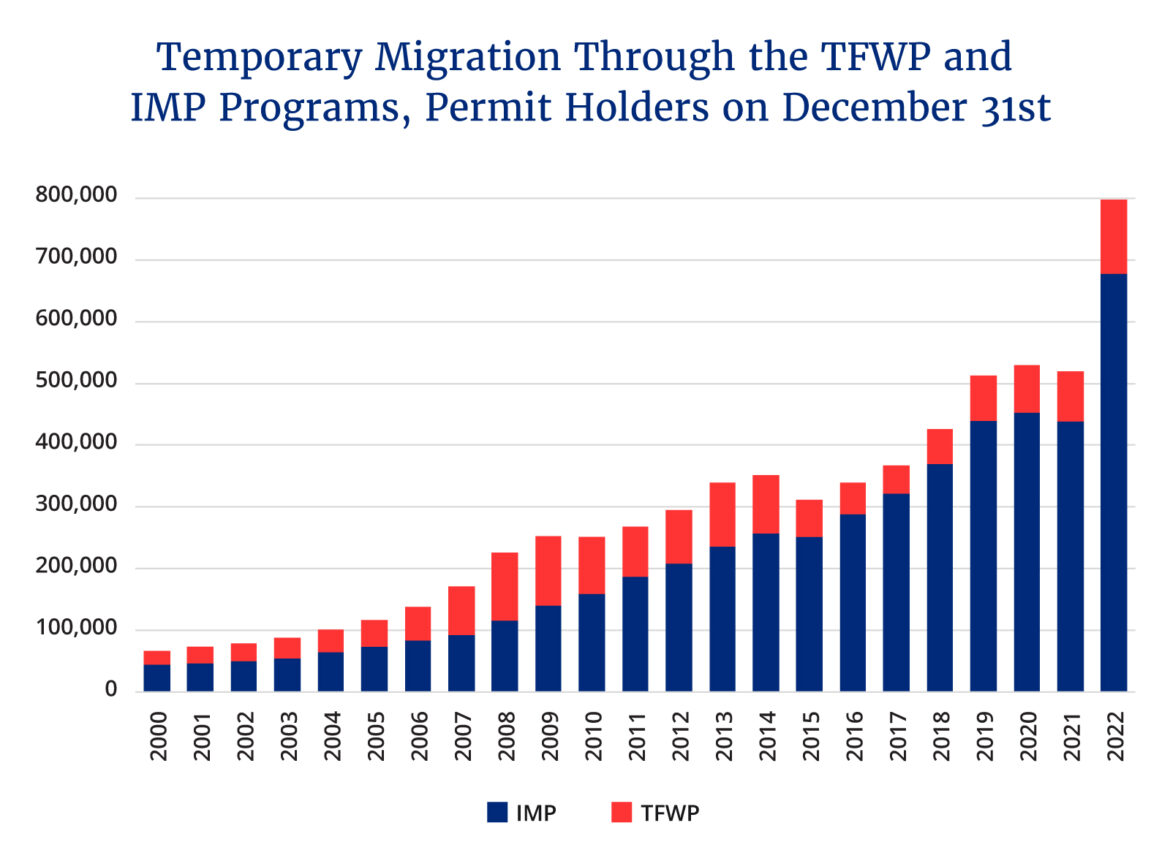
The figure below displays the number of work permit holders at the end of 2022 through Canada’s two temporary labour migration streams—the TFWP and the International Mobility Program (IMP). The TFWP covers migration programs that require a Labour Market Impact Assessment to receive a work permit such as the live-in caregiver program and various agricultural programs. The IMP does not require labour market assessments and includes individuals working on visas related to trade agreements such as the Canada-U.S.-Mexico Trade Agreement, individuals on post-graduate work permits, and so on. 

Mr. Trudeau was correct in 2014 to observe that there was a more than doubling of the program under the Conservatives before a slight reduction owing to policy changes later that year that included a partial moratorium on new permits and visas.

Graphic credit: Janice Nelson.

Under Trudeau’s tenure as prime minister, however, the number of temporary work permits has grown dramatically—far outstripping those during the Harper government. In 2015, there were a little more than 310,000 temporary work permits. By 2022, the number had more than doubled to almost 800,000. Partial data from 2023 indicate that there was a further increase last year. 

One way to understand this massive increase in the number of temporary foreign workers is to use Trudeau’s own standard of the share relative to permanent residents. He warned in 2014 that the ratio was approaching 1:1. In 2022, there were roughly 440,000 permanent residents admitted into Canada compared to the almost 800,000 working on temporary visas.

This significant growth not only conflicts with Trudeau’s chief recommendation in his op-ed that the TFWP needed to be constrained but also his broader concerns about the risks of an over reliance on temporary foreign workers. 

He concluded: 

“It cuts to the heart of who we are as a country. I believe it is wrong for Canada to follow the path of countries who exploit large numbers of guest workers, who have no realistic prospect of citizenship. It is bad for our economy in that it depresses wages for all Canadians, but it’s even worse for our country. It puts pressure on our commitment to diversity, and creates more opportunities for division and rancour.

We can and must do better.”

Source: Prime Minister Trudeau failed to follow his own advice on temporary foreign workers

Sean Speer: Canada really is broken right now [on immigration]

Of note:

A major factor behind these trends is the Trudeau government’s mismanaged immigration policy. We still don’t have an adequate explanation for what’s behind the unprecedented increase in the number of non-permanent residents into the country. Was it a deliberate policy strategy? If so, why? And if wasn’t, how did it happen? 

This past year shouldn’t be viewed as a one-off either. Virtually all of the biggest year-over-year increases in the number of non-permanent residents have during the Trudeau government. It’s hard not to conclude therefore that it has amounted to either a purposeful or inadvertent policy strategy that seems to have been pursued without any consideration of the externalities. As economist Ben Rabidoux recently put it: “If this government were actively trying to stoke anti-immigration sentiment, it would be indistinguishable from current approach.”

Source: Sean Speer: Canada really is broken right now

Sean Speer: Trudeau’s empty-calories economic agenda is failing Canada

Of note:

The key point here is that even if one is motivated by normative commitments to reducing inequality in our society, the answer isn’t to neglect the imperative of intensive growth. A policy agenda that sought to boost business investment and innovation in the name of increasing overall wealth wouldn’t necessarily involve a major equity trade-off. Higher GDP per capita growth is ultimately key to boosting living standards for all Canadian households.

The bigger point though is that the Trudeau government’s experiment with an extensive growth agenda rooted in high immigration and high public spending has manifestly failed to produce positive results. It may have staved off a technical recession, but it has contributed to deep recessionary conditions for Canadian living standards that are having far-reaching socio-political consequences including heightened pessimism about the future among ordinary citizens.

This growing realization has led to renewed debate about Canadian immigration policy. That’s a healthy development. We need to restore a more responsible policy that sets reasonable targets and reprioritizes high-skilled immigrants. Pierre Poilievre deserves political credit for taking a big step in this direction.

But that’s a necessary yet insufficient response to what ails Canada’s economic life. What we ultimately need is to replace the Trudeau government’s empty-calories economic agenda with a healthier mix of pro-growth policies to boost investment, productivity, and living standards.

source: Sean Speer: Trudeau’s empty-calories economic agenda is failing Canada

Canadians are turning against immigration. Labour economist Mikal Skuterud on how to reform the system and reverse this trend

Usual insightful comments by Skuterud:

Canada has long been an outlier in the Western world for having the rare dynamic of both high levels of immigration and high levels of public support for immigration. Paired with cross-partisan support on the topic, the issue has not been a major driving factor of the country’s politics. But that consensus may be changing. New data from the Canadian Century Initiative finds that there has been a significant increase in Canadians who believe that Canada has too much immigration.

Mikal Skuterud, a labour economist at the University of Waterloo and director of the Canadian Labour Economics Forum, offers his expertise on the topic in an exclusive exchange with The Hub’s editor-at-large, Sean Speer. He breaks down the numbers and highlights the ways Canada can reform its system to reverse these trends and better serve the country as a whole.


SEAN SPEER: As you know, the Canadian Century Initiative, a non-profit organization dedicated to the goal of raising Canada’s population to 100 million by 2100 through large-scale immigration, recently released new polling in conjunction with the Environics Institute for Survey Research. I want to start by asking for your reaction to the survey’s top-line finding. There has been a significant increase—indeed, the largest year-over-year increase since Environics started asking this question in 1977—in the percentage of respondents who believe that Canada has too much immigration. What do you think about this result? Are you surprised? And what do you think is behind it?

MIKAL SKUTERUD: While Canadians have always been, and continue to be, overwhelmingly open to immigration, opinion polls have long shown that a significant majority of Canadians believe the number of immigrants Canada accepts should be limited. I think this reflects a widespread belief that while immigration has the potential to boost average economic well-being in the population, there is a limit to that potential. The vast majority of Canadians understand that the economy has an absorptive capacity. When the population grows faster than the housing stock, public infrastructure, and business capital, there is less capital per person, and this tends to lower labour productivity and average economic living standards in the population. My best guess is that the shifting sentiments that Environics is seeing in their polling reflect concerns that the government’s ambitious immigration agenda is pushing up against the economy’s absorptive capacity. 

SEAN SPEER: The biggest explanation for the increase in the public’s misgivings about immigration is the perceived effect on housing prices. This ought to have been a predictable concern among policymakers and the Canadian Century Initiative itself. Why do you think we failed to account for housing demand and the need for greater supply in conjunction with raising immigration levels? What can be done to improve jurisdictional coordination and coherence on these issues? 

MIKAL SKUTERUD: In 2015, an economic narrative surfaced in this country that claimed heightened immigration rates, from what were already high rates when compared to other OECD countries, would be a tonic for economic growth. Canadians were told that higher population growth would not only make Canada more prosperous but that higher immigration was necessary for economic growth. For economists like me, who have been studying the economics of Canadian immigration for decades, these hyperbolic claims did not line up with the predictions of standard economic models of economic growth or with the Canadian empirical evidence. 

In March 2016, then Minister of Immigration, John McCallum, invited a group of us to share our views. In retrospect, it’s clear that our concerns fell on deaf ears. The immigration narrative was a feel-good story, and nobody likes a cold shower. The appeal of the narrative that immigration—“Canada’s secret sauce”—could be the solution to our dismal economic growth and labour productivity performance is understandable. But, of course, sometimes political narratives are so appealing that well-intentioned people get caught up in the warm feelings of what we’d like to be true and lose sight of the more important question of what is true. 

If we know nothing else about the economics of immigration, we know that immigration has distributional effects. In general, the folks who are on the opposite side of consumer and producer markets of immigrants stand to benefit, while folks on the same side are likely to experience adverse economic effects. While recent immigrants who live in the same communities as newcomers face heightened competition for housing and jobs, the competitive pressures facing sellers in mortgage markets (banks) and buyers in labour markets (employers) are alleviated. 

An interesting result from the recent Environics poll which I haven’t heard any media report on is that the biggest shift in dissatisfaction with recent immigration levels is among first-generation immigrants. This is consistent with the proposition that population growing pains are likely felt most by immigrants already here. To the extent that we care about the consequences of heightened immigration on economic inequality and social cohesion, these distributional effects should be of first-order concern to policymakers. 

SEAN SPEER: One of the issues that, according to the polling, is the subject of declining public confidence is the notion that we need or want a larger population itself. A lot of the immigration debate is implicitly motivated by the idea that we should aspire to a fast-growing and larger population. What is your view on this question? What does the scholarship tell us about the benefits of bigness? Should we have an explicit goal for Canada’s population to become larger?

MIKAL SKUTERUD: The economic case for bigness is most often made with reference to what economists call “agglomeration effects.” The general idea is that bigger cities with higher population densities are more successful in generating the flows of knowledge and ideas that result in innovation, and in turn, technological advances, and growth in total factor productivity. This mechanism could, in theory, be a source of increasing returns to scale, such that a two percent increase in the inputs that go into producing aggregate output, most importantly the labour input, result in a more than two percent increase in aggregate output. In this way, an increase in the immigration rate can produce an increase in GDP per capita. 

Unfortunately, I’m unaware of any credible evidence that this mechanism has been important in recent Canadian history. Certainly, the current push to settle more immigrants in remote communities works against this mechanism. In work with my colleague Joel Blit and recent Ph.D. student Jue Zhang, we examined the relationship between inflows of university-educated immigrants into Canadian cities to the number of new patents created in those cities and found no evidence consistent with the proposition that agglomeration effects have been quantitively important for Canada historically, in contrast to the results of a similar analysis using U.S. data. 

Perhaps a more compelling argument for why population size is, in itself, a sound economic objective is that bigger countries have more geopolitical influence on the world stage and that this advantage somehow benefits economic growth through more advantageous free trade deals, for example. However, if this mechanism was quantitatively important, we’d expect countries with larger populations to be on average richer, but the opposite is true. World Bank data from 187 countries in 2019 shows that the correlation between national population and GDP per capita is unambiguously negative. Many big countries are poor, and many small countries are rich. 

SEAN SPEER: One of the most interesting results is that 77 percent of respondents said that government policy should prioritize high-skilled immigration. Only one-third said that it should prioritize low-skilled workers and students. Yet as your work has shown, government policy has tilted away from high-skilled immigration to the latter two categories in recent years. How does one explain that dissonance and what should be done to rebalance the composition of Canada’s different immigration streams? 

MIKAL SKUTERUD: The repair to the permanent immigration system is simple: return to a single pathway for economic-class immigration with a single selection criterion. This is what we had in Canada before 2021. All economic-class immigrants (outside Quebec) received permanent residency status by entering the Express Entry pool where they were assigned a Comprehensive Ranking System (CRS) score, which is essentially a prediction of the applicants’ future earnings in Canada. Every two weeks, IRCC announced a CRS cutoff score and candidates with scores above the cutoff were invited to apply for PR status. 

However, since 2021 IRCC has introduced a series of ad-hoc TR-to-PR pathway programs intended to provide PR pathways for applicants with low CRS scores. For example, in April 2021, they announced a new PR pathway for 90,000 temporary workers employed in a list of “essential occupations” that included cashiers, cleaners, truck drivers, construction and farm labourers, and security guards. More recently, the Category-Based Selection System has been introduced allowing the minister of the day to bypass the CRS criterion to prioritize any occupation in the applicant pool. This flexibility enables the Minister to respond to business lobbying pressure for more low-skilled labour. This politicization of immigrant selection isn’t good for wage growth in Canada’s low-skilled workforce and undermines business incentives to invest in training and technologies to improve labour productivity. 

The question of whether immigration should be focused on raising the average human capital stock of the population or plugging holes in current labour markets is longstanding. Economists have overwhelmingly argued for the former approach. Their logic is simply that we don’t believe planned economies work well. There is overwhelming evidence that aggregate production in modern economies doesn’t require some fixed ratio of labour types. In 1921, one-third of Canada’s workers were employed in agriculture. After more than 100 years of innovation in farming equipment, less than two percent are. Trying to predict where job vacancies will be in five or ten years is futile because labour demand is endogenous to labour supply. Where a particular labour type is plentiful, wages will be low, incentivizing employment of those types, and where a labour type is scarce, wages will increase, incentivizing substitution to other types of labour or capital investments. If we want a low-wage low-skill economy, we should target low-skill immigrants; but if we want a high-skill high-wage economy, we should prioritize high-skill immigrants. 

SEAN SPEER: More generally, if you were advising government policymakers on their policy response to these findings, what might change? Should we lower our permanent resident target? Should we prioritize addressing the growth in non-PR streams? Should we do both? What is the Skuterud plan to restore public support for high levels of immigration?  

MIKAL SKUTERUD: A positive outcome of the growth in Canada’s foreign student and temporary foreign worker populations is it has justified a call for better data. Statistics Canada now publishes a quarterly data series on the overall size of Canada’s non-permanent (NPR) population. This population is exceptionally difficult to measure but they have taken a good shot at it. What the data show is that Canada’s NPR population increased from 1.5 million to 2.2 million—a nearly 50 percent increase—between July 2022 and July 2023. 

As the NPR population grows faster than the number of new PR entries, an increasing number of temporary residents who came to Canada with dreams of settling permanently will find their permits expiring before they’ve made the transition. This inevitably means that Canada’s undocumented population will grow. A growing undocumented population is undesirable for many reasons, so rebalancing growth in Canada’s NPR population with the growth in Canada’s PR targets should be, in my view, a first-order priority for IRCC. 

At the core of the challenge here are two realities. First, Canadian permanent residency status holds enormous economic value to huge populations of individuals around the world. Second, Canadian immigration policy has over the past decade shifted in a significant way to “two-step immigration” in which the pathway to PR status is to study or work in Canada as a temporary resident and then clear the hurdles of the PR admission system. Together these realities mean that a key factor in migrants’ private cost-benefit decisions to come to Canada is their perception of the likelihood of making a successful TR-to-PR transition while in Canada. 

While increasing TR-to-PR pathways for migrants may be well-intentioned, an unintended consequence of these programs is they increase the odds that lower-skilled migrants will get lucky and obtain PR status. In this regard, they serve to lure migrants who are willing to pay exorbitant tuition fees to postsecondary institutions that offer little educational value and or accept jobs offering substandard wages and working conditions. There’s little doubt in my mind that an important cause of the tremendous growth in the NPR population is a supply-driven response to migrants’ perceptions that their chances of winning the PR lottery have increased in recent years. Fixing this problem requires returning to a single PR pathway that is transparent and predictable and that prioritizes applicants with the highest CRS scores. 
Source: Canadians are turning against immigration. Labour economist Mikal Skuterud on how to reform the system and reverse this trend