Did discrimination keep this couple out of Canada? A Canadian court delivers a ‘bittersweet’ ruling
2023/08/28 Leave a comment
Of note, ongoing challenge of indicators used to indicate likely refugee claims and overstays:
The Canadian government has been ordered to reinstate a travel document for a Roma couple who were kept from making a trip to this country at least partly because their hosts were former refugees.
The Federal Court ruled this week on a case that put a spotlight on the Canada Border Services Agency’s use of “association with refugees” as an “indicator” to vet travellers.
And although the couple will now get their travel document, Justice Simon Fothergill ruled that the CBSA’s use of indicators did not amount to a discriminatory practice.
The couple said they were disappointed at Fothergill’s decision.
“We have been unable to visit our family in Canada for more than four years now,” said Andrea Kiss, who had set out on the 2019 trip to see her sister, who was about to have an abdominal surgery.
“I am disappointed the court did not recognize the harm and humiliation that CBSA’s discrimination against Roma people is causing.”
Kiss and her husband were set to fly from the Budapest airport in 2019 to visit Andrea’s sister in Toronto, who, along with her family, has refugee status in Canada.
Although the couple had been issued an electronic travel authorization (eTA) — a travel document required for those flying into Canada from visa-exempt country such as Hungary, they were stopped and referred for further screening.
Canadian border officials made a “no-board” recommendation and cancelled the couple’s travel authorization. The case note, among other concerns, cited their hosts as “convention refugees who arrived in Canada via irregular means in 2015 and 2016 respectively.”
The notes suggested the couple had weak ties to Hungary, where they did not own property or a long-term rental lease and were unable to explain what they would do over their three-month stay in Canada, how the husband managed to take such a long vacation from work or why they were carrying $2,000 in cash.
In fact, according to the couple’s claim, not only did they own property in Hungary, the husband had worked for the same employer for 26 years and had received approval for a six-month leave for the trip.
The Kisses challenged the decision in court with a non-Roma Hungarian family that faced a similar experience, claiming CBSA officials did not have the authority to conduct overseas examination and cancel the travel documents, and that the use of “association with refugees” as an indicator was discriminatory.
The government had agreed that their eTAs should be granted, but the complainants insisted on seeking a formal declaration from court to that effect.
“The Court has found that the Officer had statutory authority to cancel the Applicants’ eTAs, although the criteria for exercising that authority were not satisfied in either of these cases. This is conceded by the (Immigration) Minister,” Fothergill wrote in the decision.
However, there’s no evidence established, the judge found, of “the existence of a co-ordinated program by the CBSA to interdict travellers abroad solely on the ground that they are of Roma ethnicity or associated with Roma refugee claimants in Canada.”
The court said the border officials’ decisions were based on information provided by a private security agent employed by Air Canada, combined with other information contained in immigration records.
It pointed out that the decision-making officer was located in Vienna, Austria, and had no direct interaction with the travellers and did not “exercise any coercive powers,” hence the complainants’ “unauthorized overseas examination” accusation against the border officials was unsupported.
“This did not constitute the examination of foreign nationals, but rather the provision of assistance to an air carrier in meeting its obligation to ensure travellers are eligible to enter Canada,” wrote Fothergill.
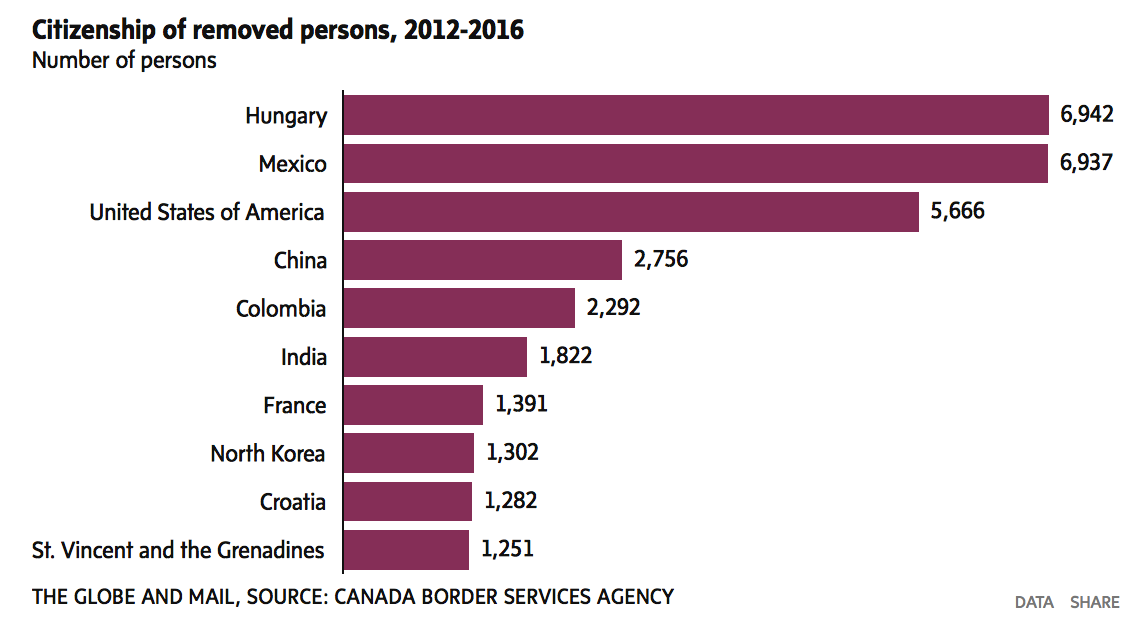
During the court proceedings, the complainants submitted evidence that showed CBSA overseas liaison officers made no-board recommendations against 1,252 Hungarian nationals between 2012 and 2018.
An affidavit from a York University law professor said the recognition rate of refugee claims from Hungary, majority of them by Roma minorities, was almost 69.7 per cent, a rate above the refugee board’s overall protection grant rate.
The complainants argued that the border officials’ cancellations of the travel authorization was part of Canada’s broader interdiction policy that seeks to enforce its border and immigration laws extraterritorially by pushing the border out against undesirable visitors such as potential refugees, even before they depart from their country of origin.
Air travel advocate Gabor Lukács, who assisted the families in court, said that while he was happy the complainants were vindicated and will have their travel authorization restored, the ruling was bittersweet.
“If you target people from Hungary who have a refugee history, it is tantamount to targeting the Roma people. The evidence on that point was clear and uncontradicted,” said Lukács, founder of the Halifax-based Air Passenger Rights.
“The court is basically saying that by preventing people to board a flight because they are too brown, because they have the wrong ethnicity, the CBSA is just helping the airlines to meet their own legal obligations. It is a whitewashing of what is quite clearly a systemic discrimination.”
Source: Did discrimination keep this couple out of Canada? A Canadian court delivers a ‘bittersweet’ ruling




 Multicultural Meanderings