BEFORE THE presidential election in 2000, George W. Bush was urged by an adviser to go after a category of voters who would love a business-friendly, socially-conservative message: Muslims. Mr Bush took the tip and it worked. In 2001, a survey of American Muslims (including those who cast no ballot or gave no clear answer) found that 42% reported voting for Mr Bush against 31% for his Democratic rival Al Gore. Among upwardly mobile Muslim immigrants, many of them professionals or entrepreneurs, the proportion voting Republican was much higher.
Now, however, with anti-Muslim sentiment ablaze among supporters of Donald Trump, and the president hardly discouraging it, that love-in is a distant memory. American Muslims are gaining political visibility, but only on the far left of the spectrum. Symptomatic of this shift is the election to the House of Representatives of two Muslim women (Rashida Tlaib and Ilhan Omar) who along with two female colleagues, also left-wing Democrats, have been taunted by Mr Trump and his supporters.
A huge change in Muslim sentiment was clear in the 2004 presidential race and confirmed by the 2008 contest won by Barack Obama. By 2007 some 63% of American Muslims at least “leaned towards” the Democrats, against only 11% for the Republicans. These figures have not changed very much since, according to Pew Research, a pollster. Among Muslims who voted in the 2016 presidential race, only 8% said they opted for Mr Trump (who had declared that “Islam hates us”) and 78% for Hillary Clinton.
Campaigners for Muslim political engagement reckoned that more than 1m were registered to vote in 2016, and that last year’s congressional elections saw an uptick in Muslims going to the polls. Pew estimates that about 3.5m Muslims live in America. At around 1% of the country’s population as of 2015, they were more numerous than Hindus (0.7%) or Buddhists (0.7%) though well outnumbered by Jews (1.8%). But that picture is projected to change fast with the Muslim share doubling by mid-century.
The main reasons for the transformation in Muslim attitudes have been much analysed. After the terrorist attacks of September 11 2001, there was a spate of hate crimes against followers of Islam and open antipathy towards Muslims emerged in a growing segment of the electorate. That put Muslim voters into a defensive frame of mind, and Democrats, with their embrace of cultural diversity, offered the safest haven. Another factor, though its importance is disputed, is that younger American Muslims have grown more liberal over cultural questions like gay rights, so they are less amenable to Republican-style “family values” arguments. As for African-American Muslims, they (like black Christians) have always been well to the left in their voting choices.
Still, to say that American Muslims have lurched from one end of the ideological spectrum to another would be an over-simplification. According to Youssef Chouhoud, a political scientist at Christopher Newport University, Muslims are not so much confirmed leftists as nomads, in search of anyone who will listen to them, and the only respectful attention they are getting is on the left. Even in that quarter, they have been feeling a bit unloved recently. At the convention on August 31st of the Islamic Society of North America (ISNA), which calls itself the country’s biggest Muslim organisation, only two candidates for the Democratic presidential nomination accepted invitations to speak: Senator Bernie Sanders and Julián Castro, a former housing secretary. Mr Sanders is also probably the most robust supporter of Palestinian rights in the primary field. As Mr Chouhoud puts it, this leaves Muslims “looking for a place they can feel wanted. Any politician who even talks to them will be appreciated.”
In this climate, Muslim Republicans are an endangered, though not extinct, species. One veteran of that cause is an Arizona-based doctor, Zuhdi Jasser. He has served as vice-chair of the United States Commission on International Religious Freedom, a bipartisan watchdog, as a Republican nominee. Although Mr Trump was not his preferred candidate, Dr Jasser declares himself “pleasantly surprised” by many of the Trump administration’s policies, and insists that “Muslim ban” is not an accurate way to describe the president’s drive to bar entry from five countries where Islam predominates.
Dr Jasser feels the “Muslim-equals-left” stereotype is partly the fault of his community’s self-appointed representatives, not so much the young firebrands as the community’s elderly godfathers. In his view, these veteran leaders have one big failing. They have never really distanced themselves from the global cause of Islamism, the notion that the only ideal form of governance is a Muslim one. (They are not, of course, proposing such a regime for America, but many have a record of endorsing political Islam elsewhere.) That soft spot for Islamism makes them particularly toxic in the eyes of mainstream American conservatives, leaving Muslims nowhere to go but left.
As he tours America addressing conservative groups, Dr Jasser finds them open to persuasion that the political doctrine of Islamism, which in his view can and must be separated from the spiritual teaching of Islam, is their real foe. He lays out the case that Islam as a set of metaphysical beliefs and ethical norms can flourish, in America and elswhere, under the principle of church-state separation which was dear to the Founding Fathers. Once that argument is made, his listeners are open to persuasion that decent American Muslims are allies against Islamism.
Whether or not they deserve to be dismissed as old-timers, America’s Muslim thought leaders, be they spiritual or political, are certainly divided. In ways that leave ordinary Muslim voters a bit baffled, they squabble among themselves, usually over events in distant lands. Arguments rage over the coup in Egypt in 2013, the failed coup in Turkey in 2016 and the civil war in Syria. At the core of many such disputes is a difference in attitudes to the global Muslim Brotherhood, as a standard-bearer of Islamism. In the words of H.A. Hellyer, an analyst for the Carnegie Endowment, “one of the fault-lines in the American Muslim intelligentsia is between those who see Islamism as the proper, basic norm of Muslim political life, and those who are philosophically opposed to it.”
Rank-and-file American Muslims may not have much time for philosophy but many will have felt some bewilderment in recent weeks as one of their most revered spiritual figures became embroiled in a row which has a domestic political dimension. Hamza Yusuf, a California-based greybeard, is often described as America’s most eminent scholar of Islam. In July he took a job, of sorts, with the Trump administration by joining a panel set up by the State Department to ponder the definition of human rights. Some said he was selling out to a Muslim-bashing administration; others that his warm relations with the United Arab Emirates, whose regime he calls tolerant, made him unqualified to pronounce on human rights. (The UAE is a declared foe of the Brotherhood, so views on that country are sensitive.) Mr Yusuf was already unpopular with left-wing co-religionists for saying after Mr Trump’s election that Muslims should accept his authority.
In recent days he has been much criticised for having spoken mockingly of the Syrian uprising that started in 2011. In a three-year-old video clip that suddenly went viral, he said the revolt had led to untold humiliation for Muslims. In a fresh video he apologised if his words had offended people who suffered under Syria’s regime.
Still, some advocates of a Muslim-Democratic coalition feel they can do fine without such prominent Muslims as Mr Yusuf. Despite the lack of interest shown by other Democrats, they took heart from Mr Sanders’s appearance at the ISNA convention and especially over one of his comments. He delighted Pakistani-Americans by saying he was “deeply concerned” about India’s “unacceptable” actions in Kashmir. That gave a hint of one foreign-policy issue which might loom rather large for south Asian voters in the 2020 race. Some Indian-Americans are impressed by Mr Trump’s friendship with Narendra Modi, India’s prime minister; many Pakistani-Americans hope a Democratic runner will take the other side.
Shadi Hamid, a fellow of the Brookings Institution, a think-tank, says the deepening partnership between Muslims and Democrats was built not on foreign-policy questions but more on adversity: the alarm created by the white-nativist spirit which they see stalking the country. Certain tensions do exist, he says, between the social conservatism of some Muslims and the ever more secular ethos of the Democrats. But for now, such tensions are kept under control by a common feeling of being endangered. If the Trump era passes, the Democratic coalition’s internal strains might come to the fore, but until that happens, a sense of being under siege will keep it together. Generally, Muslim voters are saying: “however secular the Democrats might be, it is the Democrats who have our backs.”
Hard not to agree, although the Trump effect on mainstream opinion should not be discounted:
In the aftermath of the mass shooting at an El Paso Walmart, in which the accused gunman allegedly targeted Hispanics, there’s been a great deal of focus on a short screed he appears to have posted online shortly before opening fire. In that document, the author claims that immigration across the U.S.-Mexico border is an “invasion” and that white American culture is at risk of being “replaced.”
In short order, observers noted that the rhetoric echoed President Trump’s own descriptions of the purported dangers of immigration. Trump has repeatedly spoken about immigrant invaders and has, on several occasions, warned Republicans that they were at risk of being swamped by immigrants coming into the United States to vote Democratic — even if they have to vote illegally. (There’s no evidence that this has happened more than a few times in recent years.)
The focus on the language used in that document, though, obscures the more important factor driving immigration politics in the United States: the mainstream rhetoric used to disparage or undercut immigration.
On Monday, the Trump administration announced plans to restrict access to green cards for immigrants by adding restrictions focusing on ensuring that new arrivals could immediately begin working and not need to use government resources. In an interview on NPR, the administration’s immigration chief, Ken Cuccinelli, offered a reworking of the poem that sits at the base of the Statue of Liberty: “Give me your tired and your poor who can stand on their own two feet and who will not become a public charge.”
It’s this sort of rhetoric that’s driving the administration’s policies and Republican attitudes toward immigration — and is mirrored by conservative media.
We noted on Monday that the effort to add new restrictions on immigration centered on the use of public-support systems was central to how many in the tea party viewed the issue of immigration. While Trump’s entry into national Republican politics is generally pegged to his aborted 2012 presidential run and his embrace of the false claim that President Barack Obama wasn’t born in the United States, Trump was also a supporter of the tea party movement.
The period from 2010 to 2014 was formative for Trump’s conservative politics (as it was for many Americans). From 2011 until he launched his presidential campaign in 2015, Trump had a weekly gig on Fox News’s “Fox and Friends,” contributing his thoughts on a number of issues in line with the show’s politics. He was tracking more conservative online outlets such as Breitbart, occasionally sharing stories published there. In 2013, he spoke with Breitbart’s Matt Boyle (who later became a publicly visible supporter of Trump’s), arguing that Republicans should oppose an immigration reform proposal, lest future Democrats flood across the border — rhetoric used in the screed published before the El Paso shooting.
In 2014, violence in Central America prompted a surge in the number of children arriving at the border seeking entry to the United States. Immigration as an issue quickly dominated Fox News, conservative outlets such as Breitbart and conservative radio. Former Virginia congressman Eric Cantor, then the House majority leader, lost a Republican primary that June in part because of a relentless focus by conservative media on his approach to immigration, which was perceived as overly generous.
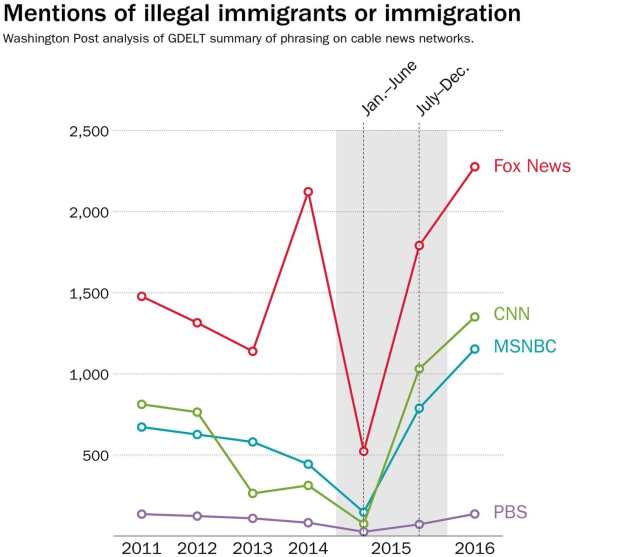
This focus on immigration in the conservative media certainly contributed to Trump’s focus on the issue during his campaign launch in June 2015. Analysis of closed-captioning data from the major cable news networks and PBS compiled by the GDELT Project shows that Fox News talked about immigration in the context of illegality more than 2,000 times in 2014. In the first half of 2015, that plunged to about 500 — but after Trump jumped into the race and, more specifically, after blowback against his anti-immigration rhetoric elevated his national profile, the network talked about illegal immigration or undocumented immigrants nearly 1,800 times in the second half of the year.
(Philip Bump/The Washington Post)
Trump’s entry into the race similarly spurred more discussion of illegal immigration on the other networks, too.
Immigration has been a constant foil for Trump during his presidency, echoed and amplified on Fox News in particular. As the 2018 midterm approached, Trump highlighted caravans of immigrants approaching the border as an imminent threat, sending troops to border states to put up concertina wire. Fox News obliged, showing footage from the border and implying that the group was rife with criminals and potential terrorists. After the midterms, Trump was prepared to sign a budget deal until hard-liners in conservative media pressured him to try to get funding for a wall on the border. The longest government shutdown in history ensued, with Trump eventually conceding defeat.
This has had an effect. Shortly after the administration announced the shift in immigration policy discussed by Cuccinelli, the Pew Research Center released new polling about views of immigrants in the United States. Republicans are consistently more likely to hold skeptical views of immigrants in the country without authorization than are Americans overall: They’re more likely to think immigrants are taking American jobs (which Trump and his administration have claimed), are not as hard-working or honest and are more likely to commit crimes (which Trump has claimed repeatedly). There’s no evidence that undocumented immigrants take jobs from native-born citizens, and immigrants to the United States commit crimes at lower rates than native-born Americans.
Notice what’s happened during Trump’s presidency. When Pew asked in August 2016 — months into Trump’s political rhetoric — Republicans were 37 percentage points more likely to say that immigrants were hard-working than not and 10 points more likely to say they weren’t more prone to committing crime.
Now? Republicans are 12 percentage points more likely to say that immigrants are hard-working, a 25-point swing. Republicans are now more likely to say that immigrants commit crime at higher rates than citizens than to say that they don’t.
(Philip Bump/The Washington Post)
We can’t run an experiment to see what those numbers would look like without Trump in the White House. Would Fox News have been as fervent on the subject? Would some other Republican have made it as significant a priority?
One thing is clear. We’ve spent more than a week debating the extent to which Trump’s rhetoric influenced the El Paso shooter. There’s little question, though, that his rhetoric has shifted how Republicans broadly view immigrants to the United States leading to an administration official literally suggesting that the wording on the Statue of Liberty was too generous to those seeking to come to the United States.
That administration official, Cuccinelli, has ancestors who came to the United States from Italy and Ireland, like those of White House adviser Kellyanne Conway. Those two groups were targets of anti-immigrant rhetoric more than a century ago, seen as dangerous infiltrators aiming to steal American jobs.
The Trump administration concealed evidence that its proposal to add a question about citizenship to the 2020 U.S. census was intended to help Republicans draw favorable electoral maps, according to immigrant advocacy groups that sued the administration over the question last year.
In a filing in Manhattan federal court on Thursday, the groups said that the administration hid the fact during the course of the lawsuit that went to trial last year that Thomas Hofeller, a longtime Republican specialist on drawing electoral districts, played a “significant role” in planning the citizenship question.
The conservative-majority Supreme Court is due to issue a final ruling by the end of June on whether the question can be added in time for next year’s census.
The challengers notified the high court about the new documents in a letter filed at the court on Thursday afternoon. They did not ask the Supreme Court to take any specific action.
The plaintiffs, which include the Arab-American Anti-Discrimination Committee and Make The Road New York, learned of Hofeller’s role after his files came to light in separate litigation in North Carolina in which Republican-drawn electoral districts are being challenged.
A Justice Department representative said the allegations were a “last-ditch effort to derail the Supreme Court’s consideration of this case.”
“The Department looks forward to responding in greater detail to these baseless accusations in its filing on Monday,” the person said.
Manhattan-based U.S. District Judge Jesse Furman blocked the question’s inclusion following the trial, but the Supreme Court appeared poised to overturn that ruling at April’s oral argument.
According to Thursday’s filing, Hofeller concluded in a 2015 study that asking census respondents whether they are U.S. citizens “would clearly be a disadvantage to the Democrats” and “advantageous to Republicans and Non-Hispanic Whites” in redistricting.
Hofeller went on to ghostwrite a draft letter from the U.S. Department of Justice to the Department of Commerce, asking for a citizenship question on the grounds it would help enforce voting rights, according to the plaintiffs.
The plaintiffs, represented by the American Civil Liberties Union, said that administration officials gave false testimony about the origin of the question during the lawsuit, and have asked Furman to consider imposing unspecified sanctions against them.
Furman has scheduled a hearing on the request for June 5.
Reuters reported in April that the Trump administration believed its citizenship question could help Republicans in elections by enabling states to draw electoral maps based only on citizen population, rather than total population.
Opponents have said a citizenship question would cause a sizeable undercount by deterring immigrant households and Latinos from filling out the census forms, out of fear the information would be shared with law enforcement. That would, they argue, cost Democratic-leaning areas electoral representation in Congress and federal aid, benefiting President Donald Trump’s fellow Republicans and Republican-leaning parts of the country.
Good commentary by Rothman. Largely a “plague on both houses” on liberal and conservative hypocrisy regarding their respective extremists, he is particularly pointed in his critique on conservatives:
Like so many terrible things, it all began with a broken window.
Stewards of the historic Metropolitan Republican Club on Manhattan’s Upper East Side awoke on the morning of October 12 to see their institution vandalized. A brick had shattered two windows. The front locks were caulked shut. The entryway keypad was smashed. And the building’s two oversize wooden doors had been marred by graffiti—the anarchist’s wreathed “A.”
“Our attack is merely a beginning,” a message left by the gang of vandals began. “We are not passive, we are not civil, and we will not apologize.” The attackers were as hostile toward the “spineless” Democrats as they were toward the Republicans being targeted, but they were not ambiguous about what had motivated them on this particular night. “The Metropolitan Republican Club chose to invite a hipster-fascist clown to dance for them,” the note read. It was a warning, and not a hollow one. This was a sign of things to come.
The “hipster-fascist” to which they referred was Gavin McInnes, a broadcaster and instigator who has aligned himself with the right’s racially antagonistic elements. He is the founder of the “Proud Boys,” an organization that promotes the superiority of Western heritage and that has some members who have an affinity with the alt-right’s most violent activists. McInnes was invited to put on a show for a GOP audience, and he delivered. On social media, McInnes advertised his intention to reenact the 1960 assassination of a Japanese Socialist Party leader at the event, and he was seen by reporters outside the venue carrying a mock Samurai sword.
Both the Proud Boys and the counter-demonstrators were primed for violence, and violence is what they got. Two blocks away from the club, reporters shooting video captured the start of a fight that clearly shows McInnes supporters beating several counter demonstrators. Police were not present at the scene and no arrests were made, but the photographic evidence is clear enough as to which party was responsible for the altercation. Elsewhere, officers were privy to an attack on one of the event attendees by three counterdemonstrators. Those assailants, who were described by a Legal Aid Society attorney as “anti-racist protesters,” were arrested and processed.
It was a sadly familiar scene. These violent spasms occur with grim regularity now. Right-wing proto-fascist elements coming to blows with left-wing socialist demonstrators is a fact of our politics. In Chicago, Sacramento, Saint Paul, Berkeley, Portland, and elsewhere, the vicious and radicalized are playing at Weimar provocation. If they are not careful, they might get what they’re looking for.
Much has been made in these pages and elsewhere of the institutional political media’s sympathy for one half of this detestable equation. The New York Times write up of these clashes described the counter-demonstrators as “anti-fascist” activists, a curious title to bestow upon a group that resorts to the political intimidation tactics of Mussolini’s Black Shirts. It is a lexical tell that showcases the ideological homogeneity within professional media reminiscent of the ubiquitous notion that the Antifa demonstrators who faced off against white supremacists in Charlottesville were the moral heirs to the Boys of Pointe du Hoc. Only after Antifa began attacking journalists did the soundness of this appraisal get a critical once over.
But liberal hypocrisy does not excuse conservative hypocrisy, and there’s enough of that to go around.
What value did this intellectual Republican institution hope to impart by hosting an accomplished provocateur—a man who has repeatedly insisted that “fighting solves everything,” that Israelis have a “whiny, paranoid fear of Nazis,” and that the starvation of millions of Ukrainians under Stalin was the work of “commie, socialist Jews?” Surely the Metropolitan Republican Club is aware that McInnes’s following has been implicated in the incitement of violence before. They must know that this group not only courts controversy but also attracts an unhinged response from the maniacs who fill the ranks of Antifa. In fact, that was most likely this act’s biggest draw.
We’ve seen this before. On college campuses, the local student-led political establishment is increasingly drawn to firebrands and agitators, not because of their challenging insights, but because they have the unique capacity to drive their untethered political opponents to fits of self-destructive rage. We’ve even seen it, writ large, in Virginia, where the GOP’s U.S. Senate candidate, Corey Stewart, is a Confederate apologist whose antics thrill the rank and file but are turning this once reliably red state a shade of dark blue.
There is some instrumental utility in transforming your adversary into a frothing bedlamite if only to present yourself as a calm and rational alternative. But no one with any coherent political philosophy believes that Milo Yiannopoulos is a great intellect because he inspires his detractors to set their surroundings on fire. No one of value believes that Stewart is onto something because the people who are offended by his frequent appeals to unalloyed racism are passionate about it. This is provocation for provocation’s sake, but it is not a sign of strength. It is the language of the fearful.
There’s a through-line that connects Manhattan’s Upper Eastside, the average college campus, and the state of Virginia. For Republicans, that through line is increasing irrelevance. In these places, they see their power wasting away, and they’re appropriately terrified. The provocation and incitement to which they gravitate isn’t just an attempt to recapture some lost attention, though that is surely the primary conscious drive. The radicalism to which they are attracted mirrors their anxieties.
For fringe factions on the right and the left, incitement and violence has become the weapon of first resort. Incidents of political violence are still few and far between, but we’re getting more accustomed to them. It’s just another part of the political landscape. That is the precipice of the abyss. And we’re staring right into it.
House Republicans will vote on their “compromise” immigration bill this week. Moderate Republican supporters of the bill may argue that its many restrictionist features—including draconian asylum provisions, cancelling the applications of 3 million people waiting to immigrate legally, and permanent reductions in legal immigration—are a small price to pay to help the entire Dreamer population gain a “pathway to citizenship.” However, an analysis of the Border Security and Immigration Reform Act (BSIF) shows that even under the most generous assumptions, the bill would likely initially legalize only 821,906 people, provide permanent residence (i.e. a pathway to citizenship) to 628,758, and result in citizenship for 421,268.
As provided in Table 1, only a third of the Dreamer population would likely receive status under the House plan (H.R. 6136), and just 18 percent would likely make it onto the pathway to citizenship. Only 12 percent would likely apply for and receive citizenship. Moreover, even the pathway to citizenship is tenuous, since—for all Dreamers in DACA or without legal status today—it is contingent on a future Congress appropriating money for a quite expensive (at least $25 billion) wall and security system along the Southwest border of the United States.
Table 1: Dreamer Populations and Eligibility Under Border Security and Immigration Reform Act
Sources: Authors’ calculations (see below) based on population estimates from Migration Policy Institute (DACA eligible and total Dreamer Population based on American Hope Act); Border Security and Immigration Reform Act (H.R. 6136)
*As of December 31, 2016
If Congress wants to help a larger number of Dreamers, then it would need to establish clear legalization criteria with lower costs and fewer risks, while providing greater legal certainty for the parents of Dreamers to mitigate fears of coming forward. Members of Congress should not exaggerate the extent of the legalization of Dreamers as a way to justify politically questionable policy choices, including reducing the annual level of legal immigration and eliminating several current immigration categories.
Restrictive Criteria in the House Bill
Back in January, President Trump promised a pathway to citizenship for Dreamers—up to 1.8 million of them. That’s still just half of the 3.6 million Dreamers—unauthorized immigrants who entered the country as minors—estimated by the Migration Policy Institute (MPI) to be in the United States as of January 1, 2017, but it’s still far more than the estimated number of Dreamers who will likely receive permanent residence under the House compromise legislation that will receive a vote this week.
The BSIF Act creates a four-part framework for potentially receiving permanent residence—a “path to citizenship”—and later citizenship (see Table 2 at the end). First, Dreamers would need to meet a set of basic criteria to receive conditional nonimmigrant status, a temporary renewable legal status. Second, after six years, most would need to apply for a renewal of this status. Third, they could apply for permanent residence over a 15-year period if they met a final set of requirements. Fourth, they could apply for citizenship five years after receiving permanent residence. Each stage will reduce the population that ultimately will become U.S. citizens.
The House immigration bill would use the same restrictive basic criteria as the Deferred Action for Childhood Arrivals (DACA) program. Its authors argue that if the requirements were good enough for President Obama who created DACA in 2012, they should be good enough for Democrats today. But as an act of prosecutorial discretion, DACA was never meant to be permanent immigration law, and in any case, President Obama tried to update its eligibility requirements in 2015, only to be stopped by the courts. The bill wouldn’t stop there. The House plan imposes additional eligibility requirements that would exclude even more Dreamers from receiving permanent protection.
The House bill will exclude Dreamers who entered after June 15, 2007, who entered at any age over 15, or who were over the age of 31 on June 15, 2017 (or 37 today). By the time the bill is implemented, people who had been residing in the United States for 10 or 11 years would be excluded from receiving status under the bill. The bill also requires a high school degree or equivalent or high school enrollment if the applicant is younger than 18. These restrictions were also in DACA, but the new bill would go even further to restrict eligibility. An applicant would be disqualified for having more than a single non-traffic-related misdemeanor, including immigration-related offenses; ever having missed an immigration court appearance; or having ignored an order to leave the country.
The biggest new restriction would be the requirement that Dreamers who are not students, disabled, or primary caregivers demonstrate that they can maintain an income of at least 125 percent of the poverty line. Not only do many Dreamers have incomes beneath this threshold, but also, if they have already lost DACA or never applied, it will be impossible for them to receive a legal job offer or demonstrate legal employment for the purposes of their application. This creates a catch-22 for applicants: prove you can support yourself in order to get work authorization in order to support yourself. (This provision should also concern employers which could see their records become the focus of government attention.)
In addition, receiving status under this bill will be far more expensive than receiving status under DACA. The bill would impose a fine—what the bill refers to as a border security fee—of $1,000. In addition, applicants would need to pay a fee to cover the cost of their application. DACA also had an application fee of $495, but the fee under this new bill would likely be more than double that because it requires an in-person interview and a medical examination. This will make the legalization more like applying for permanent residence, which costs $1,225. All told, applicants would need to pay about $2,225—4.5 times as much as DACA. This comes on top of any attorney fees. ManyDACAapplicants cite the cost as a primary challenge. MPI’s analysis also points to income as “strongly affecting” Dreamers’ ability to apply.
Finally, the bill would impose a 1-year filing deadline. This means that applicants would have just one year to gather their information, find an attorney, and save $2,225 to apply. For comparison, only 64 percent of DACA applicants submitted applications in the first 13 months of the program. This time limit will needlessly suppress applications.
Why Relatively Few Dreamers Would Even Receive Temporary Relief
In January 2018, the Migration Policy Institute used the Census Bureau’s American Community Survey to estimate that there were 1.3 million Dreamers eligible for DACA. Another 120,000 were too young to apply for DACA, but would be eligible under this legislation so long as they were enrolled in school. However, this eligible population must be reduced based on the new requirements. We estimate conservatively that the income threshold would exclude about 15 percent of the DACA eligible population. This figure is based on the share of Central American immigrants who entered between 1982 and 2007 who are below 125 percent of the poverty line, are not in school, and are not unable to work due to disability or being the primary caregiver, as recorded in the 2017 Current Population Survey.
The misdemeanor requirement is more difficult to place a precise number to, but the government says that 17,079 DACA recipients have at least two arrests, assuming that 75 percent of those arrests ended in conviction. That would reduce 12,809, or 2 percent of the DACA recipient population. Assuming that this rate would apply to the DACA eligible population as a whole (even though it is more likely that that population has more convictions that the DACA population itself), this would reduce the eligible population by another 26,000. Thus, the maximum number of Dreamers initially eligible for status under the House bill is 1.17 million. Even this is likely an overestimate because we cannot estimate how much the noncriminal restrictions (e.g. prior removal orders, false claims of U.S. citizenship, etc.) could further reduce the eligible population.
Even fewer will actually apply. Even after six years of DACA, only 61.4 percent of the eligible population applied for and received DACA. While the promise of a pathway to citizenship could result in a higher participation rate, other elements in this bill will suppress application rates, neutralizing the greater incentives to apply. Furthermore, the initial status is temporary, and the pathway to citizenship is not guaranteed. In fact, unless Congress funds the border wall repeatedly in future years, the path to citizenship would never materialize at all. Moreover, the fact that the cost will be about 450 percent higher will prevent many Dreamers from applying (as noted above).
Many Dreamers failed to apply for DACA because they didn’t realize that they were eligible, believing that they had to have finished high school or that those who had been ordered to leave the country could not sign up. This bill’s new and more complex eligibility requirements will only introduce more confusion. The risk of a denial may keep some from taking the risk to apply. Nearly 8 percent of applicants for DACA were rejected.
The uncertainty and distrust associated with the Trump administration’s enforcement actions would only add to the concern about handing over information. As we’ve noted before, many Dreamers expressedconcern that their application could be used to target their families. The House bill attempts to address this fear by limiting how their application information can be used, but it amplifies the fear in other areas by providing enforcement resources and new legal authorities to the administration to speed up deportations. A future Congress could change this privacy protection at any time, and at this point, few immigrants may trust the administration to follow this type of technical “firewall.”
According to the Congressional Budget Office (CBO), the last major legalization—the 1986 amnesty—had only a two-thirds participation rate, despite the less strict criteria than the ones contained in BSIF. Ultimately, we conservatively chose to use the CBO’s higher rate of 67 percent, rounding it up to 70 percent—10 percentage points higher than DACA’s initial enrollment rate. Based on this analysis, we can conclude that at most 820,000 Dreamers would receive initial legal status under the House GOP proposal.
Why Relatively Few Dreamers Would Receive Permanent Residence & Citizenship
Under DACA, which had no additional requirements at all to extend status other than maintaining residence in the United States for another two years, just 85 percent of initial enrollees maintained status through the end of the program. Some of this drop-off can be explained by people failing to graduate high school for a variety of reasons, but the additional cost is important as well. Under the House bill, applicants for extension of their temporary status would be required to pay a fee of another $1,225 fee (2.5 times more than DACA) and have stayed in the United States for another 6 years. Assuming this rate remains roughly the same, only 698,620 would likely end up receiving an extension under the House bill.
After receiving the extension, Dreamers—as well as some legal immigrant Dreamers*—would be able to apply for a pathway to permanent residence. The bill creates a complex points system that will prioritize applications from those with more education, longer work histories, or better language skills. But the minimum threshold for points is low enough that anyone who qualified for the initial status would be eligible to apply. Of course, there is not a strong incentive even to apply for this status, and the cost of applying for permanent residence is another $1,225. They would have to apply over the course of a 15-year period, starting five years after the initially received status. We assume that about 90 percent would apply for permanent residence. Thus, only 628,758 Dreamers would likely receive permanent residence—a path to citizenship—under the House proposal.
Finally, only about two thirds of those who receive permanent residence are likely to apply for citizenship. While Dreamers are probably more likely to apply for citizenship than other immigrants, immigrants from Mexico and Central America are much less likely to apply for citizenship than immigrants from other countries—all have naturalization rates below 50 percent—and 89 percent of DACA recipients are from Central America or Mexico. These two facts work in opposite directions, leading us to assume that Dreamers will naturalize at the average rate for all immigrants—67 percent. Based on this assumption, just 421,268 immigrants are likely to become U.S. citizens under the House compromise bill.
Conclusion
In the best case scenario, the House GOP plan would likely provide a pathway to citizenship to fewer than 630,000 Dreamers—barely a third of the president’s promise in January and just 18 percent of the entire Dreamer population. Moreover, only an estimated 421,000 immigrants are likely to become citizens.
If Congress wants to fulfill the president’s promise of a pathway to citizenship for 1.8 million Dreamers, it would need to institute a broader legalization program for Dreamers with as few risks and costs, and as little confusion, as possible. Congress would also need to provide legal certainty in some form for their parents to mitigate fear of coming forward. Members of Congress should also not exaggerate the extent of the legalization of Dreamers as part of a strategy to justify questionable policy choices, including reducing legal immigration and eliminating several immigration categories.
Table 2 compares the eligibility criteria and requirements under the BSIF Act to those under DACA and the Securing America’s Future (SAF) Act, which is the other bill under consideration this week.
Table 2: Comparison of Pathways to Status & Citizenship Under House Bills and DACA
*The legal immigrant Dreamers would slightly increase the eligible population, but there are so few who would meet the requirements (10 years of continuous residency before the bill passes plus 5 or 6 more after it is implemented) that it would not substantially alter these numbers. In any case, the estimates of the Dreamer population from MPI could include people in temporary statuses that have characteristics similar to those without status (inability to access welfare or receive certifications for legal employment).
Counter-intuitive but the spoiler alert is that this effect is on existing voters, and counties with fewer immigrants tend to provoke, apparently, more concern about immigrants:
The conclusion of this paper by Anna Maria Mayda, Giovanni Peri and Walter Steingress for the National Bureau of Economic Research is counter-intuitive, but the authors are serious people and the data, as presented, are impressive. The paper’s title is “The Political Impact of Immigration: Evidence From the United States.”
Here are the key findings:
Our strongest and most significant finding is that an increase in high-skilled immigrants as a share of the local population is associated with a strong and significant decrease in the vote share for the Republican Party. To the contrary, an increase in the low-skilled immigrant share of the population is associated with a strong and significant increase in Republican votes. These effects are common to presidential, House and Senate elections. Combining the two effects, the net impact of the increased immigrant share on the average U.S. county was negative for the Republican Party between 1990 and 2010. This was because immigration in this period was on average college-biased.
More:
Anecdotal evidence suggests, and we confirm in our data, that on average immigration in U.S. counties reduces the Republican vote share. Political scientists and analysts seem to read this evidence as driven by a “pro-Democratic Party” direct political effect – i.e. the idea that naturalized immigrants vote predominantly for the Democratic party, which has a pro-immigrant platform – and by the fact that this effect dominates whatever indirect effect immigration has on the way existing voters vote. At first sight, this interpretation may seem consistent with the empirical evidence: an increase in the share of citizen (voting) migrants reduces the Republican vote share, while an increase in the share of non-citizen migrants has no effect on average (see Mayda et al. (2016)). However, a closer look suggests that the main impact of immigration on voting outcomes comes from the skill level of immigrants – which affects the voting behavior of existing voters – and not from whether or how naturalized immigrants vote.
The authors point out that the effect of immigration in Europe is the opposite–it boosts conservative parties–and attribute this to the fact that European immigration is, on average, lower-skilled.
This finding is, as I said, counter-intuitive, but the paper clearly lays out its methodology. So, have at it!
Set aside what you think of guns or immigration as a matter of public policy or even morality. Instead, think of them as dye-markers of how our cultural politics and the nature of the two parties have changed over time.
In the 1990s, it was common for Democrats to fret over both illegal and legal immigration. “All Americans,” President Clinton said in his 1995 State of the Union Address, “are rightly disturbed by the large numbers of illegal aliens entering our country.”
Barbara Jordan, the civil rights icon and former Democratic congresswoman, headed a commission which concluded that legal immigration rates should be modestly cut.
Meanwhile countless Republicans championed immigration. “I’m hard pressed to think of a single problem that would be solved by shutting off the supply of willing and eager new Americans,” then-House Majority Leader Dick Armey said in 1994. “If anything, we should be thinking about increasing legal immigration.”
After a meeting with the National Restaurants Assn., newly elected House Speaker Newt Gingrich said, “I think we would be a very, very self-destructive country if we sent negative signals on legal immigration.”
Back then, boosting legal immigration was seen by many on the left as a sop to big business. The ruling industrial class allegedly wanted a reserve army of cheap labor. As recently as 2015, the avowed socialist Sen. Bernie Sanders sounded downright Bannonesque in telling Vox.com that “open borders” was a “Koch brothers proposal…a right-wing proposal, which says essentially there is no United States.”
Sanders is an intriguing example of how political and cultural currents swirl around us. He won his first bid for Congress in 1990 in part because he received the full-throated endorsement of the National Rifle Assn. Sanders, then the mayor of Burlington, Vt., opposed an assault-weapon ban while his GOP opponent supported one.
“It is not about Peter Smith vs. Bernie Sanders,” the NRA’s Wayne LaPierre explained. “It is about integrity in politics.”
This history was just one reason why it was amusing to listen to LaPierre at the Conservative Political Action Conference last week railing against the “socialists” determined to grab everyone’s guns. The man who helped launch the most prominent American socialist since Norman Thomas suddenly thinks socialism is an existential threat to liberty.
On the immigration front: Democrats are increasingly invested in permissive policies in large part because they’ve bought into the theory that diverse populations are their key to electoral victories going forward. In dialectic fashion, Republicans are increasingly invested in restrictive policies in large part because they’re chasing after ever-larger segments of the white vote.
As for firearms: Democrats passed an assault-weapons ban in September 1994. Even Bill Clinton credited that decision as one of the chief reasons the GOP took back the House two months later.
True or not, the more important consequence was that gun rights increasingly became a partisan issue, and the NRA had little choice but to become an adjunct of the GOP. The dynamic became centrifugal, with Democrats and Republicans becoming ever more defined by the issue.
All of these changes were driven by facts on the ground. To listen to Democrats, Republicans support gun rights because the NRA tells them to. In reality, Republicans support gun rights because their voters tell them to, just as Democratic voters tell their representatives the opposite.
But guns and immigration are not simply drivers of polarization, they are examples of its power. Politics has become a lifestyle, part of the “big sort” driving so much in our culture. That’s why the NRA’s marketing these days has so little to do with gun policy and so much to do with smash-mouth cultural resentments.
These days, if you’re a Democrat, you’re likely to be a down-the-line Democrat on a host of unrelated issue. Same if you’re a Republican. Like our representatives, many of us won’t buck party orthodoxy on any matter of importance.
Liberals like Sanders have talked about “two Americas” for generations, but they worked on the assumption that this divide was class-based. It’s not. It’s cultural, and the divide is becoming a chasm.
Overall, not terribly surprising except for the dramatic shift among Republicans over the past two years:
The recent violence in Charlottesville, Va., amplified an ongoing struggle in America about who experiences discrimination and to what extent. Many of the white nationalists who rallied in Charlottesville, for example, feel that white people are discriminated against as much as, or more than, minority groups.
Questioning others’ experience of discrimination isn’t limited to fringe protest groups. Perceptions of discrimination vary heavily across the U.S. population as a whole, as a June study from the Public Religion Research Institute showed. And those differences tend to fall along partisan lines.
The survey found that a plurality of Americans — 42 percent — perceive “a lot of discrimination” against three groups: black people, immigrants, and gay and lesbian people. But the partisan gap is large: Sixty-one percent of Democrats believed this of all three groups, compared to 19 percent of Republicans.
PRRI broke down the numbers by state. When the states’ perceptions of discrimination are lined up against states’ votes for Trump in 2016, it shows a clear negative correlation — places where there was bigger perception of discrimination had a lower likelihood of voting for Trump. Reliably liberal California and reliably conservative Wyoming reside at opposite ends of the spectrum.
It’s a relatively strong correlation, with an r value of -0.69 (that’s a statistical measure that tells the strength of correlation on a scale of -1 to 1 — a measure closer to 1 or -1 means a strong linear relationship, while a measure closer to zero means a weak linear relationship).
And while states that tend to perceive less of this discrimination also tend to be whiter (85 percent-white Wyoming, for example), and white people also tend to perceive less discrimination against blacks and immigrants than other racial groups do, the white share of a state’s population does not correlate to the discrimination data as well as support for Trump does. The r-value between those two series is around -0.44.
The data don’t say anything about the direction of correlation (standard journalist disclaimer: “correlation is not causation”), but it’s easy to see how this relationship might exist. Trump, after all, made opposing political correctness one of his (literal) rallying cries. Wherever 2016 voters’ attitudes about discrimination came from — whether stirred up by Trump or brought on by outside forces (or both) — he certainly took advantage of these feelings.
That said, it’s hard to separate Trump from Republicanism in general on this; a similarly strong correlation exists between this discrimination measure and a state’s share of Republican voters.
To Robert Jones, the founder and CEO of PRRI, it makes sense for perception of discrimination to be a partisan issue.
“I think that goes to a broader worldview thing of, it fits with a conservative bootstrap theory,” he said, ” ‘If you fail there’s no one to blame but yourself.’ ”
But one PRRI datapoint suggests that something shifted among Republicans between 2015 and 2017. Just two years ago, 46 percent of Republicans believed there was “a lot” of discrimination against blacks. As of this year, that figure was 32 percent. Among independents, however, that figure held steady between those two years (it went from 59 percent in 2015 to 58 in 2017), as it held relatively steady for Democrats (going from 80 to 77 percent).
And it’s not just PRRI’s data. A study on the 2016 presidential election found a “relatively strong indication that racism and sexism were more important in 2016 than they had been in previous elections.” The effects were particularly strong on the Republican side, with the impact of racism and sexism (as defined by the researchers) much stronger in 2016 voters’ choices than in 2012 or 2008, according to the survey by the University of Massachusetts, Amherst, and MacWilliams Sanders Communication.
Good summary of the increased divide in America and the ongoing political implications:
But recent survey data provides troubling evidence that a shared sense of national identity is unraveling, with two mutually exclusive narratives emerging along party lines. At the heart of this divide are opposing reactions to changing demographics and culture. The shock waves from these transformations — harnessed effectively by Donald Trump’s campaign — are reorienting the political parties from the more familiar liberal-versus-conservative alignment to new poles of cultural pluralism and monism.
An Associated Press-NORC poll found nearly mirror-opposite partisan reactions to the question of what kind of culture is important for American identity. Sixty-six percent of Democrats, compared with only 35 percent of Republicans, said the mixing of cultures and values from around the world was extremely or very important to American identity. Similarly, 64 percent of Republicans, compared with 32 percent of Democrats, saw a culture grounded in Christian religious beliefs as extremely or very important.
These divergent orientations can also be seen in a recent poll by P.R.R.I. that explored partisan perceptions of which groups are facing discrimination in the country. Like Americans overall, large majorities of Democrats believe minority groups such as African-Americans, immigrants, Muslims and gay and transgender people face a lot of discrimination in the country. Only about one in five Democrats say that majority groups such as Christians or whites face a lot of discrimination.
Republicans, on the other hand, are much less likely than Democrats to believe any minority group faces a lot of discrimination, and they believe Christians and whites face roughly as much discrimination as immigrants, Muslims and gay and transgender people. Moreover, only 27 percent of Republicans say blacks experience a lot of discrimination, while 43 percent say whites do and 48 percent say the same of Christians.
Taken as a whole, these partisan portraits highlight contrasting responses to the country’s changing demographics and culture, especially over the past decade as the country has ceased to be a majority white Christian nation — from 54 percent in 2008 to 43 percent today. Democrats — only 29 percent of whom are white and Christian — are embracing these changes as central to their vision of an evolving American identity that is strengthened and renewed by diversity. By contrast, Republicans — nearly three-quarters of whom identify as white and Christian — see these changes eroding a core white Christian American identity and perceive themselves to be under siege as the country changes around them.
Americans of both political parties sense the unraveling of a broadly shared consensus of American identity, although they cite different reasons for feeling that way. About seven in 10 Republicans and Democrats fear that the United States is losing its national identity, the A.P.-NORC survey found. The two political parties may not share much, but each is increasingly aware that the other has embraced a radically different vision of America’s identity and future.
These responses are shifting the political magnetic field that defines the parties. Republican leaders are finding strong support among their base for the Trump administration’s executive order barring travel to the United States from particular Muslim-majority countries. But their plan to repeal and replace the Affordable Care Act was dramatically derailed by factions within their own party.
Democrats, on the other hand, are enjoying energetic backing from their base for pro-immigration and pro-L.G.B.T. stances, but they are experiencing increasing opposition to their support for free trade.
There have been other times in our history when the fabric of American identity was stretched in similar ways — the Civil War, heightened levels of immigration at the turn of the 20th century and the cultural upheavals of the 1960s.
But during these eras, white Christians were still secure as a demographic and cultural majority in the nation. The question at stake was whether they were going to make room for new groups at a table they still owned. Typically, a group would gain its seat in exchange for assimilation to the majority culture. But as white Christians have slipped from the majority over the past decade, this familiar strategy is no longer viable.
White Christians are today struggling to face a new reality: the inevitable surrender of table ownership in exchange for an equal seat. And it’s this new higher-stakes challenge that is fueling the great partisan reorientation we are witnessing today.
The temptation for the Republican Party, especially with Donald Trump in the White House, is to double down on a form of white Christian nationalism, which treats racial and religious identity as tribal markers and defends a shrinking demographic with increasingly autocratic assertions of power.
For its part, the Democratic Party is contending with the difficulties of organizing its more diverse coalition while facing its own tribal temptations to embrace an identity politics that has room to celebrate every group except whites who strongly identify as Christian. If this realignment continues, left out of this opposition will be a significant number of whites who are both wary of white Christian nationalism and weary of feeling discounted in the context of identity politics.
This end is not inevitable, but if we are to continue to make one out of many, leaders of both parties will have to step back from the reactivity of the present and take up the more arduous task of weaving a new national narrative in which all Americans can see themselves.
As a Christian who served in the Bush and Obama administrations, I watched in dismay….
It was not long ago that George W. Bush won the Muslim vote in 2000. Throughout his presidency Bush went out of his way to express respect for Islam and to tamp down the swell of anti-Muslim sentiment after the September 11 attacks.
But the election of Barack Hussein Obama — a black man with an Arabic name and a natural rapport with Muslims — unleashed that swell of Islamophobia on the right. Even though Obama has used many of the same lines as Bush — for instance, “We are not at war with Islam” and “Islam is a religion of peace” — too many Republicans have ignored the calls for respect.
Enter Trump, stage (far) right. From registering American Muslims to banning foreign Muslims, rejecting refugees, reviving waterboarding, and implying Obama is an ISIS sympathizer, Trump’s campaign been littered with anti-Muslim pronouncements and policy proposals. And the crowds at his rallies have cheered each new inane, hateful idea. Trump has turned prejudice into an applause line.
The Republican party, in its treatment of Muslims, has lost its mind: An overwhelming amount of research shows that Muslim faith typically has very little to do with the underlying motivations for terrorism. The 2016 Republican platform champions national security, but alienating and antagonizing devout Muslims — those best situated to discredit extremist narratives — runs directly counter to America’s security interests.
And in its treatment of Muslims, the GOP has lost its soul: The Islamophobia at the Cleveland convention was a betrayal of the “Judeo-Christian heritage” touted in the GOP Platform. At the heart of Judaism and Christianity — and Islam — is the command to love God and love neighbor. For Christians, Jesus’ parable of the Good Samaritan makes it abundantly clear that our neighbors include those who are ethnically and religiously different.
In contemporary America, Muslims are the new Samaritans.
One need only look to the Bible — which Trump claims as his favorite book — to know how our forefathers would tell us to treat the Samaritans among us. And it wasn’t what we saw in Cleveland.


 Multicultural Meanderings