May: Building a culture of public service on hybrid work, Speer: It’s time for public servants to return to the office

Some good comments by those interviewed:

….Spicer, who teaches values and ethics, expects the government will face clashes between “individual values and organizational values.”

“There hasn’t been a lot of weight put behind ethics … and we now have a lot of younger folks coming in who don’t have the same kind of understanding of what it means to be a public servant, what it means to act purely within the public interest,” he says.

Spicer says many have a weaker connection to the notion of public service. Some still have the “spark” and see it as a calling. Others, however, see it as little more than a secure and steady job with benefits. Then there are advocates who want to advance a cause, such as climate change or sustainability.

The last group is more likely to quit if they don’t see progress, if their advice isn’t taken or if a change in government takes policy in a different direction or undoes policies, Spicer says.

New recruits are also more culturally diverse. Many have experience in the private sector, other levels of government or are transitioning between sectors. They tend to be professionals, bring expertise from their respective fields and often identify more closely with their profession’s code of conduct than with traditional public service norms.

The era of social media and gig employment

Spicer says they grew up on social media and juggling different jobs. Many see no reason why they can’t voice their opinions on social media or pursue a side hustle while working in government – both of which were traditionally frowned upon and are still controversial.

Public servants claim to be more productive since they began working from home, but a consensus that government needs fixing has emerged. It is too big, slow and risk-averse to deliver its basic services, let alone get ready for the world’s crises. On top of that, trust in government is dropping.

Turnbull says the political timeline “is already so much faster than the public service timeline” and working from home slows that down. The “values-transmission question” is urgent, especially with so many new public servants, she argues.

Fox says the government is committed to a hybrid work model, but departments must be more deliberate about creating a workplace culture that reflects “who we are.”

“We’ve got to have more emphasis on our environment and our learning within so people feel that they’re part of something larger and they understand the responsibilities that come with that.”

Linda Duxbury, a professor of management at Carleton University and expert on work-life balance and remote work, counters that both the unions and the government are misguided in the battle over hybrid work.

She argues there is no one-size-fits-all solution and that people need to be where the jobs can be done. A meat inspector must go to a processing plant and a customs officer must go to the border, but many other public service jobs can be done from anywhere.

However, she added that public servants’ complaints about time and money spent commuting and on lunches and child care are not the employer’s problem. These gripes also don’t fly with Canadians.

“Your job is to serve the public. So, are you serving them? Are you serving yourself?” she asks.

Duxbury says both the government and unions need to “stop with the stupid rhetoric” and start designing jobs to get the best work done. “There is not a simple solution here, so stop talking as if there is.”

Source: Building a culture of public service on hybrid work

And from Sean Speer on the politics and perceptions:

It’s time for Canada’s public servants to return to the office

On last week’s Roundtable podcast, Rudyard Griffiths and I were critical of the public sector unions’ over-the-top reaction to the federal government’s new policy that public servants must be in the office three days per week beginning in September. 

Our weekly exchange generated a bigger reaction than normal. Most of the response was positive. But some were critical of our comments, including those who support remote work in general and those who believed we were wrong to single out public sector workers in particular. 

I thought it might be useful to elaborate on our objections to the union reaction to Ottawa’s back-to-work plan. 

Although we generally think that the negative effects of remote work are underestimated and that all things being equal, workers benefit, individually and collectively, from being in physical proximity with their colleagues, we believe that it’s reasonable to have asymmetric expectations of public sector workers. 

That is to say, while our personal belief is that people should generally be back in the office, we recognize that in the private sector those decisions will be made by employers based on their understanding of the interests of their respective companies. 

Government workers, by contrast, should, in our view, be thought about differently. As taxpayers, we have a collective interest in their workplace arrangements.

There are three chief reasons why we think public servants should be back in the office.

First, we’ve discovered through the We Charity scandal, the ArriveCan scandal, and the details of public servants earning millions of dollars as third-party contractors that there’s a “crisis of culture” in the federal government. One proof-point: The federal public service has grown by more than 40 percent since the Trudeau government took office and yet its service standards and state capacity seem to have deteriorated. Getting back into the office is a crucial step to restoring a more performance-driven culture.

Second, the unionization rate is almost five times higher in the public sector which means that there are inherent limits on the employer’s ability to terminate unproductive or underperforming staff. This is important because we know that public-sector productivity is already generally lower than the private sector’s. Working-from-home can enable public sector workers to lower their productivity even further and yet the government has little to no recourse to address it. Getting back into the office should be understood as a key mechanism for accountability in an employer-employee environment in which traditional forms of accountability are weak or essentially non-existent.

Third, as we discussed on the podcast, there’s something inherently unfair about public sector workers who already benefit, on average, from higher wages, more benefits, and greater job security relative to their private sector peers to also have more flexible workplace arrangements. But there’s also a risk that, in an era of labour scarcity, an asymmetry between the public and private sectors could create perverse incentives for where people want to work. A growing concentration of scarce talent in the public sector due its long list of advantages could come at the expense of Canada’s long-run dynamism and productivity. 

That’s because, whatever the strengths of the public sector, it’s not generally viewed as a source of productivity. Many in fact would argue that Ottawa is actually a drag on productivity—which is to say, the deadweight loss of financing and staffing the government typically subtracts from the more productive deployment of these resources in the broader economy. Therefore, as we face a combination of slowing labour growth and ongoing weak productivity, we cannot afford for the government’s workplace arrangements to distort the labour market. 

The upshot: Federal public servants—it’s time to return to the office. 

Source: https://thehub.ca/2024-05-18/the-weekly-wrap-being-young-doesnt-make-right/

May: Office Blues (government back to office)

Unlikely to garner much sympathy (public servants rarely do!) but out of step with overall trend of office workers returning to the office. Not sure how many will actually “demote out” of being an executive. But appreciate the adjustment challenge:

The more than 9,000 executives who normally keep their heads down publicly are raising alarms.

APEX is getting lots of reaction from its members. Executives are now required back in the office four days a week. Some accept the shift as part of the job, but most are disappointed and surprised at the lack of consultation.

Some say they are thinking of leaving executive roles and “demoting out.” There is also a concern that the four-day requirement will discourage people from applying for promotions.

Many feel they don’t have the tools and support to smoothly manage the transition – like they don’t have the space, desks or the office configurations for their teams to be productive.

They also question this decision when the government is committed to reducing half of its office space portfolio over the decade.

Executives feel they have faced many challenges managing teams at a distance while scrambling to deliver programs during the pandemic. This is seen as another one piled onto an already taxing workload. The “straw that broke the camel’s back,” said one.

APEX says stress is high among executives, mental-health claims are rising, and this decision won’t help.

“These issues are real and concerning,” said APEX CEO Carl Trottier. “APEX has started consulting the executive community to better understand their concerns and will advocate tirelessly on their behalf to support them as they are faced with implementation.”

Source: May: Office Blues (government back to office)

The public service’s biggest disruption in decades : hybrid work

Happy I’m retired. That being said, I tried to work from home one day every week or two weeks to prepare presentations or thought pieces, away from the transactional files (but of course remaining available as need be).

In some cases, such as coordination with regions, being virtual placed NHQ on the same footing and improved engagement compared to the tedious phone conference calls, according to some colleagues and friends who worked during the pandemic.

But understand employee preference as well as political and management concerns regarding appearances, after all, those who can work from home are privileged compared to those in front-line service, whether public or private sector:

The return-to-work pushback of Canada’s public servants could lay the groundwork for the most radical change in the federal government’s relationship with its employees in a century.

The resistance reveals a grassroots shift taking place in the public service that’s all about power and control.

The public service is one of the most hierarchical employers in the country. It has operated the same way for decades. Management decides everything about staffing; how and where people work. Employees have little choice but to toe the line.

The pandemic that sent public servants home to work challenged that hierarchy by giving federal employees a taste of controlling their time and job location – factors that had been largely out of their hands.

After more than two years of working remotely, public servants like it and resent the idea of giving up the newfound control of time. They feel more productive, enjoy better work-life balance, have more child-care options. It’s also cheaper: no commuting, no parking, no restaurant or takeout lunches.

And for the first time, they had control of their space. No more cubicles. Hundreds took jobs without having to move to Ottawa and many others picked up and moved around the country.

But that flexibility has come with a price, and no city has felt the pinch like Ottawa, the nation’s capital and home to most departmental headquarters. The Ottawa Board of Trade estimates one-quarter of the city’s workforce worked downtown pre-pandemic and 55 per cent of those downtown workers were public servants sent home, leaving ghost offices behind. (A CBC radio broadcast on Aug. 25 talked about the topic.)

It also forced the biggest rethink of the future of work and the government’s relationship with employees as it officially shifted to a hybrid workforce this fall.

It will not be an easy ride.

Lori Turnbull, director of the school of public administration at Dalhousie University, called the shift to a hybrid workforce the most disruptive change in decades.

The public service has had its share of disruptions over the years – unionization and collective bargaining in the 1960s, massive downsizings and restructuring in the 1990s, the Y2K bug, 9/11, even the disastrous Phoenix pay system. This, however, could be as seismic a shift for the employer-employee relationship as when patronage was abolished a century ago and replaced with the merit system for the hiring and promotions of public servants.

“As far as disruptions go, this is the biggest one in decades, if not ever, because it’s a completely different ballgame when it comes to relationships, and how people manage their lives,” Turnbull said.

Turnbull said remote work gave workers flexibility and the value of that newfound freedom flowed more to their personal lives than their work lives. The government can’t expect to “put that genie back in the bottle,” without a fight, she said.

“Now, people, even the lowest rungs of the organization and seen as the least powerful, were given the sense of autonomy about their time and space and that is having fundamental repercussions on how the organization and management works,” said Turnbull.

The big question is whether the return-to-office will end this flexibility or will it spark worker rebellion? Before the pandemic, the thought of working only two days at the office was beyond the wildest of dreams. Today, it’s not flexible enough.

Public servants are openly voicing their displeasure about returning to the office. A growing number are mobilizing internally, speaking out on social media, signing petitions and writing letters to MPs. Some are resorting to access to information requests to get to the bottom of the decision to send them back.

Employees who want to work remotely feel the return-to-work guidelines are arbitrary and imposed top-down from management with no rationale. They feel unheard and that there is no evidence supporting why employees have to spend specified days in the office unless to satisfy political pressures, said one union official who is not authorized to speak publicly.

“If there’s a need to have public servants in the office, what is it?” the official said. “What we’re seeing right now is people being called back for the sake of being called back for political reasons.”

It will be a top issue at the bargaining table. Unions are hoping to enshrine remote work provisions into the collective agreement to give employees more say in determining where they work. Just as important is inflation, and unions, which are emboldened by a global talent shortage, are asking for big raises.

The unions’ long game is that employees will permanently have the option to work remotely. That’s a big and controversial change, however, which would mean rewriting rules, policies and collective agreements. Not to mention that Treasury Board President Mona Fortier has already said working at home is a privilege, not a right. She insists Treasury Board won’t give up its power to organize the workplace, including where employees work.

Unions hope to find some negotiating room around where public servants work. They also want less arbitrary decisions about who can work from home and what they can do remotely. That could mean explanations in writing beyond the blanket “operational requirements” that workers are hearing.

Turnbull warns a workforce feeling management exercises too much control over their time can breed mistrust and resentment that undermines productivity.

But flexibility is unknown territory for the government. More than any other employer, it has little experience with flexible work models. A study by Jeffrey Roy showed that the senior echelons are most comfortable with the traditional in-person office model – from ministers’ offices to deputy ministers and central agencies.

Flexibility on where people work opens a pandora’s box of issues. What happens to the value of work? How does it affect the 7.5-hour work day, overtime and pay? How are employees accountable when they no longer report to the office? How to track productivity, performance or deal with discipline when working from home.

Meredith Thatcher, cofounder and workplace strategist at Agile Work Evolutions, said the unfolding workplace evolution will depend on the “maturity and skills of the individual managers and whether they have the trust of their employees.”

“It is a societal earthquake that has happened, and the fallout will be years to come,” she said. “Assuming everyone will just fall in line and return to the office either full-time or mandated time is naive. The world of the office has shifted on its axis and many executives have not figured that out yet.”

But Donald Savoie, a leading public administration expert at University of Moncton, argues there is a lot more at stake than flexibility. Back in 2003, Savoie wrote Breaking the Bargain, about the unravelling of the traditional bargain underpinning the relationship between politicians and public servants.

He says public servants also have a bargain undergirding their relationship with Canadians. The public is losing confidence in the public service and its ability to deliver services – crystalized by a summer of chaotic delays at airports and passport offices.

He said Canadians are discontent with government, and populist leaders like Pierre Poilievre and anti-institution protest groups are tapping into that mistrust. He said a public service griping about going back to the office is ripe for attack.

Many see public servants asking for the freedom of an independent contractor or entrepreneur to work when and where they want while keeping the job security, pay and benefits few other Canadians enjoy.

“My advice to federal public servants: think about the institution. Think of the public service, not just your self-interest. There’s something bigger at play here. It’s called protecting the institution that you’re being asked to serve. I think too many federal public servants have lost sight of that.”

And Turnbull said Privy Council Clerk Janice Charette, a head of the public service, bears a big responsibility for the institution. She’s out in front urging departments to get employees back to the office.

“The clerk has to worry about the reputation of the public service and the sense that they have been given too much flexibility and now we see services crumbling. Even if there’s no truth to that the perception, it’s something she has to worry about,” said Turnbull.

Source: The public service’s biggest disruption in decades : hybrid work

MPI: Rise in Remote Work, Including by Digital Nomads, Requires Adjustments to Immigration Systems

Canadian examples include not requiring a work visa when working remotely in another country and stopping the clock on residency tests:

The COVID-19 pandemic has vastly accelerated a shift toward remote work that has been ongoing for decades. As countless workers worldwide stopped coming into the office, many began working from home, with some “digital nomads” moving to work remotely in another country. But most immigration systems are poorly equipped to deal with remote work arrangements, whether admitting foreign workers who may end up working partly or fully remotely for a local employer or permitting digital nomads to visit and work remotely for an employer in another country. Similarly, unclear rules around taxation, benefits and employment law pose hurdles for digital nomads and employers alike.

Failing to address remote work in immigration policies is a missed opportunity, a new Migration Policy Institute report finds. Repositioning immigration systems to introduce greater flexibility for non-traditional working arrangements could bring sizable benefits, including economic development, permitting employers to tap new pools of talent and even allowing people displaced by conflict or environmental disaster to earn incomes.

There have been some policy innovations already. More than 25 countries and territories have launched digital nomad visas that admit foreign nationals who work for an employer outside the country, or in some cases are self-employed. These digital nomad visas differ from most work visas, which assume a person will be working in-person, full-time for an employer in the same country. Digital nomad visas have seen considerable appeal among countries whose economies are heavily reliant on tourism and that are looking to make up for the pandemic-induced loss of tourism revenue, with some encouraging international remote workers to stay in smaller towns and rural communities to contribute to their economic development.

The creation of a new standalone visa is not the only way countries are adapting their immigration systems to remote work trends. Some have adjusted existing employer-sponsored visa pathways, including by expanding flexibility on residency tests. Others allow a degree of remote work while holding a visitor visa, which can benefit business travelers and tourists alike.

The report examines the implications of remote work for immigration systems, workers and employers alike, and explores how governments can develop robust remote work strategies. The analysis benefitted from information on digital nomad visas and remote work trends shared by Fragomen, a firm that provides immigration services worldwide.

“Remote work, at scale, could change the terms of the global race for talent, which would require governments to develop a more expansive understanding of labor migration policy—one that looks beyond addressing domestic skills and labor shortages to think about how best to capture the benefits of cross-border movement,” write MPI analysts Kate Hooper and Meghan Benton. “To truly reap the benefits of remote work, governments need to understand that this is about more than generating revenue from digital nomad visa programs, but also making a country an attractive environment for temporary visitors, business activity and job creation (even for jobs overseas).”

As workplaces reopen, with many retaining more flexible remote work policies, the question of how to adapt is one with which countries must reckon. As policymakers rethink immigration systems for this new era of work, the analysis suggests they should consider:

• Creating flexible immigration policies that can allow a greater degree of remote work and/or attract digital nomads, in line with national economic priorities.
• Coordinating across portfolios to develop a remote work strategy that integrates immigration priorities with economic development and inclusive growth objectives.
• Working with other countries to streamline immigration, employment, social security and tax requirements so that it is easier for workers and employers to understand the rules and their obligations.
• Exploring how regions outside of major metro areas can capture the benefits of remote work.
• Creating temporary-to-permanent pathways so that some remote workers on visitor and nomad visas can transition to permanent residence.

You can read the report, The Future of Remote Work: Digital Nomads and the Implications for Immigration Systems, here: www.migrationpolicy.org/research/remote-work-immigration.

May: The pandemic upended the federal workplace. What comes next?

Good overview of the issues and challenges:

The pandemic blew up the norms and structure of work behaviour in Canada’s public service and now bureaucrats want new rules and a say in how work fits into their lives as the federal government readies for a return to the office.

Everything about working in the public service is up for grabs.

After nearly two years, the pandemic proved public servants can work in many jobs from anywhere. That’s upended the conventional approach to work, including the 37.5-hour work week, endless in-person meetings, a soulless cubicle culture and how to climb the hierarchy. It’s an opportunity for change reformers have dreamed about for 25 years.

“Look, if I could press an undo button and make sure COVID never happened, I would… but it happened, and the silver lining is we have exponentially adopted telework,” said Dany Richard, a union president and co-chair of the National Joint Council, a joint union and management committee. “That allows us now to reassess how the future of work will be.”

With a global talent shortage and an economy favouring workers, public servants couldn’t be in a better position to make demands on their employer about their future work lives.

There are high hopes for a new telework policy being hashed out behind closed doors with unions and senior management. Advocates promise a new mobile workforce that would break the Ottawa-Gatineau monopoly on headquarter jobs. It would improve workforce diversity and work-life balance and reduce real estate and operational costs along with pollution from commuting.

The pandemic also picked up the pace of digital transformation of the public service by three to five years, said Ryan Androsoff, director of digital leadership at the Institute on Governance.

In a blink, public servants went en masse to work at home. After a mad scramble for enough laptops, bandwidth and network access, public servants learned to work in real time, mastering videoconferencing, text and chat software and editing documents collaboratively.

“It would have taken multiple years before departments would have reached the point where 100 per cent of their workforce could work in a distributed and remote way,” Androsoff said.

Public servants aren’t expected to return to offices until the pandemic is declared over, but everyone is braced for a hybrid workplace, a mix of working in office and at home.

Is government ready? Not quite. The Treasury Board’s Office of the Chief Human Resources Officer is putting together a short- and long-term plan for the future of work with a “spotlight on telework” that rolls out as COVID restrictions are lifted and public servants can return to in-office work.

Richard argued working remotely during an emergency like the pandemic worked because everyone is in the same boat. The challenge now is how to “optimize” remote work and make the most of it.

“I think the employer will generally be open to telework,” said Richard, who is president of the Association for Canadian Financial Officers. “I don’t think it’ll be 100 per cent of the time. But as long as an employee commits to, I’d guess, two days a week in the office, the employer will say, ‘Okay let’s try three days at home and two days in the office.’”

Not all federal jobs can be done from home. Ship crews, prison guards, border guards and meat inspectors can’t. Call centres, science laboratories and operations like the Canada Security Establishment need people at the workplace.

Most office workers, however, don’t want to return to the old ways. Surveys found most want to work from home full-time or several days a week. As one senior bureaucrat said, the “pinch point” is whether location of work is an employee’s right or preference. Or is it an “operational requirement” that managers should define?

“We just spent a year and half working from home on a mandatory basis. We had to work from home. Employees see the benefits and want the flexibility to choose where they work,” said Stéphane Aubry, vice-president of the Professional Institute of the Public Service of Canada (PIPSC).

As part of that flexibility, Aubry said the union wants jobs classified as remote or telework positions and no longer attached to a city or a building. It argues the government should pick up some of the cost employees bear working at home. It also wants all tasks and activities that have to be done at the office clearly laid out.

“We want a position to be officially classified as a telework job so when there’s a job opening it is put on paper as a telework job,” said Aubry. The government can then look for employees across Canada. It would change the way they do recruitment.”

At the moment, Treasury Board has left it up to departments to decide how their employees will work. The board sets guidelines but deputy ministers are responsible for how their departments run.

Some have already indicated they want workers back in the office some of the time; others are encouraging people to work from home full-time or to decide where they want to be based. Departments like Transport and Public Services and Procurement Canada have been singled out as among the most flexible. Meanwhile, unions are irked the RCMP have ordered some civilian employees back to the office before restrictions have been lifted.

That’s why some are looking for a more consistent policy. One senior bureaucrat said the approach is too “muddied” and sets the stage for expectations and conflicts between departments and unions.

“Instead of having a common approach they’ve left it scattered, which is a problem because deputy ministers are not willing to make a decision that might be precedent-setting and everybody gets stuck,” said the bureaucrat, who we are not identifying because he is not authorized to speak on the subject.

A big challenge with hybrid work is how to treat everyone equitably. The unions are worried about two tiers of employees: those who work in-office and those who don’t. It’s expected those who work in the office, where they are known by management, will have an edge for promotions and special projects.

What if deputy ministers and other senior executives return to the office? Won’t more employees follow suit and come to the office to be seen?

It could create a gender gap for women, who are disproportionately drawn to remote work to better manage parenting or other caregiving needs they juggle.

“I would love to see a situation where if government goes to a hybrid model that they actually say everybody in the organization has to work remotely two or three days a week, so that everybody’s having that same experience,” said Androsoff.

Nearly 42 per cent of public servants work in the National Capital Region. Stories abound of public servants who moved to the countryside or to the east or west coasts to work remotely during lockdown and have no plans to come back. Managers started filling Ottawa jobs with people outside the region and not requiring them to relocate.

There are far more ministers and MPs from outside Ottawa who have long tried to decentralize federal jobs to the regions. The argument for the capital’s disproportionate share of jobs was based on the location of Parliament, ministers and senior management. If the pandemic allowed MPs and Parliament to meet virtually, why wouldn’t they press for more jobs to be done remotely?

Former privy council clerk Michael Wernick says relocating Ottawa jobs is inevitable, adding it could happen in a “very conscious way” or “by stealth.” There are plenty of examples of departments operating outside the capital – Veterans Affairs in Charlottetown, Atlantic Canada Opportunities Agency in Moncton, National Energy Board in Calgary or the pay centre in Miramichi.

“The political pressure for geographic decentralization, plus work moving out to people’s homes, means a much less gravitational pull from Ottawa,” said Wernick.

“Maybe it won’t be the big departments and central agencies in the core public service, but there are 300 federal entities. And I think they may start maybe with some of those. Why does a tribunal, for example, have to hold hearings in Ottawa?”

Remote work would attract a more diverse pool of applicants who better represent Canada, including those who don’t live in urban centres, Indigenous people, visible minorities and people with disabilities.

A national recruitment strategy, however, will quickly collide with the public service’s bilingualism requirements.

“It opens doors for people from across the country to be part of the federal government in a way never possible before, but how to do that with existing bilingual policies is going to have to be explored,” said Androsoff.

A new telework policy assumes managers will shift to results-based management and hold people accountable for what they do and not just showing up for work.

But Wernick said the public service must sharpen its competitive edge to keep and attract employees in a global talent shortage. That shortage could worsen with an exodus of public servants, burned out and ready to leave after two years of going full tilt in the pandemic. Others put off retirement during lockdown and will leave rather than go back to the office.

Many argue departments will offer remote work to attract and retain people. That could also spark an internal war for talent as people flee to departments that offer the most flexibility and remote work.

The government’s technology is still years behind the private sector, but the pandemic brought all public servants to a basic level of digital literacy with new skills they want to use. Some argue home network and internet connections are now much better than what employees had at the office.

Canadians also have much bigger expectations of government. They are living more digitally now, banking and shopping online, and expect the same easy and rapid service from the government.

But Androsoff said there’s still a powerful pull from the traditionalists who would rather return to the old ways: nine to five, back to the office, in-person meetings and assigned desks.

“The federal government, by virtue of its size and history, has institutional inertia. In previous waves of reform, that inertia always pushes to go back to the way it was,” said Androsoff.

“I’m hoping for lasting change, but it remains to be seen whether this push is permanent or the pressure to go back to its institutional comfort zone wins the day.”
Source: http://click.revue.email/ss/c/LCzjJVqW3iU4uG4vv7g712DvWoe4-HnZ6yJuZDLvqqZTWNZA8CLYLQoJ2EVmLXJp-f6BAtGnwYi0Q6Mw3UjQsLzr_UnLo0Fnpd0RcU5oiRvFLh9yghjGFq7Vv2-uOpezpkZY7Qp04k28XTtLF5caIey_vLzyw6XWxvb_cl_CgSP9leyi9fT0NvRuqwg1SidLPh_ASB2mAAFiThIythTBpjCaMmAmtkFELrXsmCrcA48GoNCZQIxnBmAI_OU34jPWa1KBH4rBUZwH-PE9QsUBqv0NOVPBLuYWb7bspcRLb3-yovnR12M8WE2EzQoCd9yV/3ge/iqphGK5cTsG72MpEUAlaYQ/h10/DzzJWvLO7r53KBmOgWCEkBgiOISsXNZvF1iSJtuUysI

Remaking government: Here are the parties’ plans for a post-pandemic workforce

Will be interesting to see:

It’s one of the big questions in the dozen or so local campaigns in this federal election: when will government employees return to their offices, and under what conditions?

The answers, for one thing, will determine just how robust will be the economic recovery in the two downtown ridings. Ottawa Centre and Hull-Aylmer respectively account for 45 per cent and 20 per cent of the federal government’s owned and leased office space in the capital region.

The return to the office, if it happens, will also have a significant impact on commuting patterns throughout the city.

Pre-pandemic, the capital’s rush hour was defined by a small army of federal government workers who made their way, usually by public transit, from a handful of suburbs to the core. For the past 18 months, most of these office workers have been doing their jobs from home in the bedroom communities of Orléans, Barrhaven, Kanata and Aylmer.

The resistance to abandoning this new way of working is apparently strong.

The department in charge of the federal government’s massive real estate holdings — Public Services and Procurement Canada — said it does not have “a target date for the return to the workplace for all employees. We are currently exploring various possibilities.” This, essentially, is the Liberal Party position.

“Having done a lot of canvassing these past few weeks, I know that public servants in Orléans have different perspectives on returning to work in person,” said Marie-France Lalonde, the Liberal incumbent candidate for Orléans. “A majority seem to be leaning towards a hybrid model,” she added in reference to the arrangement that allows employees to work from home some of the time.

Lalonde stressed the government should not rush into potentially profound changes of the workplace. “The realities are not the same from one department to another,” she said, “and I know that each is working to determine the best way to proceed internally.”

Earlier this summer, PSPC launched its “pathfinder project” calling on volunteers to return to the office to test various configurations. In the first few weeks, a couple of hundred employees in the capital region stepped up.

At the beginning of the economic lockdown early last year, some 126,000 workers were directly employed locally by the federal government, representing nearly 17 per cent of the region’s workforce. Add in municipal and provincial government employees and you’ve got close to 24 per cent. Then include thousands of specialists working under contract and it’s easy to see why the region’s commuting and shopping patterns have been so radically upended during the past 18 months.

The politics associated with the mostly-closed offices is complicated. Consider the Ottawa Centre riding currently held by the Liberals. Hundreds of retailers and restaurant owners depend for their livelihood on the physical presence of government workers. But, says New Democratic Party candidate Angella MacEwan, the latter shouldn’t be pushed back to the office before they’re ready, and that means consulting the unions.

“Government offices should re-open when provincial and municipal health guidance has allowed it,” says MacEwan, “and when workers and their unions have come to an agreement that these workplaces are safe for workers.”

Which leaves the question of what to do for all those businesses adjacent to the federal towers. “We should also have targeted supports for our downtown small businesses,” adds MacEwan, pointing out these have been some of the hardest hit by the pandemic-inspired lockdowns.

For suburban ridings, the economic imperative to re-open government offices is less of a force. Nepean, for instance, accounts for less than eight per cent of the federal government’s office space in the region. The same is true of Ottawa South and Ottawa West. Most other ridings in the census metropolitan area of Ottawa-Gatineau have a minuscule federal government presence in terms of office infrastructure.

Most of Nepean’s 14,000 government workers pre-pandemic commuted to other ridings, including to the downtown core. Now they are pondering whether they should ever resume that sort of regular journey again.

“The NDP would continue to work closely with public sector unions, who are already consulting their members about permanent work-from-home solutions,” says Sean Devine, the NDP candidate for Nepean, adding that “our goal would be to arrive at mutually accepted options for where and how to work, so that the Canadian public can continue to benefit from the skill and dedication of public servants, while also ensuring that workers have choices for their own health and safety needs.”

The federal public sector unions have so far not been pressured by any of the major political parties to see their members return to the office.

Nevertheless, the Conservatives’ campaign platform framed the issue in a manner that has raised suspicions within the Public Service Alliance of Canada, the largest federal government union. PSAC focused on a couple of lines in the Conservatives’ campaign playbook that emphasized achieving savings “by making government more efficient.”

PSAC interpreted this to mean a Conservative government would trim employment and contract out more work to the private sector, though the context of the policy document suggests government employees would be permitted to work from home wherever possible, thus offering potential savings from reduced office space downtown.

“We have no intention of cutting the public service,” Matt Triemstra, the Progressive Conservative candidate for Nepean stressed during the riding’s first all-candidates’ debate. “We’re going to continue to let them work remotely.”

Which leads naturally to the issue of what to do with whatever empty space emerges.

This could provide an important opening for whichever party controls the next government. Roughly half of all federal properties are in poor condition, according to Public Services and Procurement Canada. Depending on location and building type, it might be more economical to convert such properties into apartments, or sell these properties to a private developer for the same purpose.

“The post-pandemic economy presents a unique opportunity to examine new ways to address our critical housing needs,” says Devine. “If we were to support a transition of these physical workspaces into living space, this might also help address how we re-vitalize our downtown core.”

The federal government also has flexibility with a portfolio that consists of owned and leased properties in roughly equal measure. Selling off owned properties in favour of leased offices would likely allow the government to better accommodate the unpredictable demands of a hybrid or work-from-home workforce. It would also generate some gains that could be deployed for other purposes.

Source: Remaking government: Here are the parties’ plans for a post-pandemic workforce

What if we keep working from home?

Good depiction of some of the issues, including increased inequality:

Millions of Canadians are now well into their second year of working from home. As the COVID-19 pandemic hit, non-essential employees began working from their couches, kitchens and bedrooms, hopping virtually from one endless video meeting to another. What began as a temporary arrangement, however, will likely change the way we do our jobs permanently: working from home has its challenges, but it has enough upsides that both workers and employers may be reluctant to go back to the old ways. If this happens, we must ensure that this shift does not widen workplace inequalities.

Not all workers are equally likely to have been working from home during the pandemic. The shift was easier for people with office jobs, for instance, than for those in retail. Workers with permanent, full-time, higher-paid jobs are also more likely than those with less secure, lower-paid positions to have been working from home. This is the first way in which the change has exacerbated inequality within Canadian society: more economically vulnerable workers also ended up more vulnerable to the virus owing to their need to be physically present at work. All Canadians have been urged to stay at home as much as possible during the pandemic, but their ability to do so is in large part a function of the types of jobs that they hold.

For many who made the transition from office desk to the kitchen table, the experience has generally been positive – perhaps surprisingly so. In our recent survey, more than three in five agree that working from home has been easier than expected, and they say they like working from home better than their regular workplace. The same proportion even say that working remotely has been less stressful than working in the office. So far, so good.

At the same time, more than two in five express concerns about juggling work and family responsibilities while working from home – they feel like they are constantly working and never have time for themselves or their families. One in three find it impossible to do their job well while working from home.

It will shock no one that these stresses are most acutely experienced by parents of young children. Three in five of those caring for young children say they worry that they can’t be a good parent and be good at their job at the same time while working from home.

Younger workers, immigrants, racialized people, Indigenous workers and workers with a physical or mental condition that limits their daily activity are also more likely to experience challenges working from home. Most notably, each of these groups is more likely than average to worry that working from home will have a negative impact on their career. These workers may be less securely employed, and therefore more concerned about the longer-term consequences of being physically distant from their workplaces.

What’s notable, though, is that many of those experiencing challenges with working from home nonetheless feel positive about the arrangement overall. In fact, seven in 10 of those who have been working at home say that once the pandemic is over, their employer should continue to allow them to work remotely at least a few days a week. Clearly, workers are likely to expect greater flexibility from employers from now on.

All of this puts the onus to act back on employers and policy makers alike. It is not enough to pick up on the current zeitgeist and consider offering more flexible working arrangements once all lockdowns have been lifted. This experience should bring with it an obligation to ensure that new arrangements do not simply place further disadvantages on those already less connected to the centres of power.

Coming out of the events of the past year, we must renew our resolve to tackle persistent inequalities. This includes confronting the higher risks faced by front-line workers, the bigger challenges for those combining work and family responsibilities, and the greater barriers facing minority groups. New working arrangements will need new infrastructure, new policies, new supports, new ways of thinking about work and new skills for both employee and managers. These changes must now be made, not only in the context of physical offices and places of business, but in virtual ones as well.

Source: https://www.theglobeandmail.com/business/commentary/article-what-if-we-keep-working-from-home/

Is it time to move Ottawa out of Ottawa?

Valid question given experience over more than a year with remote work. Some colleagues who are still working have indicated much easier to engage the regions given everyone on the same platform, rather than the Ottawa folks meeting in person and regional staff being on a telephone conference call.

And of course, the broader question of what percent of public servants, or what percentage of their time, requires physical presence compared to working remotely, along with the associated (but often overstated) management challenges:

The COVID-19 pandemic resulted in much of the federal public service shifting to remote work. Ottawa invested in telecommunications and found new ways for employees to work effectively from far-flung locations.

The transition was sufficiently successful that the federal government is considering continuing some remote work, possibly reducing its office rental spaces.

This raises the question — if work doesn’t need to be done in Ottawa-area offices, does it need to be done in Ottawa at all?

The centralization of federal jobs

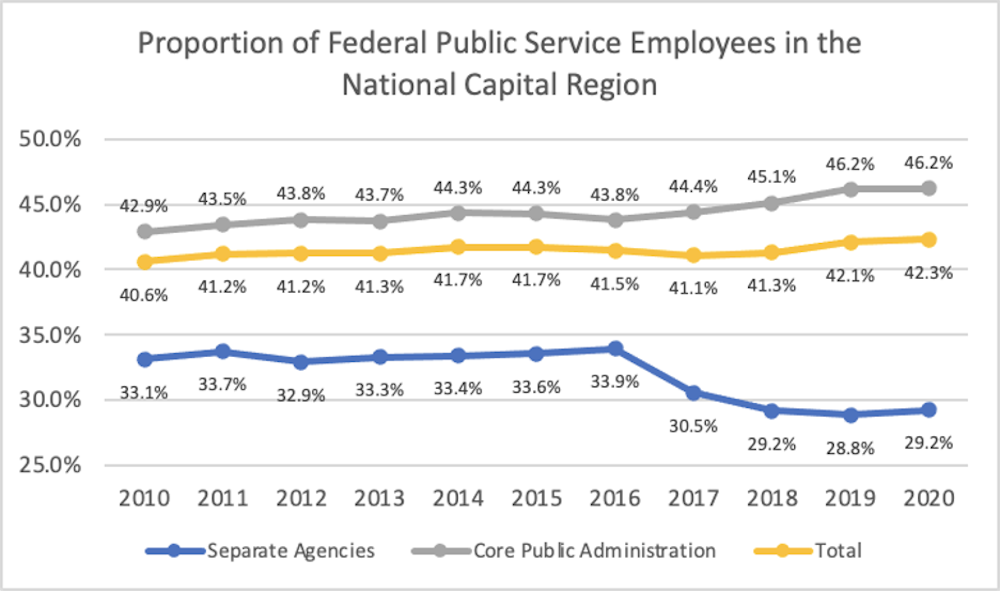
Canada has more than 300,000 federal employees, with over 230,000 in core public administration (CPA) and just under 70,000 employed in separate agencies like the Canada Revenue Agency. 

The proportion of agency jobs concentrated in the National Capital Region, which includes Ottawa-Gatineau and surrounding areas, has declined since 2016. The opposite is seen with CPA jobs. The concentration of CPA employees was only 33 per cent in 1995, but was up to 46 per cent in 2020. 

graph shows the number of federal public service jobs in the capital region
The number of federal public service jobs in the Ottawa region, according to the Government of Canada Open Data Portal. Treasury Board of Canada Secretariat, 2020

Most CPA workers are skilled knowledge workers. These are good jobs. It is time for more federal jobs, including CPA jobs, to decentralize.

The case for decentralization

Research suggests decentralizing public service jobs reduces costsstrengthens national security by spreading government functions across the country and reduces cynicism toward government

Decentralization also distributes the economic benefits of the public sector across the country. According to one 2019 British study, “the arrival of 10 civil service jobs in an area spurs the creation of about 11 jobs in the private sector,” including professional service jobs like law and consulting.

Most importantly, it gives federal governments more ability to directly engage with communities. Regional voices within government increase as career opportunities are more accessible to qualified people nationally. Advocacy and community groups across the country enjoy a more level playing field to engage in the policy process. 

This increased geographic diversity of voices working within and connecting with government can result in improved strategic policy advice. 

Creating a national strategy

Now is the perfect time to make a serious effort to decentralize Canada’s federal jobs.

The COVID-19 remote work experience demonstrates the remarkable potential of technology to overcome distance. We have learned how efficiently we can use technology to reduce unnecessary travel and connect easily across the country. We must use the disruption of the pandemic to rethink what jobs and services need to be in Ottawa at all.

We can expect growing calls for this in Canada’s economic recovery, particularly from Alberta. Just before the COVID-19 shutdown, four MPs identified the centralization of federal headquarters as an example of systemic unfairness towards Alberta. A few months later, Alberta’s Fair Deal Panel recommended western premiers request “a distribution map of federal civil servants across Canada and a list of federal government agencies and decision-making bodies that can be recommended for relocation to Western Canada.” 

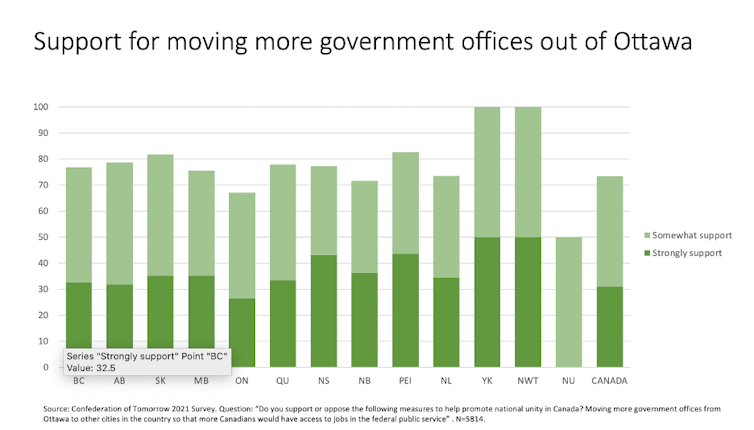
Recent surveys find decentralizing jobs may be publicly popular. The 2021 Viewpoint Alberta survey, which included over 800 respondents in Alberta and Saskatchewan, found strong support for increasing federal jobs in each province.

Similarly, the 2021 Confederation of Tomorrow survey of more than 5,800 Canadians found almost three-quarters (73.5 per cent) support “moving more government offices from Ottawa to other cities in the country so that more Canadians would have access to jobs in the federal public service.” 

A graph shows support for moving federal public service jobs out of the Ottawa area.
Support for moving federal public service jobs out of the Ottawa area. Confederation of Tomorrow 2021 Survey, Author provided

The time for action is now. In fact, Canada faces an immediate decision regarding the location of the new Canada Water Agency. While the decision process has yet to be announced, Regina and Sault Ste. Marie, Ont., are already vying for the agency headquarters. Other cities may also be planning to do so.

Canada already has experience in decentralizing federal jobs, including moving the National Energy Board headquarters from Ottawa to Calgary and creating regional Canada Revenue Agency tax centres. These serve as precedents for a bold new strategy.

Moving forward on a national strategy

To be sure, decentralization faces political challenges. As the benefits of job decentralization are long-term and the challenges are immediate, politicians more focused on the next election might be disinclined to take up the task.

Vested interests are loud. Strategies are needed to address relocation costs, including staff turnover and the associated loss of experience, though remote work options can reduce these.

A national strategy is required. The United Kingdom’s Places for Growth program will move thousands of London jobs, including policy advisory roles, to 13 regional hubs over the next decade and could provide ideas or a blueprint. 

Canada might also consider efforts to shift civil service work out of national capitals in Mexico, Norway, South Korea, Denmark and Malaysia

The COVID-19 remote work experience suggests that distance is not insurmountable for federal government work. No one is suggesting that public servants work from home forever, but the public’s business does not always have to be done in Ottawa. Let’s use this as an opportunity to rethink how we distribute federal work across Canada.

Source: https://theconversationcanada.cmail20.com/t/r-l-tlidhrg-kyldjlthkt-o/

Public servants say they work better from home, despite stress: survey

Interesting (on my to do list, look at the survey’s disaggregated data):

During the pandemic, employees of local, provincial, and federal governments from coast to coast to coast have provided essential services while working from home.

And it would appear that federal employees are happier now about their workplace than they were before the pandemic, according to the 2020 Public Service Employee Survey released by the Treasury Board Secretariat last week.

While we don’t know the full story of the “big pivot” over a single weekend in March 2020 — when public servants started working from home — we do know many have been working over weekends and statutory holidays and forgoing annual leave.

This isn’t sustainable over the long term. If not attended to, such behaviour could result in a crash or organizational failure.

Stress has increased since 2019. A third of employees said they felt emotionally drained after their workday, up from 29 per cent in 2019. Just over a quarter said their workload was heavier, up slightly from 24 per cent in 2019.

However, new questions in the 2020 survey about work-life balance during the pandemic revealed some silver linings:

  • 39 per cent of employees had requested flexible work hours since the start of the pandemic; and
  • 83 per cent said their immediate supervisor allowed them.

Employees said the quality of their work improved, too. For example:

  • only 23 per cent of employees said their work quality suffered because their department or agency lacked stability, which was down from 30 per cent in 2019; and
  • just 24 per cent of employees said their work suffered because of high staff turnover, down from 32 per cent in 2019.

Employees’ perceptions of change management also improved in 2020, with 59 per cent saying change was managed well in their department or agency, compared to 50 per cent in 2019.

They also reported better feedback from their supervisors in 2020, compared to 2019:

  • 69 per cent said they received meaningful recognition for work well done, up from 65 per cent in 2019; and
  • 77 per cent said they got useful feedback from their immediate supervisor about their job performance, up from 74 per cent in 2019.

Overall job satisfaction improved in 2020, too:

  • 83 per cent of employees said they liked their job, up from 81 per cent in 2019;
  • 78 per cent reported getting a sense of satisfaction from their work, up from 76 per cent in 2019;
  • 75 per cent said they were satisfied with their department or agency, up from 71 per cent in 2019;
  • 75 per cent said they would recommend their department or agency as a great place to work, up from 70 per cent in 2019; and
  • 71 per cent of employees said they felt valued at work, up from 68 per cent in 2019.

Respondents also felt their workplace was “psychologically” healthier. For example:

  • 68 per cent said their workplace was psychologically healthy, up from 61 per cent in 2019; and
  • 81 per cent said their department or agency was doing a good job of raising awareness of mental health in the workplace, up from 73 per cent in 2019.

In response to a new question in 2020, 69 per cent of employees said they’d feel comfortable sharing concerns about their mental health with their immediate supervisor.

The survey included new questions about working during the pandemic:

  • 70 per cent said senior managers were taking adequate steps to support their mental health during the pandemic;
  • 84 per cent felt their department or agency was effectively communicating the mental-health services and resources available to them; and
  • 81 per cent said they were satisfied with the measures their department or agency was taking to protect their physical health and safety during the pandemic.

Employees were also asked about the information they received from their department or agency about the pandemic:

  • 78 per cent said it was clear and easy to understand;
  • 81 per cent said it was consistent with the information they got from their immediate supervisor; and
  • 92 per cent said the information was available in both official languages.

And finally, instances of harassment also fell. In 2020, 11 per cent of employees said they’d been harassed on the job in the previous 12 months, down from 14 per cent in 2019. In addition, 71 per cent said their department or agency worked hard to create a workplace that prevents harassment, up from 69 per cent in 2019.

So while the pandemic isn’t over, public servants remain engaged. It would appear that working from home and away from the office has improved their view of the workplace and of their senior managers.

Stephen Van Dine is the senior vice-president of public governance at the Institute on Governance.

Source: Public servants say they work better from home, despite stress: survey

Moving for work? No thanks. Foreign talent increasingly chooses remote work over relocating amid COVID-19

Requires some thinking regarding implications for immigration policy with respect to those highly skilled who can largely work remotely. Virtual immigration should not be conflated with immigration and integration. Remote workers are highly unlikely to use Canadian government services or pay Canadian taxes:

With more opportunities emerging to work remotely in these uncertain times, fewer people appear willing to move abroad for work, according to a global survey that also found Canada is overtaking the U.S. as the world’s top destination for foreign workers.

Overall, only 50.4 per cent of the 209,000 respondents from 190 countries said they would move to another country to work, citing the COVID-19 pandemic as a key reason, according to the survey by Boston Consulting Group and The Network.

The report on global workforce trends shows a gradual decline in people’s interest in working abroad, from 57 per cent in 2018 and 64 per cent in 2014, when the surveys were previously conducted.

“These findings reflect several new factors that have penetrated the world’s consciousness and changed the workplace. The factors — the fallout from a difficult-to-control pandemic and a sharp rise in nationalism — have altered people’s thinking,” said the report released this month.

“Businesses and governments must understand these new attitudes and make adjustments of their own in order to ensure they’ll have the future workforce they need.”

Almost a quarter of respondents picked Canada as their first choice to relocate, four percentage point ahead of the United States, which, along with Australia, ranked second.

Canada is the No. 1 destination for many of the types of people that “countries prize,” including those with master’s or PhD degrees, those with digital training or expertise, and those younger than 30, said the report.

Almost all of the countries that moved up in the Top 10 rankings have a relatively low incidence of COVID-19 cases. That includes Canada (up two spots from last survey); Australia (up one place); and Japan (up to No. 6 from 10th place).

Two Asia-Pacific countries that were recognized for their public health response — Singapore and New Zealand — also appear on the Top 10 list for the first time. Many previously popular destinations, such as Germany and France, saw their ranking suffered.

“The travel restrictions that have come and gone during the pandemic have clearly had an impact on people’s attitudes,” said the report. “Relocation willingness has also been affected by the trend toward remote work.”

No physical presence needed

Fifty-seven per cent of respondents said they were willing to work remotely for a foreign employer that doesn’t have a physical presence in their home country. About one-quarter said they aren’t sure but would consider it. Few rejected the idea outright.

The overall openness to virtual work is especially high among people in the information technology and digital fields, with 71 per cent of people with digital or analytics backgrounds saying they would be willing to work for a company with no physical presence in their own country. Among those with postgraduate degrees, 62 per cent would say yes.

“Hiring people from other countries is not a new practice for employers,” said report co-author Pierre Antebi, a co-managing director of The Network, which is a global leader in online recruitment, serving more than 2,000 international corporations.

“But the trend of remote working makes it possible to do it on a broader scale and expand the available talent pool. There’s also an upside for workers, who can advance their careers without uprooting their lives.”

As a destination for international remote employment, the U.S. ranked first and was the choice of 25 per cent of respondents, followed by Canada and Australia, both getting 22 per cent of the votes.

A global and remote talent pool

That virtual mobility allows multinational companies to tap into talent without having to pay to relocate people or set up offices in foreign countries, said the report.

“An embrace of virtual mobility could mean a reversal of some of the skills shortages that countries face,” it noted.

However, the report pointed out, companies and governments must first navigate complex taxes, labour laws and work regulations. There are also other logistical challenges, such as cultural integration of remote employees and time-zone problems that need to be considered.

Seventeen governments in Europe and the Caribbean have already introduced visas that simplify the recruitment of foreign digital workers. Some of the countries offer tax exemptions to the foreign employees they need the most.

“If you’re a company or government that hasn’t previously considered international remote employment as a way to address your skills shortages, it may sound like a very complicated thing to do,” said the report. “In fact, you’re probably more ready than you think.”

Source: Moving for work? No thanks. Foreign talent increasingly chooses remote work over relocating amid COVID-19