While Australian approach to immigration is more restrictive than Canada’s, Canada’s economic and immigration recovery may also be longer than expected. But like all projections and estimates, time will tell.
Australia has been one of the more successful countries in addressing COVID-19, with only 311 infections and 4 deaths per million (July 1):
Australia’s second-most populous state was poised to take the biggest economic hit from the COVID-19 pandemic even before a dramatic spike in cases over the past fortnight forced renewed shutdowns in large parts of Melbourne.
Key points:
Victoria’s gross state product is expected to fall 1.6pc in 2020-21
The state is vulnerable due to its reliance on immigration from overseas and interstate
Many of the smaller states are expected to see higher peak unemployment rates, despite comparatively better economic performance
The latest business outlook from consultancy Deloitte Access Economics tips Victoria to suffer the biggest fall in gross state product in the 2020-21 financial year, which just began.
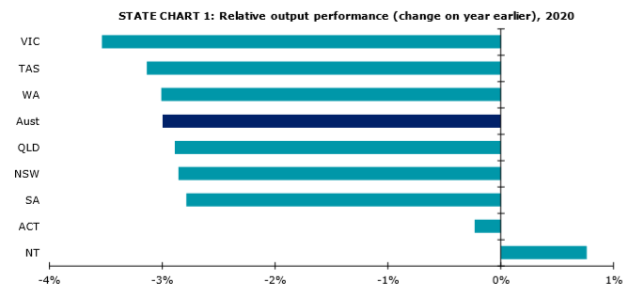
Deloitte predicts Victoria’s domestic economy will shrink 1.6 per cent this financial year, also leaving it with the worst economic performance in the nation this calendar year.
“The largest downturn is likely to be felt in Victoria given its current spike in cases, as well as that state’s dependence on migration and on foreign students in an age of lockdowns and closed borders,” Deloitte’s Chris Richardson said in the report.
Most state economies are expected to shrink around 3 per cent this year due to the pandemic.(Supplied: Deloitte)
Mr Richardson said Victoria’s economy was particularly vulnerable due to the latest wave of coronavirus cases, which would see the state cut off from the rest of the country, once the border with New South Wales closed from Wednesday.
“Victoria has had the strongest COVID restrictions across the country and now, with the prospect of a second wave returning and the reintroduction of restrictions, the state is likely to see some prolonged misery in particularly hard-hit sectors,” he noted.
Melbourne’s construction sector facing ‘severe setback’
While travel-related sectors, such as tourism and education, and hospitality will be the most immediate casualties, Mr Richardson says the medium-term effects will be felt acutely in the state’s previously booming construction sector.
“Victoria’s construction sector was already showing signs of weakness before COVID hit,” he wrote.
“With high levels of uncertainty, and an unexpected drop in population growth, construction is likely to suffer a severe setback over the coming year.
“Demand for office and apartments in Melbourne, including those projects that are halfway through, are being reconsidered as the density of Melbourne’s CBD is now less attractive across people’s daily lives.”
Mr Richardson added that one silver lining for Victoria’s construction sector was that there was a lot of planned infrastructure investment, something which would also be seen in the second-most pandemic-affected state, New South Wales.
It will particularly target transport projects in Melbourne and Sydney.
However, that investment is not expected to wholly make up for the loss of overseas arrivals.
“Other things equal, keeping tourists, students and migrants away for longer means that Australia’s economy will be some 4 to 5 per cent smaller than it could otherwise be,” Mr Richardson said.
Deloitte observed that New South Wales was similarly affected by the closure of international borders, with the state usually receiving more than a third of migrants who arrive in Australia from overseas.
However, in recent years, New South Wales has been losing existing residents to other Australian states, notably Victoria, a trend which Deloitte expects to have paused during the crisis, especially due to hard border closures.
The state’s comparatively better success in containing the virus so far has Deloitte tipping just a 0.1 per cent fall in New South Wales gross state product this financial year, as domestic activities continue to return to normal.
Some other states are expected to see a rise in their domestic activity — again excluding the large drop in exports, which includes foreign tourism and education — while the two territories are tipped to perform best.
“The lift in LNG-related exports from the Ichthys project will protect the Northern Territory, while its strong public sector base is a very welcome anchor in the storm for the ACT,” Mr Richardson explained.
Even though their domestic economies are expected to take a smaller hit than the bigger states, Deloitte is warning South Australia and Queensland will suffer the nation’s highest unemployment rates, above 9 per cent, while Western Australia and Tasmania will also have a weaker jobs market than Victoria.
Deloitte tips unemployment to be at its lowest in the ACT (5.7 per cent) and New South Wales (7.5 per cent).
COVID-19 infections ‘best’ economic indicator
Overall, Deloitte is forecasting a relatively fast recovery from the pandemic, tipping only a 0.4 per cent decline in GDP nationwide this financial year, following on from a 0.1 per cent fall in 2019-20.
It is predicting robust national economic growth of 5.3 per cent the following financial year, 2021-22.
However, this forecast is based on Australia keeping COVID-19 cases suppressed, a vaccine or good anti-viral treatments being widely available by the middle of next year, and international travel gradually recommencing, starting with trips to New Zealand at the end of this year and expanding to a general reopening of Australia’s borders by the end of next year.
Mr Richardson said a continued and widespread spike in cases would lead to much worse economic outcomes.
“That’s why opening up if virus numbers aren’t under control is risky.
“And, in a volatile environment, it is also why the best leading indicator of how an economy will perform is how that nation is going in its fight against the virus.”
Good overview of some of the challenges and options facing Canada post-COVID. The idea of “digital work permits” is innovative but not sure about how the practicalities of implementation would be that simple:
The coronavirus pandemic hasn’t stopped the flow of goods coming into Canada. That’s because countries around the world worked together to keep trade markets open for business. But Canada faces a potential crisis if its borders remain closed to people for a prolonged period of time.
How then can you maintain economic growth if no new immigrants are allowed into the country?
Every crisis can lead to new opportunities. And we’ve already seen challenges that emerged during the pandemic lead to innovative government programs. The same should happen with Canada’s immigration policy.
While the pandemic has temporarily closed the territorial borders to all foreigners for non-essential travel, there’s an opportunity to keep our “virtual” borders open to the best and brightest workers who want to come to Canada.
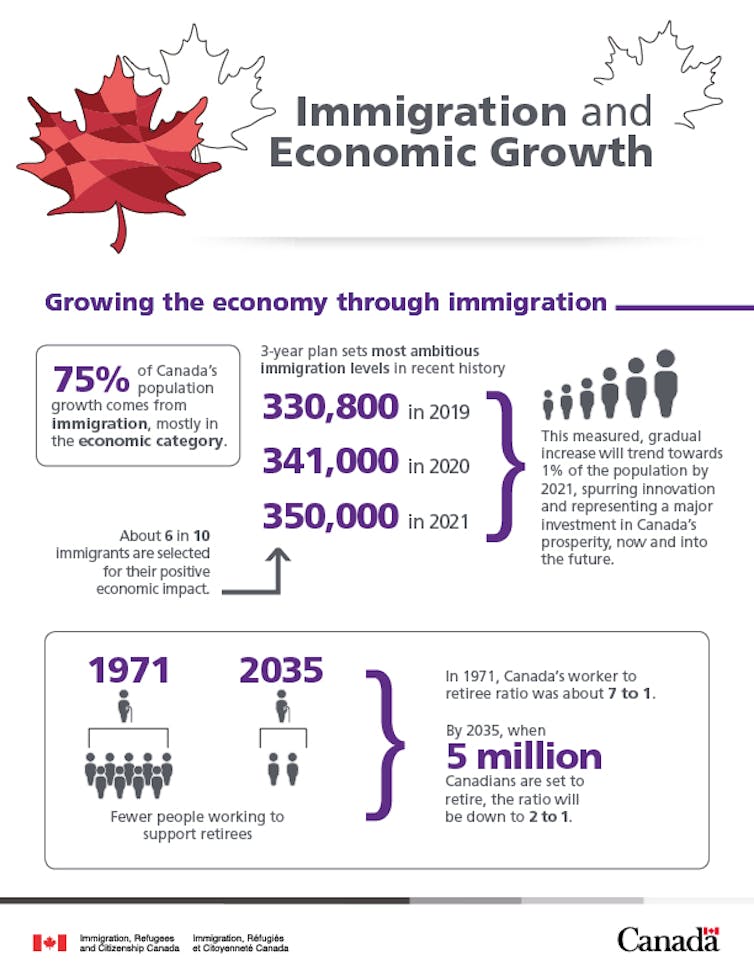
Illustrating the vital role of immigration for Canada, with emphasis on economic gain and global competitiveness, Canada’s then minister of immigration, Ahmed Hussen, stated in 2018: “The new multi-year immigration levels plan supports Canadian employers and businesses by ensuring they have the skilled labour they need to spur innovation and help to keep our country at the forefront of the global economy.”
This graphic from the government of Canada explains how immigration policy is linked to economic growth.(Immigration, Refugees and Citizenship Canada)
Some of the dilemmas that Canada will face in the post-pandemic recovery period will involve how to continue attracting the best and brightest, what sectors of the economy should be prioritized and how to deal with essential work like agriculture.
Unprecedented challenges
I have studied highly skilled and lower-skilled migration in Europe and internationally for over 20 years, with a special interest in how migration policy interacts with other sectors such as agriculture, the care industry and the competition for talent. But the COVID-19 pandemic poses unprecedented challenges for Canada’s immigration policy because of the level of uncertaintythat the whole world is facing.
For more than three months, Canada has temporarily stopped processing work permit or permanent residency applications. This presents many challenges for businesses and for workers and their families.
While working remotely is a possibility for most highly skilled workers in Canada who are in non-essential sectors, that’s not an option for those who have a job offer but are still abroad. They cannot receive a work permit, a Social Insurance Number unless they enter the country. They also can’t be paid without a SIN number. There are important consequences for organizations that seek workarounds and do not respect labour laws.
Digital work permits
Technology can offer a solution to this impasse. A security-proof digital work permit and a social identification number could be assigned remotely to allow these “virtual immigrants” to start working remotely with their Canadian employers while they wait for the entry ban to be lifted.
The permit could be for three or six months and would automatically be replaced by the regular work permit and SIN if the ban is lifted and the worker moves to Canada. The worker and employer would commit to honouring their contract by coming to Canada within 90 days of lifting the entry restrictions.
This would give everyone — government, employers, workers and their families — both the necessary guarantees and flexibility to deal with this unexpected disruption.
Canadian immigration policy involves long-term planning related to the country’s demographic composition, growth (or rather decline, without immigration), key industries and efforts to attract new immigrants to the smaller regional centres across this vast country.
In February, just before the pandemic was declared, Minister of Immigration, Refugees and Citizenship Marco Mendicino told the Canadian Club in Toronto that Canada welcomed 341,000 new immigrants last year. He then added: “In 2020, the future of Canada hinges on immigration.” But the current situations means it seems unlikely Canada will be able to meet its immigration targets this year or next.
Not a job competition
Unemployment and underemployment data from April show temporary workers, those with less than one year at their last job or people not covered by a union or collective agreement, were hit the hardest by COVID-19. While it is imperative to provide for these workers and their families, these newly unemployed workers are not in competition for the same jobs as those to be filled by the highly skilled newcomers attracted by the Express Entry or Global Talent immigration streams.
As we go through and hopefully leave behind the pandemic, Canada needs to build a stronger health sector including industries that produce gowns, masks and gloves or health-care equipment like ventilators. The medical and pharmaceutical research sector should also remain a top priority. Transnational co-operation is key to Canadian entrepreneurship. Such sectors can only gain from highly skilled migrants who bring to the country innovative ideas, much needed skills and connections to other countries and continents.
New ideas needed
While rethinking policies about bringing highly skilled immigrants to Canada, new ideas are also needed for lower-skilled workers who are essential to the economy.
We need to consider how agricultural policy and migration policy can work hand in hand to promote better working and living conditions for migrant farm workers. One idea could be the expansion of a pilot project launched in May that will allow a small number of migrant agriculture workers to apply for permanent residency.
The many challenges that both highly skilled and low skilled migrants face during the pandemic can be turned into an opportunity that would help Canada’s post-COVID-19 economic recovery.

 Multicultural Meanderings