ICYMI: CSIS has tabs on radicalized Canadians who have fought abroad

Good analysis of the challenges in knowing the numbers and the nature of radicalized Canadians:

“When we’re talking about 80 returnees, we’re not talking about 80 people who have fought in Iraq and Syria, and we’re not necessarily talking about people who were directly involved in planning terrorist activities,” Coulombe told the committee. “We have Canadians in Afghanistan, in Pakistan, in Yemen, in Lebanon, in the Sahel, in the Maghreb, who are involved in terrorist-related activities. But it could be fundraising, could be propaganda, so I don’t want people to believe that we have 80 returnees who are hard fighters in Iraq and Syria, because that is not the picture we have at the moment.”

CSIS has tabs on radicalized Canadians who have fought abroad.

RCMP looking at ways to identify young people at risk of becoming radicalized

Good overview by Douglas Quan on the various approaches being taken to reduce the numbers of those drawn to extremism:

For those who show signs of becoming involved in violent extremism but who have not yet crossed that threshold, the RCMP is developing an intervention program — set to roll out by the end of the year — designed to link those individuals with community mentors for “advice, support and counselling.”

Dash confirmed that public safety officials have been studying different intervention models, such as the Berlin-based EXIT program, which provides help to Germans trying to leave the neo-Nazi movement. A few years ago, the group created an offshoot program to support families of radicalized Muslims.

Dash declined to say what criteria the RCMP have developed to decide who merits intervention. She did say that someone who expresses extremist views is not necessarily going to be radicalized to violence. “It could be just someone who is being curious. We don’t want to stigmatize anybody.  There’s no one-size-fits-all indicator,” Dash said.

Experts say various “diagnostic tools” have been developed around the world to assess where someone falls on the “spectrum of dangerousness,” but no consensus has been reached on which one is best.

In the U.K., a police-led early-intervention program called Channel saw in its early days referrals of young people simply for wearing what were deemed to be “radical” clothes, according to a 2012 report by the International Centre for the Study of Radicalisation and Political Violence. “People were not sure what to look for and so they erred on the side of caution,” a Channel coordinator was quoted as saying.

The program has since developed a “vulnerability assessment” framework consisting of 22 behaviours to look out for. They include spending time in the company of extremists, changing style or appearance to accord with the group, loss of interest in friends, and condoning violence or harm towards others.

RCMP looking at ways to identify young people at risk of becoming radicalized | canada.com.

And Wesley Wark, as usual, pointed in his criticism for the lack of serious discussion by the Government:

The 2014 Public Report on the Terrorist Threat to Canada sums all this up. Whether you agree with the government statement or not (and maybe there are other things we should be worrying about, such as cyber threats, climate change impacts, pandemics, a new Cold War, etc…) the report moves our thinking into the present and nudges us out of a frame of reference dominated by legacy fears of Al Qaeda.

So why the whisper? Maybe the government can’t find the headline in its own report. Maybe it feels uneasy because it can’t say with certainty what the exact threat to Canada from terrorism is in the post-Al Qaeda age. Maybe it feels the public doesn’t really need an education on the new terrorism threats or is not interested. Maybe it thinks there are no votes here. Whatever the answer, it’s simply not right. We need a little less megaphone on the world stage and a little more at home.

Wesley Wark: Where’s the megaphone on the threat to Canada?

David Cameron seeks to seize passports of Islamist fighters

From The Economist

From The Economist

More on efforts to curb home-grown radicalization in the UK. While these are “hard” approaches to prevention, UK has also invested considerably in “soft” approaches as well.

As with all these initiatives, particularly their expanded application of revocation to prevent born-Britons without dual nationality to return home, questions about who decides and whether the person accused can defend himself.

One thing to hold them for investigation (legitimate), another to make a decision without due process.

One could argue that refusing entry, understandable from a security perspective, simply means that any such extremist would return to Syria or Iraq to continue their brutality, rather than being under the watch of the police in the UK:

“There are two key areas where we need to strengthen our powers to fill specific gaps in our armoury. These are around preventing suspects from travelling and dealing decisively with those already here who pose a risk.”

David Cameron’s new anti-terrorism proposals come days after the U.K. raised its terrorism alert to its second-highest level.

Cameron said he would bring in new “specific and targeted legislation” to give the police powers to temporarily seize a suspects passport at the border to give authorities time to investigate them. Currently only Britain’s interior minister has the power to withdraw a passport.

He also said the government would consult on a discretionary power to prevent Britons from returning home if they have pledged allegiance to extremist causes. This would extend existing powers which can only be applied to foreign nationals, naturalized citizens and those with dual nationalities.

David Cameron seeks to seize passports of Islamist fighters – World – CBC News.

Meanwhile, in Canada, more on the RCMP’s High Risk Travel Case Management Group approach to prevention (see also 2014 Public Report on the Terrorist Threat to Canada):

While the report’s emphasis is on prevention and intervention, several recent cases related to the Syrian conflict have raised questions about the effectiveness of efforts to reason with determined youths blinded by zeal.

After serving a prison sentence for his role in the Toronto 18 terrorist group, which plotted bomb and shooting attacks in southern Ontario, Ali Dirie used a fraudulent passport to travel to Syria, where he fought and died last August.

A British Columbia man charged with terrorism in July, Hasibullah Yusufzai, 25, was known to Canadian authorities because of a previous trip he had made to Afghanistan. Although he was on a no-fly list, he still managed to make his way to Syria using a passport that did not belong to him.

When Ahmad Waseem returned to Windsor, Ont. after he was wounded in combat in Syria, his mother hid his passport, his mosque counseled him and police spoke to him. But he returned to Syria last year and now calls the Islamic State of Iraq and Al-Sham his “brothers.” He has been charged with passport fraud.“

Early intervention through a joint community/law enforcement response is no guarantee that a person will not radicalize to violence,” the report says. “However, early intervention is one constructive way to deter potential violent extremists from causing harm.”

Canadian government plans ‘targeted interventions’ to stop citizens from joining armed Islamists in Syria
Stopping ‘terror tourism’: The behind-the-scenes struggle to keep would-be jihadists at home

Another case of homegrown radicalization, Ahmed Waseem, of Windsor, Ontario. Seems like his family and the local Imam did everything possible to dissuade him and alert the authorities on the risk that he would return to Syria:

Sgt. Cox said the RCMP “works diligently” with its partners to keep Canadians from joining terrorist groups and has been focusing on prevention programs to help communities counter the toxic narratives of extremists. “The RCMP cannot effectively counter the threat of radicalization leading to violence through detection and disruption alone.”

Imam Mahmoud said the mosque was cooperating fully with agencies conducting the investigation. But he put part of the blame on the authorities for letting Mr. Waseem slip away and not being more clear that fighting in Syria was illegal.

Recently, he said, the RCMP told Mr. Waseem’s mother to pass a message to her son. “They said, ‘If he comes back we’re going to arrest him,’” he said. But the imam said that was counterproductive, and could drive Mr. Waseem away knowing what he faces if he returns to Canada.

The imam sounded frustrated as he recounted all the community had done to get the young man back on track, efforts that were ultimately an unsuccessful match for the stubborn resolve of a determined youth. “He has free will,” he said. “If the government can’t stop him, what can we do?”

Stopping ‘terror tourism’: The behind-the-scenes struggle to keep would-be jihadists at home

Western Jihadists in Syria Threaten to Bring Their War Back Home – The Daily Beast

Maajid Nawaz of the Quillam Foundation on the risks of jihadists currently fighting in Syria and possible blowback upon their return to the West:

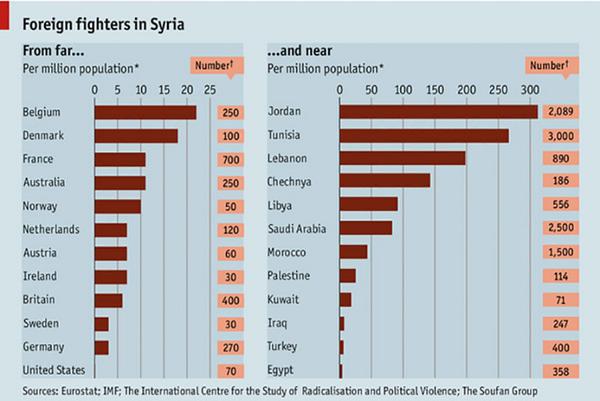
We are watching the largest mobilization in a generation of volunteers traveling abroad to join a war. An estimated 11,000 foreign fighters have been mobilized in Syria, according to a just-published study by the International Centre for the Study of Radicalisation and Political Violence (PDF). More than a quarter of those combatants are from Western countries, mostly from Britain, France, Germany, Sweden and Belgium. Australians, Canadians and U.S. citizen also have joined the ranks.

But judging by our complacency, you would be forgiven for not knowing this. Partly, that’s because some on the left in Britain and elsewhere have been busy downplaying the conflict or romanticizing it as something akin to the international brigades during the Spanish Civil War that attracted George Orwell and other idealists. But unlike Orwell in the 1930s, these fighters on their way to Syria are not traveling to fight against fascists. Many are young Western Muslims rushing to join a fascist group that is too extreme even for al-Qaeda: the Islamic State of Iraq and al-Sham (ISIS). Members have been known to behead even fellow fighters. And it’s not much consolation that the more “moderate” volunteers are joining, Jabhat al-Nusra, which is the official Al-Qaeda affiliate in Syria.

Western Jihadists in Syria Threaten to Bring Their War Back Home – The Daily Beast.

Within Canada, a RCMP initiative to reduce the number of potential extremists traveling to Syria or other hotspots:

The tactics used to disrupt extremists varied depending on whether they were preparing to leave Canada, were already abroad or had returned after training or fighting, Assistant Commissioner Malizia said.

By working with other federal agencies, the RCMP was able to determine what “enforcement or mitigation action would be most appropriate depending on the circumstances, grounds and the threat,” he said.

“Amongst others, this could include the removal of a passport. If there is a threat to aviation it could involve a referral for the Specified Persons List led by Public Safety. And in cases where the subject of investigation is not Canadian, the cancellation of a visa.”

But the program may not be able to stop determined extremists. After serving a prison sentence for his role in the Toronto 18 terrorist group, Somali-Canadian Ali Dirie was still somehow able to travel to Syria, where he died last August.

RCMP tracking ‘high-risk’ Canadians to prevent radicalized youths from joining foreign terrorist groups

Radicalization

Some good pieces on radicalization, starting with a RCMP initiative to curb radicalization among at risk youth:

RCMP set to tackle extremism at home with program to curb radicalization of Canadian youth

Secondly, an overview of the case of Damian Clairmont, a Muslim convert from Calgary, who became radicalized and was killed in Syria:

Not His War: How a Catholic Canadian Became an Islamic Extremist