‘Mental Prisons,’ the Public Service and Gilles Paquet

In the spirit of Paquet's call for the "highest and best use of irony and irreverence" and "methodological and intellectual cruelty."

In the spirit of Paquet’s call for the “highest and best use of irony and irreverence” and “methodological and intellectual cruelty.”

My review of Gilles Paquet’s Super-Bureaucrats as Enfants du siècle in the Hill Times:

Ralph Heintzman provoked considerable debate in his Canada 2020: Renewal of the Federal Public Service arguing for an independent, arms-length public service. Ruth Hubbard countered it with The real problem with the public service, arguing that the real problem is competency, not the relationship between the political and bureaucratic levels. Maryantonett Flumian reminds us that politicians are elected, officials are not, and they have to implement government priorities as long as they do not break the law in How public servants support democracy: a response to latest Canada 2020 study.

Gilles Paquet adds his voice in Super-Bureaucrats as Enfants du siècle, which, while focused on officers of Parliament, casts his critique more broadly.

Paquet’s language, as always, pulls no punches. The “tribe” of super-bureaucrats form an “oligarchy.” They have a “sense of superior expertise and total infallibility.” They are agents of “counter-democracy” and impose their “technocratic and ideological views … usurping the role of elected officials.”

Officials practise “active or passive disloyalty” and are guilty of “sabotage.” The “fairy tale” of political reliance on anecdotes versus official reliance on anecdotes led to a “destructive … misuse of power,” which “translated in subterranean efforts to block, derail, or deflect the efforts of fairly able politicians.”

But apart from the tone, what is Paquet’s argument?

That super-bureaucrats, starting with officers of Parliament, but including adjudicatory bodies and the courts, have largely usurped the authority of the government and Parliament through “mandate creep with gusto.”

Their ideology or “diktats of indiscriminate compassion” allow them to portray themselves on the “side of the angels” while pursuing an “unlimited increase of the resources dedicated to the bureaucracy.”

“Super-bureaucrats and higher courts judges have often made unwarranted claims based much more on hubris than on superior competence, and couched in drama-queenesque rhetoric …”

Media and academics have been “defending tooth and nail the sacredness of the super-bureaucrats.”

Other critiques of officers of Parliament have been expressed more in terms of the diminished role of Parliament than of deference to the government (Donald Savoie).

But let’s take Paquet’s argument at face value that the super-bureaucrats and others, including “low-level bureaucrats” like he mentioned, have been actively undermining the government.

I wrote Policy Arrogance or Innocent Bias: Resetting Citizenship and Multiculturalism as more critical of the public service than the government because I felt that we had failed in our role to provide neutral and impartial advice.

We did not acknowledge our ideological and value biases, our evidence base was too slanted towards these biases, and we clung to a narrow interpretation of risk.

But the government also shares some responsibility. It arrived to government with a stronger ideological focus, one that often coloured its perception of evidence and preference for anecdotes (e.g., labour market shortages), and its willingness to discount risk (e.g., recent number of Supreme Court defeats).

But more fundamentally, Paquet is arguing for little or no constraints upon the government of the day.

He devalues the balance that officers of Parliament, adjudicatory bodies, and the courts provide in a context where Parliament no longer plays that role, given increased partisanship, expanded use of time allocation, and omnibus legislation. These trends predate the Conservative government, but have expanded under it.

Moreover, Paquet is also silent on the government’s silencing of those whose statutory role requires them to be a watchdog (e.g., starting with Linda Keen) or kills bodies that provide independent advice (e.g., National Round Table on the Environment on the Economy).

And does he really believe that the original version of Bill C-23, the Fair Elections Act, should not have been challenged?

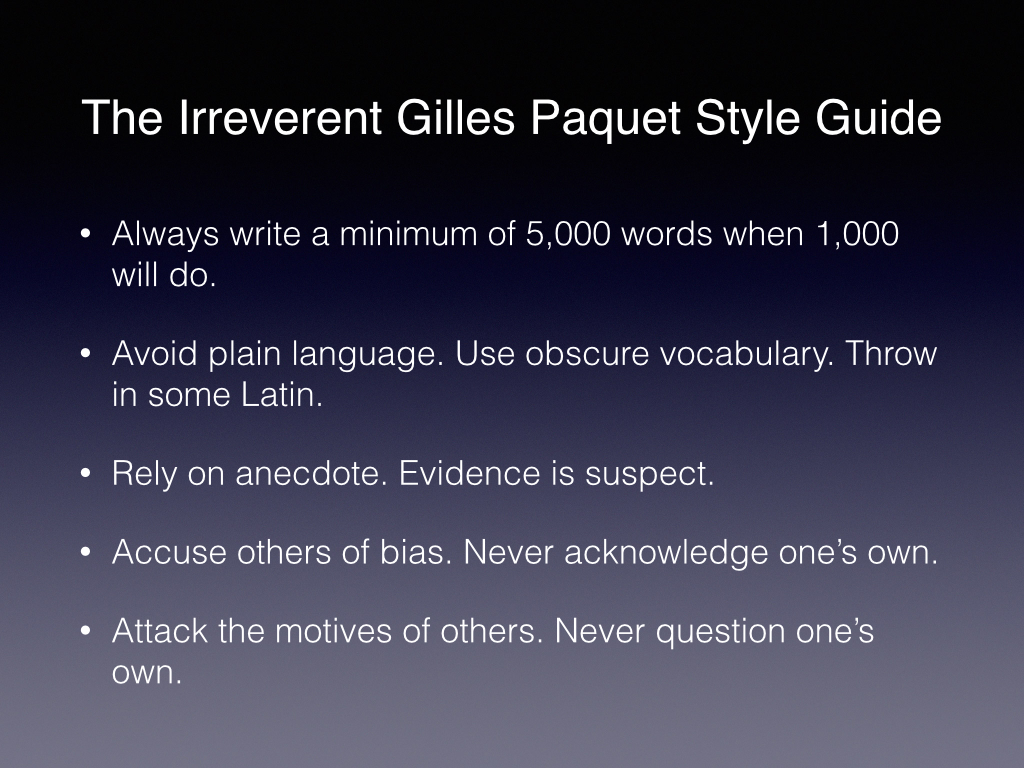
Reading this paper alongside his companion article, On Critical Thinking, one is struck by just how much Paquet, so critical of others being trapped by their “mental prison,” falls into the same trap.

Is he as mindful of his own biases, ideology, and assumptions as he accuses others of “disingenuity, sophistry, and bullshit?”After all, all three can be found in the left, centre, and right-wing versions of conventional wisdom.

Heintzman’s Canada 2020 report continues to provoke debate (pay wall)


Reforms to bring neutrality to public service could lead to ‘government by the unelected’: think tank | Ottawa Citizen

More on the debate over the Canada 2020 by Ralph Heintzman, this time from  Maryantonett Flumian, who reminds us of the parameters of public servants:

Maryantonett Flumian, president of the institute, a think-tank devoted to public service issues, said a debate on the nature of governance is long overdue, but the answer to the trust gap between politicians and bureaucrats isn’t to isolate the public service and protect it from politics.

“That means Canadians would have a public service that no one wants. There is already an official opposition in this country and no one wants to be governed by the unelected. That is not the role of the public service,” she said. ….

She said deputy ministers are the “linchpins” between the government and the public service. They bridge the two worlds. They have to translate the prime minister’s agenda into action by the public service. Similarly, they explain the views of the public service to politicians.

Flumian argues the Clerk, not the Public Service Commission as recommended by Heintzman, is ideally positioned to select deputy ministers who have the capabilities, skills and personalities best-suited to work “this two-way relationship” with ministers.

She argues turning these appointments over to the Public Service Commission makes bureaucrats independent of their political masters and risks politicizing the public service.

“Who will become those linchpins?” Does the deputy minister role get taken over by the ministers’ chief of staff?” she asked.

“If senior public servants are cloistered priests and nuns who don’t speak to the outside world and who don’t think their jobs is to understand the governance from the party in power, through to the prime minister and cabinet, then who will do that bridging?

Flumian believes Canada needs a neutral public service so to can work with any party in power. As a result, public servants don’t have an “independent voice” and their advice must be given in confidence “because it is the government that has a positions on issues, not the public service,” she said.

She acknowledged public servants are obliged to act in the public interest but the public interest is determined by the government and public servants must implement its policies whether they like it or.

“Politicians are elected, not public servants and they get to set the ground rules and, as long as they are not breaking the law, they are boss. That is what democracy is. “

Reforms to bring neutrality to public service could lead to ‘government by the unelected’: think tank | Ottawa Citizen.

Public service not irrelevant | Michael Hatfield (pay wall)

More on recent comments by David Emerson and Wayne Wouters (Public servants risk becoming policy dinosaurs, David Emerson warns), and policy advice from inside and outside government. Michael Hatfield has had experience on both sides of the policy divide and captures some of the weaknesses in Emerson and Wouter’s arguments. He neglects, however, to address adequately some of the biases in public service advice that public servants need to be more mindful of:

As Emerson suggests, it is vital for the public interest that ministers have access to the highest quality and best-informed policy advice in order to make good policy decisions. But that advice will only be forthcoming and respected under two conditions. The first is that ministers are open to hearing ideas and information that may be at variance with their own preferences. The second is that public servants focus on assuring ministers that their priority is to provide access to the best information and advice they can find which is relevant to the minister’s interests and responsibilities.

Contrary to what Wouters seems to think, simply aggregating and adapting to the Canadian context the methods and approaches of outside analysts and sources of data is neither the best nor the only realistic future role for the public service. Instead, the public service needs to return its focus to developing and maintaining high quality data sources and professional expertise and knowledge in public policy areas and identifying early on those public policy questions which are ministerial priorities. That is the way the public service can best serve the real interests of ministers and the broader public interest. The question then becomes is the Clerk prepared to make available the resources necessary to sustaining public service relevance?

Public service not irrelevant | hilltimes.com.

Public service needs ‘moral contract’ to keep it neutral, study says | Ottawa Citizen

More on the respective roles of the Government and the public service, this time from Ralph Heintzman and Canada 2020. While much of his observations and criticism is valid, it is no accident that no government has accepted an explicit moral contract or charter to govern the relationship. Ambiguity has its advantages for both sides, and the wish for clarity in the essentially messy business of governing is unrealistic.

None of this condones a number of the actions of the Conservative government but as I argued in my book, Policy Arrogance or Innocent Bias: Resetting Citizenship and Multiculturalism, the public services was also responsible for some of the breakdown in the relationship:

Canada 2020, a progressive think-tank, plans to release a paper Wednesday that calls for a “charter of public service” or a “moral contract” to set the boundaries for a bureaucracy whose role and responsibilities have become blurred by a powerful Prime Minister’s Office with an iron grip on communications.

Ralph Heintzman, the University of Ottawa research professor who wrote the paper, said the line between public servants and politicians has been blurring for years, but rapidly changing technology, the 24-hour news cycle and government’s obsession with communications and “spin” have made the problem worse.

“I think behaviours in the public service are not what they should be, but not because they are bad-willed but rather because we don’t have the right systems, rules and mechanisms to direct people how to behave properly,” he said in an interview.

Heintzman proposes a new charter that would be legislated and far-reaching. It would enshrine a value and ethics code to guide behaviour. It would include tougher communications rules; give teeth to the accountability of deputy ministers as accounting officers; and revamp the appointment process for deputy ministers by taking it out of the hands of the Clerk of the Privy Council.

… Heintzman argued the three-way relationship – between public servants, MPs and ministers – is critical to the implementation of any government’s agenda regardless of political stripe, but the need for a charter is more critical today for a public service that has been “neglected,” “devalued” and has seen its neutrality “abused” by the Harper government.

The role of the public service has been in the spotlight because of Privy Council Office Clerk Wayne Wouters’s ongoing Blueprint 2020 exercise to retool the future public service. Wouters’s report, like many previous reform exercises over the past 25 years, dodged the deteriorating relationship.

… The grey zone between politicians and bureaucrats was at the heart of everything that went wrong and led to the sponsorship scandal, concluded Justice John Gomery, who headed the sponsorship inquiry. He also recommended a legislated charter. The Tait report made a similar recommendation a decade earlier.

Heintzman argued the Conservatives’ flagship Federal Accountability Act, meant in part to fix the problem, was badly flawed and increased confusion around deputy minister accountability.

Heintzman concludes a big problem is that the Conservatives don’t value the public service as a national institution for Canada’s democracy and see it as an extension of the government to be used as desired; for example it is expected to adhere to a communications strategy to rebrand the “Government of Canada” as the “Harper government.”

“They make no distinction between the Harper ministry and the government of Canada,” he said. They think it is the same thing, so the public service is just there to achieve their own partisan objectives.”

Public service needs ‘moral contract’ to keep it neutral, study says | Ottawa Citizen.

Subsequent article and interview comments are even more critical:

The study, Renewal of the Public Service: Toward a Charter of Public Service, released by the think-tank Canada 2020, says Privy Council Office Clerk Wayne Wouters became the government’s political spokesman for stonewalling Page and refusing the information Parliament needed to do its job – right down to the language of a letter in which he wrote that “in our view” the government’s reductions are credible.

The new study, written by University of Ottawa Prof. Ralph Heintzman, argues that Wouters could have provided an explanation of the government’s reasoning but should never have publicly justified or defended a “contestable political decision” and made it his own.

“Words such as ‘in our view’ – our! – would be quite natural in the mouth of a prime minister. In the mouth of the head of the public service, they are very difficult to explain, or justify. In using them, the clerk left no space whatever between himself and the current ministry,” writes Heintzman.

“A Privy Council Office that could draft such a letter and a clerk who could sign it are at serious risk of abolishing the distinction between a public service and the political administration it serves. No wonder that under the Harper administration, the PCO has become home to a large communications machine serving the partisan needs of the incumbent government and the prime minister.”

When public servants go partisan: new study seeks solutions

The alternate view by  Maryantonett Flumian and Nick Charney, in Canadian Government Executive, is more nuanced, noting how the public service has to adapt to the government of the day:

As the new Clerk, Wouters could have taken the public service in many directions. He chose to rise to the challenge by recognizing the somewhat strained relationships and by doing what he is best at, thoughtfully and persistently building bridges between those who must work as one in the public interest. With the Prime Minister’s public support, he chose a path of reenergizing the public service and channeling its leadership toward transformation and modernization of the institution supported with the necessary infrastructure and tools to serve Canadians and the government. He has not ducked the challenges, nor has he focused on confrontation.

To everything there is a season, and this is the time when both major players seem to have understood that they depend on each other to fashion a modern, resilient and agile public service that supports a modern nation in achieving its place on the global stage. And so, in Wouters’ time at the PCO, his greatest skill as head of the public service may well turn out to be his capacity to get the Prime Minister on side and work with him on issues having to do with the role of the public service, the size of the workforce, and changing the business model of government. This bridge to the future began when he launched the Administrative Services Review. The review looked for government-wide opportunities to consolidate and standardize government operations and led, among other things, to the creation of Shared Services Canada.

Wouters’ ability to work closely with the Prime Minister has manifested itself in other areas than public service renewal, however important that may be. He used his position as Clerk, working with colleagues such as the deputy minister of Finance, to support the government’s economic goals, ensuring the development of five successive budgets that kept Canada out of recession and brought the government back into surplus. His support and advice was critical to the finalization of a number of bilateral trade agreements, including the Comprehensive Economic and Trade Agreement with the European Union and the Canada-Korea Free Trade Agreement. ….

Through Blueprint 2020, Wouters is moving the public service into unchartered waters. Responding to criticism that the public service is too focused on the short term, he is using it to promote a longer term view of policy, program development and service delivery. He is staking the future on the belief that the leadership – at all levels of the largest employer and most diverse workforce in the country, operating in very complex domains – is up to the challenge.

The Prime Minister and the Prime Ministers’ Advisory Committee on the Public Service, until recently chaired by David Emerson, are supportive and aligned to the challenge. The call to arms in the Blueprint 2020 exercise has been launched against a backdrop of cynicism, cost reduction, and a drive to operational efficiency. This renewal starts at a time when the same sort of efforts at transformation are being led by public services around the world. Blueprint 2020 fundamentally recognizes that existing policies, tools and processes no longer fit the needs of today.

The issues of engagement, culture, agility and relevance are at the heart of this renewal. There is a profound recognition, which the cynics missed in the early days, that reforming public service is a team sport where every player must be called upon to be a leader, where every step, big and small, will add up to change. With the public service going through a transformation, the need for broad engagement is fundamental. That is the engagement that Wouters, as head of the public service, has unleashed in Blueprint 2020. Over 100,000 public servants from 85 different departments and agencies have participated in this dialogue.

With the release of Destination 2020, the call to action is clear and the momentum continues. Social media, along with the openness of spirit and engagement with which Wouters has launched this dialogue on collaboration, innovation and modernization, is unprecedented in the history of public service reform. The engagement at so many different levels of the organization will ensure that the momentum will not end with the “tabling” of this living, crowd-sourced document.

To come full circle, two unlikely partners – Stephen Harper and Wayne Wouters – picked each other to work together in support of the public interest. Each is working to reshape his own sphere. There is no question that tough conversations occur – as they must – behind closed doors. What will be accomplished is a modern, relevant public service better able to serve Canadians.

I find this to be an overly optimistic take on the government-public service relationship. It avoids the difficult issues of conflicting ideologies, reliance on anecdotes over evidence, and major reductions in core policy and analytical capacity.

However, relationships and trust matter, the Clerk, deputies and other senior managers have to decide the appropriate balance between “fearless advice and loyal implementation,” and where greater cooperation rather than “confrontation” is appropriate. The public service has to adapt to the government more than the other way round.

I worked at Service Canada under Flumian and she was one of the strongest and effective leaders I have encountered. Like Steve Jobs in her ability to inspire and develop a vision, with some of the same human flaws. One of my most rewarding times in government.

To everything there is a season
Wayne Wouters: Public service reform means fixing sick leave too

More on Destination 2020 and the Clerk’s messaging on workplace stress and changes to sick leave:

Privy Council Clerk Wayne Wouters told the Citizen his Destination 2020 reforms, meant to bring the public service into the digital age, go hand-in-hand with Treasury Board President Tony Clement’s promise to replace an outdated sick-leave regime created more than 40 years ago for a very different workforce.

Wouters said he supports Clement’s plan to replace the existing accumulated sick-leave regime with a new short-term disability plan aimed at getting ill and injured workers better and back to work faster.

“Our system is not conducive to a modern workforce,” said Wouters. “People go on sick leave and they go on long-term disability and it’s out of sight, out of mind. We never think how to bring these people back, incorporate them and what kind of wellness program they need.”

A large part of stress is fundamental to the different roles of the political and official levels. When a government works well with the public service (without being captive to their advice), stress goes down. When a government is more antagonistic to the public service and often dismissive of their advice, stress goes up. Hopes that the Conservative government would evolve more into the former, given their time in office and having a majority since 2011, have not panned out as any number of recent incidents attest.

As to the replacement of sick leave and disability insurance, I have had experience on both sides of the issue: as a manager, with employees who abused the system, and as someone with an aggressive cancer which forced me to be absent for an extended period of time.

As a manager, there were few tools and support to deal with abuse in a time-efficient manner. Some employees used accumulated sick leave as “pre-retirement” time, which annoyed me to no end. But given that employees can always get a doctor to certify absence and the Health Canada verification process, while helpful, is somewhat cumbersome, there was not much that one can do. The sick leave reforms will address, at least in part, some of this abuse.

But as someone with cancer, who had banked considerable sick leave over my career, having this accumulated sick leave made a difference during my extended absence. I used it when I needed it. I also benefited from extremely supportive managers and HR. In the end, given a relapse, I ran out of sick leave and went on long-term disability.

One can argue, based upon comparability, that these changes may make sense. But as usual, when we focus on abuse, as we have to do, we penalize those who play by the rules, and who may find themselves in a catastrophic health situation where banking and flexibility can make a big difference.

Wayne Wouters: Public service reform means fixing sick leave too | Ottawa Citizen.

Culture shift: New report touts public service makeover

Destination 2020 priorities:

Innovative practices and networking: Along with an “innovation hub” and “change labs,” public servants will use social media and “Dragon’s Den”-style pitches to shape and promote new ideas.

Process and empowerment: A red-tape “tiger team” will be created to examine the snare of rules and processes that slow down operations, approvals and decision-making. Deputy ministers and their employees will connect better, for example using job-shadowing programs, reverse mentoring and Tweet Jams, moderated Twitter discussions.

Technology: An improved directory of federal public servants will include employee profiles and search functions.

People management: Job descriptions will be simplified, and new “learning tools” will help public servants keep their second-language skills up.

Fundamentals  of public service: This emphasizes the role of the public service as laid out in the code of values and ethics. New employees will get orientation training in these values.

Culture shift: New report touts public service makeover.

And some of the initial commentary:

Donald Savoie, who holds a Canada Research Chair in Public Administration and Governance at the University of Moncton, has sounded the alarm to reform the public service for a decade, particularly its fundamental role as policy adviser to government and clarifying its muddy relationship with ministers and Parliament.

“Until you deal with the role of ministers, the role of Parliament and their relationship with public servants … the vision will be only sentences in a report,” he said.

“Forgive me if I am being skeptical but I have been down this reform road too many times before and so have public servants … The report won’t go there. It would be groundbreaking if it does but I would be terribly surprised. And it’s not the clerk’s prerogative to do this, it’s the prime minister’s, and no prime minister has been prepared to do that. This is unchartered territory.”

….

“The clerk is trying to ensure the relevance of the public service at a time when many are questioning it,” said David Mitchell, president of the Public Policy Forum. ”He wants to strategically re-position it as the vital part of governance it traditionally played while recognizing social media, generational change and technology created a huge shift in the skills and competencies needed.”

Mitchell also believes the role of the public service has to be “refreshed” but to reflect the values of today rather than “turning back the clock to idealized version of the public service’s golden age.”

I tend to be somewhat cynical about these efforts, given the mixed results of previous efforts (and to my knowledge, no systematic evaluation has been done of the outcomes and results of previous initiatives, which in itself says a lot). And what will be the performance management framework and outcomes, and how will they be measured this time?

New plan for the PS of the future


Tackle workplace depression, federal executives plead

Not too surprising, in the current context of continued Government distrust of public servants, high-profile attacks (e.g., SCC Chief Justice, Chief Electoral Officer etc.), reduced role for policy advice and cutbacks:

APEX’s most recent study of the health of the government’s 6,560 executives clearly showed the workplace was making some of them sick.

The study found the organizational commitment of executives was on decline – from 64 per cent to 52 per cent. About 32 per cent are disengaged, feeling disconnected from their work and unable to deal with the jobs’ demands.

The survey found that the government’s executives are more stressed than 75 per cent of Canadians. They feel they have little control over their work, receive little support from colleagues and supervisors and get scant recognition for their efforts. They complained about incivility in the workplace and harassing bosses. About one-quarter reported symptoms of burnout, ranging from emotional exhaustion to cynicism and a declining sense of accomplishment and usefulness.

Tackle workplace depression, federal executives plead.

Kevin Page calls for public service renewal from the ‘ground up’

While I think Kevin nails the lack of senior level leadership on public service renewal (and his dismissal of initiatives like BluePrint 2020 as an “empty vessel without a rudder”), I am not sure, given the hierarchical nature of the public service, that a grass-roots initiative is workable. But his diagnostique is bang on.

Kevin Page calls for public service renewal from the ‘ground up’.

Public service losing its ability to provide policy advice, former top bureaucrat says

A good article by Kathryn May of the Ottawa Citizen on Mel Cappe’s upcoming Public Policy Forum speech. Thoughtful remarks on the decreased demand for policy advice and reduced role of the public service. Reinforces points in my book. Quote:

“The issue isn’t whether advice is followed or not but whether public servants can prepare the work they need for ministers to make decisions … Let the minister choose whether to take or ignore the advice, but they should hear it. Let the minister choose to ignore the evidence, but don’t allow them not to have the evidence in front of them.

“I never expected my advice to be followed, but it was heard, listened to and taken into account. When the government did what it thought was politically the right thing to do and I was heard, I was successful whether they followed my advice or not. But if public servants don’t get heard, it’s not a good thing for the country.”

Public service losing its ability to provide policy advice, former top bureaucrat says

My Book – Policy Arrogance or Innocent Bias: Printing Proof Stage

Just finished the final edits – substantive, copy and formatting. On track for September 16 release. Good feeling, now on to pre-production and marketing.