PS must step up recruitment to offset exodus of retiring baby boomers

Good overview of the latest Clerk’s report on the public service. Parts I found more interesting below, with the culture change the hardest challenge, along with harassment, a perennial issue:

Wernick’s report clearly indicates there will be no single plan when the task force releases its final report.

Rather, each department will develop its own “action plan” rather than shoehorn a master set of rules on all departments. That’s because the nature of federal workplaces varies wildly from white-collar office jobs to employees working in call centres, on Coast Guard ships, in prisons or the military.

Those plans will focus on changing culture with leadership, training, support for employees and managers, and then measuring the impact of those changes.

Wernick’s report noted that the last public service survey showed that harassment, discrimination and lack of empowerment are key barriers to a “respectful” workplace.

“These types of behaviours must be addressed,” he said.  “There is no place for them in society or in the workplace. Every manager and every employee is accountable.”

On the policy front, Wernick has taken exception to critics who argue the public service lost its policy-making skills over the Conservative decade.

His report, however, says the way policy is developed has to be modernized and a policy community project is underway to strengthen policy-making in a rapidly changing world.

“It will be important never to return to a time where policy was developed in splendid isolation from the operations and services that implement it, or the people affected by it. Nor should policy be developed in silos and stovepipes. All of the important issues facing Canada are broad and multi-faceted.”

Source: PS must step up recruitment to offset exodus of retiring baby boomers | Ottawa Citizen

Elizabeth May: Top Level Of Public Service ‘Contaminated’ From Harper Years

Whoa there. While she is right to flag that the transition may be hard for some senior public servants, all understand their public service role is to serve the government of the day. Those that are uncomfortable doing so will likely retire or be moved to a less important position.

And inertia, common to all bureaucracies, is different from resistance:

Green Party Leader Elizabeth May is calling for all the top senior public servants to be removed from their current jobs because, she says, they are tainted from the Harper years and resisting change.

“It’s awkward as a person in politics, you don’t want to single out public servants,” May said. “But it can’t escape note that the deputy minister for trade negotiated the Trans-Pacific Partnership, the deputy minister at Environment Canada was Harper’s lead negotiator at Copenhagen blocking climate action…

“The deputy ministers advising [Public Safety Minister] Ralph Goodale were okay with C-51, so was the deputy minister at the department of justice,” May added.

It’s not about the public service being partisan, May told reporters Wednesday during a press conference highlighting Prime Minister Justin Trudeau‘s six months in office.

“But it’s clear that the top level of the public service is contaminated by their role in the last 10 years.”

“In my opinion, right now, there is a level of resistance against change,” May said, pointing to examples of a press release and advice from bureaucrats at the department of international trade and the Canada Revenue Agency. “There is, to put it mildly, inertia in the system.”

The Green Party leader said she isn’t accusing public servants of being Harper cheerleaders or secret Conservatives but rather she is suggesting there is a problem afoot because the deputy ministers still in place are at ease with the decisions they made during the last government.

“I’m not accusing the civil service of wishing they had Stephen Harper back. They are non-partisan. But after 10 years, it takes a while to make the shift,” she said.

“It’s not really possible to imagine that there is no loyalty to the action that you’ve personally undertaken as a senior civil servant,” May added. “There is pride in accomplishments. Logically, they were doing the right thing ‘cause their job as civil servants is to follow what they are instructed to do by the political side of government.”

Source: Elizabeth May: Top Level Of Public Service ‘Contaminated’ From Harper Years

Canada’s head bureaucrat makes mental health in the workplace a top priority

Curious to see how will this be measured beyond the regular public service survey, given the performance management commitment:

Canada’s top bureaucrat is making mental health in the workplace a top management priority in this year’s performance contracts for all deputy ministers.

Privy Council Clerk Michael Wernick has notified deputy ministers that they will be assessed on the health and well-being of their departments. That means a portion of their performance pay will be tied to how well their departments are faring in building a “respectful” workplace.

It’s the second year in a row that the public service’s top bureaucrat has made mental health a management priority, which advocates say is key to driving the rollout of a much-anticipated strategy on how to make the public service a healthy workplace.

It’s unclear when the new strategy will be completed but officials say within months.

Mental illness — particularly depression — is now recognized as one of the most significant public-health issues of the 21st century. It is the leading cause of disability worldwide, hitting working populations in their prime.

The federal government has faced rising rates of mental illness among employees over the past decade. Mental-health claims, driven by depression and anxiety, account for nearly half of all health claims.

Mental Health International chairman Bill Wilkerson, who is heading a pan-European campaign on depression in the workplace, has been an outspoken critic of the federal government as one of the country’s worst employers for chronic job stress.

But Wilkerson said he believes the government has reached a “turning point,” and will come up with a plan to rid the workplace of the management and organization practices and policies that contribute to stress and depression of employees.

“Putting this in performance agreements is an important step forward because it will force deputy ministers to address the performance issues that are adversarial to good mental health for the people working in government,” Wilkerson said in an interview.

Source: Canada’s head bureaucrat makes mental health in the workplace a top priority | National Post

Diversity and Inclusion Agenda: Impact on the Public Service, Setting the baseline

My article in The Hill Times, slightly updated:

The Liberal government included in its mandate letters to all ministers a “commitment to transparent, merit-based appointments, to help ensure gender parity and that Indigenous Canadians and minority groups are better reflected in positions of leadership.”

While the focus is clearly with respect to political appointments, this commitment will likely extend to the senior ranks of the public service in a renewed emphasis on diversity. Deputy minister appointments are made by the Prime Minister upon the recommendation of the Clerk of the Privy Council. While the Foreign Affairs Minister recommends  ambassadorial appointments or equivalent, largely reflecting public service recommendations, the Prime Minister approves. The PM also has the power to select candidates for high-profile positions. ADM appointments in Canada, on the other hand, are by the public service only. All positions at this level are bilingual.

With this in mind, I have established the baseline for the current representation of women and visible minorities that will allow tracking of progress over time.

Overall, the Public Service is reasonably diverse with respect to women (54.1 percent), visible minorities (13.2 percent compared to the 15 percent who are Canadian citizens) and Indigenous Canadians (5.1 percent). For the executive ranks, women are almost at parity (46.1 percent) but visible minorities are under-represented (8.5 percent) as are Indigenous Canadians (3.7 percent). All figures are from the Treasury Board Secretariat report, Employment Equity in the Public Service of Canada 2013–14.

To determine representativeness, the government applies a labour market availability (LMA) benchmark (i.e., “the share of designated group members in the workforce from which the employers could hire”).  For ADMs and other members of the EX category,  the respective LMA is 45 percent for women, 7.5 percent for visible minorities and 4.5 percent for Indigenous Canadians.

Arguably, a more appropriate measure of inclusion is derived from comparison to the overall share of the population (or, in the case of visible minorities, the percentage of those who are also Canadian citizens – 15 percent).

However, these aggregate numbers — both actual and LMA — do not give a detailed sense of diversity within the senior ranks of the public service, defined as deputy and assistant deputy ministers (DM and ADM or equivalent).

Ministers and Parliamentary Secretaries are relatively diverse (41 percent women, 21 percent visible minority men or women).  The question is how diverse are those public servants at senior levels, with whom they work.

My information sources are reasonably accurate. For the 85 Deputies, their Associates and equivalents, public sources such as GEDS (the government electronic contact database), the Parliamentary website, cross-checked with PCO Deputy Committee lists, were used for both Deputies and Associate Deputies. This data does not include any of the recent changes announced by the Prime Minister.

For ADMs, Treasury Board Secretariat (TBS) provided official statistics for the 282 officials at the EX-4 or 5 rank for the 2013-14 year in the core public administration (77 organizations),  along with estimated labour market availability.

For senior heads of Mission (HoM), Global Affairs Canada provided a list of the 16 missions whose Ambassadorial and High Commissioner positions are currently classified at the EX4-5 level (these are a subset of the overall ADM numbers).

Some of these positions are over-filled by people at the DM level (e.g.,  Jon Fried at the WTO) or former politicians (e.g., Lawrence Cannon in Paris, Gordon Campbell in London, and Gary Doer in Washington). This data predates the announcement of the two Ambassador-designates in Washington and the UN (New York), both men replacing men.

While the data for gender is reliable, data for visible minorities is less so, given that official reports rely on self-reporting and that there are limits to using names and photos to identify visible minority status. However, this methodology is also used with respect to MP diversity.
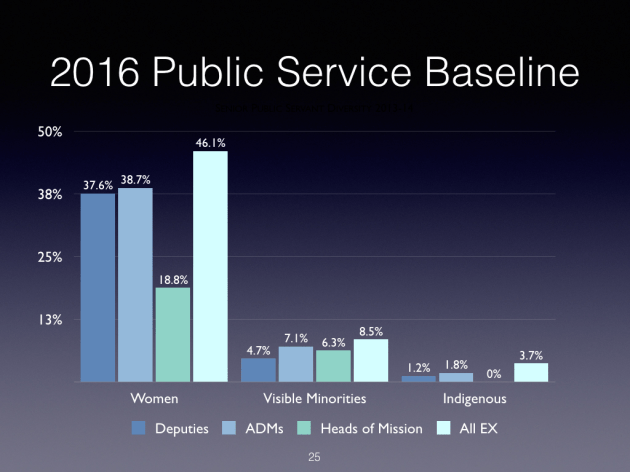
Election 2015 and Beyond- Implementation Diversity and Inclusion.001What does the data show? As seen in the chart above, representation of women is relatively close to gender parity, save for Ambassadors and their equivalents (Heads of Mission and other ADM-equivalent officials abroad).

However, visible minorities are less than half of the percentage of those that are Canadian citizens (15 percent) or in the House of Commons (14 percent).

The ‘all EX’ category has more junior executive positions (EX1-3) and thus the greater diversity in these feeder groups suggests that over time, diversity  at more senior levels should naturally increase.

The public service may feel compelled to take a more active approach given the Government’s commitment.

Likely early tests of the Government’s commitment to increased diversity will occur as deputy ministers retire and are replaced along with changes to Heads of Mission over the course of the year.

13 new Deputies have been named to date by the Prime Minister including 6 women (46 percent, reflecting in part the four women: appointed on International Women’s Day!) and one visible minority (8 percent). Future appointments will indicate whether this portends a trend.

By tracking this on an annual basis, along with changes to ADM ranks, progress can be assessed.

Diversity and inclusion agenda: impact on the public service

Non-partisan to partisan: Federal politicians pluck their staff from the civil service

Growth in political staffers 2000-15.001Some useful Treasury Board stats subject of the article below by David Akin, captured in the chart above, showing a correlation in the earlier years of the Conservative government between growth in staffers and growth in the public service (see my earlier article Diversity in political backrooms still lacking):

To fill as many as 500 partisan political jobs on Parliament Hill, the Justin Trudeau government has been dipping into the non-partisan civil service — just like the Stephen Harper government before it and the Paul Martin and Jean Chretien governments before that.

Though Harper did make a rule change about this revolving door, the system continues to be set up in a way that helps those who jump to partisan jobs go back to the civil service if the government of the day changes.

Those scooping up jobs as chiefs of staff, press secretaries, or policy advisors in ministers’ office can request an unpaid leave-of-absence, a request that is usually granted. It may not guarantee their old job if they leave politics, but it usually guarantees an equivalent job.

It also counts just as much towards a pension as the non-partisan service.

Plus the new jobs in politics usually come with a big raise.

A minister’s chief of staff can earn up to $180,000 a year. A press secretary can earn up to about $108,000.

There were 559 of these partisan staff in the last year of the Harper government.

While Conservatives are just as likely to use this revolving door as Liberals, Harper said in the 2006 election campaign that a “Liberal” civil service would act as a check on any Conservative government if only because Liberals have, since the Second World War, been in office more than the Tories.

The civil service, naturally, objects to that observation.

“It is an overarching and utmost priority of the Government of Canada to manage the public service with integrity and in accordance with existing polices and collective agreements,” said Kelly James, a spokesperson for the Treasury Board, the federal department that manages human resources policies.

The last time the Liberals were in charge, Liberal political staff had an inside track on non-partisan civil servant jobs. So long as they met the basic requirements for an open civil service position, they got the job — along with the employment security and pension opportunities.

Harper changed that, eliminating the preferential treatment.

There’s no data tracking the partisan/non-partisan revolving door, though long-time Parliament Hill watchers have seen at least a handful of Martin/Chretien era partisan staffers back in that role after spending the Harper decade in a civil servant jobs.

Source: Non-partisan to partisan: Federal politicians pluck their staff from the civil service

Perception of politicization of the public service is a problem for Liberals | Ottawa Citizen

Not unexpected to hear this kind of criticism from the opposition, as well as the more-balance assessments from others:

The appointment of Matthew Mendelsohn, who helped write the Liberal election platform, as a senior-ranking bureaucrat is a “clear, unprecedented and blunt” politicization of Canada’s non-partisan public service, says former Conservative cabinet minister Jason Kenney.

Kenney said the previous Conservative government — which had a rocky and sometimes hostile relationship with the bureaucracy — would have been vilified if it “plunked” such a key election player into the top ranks of the Privy Council Office (PCO).

“The real shocker here is his appointment to a No. 2 position in the PCO, the summit of the entire public service,” said Kenney in an interview. “A fellow who worked as a partisan political Liberal on the election campaign … I don’t think there is any precedent for this.”

That perception has dogged the Liberals since Mendelsohn was appointed in December as a deputy secretary in the PCO to head a new “results and delivery” secretariat to ensure election promises are tracked and met.

Results and delivery are big priorities for the Liberals and the public service has a lousy track record at both. By all accounts, Mendelsohn is working hard to get buy-in from ministers, deputy ministers and departments on creating a “delivery culture” in government.

And there seems little debate Mendelsohn is qualified. He is an academic, founding director of the Mowat Centre, an Ontario think-tank, a former deputy minister of several provincial portfolios; an associate cabinet secretary in Ontario and a one-time public servant.

But his bona fides include a leave from the Mowat Centre to work on the Liberal platform and help pen Prime Minister Justin Trudeau’s mandate letters for ministers.

He is also part of the Dalton McGuinty-Kathleen Wynne brain trust that has joined the Trudeau government.

He worked with Queen’s Park veterans Katie Telford, now Trudeau’s chief of staff, and Gerald Butts, his principal secretary. (Mendelsohn’s wife, Kirsten Mercer, was Wynne’s justice policy adviser who moved to Ottawa to become chief of staff for Justice Minister Jody Wilson-Raybould but has since been replaced.)

“The closer you fly to the action the bigger the risk of being branded,” said David Zussman, who holds the Jarislowsky Chair in Public Sector Management at the University of Ottawa. He was recruited into PCO to help lead the Jean Chrétien government’s massive program review.

Zussman also cautions the government has to be careful about the perception that it is too Ontario-centric when staffing ministers’ offices.

“They need a national perspective in ministers’ offices and they have to be careful about that. They could all be meritorious appointments but if they all come from the same place they are not as valuable to ministers as people who come from across the country,” he said.

Ralph Heintzman, a research professor at University of Ottawa, was a harsh critic of the Tory government for politicizing the public service particularly for using government communications to promote party interests.

Heintzman, a key player in writing the public service’s ethics code, feels Mendelsohn’s appointment is within bounds. He was tapped as a policy expert for the platform but wasn’t a candidate or campaign worker.

But perception is reality in politics and Heintzman said Mendelsohn had “sufficient involvement” with the Liberals that the government will now have to be sensitive to all future appointments.

“The very fact the appointment created a perception, fair or not, creates a new situation for the Liberals in the future because it will have to be very sensitive about any future appointments from outside the public service to make sure those impressions aren’t reinforced,” said Heintzman.

That could pose a problem for a government that is anxious to renew the public service and bring in new talent and skills to fill many policy and operational gaps.

The public service has long been criticized for monastic and a “closed shop.” In fact, former PCO Clerk Janice Charette made recruitment, including bringing in mid-career and senior executives, one of her top three priorities.

Source: Perception of politicization of the public service is a problem for Liberals | Ottawa Citizen

From a different angle, Geoff Norquay, a former staffer to former PM Mulroney, argues for greater movement between the two spheres:

We learned this week that a significant number of public servants have been joining ministerial offices in the new Liberal government.

The knee-jerk reactions of some Conservative commentators were predictable enough: “It absolutely feeds into the perception that the civil service favours the Liberals, and that the public service is becoming more political,” said Michele Austin, a former chief of staff to two Harper government ministers.

I believe these reactions are wrong, for several reasons.

Canada has a non-partisan public service, but people have been crossing back and forth between the public service and political offices for many years. It used to be a normal process and it’s not necessarily a bad thing. Actually, it’s a good thing.

Until the Harper era, these movements were openly acknowledged and positively sanctioned, because people from ministers’ offices wishing to cross over to the public service were given a priority for hiring in the bureaucracy.

As part of his effort to close “revolving doors,” Stephen Harper put a stop to the priority system. That was a mistake. Once it has worked through its top priorities, I hope the new government considers bringing the priority system back.

Ministers’ offices are the nexus where the public service and politics meet. They are the place where political judgments are applied to bureaucratic recommendations, where political desires meet practical realities, and where executive decision-making confronts the art of practical execution.

Far too often, these two sides operate as non-communicating solitudes. When relationships between ministers’ offices and the public service become strained, it’s usually because they don’t understand each other’s motivations, priorities, imperatives and constraints.

Many of these tensions and frustrations can be made more manageable if public service recommendations to ministers are more politically sensitive, and if requests and instructions from the political level are tempered by respect for bureaucratic considerations.

open quote 761b1bCreativity comes from your ability to see the different and conflicting sides of complex issues, and apply what you’ve learned from one field to the challenges of another.

The odds of this happening are much better if at least some people making these calls, and negotiating the interface, have experience on both sides. That’s certainly been my experience through more than forty years of working in and around provincial and federal governments.

Trudeau’s blurring the line between ministries and the public service. Good for him.

Ontario public servants to get mandatory sensitivity training on indigenous people, history

While sad that this is needed (it’s 2016!), better late than never and likely one of the more significant TRC recommendations that will be implemented in the long-term.

Not sure what other provinces with large numbers of Indigenous peoples are doing but this approach should be considered by them if not already in place. The same applies to the federal government:

More than 60,000 members of Ontario’s public service will soon receive mandatory sensitivity training regarding the history and experiences of the province’s indigenous people, the Star has learned.

Premier Kathleen Wynne is expected to announce on Wednesday that every OPS employee will receive mandatory indigenous cultural competency and anti-racism training. Ontario’s public servants work in all government ministries from finance to child welfare, agencies and Crown corporations.

Wynne is also expected to further outline mandatory learning expectations in the province’s public education curriculum to include the impact of residential schools, the history of colonization and the role of treaties signed between the Crown and First Nations.

The changes push Ontario toward addressing the Truth and Reconciliation Commission’s (TRC) 94 recommendations, released last June, which are meant to incorporate indigenous culture and teaching throughout Canadian society.

For 100 years, residential schools — run by churches and sanctioned by the government — took nearly 150,000 First Nations, Métis and Inuit children away from their families and communities and sent them away to school. Thousands of children never made it home and died while at the schools.

TRC chair Justice Murray Sinclair called this dark period in Canadian history an act of cultural genocide as the impact of the mass removal of generations of children from their families left a legacy of broken families, poverty, mistrust of government, abuse, alcoholism and fractured lives.

A key component of the sensitivity training will be focused on violence against indigenous women and girls.

…The sensitivity training will instruct employees on terminology, colonial history in Ontario from treaties to child welfare and Indian hospitals such as the Fort William Indian Hospital Sanatorium, which operated from the 1940s to the 1970s. The training will discuss how social disparities and inequities grew from these experiences.

The training will include interactive cultural activities, the harm of stereotyping and the legacy of colonization. It will also teach better “communications and relationship-building skills to promote positive partnerships with indigenous people,” according to information on the event obtained by the Star.

Other courses required for Ontario public servants to take include workplace violence prevention and training on Ontario Human Rights Code requirements regarding persons with disabilities.

The premier is also expected to discuss further progress on collaborating with First Nations, Métis, and Inuit partners on how they are incorporating indigenous history and culture into the public school curriculum.

Source: Ontario public servants to get mandatory sensitivity training on indigenous people, history | Toronto Star

The young and the restless: Liberals look to infuse public service with new blood

Good overview by Kathryn May of the demographics of the public service and recruitment challenge:

Knowing the talent pool of the public service will need to be renewed to push forward its agenda, the Liberal government is trying to figure out how to attract more young people to a sector where the average age of a new hire is pushing 40.

The rising age of new recruits was flagged for Prime Minister Justin Trudeau, who is also the minister of youth, as an “area in need of increased attention.”

According to Privy Council Office briefing documents, the average age of new hires has hit 37, and few young people are being hired. Once hired, however, people stay in the public service until they retire at about age 60.

“Sustained efforts are needed to recruit young people and to attract highly skilled professionals from other sectors, especially those with the skill sets needed for the future work of the public service,” say the briefing documents.

The average age of entry into the public service has been creeping up, rather than decreasing, as more and more jobs require university degrees. A decade ago, the average age of a new hire was 36 — 35 for women and 36 for men.

The public service is an older workforce compared with the private sector. It emerged out of the restraints of the Conservative era smaller and slightly older. Today, it is largely middle-aged, with more than 60 per cent of the employees between 35 and 54, and the largest concentration huddled between 40 and 54.

Over the past five years, the number of bureaucrats under 35 decreased and those over 50 increased. The average age is now 45, and more than half have worked in the public service between five and 14 years.

It’s an issue Treasury Board President Scott Brison quickly seized upon when he made a pitch last month at the World Economic Forum in Davos to the millennial generation — those under 35 — to work in government.

In an interview, Brison signalled he is reviewing how to tackle the problem to give millennials the “chance to make a difference in the future of the country.

“The complexity of decisions today is greater than it has ever been in the history of government or democracy, and now more than ever at any point in our history we need bright, talented people in government,” he said.

“And we also have the most talented, most educated, and most globally connected generation. So it seems pretty obvious to me that we need to find ways to bring millennials into these key decision-making roles in government.”

The public service never has a problem attracting people, especially when the economy slows. The big challenges are getting people with the right skills and keeping them. Young people tend to see the public service as a slow, rules-bound hierarchy with little tolerance for risk or creativity. It has countered with campaigns over the years, including one branding itself as the “employer of a thousand opportunities.”

But Brison said the image of the public service took a major beating under the Conservatives, which mistrusted public servants and “gratuitously took pot shots at public servants whenever they had the chance”

“They toxified relations with the public which was incredibly stupid given governments need the engagement of public servants to implement their agenda … We have a progressive agenda and need a motivated public service. We recognize the importance of renewing talent.”

Linda Duxbury, professor at Carleton University’s Sprott School of Business, said Brison has every reason to be worried. After a decade of being “beaten down by the Conservatives the word public service has a bad connotation.”

The big attraction, she said, for many workers in their 30s is not the work as much as job security, pensions and benefits — reinforcing a long-standing characterization of public servants who join for the benefits and stay for the pensions.

But Duxbury said the problem is that employees attracted by such “extrinsic motivators” don’t tend to be the entrepreneurial, creative thinkers and innovators the government wants to shake up the way work is done and services are delivered.

“I would like to see what is attracting them to the public service at age 37,” said Duxbury. “This isn’t just an age issue but who is attracted by what you have to offer, and if what you have to offer are extrinsic motivators like a good pension and benefits, those may not be the people you want.”

The Public Service Commission in its 2013-14 report noted the number and proportion of employees under age 35 had declined four years in a row, even though the number of new hires from this group increased. At last count, they represent 17 per cent of all permanent employees after peaking at 21.4 per cent in 2010.

At the same time, the number of people leaving or retiring outnumbered those coming into the public service. The commission warned this gap could have “implications for the renewal and future composition of the public service.”

By the Numbers: Composition of the Public Service

  • 37: average age of new hires
  • 45: average age of public servants
  • 50.4: average age of executives
  • 50: percentage with 5 to 14 years experience
  • 22: percentage with 15 to 25 years experience
  • 58: average retirement age
  • 36: percentage of baby boomers in public service workforce
  • 21: percentage of millennials in the public service
  • 257,000: number of employees in public service
  • 87: percentage of employees who are permanent or indeterminate employees
  • 13: percentage of employees who are term, casual and student employees
  • 55: percentage of employees who are women
  • 42: percentage of public servants working in National Capital Region

Source: The young and the restless: Liberals look to infuse public service with new blood | Ottawa Citizen

ICYMI: So how are those ‘sunny ways’ working out so far? Flumian

Maryantonett Flumian, president of the Institute on Governance and one of my former deputies, on the new government’s steps to dates and some of the deeper challenges.

Hard to argue with her formulation of one of her broader questions:

As it contemplates new engagement strategies, the government confronts a broader question — how governance needs to evolve in the digital age, when ubiquitous information and the instantaneous ability to collect it have challenged the position of many traditional intermediaries, governments included. Governments have already ventured into the twitterverse, with mixed results.

But for the most part it has yet to confront a host of issues. For example, what are the benefits and risks of massive “virtual” engagement in policy making? What are the best techniques? What happens to so-called ‘message control’? What frameworks might guide interaction between the public service, citizens and the media?

The governance challenges of the digital age don’t stop there. In an age of near-frictionless connectivity, why do citizens have to deal with multiple government silos to address various aspects of the same issue — whether it’s a disability, a business start-up, or becoming a senior? And given the ever-expanding applications for data, why do governments continue to sit on vast stores of information they can’t begin to fully use in the name of “confidentiality”?

Here again, the government is off to an encouraging start. In his (no longer secret!) mandate letters to ministers, the prime minister charged several of his colleagues with working toward single-window service. The government also has committed to a policy of open data by default. Some traditionalists have cautioned that it may come to regret such a commitment, but among other considerations, it’s far from clear that a generation accustomed to the digital sharing of information is invested in the information-hoarding ethic of an earlier age.

So how are those ‘sunny ways’ working out so far?

Open government push requires ‘cultural shift’ in public service, federal documents warn

Sound analysis of the challenge:

The Liberals’ promise to pry open government requires nothing less than “cultural change” within the public service, warn documents obtained by the Star.

Treasury Board President Scott Brison was told in November that there are significant hurdles to the Liberals’ campaign pledge to reform access to information laws, make government information open by default, and more effectively communicate with the public.

Documents prepared for Brison describe a federal culture of “limited disclosure, insular policy making,” which takes into account the “federal view only.”

To implement the Liberals’ ambitious democratic reform agenda, that culture will need to shift to one of “proactive release, engagement and connectivity, (and) broad leadership on open government.”

It’s not clear exactly how the government intends to change the culture of some 257,000 employees in the core public service. But Prime Minister Justin Trudeau has already made clear he wants to end the era of the federal government deciding and acting on issues unilaterally, putting an emphasis on meeting with provincial premiers and, on Friday, the mayors of Canada’s largest cities.

“The government holds a largely untapped wealth of mostly unclassified information of interest to Canadians,” read the documents, obtained under access to information laws. “This information is not sufficiently leveraged to fuel the digital economy, spur innovation, and give Canadian business a competitive edge.”

Trudeau made openness and accountability a key plank in his party’s election platform. The idea is to make government information “open by default,” unlike the current system where citizens need to resort to access to information requests that can take months or even years to process.

But releasing more information about government operations, the documents warn, carries with it the risk of public relations headaches for the new government.

In an interview Tuesday, Brison acknowledged that risk.

“(But) you can’t expect Canadians to trust us if we can’t trust them,” Brison said.

“The other thing to keep in mind is we will make better decisions when we engage Canadians in the decision-making process. The old days where governments would be covetous and secretive (with) information to try and make a decision because government thought they were smarter than citizens, are over.”

When it comes to changing the public services culture, Brison suggested the Liberals need to lead by example – and the leadership starts with the prime minister.

“(Trudeau) is absolutely committed to this throughout government,” Brison said.

“For most Canadians, the transparency bus has left the station. You try to explain to a millennial why a lot of this information isn’t rendered public, and you lose them.”

But it’s not just the culture of secrecy and risk aversion preventing information from getting to Canadians. The documents note Canada’s dated privacy and access to information acts are falling out of sync with technological development.

The Access to Information Act, for instance, has not been substantially changed since the early 1980s when most government business was conducted on paper.

Source: Open government push requires ‘cultural shift’ in public service, federal documents warn | Toronto Star