#COVID-19: Comparing provinces with other countries 2 March Update; Japan impact and policy changes

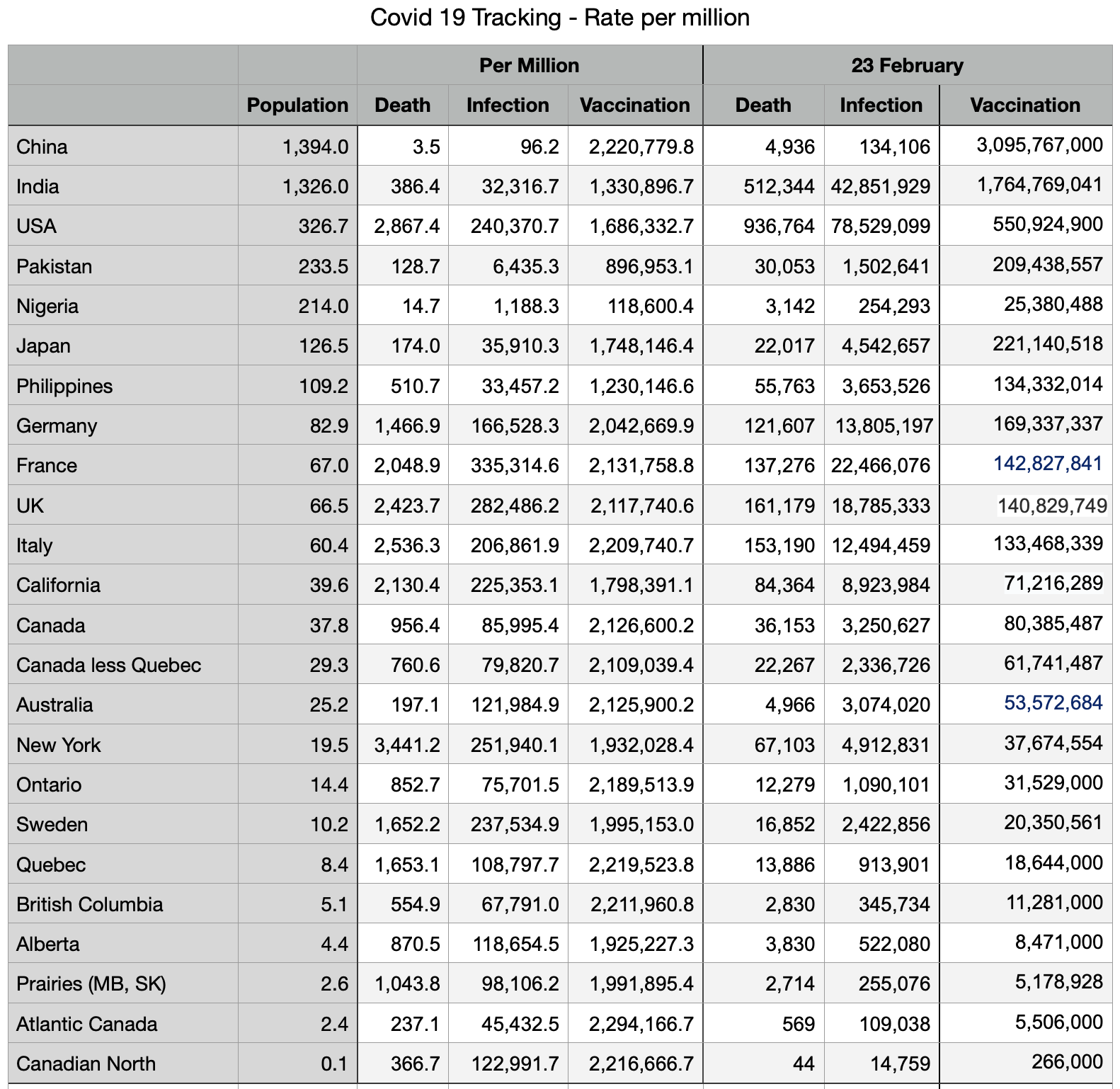
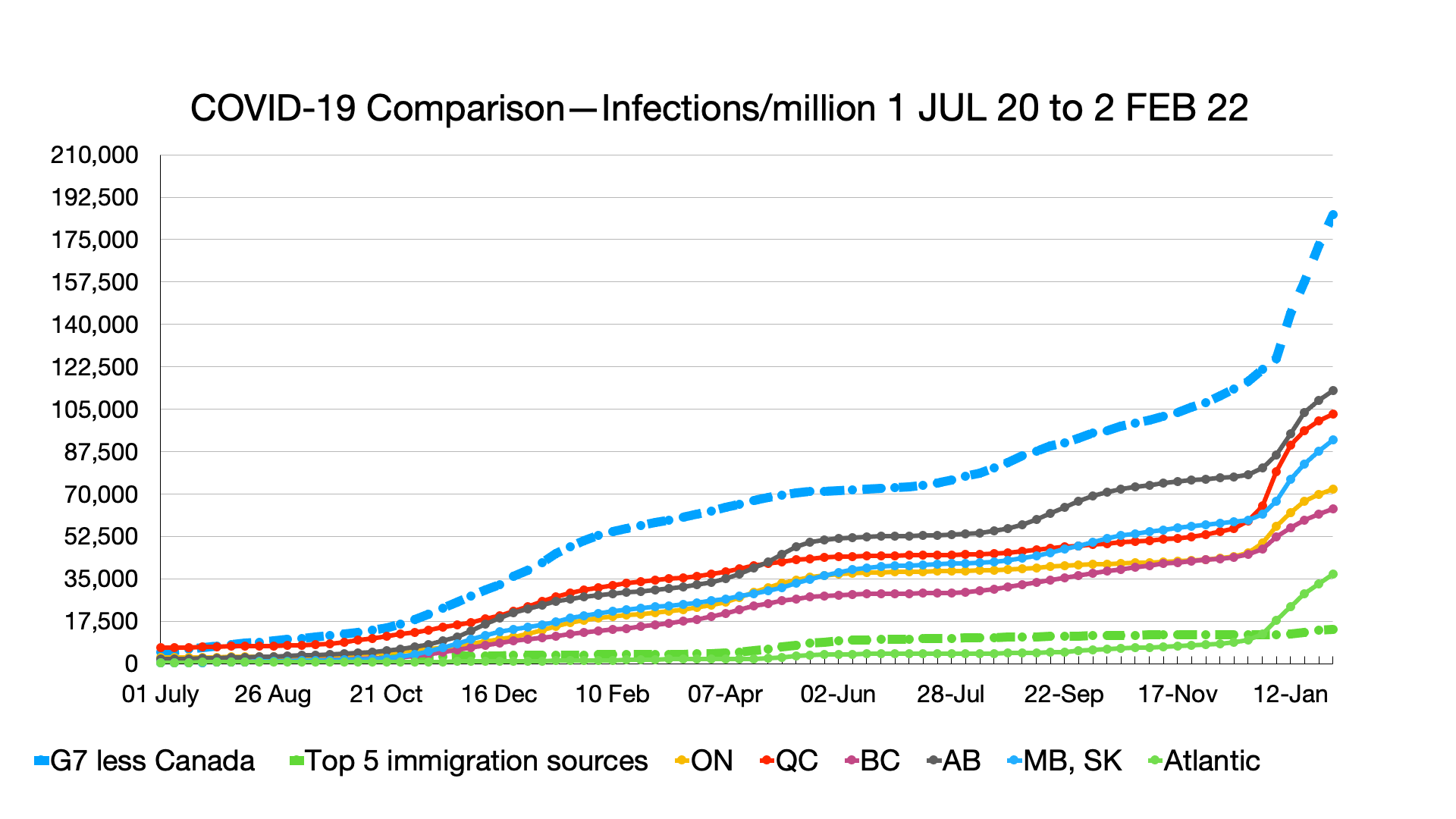
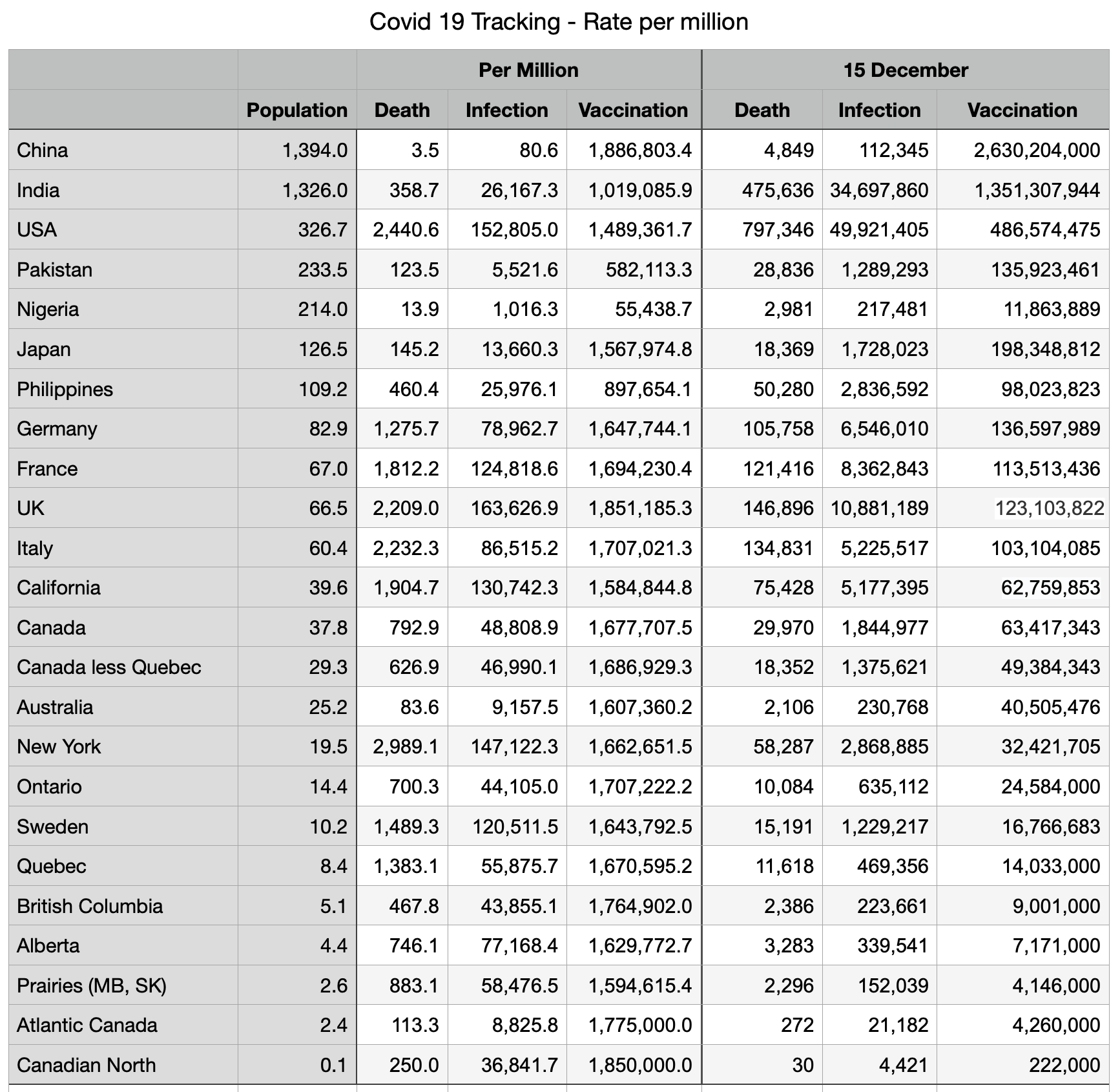
Overall decline in infections and deaths as omicron wave passes. The big news is that numbers from China have shown a significant increase in the past week, from 134,000 to 315,000 infections and from 4,936 to 5,380 deaths, perhaps reflecting suppression of numbers pre-and post-Olympics.

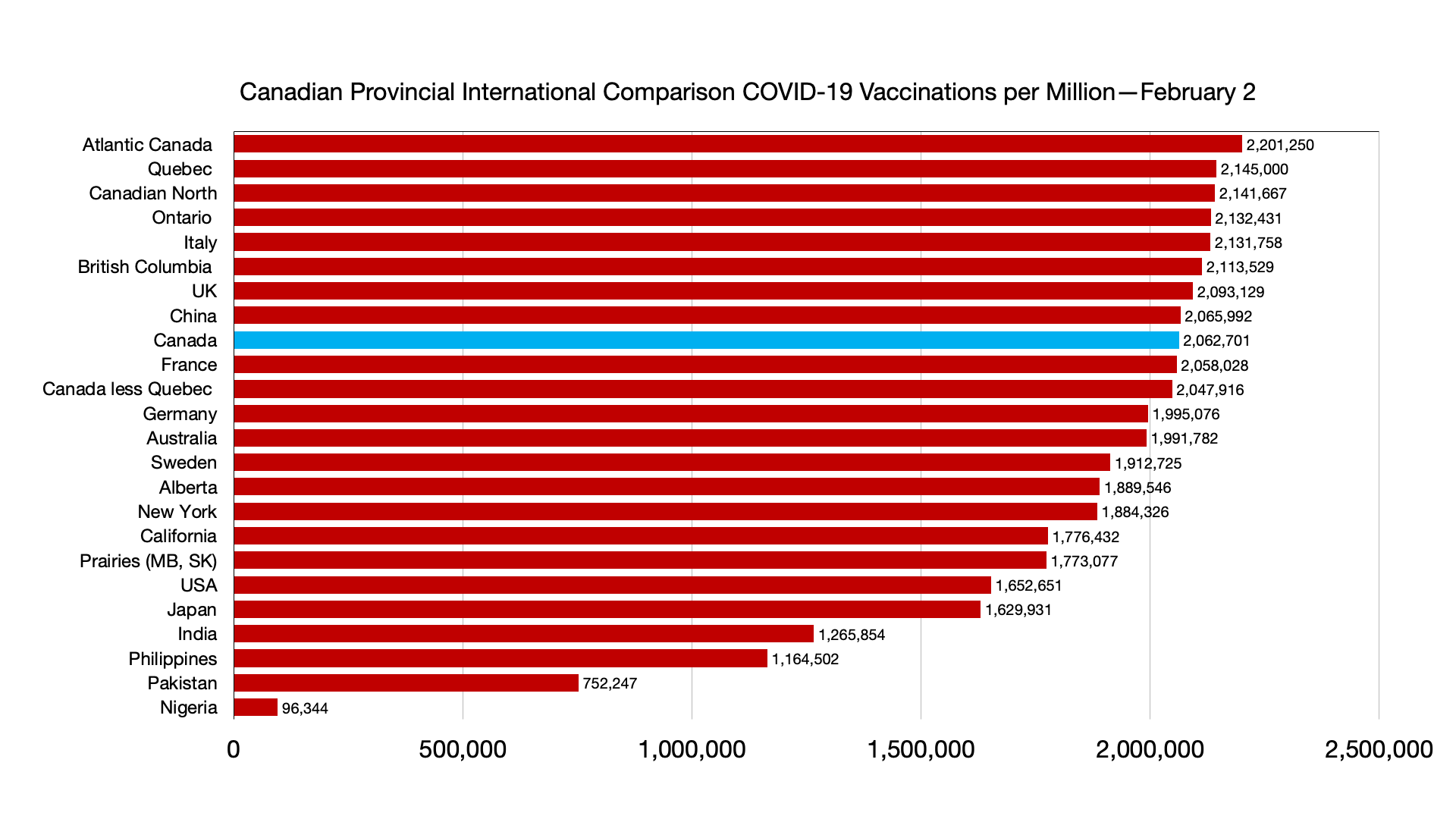
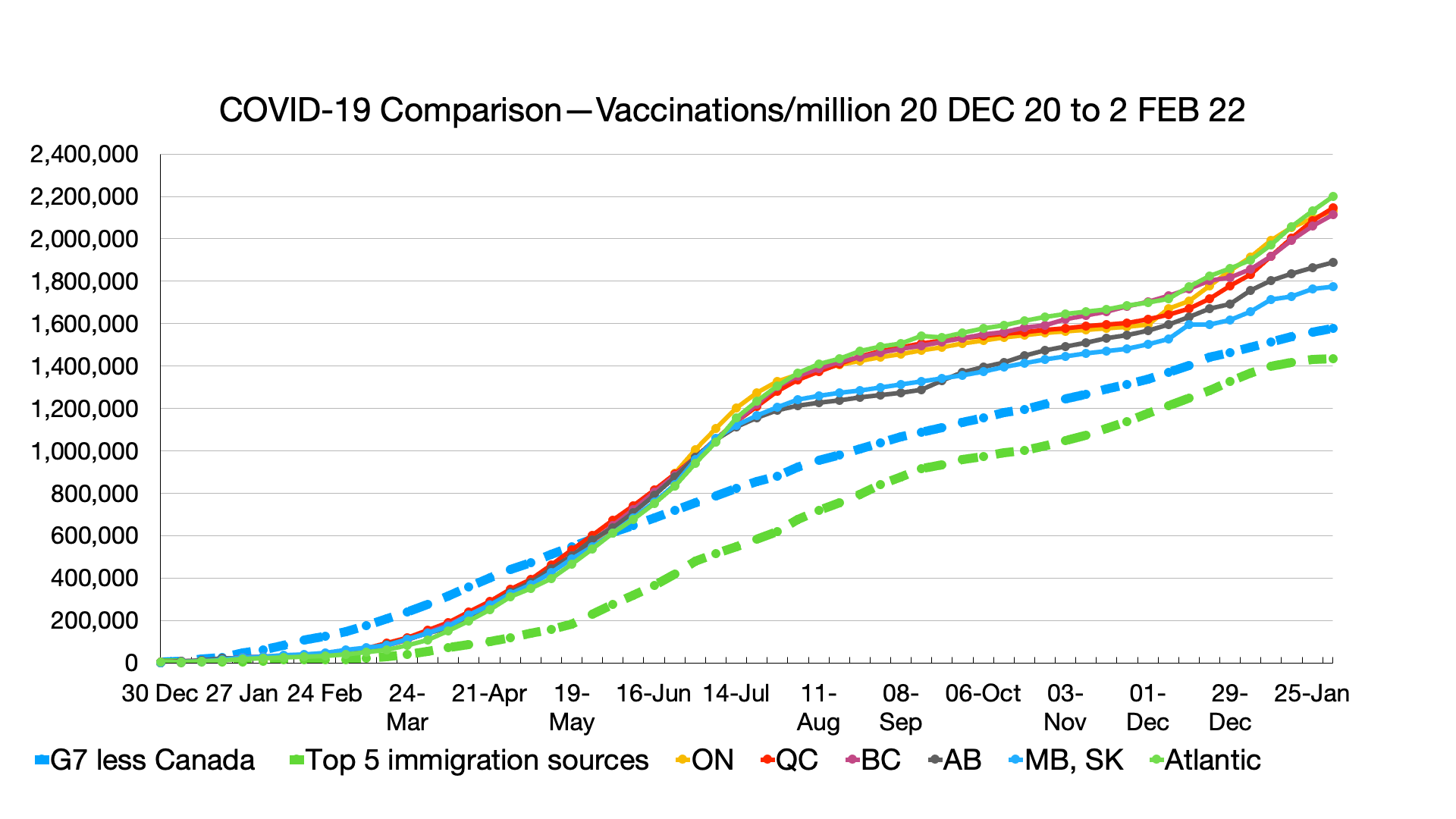
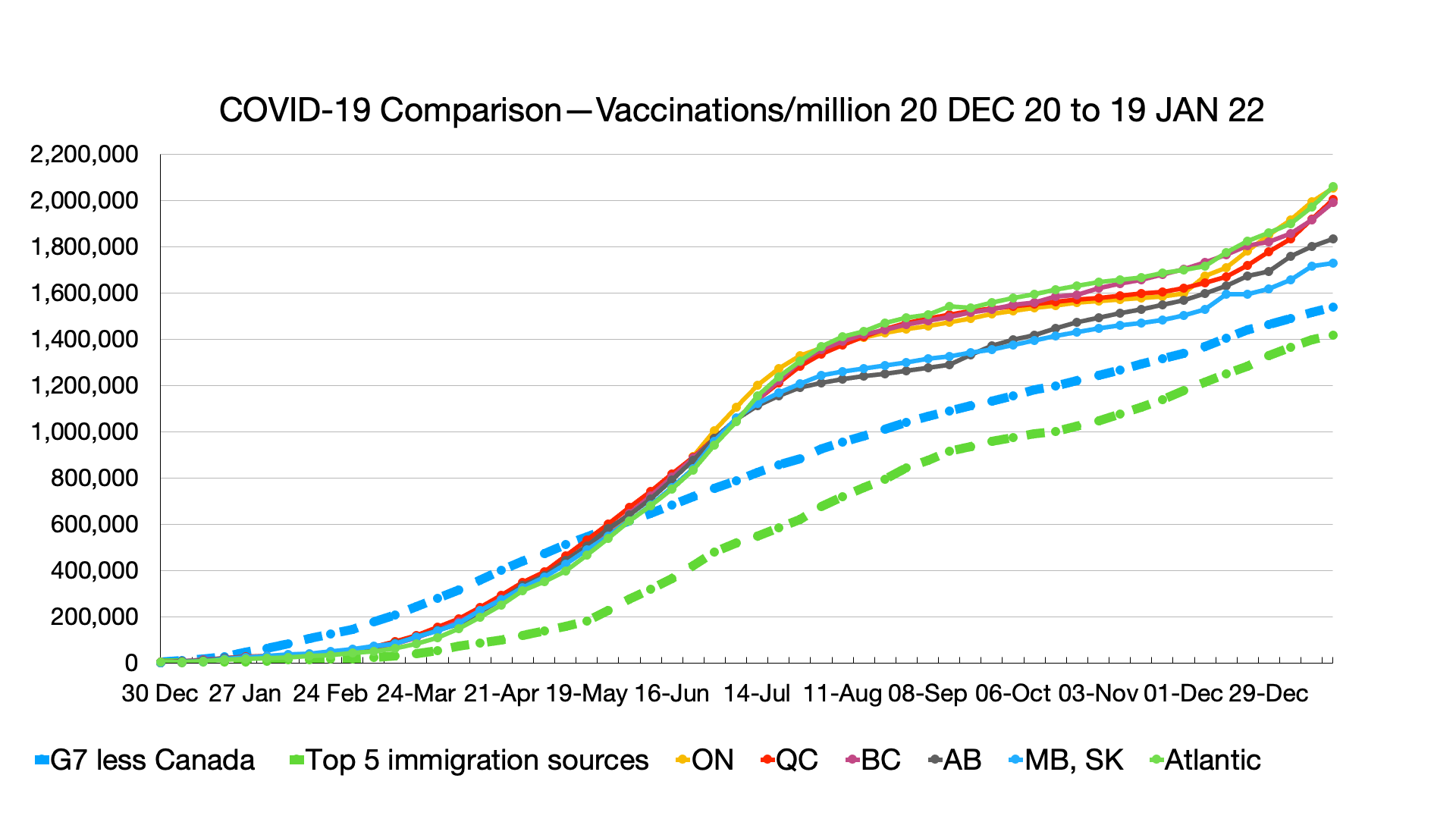
Vaccinations: Some minor shifts but convergence among provinces and countries. Canadians fully vaccinated 82.2 percent, compared to Japan 79.4 percent, UK 73.3 percent and USA 65.7 percent.

Immigration source countries are also converging: China fully vaccinated 88.3 percent (numbers have not budged over past four weeks), India 57.9 percent, Nigeria 4 percent, Pakistan 45.7 percent, Philippines 58.4 percent.

Trendline Charts:

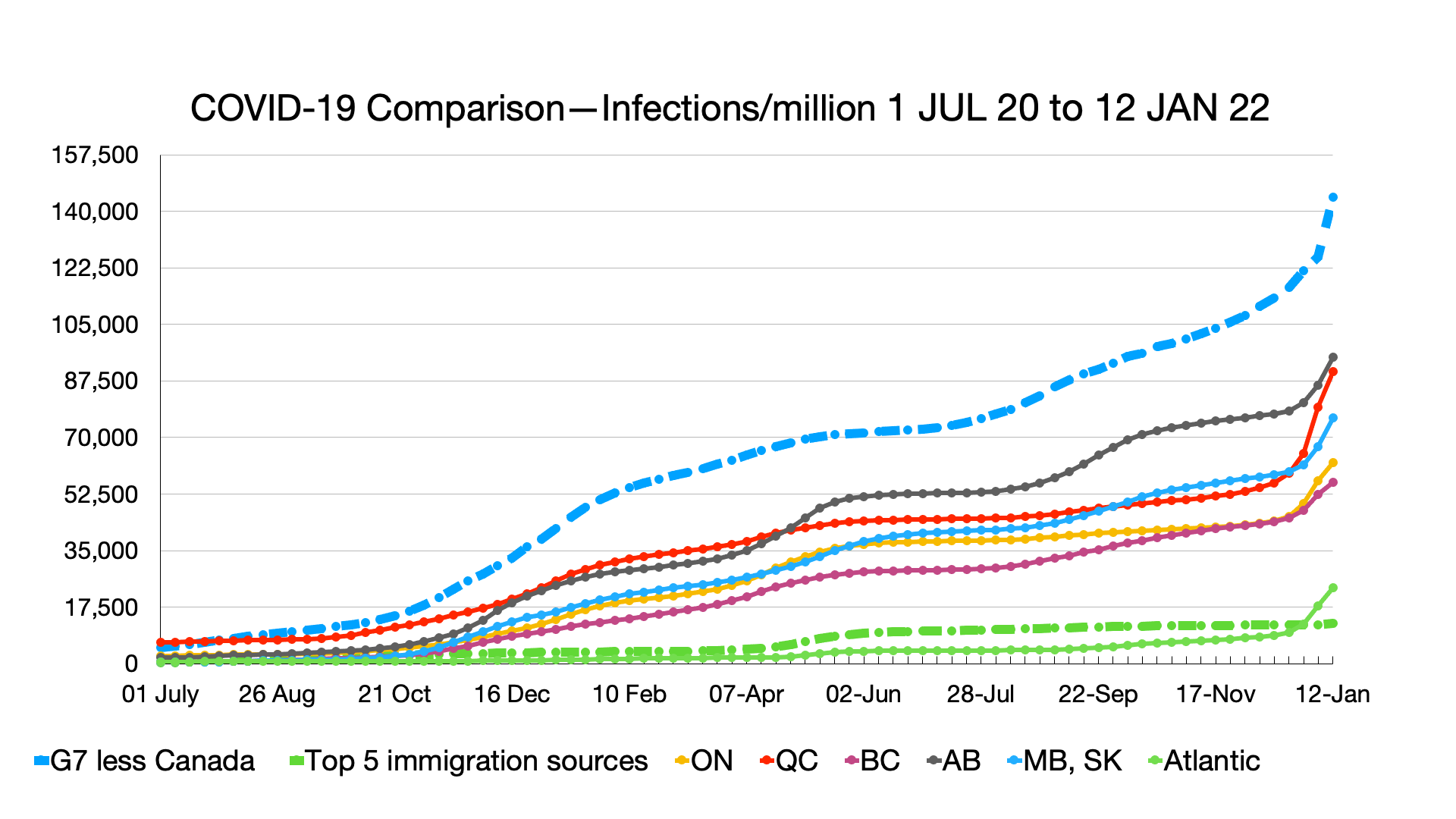
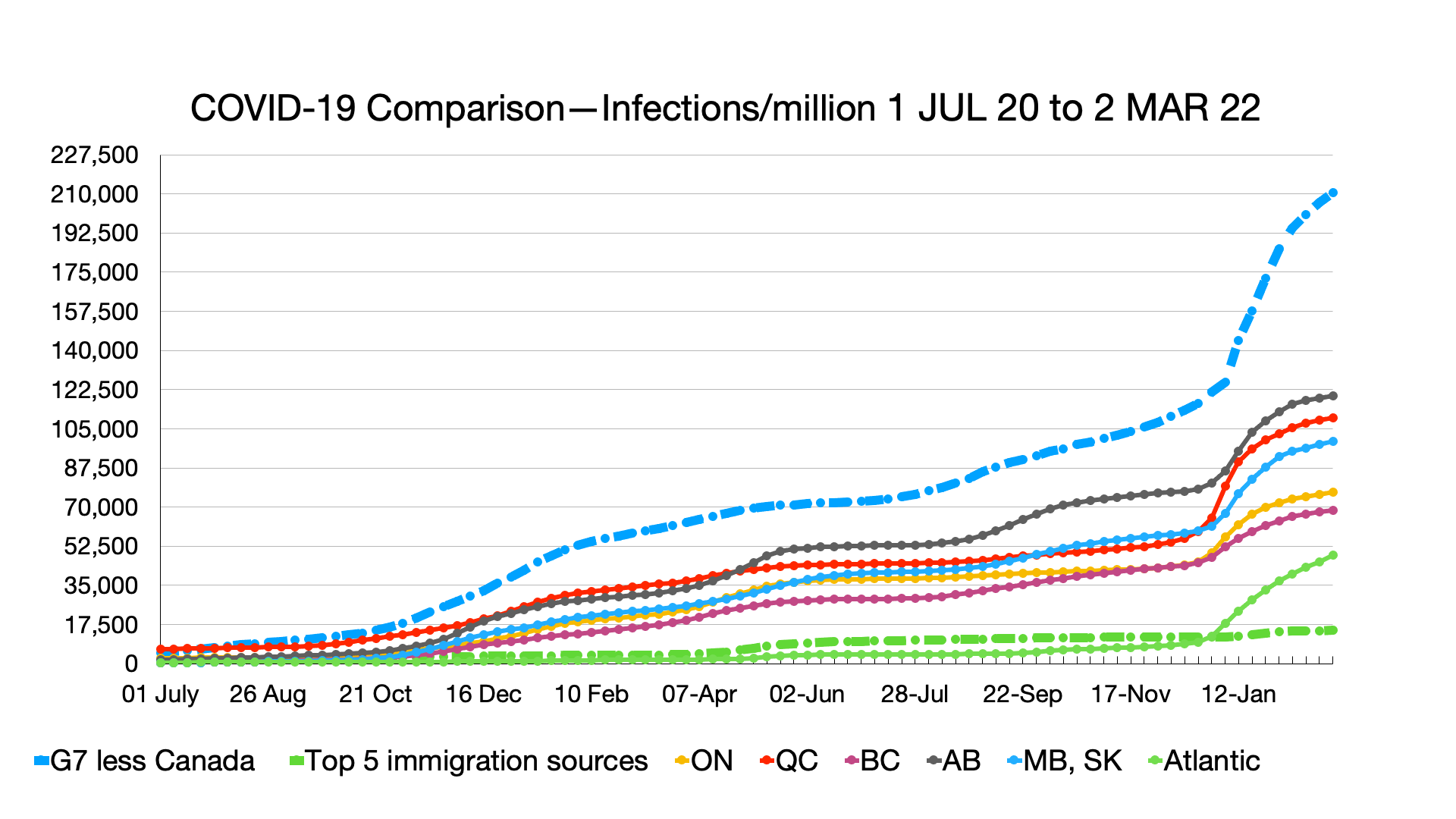
Infections: Ongoing signs of omicron and other variants plateauing.
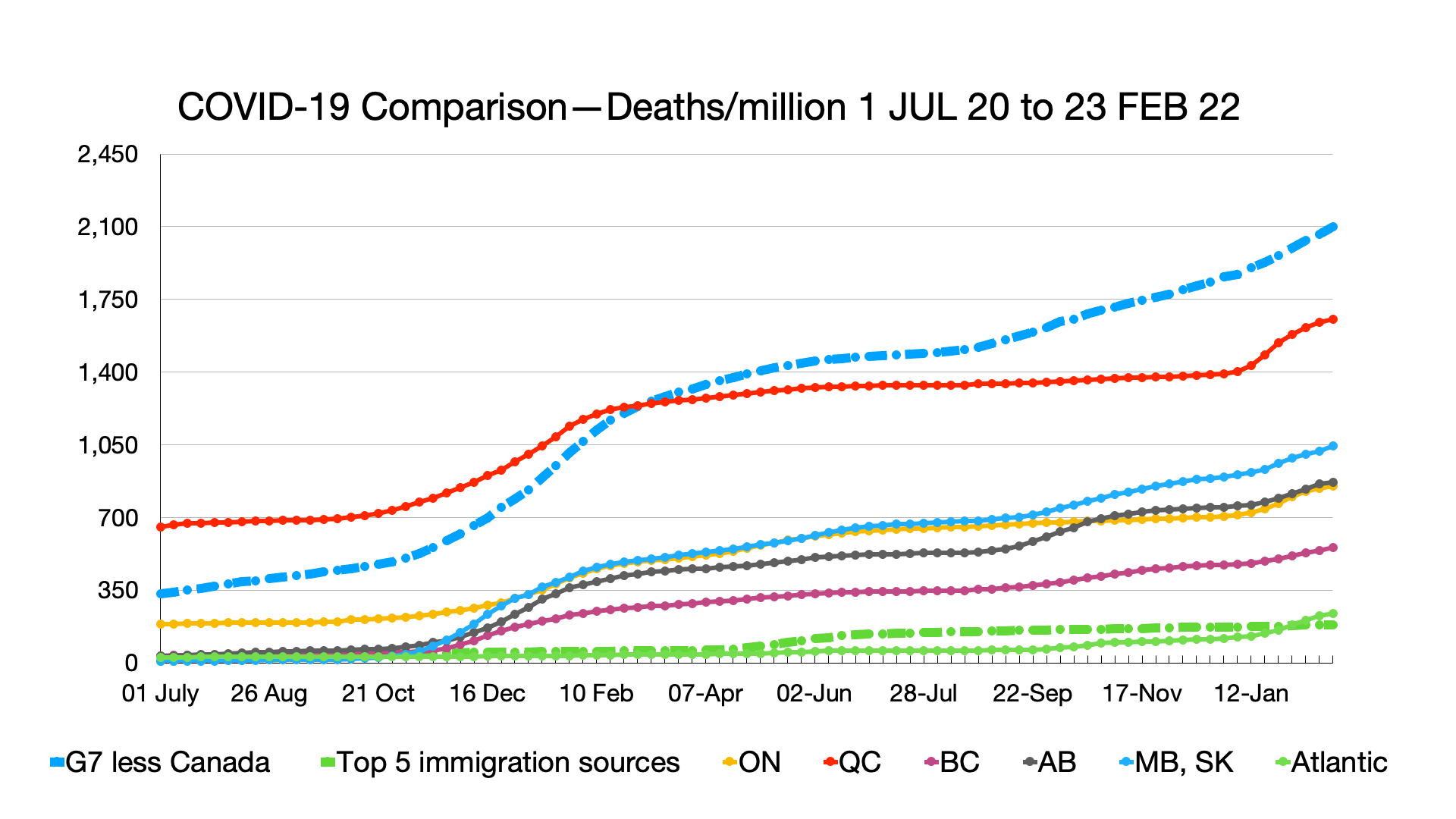
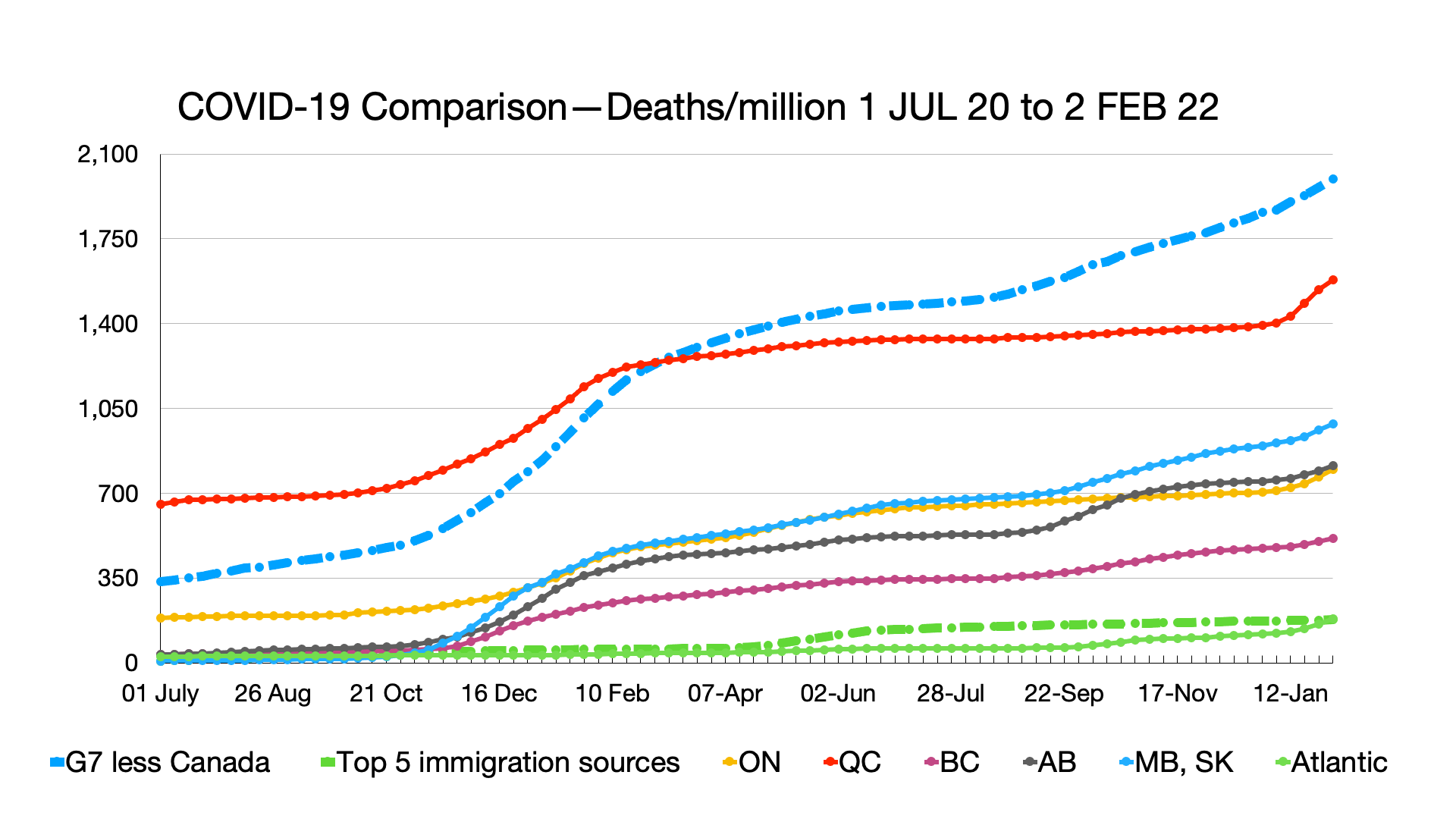
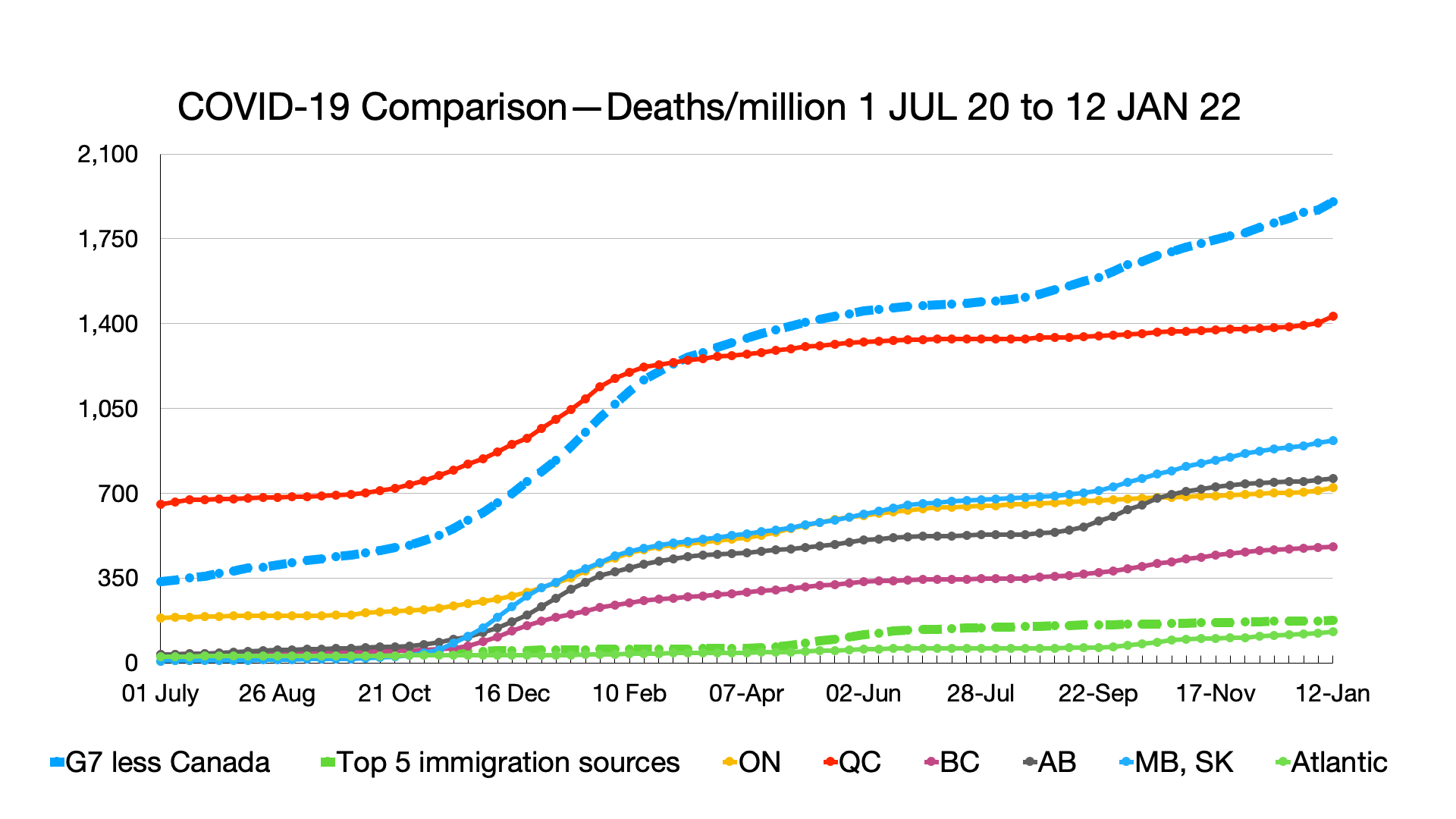
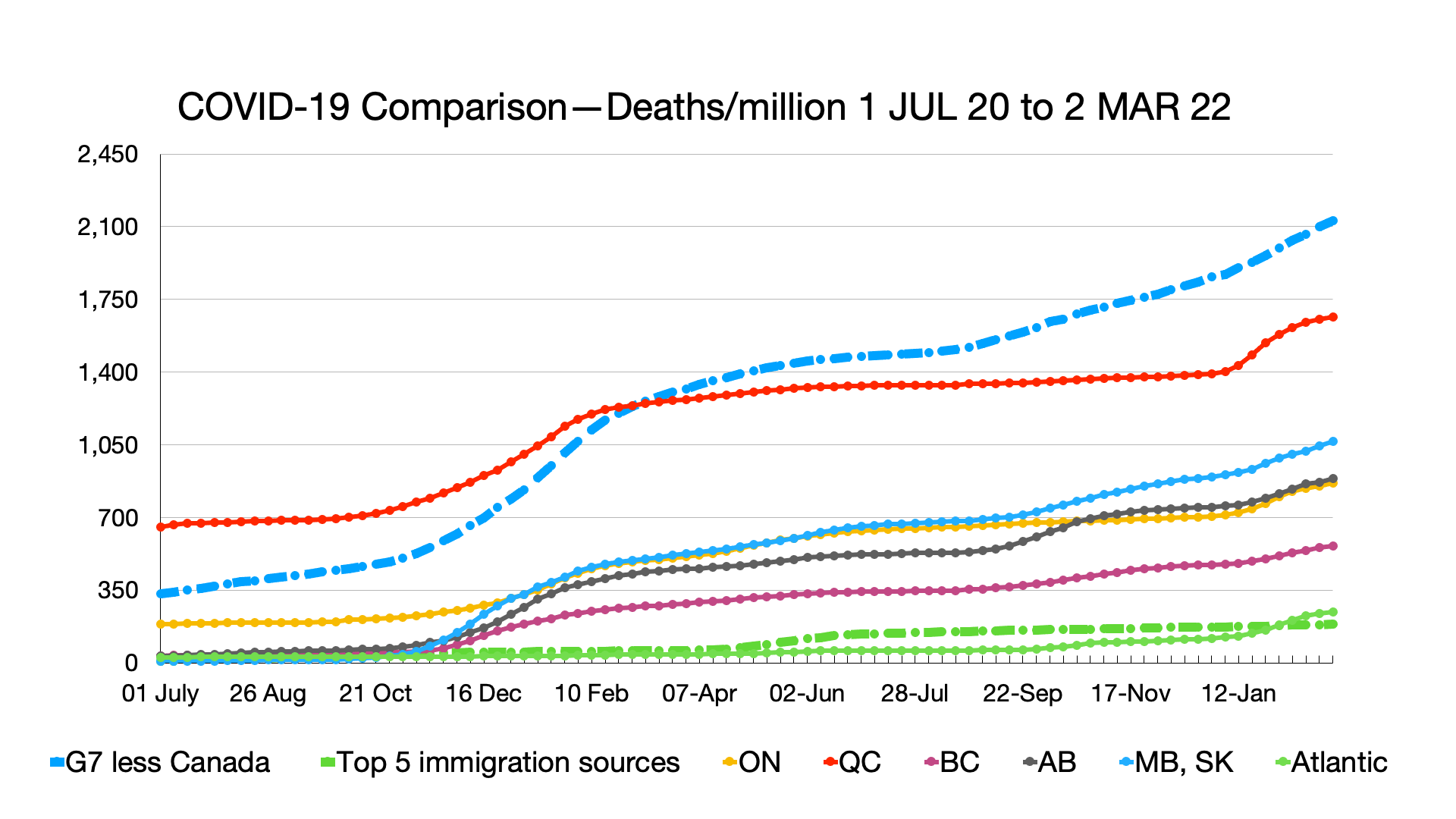
Deaths: Quebec continues to plateau with moderate increases in other provinces but G7 still not plateauing.
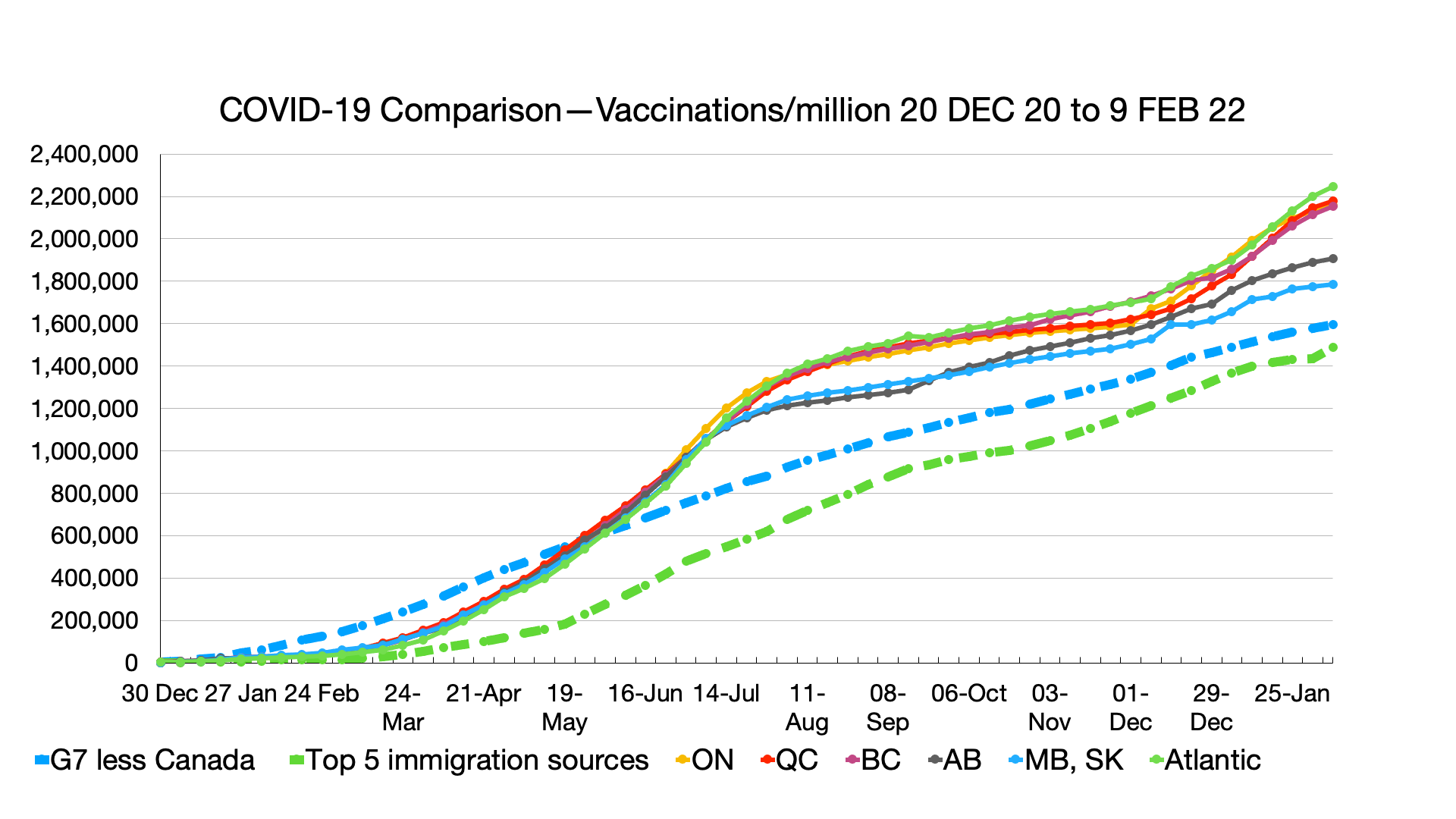
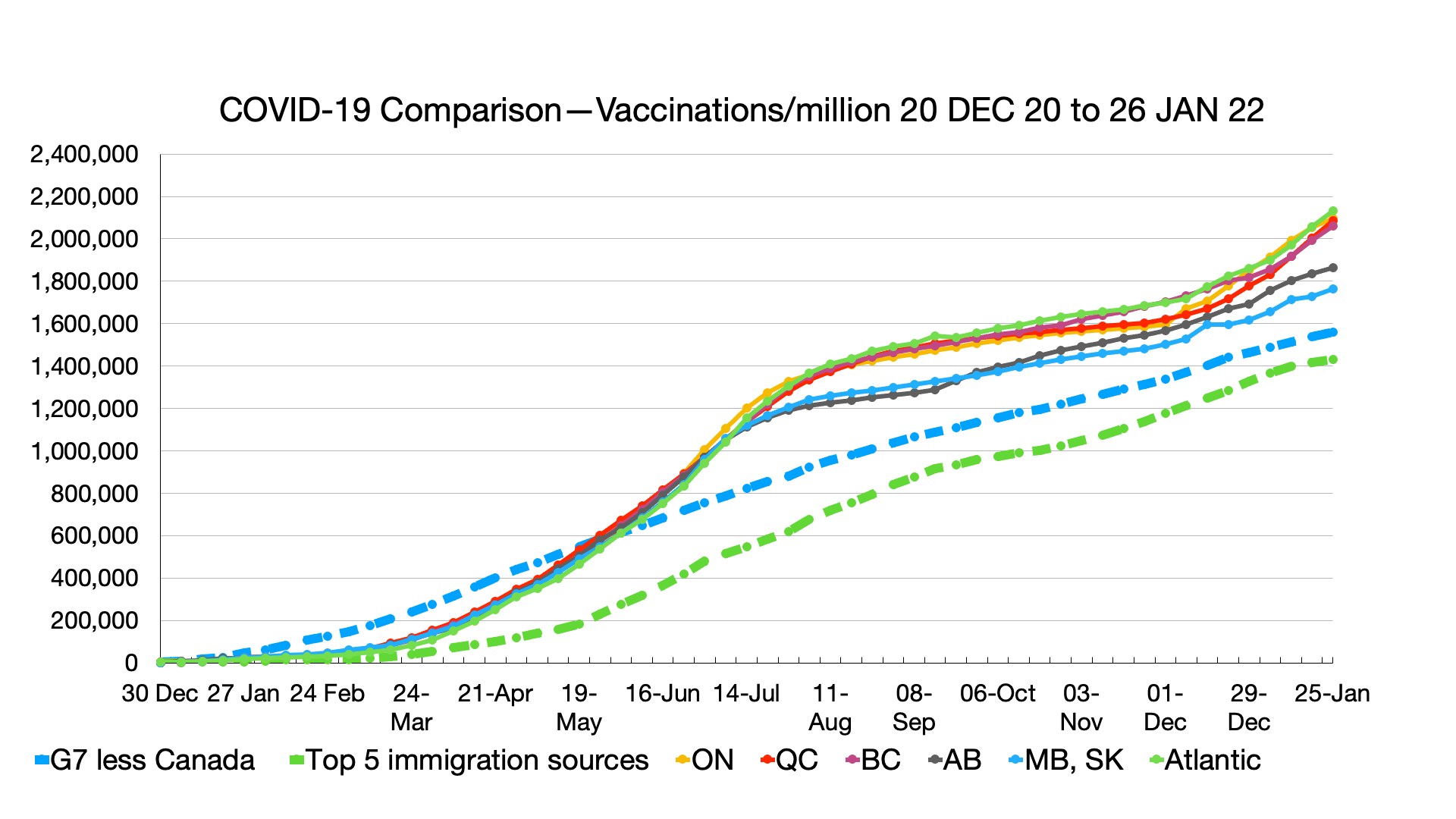
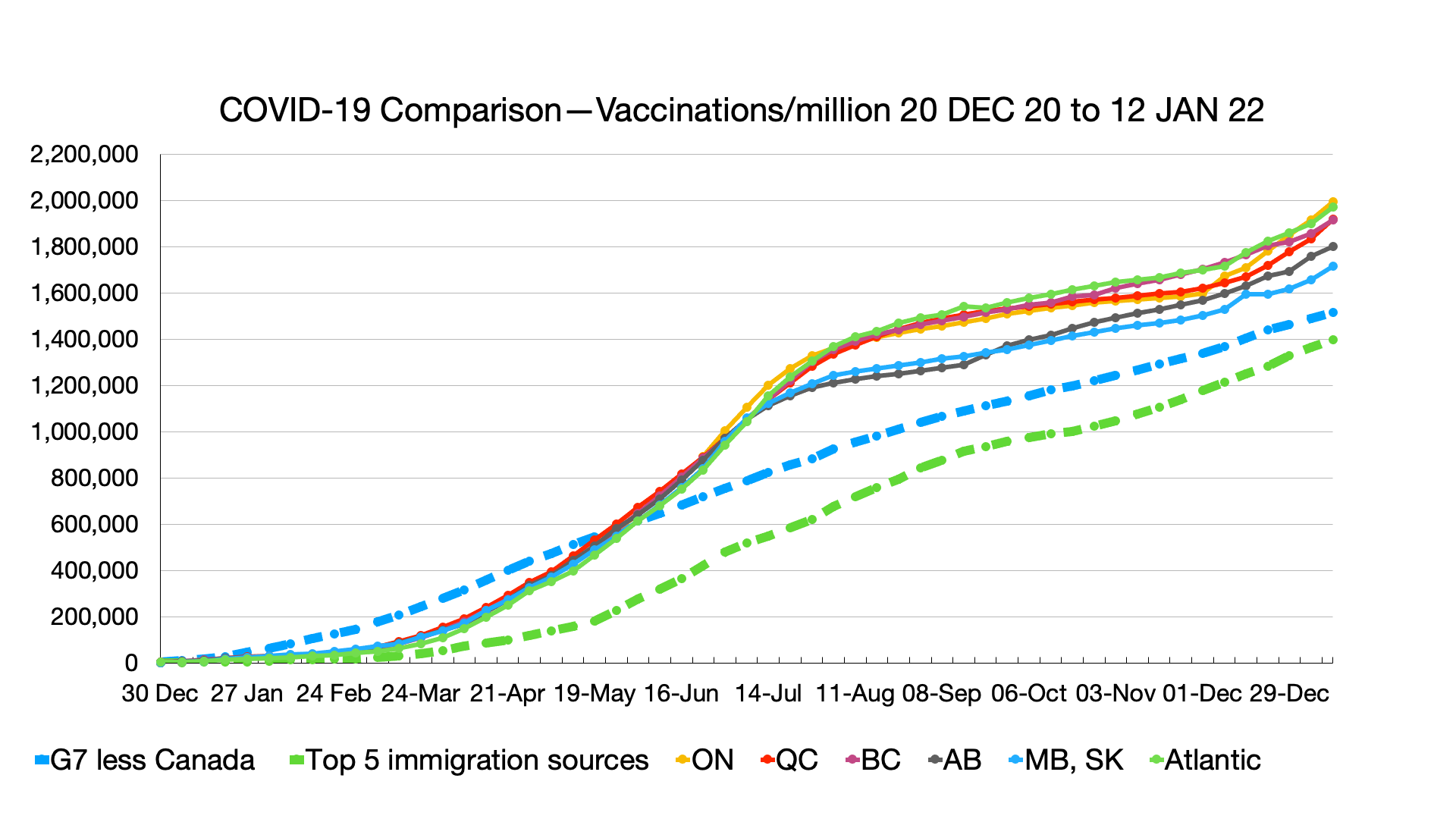
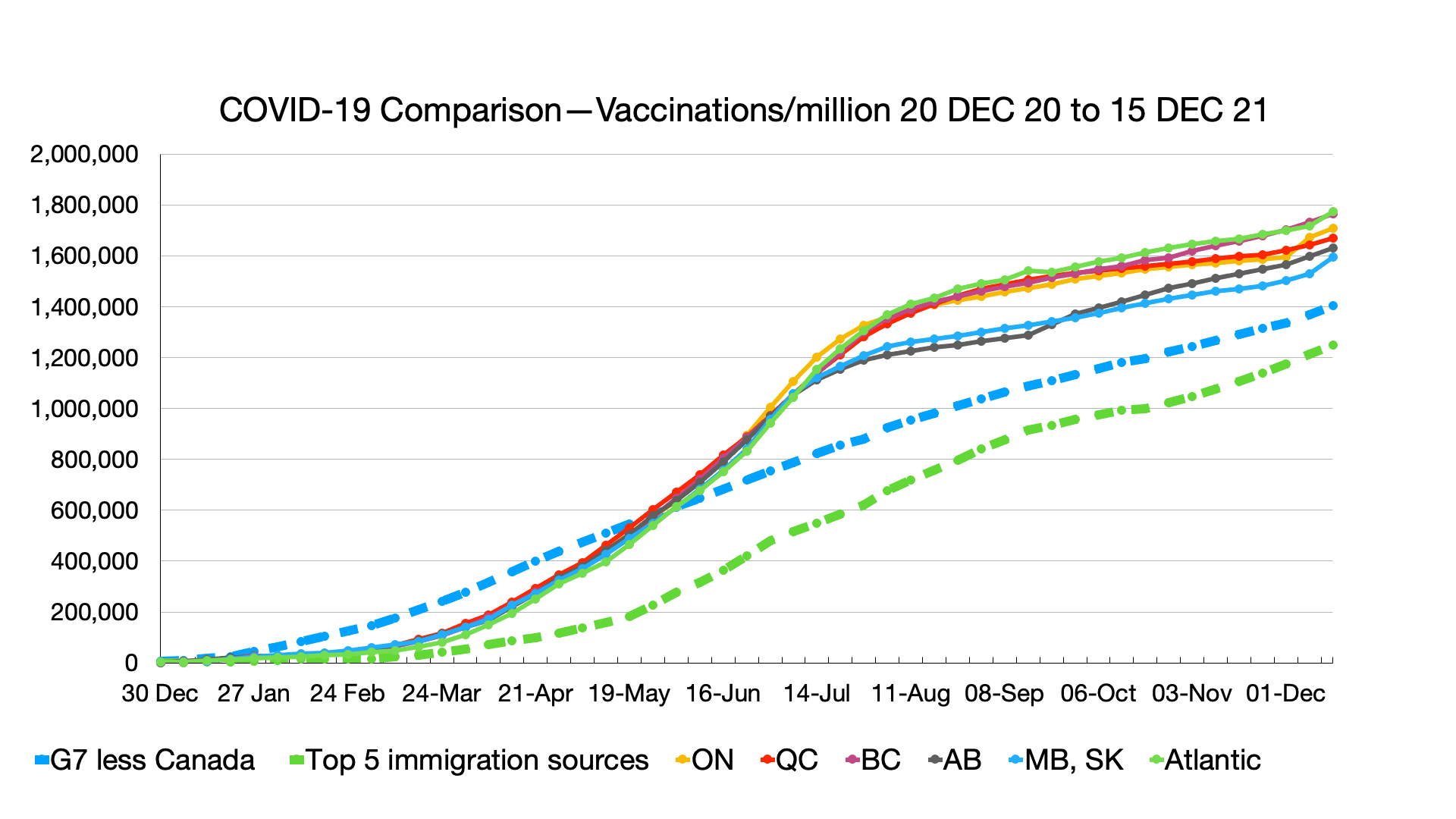
Vaccinations: No major relative changes.

Weekly

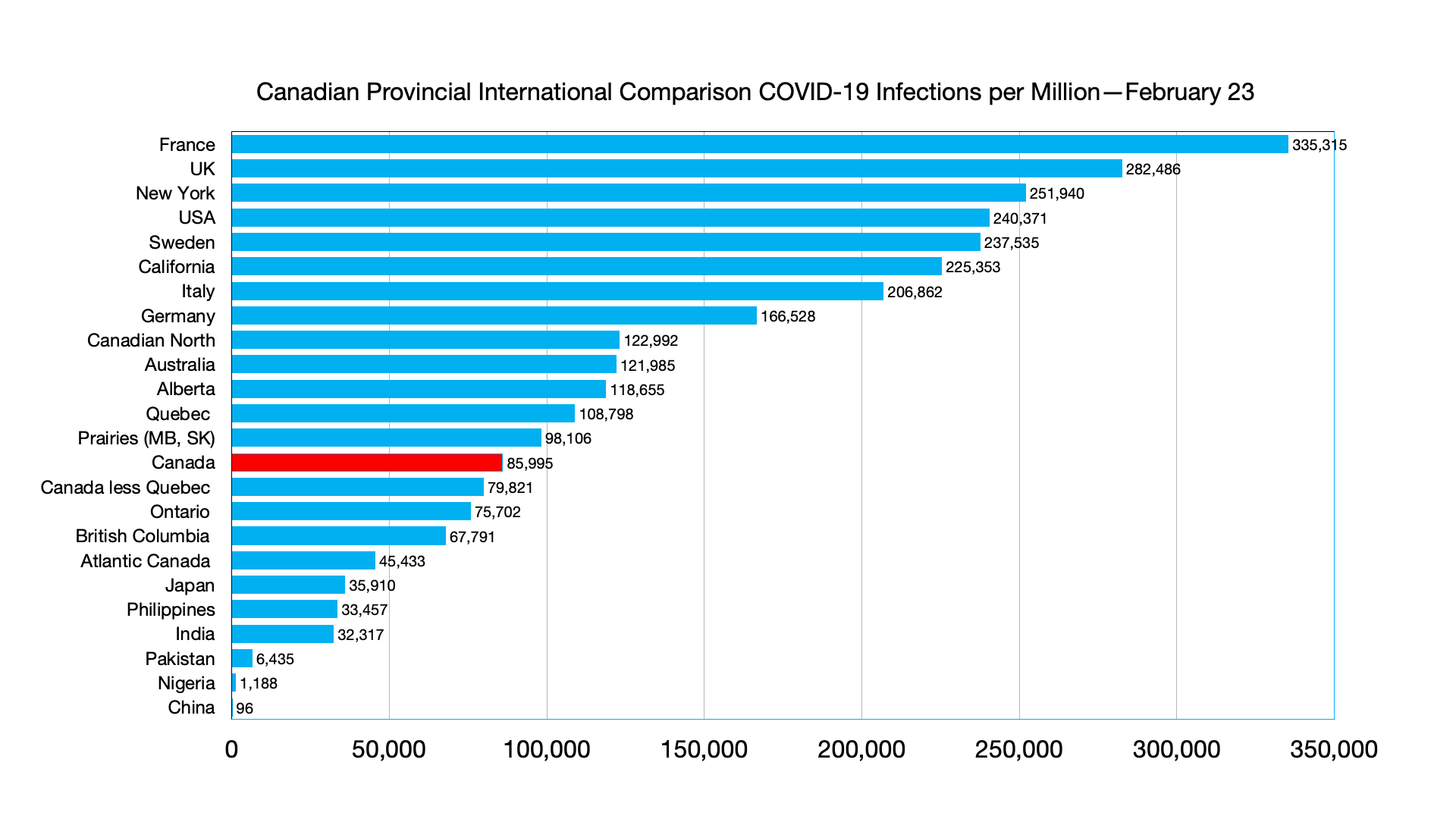
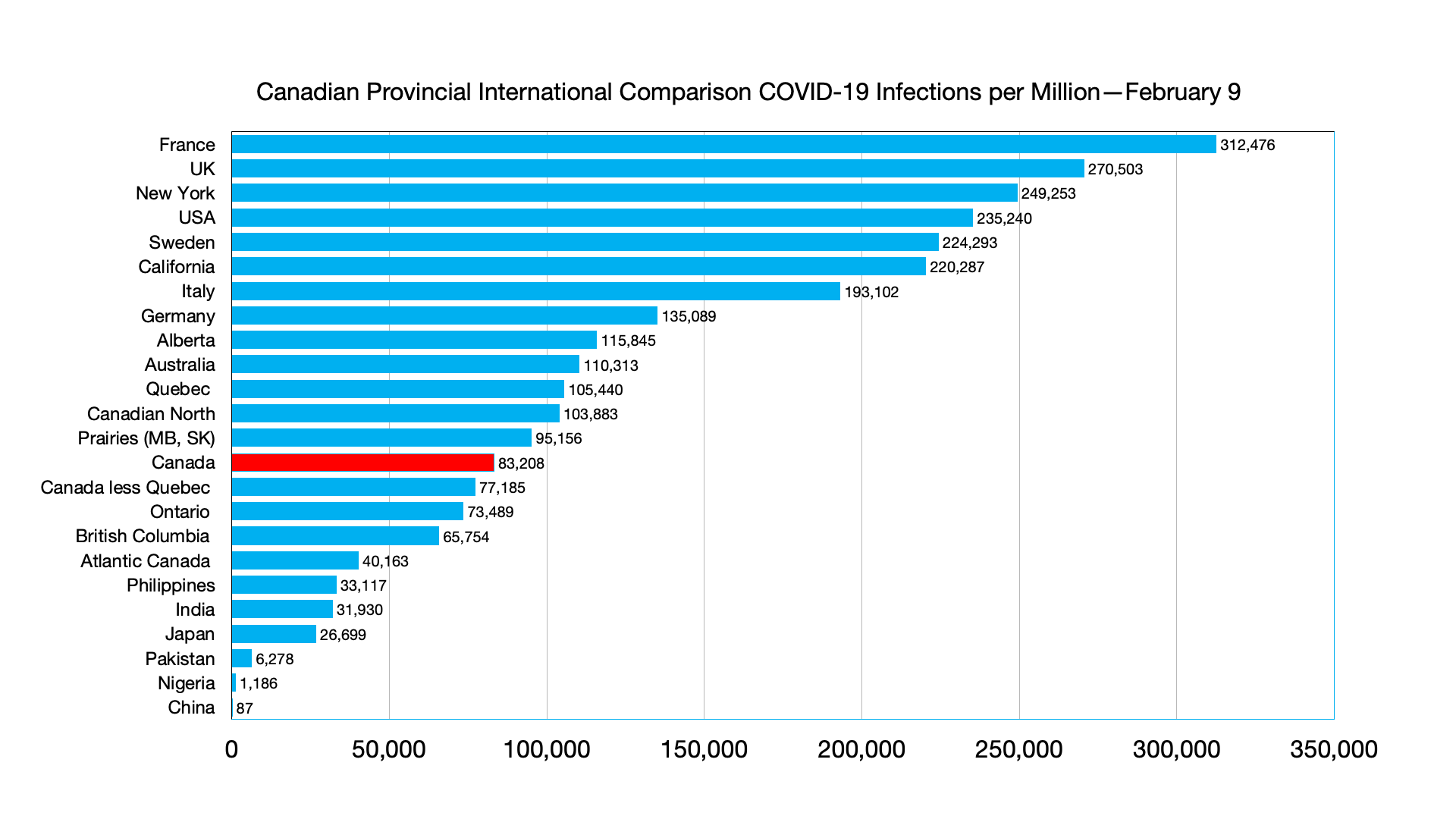
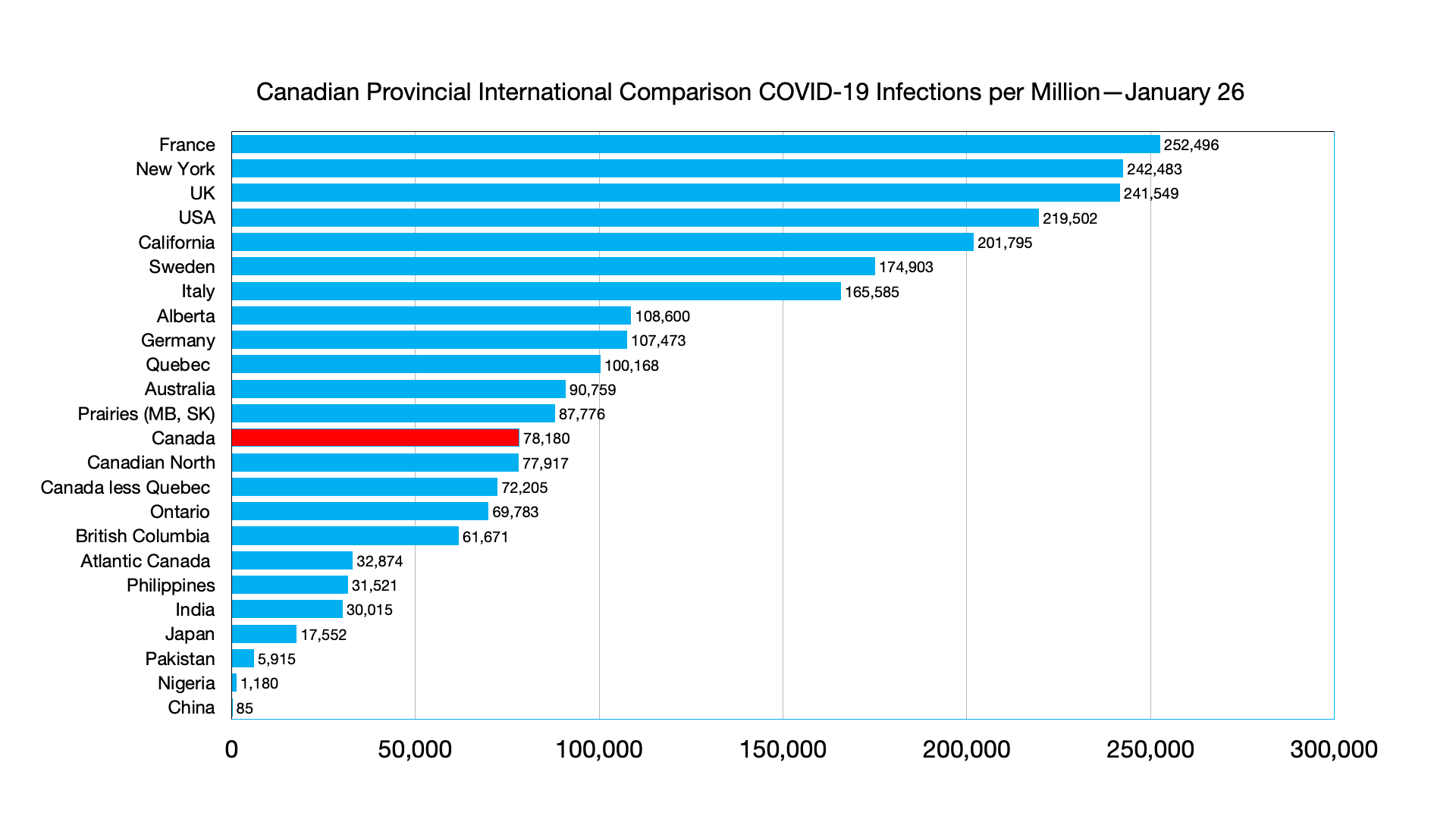
Infections: No relative changes. Infections per million in China have increased from 96 to 226 per million after relatively flat for over six months
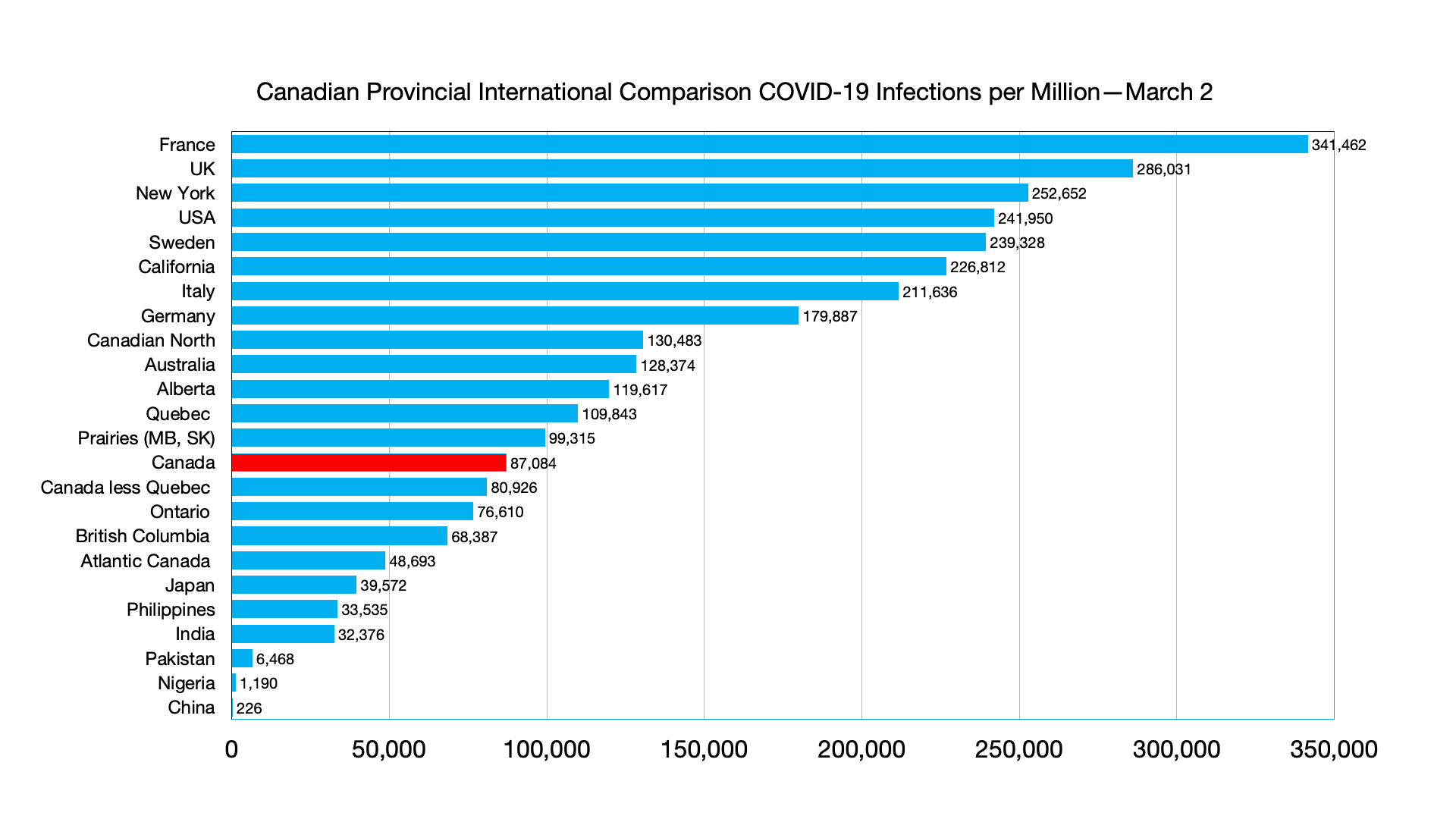
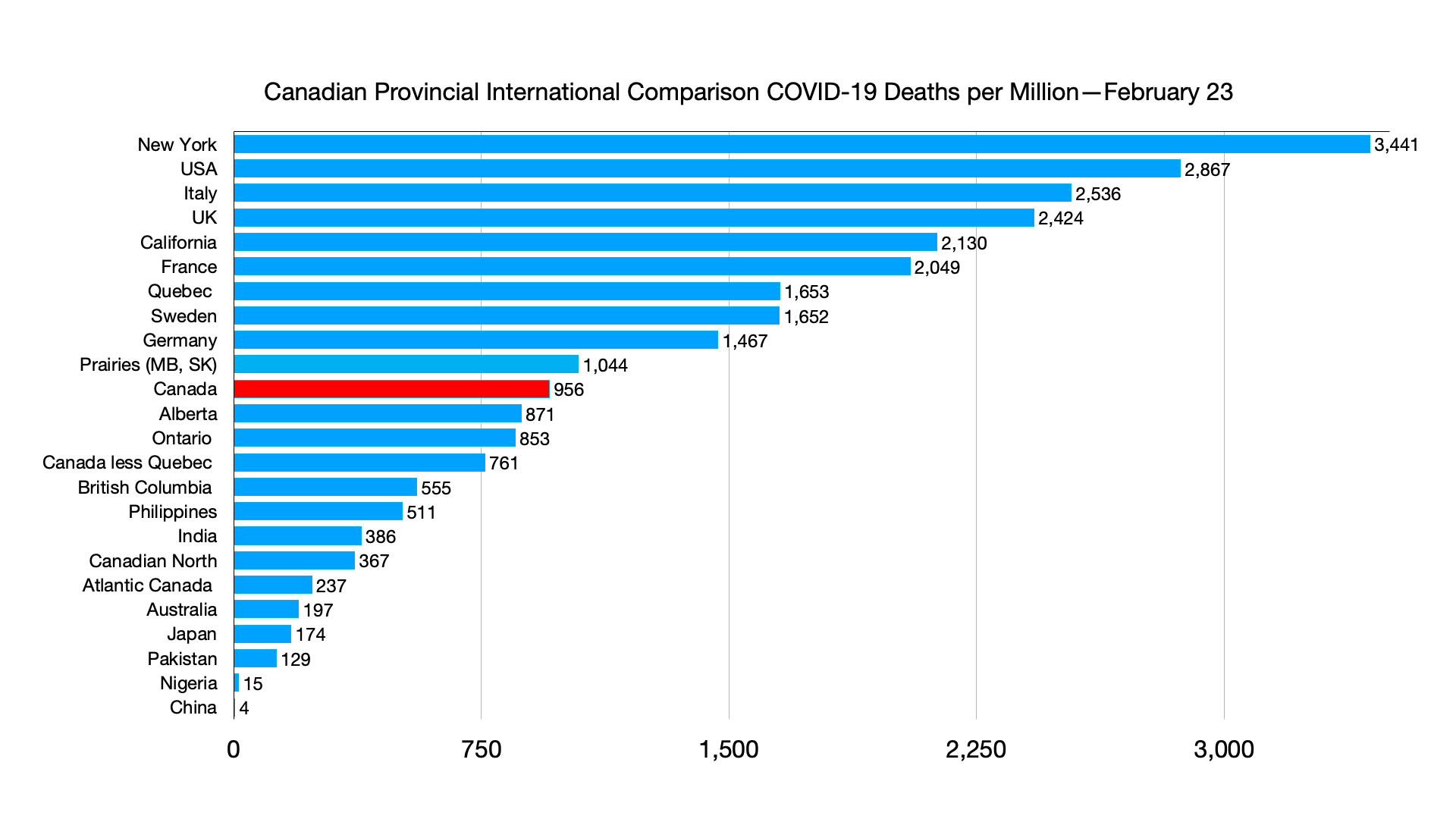
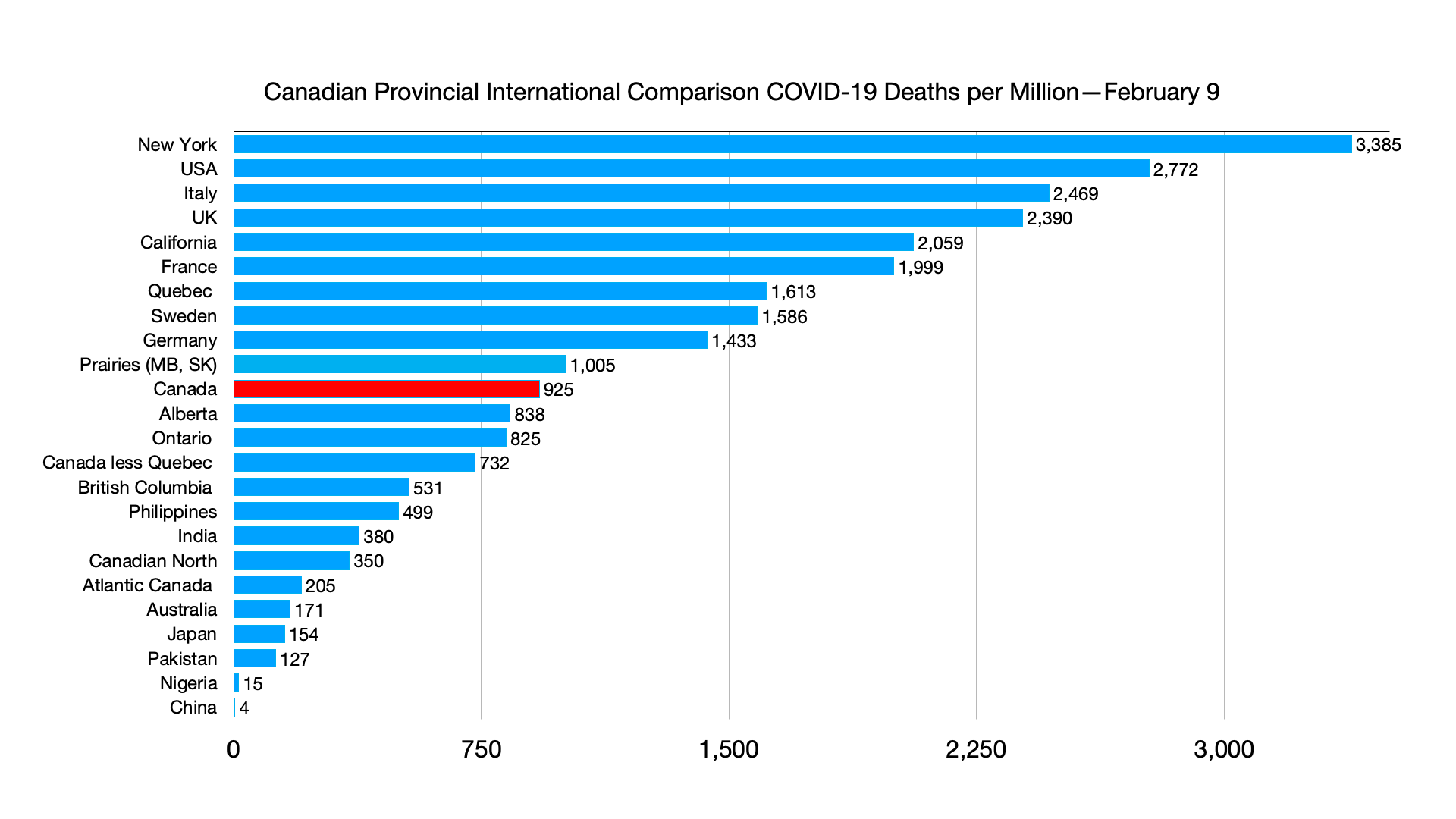
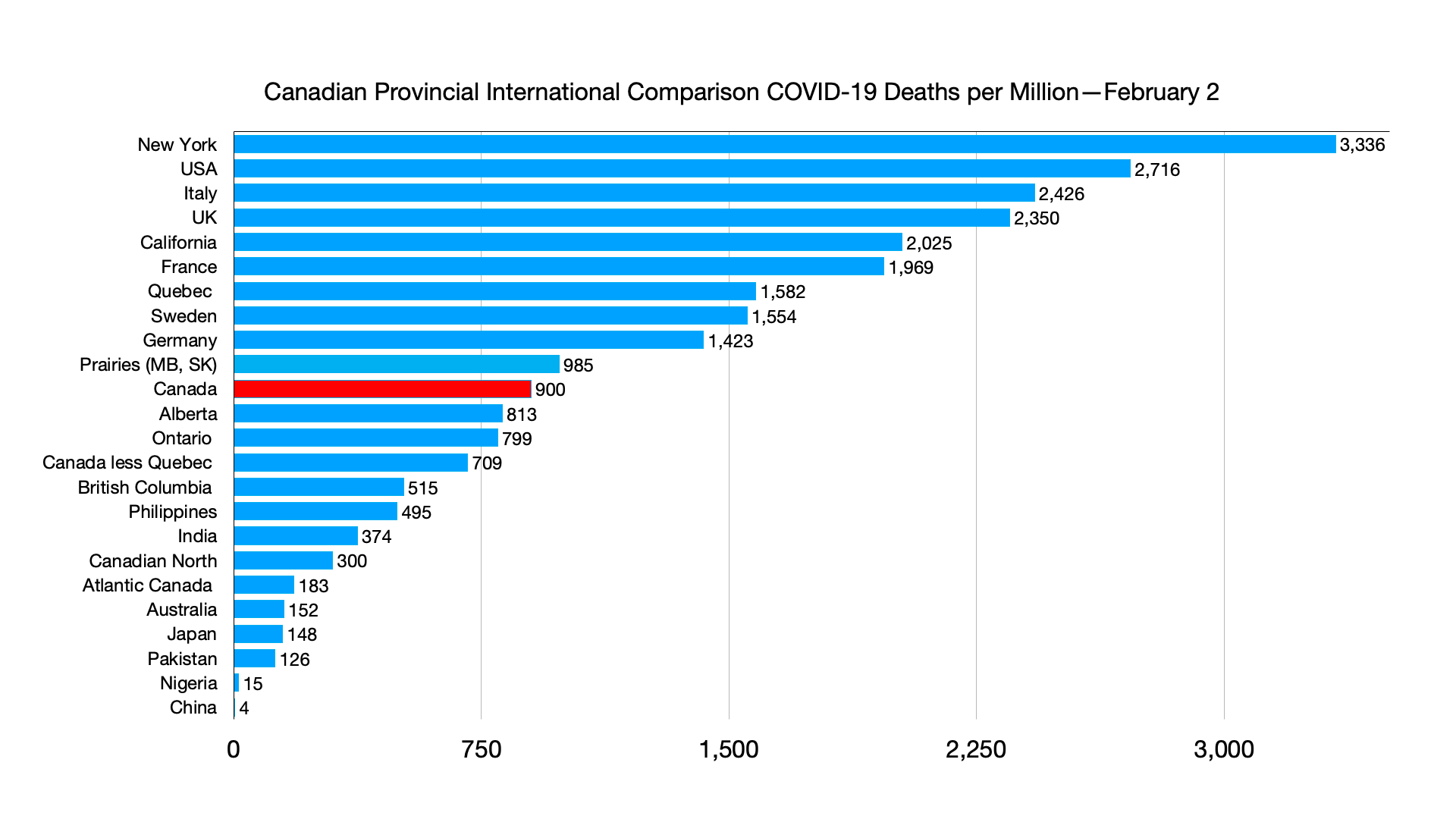
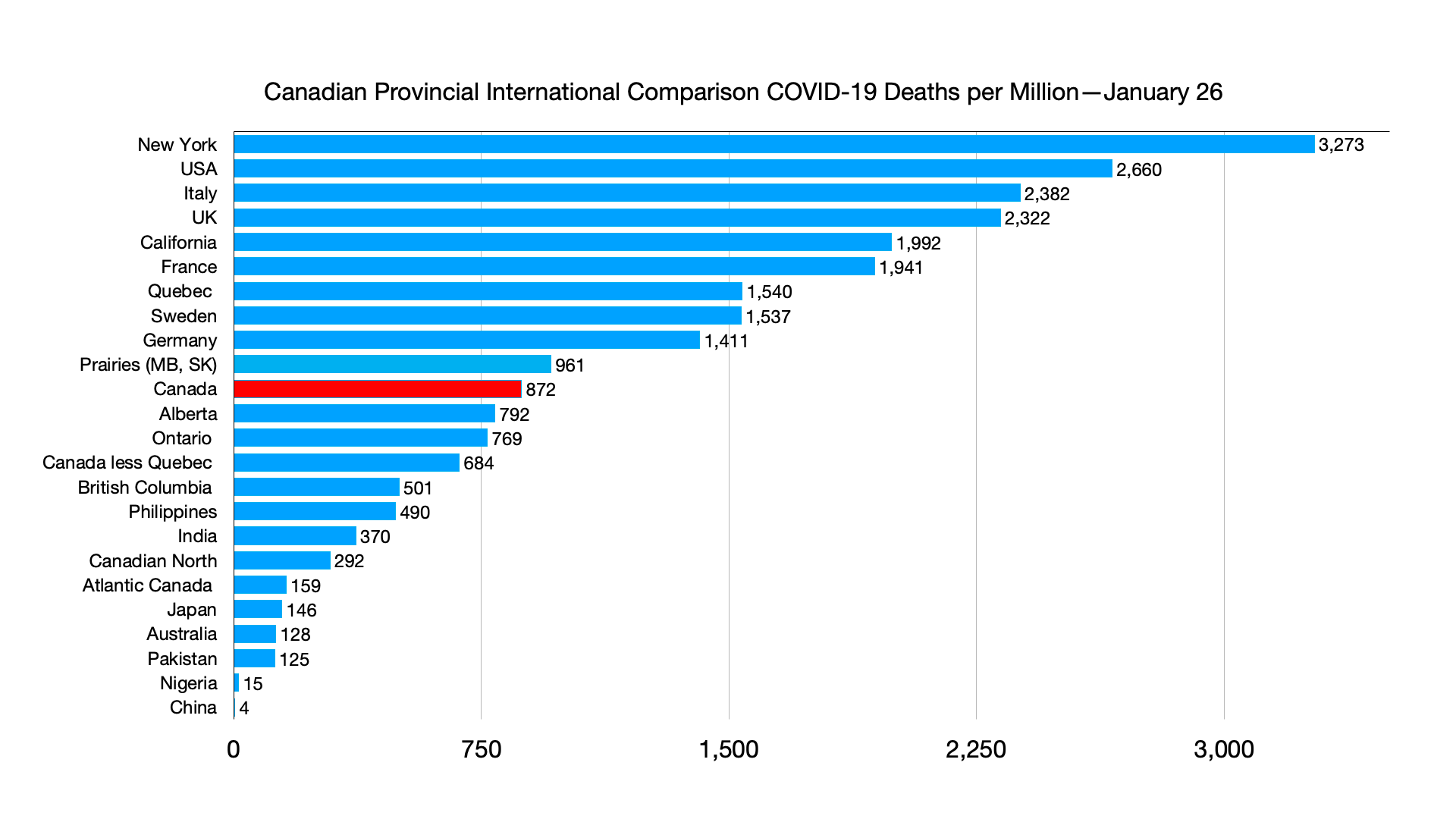
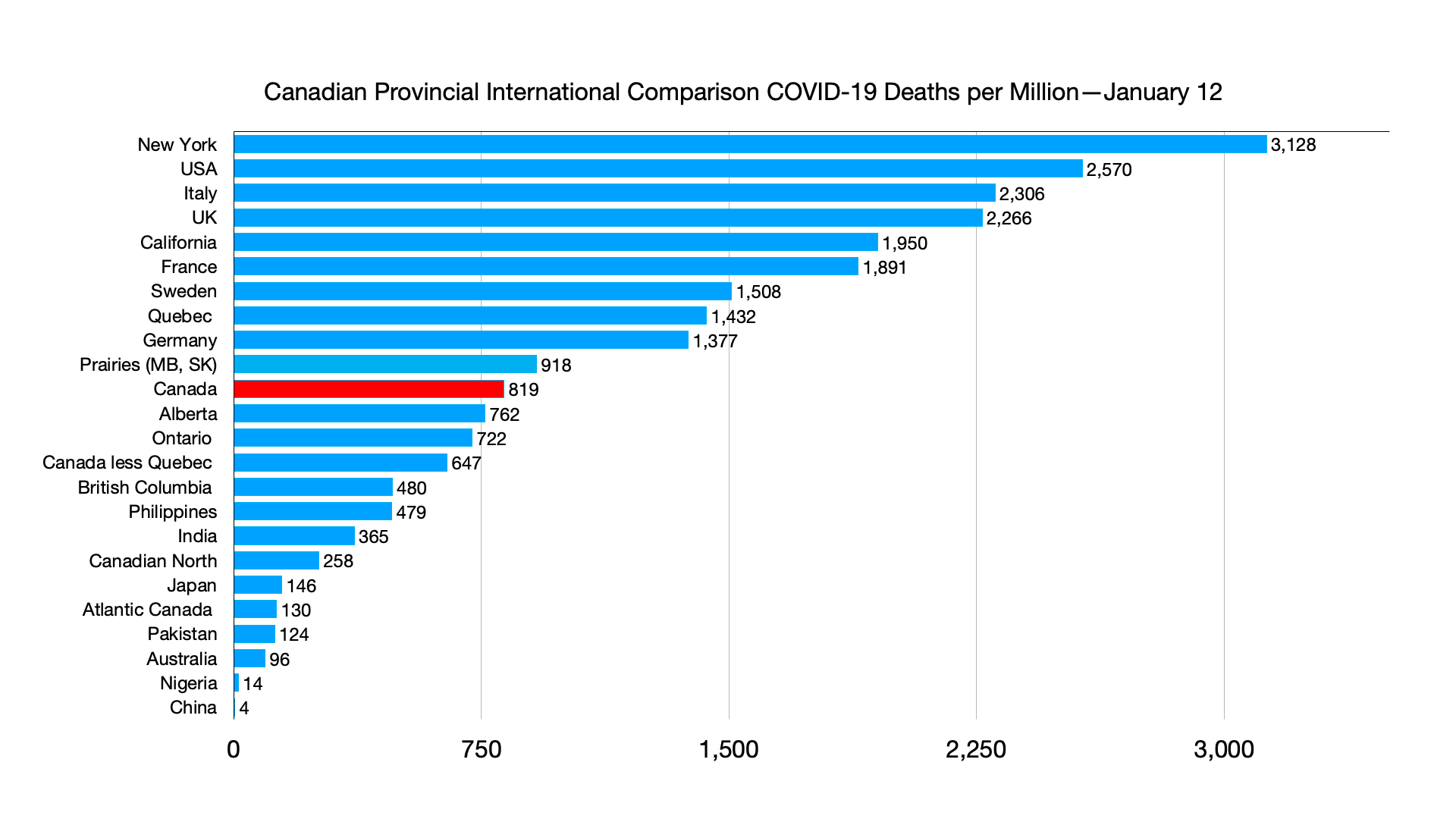
Deaths: Major change again is with respect to China with deaths per million increasing from 3.5 to 3.9. Sweden is now ahead of Quebec.

COVID-19: New Immigration Rules Crack Open Japan’s Closed Door

In early December 2021, when the highly contagious Omicron variant started spreading globally, Japan slammed its border shut. In fact, except for the first months of the pandemic, it adopted a harsher border policy than during previous infection waves.

The country would essentially remain closed to all non-Japanese citizens other than existing residents.

Among the many stranded travelers were an estimated 150,000 international students who had enrolled in Japanese universities, but never made it into Japan after the borders closed in March 2020. Also affected were business people, foreign specialists and technical interns, the term used for foreign nationals who work on farms, in fishing, food processing, hotels, nursing homes or other industries faced with a serious labor shortage.

Japan’s isolationist approach was in tune with only a few other countries, such as China and Hong Kong. Australia and New Zealand  ーwhich previously had some of the strictest border rules, stopping even their own citizens from returning homeー have recently reversed their two year long isolation.

The Japanese government has been a lot more cautious. In the wake of criticism by industry leaders and academics it has now relaxed some of the entry rules. However, its general policy to ban most new entries has not changed. Tourists still remain shut out.

Nevertheless, there is some welcome positive news going into effect from March 2022.

Raised Cap on Daily Entries

In a first sign of hope, the current limit on arrivals at the Japanese border, capped to 3,500 (roughly the passenger load of 17 airplanes), has been raised to 5,000 from March 1.

Vaccination Status Matters

One of the biggest changes is that starting on March 1, Japan will distinguish between vaccinated and non-vaccinated travelers. This is a significant step for a country that was previously disinterested in vaccination status upon entry and has not adopted any kind of vaccination passport to use domestically.

Fully vaccinated travelers coming from high risk countries can isolate at home for seven days. This period can be shortened to three full days with a negative covid-test on day three.

Fully vaccinated arrivals from low risk countries have no quarantine obligation whatsoever.

Fully Vaccinated Means Three Shots

An arriving person only qualifies as vaccinated with proof of three shots. And the vaccines used need to have been approved by Japan.

Currently, there are only four approved shots: The COVID-19 vaccine from Pfizer, Moderna, Astra-Zeneca and Johnson & Johnson. Plus, the only recognized third shots are for Moderna and Pfizer.

…. New Visa Applications

Last not least among the big changes, schools and businesses can now apply for new visas on behalf of business partners, workers and students, if they pledge to monitor that the incoming person will follow any necessary quarantine rules and other measures imposed.

A new website has been set up by the Ministry of Health to facilitate applications, named ERFS or “Entrants, Returnees Follow-up System”. Once the application is approved foreign entrants will get a Certificate of Eligibility (COE), a necessary step to get a visa stamped into the passport at a Japanese embassy or consulate abroad.

Only organizations, not individuals can apply through this website. If you have a COE that has recently expired or is about to do so, a new policy on the period of validity for a certificate of eligibility may be of help as some COE holders may be eligible for an extension.

It is not clear if people who currently have an unexpired COE have to apply.

It also remains to be seen how quickly new visas will be issued and what kind of priorities will be given to whom. After two years of closed borders there is a significant backlog of old cases.

As a cap of daily arrivals remains in place, even though it has now been lifted to 5,000 persons daily, many people will still be in for a long wait.

Source: COVID-19: New Immigration Rules Crack Open Japan’s Closed Door

#COVID-19: Comparing provinces with other countries 23 February Update

Overall decline in infections and deaths as omicron wave passes.

Vaccinations: Some minor shifts but convergence among provinces and countries. Canadians fully vaccinated 81.9 percent, compared to Japan 79.3 percent, UK 73.2 percent and USA 65.5 percent.

Immigration source countries are also converging: China fully vaccinated 87.9 percent (numbers have not budged over past four weeks), India 55.9 percent, Nigeria 3.8 percent (significant increase from very low base), Pakistan 44.4 percent, Philippines 57.9 percent.
Trendline Charts:

Infections: Ongoing signs of omicron and other variants plateauing.

Deaths: Quebec continues to plateau.

Vaccinations: No major change but Alberta and Prairies continue to be laggards compared to other provinces given resistance among residents and political considerations. Jump in Prairies reflects delayed Saskatchewan reporting (weekly, rather than daily, and Globe updates less frequently).

Weekly

Infections: Canadian North and Australia ahead of Alberta, Japan ahead of Philippines and India.

Deaths: No relative change. Of note, Chinese deaths were unchanged from September 22, 2021 until 9 February, 2022, unique among all countries and, frankly, hard to believe (infections were also relatively flat, from 107,789 to 121,629 during the same period).

#COVID-19: Comparing provinces with other countries 16 February Update

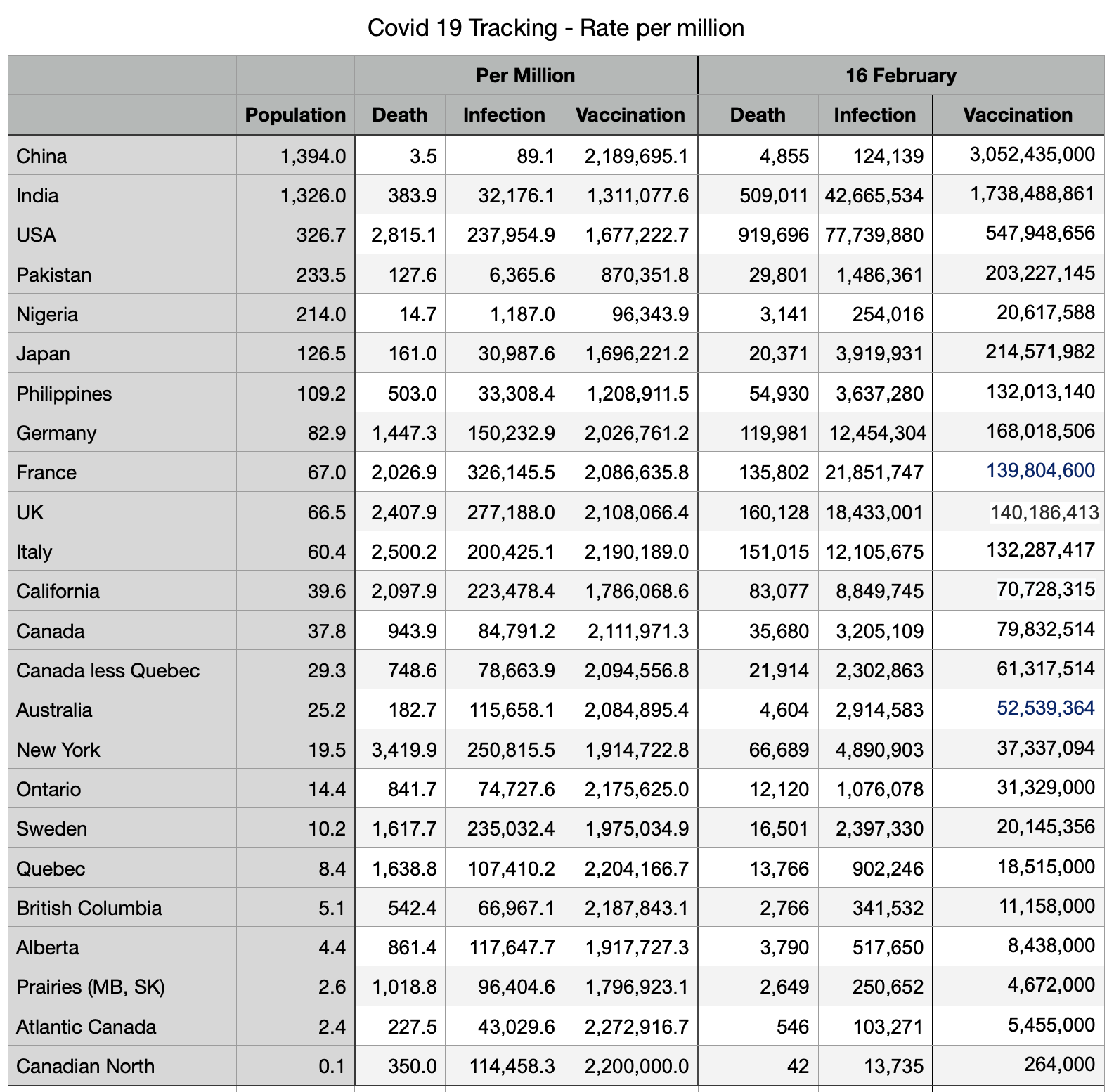
Overall decline in infections and deaths as omicron wave passes. Note Saskatchewan data is from previous Thursday given the government’s “see no evil” strategy of no longer publishing daily statistics.

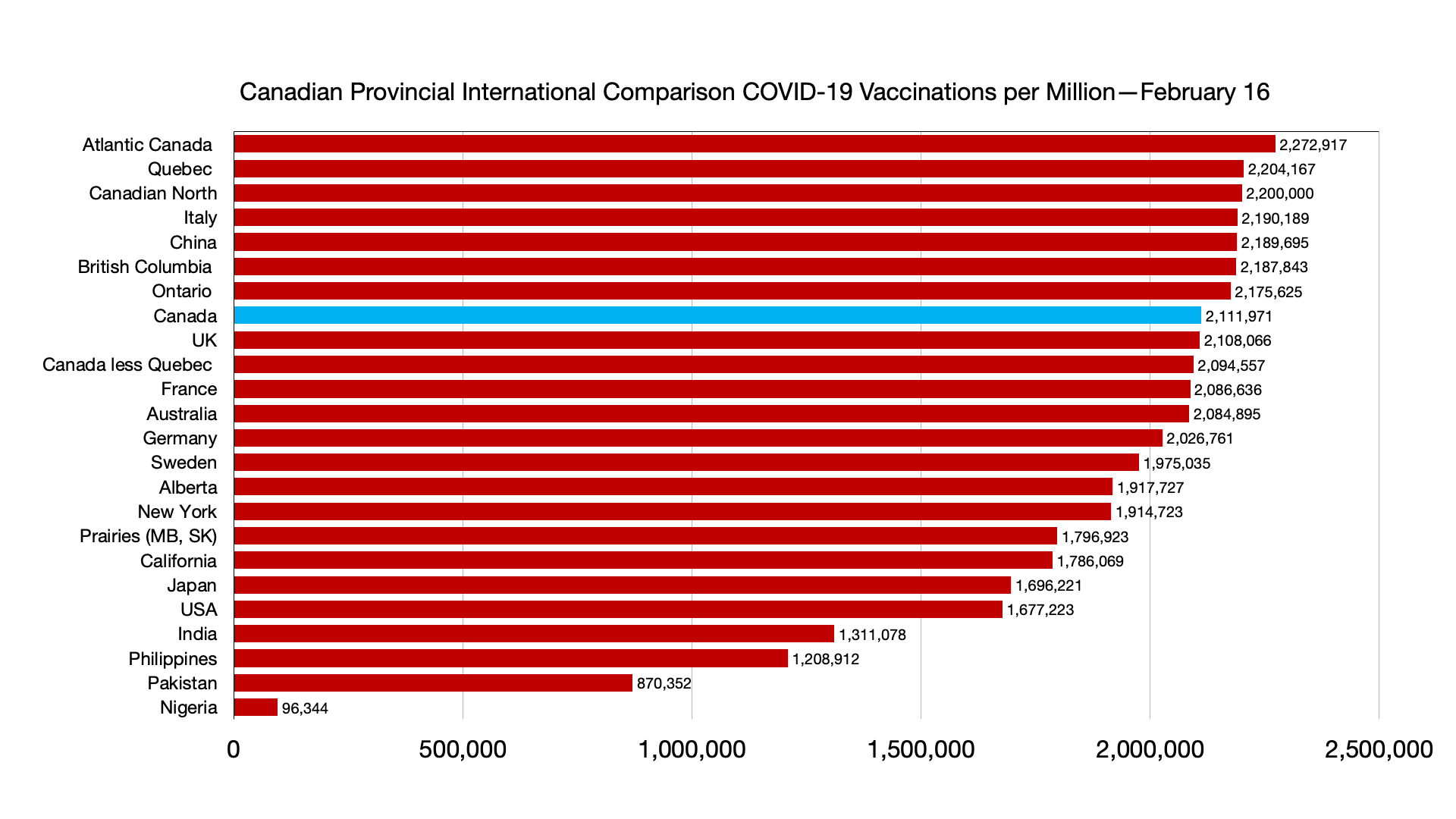
Vaccinations: Some minor shifts but general convergence among provinces and countries. Canadians fully vaccinated 81.6 percent, compared to Japan 79.2 percent, UK 72.7 percent and USA 64.9 percent.

Immigration source countries are also converging: China fully vaccinated 87.9 percent (numbers have not budged over past three weeks), India 55.6 percent, Nigeria 2.7 percent (the outlier, unchanged), Pakistan 43.2 percent, Philippines 56.7 percent.

Trendline Charts:

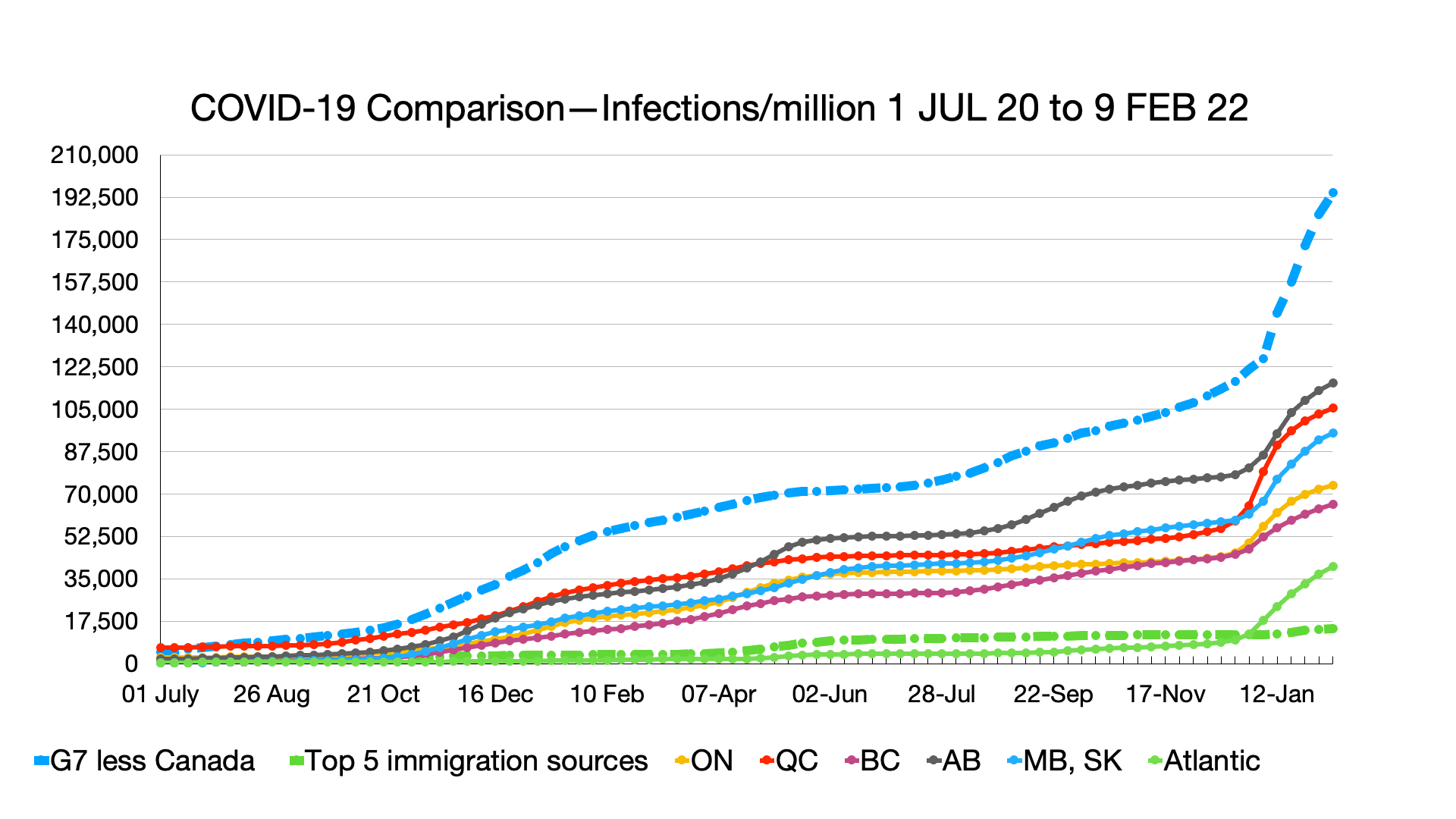
Infections: Further signs of omicron and other variants plateauing.

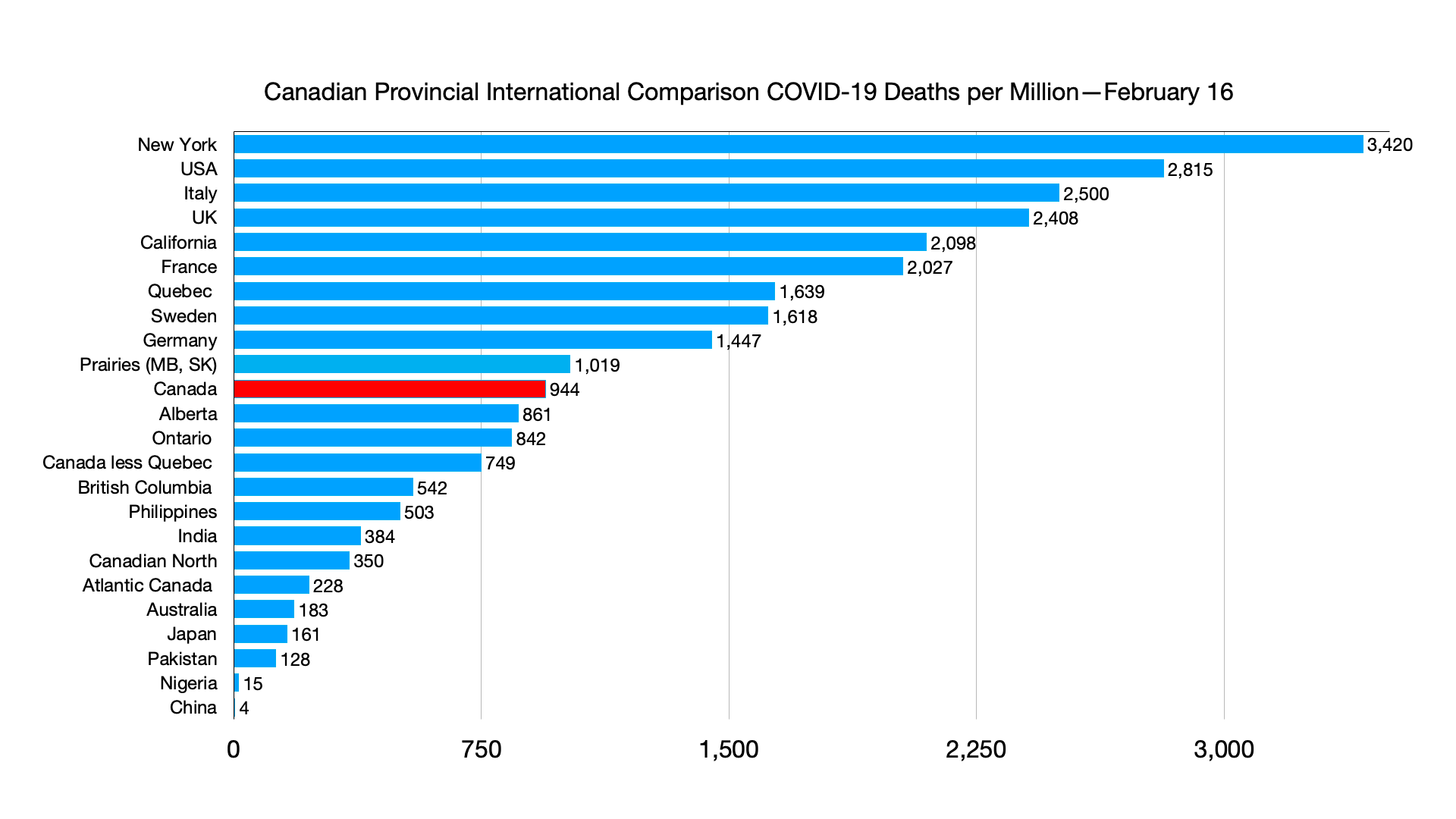
Deaths: Quebec plateauing.

Vaccinations: No major change but Alberta and Prairies continue to be laggards compared to other provinces given resistance among residents and political considerations.

Weekly

Infections: No significant relative changes.

Deaths: No relative change.

#COVID-19: Comparing provinces with other countries 9 February Update

It will be interesting to see the effects of the decisions by Alberta and Saskatchewan to relax or end restrictions over the next few weeks will in terms of infections, deaths and hospitalizations. Probably not as disastrous as “best summer ever” but likely not with consequences.

Vaccinations: Some minor shifts but general convergence among provinces and countries. Canadians fully vaccinated 81 percent, compared to Japan 79.1 percent, UK 72.7 percent and USA 64.9 percent.

Immigration source countries are also converging: China fully vaccinated 87.9 percent (numbers have not budged over past two weeks), India 53.9 percent, Nigeria 2.7 percent (the outlier, unchanged), Pakistan 40.6 percent, Philippines 55.6 percent.

Trendline Charts:

Infections: Signs of omicron and other variants plateauing.

Deaths: Quebec uptick appears to be plateauing.

Vaccinations: No major change but Alberta and Prairies continue to be laggards compared to other provinces. Ironic given they are among the first to relax and end restrictions.

Weekly

Infections: Sweden ahead of California, Australia ahead of Quebec, Canadian North ahead of Prairies.

Deaths: No relative change.

#COVID-19: Comparing provinces with other countries 2 February Update

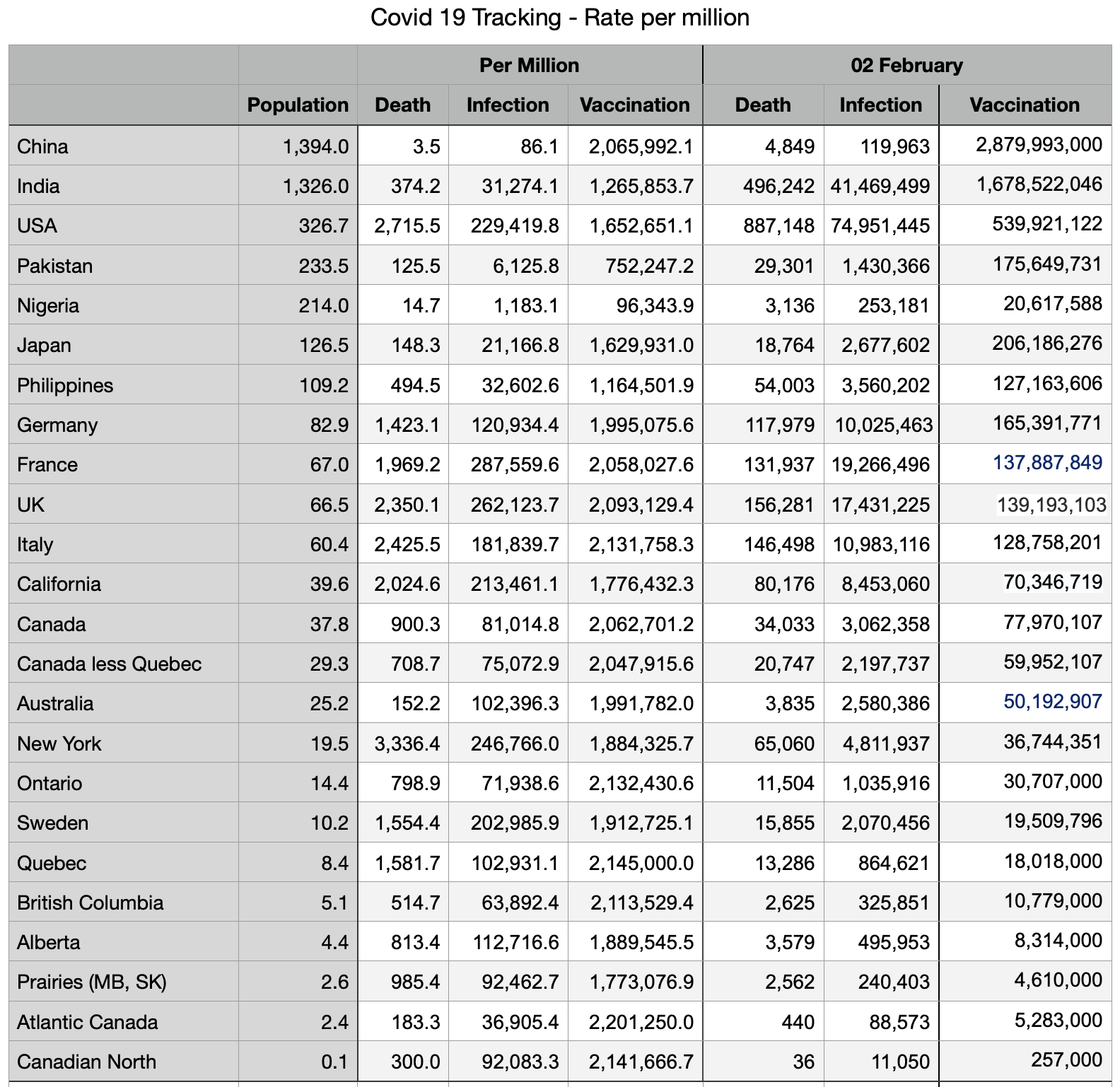
While infections appear to have plateaued, lagging indicators such as hospitalizations, ICU use, and deaths have not for the most part.

Vaccinations: Some minor shifts but general convergence among provinces and countries. Canadians fully vaccinated 80.3 percent, compared to Japan 79 percent, UK 72.5 percent and USA 64.6 percent.

Immigration source countries are also converging: China fully vaccinated 87.8 percent (numbers have not budged over past two weeks), India 52.3 percent, Nigeria 2.7 percent (the outlier), Pakistan 38.1 percent, Philippines 54.7 percent.

Trendline Charts:

Infections: Moving towards a possible plateauing in most Canadian provinces, G7 less Canada still rising more steeply than Canada.

Deaths: No relative changes but Quebec uptick remains highly visible.

Vaccinations: No major change but Alberta and Prairies continue to be laggards compared to other provinces.

Weekly

Infections: UK ahead of USA, New York and California, Germany ahead of Alberta, Canadian North ahead of Canada.

Deaths: Australia ahead of Japan.

#COVID-19: Comparing provinces with other countries 26 January Update

Steep rise of infections remains the main story, along with resulting increases in hospitalizations and ICUs.

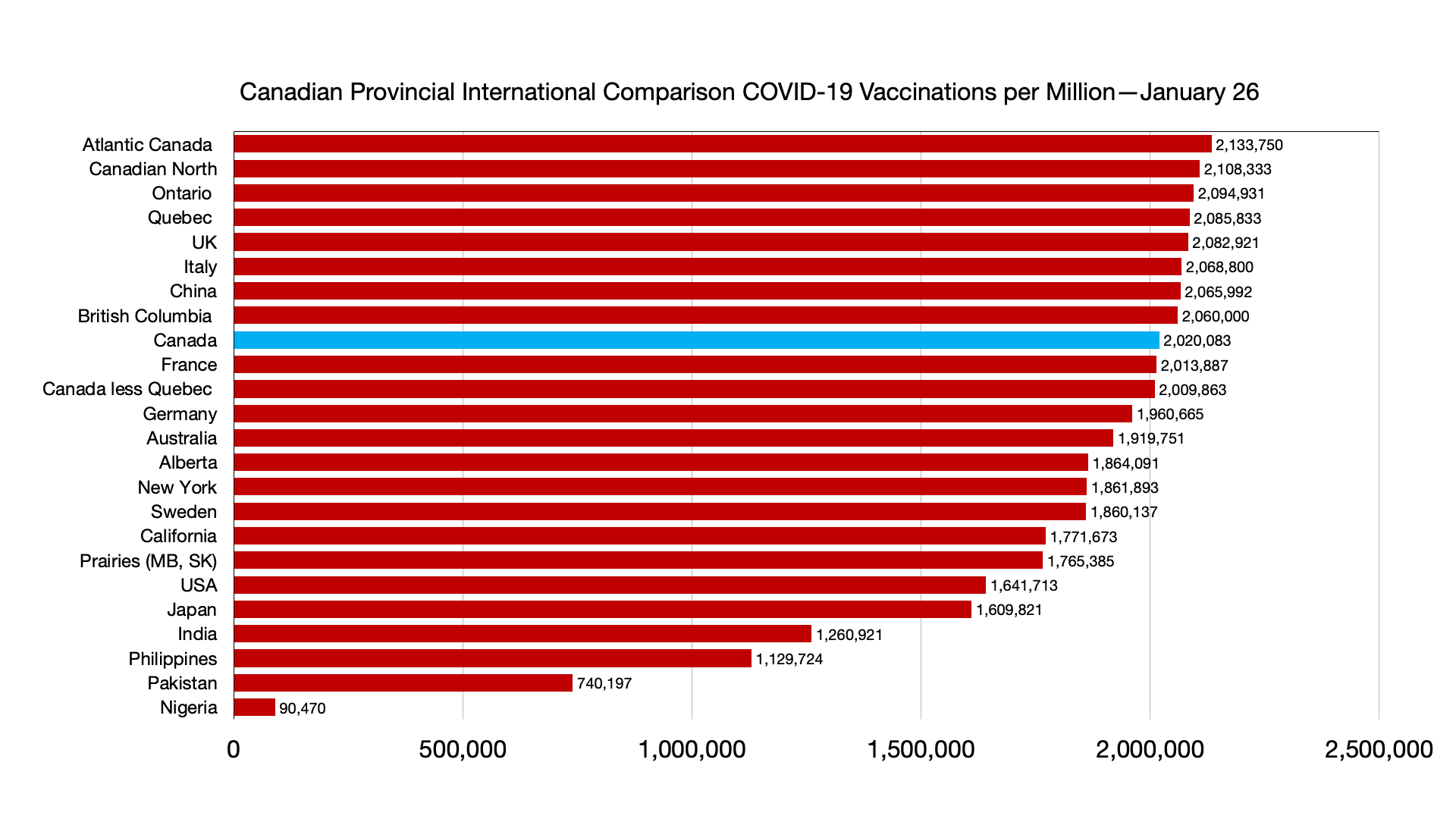
Vaccinations: Some minor shifts but general convergence among provinces and countries. Canadians fully vaccinated 79.5 percent, compared to Japan 78.9 percent, UK 72.2 percent and USA 64.2 percent.

Immigration source countries are also converging: China fully vaccinated 87.6 percent, India 50.4 percent, Nigeria 2.6 percent (the outlier), Pakistan 37 percent, Philippines 53 percent.

Trendline Charts:

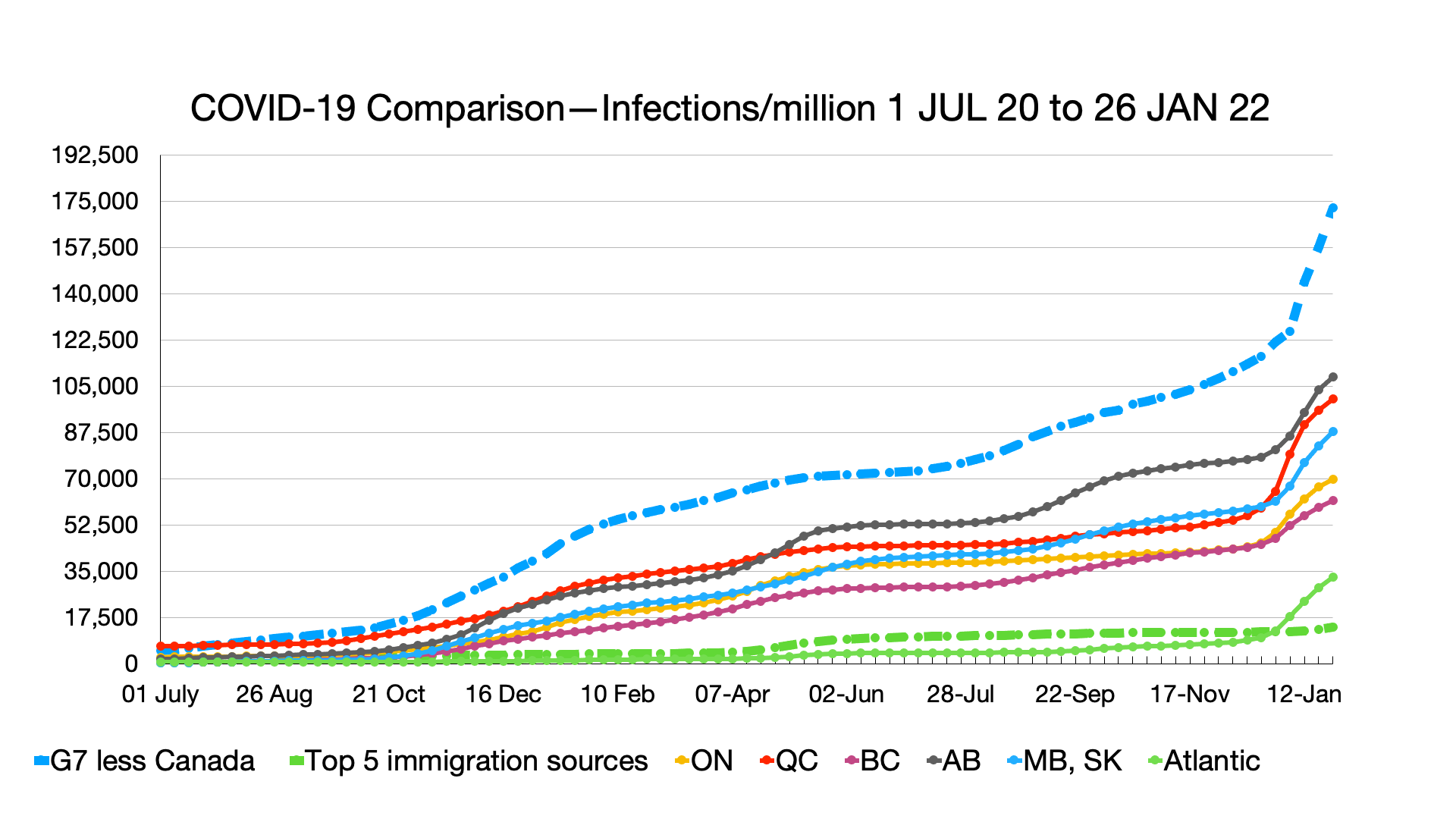
Infections: Effects of Omicron seen in steep curve in all G7 countries and provinces. No such effect in immigration source countries.

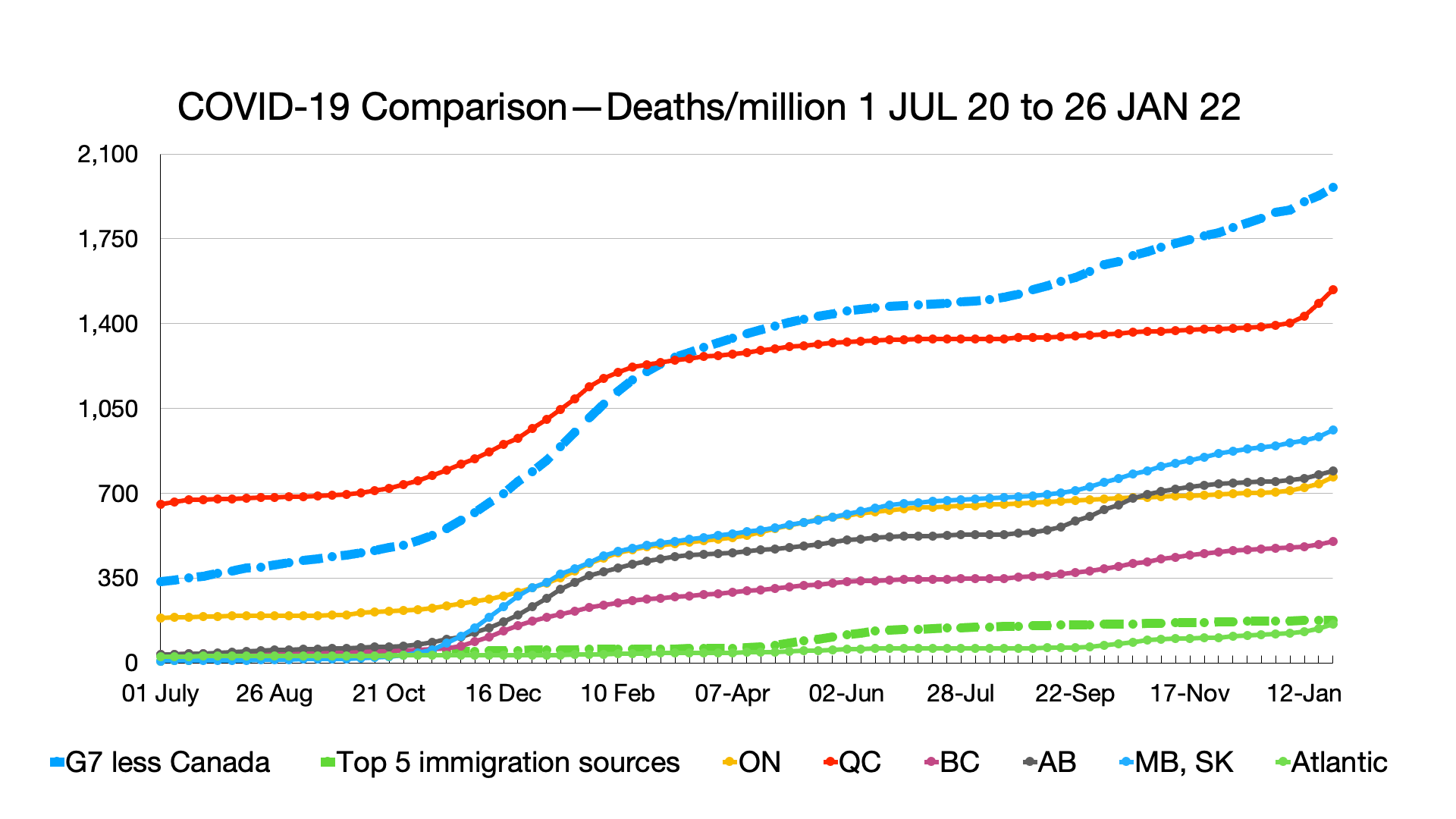
Deaths: No relative changes but Quebec uptick highly visible.

Vaccinations: Ongoing convergence among most provinces. Gap between G7 less Canada continues to grow despite overall convergence, with narrowing gap with immigration source countries save for Nigeria.

Weekly

Infections: France ahead of New York and UK, Australia ahead of Prairies, Atlantic Canada ahead of Philippines. 

Deaths: Quebec ahead of Sweden, Atlantic Canada ahead of Japan, Australia ahead of Pakistan.

#COVID-19: Comparing provinces with other countries 19 January Update

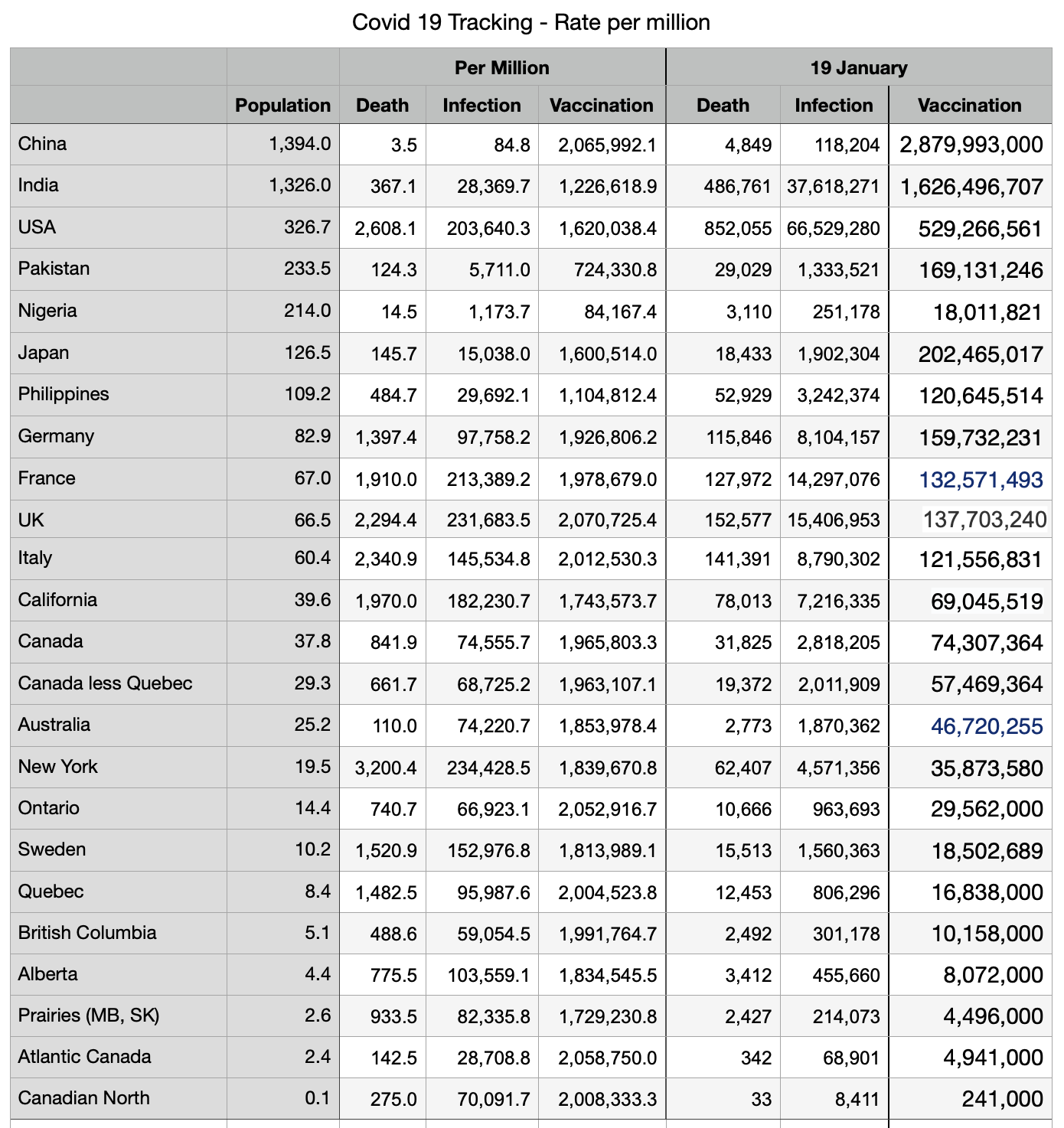
Steep rise of infections remains the main story, along with resulting increases in hospitalizations and ICUs.

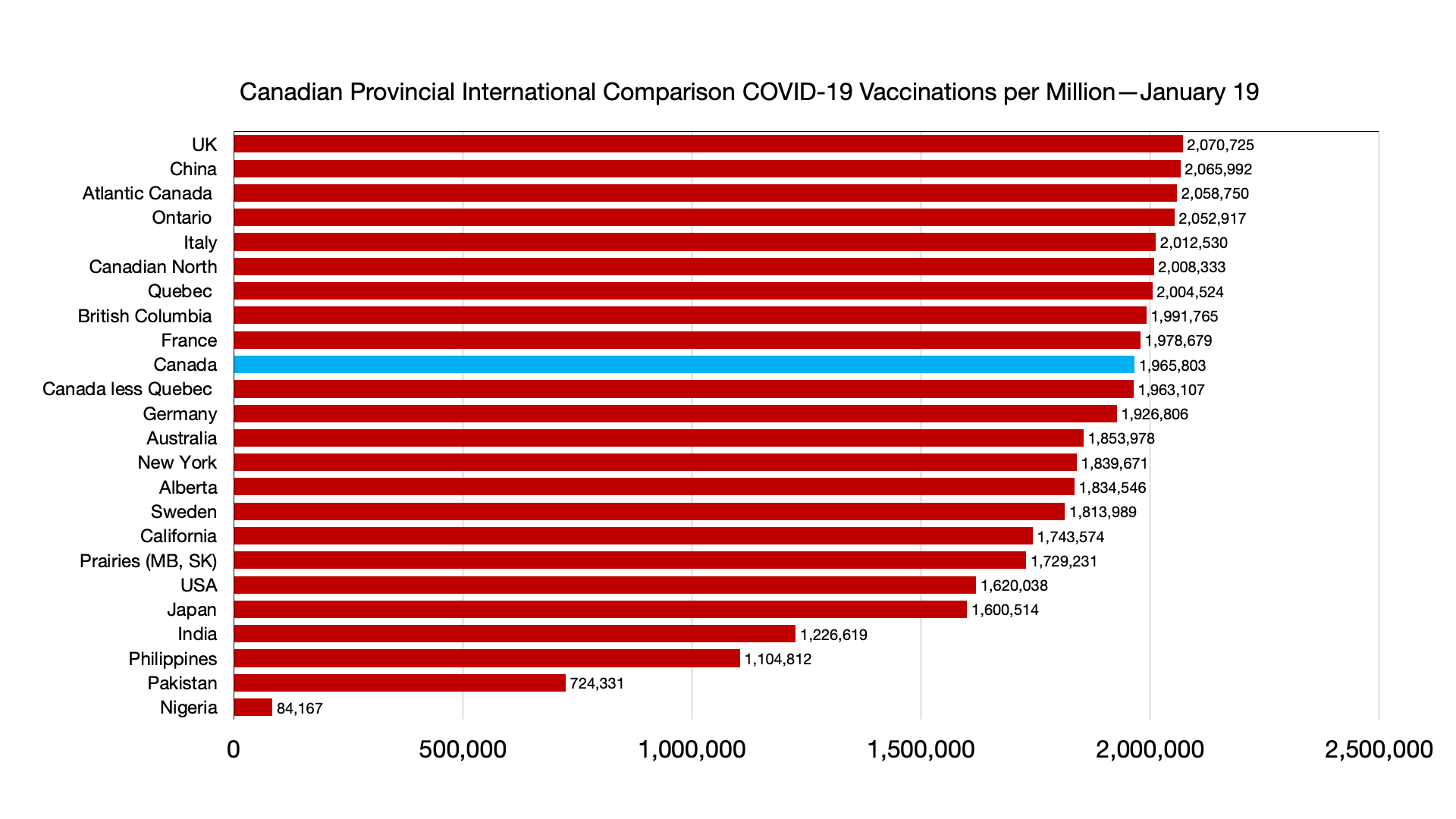
Vaccinations: Some minor shifts but general convergence among provinces and countries. Canadians fully vaccinated 79 percent, compared to Japan 78.9 percent, UK 71.4 percent and USA 63.4 percent.

Immigration source countries are also converging: China fully vaccinated 87.3 percent, India 48.2 percent, Nigeria 2.5 percent (the outlier), Pakistan 36 percent, Philippines 51.8 percent.

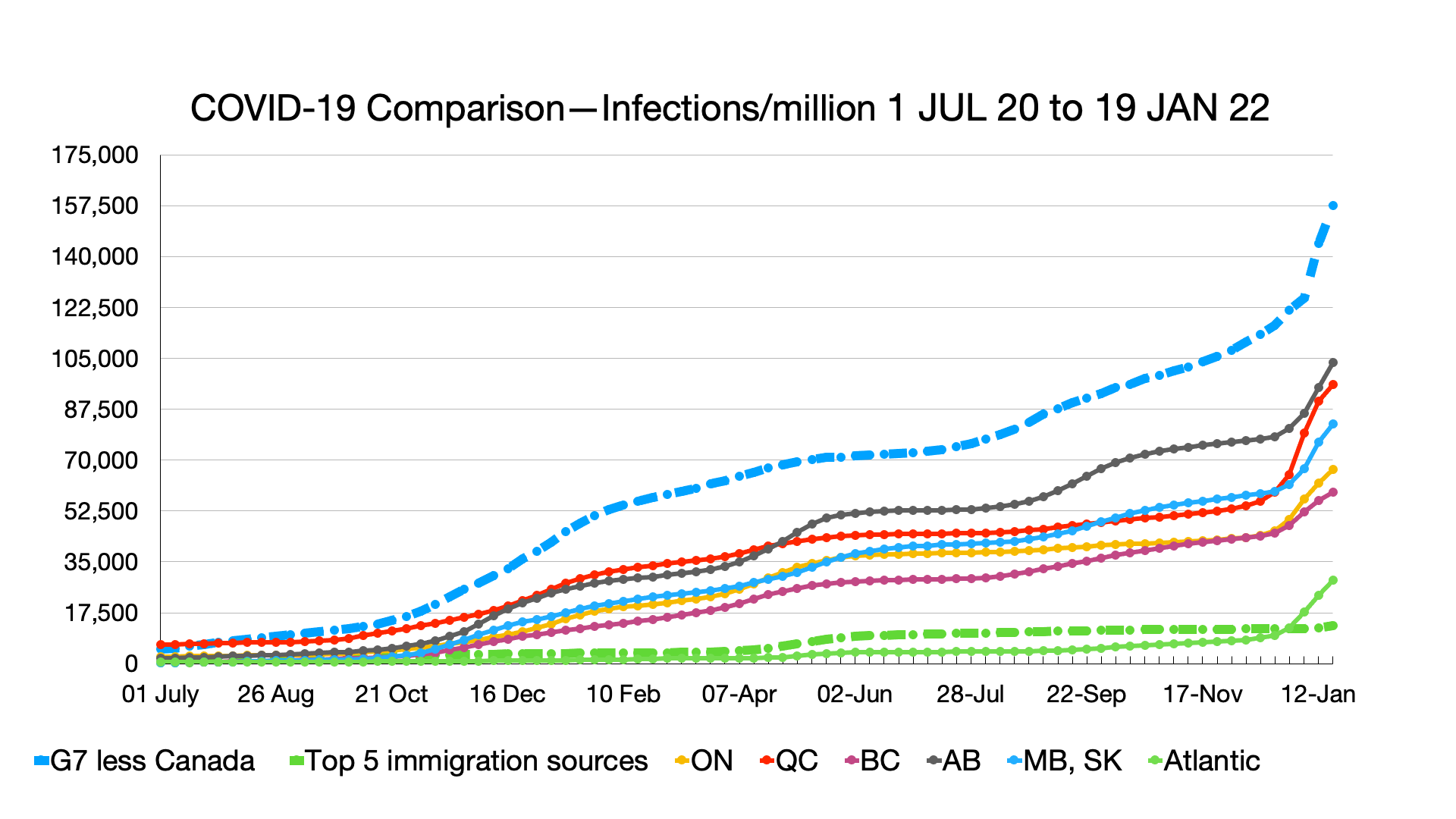
Trendline Charts:

Infections: Effects of Omicron seen in steep curve in all G7 countries and provinces. No such effect in immigration source countries

Deaths: No relative changes but Quebec uptick more visible.

Vaccinations: Ongoing convergence among most provinces but lower rates for Alberta and Prairies. Gap between G7 less Canada continues to grow despite overall convergence, with narrowing gap with immigration source countries. Nigeria remains the laggard.

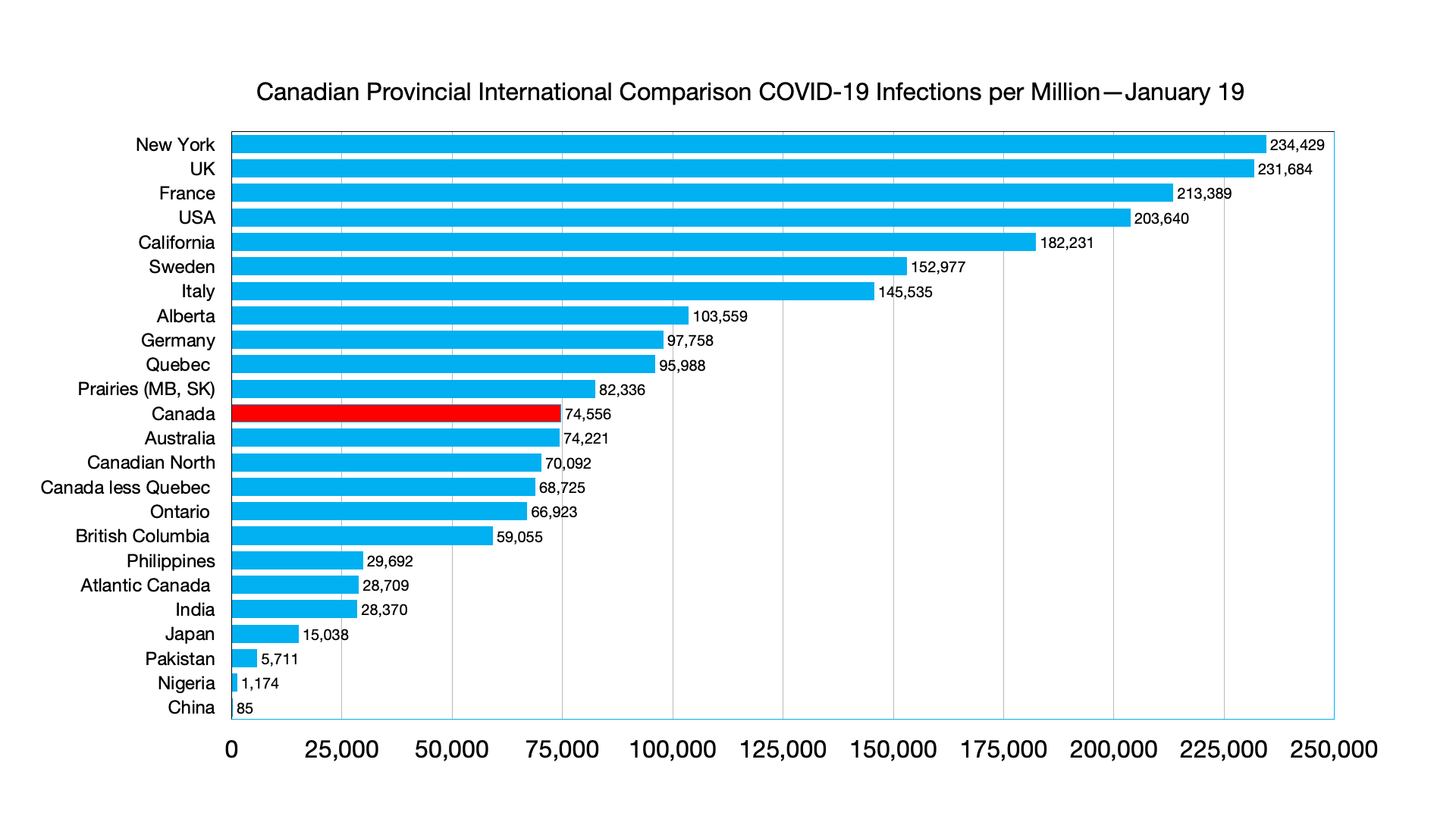
Weekly

Infections: New York ahead of UK, France ahead of USA, Australia ahead of Canada less Quebec, Atlantic Canada ahead of India. 

Deaths: No relative change.

#COVID-19: Comparing provinces with other countries 12 January Update

Steep rise of infections remains the main story, along with resulting increases in hospitalizations and ICUs.

Vaccinations: Some minor shifts but general convergence among provinces and countries. Canadians fully vaccinated 78.7 percent, compared to Japan 78.8 percent, UK 71.4 percent and USA 63.4 percent.

Immigration source countries are also converging: China fully vaccinated 87 percent, India 46.8 percent, Nigeria 2.4 percent (the outlier), Pakistan 34.7 percent, Philippines 49.4 percent.

Trendline Charts:

Infections: Effects of Omicron seen in steep curve in all G7 countries and provinces. No such effect in immigration source countries

Deaths: No relative changes but slight uptick in Quebec.

Vaccinations: Ongoing convergence among provinces and G7 less Canada and narrowing gap with immigration source countries. Nigeria remains the laggard.

Weekly

Infections: Alberta ahead of Germany, Australia and Philippines ahead of India, India ahead of Atlantic Canada. 

Deaths: Atlantic Canada ahead of Pakistan.

Fair amount of commentary on Quebec’s announcement of a health tax on the unvaccinated, with most commentary opposed to the idea. A notable exception on the right side of the political spectrum, Tasha Kheiriddin:

What to do about the unvaccinated? As Omicron tears through Canadian society, this public health question has become a political wedge issue. The Liberals and Conservatives have chosen sides, ramped up the rhetoric, and polarized the debate, each playing to the base they think is most likely to support their point of view.

With 88 per cent of Canadians over the age of 12 fully vaccinated , the Liberals figure they’re pretty safe siding with the crowd that favours the jab. Regrettably, they have chosen the strategy of demonization. On Friday, Health Minister Jean-Yves Duclos speculated provincial governments would make vaccination mandatory, which he said could be needed to get “rid” of the virus.

During the election campaign Prime Minister Justin Trudeau called the unvaccinated “misogynists and racists.” He dialled that down a bit last week when he said that Canadians are angry at the unvaccinated who take up hospital beds, but his remarks caused a furor that has yet to subside. This is not accidental.

The sad reality is that there is a subset of the unvaccinated who fit Trudeau’s description; since September, for example, some have been using the hashtag “Pureblood” on social media to self-identify as unvaccinated. You don’t have to scroll far to find tagged images peppered with shots of white supremacy gestures or MAGA hats.

The Liberals’ dogwhistle is designed to conflate these people with mainstream Conservatives — and turn people off Conservative Leader Erin O’Toole’s call for “reasonable accommodation.” O’Toole is asking for “acceptance” of the fact that up to 15 per cent of the population will not get vaccinated. He favours using rapid tests to keep unvaccinated workers on the job, as opposed to shutting down to stop the spread of the virus.

“In a population that is now largely fully vaccinated, in fact the action and inaction by the Trudeau government is normalizing lockdowns and restrictions as the primary tool to fight the latest COVID-19 variant.”

But this approach is also wrong. First, it relies on unreliable technology. Rapid tests are not good at detecting Omicron infections, particularly in the early stage when a person is infectious but shows no symptoms. Second, it sends a double message. On the one hand, the Tories encourage people to “get vaccinated.” On the other, they make allowances for those who eschew the jab. It’s like saying “wear your seatbelt, but if you don’t, that’s OK.” Well guess what — it’s not. If you get in an accident, it will cost up to three times more to treat you in hospital than if you were buckled up. Sound familiar?

The reality is that we restrict plenty of behaviours where we judge the harm to others, including economic harm, outweighs the limits to individual liberty. We don’t allow people to smoke in workplaces or public buildings. We forbid drinking and driving. And we mandate vaccination for contagious diseases such as measles if children are to attend public school. Why? Because otherwise your actions, or inaction, present a real risk of harm to someone else. They can cause quantifiable loss, in the form of sickness, suffering, even death (yes, last year 200,000 people worldwide died of measles , mostly children under five). People don’t live in a vacuum.

A liberal would cite Jean-Jacques Rousseau’s Social Contract, which called for government by popular consent; a conservative would point to Edmund Burke, who rightly observed, “Men are never in a state of total independence of each other.” In other words, there is no freedom without responsibility, no liberty without duty.

When it comes to vaccination, we should protect those who understand this truth from those who disdain it. Vaccine passports, restrictions on interaction and withdrawal of privileges are preferable to calling people names, forcing them to get the shot, or conversely accommodating a choice that puts others in harm’s way. Obliging those who opt out of vaccination to pay a penalty, such as the Quebec government is suggesting, is also a possibility. Such measures are not about cajoling or compelling, though if they do result in more vaccinations, that’s a good thing. They are meant to protect all of us who just want to move on from this once-in-a-century public emergency and get back to living our lives

Source: The unvaccinated must be deterred from harming others

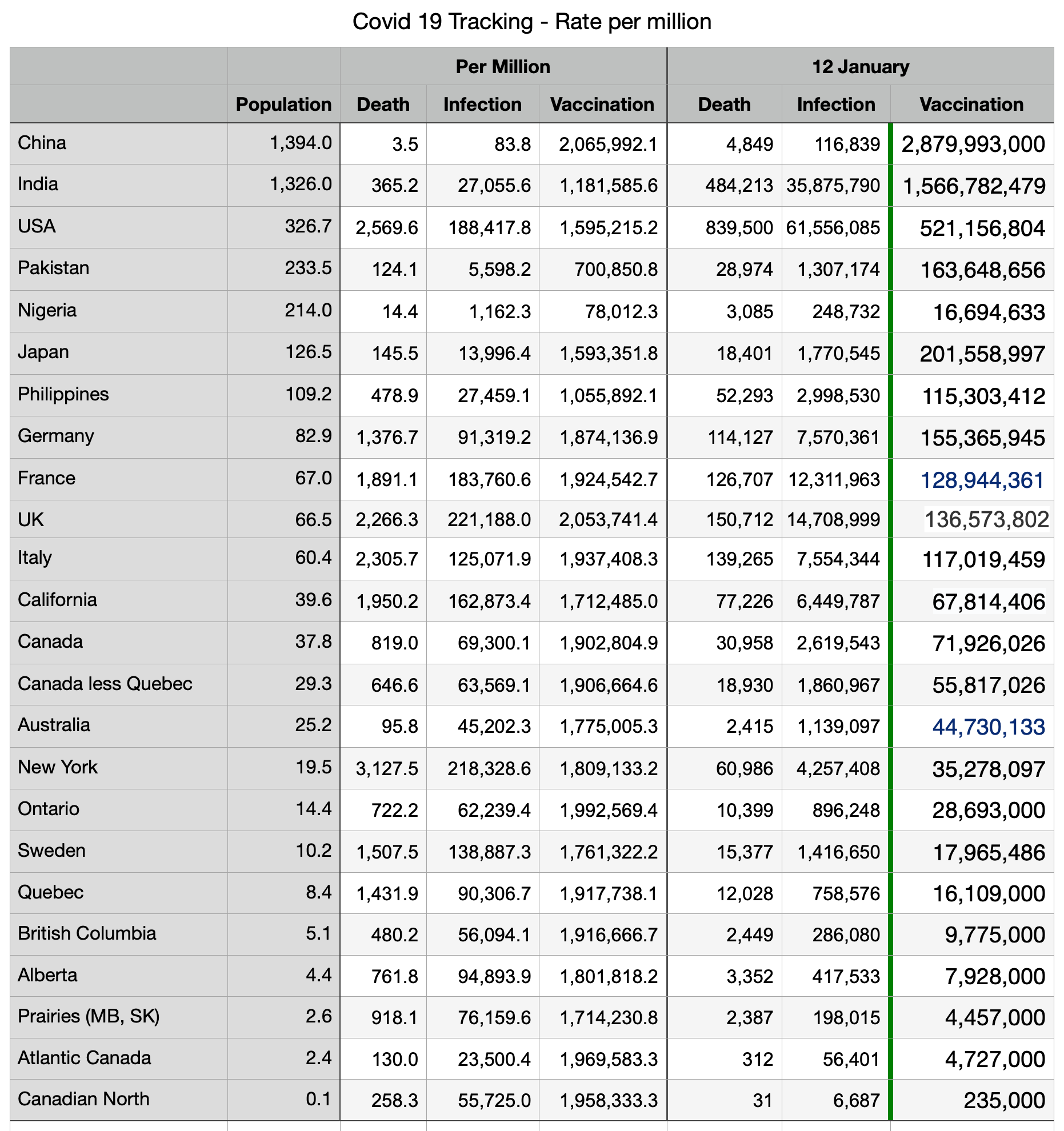
#COVID-19: Comparing provinces with other countries 5 January Update and impact of Omicron

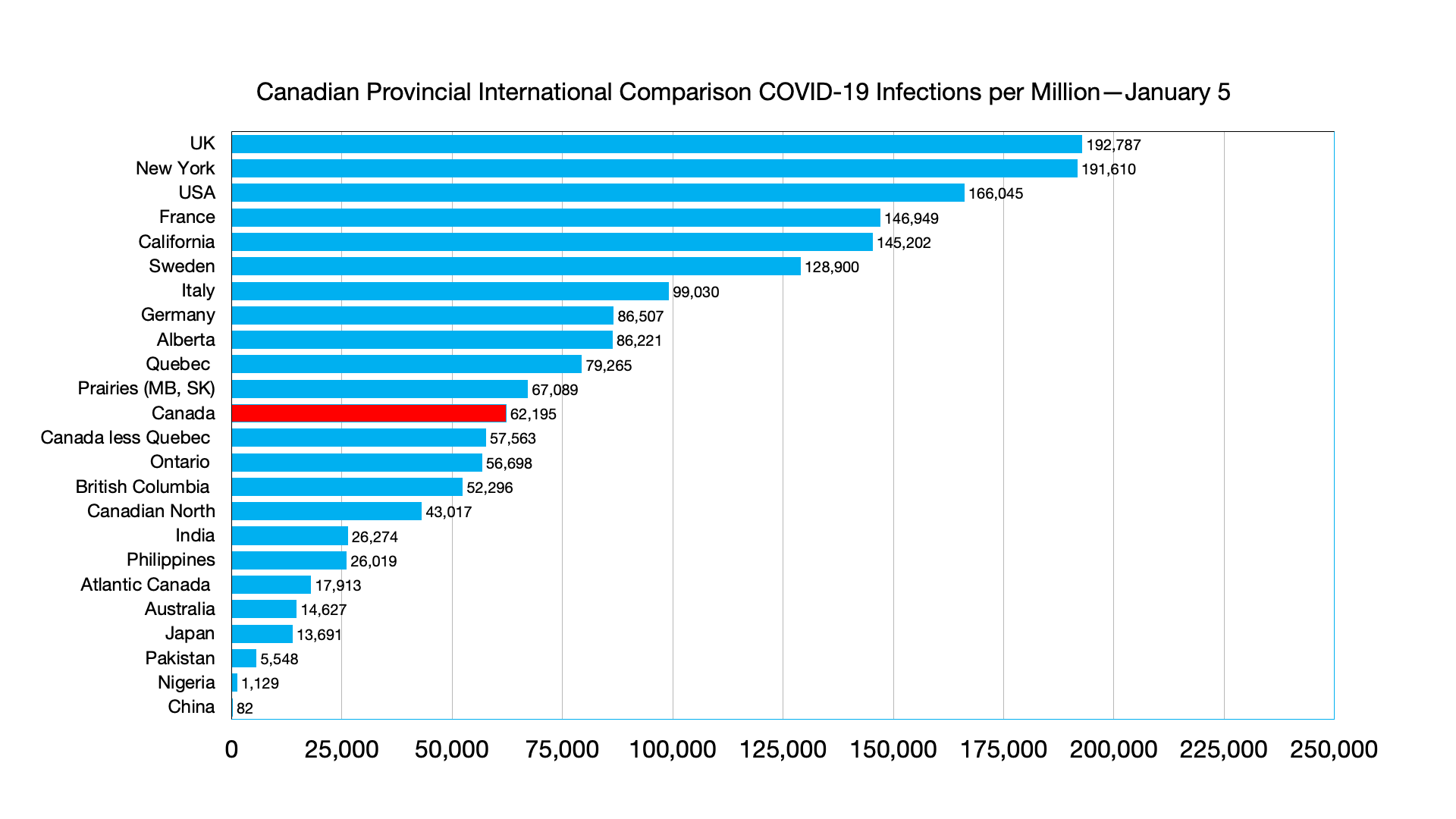
Back from my holiday break, three weeks later, the steep rise in infections due to Omicron (likely undercounted given testing constraints).

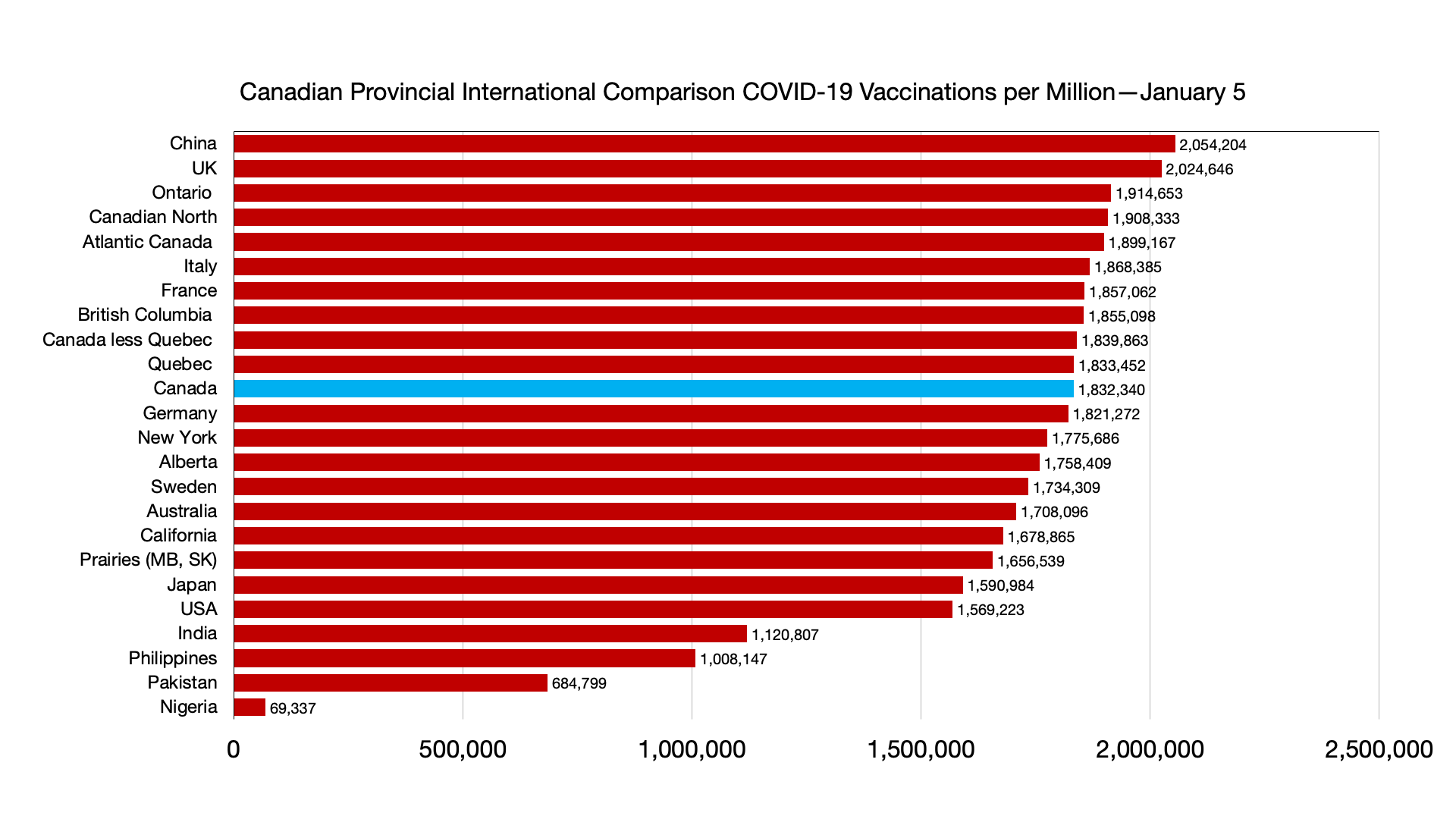
Vaccinations: Some minor shifts but general convergence among provinces and countries. Canadians fully vaccinated 78.3 percent, compared to Japan 78.7 percent, UK 71 percent and USA 62.9 percent.

Immigration source countries are also converging: China fully vaccinated 86.4 percent, India 45 percent, Nigeria 2.2 percent (the outlier), Pakistan 33.5 percent, Philippines 46.8 percent.

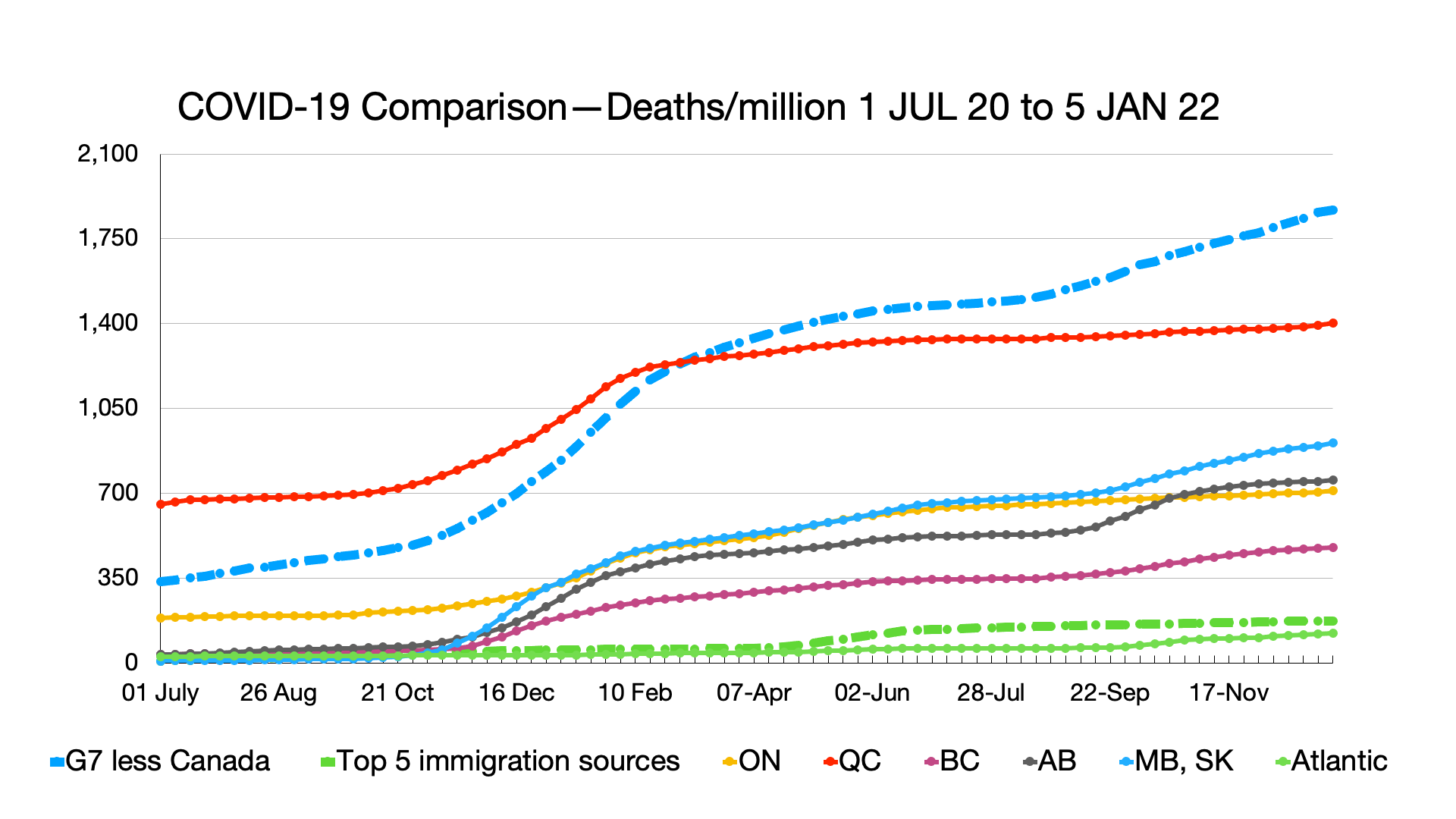
Trendline Charts:

Infections: Effects of Omicron becoming more apparent with steep rise in all provinces, led by Quebec.

Deaths: No relative changes.

Vaccinations: Ongoing convergence among provinces and G7 less Canada and narrowing gap with immigration source countries. Nigeria remains the laggard.

Weekly

Infections: Atlantic Canada ahead of Australia and Japan.

Deaths: No relative change

#COVID-19: Comparing provinces with other countries 15 December Update and the rise of Omicron

The latest charts, compiled 15 December, with the effects of Omicron.

Canadians fully vaccinated 77.8 percent, compared to Japan 77.7 percent, UK 70 percent and USA 61.7 percent.

Vaccinations: Numerous minor shifts but general convergence: UK ahead of Canadian North, Atlantic Canada ahead of British Columbia, France ahead of Canada, New York ahead Sweden and Australia, Prairies ahead of California, Japan behind California. China fully vaccinated 83.2 percent, India 38.4 percent, Nigeria 2 percent, Pakistan 26.8 percent, Philippines 38.9 percent.

Trendline Charts:

Infections: Effects of Omicron becoming more apparent.

Deaths: No significant relative changes.

Vaccinations: Ongoing convergence among provinces and G7 less Canada and narrowing gap with immigration source countries. Nigeria remains a laggard.

Weekly

Infections: Germany now ahead of Alberta.

Deaths: No relative change