Ottawa Pride parade dissolves after Palestinian demonstration blocks route

Apart from the somewhat oxymoronic name Queers for Palestine, given the lack of LGBTQ rights in Palestine and elsewhere Arab and Muslim countries, stil hard to understand how blocking route increases public support for their position.

They could have, after all, simply marched along with the others, with some signs identifying themselves their Palestinian identity:

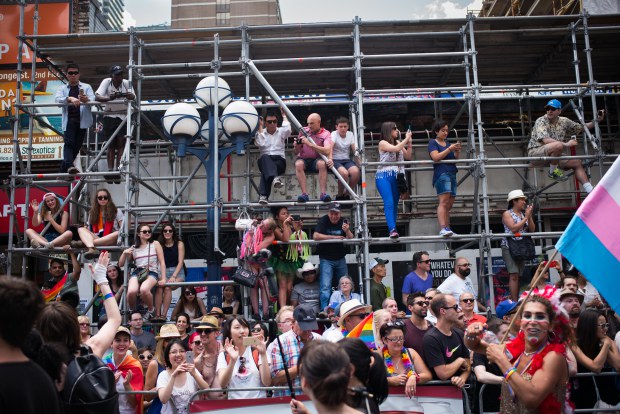
Hundreds of Palestinian supporters blocked the Capital Pride Parade shortly after it began Sunday afternoon, demanding parade officials come down and meet their “demands.”

Protesters gathered on Wellington Street near O’Connor, dancing to music while holding up signs and Palestinian flags. Many signs said “no pride in genocide.”

A giant pink-and-black banner read “all of us or none of us” and “stone wall was an intifada.” They also chanted slogans like “free, free Palestine,” “long live the intifada” and “from the river to the sea, Palestine will be free.”

“We will not leave until our elected officials and Capital Pride come down and meet our demands,” said Masha Davidovic, a member of Queers for Palestine-Ottawa group.

At about 2:30 p.m., the decision was made to cancel the remainder of the parade.

The confrontation comes after Capital Pride quietly took down its statement of solidarity with Palestinians this year, sparking criticism among some members of the community.

According to a pamphlet handed out at the protest Sunday, pro-Palestinian groups want Capital Pride to host a BDS (boycott, divestment, sanctions) townhall and support PACBI, or the Palestinian Campaign for the Academic and Cultural Boycott of Israel. The BDS movement is a Palestinian-led movement that uses economic pressures to force corporations, banks and other entities to withdraw support from Israel.

Protesters also called on Mayor Mark Sutcliffe to “apologize for last year’s boycott (of the parade) and the call to defund Pride” and “commit to stand with (protesters) and all oppressed peoples, including Palestinians.”

Stefania Wheelhouse of TotoToo Theatre was marching in the parade with 30 other people before the event was cancelled.

She told the Ottawa Citizen that they walked for about a block and half before they were stopped.

Around an hour later, they received word from Capital Pride officials that the remainder of the parade was cancelled and they were told to pack up and leave.

“We are bummed, of course, but we had a blast for the block and a half that we walked, and everyone was so positive, so it was still a net win for us,” Wheelhouse said.

“We sang, we spread the word. It’s still been a bit sad to not get to finish the run, but it is what it is.”

Donna Blackburn, an Ottawa-Carleton District School Board trustee, was marching in the parade with the rest of the school board.

Blackburn was previously censured by her colleagues for disagreeing with the school board’s decision to withdraw from the parade last year after Capital Pride issued a pro-Palestinian statement. She was also told to take part in antisemitism training.

In an interview with the Ottawa Citizen on Sunday, Blackburn called the actions taken by the pro-Palestinian movement “backwards” and said protesters had “hijacked” the parade.

“I have publicly stood up for the Palestinian community in a very public way, took a lot of personal heat for doing it. I’m now a target of the Zionists. They’re coming after me. But this is not the way to get people onto your side,” she said.

“Blackmailing the mayor in the middle of the parade is completely, highly inappropriate. … There are ways to lobby. There are ways to advocate, and holding a parade like this hostage and blackmailing politicians in the middle of it is completely inappropriate.

“Hopefully the rest of the day we can just go about celebrating. The community organizations are down (on Bank Street) with their booths, and I’m sure the music will be good and all that stuff. It’s just unfortunate the parade was hijacked.”

Sutcliffe, who attended the parade along with other city councillors and city staff, said in a social media statement that he was proud to join the LGBTQ2S+ community at Pride but said it was “deeply regrettable” that protesters and activists chose to block the parade.

“My heart goes out to the many people in our city who were deprived of the opportunity to participate in this celebration of joy, resilience, and community,” the statement read.

“At a time when 2SLGBTQIA+ rights are under attack around the world, it’s critical to show our solidarity with the community and honour all those who have achieved hard-won progress on equal rights.

“Ottawa should always be a place of inclusion, where everyone feels welcome. Let’s continue to work together for a better city, for everyone.”

Source: Ottawa Pride parade dissolves after Palestinian demonstration blocks route

From ‘eh’ to ‘meh’? Pride and attachment to country in Canada both endure significant declines 

Alarming decline, reflecting likely mix of housing, healthcare, post-COVID hangover, inflation, youth challenges etc, along with perhaps undue focus on criticism of Canada and its history. No easy corrective action no matter which government:


Link to the poll here: www.angusreid.org/

The years since the onset of COVID-19 have been a well-documented period of division and discord in this country, with Canadians expressing concerns about the lack of a “middle” option politically, an unwillingness from governments to work together for the people, weakening compassion and growing space between Canadians.
 
New data from the non-profit Angus Reid Institute find two broad trends underscoring these changes and signalling a challenge for national unity. In 2016, 62 per cent of Canadians said they had a deep emotional attachment to Canada. In 1991 that mark was three points higher (65%). Now in 2024 it is 13 points lower at 49 per cent.

Even more dramatic is a drop in a sense of pride among Canadians. In 1985, 78 per cent said they were “very proud” to be Canadian. This dropped to 52 per cent in 2016 and now by another 18 points to 34 per cent. The proportion who say they are either proud or very proud of their nationality has dropped precipitously from 79 per cent to 58 per cent over the past eight years.

Source: From ‘eh’ to ‘meh’? Pride and attachment to country in Canada both endure significant declines 

Paradkar: Muslims who fight against LGBTQ2+ inclusion are hurting many — including themselves

Of note:

A viral audio clip of an Edmonton teacher admonishing a Muslim student for avoiding Pride events perfectly encapsulates a dilemma that’s worth wrestling with. How does one tolerate — or, better still, tackle — the intolerance of some members of a group that has itself faced so much intolerance.

At least part of the answer is simple: not with the very discrimination you rail against. 

Less simple, and also wrapped up in the answer, is a layered understanding of how religion, a source of support for many, can also be a basis of discrimination.

In the two-minute audio clip from last month, an unnamed Londonderry Junior High School teacher told a student his behaviour was unacceptable, and referenced Uganda, where intolerance and criminalization of homosexuality has been boosted by evangelical Christians. 

She also pointed out there were no complaints when Ramadan was acknowledged at school. 

“It goes two ways. If you want to be respected for who you are, if you don’t want to suffer prejudice for your religion, your colour of skin or whatever, then you better give it back to people who are different from you. That’s how it works,” said the teacher. 

She should have stopped there.

It’s not uncommon to see individuals from equity-seeking groups aligning with discriminatory actions; the plaintiffs in front of the U.S. Supreme Court that struck down affirmative action last week were Asian-American. 

Of course, Muslims are not a monolith. Nor are they the only faith group to denounce LGBTQ2+ teachings at school. On June 27, a group of Muslim, Jewish and Christian parents of students at a Montgomery county school demanded that their kids be able to opt-out of the sex-ed curriculum.

But Muslim opposition to Pride in Canada and the U.S. is not restricted to one Edmonton student’s choice to skip Pride-related events, or students routinely using provincial exemptions and not attending sex-ed classes, or parents leading protests against school boards for gay-inclusive teachings and other forms of gay expression.

It also affects policy. Residents of Hamtramck, Mich., who celebrated their multiculturalism when they voted in a Muslim-majority city council during Donald Trump’s Islamophobic campaign rhetoric in 2015, were dismayed to find that council passing legislation in June that banned flying the Pride flag on city properties. 

It has become a knotty issue involving religious beliefs, political expediency and flirtation with outright hate. It raises questions about whether freedom of religious expression is more important than freedom from discrimination and paves a pathway to shaking hands with the devil. 

It is notable because individual intolerance was in a way sanctified by a statement by North American Islamic scholars that declared queer life sinful. In addition, at least one senior member of the Council on American-Islamic Relations, an important civil rights advocacy group, supported parents seeking book bans and opt-out options.

Perhaps these examples of opposition come from a loud minority among Muslims or perhaps the sentiments are more mainstream. In any case, these actions risk being weaponized for a larger, insidious cause that could end up hurting Muslims here in the long run.

Even if sex-ed exemptions are allowed in Alberta, I’m glad the Londonderry teacher challenged the disdain toward LGBTQ2+ groups.

But she didn’t end it there. Instead, what she said next has been gleefully and understandably seized upon by conservatives as proof of hypocrisy among progressives.

She said, “We believe people can marry whoever they want. That is in the law. And if you don’t think that should be the law you can’t be Canadian. You don’t belong here.”

I think we can all agree that we can’t beat homophobia with Islamophobia or racism. What are the odds that a homophobic white child would have been told “You don’t belong in Canada”? 

The National Council for Canadian Muslims lambasted the teacher’s comments as “deeply Islamophobic, inappropriate and harassing behaviour.”

But it did not weigh in on the question of whether the student should have dodged Pride events. 

Intolerance against queer identities has surfaced over fear of a “woke gender ideology” — a fear manufactured and stoked by the white Christian far-right, expressed under the guise of protecting children. 

In this twisted thinking, children being aware that a small minority of people are not heterosexual or that an even smaller minority doesn’t identify with the gender they were assigned at birth, is considered indoctrination or even pornographic corruption. (But gay and trans children and adults being surrounded and ridiculed by heterosexual cis people is apparently totally safe.) A miniscule fraction of that minority who might regret transitioning or might have had bad experiences with gender-affirming medical procedures is amplified as proof positive of hell having broken loose.

And what do Islamic experts say about the issue? Some 300 Islamic scholars and preachers across North America co-signed a statementlate in May to clarify their religious position on sexual and gender ethics. It was damning: homosexuality and transgenderism are not permissible.

“By a decree from God, sexual relations are permitted within the bounds of marriage, and marriage can only occur between a man and a woman,” said the statement titled Navigating Differences: Clarifying Sexual and Gender Ethics in Islam. 

I’m not qualified to offer a theological critique of Islamic beliefs. But this is a column about justice for the most vulnerable, and I don’t believe justice can be served by relying on principles of the past to moralize today.

That sentence by the Islamic scholars echoes the beliefs of the World Congress of Families created by American conservatives back in 1997, which now exists as the International Organization for the Family.

According to the Southern Poverty Law Center, the congress “pushed for restrictions to LGBT rights under the guise of the defense of the ‘natural family’ — defined as heterosexual married couples with their biological children.” 

The organization, which was created by the Christian right-wing, is another example of how religion is used to discriminate against others and it exists today, as the SPLC says, “as a political power broker as an anti-LGBT group in its own right.”

That group of people who blame gay lifestyles and feminist liberation for a declining white population also subscribe to the conspiracy theory of the Great Replacement of white people by Black and brown people.

In this process of rejecting LGBTQ2+ rights, conservative Muslims have linked hands with the very people who demonized them for decades.

But Edward Ahmed Mitchell, a deputy director at CAIR, calls the idea of that alliance “ludicrous,” and said parents were standing up for their religious rights “without prompting from the right and without fear of backlash from the left.”

“What matters is whether the cause itself is just,” he said in a Twitter statement.

Not only does his stance risks isolating gay and trans Muslims, the scholars’ statement that they are sinners could well be psychologically crippling at a time of rising hate against people like them.

The logical extension of the Islamic scholars’ argument is also damaging for all Muslims in North America.

For instance, the statement says, “As a religious minority that frequently experiences bigotry and exclusion, we reject the notion that moral disagreement amounts to intolerance or incitement of violence.”

By that token, could a law banning head coverings — based on a moral disagreement with seeing veiled Muslim women — no longer be criticized as being intolerant?

When it says: “Peaceful coexistence does not necessitate agreement, acceptance, affirmation, promotion, or celebration,” could that not be turned around to mean religious accommodation in schools or celebrating Muslim holidays is not required to signal acceptance of Muslims? 

It says, “there is an increasing push to promote LGBTQ-centric values among children through legislation and regulations, disregarding parental consent,” as if this exact same objection could not be used by the far-right to decry depictions of Muslims in schoolbooks as a sample of wokeness.

But leaders of the white far-right, sensing weakness in the solidarity of rights groups, have switched tacks for the moment.

Fox News host Laura Ingraham, a far-right hero, who once said the “dual loyalties” of Muslim refugees to the Qur’an that would lead them to “to try to blow us up” is now praising Muslim parents who are opposed to their children reading books with LGBTQ2+ themes. 

For white supremacists, expanding their base this way, or even appearing to grow support for their “causes”, offers a two-pronged advantage. One, images with visibly Muslim people in their midst make for an effective cover, similar to when the Proud Boys propped up the African-Cuban Enrique Tarrio as their “chairman” as if to say: See, no white supremacy here. 

And two, it’s an effective divide-and-conquer strategy. When they need to invoke the Great Replacement fear again, the anti-racist rights-seeking groups will have already been disorganized and weakened. 

To be clear, Muslims who support ultra-conservative ideologies around sexuality are not naïve dupes. They are simply being as closed-minded as conservatives of any religion.

Where is the compassion and mercy that religions are so famous for?

I don’t much care for religion nor do I particularly want it flapping in my face. Even so, I stick my neck out to speak up for the freedom of believers.

In times of disaster and injustice, in my experience, Muslims (and Sikhs) are often the first to show up to give support. That may be why I’m doubly disappointed by this not insignificant opposition to LGBTQ2+ rights.

As the Londonderry teacher pointed out, respect is reciprocal. The right to practise religion cannot trump the human right to sexuality. Because ultimately, religion and religiosity are a choice. Sexual orientation and gender identity are not. 

Source: Paradkar: Muslims who fight against LGBTQ2+ inclusion are hurting many — including themselves

Hashmi, Delic and Sherazi: Muslim families concerned about Pride activities in Ottawa schools deserve a voice

Bit of a stretch to make a parallel to colonial mindsets with respect to Indigenous peoples but a policy and practical challenge as most multiculturalism issues are in fact religious diversity issues, and involve assessing what is reasonable accommodation:

A few days before the start of June, our inboxes started filling up with messages from parents in our communities who were concerned about what their children would be taught during Pride month. They had contacted their children’s schools but were told there was a no opt-out policy in effect because participating in Pride month activities was a human rights issue.

The federal government describes human rights as “how we instinctively expect to be treated as persons. They define what we are all entitled to — a life of equality, dignity and respect, to live free from discrimination and harassment.”

When some Muslims felt their parental rights taken from them and their dignity dwindling, many decided to keep their children home on the first day of June.

When the influx of messages became so great, we created an online form to allow parents to share their concerns.

The results were disheartening. Of just under 500 responses, almost 30 per cent reported that their child had either been targeted for being a Muslim, had been taught age-inappropriate material or had their religious rights infringed upon. Another 22 per cent said they weren’t sure.

Parents shared stories about children being berated for being absent, being told they were ungrateful for having Ramadan recognized in school and being forced to attend Pride month activities. From a child being penalized with no recess for not wanting to colour in a rainbow in grade 3, to another child in junior kindergarten being asked whether she would like to be male or female, the anecdotal evidence piled up. Others reported that teachers debated religious beliefs with students to the point where the students felt targeted.

Multiple parents reported that a teacher at a Kanata school distributed a booklet to students in her Grade 5/6 class that specifically targeted Muslim students in her class, promoting the very practices and beliefs that most Muslim families find objectionable.

In one alarming incident, staff stood at the doors during an assembly to ensure no one left and even searched the parking lot for students. The irony that this took place during National Indigenous History Month should not be lost on us.

While the Ottawa-Carleton District School Board has committed to — and indeed has made great strides in — fostering a safe and inclusive environment for all students, these experiences suggest there is much more to be done.

Concerns raised by parents about Pride don’t have to do with LGBTQ+ individuals. Not one parent suggested that Pride should not be celebrated. They simply had reservations about their own children’s participation in the celebrations.

Cross-dressing and changing one’s birth gender are forbidden under mainstream Islamic teachings, as they are in some other religions, except in rare cases where there is physiological evidence to justify such a change. Active participation in activities and celebrations, whether it be a celebration of same-sex relationships, pre-marital relationships, or those involving alcohol, are largely understood to be prohibited by many Muslims.

For many parents, having their children stay home was a civil way of registering their helplessness in the face of a system that did not want to listen.

Stomping on Pride flags and other such actions are explicitly prohibited in Islamic teachings and we were quick to denounce such hurtful acts in protests. However, we are deeply concerned that our youth and some parents are being contacted by extreme right-wing groups interested in having our community be the so-called champions of this cause. People who are unheard and who feel frustrated are vulnerable to the whisperings of extremists.

We sincerely hope lessons can be learned from what has occurred to prevent it from happening again. For our part, we are committed to continuing our denunciations of hate and bullying against LGBTQ+ people, speaking out against dehumanization, and condemning disrespectful acts. Principled disagreements must not lead to hate, bigotry or disrespect.

The school board will need to calm fears, through the development of clear procedures for staff on how to navigate cases of gender dysphoria and nonconformity with age-appropriate care and professionalism. Parents need to be a part of those discussions, not an afterthought.

Recognizing that gender identity and sexual orientation are deeply personal matters, and that people choose to approach them in different ways, can help all students feel included without any judgments on personal choices or beliefs as well as help rebuild lost trust.

Raising awareness about the struggles people face, and sharing their lived experiences and histories, is an important part of fighting hate and intolerance. Both LGBTQ+ communities and Muslim communities face discrimination and hatred. But history has shown that when ideas are forced upon people, the effort often backfires and causes more damage. If our government is serious about human rights meaning living a life free of discrimination, Muslim parents and students need to stop being treated as haters.

As National Indigenous History Month comes to a closing, we would do well to remember the tremendous harm caused by teachers with colonial mindsets, demeaning the traditional and ancestral beliefs of children while isolating them from their parents. It would be wise for our public school system to not repeat similar mistakes.

Sikander Hashmi serves as imam in Kanata. Zijad Delic serves as imam in Barrhaven. Aisha Sherazi is a local writer and educator. The authors are part of the Muslim Leaders Working Group liaising with the OCDSB on this issue.

Source: Hashmi, Delic and Sherazi: Muslim families concerned about Pride activities in Ottawa schools deserve a voice

‘A sense of betrayal’: liberal dismay as Muslim-led US city bans Pride flags

Of note:

In 2015, many liberal residents in Hamtramck, Michigan, celebrated as their city attracted international attention for becoming the first in the United States to elect a Muslim-majority city council.

They viewed the power shift and diversity as a symbolic but meaningful rebuke of the Islamophobic rhetoric that was a central theme of then Republican presidential candidate Donald Trump’s campaign.

‘It’s brought us together’: at Ramadan, American Muslims on life in the age of Trump

This week many of those same residents watched in dismay as a now fully Muslim and socially conservative city council passed legislation banning Pride flags from being flown on city property that had – like many others being flown around the country – been intended to celebrate the LGBTQ+ community.

Muslim residents packing city hall erupted in cheers after the council’s unanimous vote, and on Hamtramck’s social media pages, the taunting has been relentless: “Fagless City”, read one post, emphasized with emojis of a bicep flexing.

In a tense monologue before the vote, Councilmember Mohammed Hassan shouted his justification at LGBTQ+ supporters: “I’m working for the people, what the majority of the people like.”

While Hamtramck is still viewed as a bastion of multiculturalism, the difficulties of local governance and living among neighbors with different cultural values quickly set in following the 2015 election. Some leaders and residents are now bitter political enemies engaged in a series of often vicious battles over the city’s direction, and the Pride flag controversy represents a crescendo in tension.

“There’s a sense of betrayal,” said the former Hamtramck mayor Karen Majewski, who is Polish American. “We supported you when you were threatened, and now our rights are threatened, and you’re the one doing the threatening.”

For about a century, Polish and Ukrainian Catholics dominated politics in Hamtramck, a city of 28,000 surrounded by Detroit. By 2013, largely Muslim Bangladeshi and Yemeni immigrants supplanted the white eastern Europeans, though the city remains home to significant populations of those groups, as well as African Americans, whites and Bosnian and Albanian Americans. According to the 2020 census some 30% to 38% of Hamtramck’s residents are of Yemeni descent, and 24% are of Asian descent, largely Bangladeshi.

After several years of diversity on the council, some see irony in an all-male, Muslim elected government that does not reflect the city’s makeup.

The resolution, which also prohibits the display of flags with ethnic, racist and political views, comes at a time when LGBTQ+ rights are under assault worldwide, and other US cities have passed similar bans, with the vast majority driven by often white politically conservative Americans.

While the situation in Hamtramck largely evolved on its own local dynamics, some outside rightwing agitators connected to national Republican groups have been pushing for the ban on Hamtramck’s social media pages and voiced support for it at Tuesday’s meeting. They are from nearby Dearborn where they were part of an effort last year to ban books with LGBTQ+ themes.

Their talking points mirror those made elsewhere: some Hamtramck Muslims say they simply want to protect children, and gay people should “keep it in their home”.

But that sentiment is “an erasure of the queer community and an attempt to shove queer people back in the closet”, said Gracie Cadieux, a queer Hamtramck resident who is part of the Anti-Transphobic Action group.

Mayor Amer Ghalib, 43, who was elected in 2021 with 67% of the vote to become the nation’s first Yemeni American mayor, told the Guardian on Thursday he tries to govern fairly for everyone, but said LGBTQ+ supporters had stoked tension by “forcing their agendas on others”.

“There is an overreaction to the situation, and some people are not willing to accept the fact that they lost,” he said, referring to Majewski and recent elections that resulted in full control of the council by Muslim politicians.

Though the city’s Muslims are not a monolith and some privately told the Guardian they were “frustrated” with council, the only leader to publicly question it was the former city council member Amanda Jaczkowski, a Polish American who converted to Islam.

In a statement, she raised concerns about the move’s legality: “There are far too many questions to pass this today with any semblance of responsibility.”

On one level, the discord that has flared between Muslim and non-Muslim populations in recent years has its root in a culture clash that is unique to a partly liberal small US city now under conservative Muslim leadership, residents say. Last year, the council approved an ordinance allowing backyard animal sacrifices, shocking some non-Muslim residents even though animal sacrifice is protected under the first amendment in the US as a form of religious expression.

When Michigan legalized marijuana, it gave municipalities a late 2020 deadline to enact a prohibition of dispensaries. Hamtramck council missed the deadline and a dispensary opened, drawing outrage from conservative Muslims who demanded city leadership shut it down. That ignited counterprotests from many liberal residents, and the council only relented when it became clear it had no legal recourse.

At other times, the issues are not unique to Hamtramck. In the realm of local politics, personal fights among neighbors, warring factions and dirty politics are a common part of the democratic process across the US.

“I don’t know that we’re really all that different from other cities in most ways,” Majewski said.

However, race and religion add more fraught layers to Hamtramck’s issues. Islamophobia exists here, and some Muslims say they saw bigotry in local voter fraud investigations, and in LGBTQ+ supporters not respecting their religion.

But Majewski said the majority is now disrespecting the minority. She noted that a white, Christian-majority city council in 2005 created an ordinance to allow the Muslim call to prayer to be broadcast from the city’s mosques five times daily. It did so over objections of white city residents, and Majewski said she didn’t see the same reciprocity with roles reversed.

Ghalib disagreed, and labeled the prayer broadcast a “first amendment issue” while noting no one was asking for city hall to broadcast the calls.

Moreover, the white majority council was not always hospitable to Muslim residents who have previously faced overt racism. And with a majority-Muslim council in place, more Muslims had been appointed to boards and commissions, and hired in city hall. So had some LGBTQ+ residents, Ghalib added.

Despite the political clashes, he thinks there is hope for Hamtramck to live up to its multicultural ideals.

“We can get along and people are not violent here,” he said.

Cadieux agreed peaceful coexistence was possible.

“We aren’t in the business of excluding people from our society and I’m not going to exclude socially conservative Muslims – they have a place at the table just like everyone else,” she said. “However, they cannot, and will not, shove another community out of the way.”

Source: ‘A sense of betrayal’: liberal dismay as Muslim-led US city bans Pride flags

Rahim Mohamed: Unhinged teacher tells Muslim to support Pride or ‘you can’t be Canadian’

Of note. Teacher went to far with her “you don’t belong (in Canada)!” but most other points were valid. And it is equally valid to point out the lack of consistency in reasonable accommodation arguments:

Administrators were thrust into full damage control mode on Tuesday when an audio recording of an in-class scolding of a Muslim pupil, attributed to a teacher at North Edmonton’s Londonderry Junior High, was leaked to social media.

In the recording, shared on Twitter by the London (U.K.)-based 5Pillars news, the teacher could be heard berating a student, identified as “Mansour”, for allegedly skipping class to avoid ‘Pride Month’ activities:

“You are out to lunch if you think it’s acceptable to not show up because (of) Pride activities going on at school,” the speaker admonished. “But meanwhile, (your LGBT+ classmates), they’re here when we did Ramadan… and they’re showing respect for in the class for your religion…”

“It goes two ways! If you want to be respected for you are… then you better give it back to people who are different from you.”

The speaker then references new anti-gay legislation in Uganda, a country where over eight-in-10 citizens identify as Christian: “In Uganda, literally, if they think you’re gay, they will execute you.” (Uganda’s just-passed Anti-Homosexuality Bill imposes the death penalty for so-called “aggravated” homosexual acts, such as gay sex with an underage partner or infecting a partner with HIV).

“If you believe that kind of thing, then you don’t belong (in Canada)!”

She went on to suggest that those who don’t agree with certain laws in Canada don’t belong in this country.

“We believe that people can marry whomever they want. That is in law. And if you don’t think that should be the law, you can’t be Canadian. You don’t belong here.”

(As of Wednesday morning, the recording had garnered over 100,000 views on Twitter).

5Pillars also shared a letter, dated (Saturday,) June 3, 2023, purportedly written by the school’s principal Ed Charpentier: “Many of you may have heard an audio recording of a teacher at Londonderry School circulating on social media channels,” reads the letter. “I want to emphasize that the views expressed by the teacher do not reflect the values of acceptance, inclusion and belonging that are so strong at Londonderry School.” (a phone number given at the bottom of the letter leads to the school’s central directory). The letter’s date suggests that the incident took place sometime last week.

Edmonton Public Schools added the following on Tuesday in an email to members of the media: “(We are) aware of the audio recording of a teacher at Londonderry School circulating on social media channels. The school and Division are taking steps to address the situation. Due to the Division’s legislated privacy obligations, we are not able to provide any further information.”

While the teacher was clearly out of line, the recording nevertheless reflects a religious tension that’s playing out across Canada over increasingly elaborate in-school Pride celebrations. Evidence is starting to mount that Muslim students are “opting-out” en masse from Pride-related activities — going so far as to skip school on designated Pride days.

London, Ont. (a city where nearly 10 per cent of residents identify as Muslim) has been hit by a wave of absences on school days dedicated to LGBT visibility. Just last month, nearly one-third of students enrolled at London’s largest elementary school stayed home as the district commemorated the International Day against Homophobia, Biphobia and Transphobia. (As the National Post’s Tristin Hopper reported, a majority of students absent that day appeared to be from Muslim families). At least six other schools in the London-area reported higher than usual absences that day. A similar mass absence broke out three months earlier, when the elementary school marked “Rainbow Day”.

A subsequent public statement from the London Council of Imams (LCI) read, “When it comes to activities related to ‘Pride Month’… parents play an integral role in the education of their children and are critical to empowering them to remain steadfast on their faith and beliefs. For this reason, the LCI is not in the position to direct parents on whether to choose to have your child(ren) to attend or be absent from school.” The statement advised parents to “use their discretion” to determine whether to send their children to school on days that included Pride-related activities and programming.

While Pride-related absenteeism among Muslim students has been documented most extensively in London-area schools, the leaked recording from Edmonton indicates that this issue is beginning to crop up in other Canadian cities with large Muslim populations (Edmonton is home to nearly 100,000 Muslims).

Interestingly, the brewing tensions over Muslim students declining to partake in in-class Pride activities recall the “reasonable accommodation” debates of yesteryear — only with the ideological roles reversed. The same progressives who once breathlessly defended the right of Muslim women to don Niqabs in voting booths (and, famously, at citizenship ceremonies) are now claiming that celebrating Pride Month is a sine qua non of being Canadian: “If you don’t believe that, then you don’t belong here!”

Even as they publicly condemned the teacher’s words, it would be unsurprising if many leaders in Edmonton’s ultra-progressive public school system were quietly nodding their heads in agreement with this statement.

Once again, Canada’s Muslim community finds itself at the centre of an ideologically charged debate over Canadian values. This time around, the absolutists are wearing rainbow-coloured clothing.

Source: Rahim Mohamed: Unhinged teacher tells Muslim to support Pride or ‘you can’t be Canadian’

GSS – Social Identity, 2020: A snapshot of pride in Canadian achievements among designated groups

Some of the more interesting and revealing findings for me:

  • Recent immigrants have more favourable views than longer term immigrants;
  • Children of visible minorities have less favourable views than than their parents;
  • Visible minorities have more pride in Canada’s treatment of all groups in society than non visible minorities, with differences between groups;
  • Visible minorities have more pride in how democracy works in Canada;
  • Indigenous peoples have the least pride in how Canada treats all groups and how democracy works; and,
  • Young people have less pride in how Canada treats all groups and how democracy works.

In one sense, this represents integration, as the initial reactions change with the lived experience and immigrants over time, along with their children, move closer to the non-immigrant, no-visible minority population:

“Today’s Daily article presents a snapshot of results from the General Social Survey – Social Identity (GSS SI). This first release focuses on the pride that Canadians feel for selected Canadian achievements and how it is similar or different across diverse population groups. The survey asked respondents about their pride in 13 different Canadian achievements. For this analysis, three Canadian achievements were chosen because of their relevance to the COVID-19 pandemic. These are pride in Canada’s health care system, pride in the way democracy works in Canada and pride in Canada’s treatment of all groups in society.

As part of the data pillar of Canada’s Anti-Racism Strategy, Canadian Heritage sponsored an oversample of six population groups designated as visible minorities for the latest cycle of the GSS SI. This oversample will allow data users to further disaggregate data to better represent the unique experiences of different groups of Canadians.

Canadians are most proud of Canada’s health care system

At a time when Canada’s front-line workers were treating COVID-19 patients in clinics, emergency rooms and hospitals, Canadians were most proud of their health care system. The highest share (74%) of respondents who said that they were very proud or proud of an achievement reported feeling proud of Canada’s health care system. People who belong to population groups designated as visible minorities were especially proud, with 82% reporting feeling proud of Canada’s health care system, compared with 71% of non–visible minorities. Among the different visible minority groups, Filipino (96%) and South Asian (87%) respondents were the most likely to report being very proud or proud of Canada’s health care system.

Almost half of Canadians report feeling proud of Canada’s treatment of all groups in society

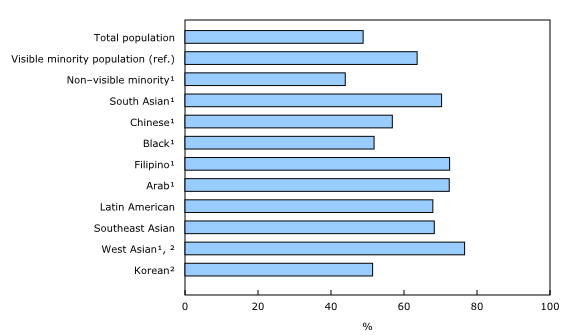
COVID-19 shone a light on the systemic inequities that many people in Canadian society experience—the health, social and economic impacts of the pandemic were not experienced equally by all Canadians. In addition, movements such as Black Lives Matter brought greater attention to the systemic inequities and racism faced by Black Canadians and other population groups designated as visible minorities. Against this backdrop, 49% of the population expressed pride in Canada’s treatment of all groups in society. However, there were differences among Canadians who belong to population groups designated as visible minorities; 64% of respondents who belong to population groups designated as visible minorities felt pride in Canada’s treatment of all groups in society, compared with 44% of individuals not in a visible minority group. Canadian-born respondents who belong to population groups designated as visible minorities were less likely than respondents in groups designated as visible minorities who immigrated to Canada to report pride in Canada’s treatment of all groups in society (45% compared with 68%).

It is important to note that there are differences between population groups designated as visible minorities. A lower proportion of Black (52%) and Chinese (57%) respondents expressed pride in Canada’s treatment of all groups in society. This contrasts with West Asian (77%), Filipino (73%), Arab (72%) and South Asian (70%) respondents, who were more likely to report pride in Canada’s treatment of all groups in society. This could be partly attributable to experiences with discrimination, which were particularly high for some population groups designated as visible minorities during the pandemic. For example, crowdsourcing data collected in August 2020 by Statistics Canada indicated that Korean (64%), Chinese (60%) and Black (55%) participants were more likely to report experiencing discrimination or being treated unfairly during the pandemic (see the publication “Experiences of discrimination during the COVID-19 pandemic“).

Chart 1  
Pride in Canada’s treatment of all groups in society among population groups designated as visible minorities, Canada, 2020

Chart 1: Pride in Canada's treatment of all groups in society among population groups designated as visible minorities, Canada, 2020

Men were more likely than women to report feeling pride in Canada’s treatment of all groups in society—52% of men compared with 46% of women. Pride in Canada’s treatment of all groups in society is the achievement with the biggest gender difference, with only minor differences between men and women for the other Canadian achievements included in the survey.

Canadians are generally proud of the way democracy works in Canada, and this is especially the case for many people who belong to population groups designated as visible minorities

Almost 7 in 10 Canadians (68%) said that they felt pride in the way democracy works in Canada. This increased to close to 8 in 10 (79%) for respondents who belong to population groups designated as visible minorities, compared with 64% of those who did not belong to a visible minority group. Some visible minority groups had a high proportion of respondents reporting pride in the way democracy works in Canada, with 80% or more of West Asian, Filipino, Latin American and South Asian respondents reporting pride in this Canadian achievement.

Canadian-born respondents who belong to population groups designated as visible minorities were less likely to report pride in the way democracy works in Canada, with 65% reporting pride in this achievement, compared with 82% of respondents in groups designated as visible minorities who immigrated to Canada. Similar to Canadian-born respondents belonging to groups designated as visible minorities, 62% of Canadian-born respondents not belonging to a visible minority group were proud of the way democracy works in Canada.

Immigrants who arrived to Canada within the past five years are more likely to feel pride in how Canada treats all groups in society

Immigrant respondents (63%) were more likely than Canadian-born respondents (43%) to be proud of Canada’s treatment of all groups in society. For immigrants, pride in how Canada treats all groups in society is connected to the time since their arrival in Canada; the longer they have been in Canada, the lower their pride in how Canada treats all groups in society. Nearly 8 in 10 immigrants who arrived in Canada 5 years ago or less (78%) expressed pride in this achievement, compared with 65% of immigrants who arrived 6 to 10 years ago and 60% of immigrants who arrived more than 10 years ago. However, regardless of the time since their arrival to Canada, the immigrant population was more likely than the non-immigrant population to report pride. 

The different levels of pride between immigrant respondents and Canadian-born respondents were observed not only for how Canada treats all groups in society but also for the health care system (79% versus 72%) and the way democracy works in Canada (81% versus 62%).

Indigenous respondents also report feeling the most pride in Canada’s health care system but are less likely to report pride in how Canada treats all groups in society and the way democracy works in Canada

As with non-Indigenous respondents, Indigenous people also reported feeling the most pride in Canada’s health care system. Among the Indigenous population living off reserve, 67% were proud of Canada’s health care system. This was the case for 63% of First Nations people living off reserve and 69% of Métis. This compares with 72% of non–visible minority, non-Indigenous respondents. Because of the small number of Inuit respondents, estimates for Inuit are not available. It is important to note that the GSS SI did not collect information for people living on reserve. Thus, the information for Indigenous people reflects only the answers of respondents who live off reserve, which may be different from those of people who live on reserve.

Close to one-third (31%) of Indigenous people living off reserve reported feeling pride in how Canada treats all groups in society, compared with 43% of non–visible minority, non-Indigenous Canadians. Indigenous people were also less likely to report feeling pride in how democracy works in Canada. Overall, just over half (52%) of Indigenous people living off reserve felt proud of the way democracy works (46% of First Nations people and 56% of Métis), compared with 63% of non–visible minority, non-Indigenous Canadians.

These results partly reflect the historical and ongoing impacts of colonization, as well as the long-standing historical inequities experienced by Indigenous people in Canada, including social, democratic and economic inequities. As well, other achievements not listed in the survey may be more relevant to Indigenous respondents.

A slightly lower percentage of persons with disabilities report pride in Canada’s health care system 

Persons with disabilities were most proud of Canada’s health care system (72%), lower than what was reported by persons without disabilities (76%). This could be attributable to barriers that persons with disabilities experience trying to access health care services. For example, slightly over three-quarters (77%) of crowdsourcing participants with long-term conditions or disabilities reported that they required a health care service but were unable to access it because of the COVID-19 pandemic (see the publication The changes in health and well-being of Canadians with long-term conditions or disabilities since the start of the COVID-19 pandemic). Results are based on participants in the 2020 crowdsourcing initiative Impacts of COVID-19 on Canadians – Living with Long-term Conditions and Disabilities (Impacts of COVID-19 on Canadians: Data Collection Series).

Persons with disabilities were also less likely than persons without disabilities to report pride in the way democracy works in Canada (64% compared with 71%). Regarding pride in the treatment of all groups in society, persons with disabilities were less likely than persons without disabilities to express pride in this achievement (43% compared with 53%). Many persons with disabilities have experienced barriers in society, including in the workplace, or have experienced discrimination. For example, almost half (48%) of participants with disabilities in the 2020 crowdsourcing initiative Impacts of COVID-19 on Canadians – Living with Long-term Conditions and Disabilities reported that they were discriminated against during the COVID-19 pandemic, compared with 25% of those without disabilities (see the publication The changes in health and well-being of Canadians with long-term conditions or disabilities since the start of the COVID-19 pandemic).

Younger Canadians are less likely to be proud of Canada’s treatment of all groups in society and the way democracy works

While similar proportions of Canadians of all ages were proud of the health care system, Canadians aged 15 to 34 were less likely than those aged 35 and older to report pride in the way democracy works in Canada and pride in Canada’s treatment of all groups in society. While 62% of Canadians aged 15 to 34 reported pride in the way democracy works, 70% of those aged 35 and older reported feeling proud. Canadians aged 15 to 34 were also less likely than older Canadians to be proud of the way all groups in society are treated, with 43% of 15- to 34-year-olds saying they were proud of this, compared with 53% of people aged 35 to 54 and 50% of people aged 55 and older. “

Source: https://www150.statcan.gc.ca/n1/daily-quotidien/210928/dq210928c-eng.htm?CMP=mstatcan

Glavin: Beijing casts shadow of fear across Canada

Terry Glavin and Ian Young have valid points along with a good thought experiment to underline them. The distinction between “Canada’s Chinese community” and Chinese Canadians is an important one:

Serving mainly the city’s ethnic Chinese community, Vancouver’s Tenth Church, in the Mount Pleasant neighbourhood, has been a venerable Vancouver institution, a refuge for the poor and the marginalized, since the 1930s. During a prayer service on Sunday, Aug. 19, a braying, flag-waving mob gathered outside. It took 20 officers from the Vancouver Police Department to guard the church doors, block passing traffic, and escort the frightened parishioners, at the conclusion of the service, through a gathered crowd of more than 100 people.

That same weekend, in Montreal, another crowd of shouting flag-wavers crashed the Pride parade after bullying organizers into barring a group of LGBTQ Chinese-Canadians from participating in the parade. Leading up to the event, on social media, the bullies had talked about following members of the ethnic Chinese group after the parade, to beat them up. The bullies went on to march alongside the annual Montreal parade in their own column, belting out a fiercely nationalistic song in a disruption of the conventional moment of silence honouring the gay community’s dead from homophobic murders, and from the time of the AIDS crisis.

In the case of the Vancouver incident, the mob was made up of people who had showed up earlier in the day, waving Chinese flags, to disrupt a rally in support of Hong Kong’s pro-democracy movement that had assembled outside the Vancouver consulate of the People’s Republic of China. The flag wavers heard about the prayer service, which was devoted to Hong Kong’s protesters, and followed the church-goers from the rally.

At the time, a thought occurred to me. Why wasn’t this a Canada-wide, above-the-fold national news story? That little puzzle is easily solved. Most of the churchgoers were not white people, and neither was the mob. They were all mostly ethnic Chinese. If the mob had been made up of preposterously nationalistic, flag-waving white people, it would have been a shocking story about a horrible, racist incident in Vancouver. But if the Christians had been mostly white people, and the mob mostly ethnic Chinese, the incident would have been lurid grist for racist teeth-grinding mills and radio hotline shouters from coast to coast.

In the case of the Montreal Pride incident, a similar thought occurred to the South China Morning Post’s Ian Young, who has developed a habit of breaking big stories overlooked by Canada’s mainstream news media. Based in Vancouver, Young ended up reporting the most complete story about what had happened in Montreal, and his thought experiment went like this: What if a mob of flag-waving American right-wingers had threatened violence and bullied the Pride organizers into expelling an ethnic Chinese group that wanted to honour Hong Kong’s LGBT community? What if the right-wingers had then crashed the parade with their own marchers, and the song they belted out during the solemn moment of silence was the Star-Spangled Banner?

You can probably imagine how widely and thoroughly a story like that would have been reported, and the sorts of stirring speeches our politicians would have made about it. But the bullies in Montreal were from the same pro-Beijing cohort as the bullies in Vancouver, and the song they sang was March of the Volunteers, the anthem of the People’s Republic of China.

You can’t say that the event in Montreal was racist, or even necessarily homophobic, exactly, just as it can’t be said that what happened in Vancouver was categorically racist, or even a straightforward case of religious bigotry. But it is exceedingly difficult to argue that something kindred to racism is not at least involved to some degree, in the way the news media fails to pay attention to the phenomenon of Beijing’s bullying and influence-peddling in Canada. And in the way our politicians, from all the political parties, if only most egregiously the Liberal Party, pander and placate in these matters.

It may not be exactly racist to resort to the term “Canada’s Chinese community,” but it will get you off on the wrong foot, and if you’re not careful, whatever your intentions, you may end up at least serving a fundamentally racist purpose.

There at nearly 2 million people of Chinese descent in Canada, but until very recently, owing to migration facilitated mainly by the scandal-plagued and now-shuttered federal Immigrant Investor Program, Canada’s ethnic Chinese came almost exclusively from the five Cantonese-speaking communities at the mouth of the Pearl River and adjacent areas around Hong Kong. Among Canada’s immigrants classified as ethnic Chinese, there are at least hundreds of thousands of people that Beijing describes in the argot of Communist Party propaganda as the “five poisons”: Taiwanese, Tibetan and Uighur nationalists, followers of Falun Gong religious practices, and democrats.

Increasingly, these Canadians are living in fear. If they aren’t careful about what they say, their family members back in China will end up being badgered, blacklisted, or worse. This fear is particularly acute among Canada’s Uighurs, whose fellow Muslims in Xinjiang have been interned, as many as 2 million of them, in re-education camps.

The fear is spreading in Canada, now that Hong Kong is in turmoil. It is restraining Canadians from exercising their rights to free speech and freedom of assembly in the Chinese-language news media — now controlled almost entirely by wealthy pro-Beijing interests — and in their decisions about whether to risk raising their voices or attending rallies in support of pro-democracy Hongkongers. It is spreading on university campuses — Beijing closely monitors the activities of Canada’s nearly 80,000 Chinese student-visa holders — and Beijing’s United Front Works Department now effectively controls hundreds of Chinese community and business associations, big and small, across Canada.

In these ways, Beijing is asserting its international reach to undermine the inviolable human rights of hundreds of thousands of Canadian citizens, and by the reckoning of the Geneva-based Human Rights Watch organization, the problem is getting worse. Earlier this year, Amnesty International and a coalition of diaspora groups presented the Canadian Security Intelligence Service with an exhaustive study that describes in detail the threats and harassment Beijing and its operatives in Canada are spreading.

“Definitely, people are afraid to speak out,” Ivy Li of the Canadian Friends of Hong Kong told me. “But it is a dilemma. People are also afraid of backlash, that Canadians in the mainstream will think all Chinese Canadians are involved in infiltration, or are working for Beijing, and will be suspect.”

Li, who emigrated from Hong Kong decades ago, said she has personally experienced hostility owing to perfectly well-justified concerns about Chinese money-laundering and the gross distortions created by Chinese capital investment in the real estate market. “But Canadians are very considerate, and we want our society to be more fair and just, and so this fear of being accused of racism, it is part of why mainstream society, especially the media, allows the pro-Beijing supporters to play the racism card.”

The role racism plays in these necessary debates is obviously complex, but even the most virtuous Canadian politicians have been happy to see Chinese immigrants as cash cows, and to regard Chinese Canadians as voting blocs, Li tells me, “and as Chinese diaspora first, rather than as Canadian citizens first.

“This allows Beijing to own at least part of us in Canada, and it means we are left to fend for ourselves against the Chinese government. And that is racist.”

Source: Glavin: Beijing casts shadow of fear across Canada

New Canadians take Oath of Citizenship at ceremony tied to Capital Pride

Noteworthy:

As about 50 people became Canadians at a special citizenship ceremony held at the Horticultural Building at Lansdowne Park Thursday morning, 25-year-old Roksana Hajrizi and her mother, Celina Urbanowicz, looked on from the just outside the area cordoned off for officials, volunteers, celebrants and their friends and families.

They watched as Bibiane Wanbji, who six years ago left her husband in Cameroon and brought her four children to Canada to find a better life, smiled at the vastness of the world that had just opened up to her. Having a Canadian passport, Wanbji explained, means she can travel just about anywhere. She hasn’t seen her extended family and friends back in Cameroon since coming to Canada, so that’s a definite destination. So, too, are the U.S. and Cuba, and “the city of love” that she’s always wanted to visit: Venice. “It’s like a passport for the world.”

And although she’s been in Canada for six years already, Thursday’s ceremony left Wanbji feeling a bit different, she said, that she has “more to give in this country, to contribute to build the country.”

Hajrizi and her mother watched, too, as 50 new Canadians, including Haguer Abdelmoneim and her children, Mahmoud, 10, and Youssef, 5, sang their new national anthem. They and Abdelmoneim’s husband came from Egypt in 2014 “for a better education for the kids” and “for a better community to grow in.”

They didn’t just choose somewhere other than Egypt, she added; they specifically chose Canada. “We like the values. It’s a very inclusive country, very welcoming to newcomers.”

Another “new” Canadian, Saiful Azad, who arrived on Canada’s shores from Bangladesh 21 years ago, agrees. “A lot of people don’t understand how important it is to be a Canadian citizen and the opportunities that are given to you here,” he said. “I don’t believe the U.S. is the land of opportunity; I believe Canada is.”

Like Wanbji, Azad, who operates a Greek on Wheels franchise in Hunt Club, cherishes his new-found ability to travel as much as his right to vote. “When you’re a Canadian citizen, people look at you differently and treat you differently. Everyone thinks that Canada is a great country, and I think they’re right.

“People who live here and want to be Canadian citizens should pursue that.”

Thursday’s event was unlike most citizenship ceremonies in that it was one of about 75 sponsored each year by the Institute for Canadian Citizenship, a national not-for-profit charity that promotes active and inclusive citizenship.  As at other ICC-hosted citizenship ceremonies, this one opened with intimate roundtable discussions at which soon-to-be Canadians were engaged in conversations with other community members.

A lot of our soon-to-be Canadians have had long journeys and long stories in getting here,” said ICC chief executive and former Ottawa-Centre Liberal MPP Yasir Naqvi just prior to the start of the ceremony, “so we want to talk a little about that. But most importantly we want to talk about what the journey is going to be like after they become Canadian citizens. How are they now going to contribute to the building of Canada? We want to promote active citizenship.”

Thursday’s ceremony was also co-hosted by Capital Pride, a first for both organizations.

“It’s an opportunity for our community and the candidates for citizenship to engage in dialogue about what our community is about and what the experience of being 2SLGBTQ is,” said Capital Pride founding director Sarah Evans. “A lot of newcomers, and even established immigrants, don’t always know a lot about the 2SLGBTQ community, so it’s a good opportunity to build that awareness.”

As she watched from the sidelines, Roksana Hajrizi was keenly aware. Describing herself as a “proud lesbian,” she attended Thursday’s ceremony partly in support of Capital Pride, and also to congratulate those being sworn in as new Canadians. “I am proud and happy for those who are Canadians today,” she said, “and I hope that one day my family and I could be citizens of this great country.”

Truth be told, Hajrizi already feels very much Canadian. She was just three years old when she and her family — her mother, father, Ismet Hajrizi, and younger sister, Camila, arrived in British Columbia from war-torn former Yugoslavia almost 23 years ago. She even has two brothers born in Canada: Sebastrijana, 22, and Daniel, 19.

But she, her mother and sister are living in Canada without official status, in constant anxiety that they will be deported. They are Roma — her mother a Polish Catholic Roma, her father a Yugoslavian Muslim one. Romas are not welcome in most places, she says, and gay ones even less so.

The United Nations’ Office of the High Commissioner for Human Rights has noted the discrimination that Roma people face worldwide, an Anti-Gypsyism expressed by “violence, hate speech, exploitation, stigmatization and the most blatant kind of discrimination.”

Hajrizi’s family was denied refugee status, and now she fears for her life and the lives of her sister and mother if they’re forced to leave the country. In 2008, her family, except for her brothers, was scheduled for deportation but was given a reprieve.

Still, Hajrizi’s father, she says, despite being a Serbian citizen, was deported in June to Kosovo, where he lives in a garage with no papers. She, with no birth documents herself, worries that it’s just a matter of time before she and her mother and sister will suffer similar fates, that she will never get to be on the other side of Thursday’s ceremony, that despite living in Canada for very nearly her whole life, she will never know what citizenship is like.

“I believe in my heart that I’m Canadian. I believe in my heart that my sister is Canadian. I believe my mother and farther are also Canadian. We’ve been here for 23 years and our roots have spread through Canadian soils. We have given our time, our compassion, our love, our kindness to our community, to our city. People who know us know that we are a good family.

“My family is being ripped apart,” she said. “My father was taken from us, and now my mother is next. But we will fight to stay in Canada.”

Source: New Canadians take Oath of Citizenship at ceremony tied to Capital Pride

Robyn Urback: How can Black Lives Matter claim ‘victory’ when Pride has left so many divided?

One of the better commentaries:

BLMTO’s leaders and their allies claim their interruption was a necessary reminder that social movements often work in the interests of their wealthy white members first — early feminism is an obvious example — leaving its communities of colour to pick up the slack behind. And they’re not wrong. BLMTO can claim, with some credibility, that its disruption of the parade was important, or necessary, but it will have a hard time making the case that it did more good than bad, especially as hundreds of simultaneous Facebook fights about “pinkwashing” and “anti-blackness” enter their second day. And surely it would not tolerate a similar protest by Pride Toronto members at the Toronto Caribbean Carnival parade later this month.

Ian Willms/Getty Images

The question of future police participation in subsequent Pride events has only compounded the mess, with many accusing BLMTO of undermining recent progress made between the LGBT community and Toronto police, which included an historic apology offered by Police Chief Mark Saunders last month for a string of raids made on gay bathhouses in 1981. They claim, rightfully, that to ban future police participation in Pride events would be a step in the wrong direction, and would only alienate gay members of the Toronto Police Service, including Const. Chuck Krangle who penned on open letter urging the organization to reconsider its promise to BLMTO, arguing that “exclusion does not promote inclusion.”

Indeed, the tens of thousands of onlookers who have watched Toronto’s annual Pride Parade march down Yonge Street have surely noted the diversity of its participants: there are Liberals, Conservatives, church groups, unions, Arabs and Jews, all marching to support inclusiveness, diversity and the freedom for people to love who they love. That’s what this year’s event, and all Pride events, should be about. Instead, this year’s Pride parade left supposed allies fuming from separate corners, while BLMTO’s leaders proudly claimed victory for a job well done. It’s hard to see how starting a fight between groups that are working toward the same goals is really a cause for celebration.

Source: Robyn Urback: How can Black Lives Matter claim ‘victory’ when Pride has left so many divided?