That Netanyahu cartoon wasn’t anti-Semitic

A contrary view by the Israeli comedian, Zeev Engelmayer:

The New York Times’ cartoon of Benjamin Netanyahu as a guide dog for Donald Trump that angered the “Jewish world” is actually a clichéd cartoon, though well-designed and certainly not anti-Semitic. It describes two leaders, one blind being led by the other. It’s a caustic image with a vicious tone, exactly what a political cartoon should be.

Netanyahu is depicted as a dachshund, which maybe is a compliment because these dogs are great hunters, and despite their natural suspiciousness, they boast an innate ability to make friends. Behind Netanyahu the dachshund walks his good friend Trump, sullenly, a kippa on his head, symbolizing the strength of his ties with Netanyahu. Trump has been photographed wearing a skull cap — near the Western Wall, for example — so it’s not something an artist has put on him without any justification.

The choice to illustrate Netanyahu and Trump walking with determination, and even against a blood-red background, hints that they’re not just taking an innocent morning walk. They’re on a survivalist hunting trip. What are they hunting? Foreigners? Leftists? The hostile media?

The media said Netanyahu was drawn with an unusually large nose, but a very superficial look confirms that Netanyahu’s nose hasn’t been distorted, certainly not in a way reminiscent of anti-Semitic cartoons, as has been alleged. The complaint that the illustration is anti-Semitic reinforces the feeling that the Foreign Ministry looks for every possible justification to play the victim to silence critics.

Images depicting politicians as blind people with guide dogs is as old as the advent of political cartoons. James Akin’s infamous one from 1804 shows Thomas Jefferson with the body of a dog. Richard Nixon has also been drawn as a dog, and Tony Blair as a dog wearing an American flag as his collar. American patriots have been depicted as a herd of blind horses.

Meanwhile, Mahmoud Ahmadinejad has been portrayed as a wild dog biting Barack Obama’s hand. His nose was made to look a lot longer than Netanyahu’s in this week’s cartoon. Was there any outcry against the Ahmadinejad cartoon or demands to outlaw it as anti-Semitic?

Theresa May was depicted by the graffiti artist The Pink Bear Rebel this year, was she not? She’s seen blindfolded being led by a blindfolded bulldog wearing a British-flag doggie jacket. You can only guess what the Foreign Ministry would say about a cartoon of a bulldog wrapped in an Israeli flag.

Under pressure from the Israeli consul general in New York and the Foreign Ministry, the Trump-Netanyahu cartoon was removed from the internet. The newspaper published a clarification, a half apology, and described the cartoon as offensive and an error in judgment.

A cartoon is by definition an exaggeration that looks for weak points. Sometimes it’s a warning sign: It provides strong, exaggerated images to shock and awaken. That was the case this time, a moment before this duo drags us along with them on a leash on a nighttime stroll.

Source: That Netanyahu cartoon wasn’t anti-Semitic | Opinion

Trump Claims There Is a Crisis at the Border. What’s the Reality?

Good analysis of the numbers:

President Trump has frequently called the situation at the southern border with Mexico a crisis and insists that building his long-promised border wall will fix it. Here are some of Mr. Trump’s most common assertions of a crisis, and the reality of what we know about immigrants and the border.

“We can’t have people pouring into our country like they have over the last 10 years.”

THE REALITY Illegal border crossings have been declining for nearly two decades. In 2017, border-crossing apprehensions were at their lowest point since 1971.

Total number of arrests for illegally crossing the Mexican border

Undetected illegal border crossings have dropped at an even faster rate, from 851,000 in 2006 to approximately 62,000 in 2016, according to estimates by the Department of Homeland Security.

However, there is one group of migrants that is on the rise: families. A record number of families have tried to cross the border in recent months, overwhelming officials at the border and creating a new kind of humanitarian crisis.

Number of arrests for illegally crossing the Mexican border

Asylum claims have also jumped, with many migrant families telling officials that they fear returning to their home countries. Seeking asylum is one way to legally migrate to the United States, but only 21 percent of asylum claims were granted in 2018, and many cases can take years to be resolved.

“Every week, 300 of our citizens are killed by heroin alone, 90 percent of which floods across from our southern border.”

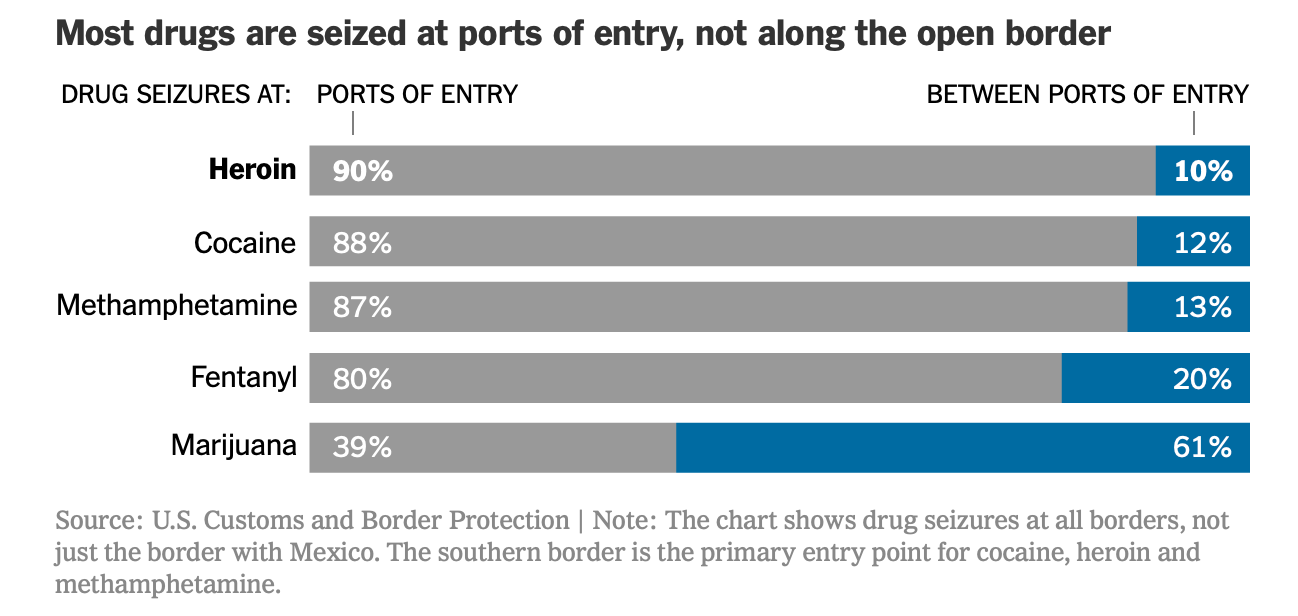
THE REALITY It is true that the majority of heroin enters the United States through the southern border, according to the Drug Enforcement Administration. But the D.E.A. also saysthat most heroin is brought into the country in vehicles entering through legal border crossings, not through the areas where walls are proposed or already exist.

Most drugs are seized at ports of entry, not along the open border

There are more than two dozen ports of entry along the southern border. Barriers are already present in Border Patrol sectors with the highest volumes of heroin seizures.

“Over the years, thousands of Americans have been brutally killed by those who illegally entered our country, and thousands more lives will be lost if we don’t act right now.”

THE REALITY It is difficult to assess the president’s claims that illegal immigration leads to more crime because few law enforcement agencies release crime data that includes immigration status. However, several studies have found no link between immigration and crime, and some have found lower crime rates among immigrants.

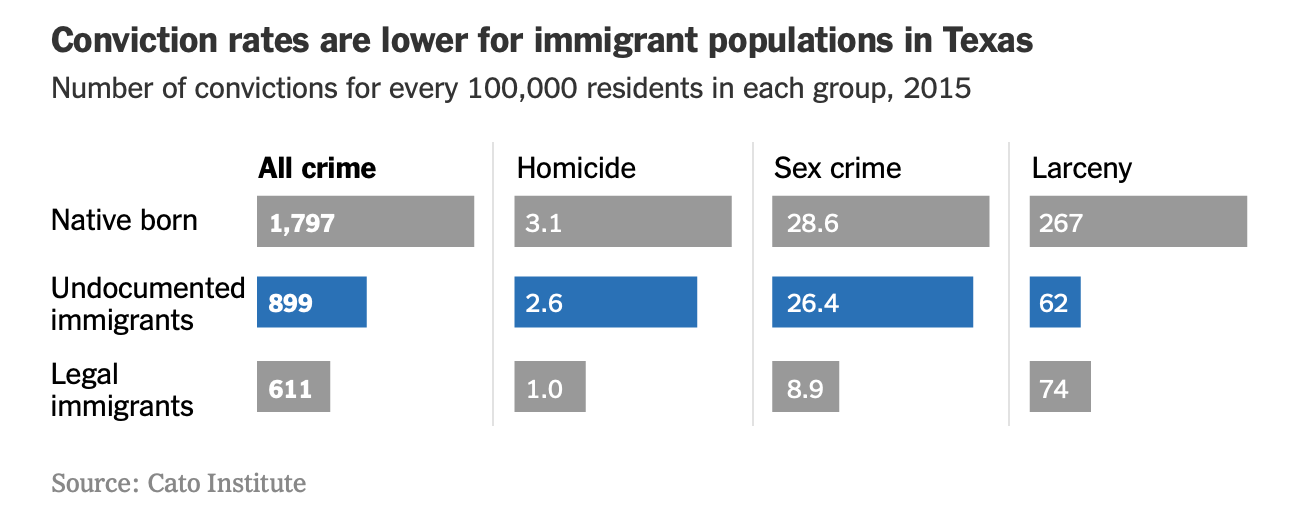
Texas, which has the longest border with Mexico and has one of the largest populations of undocumented immigrants of any state, keeps track of immigration status as part of its crime data. The Cato Institute, a libertarian research center, analyzed the Texas data in a 2015 study and found that the rate of crime among undocumented immigrants was generally lower than among native-born Americans.

Conviction rates are lower for immigrant populations in Texas

Some critics of the study argued that the reason undocumented immigrant conviction rates were low was because immigrants were deported after they served their sentences, which prevented them from committing another crime in the United States, reducing their rate of crime relative to native-born Americans.

Alex Nowrasteh, senior immigration policy analyst at the institute, addressed the complaint by comparing first-time criminal conviction rates among undocumented immigrants in Texas and native-born Americans in Texas. He found that undocumented immigrants still committed crimes at a rate “32 percent below that of native-born Americans.”

President Trump frequently tells the stories of Americans who have been killed by undocumented immigrants as examples of criminal behavior. These terrible crimes have happened, but there is no comprehensive data that shows whether these killings are happening at crisis levels.

Trump touts plan to change visas for skilled foreign workers

All those articles contrasting Canada vs US policies under Trump have provoked a reaction (factually incorrect as per usual practice):

U.S. President Donald Trump said on Friday he plans changes to the H-1B program that grants temporary visas for specialty occupations such as technology or medicine, but his administration said later he was referring to changes that were proposed last year.

“H1-B (sic) holders in the United States can rest assured that changes are soon coming which will bring both simplicity and certainty to your stay, including a potential path to citizenship,” Trump said on Twitter. “We want to encourage talented and highly skilled people to pursue career options in the U.S.”

It was unclear what Trump meant by a “potential path to citizenship” for H-1B visa holders, who already are eligible to be sponsored by employers for legal permanent residency, which would then make them eligible to become U.S. citizens.

When asked about Trump’s tweet, U.S. Citizenship and Immigration Services spokesman Michael Bars provided a statement about a formal proposal in December for changes to the H-1B process, which are likely to become final later this year.

The proposal is designed to increase by 5,340, or 16 percent, the number of H-1B beneficiaries who hold advanced degrees from American universities. It would also streamline the application process with a new electronic registration system.

“These proposed regulatory changes would help ensure more of the best and brightest workers from around the world come to America under the H-1B program,” Bars said.

Critics questioned why Trump tweeted about a month-old proposal at a time when he is battling with congressional Democrats over spending legislation to fund the federal government. Trump wants to include $5.6 billion for a wall along the border with Mexico, which he says will stem illegal immigration.

Democrats call the proposed wall expensive, ineffective and immoral. The dispute has led to a partial shutdown of the U.S. government that is now in its 21st day.

Doug Rand, a former White House official in the Obama administration who worked on immigration issues, said the proposed changes to the lottery selection process were at best modest and at worst could cause chaos. Some immigration experts do not believe the new registration system will be ready in time for the next lottery, which occurs in the spring.

“The odds that a complicated new electronic processing system will be effectively launched by DHS in time for the next lottery on April 1 is low probability and has nothing to do with a potential path to citizenship,” Rand said.

Trump backs off emergency declaration – for now

Throughout his presidency, Trump has sought to stem illegal immigration and to deport more immigrants living in the United States illegally. His administration has also worked to limit legal immigration, including through a proposal that would penalize aspiring immigrants who use public benefits.

Trump has also derided visas granted to family members of U.S. residents or citizens as “chain migration,” and backed a Republican proposal in 2017 that would have slashed legal immigration in half.

“The devil is in the details, said Todd Schulte, president of FWD.us, a nonprofit group which advocates for pro-immigration policies. He said his group, which was founded by tech executives including Facebook founder Mark Zuckerberg, remains “skeptical of vague pronouncements given the administration’s track record.”

U.S. companies often use H-1B visas to hire graduate-level workers in specialized fields including information technology, medicine, engineering and mathematics. But the visa program has also drawn criticism for being used heavily by foreign outsourcing companies that squeeze out American firms.

Source: Trump touts plan to change visas for skilled foreign workers

What’s behind the confidence of the incompetent? It’s not a disease, syndrome or mental illness

Worth reading:

You may have witnessed this scene at work, while socializing with friends or over a holiday dinner with extended family: Someone who has very little knowledge in a subject claims to know a lot. That person might even boast about being an expert.

This phenomenon has a name: the Dunning-Kruger effect. It’s not a disease, syndrome or mental illness; it is present in everybody to some extent, and it’s been around as long as human cognition, though only recently has it been studied and documented in social psychology.

In their 1999 paper, published in the Journal of Personality and Social Psychology, David Dunning and Justin Kruger put data to what has been known by philosophers since Socrates, who supposedly said something along the lines of “the only true wisdom is knowing you know nothing.” Charles Darwin followed that up in 1871 with “ignorance more frequently begets confidence than does knowledge.”

Put simply, incompetent people think they know more than they really do, and they tend to be more boastful about it.

To test Darwin’s theory, the researchers quizzed people on several topics, such as grammar, logical reasoning and humor. After each test, they asked the participants how they thought they did. Specifically, participants were asked how many of the other quiz-takers they beat.

Dunning was shocked by the results, even though it confirmed his hypothesis. Time after time, no matter the subject, the people who did poorly on the tests ranked their competence much higher. On average, test takers who scored as low as the 10th percentile ranked themselves near the 70th percentile. Those least likely to know what they were talking about believed they knew as much as the experts.

Dunning and Kruger’s results have been replicated in at least a dozen different domains: math skills, wine tasting, chess, medical knowledge among surgeons and firearm safety among hunters.

During the election and in the months after the presidential inauguration, interest in the Dunning-Kruger effect surged. Google searches for “dunning kruger” peaked in May 2017, according to Google Trends, and has remained high since then. Attention spent on the Dunning-Kruger Effect Wikipedia entry has skyrocketed since late 2015.

There’s also “much more research activity” about the effect right now than immediately after it was published, Dunning said. Typically, interest in a research topic spikes in the five years following a groundbreaking study, then fades.

“Obviously it has to do with (President Donald) Trump and the various treatments that people have given him,” Dunning said, “So yeah, a lot of it is political. People trying to understand the other side. We have a massive rise in partisanship and it’s become more vicious and extreme, so people are reaching for explanations.”

Even though Trump’s statements are rife with errors, falsehoods or inaccuracies, he expresses great confidence in his aptitude. He says he does not read extensively because he solves problems “with very little knowledge other than the knowledge I [already] had.” He has said in interviews he doesn’t read lengthy reports because “I already know exactly what it is.”

He has “the best words” and cites his “high levels of intelligence” in rejecting the scientific consensus on climate change. Decades ago, he said he could end the Cold War: “It would take an hour and a half to learn everything there is to learn about missiles,” Trump told The Washington Post’s Lois Romano over dinner in 1984. “I think I know most of it anyway.”

In this file photo taken on October 09, 2018, US President Donald Trump talks to the press as leaves the White House by the South lawn and boards Marine One en route to Council Bluffs, Iowa, for a ‘Make America Great Again’ rally in Washington DC.

“Donald Trump has been overestimating his knowledge for decades,” said Brendan Nyhan, a political scientist at the University of Michigan. “It’s not surprising that he would continue that pattern into the White House.”

Dunning-Kruger “offers an explanation for a kind of hubris,” said Steven Sloman, a cognitive psychologist at Brown University. “The fact is, that’s Trump in a nutshell. He’s a man with zero political skill who has no idea he has zero political skill. And it’s given him extreme confidence.”

Sloman thinks the Dunning-Kruger effect has become popular outside of the research world because it is a simple phenomenon that could apply to all of us. And, he said, people are desperate to understand what’s going on in the world.

Many people “cannot wrap their minds around the rise of Trump,” Sloman said. “He’s exactly the opposite of everything we value in a politician, and he’s the exact opposite of what we thought Americans valued.” Some of these people are eager to find something scientific to explain him.

Whether people want to understand “the other side” or they’re just looking for an epithet, the Dunning-Kruger effect works as both, Dunning said, which he believes explains the rise of interest.

The ramifications of the Dunning-Kruger effect are usually harmless. If you’ve ever felt confident answering questions on an exam, only to have the teacher mark them incorrect, you have firsthand experience with Dunning-Kruger.

On the other end of the spectrum, the effect can be deadly. In 2017, former neurosurgeon Christopher Duntsch was sentenced to life in prison for maiming several patients.

“His performance was pathetic,” one co-surgeon wrote about Duntsch after a botched spinal surgery, according to the Texas Observer. “He was functioning at a first- or second-year neurosurgical resident level but had no apparent insight into how bad his technique was.”

Dunning says the effect is particularly dangerous when someone with influence or the means to do harm doesn’t have anyone who can speak honestly about their mistakes. He noted several plane crashes that could have been avoided if crew had spoken up to an overconfident pilot.

“You get into a situation where people can be too deferential to the people in charge,” Dunning explained. “You have to have people around you that are willing to tell you you’re making an error.”

What happens when the incompetent are unwilling to admit they have shortcomings? Are they so confident in their own perceived knowledge that they will reject the very idea of improvement? Not surprisingly (though no less concerning), Dunning’s follow-up research shows the poorest performers are also the least likely to accept criticism or show interest in self improvement.

Source: What’s behind the confidence of the incompetent? It’s not a disease, syndrome or mental illness

Trump Is Making Americans More Immigrant-Friendly

The irony:

President Donald Trump may ultimately be a unifying force on one of the most divisive issues in U.S. politics: immigration.

That’s not Trump’s intent, of course. Having launched his presidential campaign in 2015 with a demagogic assault on immigrants, Trump has been a reliable fount of calumny ever since. His policies, from brutalizing children at the border — a 7-year-old girl died in U.S. custody last week — to terminating Temporary Protected Status for refugees, appear designed to convince his MAGAnauts that he can, and somehow will, forestall the further browning of America.

In public opinion, immigration is an imperfect substitute for “race.” However, Trump has succeeded in making it a more meaningful one. As numerous political science analyseshave determined, Trump’s racial animus is the sticky goo that binds him to his most enthusiastic followers. That goo may be a potent political force, but it’s not a boundless one. Trump appears to have found its limits.

The NBC/Wall Street Journal poll has been asking survey respondents since 2005 whether “immigration helps the United States more than it hurts it.” In December 2005, 37 percent said immigration helps more, while 53 percent said it hurts.

That anti-immigrant sentiment, regularly measured by the poll, largely prevailed until 2012, when opinions started gradually to shift. In the most recent poll, taken in September, the pro-immigration “helps” line reached a peak of 61 while the anti-immigration “hurts” side hit a new low at 28. Measured from December 2005 until September 2018, there is a 49-point swing in favor of immigration “helps.”

Likewise, in June this year, Gallup recorded a new high of 75 percent of Americans saying they believe immigration is a “good thing.”

In the 2018 midterm elections, Democratic pollster Stanley Greenberg wrote, Democrats ran as a “self-confident multicultural party” against a GOP running as an “anti-immigrant party.” The results were not good for the anti-immigrant side.

The greatest risk for Republicans is that Trump’s racial malice will energize nonwhite voters to be more politically engaged while also alienating them, long-term, from the GOP.

That’s what may have happened in California after the state GOP’s anti-immigrant turn under Republican Governor Pete Wilson, who won election in 1994 with a sharp anti-immigrant campaign. “The California GOP went from virtually splitting the Hispanic vote in 1990 to only capturing 17 percent of it in 1998,” wrote Alex Nowrasteh, an immigration expert at the Cato Institute, in an analysis of the electoral consequences. By contrast, during the same period Republicans in Texas continued to be competitive with Hispanic voters and in Florida, then-Governor Jeb Bush claimed to have won 60 percent of the Hispanic vote in his 2002 re-election.

I asked veteran Democratic consultant Bill Carrick, adviser to California Senator Dianne Feinstein, whether he sees Trump cultivating a California-style backlash. “Trump is doing for immigration nationwide what Pete Wilson did in 1994,” Carrick emailed. “The more we debate the immigration issue, the more supportive voters become of immigration reform.”

Political scientist Dan Hopkins of the University of Pennsylvania wrote in 2017 that “Americans became more liberal on immigration at exactly the time that Trump and the Republicans turned more hard-line.”

However, in an email last week, Hopkins said that his research, using a survey group that has been stable over several years, suggests that the pro-immigrant drift in the electorate has slowed. “The big-picture summary from my data,” he wrote, “is one of remarkable stability since Trump took office.”

That’s largely what Republican pollster David Winston sees as well. In a detailed report on the 2018 midterms, Winston concluded that the immigration debate did hurt Republican candidates. “The focus on the immigration/caravan issue instead of the positive jobs report in the last days of the campaign had a net result of late deciders breaking for Democrats by 12 points,” Winston wrote.

But Winston doesn’t think Democrats are necessarily gaining ground. The basic values debate between the parties, Winston said in a telephone interview, is that the U.S. is a “country of laws” (Republican) versus a “country of immigrants” (Democratic). “The public believes in both of these values,” Winston said. The job of politicians, he said, is to figure out how to make those values work together.

Making things work is not Trump’s strong suit. Consequently, there is a high probability that the immigration issue will fester until a new president is sworn in. But even if Trump doesn’t drive still more Americans into the pro-immigrant camp, the next president appears poised to have a stronger pro-immigrant constituency than Barack Obama had at any point during his presidency.

“There is a Trump effect,” said immigration advocate Frank Sharry, via email. “When it comes to the public’s view of immigrants and pro-immigration policies, Trump has made them more popular than ever.”

Source: Trump Is Making Americans More Immigrant-Friendly

Trump’s Christian Apologists Are Unchristian

Interesting public opinion research findings:

Ed Stetzer is grappling with a moral crisis. Stetzer, the director of the Billy Graham Center at Wheaton College, is preaching the Gospel to his fellow Christians. And they’re not listening. “White evangelicals are highly motivated to support President Donald Trump around the issue of immigration,” Stetzer, a Trump critic, wrote in Vox on the morning of the midterms. The next day, after reading exit polls, Stetzer lamented that the president’s scare talk about migrants had proved once again to be a winner with white evangelicals. “I’d hoped it wouldn’t be,” Stetzer told NPR. “But it was.”

Stetzer and other evangelical leaders are in the business of saving souls. But today, the souls in peril are in their own flock. Nationalism, tribalism, and a corrupt, ruthless Republican president are reviving old demons and summoning new ones. The “family values” concerns of 10, 20, or 30 years ago—homosexuality, premarital sex, women in the military—have been overtaken by a different set of moral issues, often derided by the right as “social justice.” On these emerging issues, white evangelical Protestants—for simplicity’s sake, I’ll call them WEPs—are, more than any other religious constituency, standing on the wrong side. The problem isn’t that they’re imposing their morality on others. The problem is that what they’re imposing isn’t morality. It’s wickedness.

This isn’t true of all white evangelicals, much less all Christians. It would be false and reckless to condemn all WEPs, just as it’s false and reckless to condemn all Muslims or Jews. The people doing the best work against perversions of Islam are Muslims, and the people doing the best work against perversions of evangelical Christianity are evangelicals like Stetzer. I’ve met some of them through the Faith Angle Forum, a project of the Ethics and Public Policy Center. At a conference last week, I sat with them as we studied surveys of religious voters. Stetzer is right to worry. The numbers are bad.

WEPs are one of Trump’s most loyal constituencies. Eighty-one percent of them voted for him in 2016. That’s 20 percentage points higher than Trump’s vote share among any other religious group. It’s higher than the percentage of WEPs who voted for George W. Bush, John McCain, or Mitt Romney. The wide gap between WEPs and other faith communities in support for Trump persists to this day. Every other group, on balance, views Trump unfavorably. WEPs, by a ratio of 2 to 1, view him favorably.

Many Americans reject Trump because of his meanness, his misogyny, his ethnic demagoguery, and his squalid and abusive personal behavior. But most WEPs don’t. In a September poll for the Public Religion Research Institute, two-thirds of white Catholics and white mainline Protestants agreed that Trump had “damaged the dignity of the presidency.” Most WEPs said he hadn’t. In an ABC News/Washington Post survey taken in August, most whites agreed that Trump was guilty of a crime if it was true that he had directed his then-lawyer Michael Cohen to “influence the 2016 election by arranging to pay off two women who said they had affairs with Trump.” Trump’s core constituency, white men without a college degree, also agreed. But most WEPs didn’t.

To accommodate Trump, white evangelicals have retreated from moral judgment of him.
In 2011, a PRRI survey asked whether “an elected official who commits an immoral act in their personal life can still behave ethically and fulfill their duties in their public and professional life.” At that point, two years into Barack Obama’s presidency, only 30 percent of WEPs said yes. But in October 2016, after the release of Trump’s infamous Access Hollywood tape, 72 percent of WEPs said yes. The reversal among WEPs was twice as big as similar shifts among Catholics and white mainline Protestants. In a May poll commissioned by the Billy Graham Center, nearly half of black evangelicals said personal character had influenced their voting decisions in the 2016 presidential election. Fewer than 30 percent of white evangelicals said the same.

Many WEPs haven’t just surrendered moral judgment. They’ve abdicated social responsibility. Compared with other whites, they’re more resistant to federal spending on poor people. The charitable explanation for this gap is that white evangelicals are skeptical about federal spending, not about helping the poor. But even when survey questions focus on help, not on spending, they’re unmoved. The BGC poll asked respondents to choose, from a list of 12 issues and traits, which was most important in determining how they voted in 2016. Among black and Hispanic evangelicals, a candidate’s “ability to help those in need” was the second or third most commonly named factor. Among white evangelicals, it ranked almost dead last.

WEPs are also reluctant to acknowledge racism. The September PRRI poll asked whether recent police shootings of black men were “isolated incidents” or “part of a broader pattern of how police treat African Americans.” Seventy-one percent of WEPs said such killings were isolated incidents, compared with 63 percent of white Catholics and 59 percent of white mainline Protestants. In the BGC survey, 59 percent of non-evangelical whites agreed with the statement, “I am disturbed by comments President Trump has made about minorities.” But a plurality of white evangelicals disagreed with it.

Trump’s connection with WEPs on racial issues goes deeper than indifference. It’s based on shared identity. In the words of Christian essayist Michael Gerson, evangelicals have degenerated into an “anxious minority,” defining themselves as “an interest group in need of protection and preferences.” Stetzer, based on his analysis of survey data, finds that race and ethnicity, not faith, are driving much of this process. Many white evangelicals see their religion not as a universal calling but as a heritage that sets them apart. They fear people of other creeds, colors, and languages.

The conventional explanation for Trump’s support among WEPs is that they like what he gives them on social policy: conservative judges, opposition to abortion, and a bulwark against transgender rights. But that doesn’t explain why they’ve supported Trump more than they supported Bush, McCain, or Romney. If anything, you’d expect them to support Trump less, given his history of accepting gays and abortion rights.

The mystery dissolves when you look more closely at their priorities. In the BGC survey, when white evangelicals were asked to name all the factors that influenced their votes in 2016, fewer than half mentioned abortion or the Supreme Court. Their top issues were the economy, health care, national security, and immigration. The biggest gap between pro-Trump evangelicals and other evangelicals, when they were pressed to name the most important voting issue, was on immigration. That issue was more important to Trump supporters in the BGC survey, and it’s a big winner for Trump among WEPs in other polls. “White evangelicals overwhelmingly back more hardline positions on immigration, with three-fourths wanting a reduction in legal immigration,” Stetzer reports.

The enthusiasm for Trump’s hard line on immigration isn’t just about terrorism or enforcing laws. It’s about fear of immigrants per se. In the Pew Research Center’s 2014 Religious Landscape Study, non-evangelical Republicans and Republican leaners said, by a margin of 35 percentage points, that “a growing population of immigrants” was “a change for the worse,” not for the better. Among Republicans who identified themselves as evangelical or born-again, the margin rose to 48 points. In a survey taken after the 2016 election, 50 percent of white evangelicals, compared with 33 percent of white non-evangelicals, agreed that “immigrants hurt the economy.” The 2018 PRRI survey asked whether “the growing number of newcomers from other countries … strengthens American society” or “threatens traditional American customs and values.” Only one religious group said the newcomers were a threat. You guessed it: WEPs.

Muslims, in particular, are a target of white evangelical suspicion. In a February 2017 Pew survey, WEPs were more likely than white Catholics or white mainline Protestants to worry about Islamic violence in the United States. Most WEPs, unlike members of other religious groups, said they believed that among U.S. Muslims, there was a great deal or a fair amount of support for extremism. Fifty percent of white Catholics and white mainline Protestants endorsed Trump’s executive order to “prevent people from seven majority-Muslim countries from entering the U.S.” Among WEPs, 76 percent endorsed it. The 2018 PRRI poll found a similar discrepancy.

Initially, when Stetzer diagnosed race and ethnicity as sources of the white evangelical backlash against immigration, he was talking about gaps between white and nonwhite evangelicals on poll questions that were open to interpretation. But PRRI, in its 2018 survey, proved that race and ethnicity were factors. The survey informed respondents that “by 2045, African Americans, Latinos, Asians, and other mixed racial and ethnic groups will together be a majority of the population.” Then came the query: “Do you think the likely impact of this coming demographic change will be mostly positive or mostly negative?” After listening to this question, most white Catholics and most white mainline Protestants said the change would be positive. Most WEPs said it would be negative. A PRRI/Atlantic poll taken in June found the same result.

In his warning on Election Day, Stetzer faced the bitter truth: “It is hard not to conclude that far too many white evangelicals are motivated by racial anxiety and xenophobia.”

Trump has signaled, through references to Norway, Haiti, and Africa, that he wants to let more whites and fewer nonwhites into the United States. He has advocated political violence and war crimes, and he has tried to consolidate power by firing or attempting to fire officials who investigate him. As he works to corrupt the country, there’s reason to worry that WEPs will stick with him. The BGC survey offered respondents this statement: “When a political leader is making important decisions I support, I should also support the leader when they say or do things I disagree with.” Non-evangelical whites overwhelmingly rejected the statement, but a plurality of white evangelicals endorsed it. In the September PRRI survey, 19 percent of white Catholics and 22 percent of white mainline Protestants said there was nothing Trump could do to lose their support. Among WEPs, the number was 25 percent.

Trump has already proved, by breaking up immigrant families explicitly to frighten other families, that more than a third of WEPs will stand with him, and others will stay neutral, as he attacks basic values. In a PRRI poll taken in June, 74 percent of Catholics and 60 percent of white mainline Protestants said they opposed “an immigration border policy that separates children from their parents and charges parents as criminals when they enter the country without permission.” Only 51 percent of WEPs said they opposed that policy; 36 percent supported it.

Some analysts are skeptical that Trump has a particular hold on WEPs. At the Faith Angle Forum, Alan Cooperman, the director of religion research at the Pew Research Center, argued that what attracts white evangelicals to Trump is their Republican partisanship, not their faith. That’s a good point, and a lot of data support it. But in some ways, it’s a restatement of the problem. Christianity says you should love the stranger, respect families, honor your wife, and treat all people as children of God. WEPs, more than any other constituency, are choosing to ignore those values at the ballot box.

I take two lessons from these studies of white evangelicals. One is that the “Christian right,” as represented by Trump apologists, has betrayed Christianity. Trump presents a new, or in some cases newly revived, set of moral issues. Theft, open bigotry, race-baiting, explicit discrimination, boastful misogyny, sexual abuse of minors, the promotion of political violence, and the deliberate killing of innocent people are now on the table. Jerry Falwell Jr., Robert Jeffress, Franklin Graham, and others who stand with Trump in these fights should no longer be taken seriously as spokesmen for a faith. They’re purveyors of evil.

The other lesson is not to condemn all evangelicals. Like other faith communities, they have moral sickness in their ranks, and they’re working to heal it. For every Falwell, there’s a Stetzer, a Gerson, a Michael Cromartie. Evangelicals specialize in reflection, reform, and revival. There’s nothing wrong with evangelicalism that can’t be cured by what’s right with it.

The first step is to puncture the racial bubble around WEPs. That’s what Stetzer learned in his research: Perspectives that white evangelicals need to hear can be found in evangelicals of other colors. “White evangelicals would do well to turn off cable news and listen to their sisters and brothers in the increasingly diverse pews of evangelical churches,” Stetzer wrote in his Election Day message. By connecting with others who look different but share a common faith, white evangelicals will learn to reject Trump’s message “that our love for others is conditioned by country, race, or ethnicity.” They will come to “see this culture of fear of others for what it is: un-Christian.”

Source: Trump’s Christian Apologists Are Unchristian

The perilous stakes of immigration law by executive fiat

Valid questions:

American presidents long have exercised broad powers over immigration policy. But what are the limits? Since his first days in office, President Trump has forced a national conversation around that question. One of his enduring legacies, for better or worse, may be to compel some hard answers.

In recent weeks alone, President Trump has claimed the authority to end birthright citizenship, issued an executive proclamation to drastically limit asylum eligibility, and deployed thousands of U.S. military troops to enforce immigration law. In each instance, Trump has claimed the inherent presidential authority to do so, with or without congressional approval, and perhaps even despite its disapproval.

Meanwhile, in a recent Supreme Court filing, the Trump administration rigorously defended its decision to terminate President Obama’s Deferred Action for Childhood Arrivals (DACA) program for undocumented youth. In that ongoing litigation, the Trump administration argues that rescinding DACA is justified because the Obama administration exceeded executive authority when it first created the program.

More than ironic, this duality is telling. Trump’s arguments simultaneously posit the need for limits on presidential immigration authority and shine light on the absence of a principled answer to what those limits should be. If nothing else, when sentiments about constitutional power suddenly change when the president does, that should sound an alarm that political preferences are substituting for what the Constitution requires.

Trump’s claim to sweeping executive authority no doubt is emboldened by the Supreme Court’s majority opinion in Trump v. Hawaii, which upheld his so-called travel ban against constitutional challenge. Emphasizing the breadth of presidential power in immigration matters, the five-justice majority declined to scrutinize Trump’s words and actions, as it might have in other regulatory contexts. Instead, the court explained, “[F]or more than a century, [it] has recognized that the admission and exclusion of foreign nationals is a fundamental sovereign attribute exercised by the government’s political departments largely immune from judicial control.”

The court’s extreme judicial deference in immigration traces to the Chinese Exclusion Cases, decided by the Supreme Court in the late 19th century. There, the court determined that the federal political branches had complete authority to exclude and expel immigrants on any basis, including race or nationality.

When those foundational immigration cases were decided, the court’s jurisprudence on constitutional rights was undeveloped, as were the nation’s social norms regarding discrimination. As that jurisprudence and our cultural understandings evolved over time, however, immigration law lagged behind.

The result is a modern-day immigration regime where the normal constitutional rules do not always apply. More concretely, it has allowed presidents across the political spectrum to wield governmental power that would be patently unconstitutional in other regulatory contexts.

The travel-ban case tested the currency of the court’s anachronistic immigration jurisprudence. By declining to modernize it, the court missed an opportunity to bring immigration law — and this president — in line with generally applicable constitutional limits. Now, with his recent directives, Trump is doubling-down on the idea of creating immigration law through executive fiat.

But make no mistake: The stakes transcend immigration law and our sitting president.

Lurking behind the controversies over DACA, “sanctuary cities,” asylum and citizenship, are a set of constitutional values on which those cases turn — from individual rights to separation of powers to state autonomy. The fact that these core concerns arise in situations with an immigration component should not give presidents a free pass on any of these constitutional dimensions. Otherwise, it becomes all too easy for presidents to invoke catchphrases such as “national security” or “alien invasion” to paper over our written Constitution.

Nor should questions about presidential power be confused or replaced with questions about whether we like or dislike a president’s policies. The Constitution was crafted to keep certain values safe from the political whims of any one institution of government — including the president. Constitutional structures do not grind to a halt when Congress does. If anything, congressional inaction is a telltale sign of a nation divided, not a justification for a president to go it alone.

Looking ahead, there is no reason to think future presidents will forfeit power once obtained. Indeed, Trump’s invocations of executive power are perhaps the extreme, but predictable, result of the steady accretion of presidential power over time. This one-way ratcheting of presidential power must be stopped by judicial and congressional intervention, or it will not be stopped at all.

It has become a cliché to invoke America’s status as a “nation of laws.” Less appreciated is that our laws reflect who we are and wish to be as a nation. No president should be able to unilaterally decide our national complexion. Any compromise on that point compromises our constitutional democracy.

Source: The perilous stakes of immigration law by executive fiat

Trump is Acting Desperate: Rothman

Noah Rothman on Trump’s anti-immigration campaign strategy. But as Trump might himself see, “we shall see”:

There is no doubt that Brett Kavanaugh’s confirmation hearings electrified Republican voters. Democrats spent two weeks demonstrating how they would govern in the majority, illustrating clearly for Republicans who might have been lukewarm on the GOP in the Trump era that the alternative was deeply problematic. But if the Kavanaugh effect was real, it had a short half-life. And Donald Trump seems to know it.

The president was never comfortable with the notion that GOP voters might be motivated to vote because of their enthusiasm for Republicans other than himself. Within days of Kavanaugh’s confirmation, Trump insisted that his first midterm election should be a “referendum about me.” The terrible massacre of observant Jews in Pittsburgh and a disturbed Trump fan’s campaign of terror directed at Democratic officials (an act Trump inexplicably attributed to political media’s critical coverage of his administration) has all but reset the nation’s political consciousness. Trump senses that, and he resents it. “The Republicans had tremendous momentum, and then, of course, this happened, where all that you people talked about was that,” Trump said last week to the cameras that followed him into a North Carolina campaign rally.

Source: Trump is Acting Desperate

Trump visit to Pittsburgh after deadly synagogue shooting met with anger, protests

Appropriate reaction – can’t stoke the fires of hate and then deny moral responsibility:

President Donald Trump visited a grief-stricken Pittsburgh on Tuesday in a trip meant to unify after tragedy, but his arrival provoked protests from residents and consternation from local officials in the aftermath of the synagogue shooting that left 11 people dead.

The hastily planned day trip – which the city’s mayor urged Trump not to make – was executed with no advance public itinerary and without congressional and local politicians. Some had declined to accompany the president, and others were not invited.

Trump did not speak publicly during his brief trip, instead quietly paying tribute at Tree of Life synagogue by laying flowers for the 11 victims and visiting a hospital to see officers who were wounded in Saturday’s shooting. But Trump’s trip to the area so soon after the attack tore open political tensions in the largely Democratic city, as residents angered by Trump’s arrival protested even as the first couple tried to keep a low profile during the solemn, afternoon visit.

“The sense in the community is that they didn’t think this was a time for a political photo shoot,” said Rep. Mike Doyle, D, whose congressional district covers the Squirrel Hill neighborhood where the synagogue is located. “There are strong feelings in the community about him and the divisive nature of his rhetoric.”

Trump has faced charges in recent days that his harsh political tone and effort to stoke public fears about immigrants has fomented a rising right-wing extremism embraced by the man charged in the synagogue shooting and by the suspect arrested last week after a series of bombs were mailed to prominent critics of the president. Trump has pushed back, saying the media is responsible for the growing tensions across the country.

As the president touched down in southwestern Pennsylvania on Tuesday, almost 2,000 demonstrators assembled not far from where some of the shooting’s victims had been buried that day. The relatives of at least one victim declined to meet with Trump, pointing to his “inappropriate” remarks immediately after the shooting, when the president suggested the shooting could have been avoided if the synagogue had had an armed guard.

City officials said they were concerned about protests, which occurred on the same day as funerals for some of the victims, and were not involved in planning the visit – learning about it only when White House press secretary Sarah Sanders announced it Monday.

The White House also declined to invite two Democratic officials who represent the area – Doyle and Sen. Robert Casey Jr.

“We received no call or any kind of correspondence,” Doyle said.

A spokesman for the city’s Democratic mayor, Bill Peduto, said he was invited to appear with the president but declined. Peduto had urged Trump not to visit Pittsburgh until after the funerals for the victims, saying, “all attention should be on the victims.”

The family of one of those victims – Daniel Stein, 71 – declined a visit with Trump in part because of Trump’s comments about having armed guards.

“Everybody feels that they were inappropriate,” said Stephen Halle, Stein’s nephew. “He was blaming the community.”

The White House said Trump spent about an hour Tuesday with the widow of Richard Gottfried, one of the 11 victims.

“She said that she wanted to meet the president to let him know that people wanted him there,” Sanders told reporters aboard Air Force One. Gottfried, 65, and his wife, Peg Durachko, had just celebrated their 38th wedding anniversary and were planning to retire soon.

Some residents said they welcomed the president even if it did anger some of their neighbors.

…..

The White House had asked the top four congressional leaders – House Speaker Paul Ryan, R-Wis., House Minority Leader Nancy Pelosi, D-Calif., Senate Majority Leader Mitch McConnell, R-Ky., and Senate Minority Leader Charles Schumer, D-N.Y., – to accompany Trump to Pittsburgh, but all declined, according to three officials familiar with the invitations.

Trump’s remarks and incendiary rhetoric in office contributed to the pushback his visit received before Air Force One touched down. Tens of thousands of people signed an open letter from a progressive Jewish group based in Pittsburgh saying he would not be welcome “until you fully denounce white nationalism” and “cease your assault on immigrants and refugees.”

About an hour before Trump arrived, more than 100 protesters jammed onto a street corner in Squirrel Hill, the predominantly Jewish neighborhood where the synagogue is located and many victims lived.

“This didn’t happen in a vacuum,” Ardon Shorr said. “There is a growing trend of white nationalism. And that has been enabled by Trump, who traffics in the kind of conspiracy theories that we know were foremost in the mind of the shooter last Saturday.”

“He refused to cancel his rally when it would have been the decent thing to cancel the rally,” said Jonathan Sarney, 72, referring to Trump’s campaign stop in Murphysboro, Illinois, held the same day the shooting occurred. “And now he’s coming to intrude on the funerals when it’s an indecent thing to do.”

Meanwhile, Barbara Kay remains largely in denial about the impact of Trump’s words and rhetoric in providing social license for others to express hate and the moral responsibility, if not direct responsibility, for such hate crimes: Barbara Kay: Trump’s rhetoric didn’t cause this massacre

Trump, the Jews and anti-Semitism: A Dangerous Double Game

Good summary:

U.S. President Donald Trump has long been dogged by accusations that he stokes anti-Semitism both by the language and references he uses and by hiring and embracing figures who actively promote a hyper-nationalist, racist and discriminatory agenda for the United States. This accusation took on a whole new relevance in the wake of the attack on the Tree of Life Synagogue in Pittsburgh on Saturday, in which a white nationalist killed 11 congregants during a baby naming ceremony.

Trump closed his winning 2016 presidential campaign with an ad that many observers slammed as blatantly anti-Semitic. In his first month in office Trump again sparked scandal when the White House left out any mention of Jews while marking Holocuast Remembrance Day. After topping off a campaign littered with dozens of such incidents, the accusations surrounding Trump and anti-Semitism reached a boiling point at his first solo press conference in February 2017, where, responding to a question about recent threats to Jewish centers across the country and rising anti-Semitism, Trump declared, “I am the least anti-Semitic person that you’ve ever seen in your entire life.”

The day before that press conference, Trump hosted a joint press conference with Israeli Prime Minister Benjamin Netanyahu where he was also pressed to address rising anti-Semitism in America. Trump answered, “As far as people – Jewish people – so many friends, a daughter, a son-in-law, and three beautiful grandchildren. I think that you’re going to see a lot different United States of America over the next three, four, or eight years. I think a lot of good things are happening, and you’re going to see a lot of love. You’re going to see a lot of love. OK? Thank you.”

After Trump responded, Netanyahu came to his aide saying,“I think we can put that to rest,” despite the fact that Trump never used the word “anti-Semitism.” Trump’s daughter Ivanka is a convert to Judaism and married into an Orthodox Jewish family.

In the campaign ad that Trump released back on November 5th, 2016, four villains are blamed for the problems the everyday American is facing – which Trump promised to fix as apart of his “make America great again” pitch for the presidency. Those villains were Hillary Clinton, George Soros (financier and philanthropist), Janet Yellen (then Fed Chair) and Lloyd Blankfein (Goldman Sachs CEO). Three out of the four are Jewish.

As Soros and Yellen come onto the screen in the ad, the narrator says, “The establishment has trillions of dollars at stake in this election. For those who control the levers of power in Washington and for the global special interests. They partner with these people who don’t have your good in mind.”

In August 2017, Trump stunned the nation when he declared that “both sides” were culpable for violence at a white supremacist rally in Charlottesville, Virginia, which claimed the life of a counterprotester. A torchlit march that preceded the day of violence featured white supremacists chanting “Jews will not replace us.”

Trump later clarified his original remarks and openly condemned the white nationalists. However, veteran journalist Bob Woodward wrote in his recent book “Fear,” that Trump felt, “That was the biggest fucking mistake I’ve made. You never make those concessions. You never apologize. I didn’t do anything wrong in the first place. Why look weak?”

The book put Bob Woodward in the Trump family’s crosshairs and resulted in an additional anti-Semitism scandal for the Trump clan when Eric Trump, the president’s youngest son, said of some of the claims in the book, that “It’ll mean you sell three extra books, you make three extra shekels.” Using the word “shekel” is a long-standing anti-Semitic trope going back to Judas’ betrayal of Jesus in the New Testament.

Jewish journalist Julia Ioffe’s April 27 profile of Melania Trump in GQ irked the first lady enough that she tweeted criticism of it calling it, “another example of the dishonest media and their disingenuous reporting” and that Ioffe had “provoked” the deluge of anti-Semitic hate online that followed the publication of the profile, including from the neo-Nazi website Daily Stormer, which urged its followers to “go ahead and send her [Ioffe] a tweet and let her know what you think of her dirty kike trickery.”

Jews funding immigration

Last week both Soros and Clinton were sent bombs in the mail by a Trump supporter who targeted almost a dozen Democrats and CNN – the news network Trump often singles out as “fake news” and as an “enemy of the people.”

Florida congressman Matt Gaetz, who invited a Holocaust denier to this year’s State of the Union address, posted a video on Twitter this month which shows people in Guatemala being handed money. Gaetz, without citing evidence, suggested in the Tweet that Soros was funding a migrant caravan headed towards the U.S. He wrote on Twitter, “BREAKING: Footage in Honduras giving cash 2 women & children 2 join the caravan & storm the US border @ election time. Soros? US-backed NGOs? Time to investigate the source!”

Trump tweeted the exact same video a day later, writing, “Can you believe this, and what Democrats are allowing to be done to our Country?”

The gunman in Pittsburgh, Robert Bowers, who yelled “All Jews must die” before opening fire, made anti-Semitic comments online and expressed anger at a Jewish group which helped refugees.

Bowers wrote on an alt-right social media platform, that “HIAS likes to bring invaders that kill our people. I can’t sit by and watch my people get slaughtered. Screw your optics. I’m going in.”

HIAS is an American nonprofit organization that provides humanitarian aid and assistance to refugees.  Another post from Bowers that apparently referred to HIAS read, “Open you Eyes! It’s the filthy evil jews Bringing the Filthy evil Muslims into the Country!!” Bower’s massacre of worshippers is the deadliest attack on a Jewish community in American history and his motive as of now appears to be a white supremacist driven hate of Jews and his belief that the Jewish community aids refugees and immigrants entering the U.S.

Bower’s summed this up in post he made weeks before the shooting, “There is no #maga as long as there is a kike infestation.”

Ungrateful

In December 2015, Trump again waded into anti-Semitic waters when he said in a speech addressing the Republican Jewish Coalition (RJC), “You’re not going to support me because I don’t want your money,” adding, “Is there anyone in this room who doesn’t negotiate deals? Probably more than any room I’ve ever spoken.”

However, despite his claim at the RJC that he is above transactional politics, Trump in September of this year seemed to complain that the U.S. Jewish community was not more grateful after Trump moved the U.S. Embassy, in a ceremony which included Pastor Robert Jeffress who believes “Jews are going to hell,”  from Tel Aviv to Jerusalem in May.

A report from the Jewish People Policy Institute, a Jerusalem-based think tank, in September quoted a White House official who claimed the move should have generated praise from within the Jewish community, but that Trump is treated unfairly.

“We can take justified criticism, but if Obama had transferred the U.S. embassy to Jerusalem, the American Jewish community would have been united in applauding him!” the official said.

Earlier this month, Mark Mellman, who once ran Yair Lapid’s Yesh Atid campaign in 2015, published a poll with the Jewish Electorate Institute that found roughly seventy-five percent of Jewish Americans plan to vote for the Democrats in the midterm elections, with only a quarter voting Republican.

Additionally, Fifty-six percent polled said they disapprove of the embassy move, while only 44 percent said they approved.

Growing anti-Semitism

A new report released Friday by the Anti-Defamation League (ADL) found far-right extremists have increased an intimidating wave of anti-Semitic harassment against Jewish journalists, political candidates and others public figures of next month’s U.S. midterm elections.

ADL researchers analyzed more than 7.5 million Twitter messages from Aug. 31 to Sept. 17 and found nearly 30 percent of the accounts repeatedly tweeting derogatory terms about Jews appeared to be automated “bots.”

The study also found a “surprising” abundance of tweets referencing “QAnon,” a right-wing conspiracy theory that started on an online message board and has been spread by Trump supporters.

“There are strong anti-Semitic undertones, as followers decry George Soros and the Rothschild family as puppeteers,” researchers wrote.

Trump, who has been pushing his “America first,” anti-globalist message since announcing his campaign in 2015, took the unprecedented step last Monday of outright declaring, “I am a nationalist.”

“A globalist is a person that wants the globe to do well, frankly, not caring about our country so much. And you know what? We can’t have that,” Trump said at a rally in Houston.

“You know, they have a word – it’s sort of became old-fashioned – it’s called a nationalist. And I say, really, we’re not supposed to use that word. You know what I am? I’m a nationalist, okay? I’m a nationalist. Nationalist. Nothing wrong. Use that word. Use that word.”

Trump’s rhetoric helped him win in 2016 by whipping up his base and energizing voters. His rallies have become a central feature of his presidency and while he may say he is “the least anti-Semitic” and “least racist person” ever – his rhetoric has reshaped the Republican Party and deeply divided Americans.

From Virginia to California, the Republican Party has an unprecedented amount of white supremacists and Neo-Nazis on the ballot this year. The GOP has actively worked to both distance and remove some of these candidates off the ballot in some cases, while unhappily accepting them in others.

In Virginia, Republican Corey Stewart is running for the U.S. Senate as a self-described neo-Confederate, championing a “take back our heritage” platform. In Illinois, Arthur Jones, a candidate for the state’s 3rd Congressional district boasts of his membership in the American Nazi Party. Anti-Semitic GOP candidate, John Fitzgerald, made it through his open primary and will appear on the ballot in California’s 11th Congressional District. Fitzgerald’s campaign has urged to “end the Jewish takeover of America.”

Source: Trump, the Jews and anti-Semitism: A Dangerous Double Game