Ibbitson: China’s population decline poses challenges and opportunities

We need to broaden thinking beyond “more immigration is the solution” to how Canada could adapt to a world of population decline, where fewer higher-skilled Chinese and other groups may wish to come here:

China is reportedly holding back census data because it shows the country’s population has started to decline, years ahead of even the most aggressive predictions.

If so, every game changes: global warming projections, global population projections, geopolitical and economic projections.

The world’s most populous nation is now a nation on the wane.

The Financial Times reported Tuesday that China has delayed the release of its 2020 census, which was expected earlier this month, because the data reveals that China’s population has declined from a peak of more than 1.4 billion in 2019 to less than 1.4 billion now.

If true, this is one of the most momentous events of our time. Many analyses of the geopolitical rivalry between China and the United States are predicated on the assumption of continued Chinese growth and relative American decline.

But it now appears United Nations population projections, which had China’s population peaking in the 2030s before levelling off and gradually starting to decline, were off by more than a decade.

The reason, according to a report this month by the Bank of China, is steadily falling fertility. Even after the ban on more than one child per family was lifted in 2015, China’s fertility continued to fall, to a level well below that needed to sustain the population.

For that reason, Darrell Bricker and I, in our book Empty Planet, predicted that population decline would hit China sooner and harder than expected. The question was how soon and how hard. If the answer to the first question is right now, then China could lose nearly half its population by the end of the century – more if fertility continues to fall.

The decline could have been accelerated by the COVID-19 pandemic, which has suppressed birth rates across much of the world, as couples put off having a child during this period of economic insecurity. A post-pandemic baby boom is unlikely: Past experience shows that once couples put off having a child, they don’t make up for it later on. Instead, they settle for having fewer children than they’d planned.

Population decline will present both opportunities and challenges for China. Environmentally, the news is encouraging: There will be fewer new coal-fired generating stations needed, as the number of people on the grid goes down instead of up.

The problem of labour shortages could be addressed by bringing in temporary foreign workers and improving productivity through automation.

But preserving economic growth becomes difficult when there are fewer young people every year buying their first refrigerator, their first car, their first baby stroller. Fewer young consumers also means fewer taxpayers to sustain the pensions and health care costs of older people, and fewer adult children to look after the needs of aging parents.

Countries that lose population every year stagnate economically: Italy, Spain, Japan. China is the new Japan. And that could lead to problems containing the discontent of an overtaxed, overworked, increasingly frustrated population. China announced this week that it planned to gradually raise the age of mandatory retirement, which is currently 60 for most men.

This delivers a huge competitive advantage to the United States. That country’s fertility rate has also reached record lows. But despite the effort of former president Donald Trump to seal the country’s borders, the U.S. continues to let in immigrants, both legal and illegal.

The U.S. needs to return, as quickly as possible, to its former practice of welcoming a million new permanent residents each year. That may be difficult, given rising nativism among conservatives, but if Americans want to stay ahead in the race for economic and political power, immigration is the not-so-secret weapon.

In any event, as my colleague Doug Saunders noted Tuesday on Twitter, the news about the Chinese census “will help make immigration a seller’s market.” As fertility rates decline in China and other source countries, such as Philippines and India, and as labour shortages grow in China, Japan and elsewhere, the question for immigrant-friendly countries such as Canada will shift from “how many should we let in?” to “how many can we convince to come?”

That is another reasons why former prime minister Brian Mulroney and others are right to maintain that Canada should greatly increase its immigration intake. We need to get them while we still can.
Source: https://www.theglobeandmail.com/politics/article-chinas-population-decline-poses-challenges-and-opportunities/

Canada will have to rely on immigration as global fertility rate plummets: study

More on demographic trends, without asking whether there are policy alternatives to increased immigration or accounting for the likely impact of increased automation and AI:

Canada’s current openness to immigration must continue if the country wants to maintain one of the world’s largest economies for the rest of the century, according to a new study projecting global population and economic trends between now and 2100.

The study, which was published Tuesday in The Lancet, primarily focuses on an anticipated decline in the world population as fertility rates fall in the second half of the 21st century.

It forecasts that the global population will peak in 2064 at 9.73 billion people. By 2100 – less than two generations later – that number will be nearly one billion lower, and nearly three-quarters of the 195 nations included in the study will not be producing enough children to maintain their workforces.

“Once global population decline begins, it will probably continue inexorably,” the researchers behind the study wrote.

The study predicts that Canada’s population will peak later in the century, at nearly 45.2 million in 2078, and fall slightly to 44.1 million by 2100.

According to the researchers, a declining population is “potentially good news” for the battle against climate change, but not enough on its own to save the planet from serious environmental effects.

Shrinking populations can also cause economic damage, as fewer people are available to work. One way to offset this is by accepting large numbers of immigrants to make up the difference, as Canada has been doing for decades.

The researchers expect Canada to become an even more prominent immigration hub over the next 80 years, forecasting us to have the world’s highest net migration rate – immigrants minus emigrants – by 2100, ahead of Turkey and Sweden. This would happen despite the current “steady stream” of migrants drying up somewhat, as developing nations improve their education systems and quality of life.

All that immigration would see Canada replacing Russia as the world 10th-largest economy by 2030 and remaining there for the rest of the century, even as Nigeria and Australia bump Brazil and Italy out of the top 10, according to the forecast.

“As long as these immigration policies continue, our reference scenario showed sustained population growth and workforce expansion … with concomitant economic growth,” the researchers wrote.

“The optimal strategy for economic growth, fiscal stability, and geopolitical security is liberal immigration with effective assimilation into these societies.”

In countries where immigration is not used to maintain the workforce and GDP, the researchers wrote, governments may instead look to create incentives for parents to have more children, such as baby bonuses and paid parental leave. They warned that there is also a “very real danger” that “some states might consider adopting policies that restrict female reproductive health rights.”

Not taking any action to maintain the size of the workforce could leave countries in a position where they have to significantly increase taxes or run the risk that health insurance and social security programs could collapse, the researchers said.

The study was funded by the Bill and Melinda Gates Foundation and carried out by researchers at the University of Washington.

NOT SET IN STONE

In addition to their overall projections, the researchers looked at what would happen if the worldsped up or slowed down its progress on meeting the United Nations’ sustainable development goals (SDG) regarding female educational attainment and contraceptive need. “Many countries are not on track” to achieve those goals, they said.

These factors make a significant difference in the forecasts. Slower movement toward those goals would result in a global population of 13.6 billion and still rising in 2100, the researchers found, while the pace required to fully meet the SDGs by 2100 would see the world’s population peak in 2046 and fall to 6.29 billion by the end of the century as fertility rates plummet.

The differences are less stark in Canada, where migration is expected to have a much larger impact than global fertility patterns on population trends. The study forecasts that with slower progress toward SDGs, Canada’s population would peak in 2086 at just over 46.1 million – less than one million more than the projection based on the current pace. Meeting the SDGs by 2100 would have a bigger impact, with the population peaking around 42 million in the mid-2050s and dropping to 37 million by 2100.

The researchers say these large variations show the effect political policies can have on long-term population and economic outcomes.

“Understanding potential patterns in future population levels is crucial for anticipating and planning for changing age structures, resource and health-care needs, and environmental and economic landscapes,” they wrote.

Other highlights from the study’s projections of the world in 2100 include:

  • The five largest countries, by population, will be India, Nigeria, China, the U.S. and Pakistan

  • China will have barely half of its current population, while India’s will be down by roughly 300 million and the American population will be relatively unchanged

  • Japan, Spain, Italy and 20 other nations will lose half or more of their 2017 population

  • Nearly half of the world’s population will be in Africa as the population of the sub-Saharan part of the continent triples

  • Life expectancies will continue to rise, albeit slowly, nearing 89 years in the most advanced countries

  • The mean age of a human, which was 32.6 in 2017, will be at 46.2

  • There will be more than six times as many people over the age of 80 as there were in 2017

  • The number of children under the age of five will be 41 per cent lower than it was in 2017

  • Although China will eclipse the U.S. as the world’s largest economic power by 2035, the U.S. will retake that title in 2098

Source: Canada will have to rely on immigration as global fertility rate plummets: study

Canada’s demographic gap can’t be filled with immigrants

Jason Kirby on the limits on immigration to address the aging population and the economic integration challenges immigrants face:

This isn’t to say immigrants can’t mitigate the effects of Canada’s aging population. This country’s ability to absorb people from diverse cultures is an advantage remarkably few other nations enjoy.

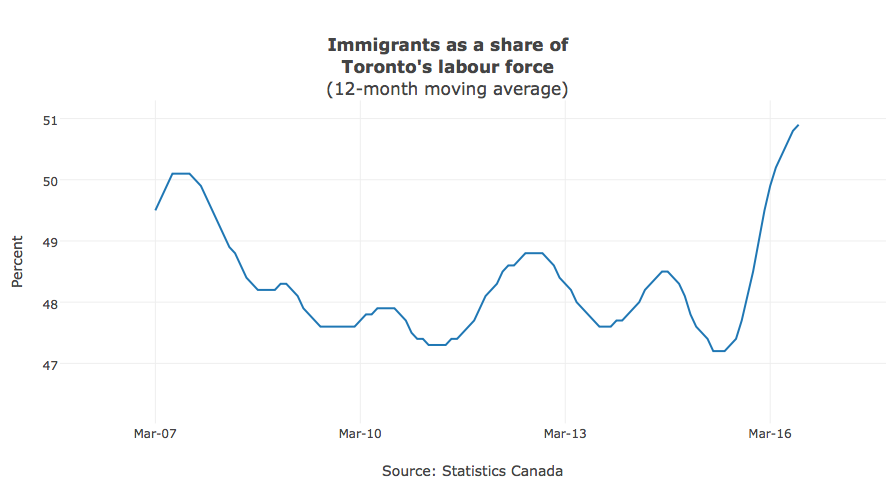
As it is, immigrants are already a major driver of Canada’s labour force. In Toronto, for instance immigrants now account for nearly 51 per cent of the city’s labour force. It’s slightly less in Vancouver (41 per cent) and lower still in Montreal (26 per cent) but all three cities have seen immigrants grow as a share of the labour force over the past few years.

kirby-article

There’s a problem here too, though. New immigrants don’t fare well in Canada’s job market. The unemployment rate among immigrants who landed in Canada within the last five years has, on average, been more than double that of Canadian-born workers over the last decade. Those who came between five and 10 years ago are a bit better off—their unemployment rate is about 1.5 times higher. It’s only among immigrants who’ve been in the country for more than a decade that the gap with Canadian-born workers is erased. It shows that even if Canada ramps up the number of newcomers it accepts, their performance in the labour market will surely lag for years.

The experience over the last year with the influx of more than 30,000 Syrian refugees, who are included in this year’s higher immigration count, has shown how challenging it is to quickly integrate large numbers of people. So too has the backlash in Vancouver against homebuyers from mainland China (and the murky question of who is a foreign buyer and who is a genuine immigrant) even as Canada works to double the number of visa offices in that country. Meanwhile, Canada may pride itself on being more open and tolerant of immigrants, especially in contrast to the ugliness going on in the U.S. and Europe, yet internal polling carried out by Immigration Canada shows one quarter of Canadians feel immigration levels are too high as it is. The news of this year’s immigration boom does not sit well with them.

Which is silly, really, because despite that headline-grabbing number of new immigrants, their number works out to just 0.8 per cent of Canada’s population, or 0.1 percentage points higher than the average of the last 20 years. Some boom.

Source: Canada’s demographic gap can’t be filled with immigrants – Macleans.ca