Poilievre calls for ‘severe limits’ on Canadian population growth

Without, of course, giving any numbers. At some point, both Poilievre and critic Rempel Garner need to provide some numbers to define what they mean by “severe”. Halving numbers back to the Harper government, less or more?

Conservative Leader Pierre Poilievre says the Canadian population has grown out of control and is calling on the Liberal government to further reduce immigration.

“We want severe limits on population growth to reverse the damage the Liberals did to our system,” Poilievre said during a press conference Tuesday in the foyer of the House of Commons.“The population has been growing out of control, our border has been left wide open. This has caused the free flow of drugs, illegal migration, human trafficking and much worse.”

Poilievre did not take followup questions from reporters on what he meant by “severe limits on population growth.”Global News has reached out to the Conservative Party of Canada for clarification but did not receive a response at the time of publication…

Source: Poilievre calls for ‘severe limits’ on Canadian population growth

In some countries, immigration accounted for all population growth between 2000 and 2020

Interesting overview. While Canada not mentioned, it is also in the same situation:

The global population ballooned by about 1.7 billion people between 2000 and 2020. But growth was uneven around the world and, in some places, immigration played a key role.

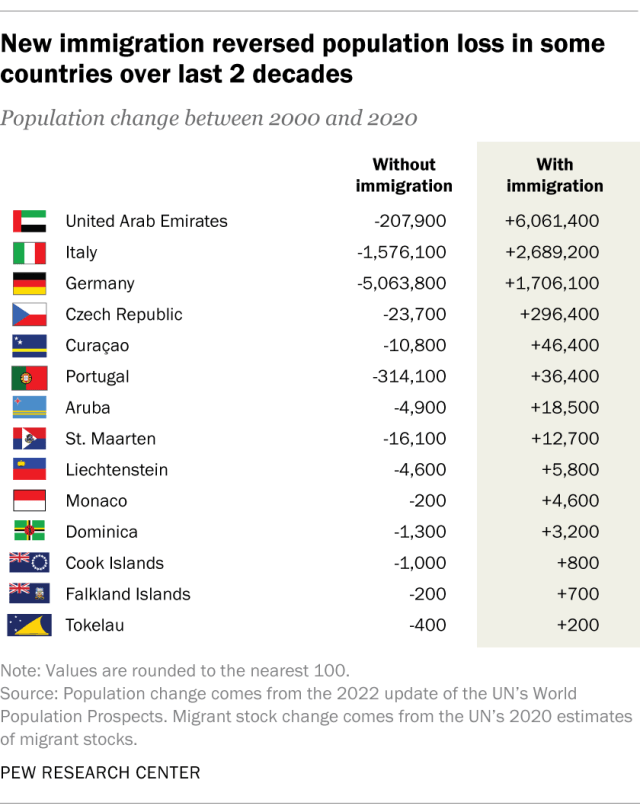
In 14 countries and territories, in fact, immigration accounted for more than 100% of population growth during this period, meaning that populations there would have declined if not for the arrival of new immigrants.

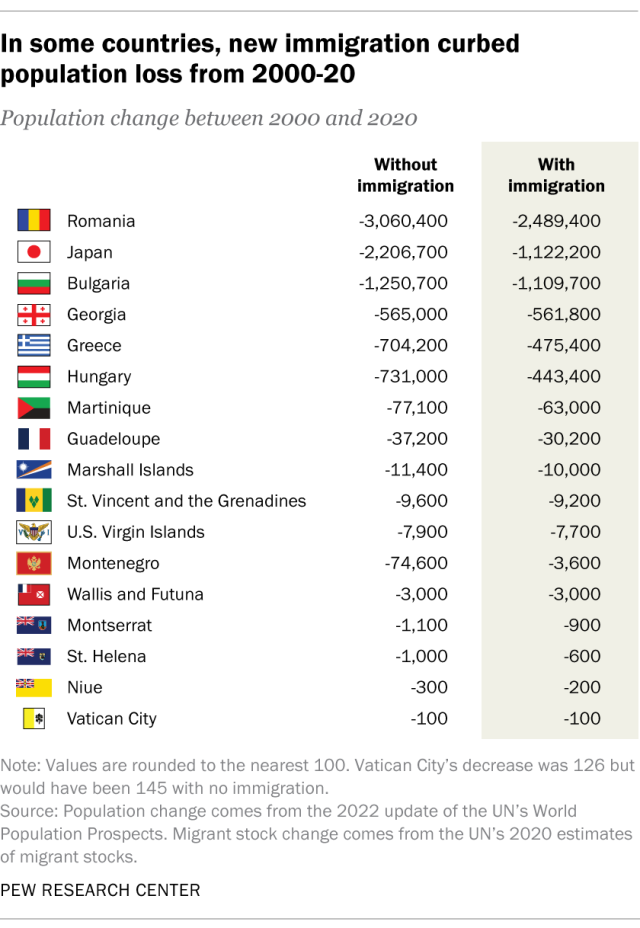
In 17 other countries, populations did decline between 2000 and 2020. But the decreases were smaller than they otherwise would have been due to growth in these countries’ immigrant populations.

How we did this

The places where populations grew only through immigration between 2000 and 2020 – and those where population losses were mitigated by immigration – are geographically scattered. What they tend to have in common is low fertility rates and aging populations. The only way a country’s population can increase, aside from having more births than deaths, is through immigration.

Population decline can be a challenge for countries experiencing it. When deaths and emigration outnumber births and immigration, countries are left with aging populations and dwindling numbers of working-age people to fill out the labor force and support older adults.

Where immigration staved off population losses

The places where immigration accounted for all population growth between 2000 and 2020 range from large countries in Europe to small island nations in the South Pacific.

A table showing that new immigration reversed population loss in some countries over last 2 decades.

Germany’s population grew by 1.7 million people between 2000 and 2020. But it would have shrunk by more than 5 million people without the arrival of new immigrants. During these years, many new immigrants arrived in Germany from Poland, Syria, Kazakhstan and Romania. Women in Germany have 1.5 children on average – far below the fertility rate of about 2.1 children per woman needed for each generation to replace itself – and half of people in Germany are older than 45.

Italy’s population grew by 2.7 million people between 2000 and 2020. However, if not for immigration from places like Romania, Ukraine and Albania, Italy’s population would have declined by 1.6 million people. Italy’s fertility rate is only 1.3 children per woman and its median age is 46.

In the Czech Republic, the overall population grew by 300,000 in 20 years, but immigrants again accounted for all growth. Without new immigrants – many of whom came from other European countries – the Czech population would have shrunk by more than 20,000. As of 2020, women in the Czech Republic had an average of 1.7 children, while the country’s median age was 42.

Portugal’s population grew modestly between 2000 and 2020 – by fewer than 40,000 people – but it would have shrunk by more than 310,000 people without new immigrant arrivals. Many migrants to Portugal were born in Angola, Brazil or France. Portugal’s fertility rate is 1.4 and its median age is 45.

Apart from Europe, immigration also played an important role in avoiding population losses elsewhere in the world.

The population of the United Arab Emirates grew by 6.1 million people between 2000 and 2020 but would have declined by 210,000 without new immigrants. Many of the UAE’s new arrivals were from South Asian countries or Egypt. The average woman in the UAE has 1.5 children, while the country’s median age is 32.

Several smaller countries and territories were also spared population decline only through the arrival of new immigrants. Aruba, the Cook Islands, Curacao, Dominica, the Falkland Islands, Liechtenstein, Monaco, Sint Maarten and Tokelau were all in this category.

Where immigration mitigated population losses

In 17 other countries and territories, populations declined between 2000 and 2020 but would have dropped even more – in some cases much more – without growth in their immigrant populations.

A table showing that, in some countries, new immigration curbed population loss from 2000-20.

In Japan, fertility rates have plummeted to an average of only 1.3 children per woman and the median age is now 48. More people are dying each year than are being born, and Japan’s population declined by over 1.1 million people between 2000 and 2020. However, Japan’s population would have fallen by twice as much (2.2 million people) during this period if not for the arrival of new immigrants. During these years, the foreign-born population of Japan grew from 1.7 million to 2.8 million. Many immigrants to Japan have come from China, South Korea, Vietnam and the Philippines.

Romania’s population shrank by about 2.5 million between 2000 and2020 but would have declined by more than 3 million if not for new immigrants, many of whom are from Moldova. Romania has a fertility rate of 1.7 and a median age of 42.

Greece’s population declined by about 500,000 people between 2000 and 2020. But it would have decreased by 700,000 if not for an increase in the country’s foreign-born population. Similarly, Hungary’s population shrank by 440,000 – but would have fallen by 730,000 without new immigrants. Both countries have low fertility rates and older populations.

In other countries where populations declined, immigrant populations did not increase between 2000 and 2020. This can happen when deaths and departures among earlier immigrants outnumber new immigrant arrivals.

Causes and consequences of population decline

Around the world, women are having fewer children. Women have increasingly put off or forgone childbearing as their average years of education increase, rates of workforce participation climb, and reliable family planning methods become more accessible.

Globally, the total fertility rate – the number of children born to an average woman – declined from 2.7 to 2.3 between 2000 and 2020, a sizable drop in only two decades. It takes an average of about 2.1 children per woman for each generation to replace itself. Naturally, populations age as birth rates dwindle. During these years, the world’s median age increased from 25 to 30.

While fertility is declining all over the world, the impact on population change is uneven. Women still have an average of more than six children in a few African countries, while the average woman in South Korea and Singapore now has less than one child. Median ages, meanwhile, range from 14 in Niger to older than 50 in Monaco and the Vatican.

Source: In some countries, immigration accounted for all population growth between 2000 and 2020

Douglas Todd: Record population growth ‘massive problem’ for housing in B.C

No real surprise but nevertheless of note:

The statisticians describe the unprecedented number of people streaming into B.C., while the province’s mayors explain how difficult and costly it is to try to house everyone.

A special housing meeting of the Union of B.C. Municipalities heard this week that B.C.’s population has jumped like never before — and that more than 600,000 new dwellings are needed just to get back to supply and demand ratios similar to a couple of decades ago.

“All of our growth is international,” said Brett Wilmer, B.C.’s director of statistics. B.C.’s population would basically remain flat, Wilmer said, if it weren’t for the dramatic hikes it has experienced in permanent residents, and especially of foreign students and guest workers.

More than 80 per cent of B.C. newcomers are moving to Metro Vancouver, Victoria, the Fraser Valley and the Central Okanagan, said Wilmer.

While B.C.’s population expanded by a near-record three per cent last year, an economist for the Canada Mortgage and Housing Corporation, Braden Batch, said new housing supply is not matching outsized demand.

“Population growth has put real strain on the housing system. It’s a massive problem,” said Batch, adding new dwellings would have to be built 2.5 times faster to keep up.

The hundreds of mayors, councillors and urban planners attending the UBCM housing summit were told that B.C.’s population will grow by almost one million in the next eight years.

Batch’s charts showed that, under current scenarios, B.C. is set to have a housing shortfall of 610,000 units by 2030.

That prompted the director of Simon Fraser University’s Cities Program, Andy Yan, to say: “We’re going out to offer the Canadian dream to people around the world, but we seem to be OK throwing them into a housing nightmare.”

B.C.’s mayors described how hard it is to get developers to build affordable new housing. They also warned it is costly for taxpayers to provide the transit, sewer systems, schools and medical care to support prodigious population growth.

During a panel titled “Housing the Next Million British Columbians,” five mayors from across the province expressed decidedly mixed feelings about the way B.C. Premier David Eby and Housing Minister Ravi Kahlon last year pushed through sweeping legislation to respond to dramatic urban population growth.

While some mayors complained they weren’t consulted, the B.C. government is now requiring municipalities to allow between three and six units per lot in virtually all low-density residential neighbourhoods, plus highrises near the transit hubs of 31 towns and cities.

Despite some mayors expressing cautious support for Victoria’s plan, they nevertheless said they didn’t think it would improve affordability.

Instead, the mayors described the high cost of supporting more people in more congested neighbourhoods, and expressed dissatisfaction about overstretched staff, loss of green space, parking debacles and a dire shortage of construction workers.

Burnaby Mayor Mike Hurley said it will cost taxpayers an average of $1 million to upgrade a typical 100-metre row of detached houses to provide the infrastructure for four- and six-plexes.

“I’m also not sure we have the workforce, the tradespeople, to do it,” said Hurley, remarking that “hopefully half of the those million more people who are arriving will be in the housing construction industry.”

Both Hurley and Richmond Mayor Malcolm Brodie said the NDP’s push for multi-unit housing throughout cities is creating chaos for their long-range community plans, which have emphasized high density around SkyTrain lines and certain town centres.

“The densification we’ve done is really stark,” said Hurley, referring to massive new skyscraper clusters Burnaby has encouraged at Metrotown, Brentwood and Lougheed town centres.

Citing Richmond’s much-praised Steveston, a community with detached homes on small lots on the south arm of the Fraser River, Brodie argued the B.C. government’s mass upzoning scheme “will destroy a fine neighbourhood.”

None of the five mayors on the “Housing the Next Million British Columbians” panel believed that efforts to increase housing supply will actually lead to affordable dwellings for middle-class and other families.

In recent years, Brodie said, Richmond “has built 50 per cent more housing units than the population has grown. But prices have still gone up by 60 per cent. It simply does not follow that supply reduces prices.”

Bluntly, the mayor of Burnaby added: “The idea that supply will lead to affordability is an absolute fallacy.”

Although speakers agreed projections about the future are hard to get right, Hurley suggested it’s possible development could slow down.

That echoed Wilmer, who told delegates the huge spike in foreign students and guest workers approved by Ottawa in the past two years should “drop back to historical levels this year and next.”

Such non-permanent residents put the most pressure on rental costs, which are at record highs in Metro Vancouver.

While Victoria Mayor Marianne Alto talked about how accommodating vigorous population growth means her city “can only go up, up, and only go in-fill,” Janice Morrison, the mayor of 11,000-resident Nelson, lamented the inevitable “loss of urban green spaces, which is a big reason a lot of people move to smaller cities.”

Richmond’s mayor disagreed over parking with Nathan Pachal, the mayor of the City of Langley. Saying it costs $90,000 to create one parking space, Pachal supported the NDP’s plan to drastically reduce off-street parking for new multi-unit housing buildings. But Brodie said it will create a parking nightmare.

Meanwhile, Nanaimo Mayor Leonard Krog was among those expressing guarded support for the provincial government’s aggressive “good intention” to provide shelter to more people through blanket upzoning.

Like some others, however, Krog suggested the strongest hope for creating more units, especially of the affordable kind, lies in government-subsidized housing — especially from the national government, which he said got out of housing incentives 30 years ago.

All in all, the mayors called firmly on the federal Liberals to show more common sense. That means, they said, Ottawa must be more pragmatic in aligning its international migration targets with the ability to provide housing for all.

Source: Douglas Todd: Record population growth ‘massive problem’ for housing in B.C

Clark: Population growth is the housing issue politicians can’t keep ducking

Indeed:

All of that is not a reason for Canada to turn its back on immigration, and its many benefits. The problem was an abject failure to plan.

But it does mean that in the short term, there is a policy lever governments can pull now to cool the housing market. That is temporarily slowing the growth of temporary residents – capping the number of new students and new temporary workers. That could prevent another year of high rent increases on new leases.

Avoiding the issue – avoiding an unavoidable fact about the housing crisis – will only pile misery onto past failures.

Source: Population growth is the housing issue politicians can’t keep ducking

U.S. Population Growth Has Nearly Flatlined. Is That So Bad?

Well worth reading, a useful and needed counterpoint to all the fretting about demographic decline and an aging population. Canadian policy makers and others need to think more about how to manage an aging population that mainly advocating for increased immigration to slow the trend:

A Demographic Crisis.” “A Blinking Light Ahead.” “The Death of Hope.” Those are some of the dire headlines that have been written in recent years about the sluggish pace of U.S. population growth, which in 2021 fell to its lowest rate ever — just 0.1 percent.

While the pandemic played a major role in driving last year’s decline, the country’s population growth has been slowing for much of the last decade, depressed by declining fertility rates, a surge in “deaths of despair” and lower levels of legal immigration.

But is a population slowdown as much of a crisis as some have made it out to be, or could it actually bring welcome changes? Here’s a look at a longstanding demographic debate.

For a population to replenish itself in the absence of immigration, demographers estimate that there must be, on average, about 2.1 births per woman. In the United States, the fertility rate has been consistently below that level since 2007. And it’s not alone: While some countries, especially in sub-Saharan Africa, are still growing rapidly, the global average fertility rate has been falling for decades, and even China’s population, the world’s largest, may very soon reach its peak.

As a result, the United Nations now predicts that the human population will start declining by the end of the century. (Other demographers have projected an even earlier peak.) Some countries — notably Japan and South Korea, whose fertility rates are among the lowest in the world — are already shrinking.

Why are fertility rates falling? The trend is typically attributed to a combination of economic prosperity, which leads to lower infant mortality, and greater gender equality. “As women have gained more access to education and contraception, and as the anxieties associated with having children continue to intensify, more parents are delaying pregnancy and fewer babies are being born,” Damien Cave, Emma Bubola and Choe Sang-Hun reported for The Times last year. Because many of those babies then go on to have smaller families than their parents did, they added, “the drop starts to look like a rock thrown off a cliff.”

It’s a stark reversal of the demographic trends of the 1900s, during which the coincidence of high fertility rates and lengthening life spans caused the global population to nearly quadruple in size, from 1.6 billion to six billion. And for much of the 20th century, it was the specter of overpopulation, not stagnation or decline, that animated dystopian visions of the future.

Which raises a question: How much stock should we really be placing in population forecasts? As David Adam explained in Nature last year, medium-term projections are usually quite accurate, as most people who will be alive in 20 to 30 years have already been born.

But over the longer term, projections diverge and become less reliable, in part because technological and environmental shocks that could cause demographic swings are impossible to predict, as Vox’s Kelsey Piper has written: “If, for example, climate change drives currently developed countries back into poverty and drives their birthrates back up, the estimates are poorly equipped to account for that. On the other hand, if more reliable contraceptives are developed and virtually end unintended pregnancies the world over, birthrates could fall much faster than predicted.”

For many futurists, the primary challenge posed by declining population growth is economic: When people live longer and have fewer babies, the population ages, leaving fewer working-age adults to support a country’s swelling number of retirees.

“Older people are more prone to illness, and many rely on publicly funded pensions and eventually require caregiving,” Stephanie H. Murray wrote in The Atlantic in February. “Many countries, including the U.S., are already struggling to meet the needs of the rapidly growing elderly population.”

This can create a kind of national languishing, as the Times columnist Ross Douthat argued last year: “If you assume that dynamism and growth are desirable things (not everyone does, but that’s a separate debate), then for the developed world to be something more than just a rich museum, at some point it needs to stop growing ever-older, with a dwindling younger generation struggling in the shadow of societal old age.”

Aging may take a particularly heavy toll on middle-income countries. Historically, as industrialized countries have become richer, their labor force grew more rapidly than their nonworking population, providing a “demographic dividend.” But in some developing countries, including Brazil and China, fertility rates have fallen to around or below replacement level much more quickly than they did for their higher-income counterparts, and their populations now face the risk of getting old before getting rich.

A population slowdown can be a symptom of other national problems. For example, as Derek Thompson has noted in The Atlantic, while declining fertility is often a sign of female empowerment, it can also be a sign of its opposite, as suggested by the growing gap between how many children Americans say they want and how many they have. “There are many potential explanations for this gap,” Thompson wrote, “but one is that the U.S. has made caring for multiple children too expensive and cumbersome for even wealthy parents, due to a shortage of housing, the rising cost of child care, and the paucity of long-term federal support for children.”

To see how population stagnation or even decline need not spell disaster, you can look at countries where it’s already occurring, as Daniel Moss, a Bloomberg Opinion columnist covering Asian economies, did last year. Take Japan: “Despite the caricature of the country as an economic failure in the grip of terminal decline, life goes on,” he wrote. “True, growth in overall G.D.P. has been fairly anemic in past few decades, but G.D.P. per capita has held up well.” What’s more, he added, Japan’s unemployment rate is very low and has remained so throughout the pandemic (it was 2.6 percent in July).

Japan’s example lends some credence to the view of Kim Stanley Robinson, a widely acclaimed science-fiction writer, who believes that an aging population with a smaller work force could actually lead to economic prosperity. “It sounds like full employment to me,” he argued in The Washington Post last year. “The precarity and immiseration of the unemployed would disappear as everyone had access to work that gave them an income and dignity and meaning.”

The challenges of an aging population could push countries to pursue policies that improve quality of life:

  • One 2019 analysis estimated that if the European Union eliminated inequities in educational attainment and in women’s and immigrants’ labor force participation, it could cancel out more than half of the labor force decline it might otherwise experience by 2060.
  • Another way governments have responded to labor shortages caused by population aging is by investing more in the automation of work, an M.I.T. study found last year. As The Times’s John Yoon reported last month, “The prospect of a shrinking work force has put South Korea at the forefront of developing robots and artificial intelligence for the workplace.”
  • In the view of the Times columnist Paul Krugman, the biggest economic problem of an aging population isn’t increased strain on the social safety net, but rather weak investment from businesses anticipating reduced consumer demand. If that scenario comes to pass, though, “why not put the money to work for the public good?” he wrote last year. “Why not borrow cheaply and use the funds to rebuild our crumbling infrastructure, invest in the health and education of our children, and more? This would be good for our society, good for the future, and would also provide a cushion against future recessions.”

Fertility rate declines may also be making climate change easier to combat, albeit not in the way many think: As Sarah Kaplan of The Washington Post has explained, fossil fuel consumption is driven primarily by increases in affluence, not the number of people on the planet per se. So while population growth in poor countries hasn’t led to large increases in planet-warming emissions, a sudden baby boom in high-income countries like the United States almost certainly would.

For some demographers, the prospect of population stagnation or decline isn’t any more a cause for alarm than population growth was; it’s simply a change that governments will need to manage. “Rather than panicking or trying to forestall this for ourselves,” Leslie Root, a demographer and a postdoctoral scholar at the University of Colorado, Boulder, wrote in The Washington Post last year, “we should be thinking about what that transition will mean globally — both for rich countries and for poor ones that will be far more burdened by aging populations than we will.”

Source: U.S. Population Growth Has Nearly Flatlined. Is That So Bad?

ICYMI: Yakabuski: Can Canada handle its coming population boom?

Valid question. Alternative question: Is the coming population boom good for Canada and Canadians?

The latest projections from Statistics Canada show that Canada’s population is poised to grow much faster over the next two decades than the federal agency forecast just three years ago, suggesting any downturn in the country’s housing market is likely to be short-lived.

Indeed, the revised Statscan figures released last week underscore the need for policy makers to clear the way for more housing and infrastructure projects now to accommodate a fast-growing national population that is projected to increase by around 10 million people by 2043.

Statscan normally updates its population projections every five years. But the agency undertook a “necessary” revision of its 2019 projections this year “to reflect recent developments in Canadian demographics,” including the pandemic and Ottawa’s move to increase immigration targets. While the longer-term impact of the pandemic on population growth is expected to be “rather imperceptible,” the opposite is true for the higher immigration levels.

In February, Prime Minister Justin Trudeau’s government announced plans to boost immigration levels “to help the Canadian economy recover and to fuel post-pandemic growth,” following a sharp drop in the number of newcomers arriving in Canada in 2020. Immigration rebounded in 2021, with a record 405,332 new permanent residents arriving here. And Canada is set to welcome about 432,000 new permanent residents this year, 447,000 in 2023 and 451,000 in 2024.

National Bank of Canada economists Matthieu Arseneau and Alexandra Ducharme noted that Canada’s population will increase by one million more people by 2032 than Statscan previously projected. Almost all of that extra growth will occur among those aged between 25 and 54 years old – an age cohort that is “crucial to the resilience of consumption and real estate.”

Royal Bank of Canada economists Robert Hogue and Carrie Freestone came to a similar conclusion even before the release of Statscan’s updated population projections. In a mid-August report, they projected that Canada will count 730,000 more households by 2024 than it had in 2021, as the country welcomes more than 1.3 million new immigrants.

“This surge, combined with shrinking household sizes, will strengthen demand for housing (whether owned or rented) and act as a powerful counter to sliding sales and prices – eventually putting a floor under the correction,” they wrote.

The updated Statscan projections highlight the urgency for policy makers to plan for what is expected to be the highest population growth among the Group of Seven countries over the next two decades and beyond. Based on the federal agency’s medium-growth scenario, Canada’s population is projected to grow to 47.8 million in 2043 from 38.2 million in 2021.

Ontario is expected to add more than four million new residents over the next 20 years, with its population rising to 19 million from 14.8 million. Canada’s most populous province will see its share of the national population increase to 39.8 per cent from 38.8 per cent.

Even so, Ontario’s 28-per-cent population growth over the next two decades is expected to pale compared with a 46-per-cent surge in Alberta, which will see its population grow to 6.5 million by 2043 from 4.4 million. Albertans will account for about 13.5 per cent of Canada’s population in 2043, up from 11.6 per cent in 2021.

However, Quebec’s share of the Canada’s population is set to fall below 20 per cent for the first time, as the province (which chooses its own economic immigrants) accepts proportionally fewer newcomers than the rest of the country. From 22.5 per cent of Canada’s population in 2021, Quebec will see its share decline to 19.8 per cent by 2043. Quebec’s overall population will grow by less than 10 per cent over the same period, to 9.4 million.

The Atlantic provinces will benefit from interprovincial migration levels that will be higher than those forecast before the pandemic, but not enough to reverse a decline in the region’s share of the national population. Newfoundland and Labrador’s population will shrink outright.

Ottawa’s higher immigration targets will on their own not be enough to ease the country’s labour shortage, as more and more Canadians retire in coming years. Even more aggressive immigration levels would be needed to reverse the aging trend that will see the share of the population over 65 increase steadily over the next two decades to 23.1 per cent in 2043 from 18.5 per cent in 2021.

The average age of Canadians, which increased from 27.3 years in 1921 to 41.7 years in 2021, will rise further to 44.1 years by 2043. And while about 871,000 were over 85 in 2021, their ranks will swell to more than 2.2 million by 2043.

Still, Canada’s population projections tell a rather enviable story compared with many European countries, where population aging is occurring at a much faster rate amid lower immigration levels. The question is whether policy makers here can move fast enough to prepare the country for its coming population boom.

Source: Can Canada handle its coming population boom?

Where two years without immigration puts New Zealand

Largely the opposite approach of Canada:

New Zealand’s population has had a growth spurt over the past decade, when compared with the rest of the OECD.

In 2016, unprecedented growth was seen at 2.2 percent a year – levels not seen since the early 1960s.

According to the Productivity Commission, a Crown entity tasked with lifting New Zealand’s productivity, the reasons for this relatively rapid growth were high resident numbers and largely uncapped temporary migration programmes.

Newspaper headlines about the ‘brain drain’ and skilled labour shortages being filled in by recent migrants were common occurrences through the 2010s – and along came a virus.

Overnight, the flow of migrants was cut down to a trickle, calling for fast-tracked changes across almost every economic sector.

Now as the border slowly returns to a more permeable state after two years of stasis, the Productivity Commission is evaluating what this means for New Zealand’s immigration policy and whether the country’s reliance on migrant labour could be labelled an objective over-reliance.

After months of research and public consultation, the commission is preparing a report on the impact of differing levels of migration to be presented to ministers in the Government on April 30.

The preliminary report highlighted the significant role immigration has played in supporting New Zealand’s population growth.

Along with this came a heavy reliance on temporary migrant workers, a potential source of volatility and economic uncertainty in the case of borders being closed.

Before March 2020, New Zealand had an annual population growth of just over 2 percent, around two-thirds of that from immigration.

Since then, it has dropped to a growth rate of 0.6 percent. That means this country went from having some of the highest annual growth rates in the OECD to being bang on average.

Massey University sociology professor Paul Spoonley specialises in how social change and demographics affect political decisions.

He said the issue of immigration is a difficult equation for New Zealand to balance, with benefits and consequences on either side.

“There are two sides to the issue because as we’ve seen, lots of the labour market in New Zealand rely on either temporary or permanent migrants,” he said. “So to actually build houses or infrastructure like roads, we’ve become very reliant on migrant labour.”

On the other hand, he noted that rapid growth also requires a matched pace in infrastructure development, especially in quickly growing cities like Auckland or Tauranga – two cities Spoonley said have “an historic deficit in terms of infrastructure”.

If infrastructure already isn’t fit for purpose, he said rapid population growth can enact enormous pressure.

So there’s a delicate balance to strike if New Zealand moves back to its prior reliance on migration. Other factors to consider include benefiting from other countries’ investment in human resources.

“What we get in terms of our skilled migrant category, where the majority of our permanent migrants were approved, is somebody whose life up to this point, including their skills, training and experience has been paid for by another country,” he said. “If we’re getting the surgeon from South Africa or the roading engineer from India, we didn’t make the investment but we are going to be the beneficiary of their skills.”

New Zealand’s immigration profile has changed in recent years, shifting from a focus on permanent migration to more migrant workers being here on work, student or visitor visas. Temporary work visas in particular have grown to represent a much larger chunk of all arrivals since around 2010.

The commission pointed to this increase in the temporary visa load as a result of policy choices made by governments in response to demands from employers for workers, an increase in international students and the points system for New Zealand residency privileging those who have already had work or study experience within the country.

But as the dust of these initial Covid years settle, many countries share the same gaps in the labour market that they are now likely to try to fill.

Spoonley says it will be a competitive market as migration resumes over the next two or three years.

“The labour crunch which Covid has accelerated is common to other countries, so what we are then doing is competing for migrants with Australia, the UK, the USA or Canada,” he said. “At the same time, they will also try to recruit out of New Zealand, in particular skilled New Zealanders.”

Could this mean a return to the ‘brain drain’ days of 2012, when a group the size of a packed-out Eden Park left for Australia?

Spoonley’s best guess is the number of Kiwis packing their bags for environs further afield will be somewhere between those seen in 2012 and now.

“I don’t know to be honest, but will we see our new graduates and some of our skilled workforce leaving to another country? Absolutely,” he said. The outflow will be seen particularly to countries that can put a premium on attracting people – whether with higher incomes or lower cost of living, pull factors that have long had Kiwis set their sites overseas.

“Australia can pay a third more,” Spoonley said. “So will we see a net outflow of New Zealanders? Almost certainly. I’m just not clear on the size of that. What I am clear about is that many of them will be highly skilled and we can’t afford to lose them.”

He said it’s a looming retention issue for the New Zealand economy, where the biggest reasons for people to stay put will be family or friends.

“Other countries will be outbidding us in terms of pay and conditions.”

Source: Where two years without immigration puts New Zealand

After years of US population growth, it’s time for a pause | TheHill

Rare questioning of the conventional wisdom of growth strategies and raising of related issues:

In the long run, no substantial benefits will result from the further growth of America’s population. The gradual stabilization of the U.S. population through voluntary means would contribute significantly to America’s ability to solve its problems.

That statement from a half-century ago was the unequivocal central finding of the groundbreaking report by the U.S. Commission on Population Growth and the American Future, submitted to the president and Congress on March 27, 1972.

However, rather than moving toward a gradual stabilization, as was clearly recommended, America’s population over the past 50 years has grown to 334 million, an increase of 123 million (about 60 percent) since 1972.

In addition, America’s population is projected to continue growing over the coming decades. According to its main projection series, the Census Bureau expects the nation’s population to be close to 400 million around mid-century.

Preceding the commission’s establishment by several years, former President Richard M. Nixon remarked that “One of the most serious challenges to human destiny in the last third of this century will be the growth of the population… Whether man’s response to that challenge will be a cause for pride or for despair in the year 2000 will depend very much on what we do today.”

Nixon’s observations are even more prescient today. Given climate change, environmental degradation, biodiversity loss, pollution and congestion, population growth in America and the rest of the world remains among the serious challenges to human destiny in the 21st century.

Similarly and more recently, naturalist Sir David Attenborough remarked, “It’s not just climate change; it’s sheer space, places to grow food for this enormous horde. Either we limit our population growth, or the natural world will do it for us, and the natural world is doing it for us right now.”

Without a doubt, America’s population growth is a major factor affecting domestic demand for resources, including water, food and energy, and the worsening of the environment and climate change. There is hardly any major problem facing America with a solution that would be easier if the nation’s population were larger. On the contrary, population stabilization would help to resolve several.

Stabilizing the population would reduce pressures on the environment, climate and the depletion of resources and gain time for America to find solutions to its pressing issues. If the United States intends to address climate change, biodiversity loss, pollution, etc., it must consider how its population affects each issue.

In contrast to the commission’s central finding, some do not recognize the need to stabilize the population. Their reasons are largely based on profit, politics and power. They give little attention to the consequences of population growth on the nation’s future.

For instance, many economists contend that continued population growth is needed to fuel economic growth. Their “bigger-is-better” arguments simply ignore or dismiss the negative consequences for the country, which are threats to the wellbeing of today’s Americans as well as the long-term sustainability of the nation.

Others argue the nation would be “more happy” with more people. Slow population growth, they claim, hurts not only America’s economic growth but also the national mood. Concerns about climate change and the environment are omitted from their rhetoric.

Some advance nationalistic appeals for continued population growth, maintaining that the more patriotic one is the more one ought to believe in a large and growing America.

Another argument is the view that “America isn’t full” and can accommodate many more people, particularly more immigrants. Those advocates, however, rarely ever specify how large the population must become to be considered full nor do explain why America needs to be full.

Thousands of scientists worldwide take an opposing view. Among their major recommendations for governments to address the climate emergency is a call for the stabilization of the world population, or ideally, a gradually reduced population within a framework that ensures social integrity.

Gradually stabilizing America’s population will provide an exemplary model for other countries to emulate. Rather than racing to increase the size of their respective populations in a world with 8 billion humans and growing, nations would see America moving away from the unsustainable demographic strategy.

As American couples are having fewer children than in the past for a host of social, economic and personal reasons, the nation’s fertility rate is unlikely to return to the replacement level any time soon. And pro-growth calls for Congress or the administration to establish pro-natalist policies to raise fertility appear unlikely to be adopted.

Source: After years of US population growth, it’s time for a pause | TheHill