Articles of interest: Immigration

Additional polling on souring of public mood on current high levels, related commentary on links to housing availability and affordability among other issues:

‘There’s going to be friction’: Two-thirds of Canadians say immigration target is too high, poll says

Worrisome trend but understandable:

Two-thirds of Canadians say this country’s immigration target is too high, suggests a new poll that points to how opinions on the issue are taking shape along political lines — a shift that could turn immigration into a wedge issue in the next federal election.

A poll by Abacus Data has found the percentage of people who say they oppose the country’s current immigration level has increased six points since July, with 67 per cent of Canadians now saying that taking in 500,000 permanent residents a year is too much.

“The public opinion has shifted in Canada to a point where if a political leader wanted to make this an issue, they could,” said Abacus chair and CEO David Coletto.

“We’re headed into a period where there’s going to be friction.”

Source: ‘There’s going to be friction’: Two-thirds of Canadians say immigration target is too high, poll says

Affordability crisis putting Canadian dream at risk: poll

Yet another poll, focussed on immigrants:

The Leger-OMNI poll, one of the largest polling samples of immigrants in recent years, surveyed 1,522 immigrants across Canada between Oct. 18 and 25. It is one of the few polls specifically surveying immigrants.  

The research finds the cost-of-living crisis is hitting immigrants hard. Eighty-three per cent polled feel affordability has made settling more difficult. While financial or career opportunities were the motivating factor for 55 per cent of immigrants’ journey to Canada, just under half surveyed think there are enough jobs to support those coming in. 

A quarter (24 per cent) feel their experience in Canada has fallen short of expectations.

Source: Affordability crisis putting Canadian dream at risk: poll

Kalil: We simply don’t have enough money to solve Canada’s housing crisis 

Reality:

Housing does not magically appear when there is demand for it. It takes time, infrastructure needs to be built to support it, the construction industry needs to have the capacity to deliver it, and our housing economy needs to hold enough money to fund it – which it does not.

Source: We simply don’t have enough money to solve Canada’s housing crisis

Burney: Trudeau, please take a walk in the snow

Burney on immigration and his take on the public service:

A rapid increase in immigration numbers was touted until it was seen simply as a numbers game, lacking analyses of social consequences, notably inadequate housing, and unwelcome pressures on our crumbling health system. Meritocracy is not really part of the equation, so we are not attracting people with needed skills. Instead, we risk intensifying ethnic, religious and cultural enclaves in Canada that will contribute more division than unity to the country.

The policy on immigration needs a complete rethink. But do not expect constructive reform to come from the public service, 40 per cent larger now than it was in 2015 and generously paid, many of whom only show up for office work one or two days per week. Suggestions that they are more productive or creative at home are absurd.

Source: Trudeau, please take a walk in the snow

Keller: The Trudeau government has a cure for your housing depression

Here’s what Stéfane Marion, chief economist with National Bank, wrote on Tuesday. It’s worth quoting at length.

“Canada’s record housing supply imbalance, caused by an unprecedented increase in the working-age population (874,000 people over the past twelve months), means that there is currently only one housing start for every 4.2 people entering the working-age population … Under these circumstances, people have no choice but to bid up the price of a dwindling inventory of rental units. The current divergence between rental inflation (8.2 per cent) and CPI inflation (3.1 per cent) is the highest in over 60 years … There is no precedent for the peak in rental inflation to exceed the peak in headline inflation. Unless Ottawa revises its immigration quotas downward, we don’t expect much relief for the 37 per cent of Canadian households that rent.”

What are the odds of the Trudeau government taking that advice?

Source: The Trudeau government has a cure for your housing depression

Conference Board: Don’t blame immigration for inflation and high interest rates – Financial Post

Weak argumentation and overall discounting of the externalities and wishful thinking for the long-term:

Of course, immigration has also added to demand. Strong hiring supported income growth, and immigrants coming to Canada need places to live and spend money on all the necessities of life. This adds to demand pressures and is especially concerning for rental housing affordability. Such strength in underlying demographic demand is inflationary when there is so little slack in the economy. Taking in so many in such a short period of time has stretched our ability to provide settlement services, affordable housing  and other necessities. But there is also no doubt that the surge in migrants has alleviated massive labour market pressure and is thus deflationary. Without immigration, Canada’s labour force would be in decline, especially over the next five years as Canada’s baby boomers retire in growing numbers. Steady immigration adds to our productive capacity, our GDP and our tax take — enough to offset public-sector costs and modestly improve government finances.

One thing is certain, if immigration is aligned with our capacity to welcome those who are arriving, it will continue to drive economic growth and enrich our society through diversity, as it has through most of our history.

Mike Burt is vice president of The Conference Board of Canada and Pedro Antunes is the organization’s chief economist.  

Source: Opinion: Don’t blame immigration for inflation and high interest rates – Financial Post

More international students are seeking asylum in Canada, numbers reveal

Another signal that our selection criteria and vetting have gaps:

The number of international students who seek asylum in Canada has more than doubled in the past five years, according to government data obtained under an access-to-information request.

The number of refugee claims made by study permit holders has gone up about 2.7 times to 4,880 cases last year from 1,835 in 2018, as the international student population also surged by approximately 1.4 times to 807,750 from 567,065 in the same period.

Over the five years, a total of 15,935 international students filed refugee claims in the country.

While less than one per cent of international students ended up seeking protection in Canada, the annual rate of study permit holders seeking asylum doubled from 0.3 per cent to 0.6 per cent between 2018 and 2022.

Source: More international students are seeking asylum in Canada, numbers revea

‘It’s unfair’: Haitians in Quebec upset province has opted out of federal family reunification program

Well, Quebec has the right to opt-out and face any resulting political pressure:

The federal program, announced in October by Canadian Immigration Minister Marc Miller, will open the door to 11,000 people from Colombia, Haiti and Venezuela who have immediate family members living in Canada either as citizens or permanent residents.

But when it launched on Nov. 17, it made clear that only those who “reside in Canada, outside the province of Quebec,” would be eligible to sponsor relatives.

The province of Quebec had opted out of the program.

Source: ‘It’s unfair’: Haitians in Quebec upset province has opted out of federal family reunification program

Douglas Todd: Californians taken aback by vast gap between wages and housing costs in Vancouver

More evidence of the disconnect between housing affordability, income and population:

Last month, scholars at the University of California, Berkeley invited a Canadian expert to offer his analysis of the riddle that is crushing the dreams of an entire generation.

“What really surprised them in California was the sharp decoupling there is in Metro Vancouver between incomes and housing prices,” said Andy Yan, an associate professor of professional practice at Simon Fraser University who also heads its City Program.

It’s relevant that Yan was invited to speak to about 75 urban design specialists in the San Francisco Bay area, since it also has prices in the same range (adjusted to Canadian dollars) as super-expensive Metro Vancouver.

But there is a big difference. Unlike Metro Vancouver, the San Francisco region also has the fourth-highest median household incomes in North America.

Indeed, median wages in the California city come in at the equivalent of about $145,000 Cdn., 61 per cent higher than $90,000 in Vancouver.

In other words, while things are rough for would-be homeowners in the San Francisco area, they are horrible for those squeezed out of the Metro Vancouver market.

Why is that? In his California presentation, Yan talked, quite sensibly, about the three big factors that normally determine housing costs: supply, demand and finance.

Source: Douglas Todd: Californians taken aback by vast gap between wages and housing costs in Vancouver

Glavin: Is there a triumphant Geert Wilders in Canada’s future? Not yet, but …

The risk exists but overstated:

….To object to this state of affairs doesn’t make Canada a racist country, and state-sanctioned rejection of the very idea of mainstream Canadian values, coupled with the catastrophic mismatch between immigration levels and Canada’s capacity to accommodate them all, doesn’t mean there’s some hard-right turn just around the corner with a Geert Wilders figure coming out of nowhere.

But it does mean that Canada is barrelling towards a brick wall, and we should stop and turn around.

Source: Glavin: Is there a triumphant Geert Wilders in Canada’s future? Not yet, but …

Antiquated U.S. Immigration System Ambles into the Digital World

Similar challenges as Canada:

Notorious for its reliance on antiquated paper files and persistent backlogs, the U.S. immigration system has made some under-the-radar tweaks to crawl into the 21st century, with the COVID-19 pandemic serving as a catalyst. Increased high-tech and streamlined operations—including allowing more applications to be completed online, holding remote hearings, issuing documents with longer validity periods, and waiving interview requirements—have resulted in faster approvals of temporary and permanent visas, easier access to work permits, and record numbers of cases completed in immigration courts.

While backlogs have stubbornly persisted and even grown, the steps toward modernization at U.S. Citizenship and Immigration Services (USCIS) and the State Department have nonetheless led to a better experience for many applicants seeking immigration benefits and helped legal immigration rebound after the drop-off during the COVID-19 pandemic. Swifter processes in the immigration courts have provided faster protection to asylum seekers and others who are eligible for it, while also resulting in issuance of more removal orders to those who are not.

Yet some of these gains may be short-lived. Some short-term policy changes that were implemented during the pandemic have ended and others are about to expire, raising the prospect of longer wait times for countless would-be migrants and loss of employment authorization for tens of thousands of immigrant workers. Millions of temporary visa applications may once again require interviews starting in December, making the process slower and more laborious for would-be visitors. This reversion to prior operations could lead to major disruptions in tourism, harm U.S. companies’ ability to retain workers and immigrants’ ability to support themselves, and create barriers for asylum seekers with limited proficiency in English.

Source: Antiquated U.S. Immigration System Ambles into the Digital World

Thousands of Canada’s permanent residents are afraid to leave the country. Here’s why

Another policy and service delivery fail:

According to an email from Immigration, Refugees, and Citizenship Canada (IRCC), there are over 70,000 Ahmad Omars out there, waiting on their first PR cards. This situation has left them trapped in a travel limbo, unable to leave the country or make future plans.

“Initially, the estimated waiting time for the PR card was 30 days. However, 30 days later, it extended to 45 days, and then, 45 days after that, it became 61 days. Now, I find myself significantly beyond the expected waiting time,” Omar said.

“It doesn’t feel like I am actually a permanent resident until I get the card.”

Source: Thousands of Canada’s permanent residents are afraid to leave the country. Here’s why

Saunders: How the push for border security created an illegal-immigration surge

Agree, but likelihood low:

If we wanted to reduce legal immigration numbers, as Mr. de Haas argues, we’d need to change the underlying economy: fund universities and colleges so they don’t rely on overseas student fees; incentivize farms to rely on technology rather than cheap labour (at the cost of higher food prices); make domestic housecleaners and child-minders a strictly upper-class thing again; and settle for lower levels of competitiveness and economic growth.

What doesn’t work is the entire false economy of border security – as years of expensive, dangerous experiments show, it actually amplifies the problem it’s meant to solve.

Source: How the push for border security created an illegal-immigration surge

Rise in net migration threatens to undermine Rishi Sunak’s tough talk – The Guardian

Leaving others to clean up the mess:

Of Boris Johnson’s many broken promises, his failure to “take back control” of post-Brexit immigration is the one that Tory MPs believe matters most to their voters.

Johnson has long fled the scene – Rishi Sunak is instead getting the blame from his New Conservative backbenchers who predict they will be punished at the ballot box in the “red wall” of the north and Midlands.

The former prime minister’s battlecry of “getting Brexit done” at the 2019 election went hand-in-hand with a manifesto promise to reduce levels of net migration from what was about 245,000 a year.

A tough “points-based immigration system” was going to be brought in by the then home secretary, Priti Patel, and supposedly allow the UK rather than Brussels to have control of the numbers.

And yet the latest net migration figures of almost 750,000 for 2022 show that far from decreasing, net migration has gone up threefold. Many economists believe this level of migration is necessary and the natural consequence of a country facing staff shortages and high domestic wages.

Source: Rise in net migration threatens to undermine Rishi Sunak’s tough talk – The Guardian

The Provincial Nominee Program: Retention in province of landing

Good analysis of retention rates by province:

“The Provincial Nominee Program (PNP) is designed to contribute to the more equitable distribution of new immigrants across Canada. A related objective is the retention and integration of provincial nominees in the nominating province or territory. This article examines the retention of PNP immigrants at both the national and provincial or territorial levels. The analysis uses data from the Immigrant Landing File and tax records, along with three indicators of retention, to measure the propensity of a province or territory to retain immigrants. Results showed that the retention of PNP immigrants in the province or territory of landing was generally high. Overall, 89% of the provincial nominees who landed in 2019 had stayed in their intended province or territory at the end of the landing year. However, there was large variation by province or territory, ranging from 69% to 97%. Of those nominees located in a province at the end of the landing year, a large proportion (in the mid-80% range) remained in that province five years later. Again, there was significant variation by province, ranging from 39% to 94%. At the national level, both short- and longer-term provincial and territorial retention rates were lower among provincial nominees than among other economic immigrants. However, after adjusting for differences in the province of residence, sociodemographic characteristics and economic conditions, the provincial nominee retention rate was marginally higher than that among federal skilled workers during the first three years in Canada, and there was little difference after five years. Ontario, Alberta and British Columbia had the highest PNP retention rates, and Newfoundland and Labrador, Prince Edward Island, and New Brunswick, the lowest. This gap among provinces tended to increase significantly with years since immigration. Accounting for the provincial unemployment rate explained some of the differences in retention rates between the Atlantic provinces and Ontario, Alberta and British Columbia. However, even after adjusting for a rich set of control variables, a significant retention rate difference among provinces persisted. Provinces and territories can benefit from the PNP not only through the nominees retained in the province or territory, but also from those migrating from other provinces or territories. Ontario was a magnet for the secondary migration of provincial nominees. After accounting for both outflows and inflows of provincial nominees, Ontario was the only province or territory that had a large net gain from this process, with significant inflows of provincial nominees from other provinces. Overall, long-term retention of provincial nominees tended to be quite high in Ontario, Alberta and British Columbia, particularly when considering inflows, as well as outflows. Manitoba, Saskatchewan and Nova Scotia tended to have an intermediate level, but still relatively high longer-term retention rates. Prince Edward Island, New Brunswick, and Newfoundland and Labrador had the lowest retention.”

Read the full report: https://www150.statcan.gc.ca/n1/pub/36-28-0001/2023011/article/00002-eng.htm

Keller: Why are our schools addicted to foreign student tuition? Because government was the pusher

Unfortunately, a large part of the visa system has been diverted to other purposes. We’re basically selling citizenship on the cheap, with the funds backfilling for provincial governments’ underfunding of higher education.

Source: Why are our schools addicted to foreign student tuition? Because government was the pusher

International students, advocates say Canada should permanently lift 20-hour work cap

Advocates underline point that international students have become a back-door immigration worker stream:

Advocacy group Migrant Workers Alliance for Change has been calling for this change since 2017 and has been fielding increasing calls from concerned students.

The alliance’s organizer, Sarom Rho, said it has been organizing against the 20-hour work limit since international student Jobandeep Singh Sandhu was arrested for working too many hours outside school in 2019.

“This is a question about whether we want to live in a society where everybody has equal rights and protections, or if we’re going to allow a system that sections off a group of people on the basis of their immigration status and denies them the same rights,” she said.

“There are six weeks left until the end of this temporary policy. Every day matters and the clock is ticking. We’re calling on Prime Minister Trudeau and Immigration Minister Mark Miller to do the right thing and permanently remove the 20-hour work limit.”

Source: International students, advocates say Canada should permanently lift 20-hour work cap

‘Canadian experience’ requirements are not just discriminatory – they harm the economy

Change happening but too often Canadian experience applied unevenly. That being said, during my experience during cancer treatment, there were some cultural differences in patient care, reminding me that immigrants would encounter also encounter differences:

In 2021, immigrants made up nearly a quarter of the Canadian population, a historic high. As Canada ages, immigration is projected to fuel the country’s entire population growth by 2032.

It is often said that immigrants help drive Canada’s prosperity. But if “Canadian experience” remains a stumbling block for newcomers to enter the job market, that vision will be nothing but a pipe dream.

Fortunately, I am now employed, working in a field where my past skills are highly relevant and respected. In hindsight, I would have answered that recruiter’s question differently.

There is nothing alien about my “foreign experience,” I would have emphasized. What I learned in China – skills like collaboration, research, empathy and writing – still applies. And I say this as a writer and communicator: a skill is a skill, regardless of where I call home.

Owen Guo is a freelance writer in Toronto. He is a former reporter for the New York Times in Beijing and a graduate of the University of Toronto.

Source: ‘Canadian experience’ requirements are not just discriminatory – they harm the economy

Australia’s political opportunists have stoked hysteria and robbed refugees of their humanity – The Guardian

By former Minister of Immigration 1079-82:

There was a time in Australia when refugees were heroes. In the late 1970s, when thousands of Vietnamese refugees settled in Australia, the then Fraser government publicised their “stories of hardship and courage”. They were presented as individuals with names and faces, possessing great resilience and ordinary human needs. Giving these brave people – nurses, teachers, engineers among them – and their children sanctuary made sense. When we are humane and welcome refugees, we assist them and ourselves.

Much has changed since then. As Fraser’s former minister for immigration and ethnic affairs, I have watched with dismay the shift in Australian public attitudes to refugees over the past two decades, since the Howard government began to pedal hard on the issue, depicting people seeking asylum as a threat to the Australian way of life. The humanity and individuality of refugees has been lost in political opportunism, as dog-whistling slogans stoked the hysterical, sometimes racist elements of public discourse. Yet this politics proved a winner and over the past two decades both major parties came to share the same dehumanising asylum policies. This is evident in the recent ugly, bitter parliamentary debate following the high court’s decision that it is unlawful for the Australian government to indefinitely detain people in immigration detention and the hasty legislative response.

Ian Macphee AO was minister for immigration and ethnic affairs in the Fraser government (1979-1982)
Source: Australia’s political opportunists have stoked hysteria and robbed refugees of their humanity – The Guardian

Graves and Valpy: Who supports the ‘freedom’ protesters and why

Useful and informative public opinion insights:

In the turbulent 1960s, American journalist Hunter S. Thompson spent nearly a year following around the Hells Angels outlaw motorcycle gang. His most striking conclusion was not their violent hedonism but their “ethic of total retaliation” against a technologically advanced and economically changing America in which they felt they’d been left behind.

As he wrote in an article for The Nation, that kind of politics is “nearly impossible to deal with” using reason or empathy or awareness-raising or any of the other favourite tools of the left.

And in 2016, political scientist Susan McWilliams Barndt, also writing in The Nation, borrowed Thompson’s language to describe her fellow citizens who elected Donald Trump, introducing a new, deeply polarized right-wing politics into her country’s civic life.

Which brings us to the occupation of Ottawa and the blockading of border-crossings and Prime Minister Justin Trudeau’s invocation of the federal Emergencies Act — in Canada, for heaven’s sake.

“Thompson was the only American writer to warn coastal, left-liberal elites about their disconnection from poor and working-class white voters,” wrote McWilliams Barndt.

“Thompson’s Angels were mostly working-class white men who felt, not incorrectly, that they had been relegated to the sewer of American society. The manual-labor skills that they had learned and cultivated were in declining demand.

“Though most had made it through high school, they did not have the more advanced levels of training that might lead to economic or professional security,” wrote McWilliams Barndt.

“Their lack of education,” Thompson wrote of the Angels, “rendered them completely useless in a highly technical economy.”

Source: Who supports the ‘freedom’ protesters and why

The consequences of ‘horse race’ reporting: What the research says

For those of us who are both fascinated and bored by horse race reporting, found this article and related analyses of interest:

When journalists covering elections focus primarily on who’s winning or losing — instead of on policy issues — voters, candidates and the news industry itself suffer, a growing body of research has found.

Media scholars have studied so-called “horse race” reporting for decades to better understand the impact of news stories that frame elections as a competitive game, relying heavily on public opinion polls and giving the most positive attention to frontrunners and underdogs who are gaining in popularity. It’s a common strategy for political coverage in the United States and other parts of the world.

Thomas E. Patterson, the Harvard Kennedy School’s Bradlee professor of government and the press, says election coverage often does not delve into policy issues — what candidates say they would do if elected. Policy issues accounted for 10% of news coverage of the 2016 general presidential election, according to an analysis Patterson did as part of a research series that looks at journalists’ work leading up to and during the election. The bulk of coverage that Patterson examined concentrated on who was winning and losing and why.

“The horserace has been the dominant theme of election news since the 1970s, when news organizations began to conduct their own election polls,” Patterson writes in a December 2016 working paper, “News Coverage of the 2016 General Election: How the Press Failed the Voters.”“Since then, polls have proliferated to the point where well over a hundred separate polls — more than a new poll each day — were reported in major news outlets during the 2016 general election.”

Decades of academic studies find that horse race reporting is linked to:

  • Distrust in politicians.
  • Distrust of news outlets.
  • An uninformed electorate.
  • Inaccurate reporting of opinion poll data.

Horse race coverage also:

  • Is detrimental to female political candidates, who tend to focus on policy issues to build credibility.
  • Gives an advantage to novel and unusual candidates.
  • Shortchanges third-party candidates, who often are overlooked or ignored because their chances of winning are slim compared to Republican and Democratic candidates.

Horse race reporting helped catapult billionaire businessman Donald Trump to a lead position during the nominating phase of the 2016 presidential campaign, finds another paper in Patterson’s research series, “News Coverage of the 2016 Presidential Primaries: Horse Race Reporting Has Consequences.”

“The media’s tendency to allocate coverage based on winning and losing affects voters’ decisions,” Patterson writes. “The press’s attention to early winners, and its tendency to afford them more positive coverage than their competitors, is not designed to boost their chances, but that’s a predictable effect.

The following academic studies, most of which were published in peer-reviewed journals, investigate the consequences of horse race reporting from multiple angles. For added context, we included several studies that take a critical look at how journalists use and interpret opinion polls in their election stories.

——–

The Consequences of Strategic News Coverage for Democracy: A Meta-Analysis
Zoizner, Alon. Communication Research, 2018.

In this study, researcher Alon Zoizner of the Hebrew University of Jerusalem, analyzes 32 studies published or released from 1997 to 2016 that examine the effects of “strategic news” coverage. Zoizner describes strategic news coverage as the “coverage of politics [that] often focuses on politicians’ strategies and tactics as well as their campaign performance and position at the polls.”

Among the main takeaways: This type of reporting elevates the public’s cynicism toward politics and the issues featured as part of that coverage.

“In other words,” Zoizner writes, “this coverage leads to a specific public perception of politics that is dominated by a focus on political actors’ motivations for gaining power rather than their substantive concerns for the common good.”

He adds that young people, in particular, are susceptible to the effects of strategic news coverage because they have limited experience with the democratic process. They “may develop deep feelings of mistrust toward political elites, which will persist throughout their adult lives,” Zoizner writes.

His analysis also finds that this kind of reporting results in an uninformed electorate. The public receives less information about public policies and candidates’ positions on important issues.

“This finding erodes the media’s informative value because journalists cultivate a specific knowledge about politics that fosters political alienation rather than helping citizens make rational decisions based on substantive information,” the author writes. Framing politics as a game to be won “inhibits the development of an informed citizenship because the public is mostly familiar with the political rivalries instead of actually knowing what the substantive debate is about.”

Another key finding: Strategic news coverage hurts news outlets’ reputations. People exposed to it “are more critical of news stories and consider them to be less credible, interesting, and of low quality,” Zoizner explains. “Strategic coverage will continue to be a part of the news diet but in parallel will lead citizens to develop higher levels of cynicism and criticism not only toward politicians but also toward the media.”

News Coverage of the 2016 Presidential Primaries: Horse Race Reporting Has Consequences
Patterson, Thomas E. Harvard Kennedy School working paper, December 2016.

Horse race reporting gave Donald Trump an advantage during the 2016 presidential primary season, this working paper finds. Nearly 60% of the election news analyzed during this period characterized the election as a competitive game, with Trump receiving the most coverage of any candidate seeking the Republican nomination. In the final five weeks of the primary campaign, the press gave him more coverage than Democratic frontrunners Hillary Clinton and Bernie Sanders.

“The media’s obsession with Trump during the primaries meant that the Republican race was afforded far more coverage than the Democratic race, even though it lasted five weeks longer,” writes Patterson, who looked at election news coverage provided by eight major print and broadcast outlets over the first five months of 2016. “The Republican contest got 63 percent of the total coverage between January 1 and June 7, compared with the Democrats’ 37 percent — a margin of more than three to two.”

Patterson’s paper takes a detailed look at the proportion and tone of coverage for Republican and Democratic candidates during each stage of the primary campaign. He notes that the structure of the nominating process lends itself to horse race reporting. “Tasked with covering fifty contests crammed into the space of several months,” he writes, “journalists are unable to take their eyes or minds off the horse race or to resist the temptation to build their narratives around the candidates’ position in the race.”

Patterson explains how horse race journalism affects candidates’ images and can influence voter decisions. “The press’s attention to early winners, and its tendency to afford them more positive coverage than their competitors, is not designed to boost their chances, but that’s a predictable effect,” he writes. He points out that a candidate who’s performing well usually is portrayed positively while one who isn’t doing as well “has his or her weakest features put before the public.”

Patterson asserts that primary election coverage is “the inverse of what would work best for voters.” “Most voters don’t truly engage the campaign until the primary election stage,” he writes. “As a result, they enter the campaign nearly at the point of decision, unarmed with anything approaching a clear understanding of their choices. They are greeted by news coverage that’s long on the horse race and short on substance … It’s not until later in the process, when the race is nearly settled, that substance comes more fully into the mix.”

What Predicts the Game Frame? Media Ownership, Electoral Context, and Campaign News
Dunaway, Johanna; Lawrence, Regina G. Political Communication, 2015.

This study finds that corporate-owned and large-chain newspapers were more likely to publish stories that frame elections as a competitive game than newspapers with a single owner. It also finds that horse race coverage was most prevalent in close races and during the weeks leading up to an election.

Researchers Johanna Dunaway, an associate professor of communication at Texas A&M University, and Regina G. Lawrence, associate dean of the School of Journalism and Communication Portland, looked at print news stories about elections for governor and U.S. Senate in 2004, 2006 and 2008. They analyzed 10,784 articles published by 259 newspapers between Sept. 1 and Election Day of those years.

Their examination reveals that privately-owned, large-chain publications behave similarly to publications controlled by shareholders. “We expected public shareholder-controlled news organizations to be most likely to resort to game-framed news because of their tendency to emphasize the profit motive over other goals; in fact, privately owned large chains are slightly more likely to use the game frame in their campaign news coverage at mean levels of electoral competition,” Dunaway and Lawrence write.

They note that regardless of a news outlet’s ownership structure, journalists and audiences are drawn to the horse race in close races. “Given a close race, newspapers of many types will tend to converge on a game-framed election narrative and, by extension, stories focusing on who’s up/who’s down will crowd out stories about the policy issues they are presumably being elected to address,” the authors write. “And, as the days-’til-election variable shows, this pattern will intensify across the course of a close race.”

Gender Bias and Mainstream Media
Conroy, Meredith. Chapter within the book Masculinity, Media, and the American Presidency, 2015.

In this book chapter, Meredith Conroy, an associate professor of political science at California State University, San Bernardino, draws on earlier research that finds horse race coverage is more detrimental to women than men running for elected office. She explains that female candidates often emphasize their issue positions as a campaign strategy to bolster their credibility.

“If the election coverage neglects the issues, women may miss out on the opportunity to assuage fears about their perceived incompetency,” she writes. She adds that when the news “neglects substantive coverage, the focus turns to a focus on personality and appearance.”

“An overemphasis on personality and appearance is detrimental to women, as it further delegitimizes their place in the political realm, more so than for men, whose negative traits are still often masculine and thus still relevant to politics,” she writes.

Contagious Media Effects: How Media Use and Exposure to Game-Framed News Influence Media Trust
Hopmann, David Nicolas; Shehata, Adam; Strömbäck, Jesper. Mass Communication and Society, 2015.

How does framing politics as a strategic game influence the public’s trust in journalism? This study of Swedish news coverage suggests it lowers trust in all forms of print and broadcast news media — except tabloid newspapers.

The authors note that earlier research indicates people who don’t trust mainstream media often turn to tabloids for news. “By framing politics as a strategic game and thereby undermining trust not only in politics but also in the media, the media may thus simultaneously weaken the incentives for people to follow the news in mainstream media and strengthen the incentives for people to turn to alternative news sources,” write the authors, David Nicolas Hopmann, an associate professor at University of Southern Denmark, Adam Shehata, a senior lecturer at the University of Gothenburg, and Jesper Strömbäck, a professor at the University of Gothenburg.

The three researchers analyzed how four daily newspapers and three daily “newscasts” covered the 2010 Swedish national election campaign. They also looked at the results of surveys aimed at measuring people’s attitudes toward the Swedish news media in the months leading up to and immediately after the 2010 election. The sample comprised 4,760 respondents aged 18 to 74.

Another key takeaway of this study: The researchers discovered that when people read tabloid newspapers, their trust in them grows as does their distrust of the other media. “Taken together, these findings suggest that the mistrust caused by the framing of politics as a strategic game is contagious in two senses,” they write. “For all media except the tabloids, the mistrust toward politicians implied by the framing of politics as a strategic game is extended to the media-making use of this particular framing, whereas in the case of the tabloids, it is extended to other media.”

How journalists use opinion polls

The ‘Nate Silver Effect’ on Political Journalism: Gatecrashers, Gatekeepers, and Changing Newsroom Practices Around Coverage of Public Opinion Polls
Toff, Benjamin. Journalism, 2019.

This study, based on in-depth interviews with 41 U.S. journalists, media analysts and public opinion pollsters, documents changes in how news outlets cover public opinion. It reveals, among other things, “evidence of eroding internal newsroom standards about which polls to reference in coverage and how to adjudicate between surveys,” writes the author, Benjamin Toff, an assistant professor at the University of Minnesota’s Hubbard School of Journalism and Mass Communication. Toff notes that journalists’ focus on polling aggregator websites paired with the growing availability of online survey data has resulted in an overconfidence in polls’ ability to predict election outcomes — what one reporter he interviewed called the “Nate Silver effect.”

Both journalists and polling professionals expressed concern about journalists’ lack of training and their reliance on poll firms’ reputations as evidence of poll quality rather than the poll’s sampling design and other methodological details. Toff, who completed the interviews between October 2014 and May 2015, points out that advocacy organizations can take advantage of the situation to get reporters to unknowingly disseminate their messages.

The study also finds that younger journalists and those who work for online news organizations are less likely to consider it their job to interpret polls for the public. One online journalist, for example, told Toff that readers should help determine the reliability of poll results and that “in a lot of ways Twitter is our ombudsman.”

Toff calls on academic researchers to help improve coverage of public opinion, in part by offering clearer guidance on best practices for news reporting. “The challenge of interpreting public opinion is a collective one,” he writes, “and scholarship which merely chastises journalists for their shortcomings does not offer a productive path forward.”

Transforming Stability into Change: How the Media Select and Report Opinion Polls
Larsen, Erik Gahner; Fazekas, Zoltán. The International Journal of Press/Politics, 2019.

In this study, researchers find that journalists covering Danish elections are more likely to cover polls that suggest shifts in voter support than polls that reflect stable voter support. The researchers also find that when journalists tell their audiences that voter support has risen or fallen, it’s often misleading — there usually has been no statistically significant change when taking the poll’s margin of error into account.

Erik Gahner Larsen, a lecturer in quantitative politics at the University of Kent, and Zoltán Fazekas, an associate professor of business and politics at the Copenhagen Business School, examined news coverage of all opinion polls that eight polling firms conducted between 2011 and 2015 to measure Danish voters’ intentions. The analysis focuses on 4,147 news articles published on the websites of nine newspapers and two national TV companies, which, together, featured the results of a combined 412 opinion polls.

“In a majority of the cases the [journalists’] reporting should be about stability,” Larsen and Fazekas write. “However, 58% of the articles mention change in their title. Furthermore, while 82% of the polls have no statistically significant changes, 86% of the articles does not mention any considerations related to uncertainty.”

The authors note their findings reflect “systematic patterns in how journalists turn these polls into an illusionary political horserace.”

News Reporting of Opinion Polls: Journalism and Statistical Noise
Bhatti, Yosef; Pedersen, Rasmus Tue. International Journal of Public Opinion Research, 2016.

This paper, which also looks at news coverage of opinion polls in Denmark, finds that Danish journalists don’t do a great job reporting on opinion polls. Most journalists whose work was examined don’t seem to understand how a poll’s margin of error affects its results. Also, they often fail to explain to their audiences the statistical uncertainty of poll results, according to the authors, Yosef Bhatti of Roskilde University and Rasmus Tue Pedersen of the Danish Center for Social Science Research.

The two researchers analyzed the poll coverage provided by seven Danish newspapers before, during and after the 2011 parliamentary election campaign — a 260-day period from May 9, 2011 to Jan. 23, 2012. A total of 1,078 articles were examined.

Bhatti and Pedersen find that journalists often interpreted two poll results as different from each other when, considering the poll’s uncertainty, it actually was unclear whether one result was larger or smaller than the other. “A large share of the interpretations made by the journalists is based on differences in numbers that are so small that they are most likely just statistical noise,” they write.

They note that bad poll reporting might be the result of journalists’ poor statistical skills. But it “may also be driven by journalists’ and editors’ desires for interesting horse race stories,” the authors add. “Hence, the problem may not be a lack of methodological skills but may also be caused by a lack of a genuine adherence to the journalistic norms of reliability and fact-based news. If this is the case, unsubstantiated poll stories may be a more permanent and unavoidable feature of modern horse race coverage.”

Looking for more information on horse race reporting and opinion polls? Check out our tip sheet outlining 11 questions journalists should ask about opinion polls and our write-up of a study that finds that academic scholars are more likely to be included in horse race stories than issue coverage. Our collection of research on opinion polls digs into such things as polling errors and the relationship between media coverage and polling.

Liberals risk new-Canadian vote with border-crossing response, say pollsters

Some relevant polling data – will see how these numbers shift or remain stable should the trend continue or change:
Politicians and the media are to blame for using needlessly alarmist language on the rise of asylum seekers, when the system has the capacity to manage, says a former Immigration and Refugee Board chair.

The Liberals have switched to more hardline messaging around asylum seekers, say pollsters and observers, as the government’s response has left it open to attack in the face of increasing irregular border crossings and charges from the Conservatives that the Grits are soft on border security.

Politically, the challenge and vulnerability for the Liberals is especially acute among first-generation and new-Canadian communities, said Jackie Choquette, vice-president at Hill+Knowlton Strategies, which both parties have been targeting and fighting over for several elections.

“That’s traditionally been a huge area of support for the Liberal Party,” said the former provincial Liberal staffer, and an area where they could lose votes.

The issue is starting to gain traction as opinions shift within that community, she said.

“That’s a more-difficult, nuanced conversation, I think, for the government to have and that’s why I think it’s the biggest vulnerability.”

Though the Conservatives have been accusing the Liberals of being weak along the border, Summa Strategies senior consultant Kate Harrison said the attack line that’s more “acutely felt” is “on the notion of queue jumping.”

In a move many saw as a way to court new Canadian votes ahead of the 2015 election, Prime Minister Justin Trudeau (Papineau, Que.) promised to make family reunification easier for new immigrants to sponsor relatives coming to Canada.

Those “lofty promises” present a political vulnerability, Ms. Harrison said, as some families still wait for that to happen while hearing messages—accurate or not—that others get to jump the line.

“If they don’t make any progress on family reunification, a lot of those new Canadians that are already here and have family members that have been waiting to [come] here may grow very resentful,” said Ms. Harrison, a former Conservative Party staffer.

No party wants the discussion to devolve into “stoking resentment” within those communities, she said, but it has the danger of heading that way if parties aren’t careful.

All parties are “playing a careful dance” around how they frame the “tricky issue” because it “cuts to the very core of who we are as Canadians,” said Ms. Choquette, particularly as the country tends to pride itself on being welcoming.

Government shifts, sharpens message on asylum seekers

At committee and in Question Period last week, Public Safety Minister Ralph Goodale (Regina-Wascana, Sask.) responded to Conservative questions on what they’ve called “the border crossing crisis” by reiterating international obligations to refugees and stressing the government doesn’t think the situation is acceptable.

“Coming across the border in a way that tries to circumvent the law or defy proper procedure is no free ticket to Canada,” Mr. Goodale told reporters last week.

Observers saw that language from him and other officials as a very different, more stern approach. It was also a necessary shift following documents that showed Mr. Trudeau’s tweet from January 2017 welcoming “those fleeing persecution, terror [and] war,” caused confusion among officials and a flood of inquiries.

Angus Reid Institute executive director Shachi Kurl said there are a couple of outstanding questions.

“We’ve seen that message sharpened in the last little while, but is it enough? Is it enough practically and is it perceived to be enough in the minds of Canadians?” she said, adding the firm plans to poll soon on this issue again.

In a September poll following a summer spike in irregular crossings, Angus Reid found 53 per cent of respondents said the country has been “too generous” to the border crossers.

“I think there’s a narrative—which is not necessarily an accurate narrative—that Canada is an endlessly welcoming and generous country,” she said, but the polls show that’s not the case.

“As we see more individuals arriving at the border I think if anything that concern is only heightened, not lessened,” she said, adding the same goes for general awareness of the issue. “For those who are concerned, they are unlikely to have seen anything in terms of a change of approach that will have lessened or alleviate those concerns.”

‘Alarmist’ language a problem: former IRB chair

Because Canada and the United States are part of the Safe Third Country Agreement, people who cross from the U.S. at regular points of entry along the border or at airports aren’t able claim refugee status. The same does not apply at unofficial entry points, prompting the Conservatives to call on the Liberals to suspend the agreement.

Mr. Goodale has said the government broached the subject and is having “exploratory” talks with the U.S.

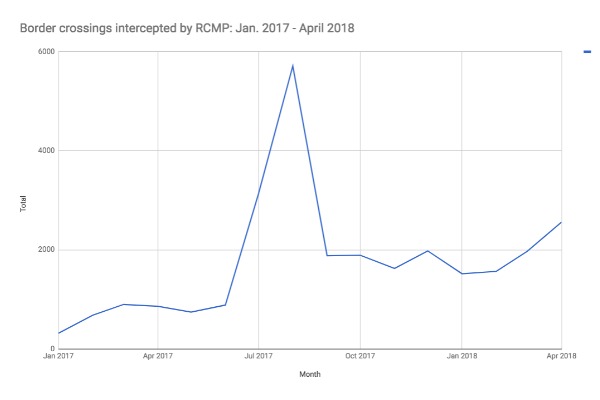
The latest government numbers show 2,560 such entries in April—a 30 per cent increase over the previous month. There were 20,593 irregular crossings from the United States in 2017 and have remained above 1,500 crossings a month since July 2017. The vast majority of those crossings are through Quebec, which observers note is a strategically important province politically in which the Liberals are pouring resources and where Conservative leader Andrew Scheer (Regina–Qu’Appelle, Sask.) has recently spent time courting disenchanted Bloc Québécois supporters. While the Liberals still lead the pack, a new poll showed the Tories are making gains in the province.

Source: Immigration, Refugees and Citizenship Canada

That uptick in border crossings “is only an increase compared to the unusually low numbers of claims in the past few years,” according to the Canadian Council for refugees.

The average number of refugee claims between 2013 and 2015 was 13,300 per year but between 2000 and 2009, it was an annual average of 31,400, the council said, arguing the case could be made that Canada is “returning to more usual numbers.”

Both the “loose language” and discussion around numbers from media and politicians has been “alarmist,” said Peter Showler, former chair of the Immigration and Refugee Board.

“It’s a kind of Chicken Little reporting on the numbers as though … the sky is going to fall,” he said. “The sky hasn’t fallen.”

The claims that came through in the last year “are well within the capacity of the Canadian refugee system,” he said, though agreed it requires more resources.

Part of the problem, he said, is use of the word “illegal” rather than “irregular” in discussing the kind of crossing.

The NDP has also raised this concern, that people have a right to seek protection and there are specific laws and processes in place to determine if someone falls within Canada’s definition of refugee.

The focus instead should be on protection and the legal rights of entrants, Showler said. And just because a claim is determined not to fall within Canada’s definition of refugee, that doesn’t make them fraudulent.

Most importantly, he noted the acceptance rates currently are approximately the same as those of the national average for refugee claims.

“It means that the significant majority of people who are seeking Canada’s protection, the Immigration Refugee Board has reached the conclusion that they are in need of protection,” said Mr. Showler, adding the rate is for the last two to three years is about 65 to 70 per cent—”which historically is quite high.”

Canadians should have a better understanding of the distinct refugee flows, he said, and the impact of U.S. President Donald Trump and his government’s pronouncements, including an executive order last year banning refugees and visitors from Muslim-majority countries.

Last year, many coming to Canada were from Haiti and feared deportation as Mr. Trump announced the 2019 end of the temporary residency program set up to take in those seeking refuge from the 2010 earthquake, he noted. Canada has already ended a similar program. More recently, arrivals are originally from Nigeria and head north soon after they land in the U.S., leading Immigration Minister Ahmed Hussen (York South–Weston, Ont.) to travel to Nigeria this week to meet with officials on the ground.

For the most part, pollsters say opinions on refugees are polarized along political lines, with Conservative voters more likely to say the country is being too generous to asylum seekers.

Pushing border security and painting the Liberals as soft may produce “modest gains” for the Tories but it’s not a strategy that will dramatically increase their support, said Frank Graves, president of EKOS Research Associates.

However, it can provide emotional energy for motivating their base, he said, which are “far more concerned” about the issue.

“Frankly, elections are won on emotional engagement,” he said, and the approach can bring out committed supporters, which can produce higher turnout, better fundraising, and more involvement.

Even so, Mr. Graves said he doesn’t see this issue as “a huge exposed flank” for the government while Ms. Choquette said the Liberals still need a win on the file.

“They need to make a measurable difference on one aspect of this issue, even if it’s a small aspect,” she said, though there’s no easy solution. “The potential for this issue is it hurts them with a number of key constituencies that they rely on or will need to rely on in 2019. They’re running out of time.”

via Liberals risk new-Canadian vote with border-crossing response, say pollsters – The Hill Times

ICYMI – Attitudes to Islam in Europe are hardening: The Economist

Good summary of recent European polling and worrisome (and correct) fear of further polarization:

IF integration means doing a bit better in education and the job market, then there are grounds to be optimistic about the status of Muslim communities across western Europe. But when you ask Europeans how they feel about Islam and its adherents, then the picture is much harsher and in some ways getting worse.

Those are the broad impressions left by a raft of recently published surveys on the subject. The authors of a study by Germany’s Bertelsmann Foundation, focusing mainly on Britain, France, Germany, Switzerland and Austria, found some encouraging indicators on schooling and employment but still reported a big income disparity between Muslims and non-Muslims.

Professional progress was “not accompanied by an equal level of…social acceptance,” noted the report, which looked not at refugees but longer-standing Muslim residents. The authors were troubled by the finding that 20% of respondents did not want Muslim neighbours. That number would almost certainly have been higher if the study had looked at countries further south and east. A poll by Pew Research, an American think-tank, found that a majority of people in Hungary, Italy, Poland, Greece and Spain harboured hostile attitudes to Islam while only a minority of northwestern Europeans held similar views.

The Bertelsmann report welcomed the fact that in France, only one in ten Muslims leaves school before turning 17, compared with about a third of Muslim youngsters in Germany. But learning doesn’t seem to guarantee earning. In neither Germany nor Switzerland was there much difference between the employment rate of Muslims and non-Muslims. In France, by contrast, the jobless rate was 14% for Muslims compared with 8% for non-Muslims.

Moreover, there are some clear signs of hardening attitudes. In England, around four people in ten acknowledged that they have become more suspicious of Muslims following terrorist attacks in London and Manchester. That was one of the findings of the latest study published by Hope Not Hate, an anti-extremism lobby group.

Looking at a series of recent data, it concluded that in many ways sentiment in England was gradually becoming more liberal and tolerant of diversity, but Islam and the reactions it inspired were a clear exception. About half the population apparently thought Islam posed a “threat to Western civilisation” while a quarter regarded it as a “dangerous” religion because of its perceived capacity to incite violence. The picture changes depending on how the question is framed. The pool of respondents who opined (50% versus 22%) that the Muslim faith was a civilisational threat also agreed by a clear majority that it was wrong to blame an entire religion for a few extremists.

In Germany, a widely-quoted poll last year found that more than half the population believed that Islam did not belong in their country. But attitudes to Muslim people, as opposed to their religion, can sometimes be much more emollient, albeit varying a lot with the respondent’s political ideology.

Pew found that half the Germans who hewed to the political left thought Muslims were making a good effort to adapt to the country’s way of life, compared with one in five of those who leaned rightwards. The numbers for Britons of right and left were almost exactly the same. Given the many different ways in which progress (or regress) can be measured, the state of Islam in Europe may always be a vessel that some see as half-empty and others see as half-full.

What’s worrying is that almost every terrorist movement aims to polarise feelings in a way that drives people into opposing camps. The terrorist who claims to represent a certain community often hopes that the authorities, and perhaps society as whole, will stigmatise that community and provoke in it a defensive mood, so that violence starts to seem like a reasonable option. Historically, such polarising tactics have often worked.

Although things have not yet reached that point, these poll results suggest something sinister: it’s perfectly conceivable that the murderous van-drivers and knife-wielders who claim to speak for Muslims in Europe could enjoy a similar “success” in polarising sentiment across the continent.

Source: Attitudes to Islam in Europe are hardening

Charter fuels stereotyping, tension: poll

More on the Charter as the hearings begin. First, the latest poll showing the same divisions of support between francophones and non-francophones. More interesting is the impact of the proposed Charter:

Fifty-three per cent of people polled, including 49 per cent of francophones and 69 per cent of people from other linguistic groups — said they believed relations between communities have already deteriorated since the debate over the charter of values began.

Forty-nine per cent of people polled said they believe adoption of the charter will give rise to civil disobedience in public institutions.

Roughly half of those polled said they believe there has already been an increase in stereotyping against religious minorities. Fifty-seven per cent of people polled — including 80 per cent of non-francophones — said they believe Quebec’s Jews, Muslims and Sikhs should have an equal say to other groups in discussions about the charter.

Support for the charter was higher among manual labourers, retired people and people with incomes of $60,000 to $100,000 than it was for young adults, students and homemakers.

Charter fuels stereotyping, tension: poll.

A good overview of organizations in favour and opposing the Charter, and the related politics and political strategy by Chantal Hébert of The Star:

Get ready for Quebec values charter debate replay: Hébert

Canadian Muslims encounter increasing hostility

Haroon Siddiqui of The Star on polls showing different levels of distrust for different ethnic and religious communities, similar to the earlier poll posted on BC attitudes (British Columbians grow more wary of other religions, interfaith marriages).

While some of this is normal (negative attitudes tend to prevail regarding more recent communities), the gaps are still startling.

We didn’t have such polls 50 years ago when the minorities that were likely viewed with suspicion included Jewish Canadians, Italian Canadians and the like.

Canadian Muslims encounter increasing hostility: Siddiqui | Toronto Star.