Skuterud et al: How We Subverted our Skills Based Immigration System

Valid critique:

In 2023, with little fanfare and no political opposition, the federal government gave itself the power to subvert Canada’s world-renowned skilled immigration system.

That system was formerly centred on the “points system,” called the Comprehensive Ranking System (CRS) in its most recent incarnation. 

Under the CRS, applicants for permanent residency were evaluated on their education, work experience, and language proficiency and the highest scoring applicants were admitted. The result was a continuous inflow of top talent chosen without political influence that benefited the Canadian economy and was admired by many countries (and emulated by some).   

But in 2023, the government created a new category-based feature in the system. That feature gave the immigration minister the power to prioritize categories of immigrants and move them to the front of the line. A rules-based system was replaced with a discretion-based system. 

The result is an opaque system that is exposed to political lobbying, looks like a lottery to prospective migrants, and squeezes out highly skilled candidates. In 2025, the leading category of immigrants under the new category-based system are francophones applying to live outside Quebec. 

Contributing to Canada’s patchwork immigration system, provincial nominee programs, which give provinces the ability to prioritize groups unable to meet the standard of the points system, account for an ever-increasing share of immigrant admissions. 

Admitting fewer skilled immigrants reduces our country’s productivity and tax revenue making it harder to fund social programs. It also affects Canada’s ability to attract the world’s best and brightest students to our post-secondary institutions, which are collectively reeling from plummeting international enrolment. 

Under the Canadian Experience Class (CEC) program, former international students with a Canadian postsecondary credential and one year of work experience in a skilled occupation are eligible to transition to permanent resident status without leaving the country. 

The CEC program’s intention is a good one – we attract whiz kids from around the world and provide them with an education that Canadian employers can easily evaluate. When this path works, it works well. International students pay high fees, lowering tuition costs for Canadians, and those who stay end up doing well in Canada’s labour markets. 

However, this approach can be abused when postsecondary institutions use immigration, not education, to lure foreign students. This has contributed to the growth of low-quality programs and distorted incentives on all sides. The problem lies in policy design.

In response to unsustainable growth in Canada’s non-permanent resident population and worries about housing, healthcare and labour market effects, the government has cut international student admissions for 2026 by 50 percent. 

The reduction is facing criticism from the postsecondary sector, but critics are overlooking that universities and colleges are not even reaching the quotas they have been given under the already reduced caps. New foreign student arrivals are on track to reach less than 160,000 in 2025, far below the government’s cap of 305,900. 

Foreign student applications to Canada’s universities and colleges have declined dramatically because prospective students no longer see a clear path to staying in Canada. Graduate students in computer science who want to stay are being told that learning French is their best option. And they fear that when they graduate, a different arbitrary category will be the priority. The current system discourages the best foreign students from applying to Canadian postsecondary institutions and blocks many of those who graduate from remaining in Canada.  

What should be done?

First, turn back the clock. Return to the immigration system that existed as recently as 2019 when immigrants were admitted through a single selection system that prioritized candidates with the highest future Canadian earnings. That system was transparent, predictable, and not easy for lobbyists to manipulate.  

Second, send a clear message that Canada welcomes foreign students. At a time when our goods exporting industries face major challenges, we should promote one of our most valuable services exports – educating international students. Education is an export that is uniquely dependent on trust, as students must live in Canada to consume the product.

Third, refine the points system to better target international graduates with the best earnings prospects. This would lead to increased demand by international students for programs with high post-graduate earnings and benefit our immigration program. Demand for programs that offer low earnings returns would moderate attracting only those international students who are coming solely for the education, since these programs would provide no realistic pathway to PR status.  

Canada needs immigration reform now. What we have now is a bungled system that prioritizes lobbying effort over the very real contribution that immigration can make to the Canadian economy.

David Green is a professor at the Vancouver School of Economics, Philip Oreopoulos is distinguished professor in economics at the University of Toronto. Craig Riddell is emeritus professor at the Vancouver School of Economics. Mikal Skuterud is economics professor at the University of Waterloo, and the Rogers Phillips Scholar of Social Policy at the C.D. Howe Institute and Christopher Worswick is professor of economics at Carleton University and a research fellow at the C.D. Howe Institute.

Source: How We Subverted our Skills Based Immigration System
Can we avoid bias in hiring practices?


Good analysis of some of the weaknesses in the Treasury Board and selected departments piloting of masking applicant names to remove hiring bias.

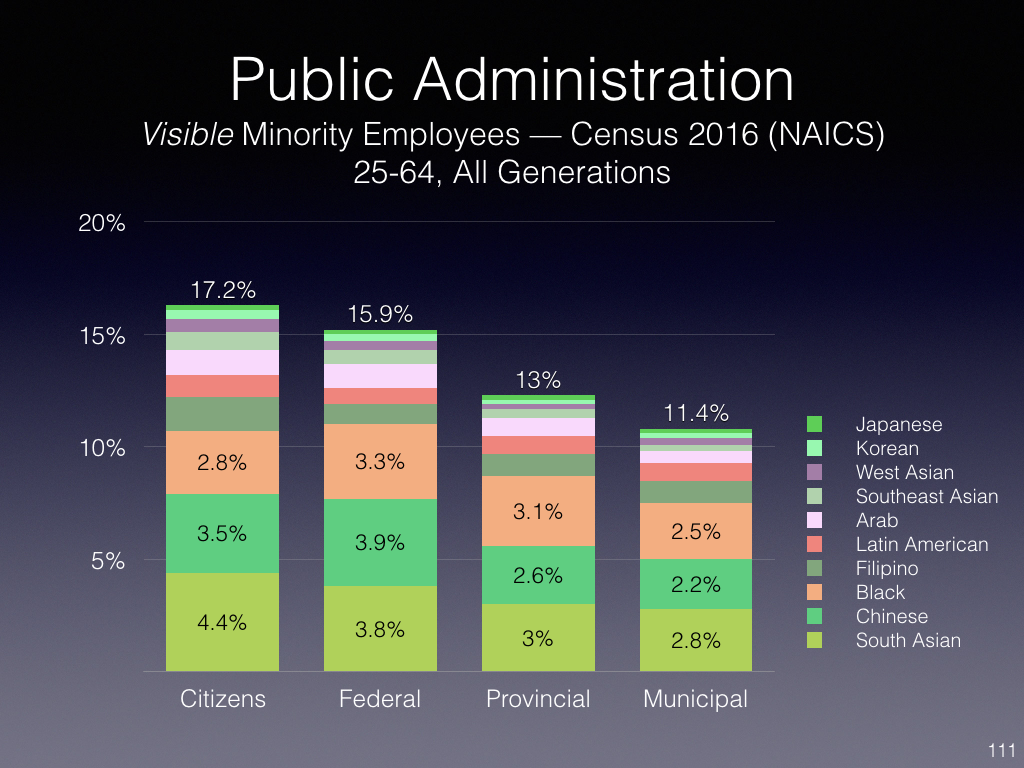
That being said, federal government representation of visible minorities, at 15.9 percent (2016 Census public administration less Canadian Forces, a number slightly higher than the most recent federal employment equity data), is relatively close to the percentage who are also Canadian citizens (17.2 percent, 2016 Census):

Ottawa’s Name-Blind Recruitment Pilot Project was launched in April 2017 to explore whether masking applicants’ names would remove bias in the hiring process for the federal public service. There was a lot to praise in this initiative of the Public Service Commission (PSC). Previous research, including some of our own, has shown that recruiters often react to the name on a resumé, independently of other factors such as education and experience. Our most recent publication (in the March issue of Canadian Public Policy) suggests that much of this discrimination is unconscious and unintentional, so employers actually could benefit from better hires by taking relatively straightforward steps to remove names during the initial stages of the selection process.

One similar and important example is the case of musicians auditioning for positions in popular orchestras in the United States. Traditionally orchestras have been male dominated, and criticized for discriminating against women. Researchers showed convincingly that orchestras that held auditions with the applicants performing behind a screen began to hire more women. Given that auditions are an effective means to observe productivity (music quality), the fact that more women were hired under this method suggests that orchestras previously were missing out on better musicians when gender was known. Most orchestras now audition using screens, showing a desire to avoid discrimination and make better hires. It’s a classic case of win-win-win: a win for women musicians getting more equal opportunity, a win for orchestras tapping a larger talent pool and a win for audiences enjoying better music.

However, the PSC’s hiring bias experiment has yet to yield such positive results. When the project report was released in January 2018, it appeared to show there was in fact “no bias” in federal public service hiring in the first place. This led Treasury Board President Scott Brison to write, “The project did not uncover bias.” National media disseminated this story. The CBC, for example, ran with the headline “No Sign of Bias against Government Job-Seekers with Ethnic-Sounding Names, Pilot Project Finds.” The article states that hiding ethnic-sounding names on resumés was found to have “no real bearing on who’s picked from the pile of applications.”

Unfortunately, this version of the results significantly misrepresents the actual findings of the pilot project. A careful reading of the report indicates that the pilot project was not really designed as a test of discrimination, and the report clearly acknowledged this fact.

The design of the pilot project included two features that would undermine its relevance in assessing the broader use of name-blind hiring. First, the project relied on departments within PSC that volunteered to take part, and within those, job openings were considered for inclusion as they arose; both features introduce a non-random element that undermines the value of the results. Second, and more important, all hiring managers in the project made their decisions knowing that they would be subject to review. For the managers using the traditional method, the awareness that their decisions would be scrutinized and compared with results from name-blind hiring made them more likely to be conscious of bias, and therefore more likely to alter their hiring decisions accordingly.

The procedure in the PSC pilot removed more than the applicant’s name; it also took out all other potentially identifying information — information that might have been useful in assessing the resumé. This was likely why anonymized applications in the pilot were less likely to lead to call-backs.

The report points out that a different study approach used to measure bias, called audit methodology, would have lessened the effect of managers’ awareness of being in a comparative study. Our own study used the audit methodology, in which employers are selected at random and are sent computer-generated resumés for assessment without advance notification. Such a procedure has been employed many times, in a number of countries.

Of course, it’s possible that discrimination against applicants with ethnic-sounding names doesn’t exist in the federal public service. For name-blinding to influence hiring decisions, there must be a problem to begin with. As the report mentions, the PSC is already taking steps to help ensure that the federal government is practising unbiased hiring, and it outlines several important initiatives.

Our research found that bias varies considerably among organizations. We’ve shown in data from Toronto and Montreal that large organizations with over 500 employees practise discrimination against applicants with Asian names about half as often as smaller organizations. This difference may well arise from a tendency for large organizations to have more policies in place to help avoid discriminatory behaviour. The potential benefits from name-blinding may be minimal for the federal government if it is already doing a good job minimizing bias.

However, to conclude that there is no bias in hiring within the federal public service on the basis of the January report — which clearly indicates that the pilot project was not designed to test bias effectively — may move efforts to promote fairness backward rather than forward. There is still a need to follow through on the good intentions that seemed to motivate the name-blind hiring pilot when it was first announced. Ideally, a study on the impact of name-blinding would first identify an organization where clear discrimination occurs, as shown through an audit, and then explore how name-blinding affects the chances of applicants getting an interview, and ultimately getting hired. Tellingly, the report suggested an audit study as a good next step “to improve the understanding of any potential bias during selection of candidates.” In fact, any organization, including the federal public service, that wishes to consider name-blind recruitment as a way to broaden its talent pool would be well-advised to consider an audit as a first step to test for bias.

It can be quite challenging to design an effective name-blind hiring procedure. The procedure in the PSC pilot removed more than just the applicant’s name; it also took out all other potentially identifying information — information that might have been useful in assessing the resumé. This was most likely the reason that anonymized applications in the pilot were less likely to lead to call-backs than traditional applications. One option would be to remove only the name, or only a very limited amount of other information in the resumés that might give away the visible minority status of the applicant. An automated tool for reviewing submitted resumés might be developed to facilitate this approach.

It’s critical that the desire of an organization to burnish its public image not stand in the way of ensuring a fair and equitable process of finding the best candidates for available jobs. It may feel great to say, “We didn’t uncover any bias.” But if bias does exist, it’s better to be able to say, “We found bias and we’ve taken meaningful steps to eliminate it.”

Source: Can we avoid bias in hiring practices?

Applying for a job in Canada with an Asian name: Policy Options

More good work on implicit biases and their effect on discrimination in hiring by Jeffrey G. Reitz, Philip Oreopoulos, and Rupa Banerjee:

Our most recent study analyzed factors that might affect discriminatory hiring practices: the size of an employer, the skill level of the posted job and the educational level of the applicant.

First, we divided the employers into large (500 or more employees), medium-sized (50 to 499 employees) and small (less than 50 employees). We expected that large employers might treat applicants more fairly because they have greater resources devoted to recruitment and often have a more professionalized recruitment process. They also tend to have more experience with ethno-racial diversity in their workforces.

Asian-named applicants’ relative callback rates were indeed the lowest in small and medium-sized organizations, and somewhat higher in the largest employers. Compared with applicants with Anglo names, the Asian-named applicants with all-Canadian qualifications got 20 percent fewer calls from the largest organizations, but 39 percent fewer from the medium-sized organizations and 37 percent fewer from the smallest organizations. So, the disadvantage of having an Asian name is less for applicants to the large organizations, although it is still evident.

Looking at treatment of Asian-named applicants with some foreign qualifications, we found the largest organizations are generally the most likely to call these applicants for interviews. Large employers called these applicants 35 percent less often than Anglo-Canadian applicants with Canadian education and experience; medium-sized employers called 60 percent less often, and the smaller employers called 66 percent less often.

We were also interested in whether the skill level of the job affected discriminatory hiring practices and, in particular, whether Asian-named applicants faced greater barriers in higher-skill jobs, which are likely to be better paid. We found that the extent of discrimination against Asian-named applicants with all-Canadian qualifications is virtually the same for both high-skill jobs and lower-skill jobs. For the high-skill jobs, these applicants were 33 percent less likely to get a call; for the low-skill jobs, 31 percent less likely.

Skill level matters much more when Asian-named applicants have some foreign qualifications. Overall, these applicants had about a 53 percent lower chance of receiving a callback than comparable Anglo-Canadian applicants. But their rate of receiving calls is significantly lower at higher skill levels: they receive 59 percent fewer callbacks for high-skill jobs, 46 percent fewer for low-skill jobs. Employers may respond less favourably to Asian-named and foreign-qualified applicants for higher-skill positions because in those jobs, more is at stake, and assessing foreign credentials is more difficult than checking local sources. Avoiding the issue by not calling applicants to an interview is apparently viewed as the safer option.

Finally, we asked whether having a higher level of education than Anglo-Canadian-named applicants would lessen the negative effect of having an Asian name. We found that Asian-named applicants with Canadian education including a Canadian master’s degree were 19 percent less likely to be called in for an interview than their Anglo-Canadian counterparts holding only a Bachelor’s degree. For Asian applicants with foreign qualifications and a Canadian master’s degree, the likelihood of a callback was 54 percent lower than the rate for less-educated Anglo-Canadian-named applicants. Acquiring a higher level of education in Canada did not seem to give Asian-named applicants much of an edge.

Overall, we found that employers both large and small discriminate in assessing Asian-named applicants, even when the applicants have Canadian qualifications; and they show even more reluctance to consider Asian-named applicants with foreign qualifications. These biases are particularly evident in hiring for jobs with the highest skill levels. However, there is a substantial difference between larger and smaller organizations. Larger organizations are more receptive to Asian-named applicants than smaller ones, whether or not the applicants have Canadian qualifications.

In order to fully understand the disadvantages that racial minorities experience in the Canadian labour market, it is crucial to go beyond surveys, in which discrimination may be hidden and difficult to identify. Audit studies like ours capture “direct discrimination” by observing actual employer responses to simulated resumés. This form of discrimination is particularly significant since the inability to get an interview may prevent potentially qualified job-seekers from finding appropriate work. Its effect may be compounded in promotions and other stages of the career process and in turn exacerbate ethno-racial income inequality in Canada.

Meanwhile, employers might also be unwittingly disadvantaged, because it can prevent them from finding the best-qualified applicants. Small employers are particularly disadvantaged since they may lack the resources and expertise to fully tap more diverse segments of the workforce.

A number of measures may help to reduce name-based discrimination in the hiring process. First, a relatively low-cost measure would be for employers to introduce anonymized resumés. They could simply mask the names of applicants during the initial screening, and then track whether this results in more diverse hiring. Second, employers should ensure that more than one person is involved in the screening and interview process and that the process of resumé evaluation is open and transparent. Lastly, hiring managers should receive training on implicit bias and how to recognize and mitigate their own biases when recruiting job applicants.

Source: Applying for a job in Canada with an Asian name