Pew Study On Religion Finds Increased Harassment Of Jews : The Two-Way : NPR

Pew_Forum_Religious_Harassment_2015_pdfThe latest report on harassment of religions, both from governments and by individuals:

The Pew report, which is based on data and reports from 2013, finds that Muslims and Christians face comparable levels of hostility, though Christians are harassed more often by governments, Muslims more often by individuals.

One group faces increased hostility: Jews. Each year since 2007, when Pew began these surveys, the targeting of Jews around the world has gotten worse.

European Jews, in particular, encounter intolerance, says Peter Henne, the lead Pew researcher on the report.

“There’s a pretty marked harassment of Jews in Europe,” he says. “They’re harassed in 76 percent of countries in Europe, which is higher than the number of countries in which they’re harassed in other regions.”

The United States does not get off the hook in the Pew report. It ranks the U.S. as having a “moderate” level of religious harassment, on par with such countries as France, Slovakia and Mongolia.

“In terms of what we see in the United States, there are some issues with land use, churches or mosques trying to build or expand their site and being blocked by local governments,” Henne says. “There are some tensions in prisons — limits on prisoners’ ability to convert or to use things like tobacco in religious ceremonies.”

Overall, the level of religious harassment in 2013 is about the same as it was the year before, according to Pew. But with only seven years of data, it’s hard to see any historical trend.

Pew Study On Religion Finds Increased Harassment Of Jews : The Two-Way : NPR.
The US political divide on views toward Muslims and Islam | Pew Research Center

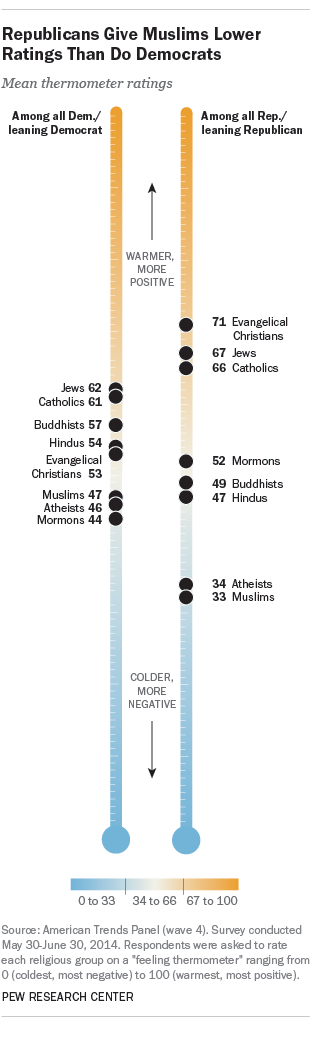
USA Views of Religion - PewMapping US party affiliation to attitudes towards different religions. Sharp contrast:

Party affiliation is not the only factor that correlates with differing views toward Muslims and Islam. Younger U.S. adults of all ideological stripes feel more warmly toward Muslims than do older Americans. On the feeling thermometer, those ages 65 and older gave Muslims an average rating of 32 – they don’t rate any group more negatively – while Americans ages 18-29, on average, rated Muslims more positively, at 49.

One’s own religious affiliation also is a factor. For instance, we found that no other religious group is cooler toward Muslims than are white evangelical Protestants, who give Muslims an average rating of 30.

Compared with other groups, older Americans and white evangelicals both tend to affiliate heavily with the Republican Party.

Haven’t seen an equivalent chart for Canada mapping political affiliations to political party supporters although one would expect a similar breakdown between Canadian right and left leaning parties.

The political divide on views toward Muslims and Islam | Pew Research Center.

France Has A History Of Anti-Semitism And Islamophobia | FiveThirtyEight

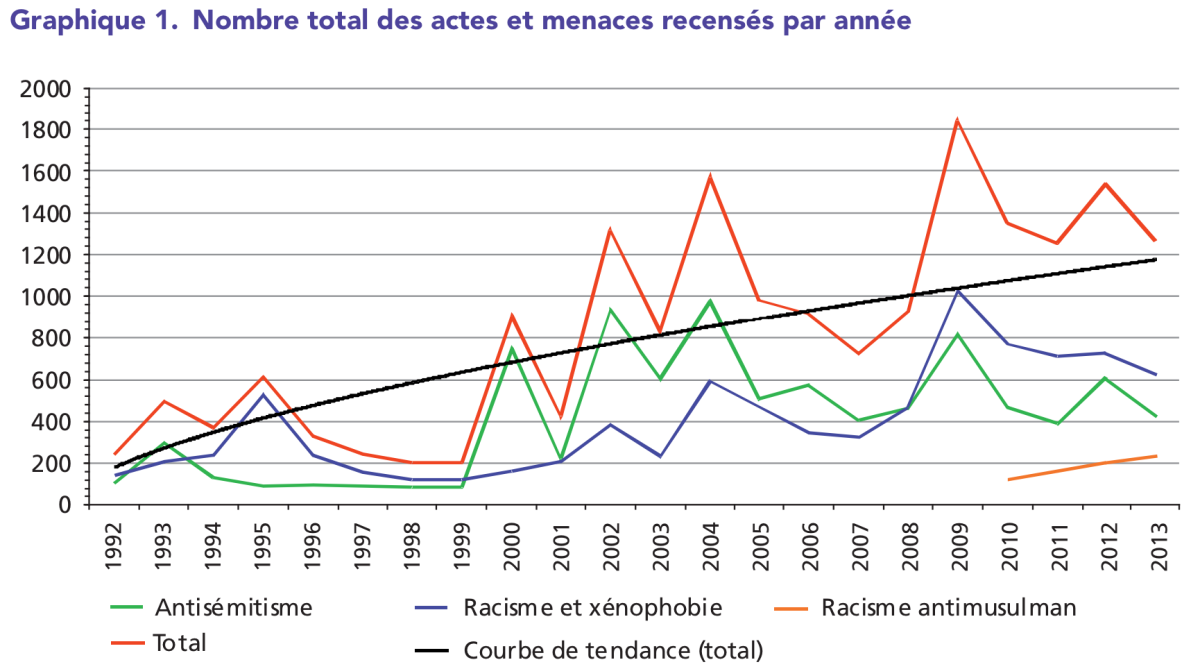
Hate crimes FranceBeyond the anecdotes, hate crime data (chart above) and public polling:

Public opinion surveys might offer some further insight into how Islamophobia is changing in France. In the spring of 2008, Pew surveyed 754 adults in the country about their views on various religious groups. Thirty-eight percent of respondents said they had a “somewhat” or “very” unfavorable opinion of Muslims. That figure was slightly higher than in previous years — in 2006, 35 percent said they had an unfavorable opinion of Muslims in 2005, and in 2004 it was 34 percent.

In 2014, Pew commissioned a new survey, this time posing a question to 1,003 French adults with a slightly different wording. Rather than asking about attitudes toward religious groups in general, the survey asked specifically about attitudes towards religious groups living in France. This time, 27 percent of respondents expressed a somewhat or very unfavorable opinion of French Muslims.

Three-quarters of French respondents believe Islam is an “intolerant” religion, incompatible with the values of French society, according to a January 2013 poll by the French newspaper Le Monde and the market research company Ipsos.

Anti-semitism in France

Rabbis in France have described the country’s Jewish population as “tormented with worry” after Friday’s attack on a French supermarket. On Monday, 5,000 police officers had been sent to Jewish schools and religious sites amid security concerns in addition to 10,000 troops deployed across the country.

The nonprofit Service de Protection de la Communauté Juive (the Jewish Community Security Service, SPCJ) publishes an annual summary of anti-semitic attacks reported to the organization and to police precincts in France. Its latest figures show that in 2013 there were 105 anti-semitics acts and 318 anti-semitic threats. Taken together, the number of threats and acts in 2013 was lower than in 2012 (when there were 614 total incidents) but higher than in 2011 (389).

Pew’s 2014 survey also asked about respondents’ attitudes toward French Jews, with 10 percent of respondents expressing an unfavorable opinion.

In September 2014, Fondapol, a French think tank, posed a range of questions that might reveal anti-semitic attitudes to 1,005 French people age 16 and over. The choice of wording in the survey is interesting. One question asked “when you learn that someone you know is Jewish, what reaction do you have,” to which 91 percent of respondents said “nothing in particular,” 3 percent said “I like them” and 3 percent said “I don’t like them” (the rest refused to answer). However, 21 percent of respondents said they would prefer to avoid having a Jewish president, 14 percent a Jewish mayor, 8 percent a Jewish doctor and 6 percent a Jewish neighbor.

France Has A History Of Anti-Semitism And Islamophobia | FiveThirtyEight.

Ben Affleck and Bill Maher are both wrong about Islamic fundamentalism – The Washington Post

Ben_Affleck_and_Bill_Maher_are_both_wrong_about_Islamic_fundamentalism_-_The_Washington_PostOne of the better pieces responding to the Majer/Affleck debate, by looking at public opinion data from a range of Muslim countries.

Expect that part of the explanation for the variations reflect local and tribal histories, culture and income:

Overall, the picture that emerges of fundamentalism among the worlds Muslims is considerably more complicated than either Affleck or Maher seem to realize. Theres no doubt that, particularly among some Middle Eastern Muslims, support for intolerant practices runs high. It’s quite easy to criticize these practices when a repressive regime is inflicting them upon an unwilling population. But things get much more difficult when such practices reflect the will of the people, as they seem to do in Afghanistan, Pakistan and Egypt.

On the other hand, majorities of Muslims in many countries — particularly Western countries — find these practices abhorrent. Maher tries to speak in broad brushstrokes of a “global Islam,” but Pews data show that such a thing doesn’t really exist.

Ben Affleck and Bill Maher are both wrong about Islamic fundamentalism – The Washington Post.

More Americans Favor Mixing Religion And Politics, Survey Says : The Two-Way : NPR

Religion has always been an important force in US politics, more so than in Canada (roughly a quarter of Canadians in the 2011 National Household Survey reported as “nones,” 44 percent in British Columbia):

As we [Pew] reported two years ago, the percentage of those “nones” has grown in recent years, especially among younger Americans. In a 2012 Pew survey, 1 in 5 in the U.S. said he was “religiously unaffiliated,” a group that includes those who say they have no particular religion as well as self-described atheists and agnostics. Among those under 30 years of age, fully one-third said that religion played “little or no role” in their lives.

Other findings in the latest poll: a slight drop in support for allowing gays and lesbians to marry, with 49 percent of Americans in favor and 41 percent opposed; a 5-point dip in support from a February Pew Research poll, but about the same level as in 2013, Pew says. However, Pew notes: “It is too early to know if this modest decline is an anomaly or the beginning of a reversal or leveling off in attitudes toward gay marriage after years of steadily increasing public acceptance.”

There has also been a rise in the number who view homosexuality as a sin 50 percent from 45 percent a year ago. While almost half 49 percent of those surveyed say they believe that businesses such as caterers and florists should not be allowed to reject same-sex couples as customers, nearly as many 47 percent said they approved of such a practice.

More Americans Favor Mixing Religion And Politics, Survey Says : The Two-Way : NPR.

The Spiral Of Silence – Social Media « The Dish

Another angle to how social media narrows discussion and debate:

It seems counter-intuitive–if we’re getting only what Facebook things we want to get based on everything they know about us, which is a lot, shouldn’t we assume we are always among friends? But it makes sense. We’re worried about losing friends, which is to say that we’re worried our number of friends will diminish.

What’s peculiar about the Pew study is how the questions were asked. Though the survey took place in the months after Snowden’s revelations, the subjects were asked will you and would you… not did you. Using the conditional to report on behavior that already might or might not have happened tends to make the whole exercise, well, an exercise.

It turns out, too, that the spiral of silence does not only extend to individuals. Take this week’s revelation about the NSA’s Google-like search engine that shares something on the order of 850 billion data points such as private emails obtained without a warrant from ordinary American citizens among numerous government agencies. This is a big deal for many reasons, not the least of which is that it may enable the FBI or the DEA to illegally obtain evidence and cover their tracks while so doing. Yet the mainstream media almost uniformly ignored the story. When I searched ICREACH today, only the online tech media had picked it up and run with it. Is it possible that the mainstream media is afraid of losing friends, too?

The Spiral Of Silence « The Dish.

What Europe Thinks of Jews, Muslims and Roma – Pew

Some interesting comparative data on European country attitudes towards Jews, Muslims and Roma in the recent Pew study:

Roma, often dismissively referred to as “gypsies” in Europe, have suffered discrimination in Europe for centuries, and some estimates suggest that 70 percent of their European population was killed during the Holocaust. Last year, Europe’s tabloid media got into a frenzy over allegations that Roma families in Greece and Ireland had stolen “blond girls.” (In both cases, it was later confirmed that the children were actually Roma).

Many are predicting a good showing for right-wing and nationalist groups in the elections, which begin May 22. If so, these charts may be worth remembering: As Pew notes, “negative sentiments about all three groups are consistently more common among people on the ideological right.”

What Europe thinks of Muslims, Jews and Roma

A bad month for diversity-focused fear-mongers | Toronto Star

Good piece by Natalie Brender on the fear mongers, citing the defeat of the PQ and its values charter, the Mosaic Institute’s study on imported conflicts (Do new Canadians leave old conflicts behind?) and the Pew Research study on how increased diversity tends to correlate with lower levels of violence (Countries With Less Religious Diversity Have More Faith-Based Violence):

Fear-mongers keen on stirring up angst about the increasingly diverse nature of Canadian society have had a bad month of it, on the whole. That’s because three recent sets of evidence suggest that really there’s not that much to worry about in face of a blossoming patchwork of religious headgear being worn, languages being spoken and national soccer teams being cheered for across the land. Such reassurances are relatively undramatic to report on — but it’s worth taking some sedate pleasure in a trio of dogs that didn’t bark alarms of warning in the past month.

A bad month for diversity-focused fear-mongers | Toronto Star.

Countries With Less Religious Diversity Have More Faith-Based Violence

Interesting study with the caveats below:

Of course, these findings come with some limitations. The diversity study doesn’t account for different denominations within religions, like Sunnis and Shiites in Muslim countries or Protestants and Catholics in Christian countries; apparently it was too difficult to gather enough data to make those distinctions. It’s also impossible to make conclusions about cause and effect: Pluralism itself might help reduce violence, or countries that tolerate high levels of diversity might attract people less inclined to violence. And these trends may be related to overall patterns of violence and political instability in the world—in the past several years, some of the countries with the highest levels of religious affiliation have been hit hard by war, especially in the Middle East.

Still, the two studies reveal an interesting pattern: Spiritual consensus is not the key to peace or stability. And this seems to be true across faiths: The most violent, homogenous places include countries that are primarily Buddhist, Muslim, and Christian. It may not be true everywhere, but these data suggest something remarkable: Religious pluralism can be, and often is, compatible with peaceful societies.

Countries With Less Religious Diversity Have More Faith-Based Violence – Emma Green – The Atlantic.