Atheists, Agnostics, Nonreligious Remain Far Underrepresented In US Congress : NPR

Interesting comparison between the US Congress and the population it represents (in Canada, it is about one in four). In terms of the religion of Canadian MPs, my analysis of visible minority MPs is below:
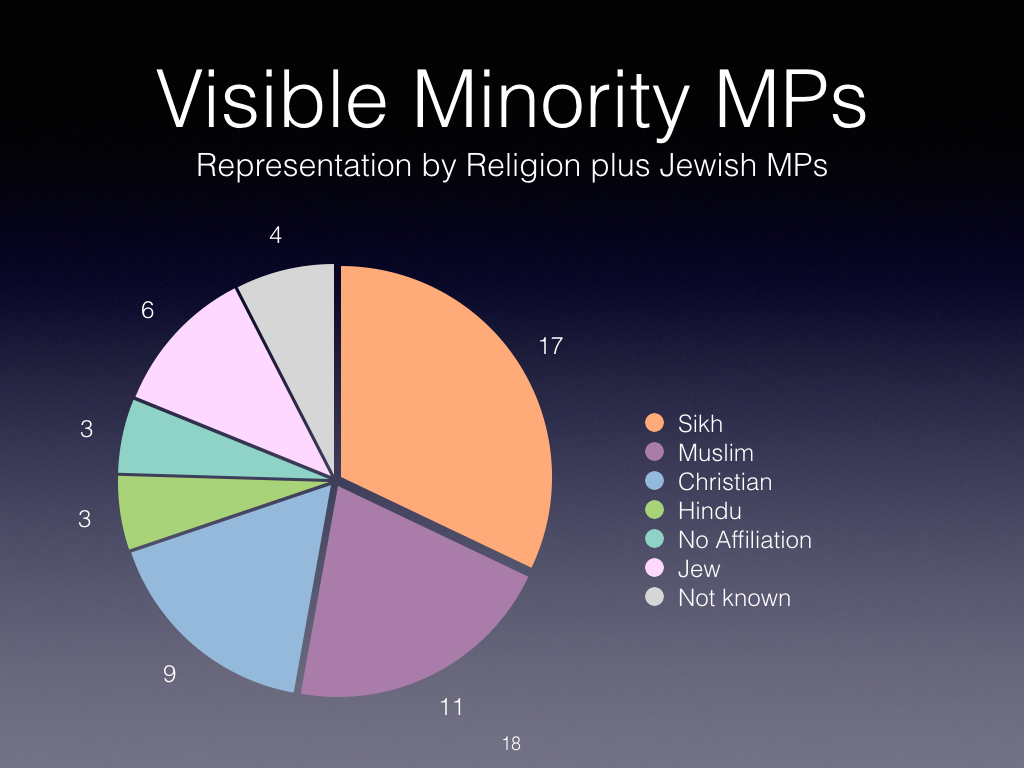
election-2015-vismin-and-foreign-born-mps-018

atheists__agnostics__nonreligious_remain_far_underrepresented_in_congress___nprOne in five Americans is religiously unaffiliated. Yet just one of 535 members of the new Congress is.

That’s what the latest data from the Pew Research Center show on the opening day of the 115th Congress. The nation’s top legislative body remains far more male and white than the rest of the U.S. population as well, but religion is one of the more invisible areas where legislators in Washington simply aren’t representative of the people they represent.

Only Arizona Democratic Rep. Kyrsten Sinema admits to being “unaffiliated,” which Pew defines as people who are atheist, agnostic or who describe their religion as “nothing in particular.” That means only 0.2 percent of Congress is unaffiliated, compared with 23 percent of U.S. adults. That group is faster-growing than any religious group in America, as Pew found in 2015.

Meanwhile, nearly 91 percent of congressional members are Christian, compared with 71 percent of U.S. adults. Here’s a full breakdown of how Congress’ religious affiliations compare with those of the U.S. population:

America’s nonreligious are young — and not politically organized

Why the massive gap? For one, religiously unaffiliated people tend to be young, and Congress just isn’t that young. In the 114th Congress, the average age for House members was 57 years old and for senators it was 61. (To a modest extent, this is a reflection of age rules: Senators must be 30 or older, and representatives have to be at least 25.)

In addition, younger Americans tend to have much lower voting rates than older people. That may also contribute, though the logic requires a couple of leaps — if this means the (relatively young) religiously unaffiliated population isn’t voting as much, and if the religiously unaffiliated are more drawn to likewise unaffiliated politicians — that could also help explain the lack of “nones” in Congress. Likewise, the inverse is true: If older (and more religious) Americans are voting for more religious politicians, it means less room for the nonreligious ones.

(Perhaps unsurprisingly, the unaffiliated Sinema is also relatively young for a congressional member at 40.)

One more potential reason unaffiliated people aren’t in power: Not being affiliated often also means not being politically cohesive.

Source: Atheists, Agnostics, Nonreligious Remain Far Underrepresented In Congress : NPR

USA: Most say immigrants strengthen the country – Pew Research

The latest numbers from Pew Research, both surprising in terms of overall support and less so given the sharp contrast between Democrats and Republicans:

About six-in-ten Americans (63%) now say immigrants strengthen the United States because of their hard work and talents, while 27% say immigrants are a burden on the country because they take jobs, housing and health care. The share of Americans who see immigrants as more of a strength than a burden is now at its highest level in more than twenty years of Pew Research Center surveys.

The stark partisan differences in opinion on how immigrants impact the nation are little changed over the course of the last year. Today, an overwhelming share of Democrats and leaners (82%) think immigrants strengthen the country with their hard work and talents, while just 13% say they are a burden. By contrast, Republicans are more divided: Roughly as many (44%) say immigrants are more of a burden on the country because they take jobs, housing and health care as say they strengthen the country because of their hard work and talents (39%).

There are key demographic differences within the Republican Party, however. About half of Republicans under the age of 50 say immigrants strength the country (51%), while fewer say they are a burden (35%). For older Republicans, the balance of opinion is the reverse: More say immigrants burden the country (52%) than say they strengthen it (29%).

Similarly, Republicans with a college education are more likely to say immigrants strengthen the country than say they burden the U.S. (51% vs. 34%). By contrast, Republicans without a college degree are more likely to say immigrants burden the country because they take jobs, housing and health care (47% vs. 36%).

There are only modest demographic differences among Democrats; wide majorities across age and education groups say immigrants strengthen the country because of their hard work and talents.

Source: 3. Political values: Government regulation, environment, immigration, race, views of Islam | Pew Research Center

For Interracial Couples, Growing Acceptance, With Some Exceptions – The New York Times

In addition to the numbers cited below, some good personal stories in the full article:

It’s a sentiment that mixed-race couples hear all too frequently, as interracial marriages have become increasingly common in the United States since 1967, when the Supreme Court’s decision in Loving v. Virginia struck down laws banning such unions. The story of the couple whose relationship led to the court ruling is chronicled in the movie, “Loving,” now in theaters.

In 2013, 12 percent of all new marriages were interracial, the Pew Research Center reported. According to a 2015 Pew report on intermarriage, 37 percent of Americans agreed that having more people marrying different races was a good thing for society, up from 24 percent only four years earlier; 9 percent thought it was a bad thing.

…People of some races tend to intermarry more than others, according to the Pew report. Of the 3.6 million adults who wed in 2013, 58 percent of American Indians, 28 percent of Asians, 19 percent of blacks and 7 percent of whites have a spouse whose race is different from their own.Asian women are more likely than Asian men to marry interracially. Of newlyweds in 2013, 37 percent of Asian women married someone who was not Asian, while only 16 percent of Asian men did so. There’s a similar gender gap for blacks, where men are much more likely to intermarry (25 percent) compared to only 12 percent of black women.

Source: For Interracial Couples, Growing Acceptance, With Some Exceptions – The New York Times

What France thinks of multiculturalism and Islam – The Washington Post

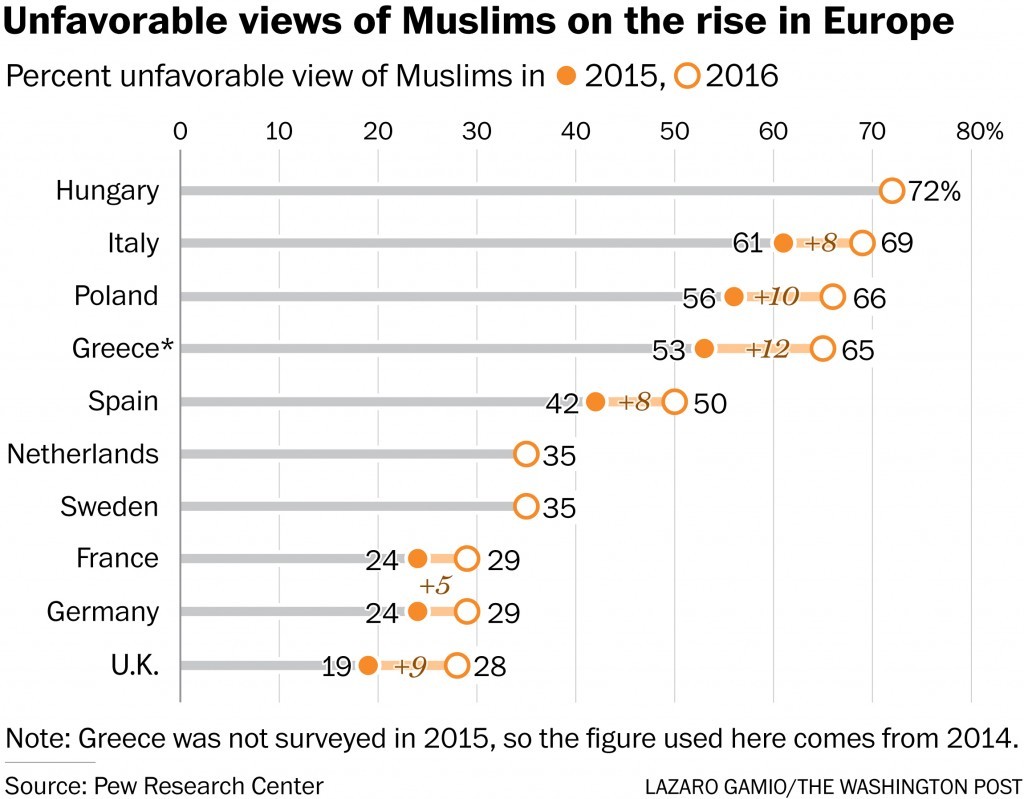
2300europemuslims-11-1024x799Some interesting polling data that sometimes gets lost in the rhetoric:

In the aftermath of a devastating attack in Nice, France, Poland’s interior minister, Mariusz Blaszczak, told reporters that the blame lay with the embrace of multiculturalism. “Have we not learned lessons from previous attacks in Paris and Brussels?” the Financial Times reported Blaszczak as saying. “This is a consequence of the policy of multicultural politics, and political correctness.”

A member of Poland’s controversial right-wing Law and Justice Party, Blaszczak’s point may be in bad taste. However, many around the world probably agree with it.

It’s certainly hard to disagree with the idea that France seems to be more embracing of multiculturalism than Poland. In a recently released study by the Pew Research Centerthat was conducted early this year, just 24 percent of French people were found to believe that diversity made France a worse place to live. A higher proportion, 26 percent, said it made France better, while 48 percent said that it didn’t make much difference.

These results appeared to show that France has one of the most tolerant, though also largely indifferent, attitudes to racial and ethnic diversity in Europe. Only Spain had a higher positive view of diversity. Meanwhile, in Poland, 40 percent of the population said that diversity was a negative, while only 14 percent said it could be a positive and 33 percent said it made no difference. Hungary, Italy and Greece were the only countries with higher negative feelings toward diversity.

The same poll found that France had a far more positive view of Muslims than much of Europe. Despite a series of terror attacks that were inspired by Islamic extremism, just 29 percent of French citizens were found to have a negative view of Muslims, while 67 percent had a positive view. While this was an increase of 5 percentage points over previous years, only Germany and Britain had more positive views.

Conversely, in Poland, 66 percent had negative views of Muslims, while only 19 percent said they had positive views. Hungary and Italy were the only countries with more negative views — 72 percent and 69 percent, respectively.

People in Poland were also far more likely to believe that Muslims in their country were supporters of groups like the Islamic State, a group whose supporters have cheered the attack on Nice but have not claimed official responsibility. Twelve percent of Poles were said to believe that “most” Muslims in their country supported extremist groups, and a further 23 percent said “many.” Just 12 percent said “very few” supported these groups. In France, 44 percent said “very few” Muslims in their country supported extremism, while just 6 percent said “most” and 13 percent said “many.”

And despite the perceived link between refugees from Muslim majority countries and terrorism that is widespread across Europe, Pew’s data showed that on the whole, French citizens were more concerned about economic factors.

Source: What France thinks of multiculturalism and Islam – The Washington Post

The Divide Over Islam and National Laws in the Muslim World | Pew Research Center

How_much_should_the_Quran_influence_our_country_s_laws____Pew_Research_CenterUseful indication of the differences among countries in the Muslim world:

As strife in the Middle East continues to make headlines, from the militant group ISIS to Syrian refugees, the Muslim world is sharply divided on what the relationship should be between the tenets of Islam and the laws of governments. Across 10 countries with significant Muslim populations surveyed by Pew Research Center in 2015, there is a striking difference in the extent to which people think the Quran should influence their nation’s laws.

Source: The Divide Over Islam and National Laws in the Muslim World | Pew Research Center

US election 2016: What does ‘Islam’ think of America? – BBC News

Useful summary of what some of the polling data indicates:

The Pew Research Centre, which surveys global attitudes, said anti-Americanism was strong around the word around the time of the US invasion of Iraq.

However, currently there is little evidence of profound anti-American sentiment except for in a handful of countries, it says.

Bruce Stokes, director of global economic attitudes at Pew, says sentiment towards the US varies widely between Muslim-majority countries.

“We tend to see more negative sentiment among Muslims in the Middle East, such as those from Egypt and Jordan,” he says.

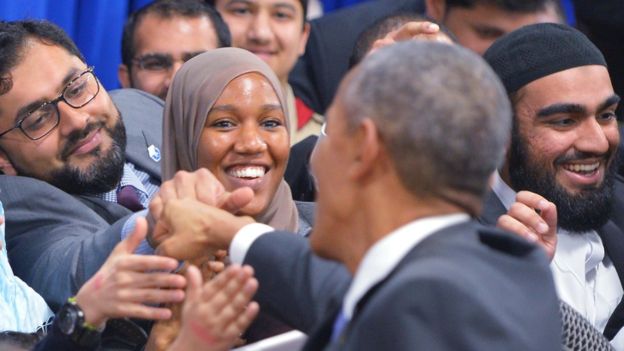
Barack Obama meeting American MuslimsImage copyrightGetty Image
“But Muslims outside the Middle East generally have a more positive outlook,” he adds.

In Indonesia, the world’s most populous Muslim country, 62% of people hold a favourable opinion of the US, Pew’s latest data suggests.

That figure rises to 80% in Senegal, a country which is over 90% Muslim. Mr Stokes points out that this is a stronger approval rate than Germany.

“Attitudes have also been changing over time. We’ve seen a gradual rise in positive sentiment since President Barack Obama came to power,” Mr Stokes says.

“Even in the Palestinian Territories, where sentiment is 70% unfavourable, that’s an improvement on 82% in Barack Obama’s first year.”

The BBC World Service commissioned its own poll of global attitudes in 24 countries in 2014.

Among other things, it asked respondents if they thought the US “had a mainly positive or mainly negative influence in the world”.

Pakistanis generally held the worst view of the US, with 61% saying the US had a negative influence.

But both China and Germany were not far behind, scoring 59% and 57% respectively.

Turkey, almost 98% Muslim, was split between 36% positive, 36% negative and 28% neutral.

Source: US election 2016: What does ‘Islam’ think of America? – BBC News

How America’s Demographic Revolution Reached The Church

Source: How America’s Demographic Revolution Reached The Church

Asians will be largest immigrant group in U.S. in 50 years: Pew study

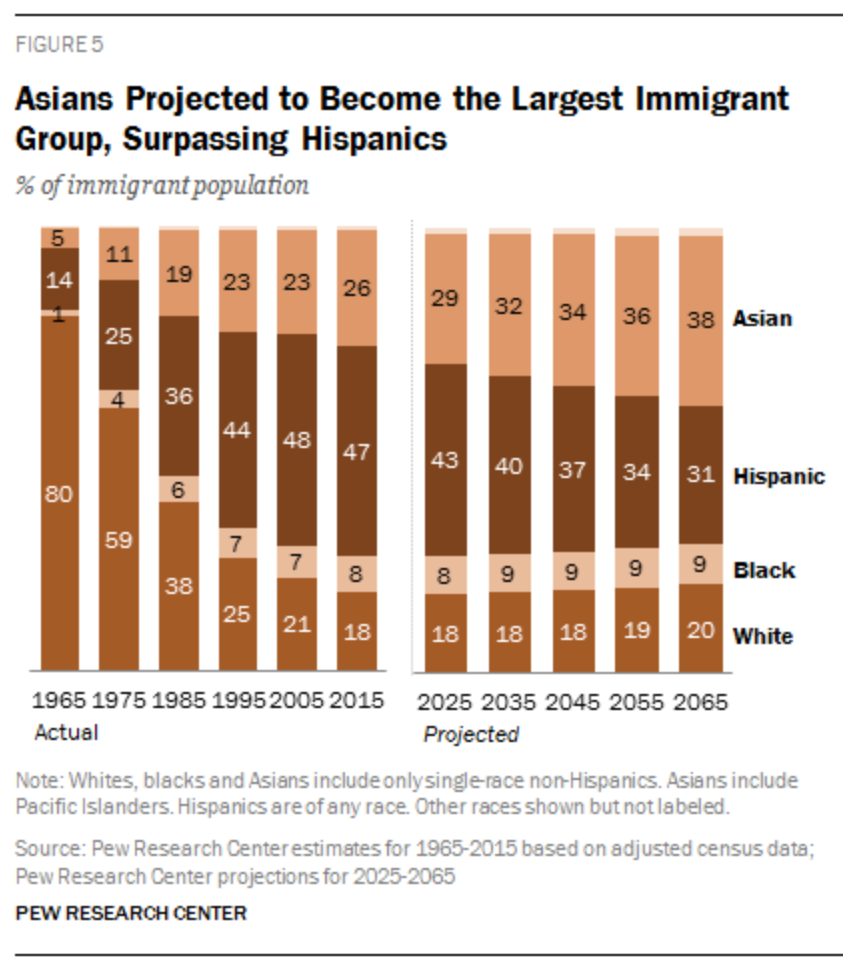
Pew_Immigration_ProjectionsInteresting demographic shift and may, over time, shift immigration debate in USA:

In a major shift in immigration patterns over the next 50 years, Asians will have surged past Hispanics to become the largest group of immigrants heading to the United States, according to estimates in a new immigration study.

The study looks in detail at what will happen by 2065, but the actual tipping point comes in 2055.

An increase in Asian and Hispanic immigration also will drive U.S. population growth, with foreign-born residents expected to make up 18 per cent of the country’s projected 441 million people in 50 years, the Pew Research Center said in a report being released Monday. This will be a record, higher than the nearly 15 per cent during the late 19th century and early 20th century wave of immigration from Europe.

Today, immigrants make up 14 per cent of the population, an increase from five per cent in 1965.

The actual change is expected to come in 2055, when Asians will become the largest immigrant group at 36 per cent, compared with Hispanics at 34 per cent. White immigrants to America, 80 per cent back in 1965, will hover somewhere between 18 and 20 per cent with black immigrants in the eight per cent to nine per cent range, the study said.

Without any post-1965 immigration, the U.S. would be 75 per cent white, 14 per cent black, eight per cent Hispanic and less than one per cent Asian, Pew said.

Currently, 47 per cent of immigrants living in the United States are Hispanic, but by 2065 that number will have dropped to 31 per cent. Asians currently make up 26 per cent of the immigrant population but in 50 years that percentage is expected to increase to 38 per cent.

Pew researchers analyzed a combination of Census Bureau information and its own data to develop its projections.

Part of the reason for the shift is that the fertility rate of women in Latin America and especially Mexico has decreased, said Mark Hugo Lopez, Pew’s director of Hispanic research. In Mexico, Lopez said, women are now having around two children, when back in the 1960s and 1970s, they were having about seven children per woman.

“There are relatively fewer people who would choose to migrate from Mexico so demographic changes in Mexico have led to a somewhat smaller pool of potential migrants,” he said. “At the same time we’ve seen a growing number of immigrants particularly from China or India who are coming for reasons such as pursuing a college degree or coming here to work temporarily in the high-tech sector.”

Source: Asians will be largest immigrant group in U.S. in 50 years: Pew study – World – CBC News

Link to study: Modern Immigration Wave Brings 59 Million to US, Driving Population Growth and Change Through 2065

Pew Research: Anti-Minority Sentiment Not Increasing in Europe

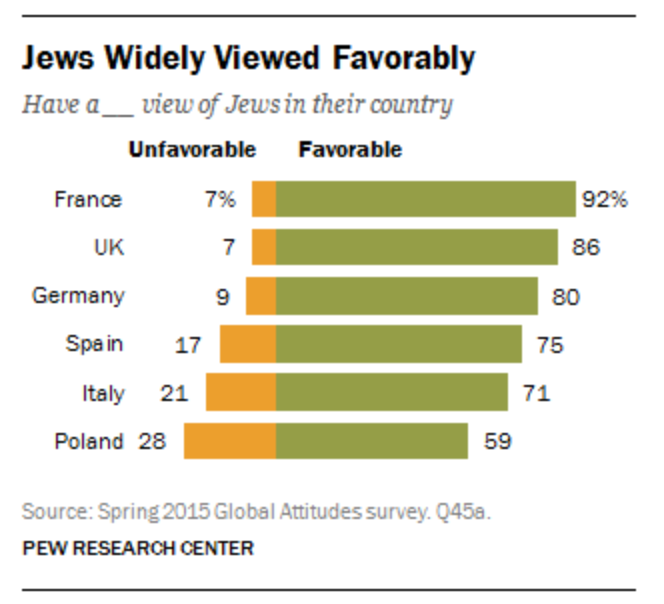
European Perceptions of Roma European Perception of Jews European Perceptions of MuslimsInteresting recent public opinion research on attitudes in Europe, with above charts showing highlights. Summary conclusion:

The economic downturn in Europe that followed the euro crisis raised concerns that economic stress would turn Europeans against each other, as many severe economic downturns have done throughout history, sparking xenophobia and anti-Semitism. And Europe has seen a number of hostile actions against Muslims, Jews, Roma and other minorities in recent years. But the activities of a few are not necessarily reflected in the views of the general public.

The 2015 Pew Research Center survey was conducted after the Charlie Hebdo massacre and the simultaneous attack on a Jewish grocery store, perpetrated by radical Islamists in Paris. But, in the wake of these events, there is no evidence that the atrocity sparked new public antipathy toward Muslims in any of the six European Union nations surveyed. In fact, favorability of Muslims actually improved in some nations. At the same time, French sympathy for Jews increased.

http://www.pewglobal.org/2015/06/02/chapter-3-anti-minority-sentiment-not-rising/

Fewer Americans Calling Themselves Christians, Survey Finds

Similar to Canadian numbers:

The share of Americans calling themselves Christians has dropped sharply in recent years, according to a new Pew Research Center survey — while the population of religiously unaffiliated adults has risen.
Though more Christians call America home than any other country, the percentage of American adults identifying as Christians has fallen from 78.4% in 2007 to about 70.6%. Meanwhile, over one in five (22.8%) say they are unaffiliated with any faith, a 6.7% percentage point jump since 2007.
Pew finds the Millennial generation is leading the decline in religious affiliation, though adults of all ages and across all demographic groups are steering away from Christianity. About 36% of Americans between 18 and 24 claim to be religiously unaffiliated, along with some 34% of Americans between 24 and 33.

http://time.com/3855277/american-christianity-poll-nones/