Articles of interest: Citizenship

Starting up my blog again, highlighting some of the articles I found of interest.

Past Imperfect: J. L. Granatstein’s prescient warning

Agree, both the good and the bad:

Also regrettable is that Granatstein did not offer a more pointed rationale for learning hist­ory. He argued that an understanding of the subject was “the prerequisite of political ­intelligence” but without going further. The cost of not knowing history is much deeper, in my view. It creates a real disquiet and robs the community of its ability to find nuance in any dispute. Indeed, one could argue that the incoherence of a vast array of policy areas in this country — from cultural and global affairs to housing and homelessness — can be explained only by a general loss of historical consciousness.

To talk historically about any episode — a court case, a medical issue, a construction problem, even a love dispute — is to inquire about “what really took place last time.” It ­naturally invites subtlety, attention to context, and storytelling that can lay the groundwork for compromise. It calls for clarity in sequencing events and necessarily examines what’s behind the story: “Well, we didn’t have the tools” or “Our thinking was wrong” or “We simply didn’t know.” It can build respect and, not least, modesty. But it can also bridge solitudes and open the road to cooperation, better understanding, and perhaps even reconciliation and forgiveness. No one who studies history seriously can be insensitive to the anxieties and cruelties of humanity or unimpressed by its resilience, ­creativity, and kindness.

But that sort of discipline has been evacuated from popular culture. For over a dozen years now, history departments have seen their student numbers decline. Consequently, new hires are even rarer than before. Governments seldom consider the failures and successes of previous policies; museums dedicated to the past are shrivelling without money for new exhibits and programs. Historians, terrified of being misunderstood, refuse to engage in public debates that could bring nuance to policy issues. Canada is not in a state of post-nationalism but is rather a place of hiber‑nation — a country that has fallen asleep and forgotten its past.

This is dangerous. Historical awareness bolsters democracy and democratic instincts. Take away history and you undermine the ability to discuss, to debate, and to share knowledge on how things evolved. Without such skills and knowledge, democracy as we know it will wither and die

Source: Past Imperfect: J. L. Granatstein’s prescient warning

Local citizenship judge wins Community Impact Award – Thorold News

A reminder of the power of in-person ceremonies:

The ceremonies to which she is referring are citizenship ceremonies. For just over five years Ivri has been a citizenship judge with Immigration Refugees and Citizenship Canada. In an average week in this role she swears in between 1,200 and 1,500 new Canadians.

In the relatively short time that she’s been one of nine judges in the Niagara and Hamilton offices of the department, she has welcomed more than 100,000 newcomers to Canada. Besides her family – husband Eldean and children Elijah, Zachariah, Ezekiel and Michaiah – she says it’s the most rewarding thing she’s ever done.

Ivri herself comes from an immigrant family. Her mother Valerie came to Canada to visit an uncle in 1967, leaving behind her husband Roosevelt and their son back in Jamaica. On leave from her job as a customs officer there, Valerie went to a Canadian immigration office to extend her visa. An officer there suggested she instead apply for citizenship, so she did.

Source: Local citizenship judge wins Community Impact Award – Thorold News

Shawn Taylor: Are Immigrants Falling out of Love with Canada? (And is it Because We Feel the Same?)

Overly negative but not without merit:

The evident decline in Canada’s citizenship rates may say more about the attitudes and habits of existing Canadians than those of newly-arriving immigrants. The federal bureaucracy’s failure to meet its own published service standards is certainly a self-inflicted wound. As is the proposal to solve this problem by eliminating much-loved citizenship ceremonies. The effect of both situations is to debase the perceived status of Canadian citizenship by emphasizing the transactional over the transformational. Then there’s the Roxham Road debacle, which offers migrants the opportunity to illegally sneak into our country via a dead-end road rather than at a regular border crossing and still be recognized as refugee claimants, with all the official support and standing this entails. If Canadian citizenship is supposed to be so valuable, it seems foolish to further cheapen the reputation of the entire immigration system in this way.

Beneath these obvious failures of governance and policy, however, lurks an even deeper and more insidious problem. As Bernhard explains, becoming a citizen is akin to joining a team with all other Canadians. A “club,” so to speak, that is exclusive to those who wish to be identified as Canadian and who intend to participate in its promotion and maintenance by voting and performing other civic duties. If we accept such an analogy, then it clearly matters how we advertise and promote this club to new members. So what sort of stories do Canadians tell about their own country these days? And do they amount to an effective marketing strategy?

 “The story of Canada that our major institutions tell has increasingly become one that focuses on only the most negative aspects of our country, such as oppression, racism, discrimination and dispossession,” observes Christopher Dummitt, an historian at Trent University’s School for the Study of Canada in Peterborough, Ontario. Common examples of this new tendency are factually-dubious claims, often from officially sanctioned sources, that Canada has committed and continues to commit genocide against the Indigenous population, is systemically racist towards black people, was once a slave country, and on and on. “It is a deliberate distortion of our actual history,” says Dummitt in an interview.

This sense of national self-loathing has become so encompassing that official multiculturalism, once billed as an unquestionable Canadian value, is now considered evidence of an “unjust society premised on white supremacy,” as two University of Calgary education professors absurdly argued last year. Even professed supporters of Canadian identity, such as ICC co-founder Ralston Saul, now casually declare that “Canada has failed on many fronts.” As for how such a perspective might work as a branding exercise, Dummitt says, “If the story about Canada is that it was an institutionally corrupt nation beset by the original sin of colonialism, then why would anyone want to become a citizen of that?”

Dummitt has been pushing back against the now-pervasive narrative that Canada is, at its core, morally bankrupt. In 2021 he organized a rebuttal signed by many eminent Canadian historians condemning the Canadian Historical Association’s (CHA) unilateral declaration that Canada’s treatment of Indigenous peoples was “genocidal.” In making such a claim, Dummitt’s rebuttal stated, the CHA was “insulting the basic standards of good scholarly conduct.” He has also spoken out against the practice of tearing down statues honouring Canada’s founding fathers, and is currently fighting Toronto’s plans to scrub the name of 18th century British parliamentarian Henry Dundas from its streets and public squares on the (entirely bogus) assertion that he was an ally to the slave trade. “We need to call out these nonsensical claims,” Dummitt states determinedly. “And we need politicians who are willing to celebrate the Canadian nation in diverse ways.”

With this sort of self-hatred being expressed by current citizens, is it any wonder immigrants are having second thoughts about joining Club Canada

Peter Shawn Taylor is senior features editor at C2C Journal. He lives in Waterloo, Ontario. 

Source: Are Immigrants Falling out of Love with Canada? (And is it Because We Feel the Same?)

Is Portugal’s Golden Visa Scheme Worth It?

No:

On Nov. 7, the same day that Portugal’s Prime Minister António Costa resigned amid corruption allegations pertaining to lithium contracts, federal officers in Brazil raided the Portuguese Consulate in Rio de Janeiro.

The Brazil raids were not connected to the Lisbon investigation, a spokesperson said. Instead, according to Brazilian police, they were part of a separate investigation into the falsification of documents in collusion with applicants seeking Portuguese visas and citizenship. Since the 1990s, amid periods of economic downturn and social instability, large numbers of Brazilians have struck out for Portugal. When the country began its “golden visa” program in 2012, wealthy Brazilians became the second largest group to take advantage of it.

Portugal’s golden visa grants European Union access to foreigners in exchange for investment. From its inception in the wake of the 2008 global financial crisis, it has faced backlash, and the criticism has only grown more vocal in recent years. Chiefly, it is blamed for contributing to a severe housing crisis that has made affordable housing unattainable for most Portuguese.

In early October, Costa’s Socialist government finally passed a law that took aim at the issue, removing the real estate investment pathway from the golden visa program. Previously, people who invested in a qualifying property worth at least 280,000 euros (about $305,000) were eligible. The change, almost a year in the making, has ricocheted around the world of global elites, many of whom had come to regard Portugal as a foothold into Europe. Although more than 30,000 foreigners have benefited from Portugal’s golden visa, its benefits for the Portuguese themselves are less clear.

Source: Is Portugal’s Golden Visa Scheme Worth It?

German State Saxony-Anhalt: No citizenship without supporting Israel’s existence 

Hard to see how this will work in practice:

The decree instructs authorities to pay close attention to whether an applicant exhibits antisemiticattitudes and states that “obtaining German citizenship requires a commitment to Israel’s right to exist.”

In a letter to local authorities, the Saxony-Anhalt state Interior Ministry said naturalization is to be denied to foreigners who engage in activities directed at Germany’s liberal democratic order as outlined in the country’s Basic Law. The denial of Israel‘s right to exist and antisemitism are included among such activities.

Local authorities have been instructed to deny an applicant’s naturalization request if they refuse to sign the declaration. A refusal is also to be documented in the individual’s application filing for future reference.

Source: German state: Citizenship applicants must support Israel

Shawn Taylor: Are Immigrants Falling out of Love with Canada? (And is it Because We Feel the Same?)

Further interest by conservatives on self-administered citizenship oaths, along with concerns over declining naturalization rates, the latter reflecting a longer-term trend, the steep increase in citizenship fees under the Harper government, and the shutdown and slow recovery of citizenship in 2020 and 2021. Dual citizenship prohibitions appears to be less of a factor except for Chinese immigrants.

Understandably, but unfortunately, Shawn Taylor then argues that it is more the “sense of self loathing” and negative narratives that explains the decline with little to no evidence (no public opinion research that I have seen substantiates this claim). He then praises the existing citizenship guide, Discover Canada, developed under the Harper government, which was a vast improvement over its predecessor but overly reflected the ideological bias of that government:

New Canadians may soon face a brand-new obstacle on their path to citizenship. Beyond interminable delays and hefty fees, by June they could also find themselves having to prove they’re not a robot by clicking on every image that contains a motorcycle. Or a parking meter. Or a horse

Last month Ottawa announced plans to eliminate the long-standing requirement that citizenship applicants publicly swear (or affirm) Canada’s Oath of Citizenship at an official ceremony before receiving their citizenship papers. Such oath-taking ceremonies have been a requirement since 1947. And while they went virtual during Covid-19, they’ve always been public events overseen by a citizenship judge or other designated Crown representative.

Now, with massive waiting times afflicting the entire immigration system, the federal Liberals are proposing to speed up this last stage in the process via a “secure online solution.” Immigrants will simply have to left-click their computer mouse to complete their oath and thus become citizens of Canada. It seems an uninspiring culmination to what should be an important, if not life-changing, event.

Prime Minister Justin Trudeau’s government unveiled this time-saving proposal quietly in the Canada Gazette on February 25, but it has since attracted plenty of high-profile outrage from Canada’s Liberal elite. Former Governor-General Adrienne Clarkson said she was “horrified” by the idea of doing away with citizenship ceremonies, calling them the “mark of a civilized society.” Sergio Marchi, federal immigration minister during the Jean Chrétien years, called it “a misguided idea” that would add “insult to injury!” (Exclamation in original.) Former Calgary mayor Naheed Nenshi added that it was “a terrible idea.”

“Becoming a Canadian citizen is a transformational event,” explains Daniel Bernhard, CEO of the Institute for Canadian Citizenship (ICC), in an interview. “This is truly a special ‘once in a lifetime’ occasion – you can get married more than once, you can have more than one child but you can only become a Canadian once. We should celebrate it as such.” Bernhard worries that turning the final stage of citizenship into a “box you tick” will degrade its significance by making it indistinguishable from any run-of-the-mill online transaction.

The ICC, founded by Clarkson and her husband John Ralston Saul in 2005, is an advocacy group focused on integrating and celebrating new Canadians. To this end, it hosts lavish citizenship ceremonies in iconic locations, such as Toronto’s Pearson International Airport or in national parks, and encourages existing Canadians to attend in order to create a broader sense of community engagement. “Everyone is invited to the party,” Bernhard says. “We want to extend a collective welcome and make it a moment for reflection and celebration. Citizenship isn’t just something on your passport. It should exist in your heart as well.”

Immigration, Refugees and Citizenship Canada is actually over-staffed when it comes to processing immigration applications. ‘IRCC is estimated to have 65% more staff than would be required to meet the goal’ of its own service standards, the PBO reports.Tweet

It is, of course, impossible to know what exists in Ottawa’s heart. But the federal government appears determined to make the citizenship process dramatically less special – downright banal, in fact. And for reasons that are of its own creation. While the federal government’s current service standard states that a citizenship application will be processed in 12 months, new applicants are currently being told it will take two years to complete, including a three-month wait to schedule a citizenship ceremony.  

What’s causing the delay? Waiting times have exploded across the federal bureaucracy, and it can’t be blamed on a lack of resources. According to a recent report from the Parliamentary Budget Officer, Immigration, Refugees and Citizenship Canada (IRCC) is actually over-staffed when it comes to processing immigration applications. “IRCC is estimated to have 65% more staff than would be required to meet the goal” of its own service standards, the PBO reports.

Set against such evidence of bureaucratic ineptitude, it seems downright satirical for Ottawa to suggest that new Canadians will “enjoy time savings…[of] approximately 90 minutes” by not having to sit through a formal citizenship ceremony they would likely have remembered for the rest of their lives. “This government has a problem providing the basic service of immigration applications,” snaps Bernhard. “The ceremony is not the problem.”

An Even Bigger Citizenship Problem

When it comes to the state of Canadian citizenship, however, Bernhard has bigger worries than the mere loss of public formalities. Top of the list is the fact new arrivals to this country appear to be falling out of love with the idea of becoming Canadian in the first place. Earlier this year, ICC asked Statistics Canada for an update on the rate at which immigrants become citizens.

In 1991, 68.6 percent of immigrants holding a permanent residency card achieved citizenship between five and nine years of arriving. (Permanent residents can apply for citizenship after spending five years in Canada.) This figure rose above 75 percent in the next two censuses. It has since fallen dramatically. In 2016, only 60.4 percent of permanent residents became citizens within the stated time period. And according to the latest 2021 census data provided by Statcan, it’s now down to 45.7 percent. In other words, fewer than half of recent immigrants are choosing to become Canadian citizens once they’re eligible.

Falling out of love with Canada? According to recent Statistics Canada data, fewer than half of recent Canadian immigrants choose to apply for citizenship after their five-year wait period is up.

“The figures are shocking,” says Bernhard. He considers the trend a fundamental blow to Canadian identity: “One of the ways Canadians see themselves as being unique in the world is in how we welcome immigrants. It is a tradition that goes back to before the founding of Canada.” As proof, he cites an 1840 speech by pre-Confederation Quebec politician Louis-Hippolyte Lafontaine, who declared that Canada’s strength lay in welcoming “various populations which come from diverse portions of the globe” and making them “like ourselves, Canadian.”

Now, however, the data suggests a decided lack of interest among new arrivals in joining what Bernhard calls “the team that is Canada.” If immigrants decide they don’t really care about signing up for membership in Team Canada, “then we’ve got a big problem.”

Mobile Free Agents or Pressure from Communist China?

Canada has a lot invested in immigration. Earlier this year, the Trudeau government announced new targets for in-migration that are unprecedented in the modern era. After accepting fewer than 200,000 permanent immigrants in 2020, the Liberals now plan to increase intake to 465,000 in 2023 and 500,000 by 2025. Such a tidal wave of new residents clearly is already straining the capacity of the housing market and likely fuelling inflation as well. Nonetheless, immigration enjoys strong support across all political parties and regions, if somewhat tempered in Quebec. This national consensus appears to be holding because the needs of the labour market are so great. But if all these newcomers feel no particular attachment or affection for their new country, then the economic argument for immigration becomes much weaker.

Chinese immigrants must now choose one passport or the other when they arrive in Canada. If they can’t have both, it appears most are deciding to remain Chinese citizens even after they settle permanently in this country.Tweet

Bernhard admits he doesn’t have an answer to why new arrivals seem to be increasingly disenchanted with becoming Canadian, and he’s hoping Statcan will soon offer more clarity on the issue. From his perspective, the worst-case scenario is if these ambivalent immigrants are mostly highly-educated, high-income “free agents” who are prepared to pull up stakes and move to another country as soon as something better comes along.

Bolstering this fear is a recent poll conducted by ICC of new Canadians showing that nearly one-third of 18-34-year-olds and one-quarter of those with a university education considered themselves likely to move elsewhere in the next two years. As these potentially wealthy – and wealth-creating – individuals offer a substantial economic advantage to whichever country they settle in, Canada has a strong incentive to retain them. Getting them to become citizens seems the surest way to lock them down.

Partly easing this fear of mobile free-agent immigrants is a 2019 Statcan study using earlier data that found the decline in citizenship uptake to be largely driven by immigrants with low education and low income. Further, almost the entire drop between 1996 and 2016 was attributable to migrants from one country in one region. “Most striking was the large decline in citizenship take-up among immigrants from East Asia – mainly China,” the Statcan report states. Naturalization rates for all East Asian immigrants fell from 83 percent to 45 percent over this time.

Communist China’s increasingly strident prohibition on dual citizenship may be to blame here, since it means footloose Chinese immigrants must now choose one passport or the other when they arrive in Canada. If they can’t have both, it appears most are deciding to remain Chinese citizens even after they settle permanently in this country. And if government policy in China is the principal factor behind the precipitous decline in citizenship uptake, then there’s little Canada can do to correct the situation

An international perspective is also useful. According to the Organisation for Economic Cooperation and Development’s (OECD) International Migration Outlook 2022 Canada remains near the top of the immigration leaderboard despite recent concerns. We stand third overall in terms of total immigrants accepted, trailing only the United States and Germany. (While the U.S. is often painted as unwelcoming, it has long been the world’s dominant recipient of permanent, legal immigrants. Under President Donald Trump, for example, it admitted more than 1 million immigrants annually until Covid-19 hit in 2020; last year it welcomed over 830,000.)

As well, the average annual rate at which foreign-born residents become citizens across all OECD countries is just 2.2 percent. In Canada, it’s 4 percent – nearly twice as high. While the OECD also notes Canada’s citizenship rate has fallen significantly in recent years, this global perspective does not reveal any grave threat to Canada’s way of life or its ability to attract immigrants. Among the top five immigrant-accepting countries (Spain and the United Kingdom complete the set), all have substantially larger populations than Canada; our status as a generous, welcoming and desirable country appears solid.

The Horror Stories We Tell Ourselves 

The evident decline in Canada’s citizenship rates may say more about the attitudes and habits of existing Canadians than those of newly-arriving immigrants. The federal bureaucracy’s failure to meet its own published service standards is certainly a self-inflicted wound. As is the proposal to solve this problem by eliminating much-loved citizenship ceremonies. The effect of both situations is to debase the perceived status of Canadian citizenship by emphasizing the transactional over the transformational. Then there’s the Roxham Road debacle, which offers migrants the opportunity to illegally sneak into our country via a dead-end road rather than at a regular border crossing and still be recognized as refugee claimants, with all the official support and standing this entails. If Canadian citizenship is supposed to be so valuable, it seems foolish to further cheapen the reputation of the entire immigration system in this way.

Beneath these obvious failures of governance and policy, however, lurks an even deeper and more insidious problem. As Bernhard explains, becoming a citizen is akin to joining a team with all other Canadians. A “club,” so to speak, that is exclusive to those who wish to be identified as Canadian and who intend to participate in its promotion and maintenance by voting and performing other civic duties. If we accept such an analogy, then it clearly matters how we advertise and promote this club to new members. So what sort of stories do Canadians tell about their own country these days? And do they amount to an effective marketing strategy?

 “The story of Canada that our major institutions tell has increasingly become one that focuses on only the most negative aspects of our country, such as oppression, racism, discrimination and dispossession,” observes Christopher Dummitt, an historian at Trent University’s School for the Study of Canada in Peterborough, Ontario. Common examples of this new tendency are factually-dubious claims, often from officially sanctioned sources, that Canada has committed and continues to commit genocide against the Indigenous population, is systemically racist towards black people, was once a slave country, and on and on. “It is a deliberate distortion of our actual history,” says Dummitt in an interview.

This sense of national self-loathing has become so encompassing that official multiculturalism, once billed as an unquestionable Canadian value, is now considered evidence of an “unjust society premised on white supremacy,” as two University of Calgary education professorsabsurdly argued last year. Even professed supporters of Canadian identity, such as ICC co-founder Ralston Saul, now casually declare that “Canada has failed on many fronts.” As for how such a perspective might work as a branding exercise, Dummitt says, “If the story about Canada is that it was an institutionally corrupt nation beset by the original sin of colonialism, then why would anyone want to become a citizen of that?”

Dummitt has been pushing back against the now-pervasive narrative that Canada is, at its core, morally bankrupt. In 2021 he organized a rebuttal signed by many eminent Canadian historians condemning the Canadian Historical Association’s (CHA) unilateral declaration that Canada’s treatment of Indigenous peoples was “genocidal.” In making such a claim, Dummitt’s rebuttal stated, the CHA was “insulting the basic standards of good scholarly conduct.” He has also spoken out against the practice of tearing down statues honouring Canada’s founding fathers, and is currently fighting Toronto’s plans to scrub the name of 18th century British parliamentarian Henry Dundas from its streets and public squares on the (entirely bogus) assertion that he was an ally to the slave trade. “We need to call out these nonsensical claims,” Dummitt states determinedly. “And we need politicians who are willing to celebrate the Canadian nation in diverse ways.”

If there is a piquant irony to how Canadian history is currently being told by and to Canadians, it’s that new immigrants are actually more likely to receive a fair, balanced and generally uplifting vision of their new country than native-born residents. That’s because immigrants must still study for their citizenship test using a guidebook written by the Conservative government of Stephen Harper before our current historical miasma took effect.

Discover Canada, unveiled in 2011 by former Citizenship and Immigration minister Jason Kenney, was widely recognized for its nuanced treatment of Canada’s history, governance and culture. It explicitly acknowledges the low points in our past – including the Indian Residential School system and racist policies towards Chinese immigrants – but never claims such events represent the totality of the Canadian experience. The overall (and entirely honest) message is that Canada has always been a remarkably tolerant and welcoming country with a proud heritage of accommodation, democracy and the opportunity to achieve prosperity for all. As a result, Dummitt observes, immigrants who read the guidebook may actually have a better understanding of the true nature of Canada than Canadian students who’ve been force-fed a litany of horror stories about our past in high school and university classrooms.

Precisely because of the guidebook’s even-handedness and generally upbeat tone, however, many groups are demanding it be replaced with something grimmer and much less complimentary about Canada and its past. When the CBC tried to foment outrage over the continuing existence of the Harper-era citizenship guide in 2019, Janet Dench, then-executive director of the Canadian Council for Refugees, called the situation “incomprehensible” and demanded a new version that “acknowledges the problems in Canadian and current reality, and how that affects Indigenous and racialized people.” In other words, Dench wanted Ottawa to tell newcomers a much more negative – and almost certainly much less accurate – story about the country they were coming to. With this sort of self-hatred being expressed by current citizens, is it any wonder immigrants are having second thoughts about joining Club Canada?

Discover Canada, the Canadian citizenship study guide introduced by the Harper government in 2011, is one of the few remaining official documents that offers an evenhanded and generally uplifting vision of Canada’s history by celebrating our legacy of democracy, accomodation and prosperity. 

If we want to make Canadian citizenship more attractive to newcomers, the first order of business should be to project a more uplifting story about what Canada means. And to do that, says Dummitt, “we need to stop telling lies about our past.”

Peter Shawn Taylor is senior features editor at C2C Journal. He lives in Waterloo, Ontario. 

Source: Are Immigrants Falling out of Love with Canada? (And is it Because We Feel the Same?)

It’s Time to Abolish the Absurd (and Slightly Racist) Concept of “Visible Minorities”

Apart from some of the hyperbole, without some system of classification, it becomes difficult if not impossible to assess socioeconomic and political outcomes and thus inclusivity. Visible minorities, like Indigenous peoples, have disaggregated data which is increasingly more widespread (e.g., public service).

It is one thing to criticize how activist use the data, another to argue for not collecting and analyzing the data.

In my analysis of public service employment equity, I find many activists have not taken a serious look at the data in making their case for change (see Will the removal of the Canadian citizenship preference in the public service make a difference?, where I provide occupational and group breakdowns, which interestingly, for example, that Blacks in EX positions were under-represented to a lessor degree than South Asians and Chinese).

But data, in highlighting similarities and differences, provides a frame under which one can analyse and hopefully understand some of the underlying reasons for those differences, as Skuterud does (some of which may reflect historically patterns of discrimination).

As to repealing the Employment Equity Act, hard to see any government doing so or abandoning the collection of disaggregated data minority groups. But Woolley’s point of shifting the focus towards socioeconomic measures of disadvantage is not incompatible with attention to minority groups as a means of analyzing and assessing differences in outcomes.

No other country in the world divides itself along racial lines as we do in Canada. According to federal legislation, our country consists of three distinct race groups: Indigenous people, whites and everybody else. Members of this final catch-all category are officially deemed “visible minorities” and defined in law as “persons, other than Aboriginal people, who are non-Caucasian in race or non-white in colour.” Canadians can either be native, white or non-white. How’s that for inclusivity?

The term “visible minority” was invented in 1975 by black activist Kay Livingstone, founder of the Canadian Negro Women’s Association, as the means to unite disparate immigrant groups at a time when Canada was overwhelmingly Caucasian. By 1984, the phrase had gained sufficient currency to play a starring role in the final report of Judge Rosalie Silberman Abella’s Commission on Equality in Employment, and was later enshrined in law via the federal Employment Equity Act of 1986. This law requires all public and private sector employers to improve the job prospects for visible minorities, women, Aboriginals and people with disabilities through the elimination of barriers and creation of various “special measures,” such as targeted hiring. Today, this dichotomy of “able-bodied white males versus everyone else” still forms the basis for myriad policies and regulations meant to impose greater diversity in the workplace and throughout society.

While Abella’s report was instrumental in cementing the concept of visible minorities in federal law, she recognized at the time that lumping everyone who isn’t white into a single generic category could create complications. “To combine all non-whites together as visible minorities for the purpose of devising systems to improve their equitable participation, without making distinctions to assist those groups in particular need, may deflect attention from where the problems are greatest,” Abella wrote. That said, the future appointee to the Supreme Court of Canada figured a solution would eventually appear. “At present,” she observed, “data available from Statistics Canada are not sufficiently refined by race…to make determinative judgements as to which visible minorities appear not to be in need of employment equity programs.” (Emphasis in original.)

The term ‘visible minority’ was invented in 1975 by black activist Kay Livingstone, founder of the Canadian Negro Women’s Association, as the means to unite disparate immigrant groups at a time when Canada was overwhelmingly Caucasian.Tweet

Nearly four decades later, Canada no longer suffers from an absence of race-based data. We are, in fact, inundated with it. And the evidence arising from this flood of racially-focused statistical work is clear and unambiguous: the entire concept of visible minorities – along with the superstructure of policies and laws that support it – makes no sense in our pluralistic 21st century Canada. It’s time to abolish this outdated, imprecise and subtly racist idea.

The Data Speak Volumes

Among the Trudeau government’s many indulgences to the cause of social justice has been the creation of the Centre for Gender, Diversity and Inclusion Statistics at Statistics Canada. Reports from this branch of our national statistical agency focus almost exclusively on dividing Canadian society up into ever-smaller slices by race, gender and other attributes (a recent effort tracks the educational attainment of bisexual people) and frequently serve as fodder for activists intent on claiming Canada is rife with systemic discrimination and racism whenever a gap is identified. Yet a gap-filled study released last month examining how various racial groups within the visible minority category are doing in Canada’s labour market received surprisingly little attention from the media or within activist circles. This may be because most of the gaps it reveals aren’t the sort that give rise to claims of racism.

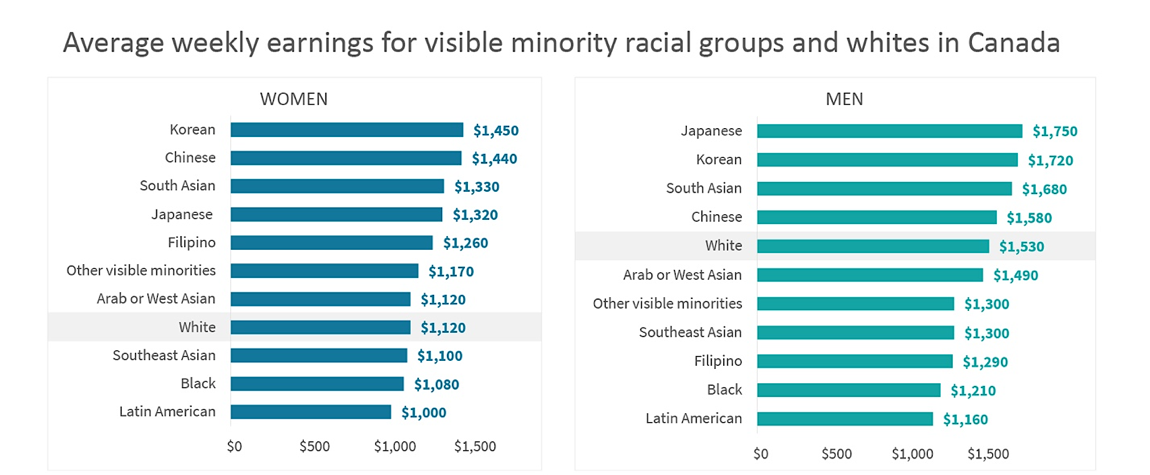
The results of the study by Statcan researchers Theresa Qiu and Grant Schellenberg will come as a shock to anyone expecting to find whites sitting atop the labour market. Rather, the best earners are Canadian-born Japanese males, who earn an average $1,750 per week. This compares to $1,530 earned by white men. Chinese, Korean and South Asian (from India, Pakistan etc.) males also take home more than whites. Among women, whites are out-earned by a majority of groups within the visible minority category, including Chinese, Korean, Japanese, Filipino, South Asian and Southeast Asian (from Vietnam, Thailand etc.). At $1,450 per week, the average Canadian-born Korean woman earns $330 more per week than the average white woman. For both men and women, the two lowest-earning categories are blacks and Latin Americans.

Source: The weekly earnings of Canadian-born individuals in designated minority and White categories in the mind-2010s by Theresa Qiu and Grant Schellenberg, Statistics Canada, 2022

While clearly contrary to current narratives declaring all of North America to be a bastion of white supremacy, these findings are not unusual for either side of the border. The latest American data on full-time workers similarly shows Asian men to be the highest income earners among full-time workers in the U.S., at US$1,457 per week, exceeding the US$1,108 per year earned by white men. 

Asian women also out-earn American white women, by nearly US$200 per week. Other data from the Pew Research Center on household income point to South Asian-born families as the top earners in the U.S. by a substantial margin.  It bears notice that Qiu and Schellenberg wisely avoid confusing the immigrant experience, which entails numerous challenges of language, culture and credentials, with that of being a visible minority in Canada. They do so by focusing only on Canadian-born visible minorities aged 25 to 45 (that is, young second-generation immigrants) and comparing them with similarly situated whites. 

Source: Facts on U.S. Immigrants, 2018 by Pew Research Center, 2020

The researchers further refined their work by adjusting for university education and other demographic characteristics. Here South Asian men were found to do significantly better than white men. Blacks and Latin Americans again did worse. Among women, several visible minority categories statistically outperformed whites, and no group – not even black women – did worse.

The results illustrate the pre-eminence of a university education in explaining job market success. ‘Nearly three-quarters of Canadian-born Chinese women have a university degree,’ marvels Skuterud. ‘That’s amazing.’Tweet

A Good News Story for Many, but not All

Do such results bolster the loud and widespread narrative that Canada is a systemically racist country? According to one labour market expert, such a declaration is impossible to make despite the large gaps in performance seen across the visible minority subgroups. “There is absolutely no way to infer any conclusion from this data about whether there is racial discrimination in the labour market,” says Mikal Skuterud, an economist at the University of Waterloo, in an interview. “Some groups are clearly outperforming whites, but no one would interpret that as evidence of discrimination against whites, or for Canadians with Chinese, Korean or Japanese ancestry.”

To Skuterud, the fact many Asian groups outperform the rest of Canadian society is a “good news story” since these segments comprise a large and growing share of Canada’s current immigration intake; this bodes well for the integration of future immigrants from these countries in coming years. The results also illustrate the pre-eminence of a university education in explaining job market success, as the strong performance across many Asian groups is closely linked to their high rates of university completion. “Nearly three-quarters of Canadian-born Chinese women have a university degree,” marvels Skuterud. “That’s amazing.”

Skuterud is troubled, however, by the poor results for blacks and Latin Americans, something that also appears in his own research. It is conceivable, he notes, that such persistent gaps are the result of labour market discrimination specifically targeted towards certain groups, rather than across the entire visible minority population. Such a possibility requires further investigation, he says. There are, however, numerous other explanations for this phenomenon, including broader cultural or socioeconomic factors not captured by the recent study. For example, another Statcan report found the rate of lone parenthood, a factor strongly associated with poverty and poor educational outcomes, is nearly three times more common among black mothers than in Canadian society at large. “Black immigrant populations stand out for their prevalence of lone mothers compared to the rest of the Canadian population,” the 2020 report observed. It is hard to imagine this not being a significant factor when it comes to the jobs market.

Taken at the broadest level, Qiu and Schellenberg’s results can be seen as a thorough dismantling of Livingstone’s nearly half-century-old claim that the term “visible minority” describes a single coherent category unified by the lack of whiteness of its members. This “group” now includes both the highest and lowest-earning racial categories in Canada, a fact that stretches diversity to the point of absurdity. The exceptional outcomes for Canadian-born Asian men and women strongly suggest factors other than discrimination – primarily education, family and socioeconomic status – are driving the divergence in earnings across race. And if skin colour is not a useful explanation for performance in the labour market, using it as a basis to set employment targets, as is the case within the federal public service, becomes a perversion of good policy.

“Did it ever make any sense?” 

In a column in the Globe and Mail nearly a decade ago, Carleton University economist Frances Woolley declared that, “There is something almost racist about the assumption that whites are the standard against which anyone else is noticeably, visibly different.” Her opinion hasn’t changed much since then. Asked today if it still makes sense for Canada to enshrine the concept of visible minority in law given the recent Statcan results, she shoots back, “Did it ever make any sense?”

The current system, Woolley observes in an interview, is entirely arbitrary in its binary conception of people as either white or not. “The word white is very imprecise,” she notes. According to Statcan, for example, Greek Canadians are European and part of the dominant white, mainstream society. Yet anyone who traces their roots to Turkey, right next door, is considered West Asian and hence a visible minority. As a result, one neighbour is eligible for special measures and one is not. Plus, “a lot of people who consider themselves white – such as Lebanese Christians – are identified as visible minorities by the Census,” Woolley adds. The U.S. classifies most Arab ethnicities as Caucasian.

The rise of individuals with multiple or competing racial identities due to the rapid growth in interracial marriages further complicates the notion of colour-coding Canada’s population. The share of mixed-race relationships has more than doubled over the past decade and now comprises 7.3 percent of all marriages and common-law relationships in this country. As these couples have children, it will get progressively more difficult to sort Canadians into separate racial baskets of white and non-white. (Aka oppressors and victims.)  

Then there is the issue of how nearly everyone can end up being considered part of a minority group and thus deserving of special treatment. Visible minorities currently comprise 22 percent of Canada’s total population, based on 2016 Census data, a figure that will undoubtedly rise with the release of updated 2021 Census data later this year. In some urban centres such as Surrey, B.C. or Markham, Ontario, visible minorities already constitute a clear majority. Indigenous people make up another 5 percent of Canada and people with disabilities are estimated at 22 percent. Finally, women represent 50 percent of all other groups. “Designated groups [under the Employment Equity Act] are now an overwhelming majority in the labour market,” says Woolley. “Surely we can all agree that’s problematic.”

The only slice of the Canadian population not offered special treatment under this framework is that of able-bodied white men. Yet the notion that white men stand astride the Canadian economy like a Colossus is both outdated and unfair. As Qiu and Schellenberg reveal, white men have one of the lowest rates of university completion across all racial groups, at 24 percent. This is significantly lower than black women at 36 percent, and only slightly higher than black men, at 20 percent. Given the importance of education to future earnings, low rates of university education in any racial group should be a troubling matter for fair-minded policy-makers.

Whites, both male and female, are also much more likely to live outside urban areas, another factor Qiu and Schellenberg found to be associated with lower earnings. And as a group, whites are noticeably older than those within the various visible minority subcategories. All of which suggests whites, and in particular white men, are likely to face strong headwinds in the future. They may, in fact, be more deserving of government attention than many other identity categories. “The real question,” insists Woolley, “is how can we make the system fair for everyone, not just designated groups.”

A Better Way Than Racializing Everything

Faced with the obvious folly of the entire visible minority concept, the progressive activist community appears focused on changes of nomenclature rather than substance. Linguistic constructs such as BIPOC or “racialized individuals” are more commonly used these days than the term visible minority. But such changes raise more questions than they answer. Consider BIPOC, an imported American acronym for Black, Indigenous and People of Colour. But aren’t black people also people of colour? And if so, why include them twice? As for “racialized,” the word appears derived from an invented verb: to racialize. But that suggests identity is dependant on the views of others, rather than a permanent, self-conceived state.

Any real commitment to tackling the inconsistencies inherent to the uniquely Canadian concept of visible minority must do more than just fiddle with terminology. In its 2020 Fall Economic Statement, the Trudeau government announced plans to review and modernize the Employment Equity Act. The most attractive solution would be to scrap it altogether and recuse the federal government from any further involvement in private-sector hiring practices. A competitive job market driven by need and focused on merit has no apparent problems hiring well-qualified candidates regardless of race, as the Asian experience ample demonstrates. Yet such a hands-off, market-driven and colour-blind approach seems extremely unlikely.

In the absence of simple economic logic, one immediate remedy would be to stop using whites as the reference group. Given evidence that whites no longer command the highest wages or best jobs, it makes more sense to shift to a simple Canadian average in future Statcan reports. This would resolve Woolley’s complaint about the implicit racism of making whites the standard by which all others are measured. “If you tested everyone relative to the Canadian average rather than whoever is considered ’white,’ I think that would be a good thing,” she says. “It would mean we are no longer taking the white experience as aspirational, or the norm.”

Achieving a colour-blind labour market would require shifting away from our current preoccupation with race to focus on more important factors. Poverty would be a good place to start.Tweet

Then again, any system that continues to examine performance by race, regardless of the comparator, perpetuates the fiction that racial identity is the ne plus ultra of the job market – if not personhood itself. While a fixation on skin colour has lately come to define public policy in many troubling ways, doing so embeds the concept that Canada is a collection of disparate racial groups constantly in conflict with one another. It would be far healthier for society to simply accept that we all share a common identity as members of a pluralistic Canada. Full stop.  

Plenty of evidence suggests Canadians don’t care nearly as much about race as the media or political classes constantly claim they do. Consider the 2019 federal election, which featured those potentially damning images of a young Justin Trudeau in blackface. Most Canadians simply shrugged it off. As author Christopher Dornan observed in his book recapping the election, “The issue of racism – overt and latent, deliberate and unwitting, systemic and extrinsic – simply did not take hold in the election discourse.”

Achieving a colour-blind labour market would require shifting away from a preoccupation with race to focus on more important factors. Poverty would be a good place to start. Says Woolley, “If your family income is a million dollars a year and both your parents have PhDs, then the colour of your skin doesn’t matter. The same goes if you grew up in foster care and have struggled all your life.” Disadvantage and hardship can occur in families of all races and ethnicities. Yet under Canada’s visible minority framework, needy individuals can be ignored while others with a different skin tone get a leg-up they don’t deserve. “We need a fair process and fair procedures,” Woolley asserts.

A fairer system, Woolley says, should “try to get at socioeconomic measures of disadvantage rather than assuming that identity” is the crucial factor. As an example of such a system, she points to the fact many universities around the world that now use socioeconomic status (SES) measures such as family income, rather than race, to determine entrance qualifications for disadvantaged students. Such “class-based” or “race-neutral” standards have a successful track record in Israel.

SES factors are also widely used in the U.S., although they remain a work in progress. The reason many American schools rely on SES is that they’ve been forbidden from accepting students based solely on race due to court rulings on constitutional grounds. In many cases, however, the universities manipulate their allegedly colour-blind SES rankings in order to sort students by colour regardless of what the courts say. This has led to numerous lawsuits objecting to such subterfuge, including one well-publicized case involving Asian students denied entrance to Harvard University because of their race. (They lost in 2019, but the case is now heading to the Supreme Court.) Regrettably, even plans meant to ignore race somehow end up becoming fixated on race.

The final word on ending to racial employment laws should go to the great human rights advocate Martin Luther King, Jr. King strongly opposed race-based quotas and other affirmative action measures because he anticipated their divisive effect on social harmony. In 1964 he wrote, “It is my opinion that many white workers whose economic condition is not too far removed from the economic condition of his black brother, will find it difficult to accept…special consideration to the Negro in the context of unemployment, joblessness etc. and does not take into sufficient account their [own] plight.” He argued against different treatment based on race because he thought help should be provided to all who need it, regardless of their skin colour. In other words, he dreamt of a truly just and fair world. We’re still waiting.

Source: It’s Time to Abolish the Absurd (and Slightly Racist) Concept of “Visible Minorities”

Cross and Taylor: Lies, Damned Lies, And Race-Based Statistics

Reading this commentary reminded me of an anecdote that I can’t unfortunately locate: former PM Harper’s decision to replace the mandatory census with the voluntary, and less accurate, National Household Survey in 20ll was driven in part by the data being used by academics, advocates and activists as a basis for more progressive policies.

The alternative, as Cross and Taylor appear to advocate, is not to have visible minority breakdowns in the labour force survey to avoid this use of data. To my mind, it is a head in the sand approach as such data is needed to understand how well Canadian society is working in terms of economic integration.

COVID-19 has demonstrated the various inequalities between different groups. The regular censuses have also captured these inequalities as well so expanding this to the labour force survey (and public service employment equity reports) is consistent with long-standing practice.

To my mind, issues lie more with respect to how the disparities are interpreted, whether narrowly or looking at the range of factors that influence these disparities.

For example, when I look at public service employment equity data, groups that have lower levels of educational attainment (e.g., Blacks, Latin Americans) are less represented among occupations requiring university degrees. This disparity, of course, likely reflects in part earlier barriers and discrimination encountered by those groups (e.g., streaming of Blacks into non-academic streams, recently addressed by the Ford government).

Disaggregated date is need to be aware of disparities and point towards questions regarding the reasons for these disparities, and assess the degree to which policy interventions, and which kinds, may be warranted.

To their credit, Cross and Taylor do some analysis, looking at occupations and visible minorities, highlighting that Koreans, Filipinos and Southeast Asians are more concentrated in the accommodation and food service industry than not visible minorities as an explanation of why these groups were more affected by COVID-19 lockdowns.

But it is ingenuous, at best, to present socioeconomic circumstances as completely unrelated to barriers faced by some groups.

And of course, the data will be used and sometimes misused by advocates and activists, and one could argue that Cross and Taylor are equally and legitimately using data to support their position.

But curious for a former statistician to be arguing for less data and thus less needed information for evidence-based policy. And using France as a model?:

Since July, Statistics Canada has been publishing labour-market data divided into 12 ethnocultural categories including Chinese, South Asian, Southeast Asian, West Asian, Korean, Japanese, Arab, Black, Filipino, Latin American, White, and Others. Sliced this way, Statcan’s figures reveal the unsurprising fact that unemployment is unevenly distributed across Canada’s racial populations, just as it varies by region, gender and age. The adult Canadian unemployment rate in January was 9.4 percent, but 20.1 percent for Southeast Asians, 16.4 percent for Blacks and 16.6 percent for Latin American Canadians. “Others” had a slightly-better-than-average unemployment rate of 8.9 percent.

This move to produce racially-specific labour-market data may well have been inevitable, given the intersectional enthusiasms of Prime Minister Justin Trudeau, who recently declared his next budget will be an explicitly “feminist”document. It also follows logically from his government’s creation of Statcan’s Centre for Gender, Diversity and Inclusion Statistics in 2018. Equally predictable is the effect this new information has had on public discourse.

The release of race-based labour-market data has provided further fuel to the ascendent view that Canada is an inherently unfair and racist country. Lobby groups and organizations representing the various racial groupsidentified by Statcan have latched onto the new data to back up claims regarding the “negative labour market impact of racism on Black youth” and other collective sins aimed at Canadian society. The figures are also frequently held as proof that employment equity programs and other government market interventions must be scaled to industrial proportions to eliminate the discrimination baked into Canada’s labour market.

But when it comes to fomenting outrage, Statcan is just getting started. In a recent commentary in The Globe and Mail, Anil Arora, Chief Statistician at Statistics Canada, explained his organization’s intention to double down on the collection and dissemination of race-based data. Because the initial effort last July revealed such glaring “racial disparities”, he wrote, Statcan will now be using “data from varying lenses…to measure those inequalities and track the progress being made to address them.”

French law specifically forbids INSEE from processing or analyzing data regarding “ethno-racial classifications” because it could violate constitutional requirements that all citizens must be treated equally.Tweet

As exciting and progressive as all this may seem, however, Statcan should tread carefully. Collecting race data is inherently contentious and divisive, something all national statistical agencies must recognize. While the United States has a long history of collecting very detailed race-based data, others such as France’s Institut national de la statistique et des études économiques (INSEE) do not disseminate any race statistics. In fact, French law specifically forbids INSEE from processing or analyzing data regarding “ethno-racial classifications” because it could violate constitutional requirements that all citizens must be treated equally “without distinction of origin, race or religion.”

As we shall see, unequal racial outcomes revealed by national statistics do not necessarily prove racism, and often lead to intractable debates. This is especially so in a country like Canada, where there’s a large overlap between visible minorities and immigrants who historically take years to match the outcomes for Canadians born in the country. Feeding a culture of grievance that denies any role for cultural differences in generating observed inequality can, paradoxically, perpetuate unequal racial outcomes. And as the state of affairs in the U.S. suggests, a surfeit of race-based statistics is no guarantee of racial harmony.

Neither is Statcan exempt from the principle of opportunity cost. Collecting one set of data inevitably means foregoing others – some of which may be of greater value. For years, researchers from social policy groups such as Cardus have asked for better data on how marital status affects employment and income. This would provide more detail on the important role played by family in the labour market. Yet these requests have long been ignored for cost reasons. Statcan presumably has better things to do with its limited resources. Now, however, in the middle of a pandemic, the agency has suddenly discovered the means to produce divisive race-based unemployment data.

Pandemic and Race

There are many pitfalls and risks associated with attributing different outcomes experienced by different racial groups exclusively to race, especially when these accusations are based on superficial statistics. In its July 2020 labour market report that, for the first time, segmented unemployment by race, Statcan itself noted that the top line figures showing poorer outcomes for most visible minorities categories reflected, in large part, the tendency of certain racial groups to work in industries deeply affected by the pandemic.

For example, 19.1 percent of Koreans, 14.2 percent of Filipinos and 14.0 percent of Southeast Asians were employed in the accommodation and food industry, according to the 2016 Census, compared with only 5.9 percent of Whites. Given the dramatic effect the pandemic-related lockdowns and other measures have had on the hospitality sector, it seems reasonable to conclude that race played little or no role in these unequal outcomes. Rather, it was the circumstances of the industries they were working in.

It has also been widely reported that different racial groups contract Covid-19 at different rates. Some concluded that this was because these groups are particularly disadvantaged by a racist society, while others wondered whether particular racial groups might have a different genetic susceptibility to the virus. As a recent U.S. National Bureau of Economic Research study warns, merely noting differences among racial groups without knowing their source means “the political discourse can gravitate toward ‘biologic explanations’ or explanations based on racial stereotypes which are harmful in themselves and get in the way of policy solutions.” The same study made plain that it was the socio-economic circumstances of particular groups that affected their exposure to the virus. This was due to working in particular industries and using public transit, which increased their contact with other people and, in turn, led to a higher rate of infection. Once the data was corrected for these variables, visible minorities in the U.S. were found to be no more susceptible to the virus than whites.

Given how easily some data can be misinterpreted or misrepresented, it would seem that Statcan has a clear responsibility to caution users about its proper use. Figures regarding the distribution of federal government revenues and spending by province, for example, are regularly twisted by politically-motivated analysts and governments. As a result, Statcan published an article in 2007 offering a detailed explanation for why these statistics should not be considered a scorecard for which provinces are gaining or losing from their dealings with the federal government.

Much of the current debate over racism in Canada arises from the presumption that all aspects of life should be perfectly evenly distributed, and that any deviation from pure equality must be considered prima facie evidence of systemic racism. Tweet

It is, accordingly, curious that these new race-based labour-market figures do not come with a similar warning; race data is far more emotionally and politically incendiary than provincial fiscal data. It is also surprising that Statcan did not directly address the issues raised by France’s refusal to collect race-based data.

Racism of the Gaps

Much of the current debate over racism in Canada arises from the relatively recent presumption that all aspects of life should be perfectly evenly distributed, and that any deviation from pure equality (a term also recently redefined from equality of opportunity to sameness of outcomes) must be considered prima facie evidence of systemic racism. With dizzying speed, this eminently contestable claim has been elevated nearly to conventional wisdom.

In an insightful commentary published earlier this month by the Macdonald-Laurier Institute, Vancouver-based writer Sonia Orlu tackled head-on the notion that “any disparity in outcomes between blacks and whites is the direct result of racism, as opposed to class differences, culture, personal ‘(ir)responsibility,’ or any other myriad of situational factors.” As Orlu, who is black, points out, this “racism of the gaps” generally relies on surface-level observations lacking in context or detail.

Nowhere is this assumption more explosive than regarding claims that members of visible minorities are disproportionately targeted, arrested or killed by police. As Orlu points out, a case for systemic racism in policing can only be proven with detailed race-based data showing police interactions as a share of the overall criminal population, rather than the population at large. While racism may create the conditions in which visible minorities commit more crime, simply arresting more visible minorities is not, in and of itself, proof police are acting with racist intent.

Orlu notes, however, that Canada does not collect the sophisticated race-based data necessary to come to an informed observation on this heated topic. With only the most basic statistics available regarding race, arrests and incarcerations, it is easy to conclude that police actions are driven by racism rather than other factors. And even when detailed race and crime evidence is available, as it is in the U.S., Orlu points out it is generally ignored by the media and public because it does not align with popular “anti-racism ideology” narratives. More information, in this case, does not produce a better debate or better decisions.

This problem is further illuminated by economist Tim Harford in his fascinating new book The Data Detective. Harford offers the example of an algorithm called COMPAS (Correctional Offender Management Profiling for Alternative Sanctions) used in the U.S. to predict the probability of a criminal being re-arrested. Because the algorithm produced racially disparate results – giving higher probabilities for blacks to be re-arrested than whites under similar circumstances – it was accused of perpetuating systemic racism. And yet the algorithm itself was colour-blind; race was not an input factor.

A detailed investigation by a team of statisticians revealed that the differing results were the product of members of different races behaving differently and/or living in different neighborhoods. As Harford concluded, “The only way in which an algorithm could be constructed to produce equal results for different groups…would be if the groups otherwise behaved and were treated identically.” Such an outcome adds evidence to the proposition that unequal results between races do not prove racism if behaviour and circumstances differ.

Examples of the racism gap fallacy are in ample supply elsewhere. Last month, for example, Akim Aliu, a former NHL player and founding member of the lobby group Hockey Diversity Alliance, claimed that an observed lack of racial diversity in the National Hockey League could only have one possible source. “There are still owners in the league who don’t even believe [racism] is a problem,” Aliu complained to Reuters in a Black History Month article. “To me that is just unfathomable, 95 per cent of your league is white and you don’t see there is an issue of race.”

Yet visible minorities make up a vast majority of the lineups in many other sports. The National Basketball Association is 74 percent black, and the National Football League 68 percent. While the Canadian Football League does not provide readily-accessible race-based statistics, the number of black players in this league also appears to far exceed representation in the general population. Should all this be taken as self-evident proof that football and basketball are equally prejudiced, but in favour of visible minorities? Of course not.

In another fixation on gaps, Statcan’s Arora in his Globe and Mail commentary emphasizes the importance of moving “toward levelling the uneven economic playing field”, citing the unequal unemployment and poverty rates among immigrant women as a key example. It must be noted, however, that there is a large overlap in Canada between visible minorities and immigrants. The lagging labour market outcomes for visible minorities and other Canadians reflect the long-standing challenges of immigrants establishing themselves in Canada.

In 2016, for example, Canada admitted thousands of Syrian refugees, many with limited education and little or no knowledge of either of Canada’s official languages. Do inferior incomes and more joblessness among the women of this group in the short time since they arrived prove the “playing field” in Canada is uneven? Inferior outcomes for some players don’t necessarily indicate a tilted field, it may merely demonstrate that they were sent out onto the field without the skills and training needed to compete. It is also worth remembering that the prevalence of poverty and inequality of income is much greater in the countries most immigrants come from, than is their inequality compared with native-born Canadians.

 The Inconvenient Truth that some Minority Groups Outperform the Majority

Racism – defined as the presence of deep-seated prejudices that affect individual and collective behaviour – certainly exists in Canada, as it does in all countries. And wherever present, it should be challenged and overcome. That said, collecting race-based data may not contribute to that worthy goal at all. It could instead cultivate a mentality of grievance and entitlement that undermines the impetus for individuals to strive to achieve more for themselves and their children. Look how easy it was for Aliu, for example, to take a simple statistic regarding the race of NHL players and turn it into a bitter accusation.

Arora’s recent Globe commentary, meanwhile, laments the “many economic challenges facing racialized populations, Indigenous people, persons with disabilities and other marginalized groups” as proof of the need for Statcan’s big move into race data. But might it not be more useful to study how certain minority groups have overcome even-greater challenges in the past? Few groups have suffered more persecution and discrimination than Jews, yet their internal culture enabled Jewish people to achieve superior results in multiple fields of endeavour in country after country. Japanese Canadians are another example, overcoming their forcible removal from their homes to be quarantined in remote camps during the Second World War, and going on to achieve one of the highest income levels of any racial group.

It is too easy to dismiss the achievements of certain races or ethnic groups as the result of advantages and privileges. While the lagging performance of some visible minorities is automatically assumed to be evidence of Canada’s innate racism, the opposite conclusion is never drawn from the superior results displayed by other minority groups (such as Chinese, to use Statcan’s terminology) in terms of employment, scholastic achievement or avoidance of crime. Looking south of the border, pre-Covid U.S. Census Bureau data revealed that the real median household income of Asian-Americans is nearly 30 percent higher than that of whites.

Thomas Sowell, the renowned black economist at the prestigious Hoover Institution at Stanford University, has written extensively on the use and misuse of race-based data. His insights on the importance of the culture internalized within racial groups provides a good lesson on the pitfalls of superficial interpretations of race data. As Sowell observed in his 2013 book Intellectuals and Race: “Different races, after all, developed in different parts of the world, in very different geographical settings, which presented very different opportunities and restrictions on their economic and cultural evolution over a period of centuries.” Further, people tend to blame racial differences on bias, which ignores “internal explanations of intergroup differences in favor of external explanations.”

As Sowell noted wryly in his 1996 book Black Rednecks and White Liberals, “all things are the same except for the differences, and different except for the similarities.” Given current demands for diversity in all things, he was observing, why should anyone expect identical outcomes as a result? Perhaps that comment should be attached to every Statcan press release on racial differences in the labour force survey.

The Politics of Distribution Versus the Economics of Growth

There is a growing sense of malaise in Canada, including worry that we are falling well short of our economic potential. Our political and economic leaders ought to be focusing on creating the macroeconomic and cultural conditions wherein all groups can thrive. Instead, our country’s growing fixation on racial issues – including the collection of race data – invites policymakers to think in terms of improving Canada one micro-group at a time.

We have already seen its nefarious impact. The most salient fact of the Covid-19 pandemic has been its devastating impact on all of Canada, with 5.5 million people losing their jobs or having their work severely curtailed in the spring of 2020. Rather than proposing general solutions to support growth and allow the reopening of the economy, numerous special interest groups have used the pandemic as an excuse to advance their particular pet policy projects, re-packaging old proposals that have circulated for years or decades to “solve” a once-in-a-lifetime crisis. The ideas include greater provision of day care, universal basic income, universal Pharmacare, extended employer-paid sick leave and so on, almost ad infinitum, as if budget constraints no longer existed.

The greater influence of broad economic conditions than specific social policies is revealed by Arora’s own reference to the “significant progress” visible minorities were making towards equality before the pandemic set them back. He cited a sharp drop in poverty and “rapidly rising employment rates among working-age immigrant women” as evidence of this happy situation. Such pre-pandemic levels of achievement – closing numerous gaps with the rest of society – was not the product of programs targeting specific aggrieved minority groups, but the result of an improving and robust economy-at-large. As Canada as a whole grows, its gaps shrink.

The best way to resuscitate the fortunes of visible minorities is the same as for all other Canadians: reopen the economy as quickly as possible and adopt policies and attitudes aimed at supporting long-term economic growth. Tweet

The same phenomenon was in even greater evidence in the U.S., where wage gains in 2019 were led by the lowest wage-earners, especially visible minorities. In recognition of this, more Latino and black voters cast ballots for Donald Trump last November than in 2016, despite his obvious negative attributes. The clear lesson is that better macroeconomic policy and economic growth always outweigh the impact of targeted government programs.

It is important to remember that the reversal of fortunes for minorities during the pandemic was because our economy was struck by the economic equivalent of a thermonuclear device, not because Canada overnight became more racist. The best way to resuscitate the fortunes of visible minorities, therefore, is the same way as for all other Canadians: reopen the economy as quickly as possible and adopt policies and attitudes aimed at supporting long-term economic growth.

Statcan’s new race-based data invites the facile conclusion that one group’s success explains another group’s relative failure and justifies its grievance. And our faltering economic growth reinforces the sterile view that the size of the economic pie is fixed and any gain by one group comes at the expense of others. The result is a focus on the politics of distribution instead of the economics of growth.

To be fair, Statcan did a lot of good work in response to the pandemic. This includes flash estimates of GDP, adjustments to how it measures labour under-utilization, more timely data on firm turnover, and innovative ways to track population mobility during a lockdown. The agency’s recent move into race-based data does not, however, rank among these useful innovations. And its effects may outlast all the others due to the appeal it holds for groups dedicated to fanning the flames of internal complaint.

With race-based data now being widely disseminated, this process may be unstoppable. Any move to cut off funding for this project will be widely condemned by the many vocal advocates of the “race industry”. Canadians should thus prepare themselves for a steady stream of studies in the coming years declaring the presence of gaps that allegedly prove the existence of systemic racism, but which tell us nothing about their origin or the best way to reduce them. All this is an unfortunate but costly distraction from the bigger and more important issues of innovation, investment and entrepreneurship that will be necessary to restore an economy that will benefit all Canadians – of every race and colour.

Philip Cross is a senior fellow of the Macdonald-Laurier Institute and the former chief economic analyst at Statistics Canada. Peter Shawn Taylor is senior features editor of C2C Journal.

Source: https://c2cjournal.us19.list-manage.com/track/click?u=e8efce716429c34122979e2de&id=ca577642d5&e=4174a59277

Langevin, Ryerson, Cornwallis: Is our past unfit for the present? – Peter Shawn Taylor

More good commentary by Peter Shawn Taylor (The case for keeping ‘Langevin Block’ – Peter Shawn Taylor, Begbie’s Statue – Bill McKee) and useful citing of historian Witt’s test questions on renaming:

Yale University has long wrestled with similar complaints about Calhoun College, named for benefactor John C. Calhoun, a U.S. senator from South Carolina and outspoken proponent of slavery during the pre-Civil War era. Last year, Yale asked historian John Fabian Witt to resolve the controversy. His response was a unique series of questions meant to gauge the validity of renaming demands. It’s a first stab at a coherent, standardized system for settling commemoration disputes, and other U.S. institutions have quickly grasped its significance. Last month, the University of Mississippi employed Prof. Witt’s test in removing some controversial names from its campus, while letting other remain. In the absence of anything similar in Canada, we should adopt the Witt test to settle our own namesake dilemmas.

Prof. Witt begins with the overarching principal that name changes should be considered “exceptional events” and not frivolous or political acts. “Renaming has often reflected excessive confidence in moral orthodoxies,” he observes, pointing with caution to the Soviet Union. Then again, not every urge to rename is Orwellian: post-Apartheid South Africa or post-Nazi West Germany, for example.

To decide what deserves to be removed and what should stay, the Witt test applies four questions, modified here for domestic use, that weigh the actions and time periods of commemorated individuals.

  • First: Is the principal legacy of the namesake fundamentally at odds with Canadian values? This requires a broad understanding of the life’s work of the individual in question.
  • Second: Was the relevant principal legacy significantly contested during the namesake’s lifetime? Isolated statements or actions considered controversial today may have been conventional wisdom at the time. Context matters.
  • Third: At the time of the naming, was the namesake honoured for reasons fundamentally at odds with Canadian values? Why was this person commemorated?
  • Finally: Does the building play a substantial role in forming community? The more prominent the edifice, the greater the casefor retaining names of historical significance, Prof. Witt says.

Using the Witt test, Yale announced in February the removal of Mr. Calhoun’s name. White supremacy, it concluded, was his principal legacy. Mr. Calhoun claimed slavery was “a positive good” and that the Declaration of Independence erred in stating all men are created equal. For this, he was criticized in his own time and today.

Applying these same standards to Mr. Langevin, however, yields a different result. As an important French-Catholic Conservative federalist in the Confederation era, Mr. Langevin’s principal legacy was building a bicultural Canada, something once considered a great virtue in this country. This is why his name was placed on an important building in Ottawa. Though his name is today often paired with residential schools, Mr. Langevin was primarily involved with constructing the buildings, not championing the policies. The infamous speech he gave in Parliament on the subject was actually parroting what his boss – Sir John A. Macdonald – had said days earlier. While his comments are grating to modern ears, he was merely repeating widely accepted views from his time. The Witt test exonerates Mr. Langevin.

The legacies of Mr. Begbie, Mr. Ryerson, Mr. Cornwallis and the rest of Canada’s historically accused deserve a fair trial as well.

Source: Langevin, Ryerson, Cornwallis: Is our past unfit for the present? – The Globe and Mail

The case for keeping ‘Langevin Block’ – Peter Shawn Taylor, Begbie’s Statue – Bill McKee

I agree with Taylor on the risks of ignoring the historical context and focusing only on one aspect of their role in Canadian society. Those who forget (or erase) history, are condemned to repeat it, albeit with twists. McKee’s point on interpretative panels is a better way:

Taken on its own, Langevin’s quotation is a devastating indictment to modern ears. But what if we let the tape roll a bit longer? Later in that same speech, for example, Langevin said it was his intention to give every native child who graduates from residential school a free homestead. And in response to Langevin, Edward Blake, the leader of the Liberal party of the day, not only used words to describe Indigenous men and women that would be considered horrific today, he also complained that Ottawa’s plan was overly generous. The Liberal party of the day wanted to spend far less on the native file.

Extreme narrow focus on a few sentences of one speech may provide damning evidence of Langevin’s unfitness for present-day memorialization. But in the context of his time, Langevin actually stands among the more enlightened representatives of the federal government. As for the accusation that Langevin believed in assimilation of the Indigenous community—a concept now properly and universally considered abhorrent—he is guilty as charged.

But assimilation was conventional wisdom among all elite thinkers of his era. If statements in support of it are to be considered sufficient reason for removal from the historical record, then every politician of note in Canada prior to the 21st century must eventually be struck from the record—from Macdonald to Sir Wilfrid Laurier on down. Even Pierre Trudeau, often considered the father of an inclusive, multicultural Canada, was a confirmed assimilationist. His 1969 White Paper on “Indian Policy” planned to eliminate Indigenous status entirely. When such a plan was firmly rejected by the Indigenous community, Trudeau replied bitterly, “We’ll keep them in the ghetto for as long as they want.” Is the legacy of Trudeau senior next on the list for erasure?

And entirely ignored within the current debate over Langevin and the residential school issue is his stature as a key Francophone Quebec federalist during the crucial pre-Confederation era, which was the reason his name ended up on a federal building in the first place. Reconciliation between French and English was once considered a great Canadian virtue. It should still count for something today.

As for Cornwallis, in 1749 he did declare a bounty of 10 British guineas for every Mi’kmaq scalp delivered to him during a colonial-era conflict known as Father Le Loutre’s War. Like Langevin’s speech on residential schools, singular attention on this one act seems sufficient to declare him unfit for present-day consumption. By any standard, scalping is an horrific act. But once again history throws up some uncomfortable facts.

Father Le Loutre’s War (1749 to 1755) was the handiwork of French Catholic priest Jean-Louis Le Loutre, who goaded local Mi’kmaq tribes into conflict with the British in hopes of reclaiming New Brunswick and Nova Scotia for the French. For added motivation, he explicitly promised to pay Mi’kmaq warriors a bounty for English scalps. And they delivered. In 1753, for example, Le Loutre was reimbursed 1,800 French livres by the colonial government in Quebec City for sums he paid to the Mi’kmaq for 18 English scalps.

The payment of scalp bounties was unsettlingly common throughout North America during the entire colonial period. It was, in fact, standing French policy to offer payments for the scalps of the English—men, women and children—as a subsidy to ensure the continued loyalty of allied Indigenous tribes. Scalp bounties in the English-speaking colonies generally only appeared when a war was on; and their value waned and fluxed depending on the public’s panic level. It thus seems unfair to use Cornwallis’s scalping proclamation as conclusive evidence against him when both sides in this ancient conflict, including those Mi’kmaq nations who today demand Cornwallis’s expulsion from the public square, were fully engaged in the repulsive tactic.

And while Amherst is widely considered to be the father of modern germ warfare for allegedly handing out smallpox-infected blankets to Indigenous foes, this is a falsehood. There is no proof he ever did such a thing. Amherst responded positively to the suggestion from a fellow officer in a letter dated July 16, 1763, but this came a month after the one and only time British troops actually stooped to such a tactic—during a native siege of Fort Pitt (near present-day Pittsburgh) on June 24, 1763.

Finally, Begbie was indeed responsible for sentencing six Indigenous leaders to hanging for their role in the killing of 20 non-natives during B.C.’s Chilcotin War. Yet condemning him into oblivion on this basis ignores his vast record of support and understanding for the province’s Indigenous communities at all other times. He was fluent in several Indigenous languages, recognized the concept of Aboriginal title in his rulings and took a strong position against racism. Begbie was perhaps the most liberal and native-friendly judge of his time. As for his controversial hanging decision, which the B.C. government recently apologized for, he had no choice. The death penalty was mandatory for murder cases. Despite all this, his own law society has removed him from the firmament.

To our great disadvantage, Canada has become obsessed with replaying a slow-motion, high-definition version of our past. Historical figures are now judged by intense focus on individual statements or actions. One ‘infraction’ at odds with current acceptable standards has become sufficient evidence for expulsion from present-day society. Yet it is reasonable, if not inevitable, to expect that every notable figure from the past has probably said or done something that will grate against modern sensibilities, particularly with respect to Indigenous relations. It is therefore only a matter of time before every statue, park and street named for an historical character in Canada is declared incompatible with the present.

But while the fraught relationship between colonial Canada and Indigenous peoples is an important component of our history, it is not its entirety. We should not allow current attention being paid to the Truth and Reconciliation Commission’s findings, necessary and disturbing as they may be, to become a mechanism that strips Canada of our most significant characters and events. Or removes the context and detail from the stories of who we are and where we came from.

Source: The case for keeping ‘Langevin Block’ – Macleans.ca

Bill McKee, the former curator of B.C. history at the Museum of Canadian History in Ottawa makes a sensible suggestion on how to keep historical names and statues while acknowledging the less savoury aspects of their legacy:

Removing his [Begbie’s] statue will accomplish nothing of general benefit. It would help to hide this sad part of our history. In its absence, no one will remember or learn a lesson to understand the native side of the Chilcotin War, and the complex story behind the execution of the chiefs.

I would suggest, rather than removing this important statue, a more useful step would be to provide interpretive panels explaining all parts of the life of Matthew Baillie Begbie, around the statue, similar to an interpretive exhibition in Vancouver’s Chinatown, just east of Carrell Street. The exhibition could highlight his impact upon our history, and focus on his impact upon First Nations, not as an aside, but a central part of our history.

Another important way to recognize the cost of the arrival of the British and Canadian fur traders, the participants in the several gold rushes and of the British colonial society upon our First Nations would be to erect another large statue recognizing the story of the Chilcotin War and the resulting executions of indigenous leaders. The funding could come from the public, as well as the City of New Westminster and the governments of B.C. and Canada. It could be located on the site of the former cemetery next to the new high school or near the courthouse, where the remains of the chiefs were possibly buried. I would think the site near the high school would be a chance to highlight the story of our First Nations to young people in New Westminster.

I also want to point out that the statue of Sir Matthew Baillie Begbie was created by Elek Imredy, a refugee who came to Canada from Hungary, after the Soviet suppression of the Hungarian revolution. Many people will recognize his “Girl in a Wetsuit” statue off of Stanley Park, at the entrance to Burrard Inlet, which was created at the request of the City of Vancouver. These statues are a reflection of the contributions of the many immigrants and refugees who have contributed to our history.

Please don’t remove the statue of Matthew Baillie Begbie.

Source: Opinion: Removing statue of Judge Begbie benefits no one

Why budget ‘gender statements’ are a bad idea

One thing to argue that gender and diversity analysis should include men (hard not to agree given some of the disturbing trends regarding education and outcomes), quite another to dismiss GBA entirely like Peter Shawn Taylor appears to do.

In my various analyses of diversity in government appointments, it is generally simpler to present one gender than both, as the numbers are simply the flip side of one another (and yes, traditionally women and other minorities have been under-represented). But narratives can and should be more inclusive.

And while Lilla’s thesis that identity politics led to the alienation of white males, it is more likely that the fundamental changes in the economy and the impact on white working class males played a larger part:

The Gender Statement’s ultimate consequence is to promote a winner-take-all gender competition—a battle between the sexes to see who can muster the best (that is, worst) numbers in making their case for systemic discrimination. The mere fact I’m writing this now—the heresy of men’s rights notwithstanding—proves the point. Ottawa’s plan to expand its Gender Statement in future years to include new identities such as ethnicity, age and sexual orientation can only raise this contrived grievance-search to new, intersectional heights.

At this point, I’m reminded of Columbia University humanities professor Mark Lilla’s much-shared essay in the New York Times, The End of Identity Liberalism, in which he unpacked the destructive impact of the political fixation on gender, racial and sexual identities on the U.S. election.

“A generation of liberals and progressives [have become] narcissistically unaware of conditions outside their self-defined groups,” he writes. Such obsessive attention to self-identity eventually caused white, predominantly-male Americans to similarly think of themselves as a disadvantaged group, thereby putting Donald Trump in the White House. “Those who play the identity game should be prepared to lose it,” Lilla concludes, calling on liberals to spend more time promoting shared experiences and values, rather than curating differences.

Surely this is the fire we’re playing at in Canada as well with the budget’s Gender Statement. It encourages Canadians to consider the country’s fiscal plan not in its broad sweep and affect on the country, but rather through the lens of narrowly-defined identity categories. And to succeed in this context, it becomes necessary to elevate whatever disadvantages your group might experience while ignoring those of competing groups.

This might work for a while. But eventually everyone will start to demand their special moment. Men might even wonder why they’re asked to pay 66 per cent of all taxes, while their problems get zero per cent of Ottawa’s sympathy and attention. And then what?

Source: Why budget ‘gender statements’ are a bad idea – Macleans.ca