Should we replace some public servants with computerized agents?

Yes, as a means to improve citizen service and reduce wait times for routine applications and services. But prior to doing so, do the hard work of reviewing programs and opportunities for simplificant and streamlining rather than assuming tech is a solution to address program complexity, duplication and incoherence between programs.

Most of us have experience with chatbots, who are likely to become more effective given advances in large language models such as ChatGBT:

Take a moment to imagine your next application for passport renewal. Rather than heading to a passport office, the government now allows you to apply online. If the passport office wants to follow up, instead of inviting you to visit in person, they send you a text, asking you to call a number.

Your call is connected immediately, and the agent is pleasant, speaking your language fluently with a slightly hard-to-identify accent. She asks you benign but interesting questions about your upcoming trip. At the end of the conversation, she lets you know that your application will be approved. You thank her enthusiastically, and she wishes you a safe journey.

This scenario is the kind of ideal government interaction that Canadians dream of. But what if that pleasant person who helped you was in fact a highly intelligent computer? Would it change our feelings about the level of service?

What if, instead of a passport application, you were interacting over a medical need; a question of a child support payment; or a request for employment insurance after a job loss? What if you were trying to speak to your local member of Parliament, asking them for assistance in a public matter or to express your opinion on an issue

The reality is that governments are not far from having access to such services. Large language models – made famous by OpenAI’s ChatGPT – are improving at a breathtaking pace. Speech technology and voice recognition are developing at a similar rate. When the linguistic fluency of a language generator is combined with speech technology, the capacity exists to have a conversation with a computer that differs undetectably from one with a human. These digital agents can seamlessly incorporate the information they are receiving in real-time to make judgments that their owners – in this case, the government – program them to make. A world of digital agents who can replace public servants is closer than we think.

Should we help that world develop or hold it back? Of course, we would all rather deal with a real human who behaves like our imaginary artificial agent – quickly, empathetically and accurately. But for many users of government services, that’s not the right comparison case. Which would you prefer: The scenario we described above with an intelligent chatbot? Or the scenario in which you get a notification that you have to head to the passport office (which involves finding it and either securing an appointment or waiting in line) to talk to someone? Or the alternative – to wade through phone trees and hold music to talk to someone who may be at the end of a difficult day and not all that interested in solving your problem, not able to speak your language idiomatically, or unable to explain things in terms you understand?

In the passport example, the constraint on providing better services with an intelligent chatbot would not be the availability of workers to process passport decisions, but the capacity of this technology to scale up. Marginal costs are low here.

To be sure, there are challenges in using these technologies. Their advantages are only realized when more discretion is given to the digital agent. We would have to allow it to make decisions. How do we audit the decisions of robots? And who is accountable for the decisions which they make? What is the recourse when they make the wrong calls, or even do harm through their choices?

These are the kinds of choices governments will need to make about how they are willing to deploy digital agents to deliver services. There will come a moment in the future, perhaps the near future, where the cost of such agents will be low enough and the need for more government services will be high enough, that saying no to such machines will be impossible. Before that time comes, governments ought to decide what principles will guide their use.

There are multiple ways to achieve this. Governments could engage in substantial public consultations and hearings, with both experts and regular citizens. They could convene groups of citizens to deliberate over the principles and rules for the deployment of digital agents. They could run small, open trials, where citizen use of these technologies is entirely voluntary and the results of decisions are open to public scrutiny.

However governments decide to tackle these future choices, the decision must be made a priority now. The aspiration of democracies has long been a government for the people, but also by the people. And it’s up to democracies to decide if the same rule should apply to public services.

Peter Loewen is the director of the Munk School of Global Affairs & Public Policy. Gillian Hadfield is the director of the Schwartz Reisman Institute for Technology and Society.

Source: Should we replace some public servants with computerized agents?

Conservatives, Liberals rank economy high in immigration file, but diverge on integration, cultural values, says survey

What one would expect given other polling data but still of interest:

Conservatives and Liberals tend to agree that jobs and the economy should rank high when it comes to the immigration file, but concerns for the plight of refugees and integration of immigrants depends on where one falls on the political spectrum, suggests a new study released today.

Whereas many Conservatives prioritize on cultural values, national security, and jobs, the Liberals and NDP place less importance on those concerns, according to a survey from the Digital Democracy Project, a months-long effort that the Public Policy Forum and McGill University’s Max Bell School of Public Policy are leading.

“Partisans differ in terms of what they’re talking about when they talk about immigration, what dimensions … they think about,” said Peter Loewen, a political science professor at the University of Toronto’s Munk School of Global Affairs, one of the report’s authors.

Respondents were asked to rank eight dimensions related to immigration, including social services and welfare; diversity and multiculturalism; and illegal immigration, were of high concern.

For example, Conservative partisans expressed more concern over illegal immigration than other partisans, with 42 per cent saying it’s a concern, compared to 28 and 27 per cent of respondents who identified as Liberal and NDP supporters, respectively, the survey suggested.

The data, based on an online panel survey of 1,559 Canadians, was conducted from Sept. 11 to 16. Online polls are not considered to be truly random and cannot be assigned a margin of error.

There are marked differences between the Liberals and NDP on the immigration file, too. NDP supporters rank Canada’s responsibility towards welcoming refugees as higher on the list over jobs and the economy, while Liberal supporters indicated it as less of a priority, with 29 per cent choosing it as a top concern, compared to 44 per cent who identify with the NDP.

Researchers also found that most Canadians are misinformed about Canada’s immigration levels and refugee intake. Asked how many refugees Canada admitted in 2018, only 12 per cent answered correctly, 61 per cent were unsure, and 24 per cent said it was higher than the actual figure of 28,000.

“The worrying takeaway is that the more people are exposed to traditional news, to social media, the more likely they are to give incorrect answers about immigration levels, refugee intake levels,” Prof. Loewen said. “People are taking misinformation from somewhere in the ecosystem.”

Nativism could also explain differences in views on immigration policy, the report noted. In seeking to measure the level of nativist sentiments with a series of questions, researchers found that while Canadians “exhibit modest levels of nativism,” Liberal and NDP supporters have lower scores than Conservative supporters. (To measure respondents’ openness to nativist sentiments, they were asked to rate six statements, including whether they agree “immigrants take jobs from real Canadians” and if Canada “would be stronger if we stopped immigration,” on a five-point scale.

Attempts to provide information on the economic benefits of immigration had an influence on respondents’ perception of immigration, according to the study. Half of respondents were given an excerpt from a 2018 Conference Board of Canada report that said immigrants are key to economic growth. Among those who weren’t given the report, 23 per cent said immigration was bad for the economy and 57 per cent said it was good. Those figures changed slightly to 19 per cent and 63 per cent among those who viewed the report.

“While theories of motivated reasoning suggest that partisan respondents will reject information that doesn’t conform to their existing values or beliefs, the effect of this intervention was stronger for right-leaning partisans than for left-leaning partisans,” the report noted. “…This suggests that providing the public with relevant information could also influence their opinions on public policy, and that nativism is not as much of an immutable sentiment as commonly believed.”

Though Canada isn’t immune from nativist and populist sentiments, the report noted that such expressions don’t mimic the trends in the U.S. and “far-right parties in Europe.” The report suggested that the embrace of populist sentiments is “most common” among NDP supporters than Liberals, while the Conservatives are in between.

Previous studies from the Digital Democracy Project have looked at how Canadians consume and share media and its effects on their support for policies in the lead-up to the federal election.

Source: Conservatives, Liberals rank economy high in immigration file, but diverge on integration, cultural values, says survey

Michael J. Donnelly and Peter Loewen: Canadians’ feelings about immigration are mixed at best

Interesting new study by political scientists and Peter Loewen, reinforcing in part some of the conclusions of the earlier Angus Reid poll (CBC-Angus Reid poll: Canadians want minorities to do more to ‘fit in’) and subject to some of the same critiques (Angus Reid’s survey actually shows high level of support for our diverse society: CardozoHow Angus Reid, CBC got it wrong about multiculturalism: Jedwab).

That being said, their policy conclusions – our political system reduces the risk, politicians and others should avoid pandering or cultivating xenophobic attitudes – are sound:

Our core conclusion:? Canadian attitudes are not exceptionally pro-immigrant or racially enlightened. Instead, Canadian society contains the potential for the same kinds of hate that we see elsewhere.

One question we asked was whether respondents would support, oppose, or neither support nor oppose cutting off all immigration to Canada. Not surprisingly, only 19 per cent of respondents supported such a step. However, only 46 per cent expressed opposition, with the rest on the fence. How does this compare to our southern neighbours? In 2010, the same question was asked of the American public. There, a similar 42 per cent expressed opposition. When asked about allowing immigrants from poor countries, the Canadian public answered more positively than 9 and less positively than 11 European countries where the same question was asked in 2014 and 2015. In other words, Canadian attitudes are normal for a developed country. Canada is not exceptional on that score.

The study, a project of the McGill Institute for the Study of Canada (MISC), also found that while attitudes among Canadians towards refugees and immigrants range largely from positive to benign, those views are not necessarily strongly held.

Study author Michael Donnelly, a political science professor at the University of Toronto, concludes that, as a result, there is potential for intolerant, anti-immigrant, and anti-refugee sentiment to increase.

None of this means that Canadian politics will inevitably go the way of populist rhetoric and action. Canadian institutions and — especially — Canadian leaders have the ability to guide politics, to maintain the norms of non-racism and to pursue policies of inclusion and cooperation. Attitudes do not lead inexorably to policies or even to politics. As two of the three largest Canadian political parties choose new leaders, those party elites and activists who have a say in the process have a duty to avoid the mistakes of the U.S. Republican Party. There, a fractured elite and the use of primary elections meant that Donald Trump could use racist demagoguery to capture the leadership of a party that contains many for whom such rhetoric was not attractive. That, in turn, meant that when the normal processes of partisanship and retrospective voting took over in the general election, he had a roughly 50/50 chance of capturing the presidency.

To see if this could happen in Canada, we asked respondents who expressed support for one of the four largest parties to choose between hypothetical candidates for leadership, based only on their names, ages, province of residence and positions on the CPP, immigration and refugees. What we found is, in some ways encouraging, but contains hints of danger for the Canadian model of openness and multiculturalism. We saw no evidence of discrimination against candidates with Indian or Francophone names, and no evidence of discrimination against female names. However, among none of the parties was there clear evidence of an electoral benefit to more open immigration or refugee policies. Indeed, among Conservatives, accepting zero Syrian refugees is a “winning” strategy, and among NDP partisans, a candidate that called for increasing economic immigration appears to suffer a large electoral penalty.

We do not write this to encourage candidates to pursue such policies in their respective leadership contests. After all, public surveys offer little insight into the opinions of the small slice of Canadians who will select leaders in both parties. Rather we offer this as evidence of two claims. First, Canadian institutions of leader selection may lead to better, less divisive leaders. Second, politicians and those selecting them have a responsibility to avoid xenophobic pandering and to reinforce the norms of behavior that have allowed the Canadian model, for all its faults, to create the open, exciting and peaceful society we enjoy.

Source: Michael J. Donnelly and Peter Loewen: Canadians’ feelings about immigration are mixed at best | National Post

Another poll from Pew provides a slightly different picture:

Most Canadians don’t care where residents are born, but they do care about whether they speak English or French.

A global study of national identity by Pew Research has discovered that Canadians are among the least inclined to think place of birth defines whether someone is an authentic citizen.

Only 21 per cent of Canadians said place of birth is important. That compares to 32 per cent of those in the U.S. and more than 50 per cent of the population in Greece and Japan who believe birthplace is crucial to national identity.

The Pew Research study was done in the wake of growing concerns in the U.S. and Europe about globalization, high migration rates and protectionism, factors that have contributed to the rise of Donald Trump and immigration-skeptic parties.

pew-graph-identity-place-of-birth

Canada under the Liberals has gone a different direction, with Prime Minister Justin Trudeau talking about this being the world’s “first post-national country.”

Even though Canadians did not emphasize place of birth in the Pew poll, they did care about whether residents can speak English or French, the official languages.

Three in five Canadians agreed that “being able to speak our national language(s) is very important for being truly Canadian.”

Canadians’ language expectations, however, were still quite a bit lower than they are the Netherlands, the United Kingdom, Germany, Japan and the U.S. (See chart below.)

In Canada, one out of five people do not have English or French as their mother tongue.

Source: ‘True’ Canadians don’t need to be born here, but language matters: Poll

How Tories win immigrant votes using anti-immigrant messages: Doug Saunders

Doug Saunders, always worth reading, flags the longer-term risks of the Conservative approach, drawing on the analysis of Peter Loewen (see earlier post Support for Conservatives’ niqab ban is deep and wide, even among immigrants). We will, of course, see the extent to which the strategy works on election day:

The second is that after accomplishing this, Mr. Harper’s party has run a 2015 campaign built on ethnic and religious distrust, fear and divisiveness. By turning a non-existent issue – involving a miniscule subgroup, women who wear the niqab – into a major campaign issue, and by tying immigration and terrorism policies together rhetorically, the Conservatives have stoked anti-immigrant sentiments and religious intolerance.

That leads to the third surprise: This does not appear to have cost the Conservatives support among immigrants and members of most minorities.

I checked this with Peter Loewen, a specialist in public-opinion analytics at the University of Toronto’s department of political science. He is one of the operators of localparliament.ca, an online portal that tracks the voting intentions of 11,442 eligible and likely voters across Canada. While the survey’s big-picture forecasts are subject to the distortions and biases of online polling (and use algorithms to correct for these), it shines at providing a uniquely large-sample, daily breakdown of intention by immigration status.

It shows that, as of Wednesday, non-immigrant Canadians have a predicted likelihood of voting Conservative of 27 per cent, while foreign-born Canadians have a likelihood of 34 per cent – a statistically significant 7-point difference recorded well after the Tories’ tilt toward ugly ethno-politics.

More significantly, Dr. Loewen told me, “there is no evidence that immigrants are becoming less likely to vote Tory as the campaign goes on. In fact, if anything, the opposite appears true.”

By turning sharply toward anti-immigrant messaging, the Conservatives didn’t lose, and might even have gained, support among immigrants. What gives?

It shows that the politics of intolerance, as well as the more benign social and economic appeals to small-c conservatism, are at least as likely to appeal to minority immigrants as they are to “white” Canadians. On one level, realizing this represents a sort of political maturity – better to have conservative parties fighting for minority votes than the situation in the United States or France, where the right-wing parties still rely on the monolithic intolerance of the white majority.

David Cameron, Britain’s Tory Prime Minister, ran a re-election campaign this year larded with tough messages about detaining and sending back immigrants; he not only won a majority but also doubled his party’s support among ethnic minorities, attracting a million visible-minority Britons.

On a more extreme level, former Toronto mayor Rob Ford’s xenophobic and often outright racist rhetoric made him the preferred candidate for lower-income immigrant voters; his faction still controls the city’s most minority- and immigrant-heavy wards.

Mr. Harper has probably lost the Muslim vote, but that’s only 3 per cent of Canadians. He and his ethnic-outreach agent, Multiculturalism Minister Jason Kenney, are evidently making a calculated bid to make gains among Hindu, Sikh, Buddhist and Christian diasporas by playing on their atavistic fears of their Muslim neighbours.

This is a dangerous game.

Research has shown that Canadians do not bring the ethno-political divisions of their home countries with them: Indo-Canadian Muslims prefer to live among Indo-Canadian Hindus and Sikhs rather than Muslims from other backgrounds, for example. Intermarriage rates are high.

But diversity does not mean that everyone trusts everyone else. My Trinidadian neighbours have sour things to say about Jamaicans, and the Malaysian guy up the street says unprintable things about the local Eritreans. The schisms of the Indian subcontinent – Hindu, Sikh and Muslim; Sinhalese and Tamil; Sunni and Shia; Deobandi and Barelvi – are woven into many family histories. The schisms of the Middle East are woven into others. But in Canada’s system of democratic pluralism, those private divisions are kept in the background, subsumed under a larger values of mutual respect, cooperation and equal treatment. Playing on these histories for electoral gain goes against Canada’s basic values.

Building a diverse and inclusive conservative movement ought to have been a historic accomplishment. But by using intolerance to fuel sectarian mistrust, Mr. Harper is damaging that legacy.

Source: How Tories win immigrant votes using anti-immigrant messages – The Globe and Mail

Loewen: Support for Conservatives’ niqab ban is deep and wide, even among immigrants

Analysis by Peter Loewen

Analysis by Peter Loewen

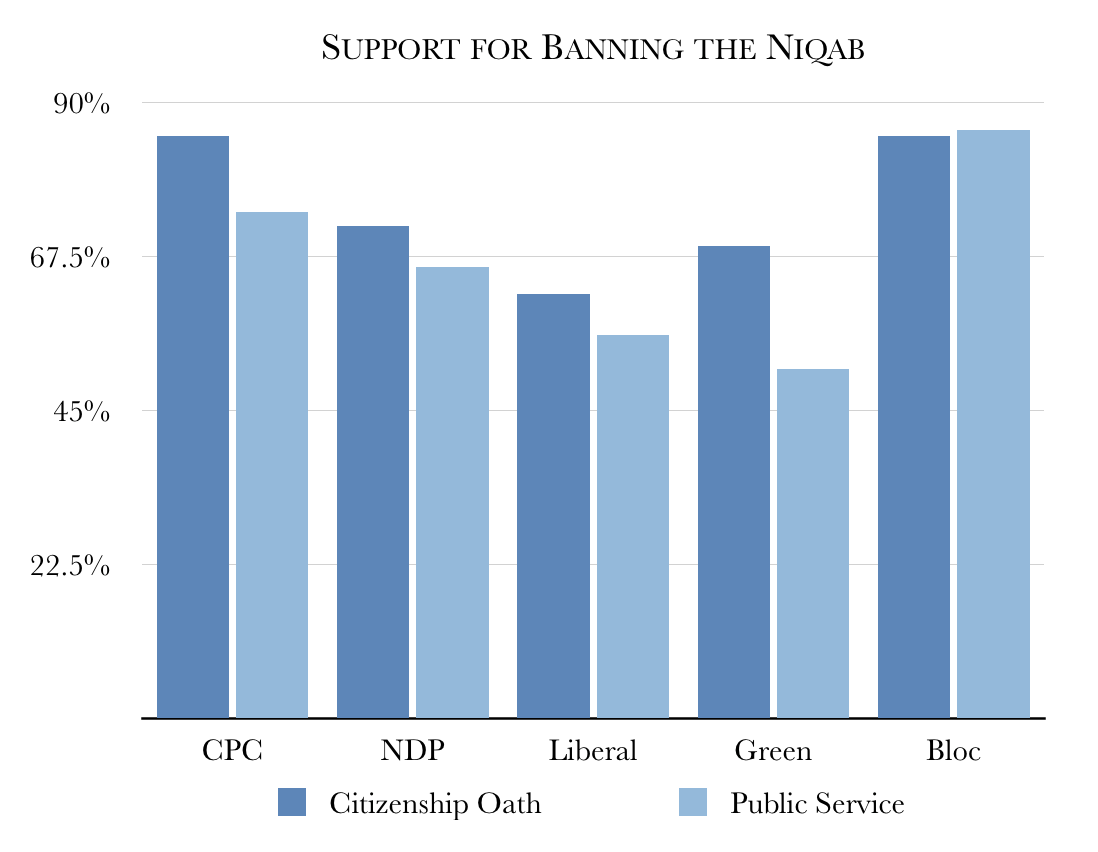
Interesting analysis by Daniel Robinson and Peter Loewen on the changing voting patterns of immigrant voters and the niqab, providing more analysis than in Doug Saunders synopsis (How Tories win immigrant votes using anti-immigrant messages). The chart above compares party supporter views:

On the citizenship oath measure, 72 per cent of Canadians agree. Just 14 per cent disagree. (Another 14 per cent either don’t know or are ambivalent.) This opinion is not isolated to “old stock” Canadians. Among those citizens born outside the country, 70 per cent agree with forcing women to reveal their faces.

… It is a similar story when we ask whether the public service should ban niqabs. Sixty-four per cent of people we surveyed support such a ban. Just 19 per cent oppose it. Support is undiminished among immigrants, where two-thirds (66 per cent) would support a ban and just 16 per cent would not. …

Some have noted that the niqab is an effective issue, not only because it garners wide support but also because it is largely irrelevant to voters. It is, at best, a useful distraction. But this misses something important about voters: they often take their cues from politicians about what is important. By the time we surveyed voters, the niqab had been a point of discussion for more than two weeks. When we asked our respondents how important the issue is to them, 78 per cent indicated that the niqab in citizenship ceremonies is a somewhat or very important issue. We got the same results when we asked about a niqab ban in the public service.

We now have a situation in which opinion-leaders – newspaper columnists, pundits, commentators – almost uniformly insist that a policy is both wrong and unimportant while voters disagree on both accounts.

Our data tell a broader story about multiculturalism and Tory support. Political scientists – especially André Blais and Richard Johnston – have long noted that the 20th century dominance of the Liberal party was attributable to outsized support among Catholics and visible minorities, perhaps especially immigrants (to the extent that those categories overlap). Consequently, the Tories have spent considerable effort courting various groups of immigrants to their party.

Data from both the 2011 Canadian Election Study and Ipsos-Reid’s massive 2011 exit survey suggest that the Tories may have finally closed this “immigrant gap” in the last election. Our data suggest that they have now not only closed the gap, but have created a significant advantage of their own among immigrant Canadians.

To test this, we calculated the odds of Canadians voting Conservative that controls for a respondent’s age, income, education and gender, province of residence and, importantly, religion.

The results, which draw on massive sample sizes, show that a native-born citizen has a 27 per cent likelihood of voting Conservative. The likelihood for an immigrant Canadian voting Conservative is 34 per cent.

Because we controlled for religious affiliation, we can also estimate these effects. Compared to the non-religious, Jews and non-Orthodox Christians have a greater likelihood of voting for the Conservative party. But among Muslim Canadians, there is a clear aversion to the Conservative Party of Canada.

The niqab has become a campaign issue in this election, and perhaps the issue. The are several reasons for this, but public opinion research points to one of the more important ones: given the consistent, widespread support across the political spectrum for the Conservatives’ stated position, the Tories can only stand to gain from the issue playing prominently in the public discourse.

Source: Loewen: Support for Conservatives’ niqab ban is deep and wide, even among immigrants | Ottawa Citizen