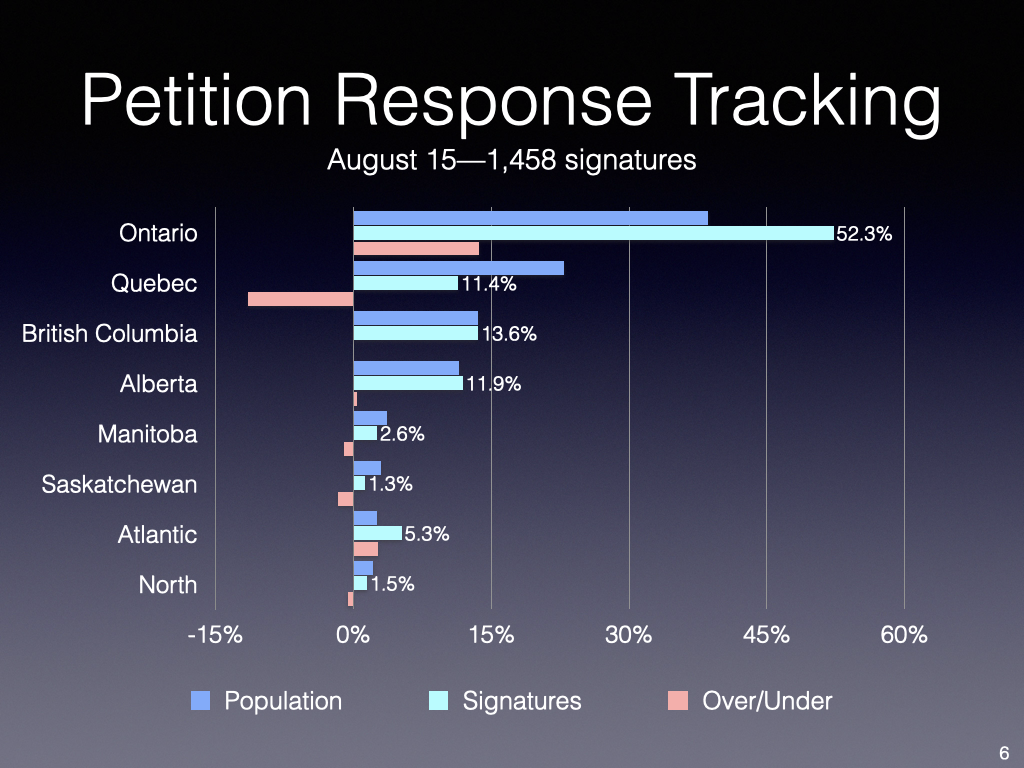
Petition e-4511 – Opposing self-affirmation of the #citizenship oath “citizenship on a click” – Signatures to August 15

The chart below breaks down the 1,458 signatures as of 15 August by province. No major changes by province as numbers plateau.

And if you haven’t yet considered signing the petition, the link is here: https://petitions.ourcommons.ca/en/Petition/Details?Petition=e-4511

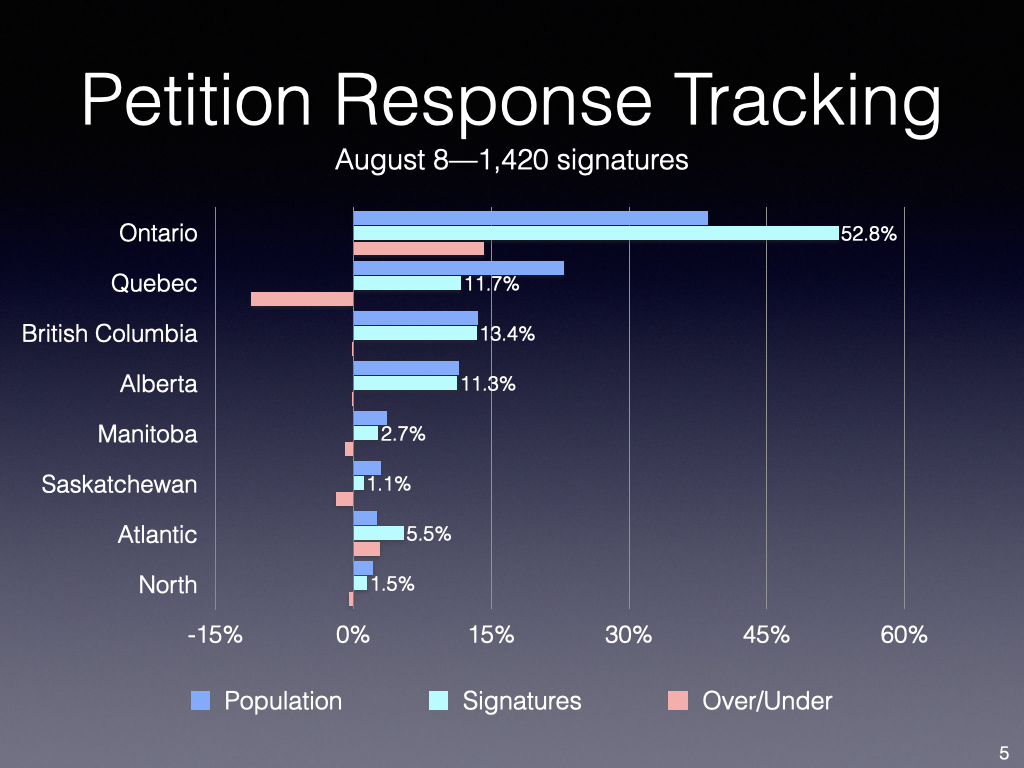
Petition e-4511 – Opposing self-affirmation of the #citizenship oath “citizenship on a click” – Signatures to August 8

The chart below breaks down the 1,420 signatures as of 8 August by province. No major changes by province although Nova Scotia had the highest weekly increase of over 100 percent.

And if you haven’t yet considered signing the petition, the link is here: https://petitions.ourcommons.ca/en/Petition/Details?Petition=e-4511

Urbaniak: Becoming a Canadian citizen should require a ceremony

Another good commentary on the need for ceremonies. New immigration minister Miller likes attending ceremonies so perhaps he can ensure that most new Canadians can as well:

Last week, the federal cabinet had a major shuffle.

The new ministers and the re-positioned ministers did not “self-administer” their oaths and declarations. They were not sitting by themselves in their living rooms with no one watching when they assumed their new roles.

On the contrary, they were expected to attend a ceremony.

The ritual, the formality and the gravity of the event at Rideau Hall – steeped in symbolism – signalled to the ministers and to everyone that ministerial appointments are important.

Well, becoming a Canadian citizen is very important. Canada is important.

Becoming a Canadian citizen merits a ceremony in most cases, not just in occasional cases by request.

The government of Canada is wrong to push self-administered, on-line oaths with no ceremony of any kind.

This policy was recently announced in the Canada Gazette, the official record of federal government notices and decisions.

Inspirational Canadian

In 2018, I came across the obituary of Kamal Akbarali. I was sad to see it. I had met Judge Akbarali several times as a high-school student in the 1990s.

Kamal Akbarali was a citizenship judge, and he performed the role very well. He was also an inspirational Canadian. He loved this country.

My fellow students and I had the pleasure of attending a few public citizenship ceremonies at which Judge Akbarali presided. We were the “audience.” We were there to welcome and acknowledge the new Canadians, our soon-to-be-fellow citizens. Some of them were our peers from school.

Judge Akbarali made an impression on me.

I remember being moved by what he said about his own journey. It sounded like the stories of my own grandparents, who found freedom and possibilities and affirmation in Canada.

Judge Akbarali came to Canada from Pakistan in 1965. At the ceremonies, he talked about how he got started in this country. He took on a career in finance and started a family.

Judge Akbarali talked about the plight of refugees, about democracy, about peace, about service to others, about respect for Indigenous Canadians and people from all over the world.

In other words, he talked about Canada and aspirations for Canada.

Although full of gratitude, he did not insist the country was perfect. In his view, a good citizen is compassionate, sometimes critical and always constructive.

As Judge Akbarali spoke, I could almost feel the beautiful vastness and diversity of the country. I felt hopeful and motivated.

After each ceremony, a beautiful cake would be rolled out so that we could celebrate our fellow Canadians. The new citizens had just gone through a life-changing, emotional event.

Bureaucratic efficiency?

The stated rationale for the move toward self-administered oaths is administrative efficiency – easing the backlog by “three months of processing time.” (The change, however, is slated to be permanent.)

There is essentially no acknowledgment of the value of civic symbolism, public celebration and instilling a sense of community by the act of officially gathering.

To clear backlogs, additional part-time officiants – respected citizens — could be brought on by Ottawa. They could help with processing. They could preside at ceremonies by request. (Nova Scotia recently did this with a successful recruitment push for part-time administrative justices of the peace for civil weddings. I happen to be one of them.)

What can we do now?

I believe this is a case where a personally addressed note, in your own words, to your member of parliament could have some impact.

A petition

Also, please check out the excellent petition by Andrew Griffith, a former senior public servant in the federal Department of Immigration, Refugees and Citizenship.

You can sign it electronically on the website of the House of Commons. It is labelled as petition e-4511.

The petition calls on the Minister of Immigration, Refugees and Citizenship to “abandon plans to permit self-administration of the citizenship oath.”

The petition also urges Ottawa to “revert to in-person ceremonies as the default, with virtual ceremonies limited to 10 per cent of all ceremonies.”

Griffith believes backlogs can be addressed by other efficiencies and by holding more ceremonies on evenings and weekends.

I concur. I hope the minister listens.

The minister’s name is Marc Miller, and he assumed his current role in a ceremony – the same one that was held at Rideau Hall last week.

Dr. Tom Urbaniak, professor of political science and director of the Tompkins Institute at Cape Breton University, is the author of six books. The most recent is “In the Public Square: A Citizen’s Reader.”

Source: URBANIAK: Becoming a Canadian citizen should require a ceremony

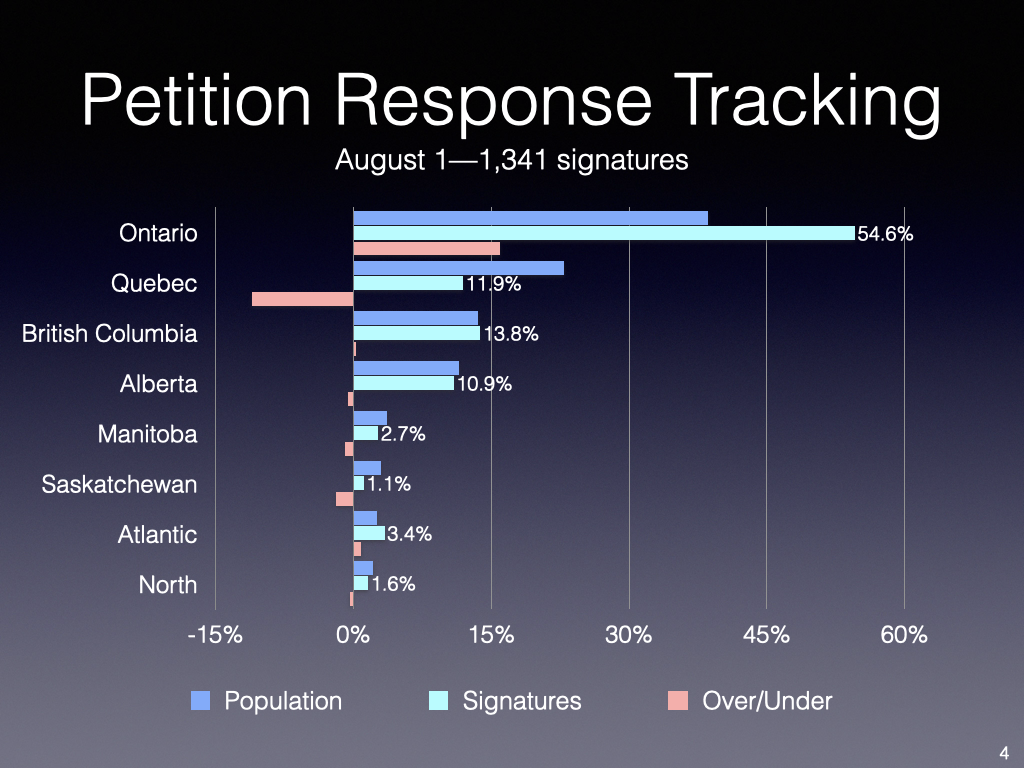
Petition e-4511 – Opposing self-affirmation of the #citizenship oath “citizenship on a click” – Signatures to August 1

The chart below breaks down the 1,341 signatures as of 1 August by province. While Ontario remains over-represented, this is gradually becoming less so. Quebec overtook Alberta this week and, if current trends continue, will approach or surpass British Columbia, thanks to my friend and partner on this petition, Richard Babczak.

And if you haven’t yet considered signing the petition, the link is here: https://petitions.ourcommons.ca/en/Petition/Details?Petition=e-4511

Ragbag: Did I just become a citizen of a country [USA] that doesn’t want me? [power of citizenship ceremonies]

Reminder of the various paths people take and the questions they have when taking up citizenship (likely more of an issue for those on the left who tend more to over-think). But a nice vignette on the USA citizenship ceremony and what it signified to those taking the oath.

While DG Citizenship and Multiculturalism, had an opportunity to witness a US citizenship ceremony; while different from the Canadian ceremony in some details, the overall message of inclusion and belonging was the same. Hard to imagine the USA doing away with the in person oath unlike the unthinking politicians and officials in Canada:

When the news that the Supreme Court had ruled in favor of doing away with race-conscious college admissions, I was on a plane, traveling to Texas to be sworn in as an American citizen. By the time we landed, my texts and social media feeds were consumed by the ruling. While other passengers hopped out of their seats to grab overhead bags, I sat stunned. Was I really going to go through with raising my right hand to swear that, should the law require it, I would bear arms to protect a country that keeps telling me it’s not sure if it wants to protect me? 

Let me back up. For the last 29 years, I’ve resided in the U.S. — as a student, an arts administrator, a curator, a writer, and most recently, a business owner. I’ve lived in New York, Boston, Philadelphia and Austin. I have been a permanent resident of the U.S. since 1994, but Montreal has always felt like home to me.

Some of my life’s biggest changes have happened during this time. I became a parent. I got married. (In that order.) I was quite comfortable with my permanent resident status — much like the comfort that comes with a non-committal relationship, which I know a lot about. But after nearly three decades, I am no longer comfortable not having a vote in the country where I am raising a child and growing a business. I’m no longer comfortable not having a say in how my body, my child, the people I work with, my friends, neighbors and family are cared for.

Why has it taken me nearly 30 years to make this decision? The most honest answer is that I don’t know if I feel safe here. Because I am a Black queer woman. Because I have been detained by U.S. Border Control. Because an immigration officer once told me that Americans lynch Canadians. Because guns. Because a growing scarcity mindset has made it harder for people to be kind to each other. But the decision to become an American citizen moves beyond me— anchored to the belief that after nearly three decades, it is my responsibility and privilege to shape a country for the people who I care for, and for those who care for me. This belief let me begin the citizenship process.

Along the way, my resolve in this belief would continue to be tested, along with my fears about living in this country.

* * *

Six months after completing an online questionnaire that asked questions like Have you EVER been a habitual drunkard? I was invited to an in-person interview. When the officer, seemingly making small talk, asked, “Aren’t you moving the wrong way? Do you not like free Canadian health care?”

A trap! I thought, laughing nervously. “Well, these things are complicated,” I said, trying my hand at witty banter. But he stayed quiet.

I aced my verbal exam by answering six questions in a row correctly. Some were easy: What is the ocean on the West Coast of the United States? Others were a little trickier: What is the supreme law of the land? And after I was asked —  twice— “If the law requires it, are you willing to bear arms on behalf of the United States?” I was invited to return the following week for a swearing-in ceremony. 

I flew back east to my husband and child who were visiting family in New Jersey, before returning to Texas by myself. While still on the plane, I learned of the Supreme Court’s decision to ignore the far-reaching impacts of systemic racism. The announcement continued to test my fears and my resolve. But I got off the plane to pick up a rental car to make the hour-and-a-half drive to San Antonio, where I would be sworn in.

My drive in the rental — a red pickup truck — gave me plenty of time to think about how I got to this point. I drove with the windows down. From time to time, I checked my rearview mirror.

* * *

My parents emigrated from Trinidad to Montreal in the 1960s. Because Trinidad was still a crown colony at the time, my father actually entered Canada on a British passport. As a child, the fact that my parents left where they were from, for somewhere new, was such a non-thing — in line with the experiences of many of my friends’ parents, who’d come from Italy, China, Ukraine, Portugal. (And that was just on our block.) I simply believed that moving away was something you do when you grow up. Even my name is evidence of the role moving away plays in my family’s history. Lise is a common French-Canadian — not French — name. And Ragbir is a common Indo-Caribbean — not Indian — name. Both names allude to the far-reaching and ongoing impact of colonialism as we give power to borders and trust a fiction that has shaped histories and lives.

“Hello everyone! Are you all ready to become American citizens today?”

In the 1980s, as Quebec politics increasingly shaped the provincial economy, my parents applied for Permanent Resident status in the U.S., in an effort to keep their options open. Like many West Indians, their siblings had dispersed across the globe, with many ending up in the U.S. — New York, specifically. Throughout grade school, I can’t remember a summer, Easter, or Canadian Thanksgiving when we didn’t pack the car to make the seven-hour drive from Sherbrooke Street to Flatbush Avenue via I-87.

In high school, I started making the trip without my parents, to visit cousins and see shows by artists like The Pharcyde, De La Soul and KRS One. As such, New York became the backdrop to my coming of age. New York wasn’t like Montreal. At parties in Brooklyn, I wasn’t the only Black person. Standing in line at Gloria’s roti shop, I wasn’t the only kid with Trini parents. So when my parents were approved for permanent resident status after waiting nearly 15 years, I jumped at the chance to move south. Within months, my parents let their status wane. They never took up residency and remain in Canada to this day.

* * *

On the drive from Austin to San Antonio, I saw a range of bumper stickers that continued to test my fear and resolve: “Country girls don’t retreat, they reload.” “Dump Joe and the Hoe.” “I’ll keep my guns, freedom, and money. You keep the change.”

My seatbelt felt tight as I drove.

In a strip mall in the San Antonio suburbs, people meandered through the parking lot of an immigration office carrying official-looking envelopes and little American flags. The majority of us in attendance were people of color, as were the immigration officers who were patient, and I daresay, joyful.

After being herded through a metal detector, I was asked to hand over my green card. “You’re taking it? Like, for good?”

“That’s right. You don’t need it anymore,” the officer said with a smile. I didn’t tell him I’ve been carrying my green card with me every day since 2015. Without it, I felt vulnerable, even as I made my way to the ceremony room.

Inside, nervous-looking people were taking selfies, or reading the letter from the President that we each found on our seats. I did neither.

I walked into the Texas heat carrying my little American flag. People looked at me as though I’d just won a prize.

“Hello everyone! Are you all ready to become American citizens today?” asked a cheerful man from the podium. He looked to be my age. Dark hair. Olive skin. He identified himself as a supervisor. The room full of people nodded as if on cue, and I felt like I was the only one having mixed feelings.

He ran through a list of dos and don’ts. (Do raise your right hand when told. Don’t record anything.) He’d obviously done this about a million times and clearly loved it. His enthusiasm was infectious.

He led us in a rehearsal of the oath. Then, perhaps sensing the collective anxiety, he coaxed a room full of about-to-be Americans into doing the wave, like we were at a baseball game or a Beyoncé concert. We had to do it twice because the first time we messed up. You know, nerves. But by the time we were done, everyone was laughing and smiling at each other and we felt like we were in this wild thing together. He didn’t miss a beat — he launched straight into the ceremony.

“Can you all please raise your right hand?” The words were a blur, but I said “I do” at the right time and the woman next to me bounced up and down, her blonde bob swinging above the straps on her summer dress. She went to hug me, but my face said, That was nice and all, but please don’t.

One by one our names were called to receive our naturalization certificate. When the supervisor handed me mine I thanked him and said, “You were really good. You made that so pleasant and easy. And you were just so kind.”

“Well, thank you,” he said. “I try.”

I walked into the Texas heat carrying my little American flag. People looked at me as though I’d just won a prize. I didn’t have the urge to hug strangers out of sheer joy, so part of me felt like a fraud. Another part of me, however, was proud —I’d moved through my fear to stand on this side. I did this thing that people have died for. I did this thing that gave me an extra coat of armor — for better or worse.

Around me, families cheered and cried and hugged and laughed. I choked down the knot in my throat and made my way through the crowded lot. In my truck, I locked the doors, placed my certificate and flag on the passenger seat and took a snapshot to send to family and friends, most of whom knew about my mixed feelings. One friend suggested I listen to Jimi Hendrix’s version of “The Star-Spangled Banner,” which I did, on repeat. The rendition is perfect dissonance: a balance of hope and frustration and beauty and pain. The certificate and flag sat in the passenger seat while I drove back to Austin.

* * *

I have always believed that my parents’ choice to leave the island of Trinidad for the island of Montreal had a very matter-of-fact, straightforward quality to it. And maybe it was that way for them. In fact, for millions of people, leaving where you’re from is what you do. In 2020, it was estimated that more than 280 million around the world left their place of birth — because it was expected of them, or it was necessary, or they had no choice.

But officially leaving wasn’t straightforward for me. The decision to become a U.S. citizen wasn’t like the decision my parents made. Yes, the world is different now. For one, Trinidadians no longer have automatic British passports like my father did. But change doesn’t end there.

In addition to the blow to Affirmative Action, in the same week, the Supreme Court shot down President Biden’s proposal to forgive student debt and ruled that businesses are allowed to discriminate against members of the LGBTQ community. In one week, we saw how much this country is changing — and how far we need to go.

In a recent conversation with my parents, my mother said that while she understands why I did it, she struggles with the idea that I became a citizen of a country where some of the laws seem unjust. My father, on the other hand, said that if he could, he would do exactly what I did. “I think the U.S. is through a rough time—maybe like growing pains—but they will get back

This is not an argument for, or against, becoming an American citizen. I know this is a privilege that many have lost their lives trying to attain.

He added that when he left Trinidad in the ’60s, he had initially planned to go back some day. “I didn’t want to stay in Canada,” he said. “For decades, Trinidad was my home. But now Montreal feels more like home.”

I wonder if the same thing will happen to me. Maybe, like him, it will take time.

Before I’m told to go back to where I came from, let me be clear: This is not an argument for, or against, becoming an American citizen. I know this is a privilege that many have lost their lives trying to attain. I know that my citizenship lets me move about the world with an ease unknown to billions of people. I know that legally, my citizenship lets me voice my opinion without risk. But with the Supreme Court rulings that we’ve seen in the last year, for someone like me — even with all the privilege that comes with being an American — the decision to dig deeper into this country is complex, even as I stand on this side of my fear, equipped with all the privileges that come with being an American.

When I got home, I read the letter from President Biden. In addition to acknowledging the courage it takes to start a life in a new country, the letter declares that America is a nation of possibilitiesand that the country has flourished because of immigrants.But I was most struck by this line: “Thank you for choosing us and for believing that America is worthy of your aspirations.”

Maybe one day the world won’t have borders, education will be available to everyone, and regardless of race, gender, sexual orientation, age or ability, we will all be treated equally. But until then, I raised my right hand and took an oath to protect this country because I want to believe that my voice will add to the chorus of change. Because I want to believe that as we move forward, we can all be protected. I don’t know how long this will take, or even if it’s possible. But as a new American citizen inspired by an immigration supervisor, I have to try.

Lise Ragbir writes about race, immigration, arts and culture, and relationships. She was born and raised in Montreal, Quebec, and now makes her home in Austin, Texas.
Source: Did I just become a citizen of a country that doesn’t want me?

Letters to Globe Editor on the Change to Self-Administered Citizenship Oath

Of note, letters in response to the Globe’s excellent editorial, What we all lose when we lose the citizenship ceremony. Opportunity for Minister Miller to make his mark and reverse this counter-productive proposal:

Stand on guard

Re “Citizenship is about more than just a click, a ceremony or an oath” (July 21): As is often the case, the bottom line is an influential factor for discouraging prospective Canadian citizens from having in-person swearing-in ceremonies, although the government prefers to highlight the speeding up of the procedure.

The government also wants to spare employees from having to take unpaid leave to attend. This should not be an issue. If voters in a national election are allotted three paid hours to do their duty, the same should be the law for citizenship ceremonies.

How underwhelming to sit at one’s computer, alone, after all the work entailed to pass the test, no one with whom to celebrate. Where is the government’s sense of occasion?

Ann Sullivan Peterborough, Ont.


I am appalled by the idea that our citizenship ceremonies should be reduced to a click on one’s computer.

I became a citizen at the age of 26. It was a proud event. I was born in a country where such things are important and respected, just like the flag.

There, the flag was treated with great respect and only hoisted for special days or events, then taken down at sundown. It really bothers me to see a row of faded Canadian flags at a car lot, a car with two flags to protest whatever or a homeowner proudly hoisting a flag, but only to see it faded and torn years later.

Another national symbol going down the drain. I am a proud Canadian. It hurts.

Vince Devries Ladysmith, B.C.


I became a naturalized Canadian many decades ago.

Because I was already a British subject, I swore an oath in a bureaucrat’s office, signed documents and I was done. As time went on and I attended friends’ public ceremonies, I developed a strong feeling of having been shorted.

A public ceremony, I think, would have made me feel more Canadian more quickly.

R. A. Halliday Saskatoon


My memory worsens by the day. But, although it happened decades ago, I will never forget my citizenship ceremony.

I recall the interesting mix of people who were there that sunny day in Vancouver. There was the smile and raised eyebrow of the citizenship judge when, feeling flustered, I told her that Canada Day was July 4. Immediately knowing my mistake, I said sorry. I became a Canadian.

As a retired university teacher, I know that nothing compares with the in-person experience. If that is true for birthdays and weddings, it is equally true for the life-changing event of becoming a citizen.

Richard Harris Hamilton


I arrived in Canada in 1968. Immediately after the required five years of residency, I applied for citizenship.

I remember my ceremony well. In those days, we were each given a Bible on which to swear allegiance to the Queen. It was the New Testament, and being Jewish I was not able to swear on it.

I asked if there was an Old Testament, and there began a good deal of searching. I was about to stop them, I would just affirm, but then a copy was placed into my hands.

With great pride and a swelled heart, I pledged my fealty to my new country and liege.

Michael Gilbert Toronto

Source: Trudeau’s cabinet shuffle plus other letters, July 28

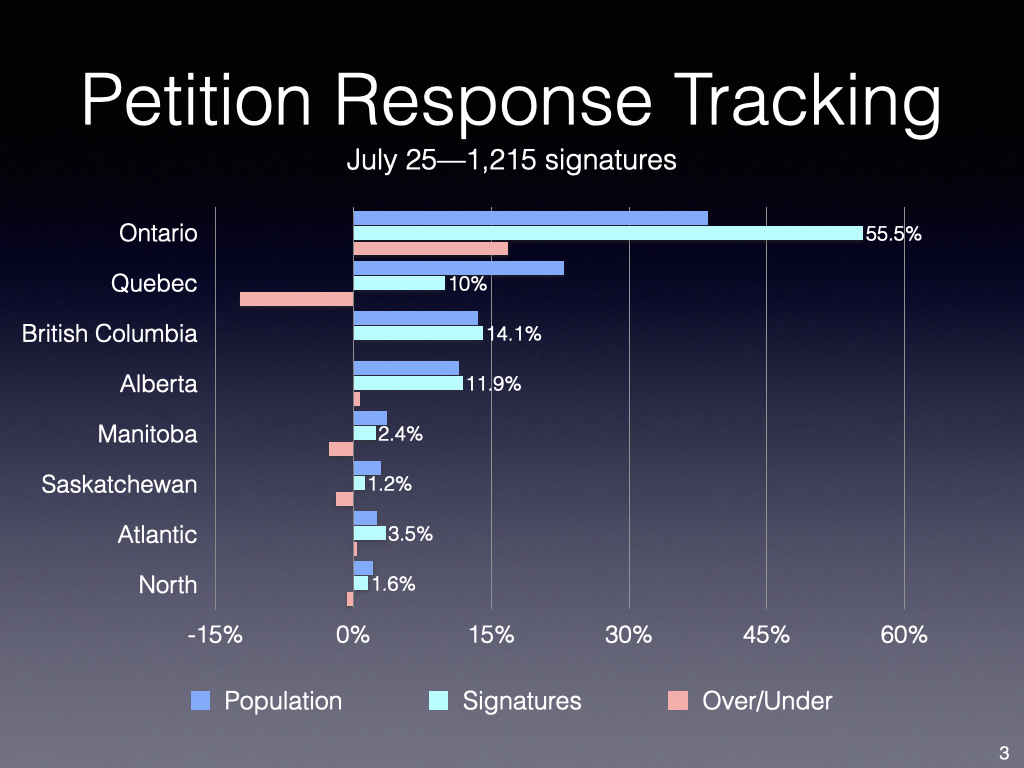
Petition e-4511 – Opposing self-affirmation of the #citizenship oath “citizenship on a click” – Signatures to July 25

The chart below breaks down the 1,215 signatures as of 25 July by province, highlighting Ontario over representation and Quebec under representation. British Columbia and Alberta in line with their share of the population but Manitoba and Saskatchewan under represented. No major change in regional breakdown since last week.

To date, the petition has received good media coverage, one of its objectives:

Why Canada’s ‘citizenship on a click’ is proving controversial

John Ivison: The Liberals are too eager to erode the singular power of the citizenship oath

Globe editorial: What we all lose when we lose the citizenship ceremony

Yakabuski: Cliquer pour devenir Canadien

Griffith wants in-person citizenship oath

And a contrarian perspective by Themrise Khan:

Citizenship is about more than just a click, a ceremony or an oath

And if you haven’t yet considered signing the petition, the link is here: https://petitions.ourcommons.ca/en/Petition/Details?Petition=e-4511

What we all lose when we lose the citizenship ceremony

Couldn’t have said it better myself.

Timing is interesting, one day after Themrise Khan’s op-ed dismissing the ceremony and oath, almost being used as a foil for this editorial:

The federal government will at some point this year allow new citizens to skip the ritual of mass swearing-in ceremonies and instead let them take the citizenship oath alone at home, on a secure website, with no authorized individual overseeing them, simply by ticking a box on their computer screen.

It’s a move Ottawa says will help eliminate a backlog of 358,000 citizenship applications (as of last October), reduce by three months a processing time that can stretch two years – double the published service standard – and spare low-income working people the difficulty of taking an unpaid day off in order to be present at a ceremony.

It’s part of a broader government effort to accommodate a surge in citizenship applications. In a fractious world, a Canadian passport is increasingly desirable. Ottawa says applications more than doubled between fiscal 2017 and fiscal 2022, rising to 243,000 from 113,000.

With immigration surging under the Trudeau government to as high as 500,000 people a year, the demand is only going to keep growing. Immigration, Refugees and Citizenship Canada is hoping to process 300,000 citizenship applications this fiscal year, a 34 per-cent increase over the previous year.

To do that, it has already moved the application process online. And it has made the oath of citizenship an almost entirely virtual experience. Of 15,457 swearing-in ceremonies involving 549,290 applicants since April, 2020, Ottawa says 15,290 were video calls.

And now the government wants to go one step farther and reduce the final step to becoming a Canadian – taking the oath of citizenship – to something akin to agreeing to the terms of service on a smartphone app.

That’s one step too far. While it is obvious that the case can be made to allow some applicants in urgent circumstances to take the oath online, gaining Canadian citizenship is too important to be voided of all ceremony for the sake of convenience.

Ceremonies and rituals matter. They unite communities around various milestones – momentous days on the calendar, births, graduations, marriages, anniversaries and deaths – and in doing so reinforce shared values.

The moment of becoming a new citizen is among those milestones. Arguably, gathering to mark it is as important as the taking of the citizenship oath itself.

For new Canadians, the ceremony signals the end of a long and at times arduous journey from emigration to permanent residency to taking the citizenship test to becoming a full citizen. It’s a chance to celebrate with friends and family. Many who’ve been through it will tell you how much it meant to them to sing the national anthem as a citizen for the first time, in a room surrounded by others like them.

The ceremony is just as important for the host country. An in-person ceremony is a chance for the federal government to show its appreciation for the people who’ve chosen Canada. It also serves as palpable recognition of the immense value that immigration holds for this country, and signals to those already here how welcome the newcomers are.

Above all, the in-person nature of the ceremony reinforces the idea of Canada as a community of people who share the same values – something that won’t happen in the cold isolation of the internet.

Ottawa absurdly hopes that its proposal will reduce the demand for in-person and online ceremonies (which will still be optional), and thereby save it a few dollars.

That is a robotic, unthinking cost-benefit analysis. So is Ottawa’s argument that its plan will cut a few months off the waiting time for taking the oath.

If Ottawa wants to speed up the citizenship process, it should find ways of doing it without eliminating the citizenship ceremony. It is trying to save a small amount of money at the expense of a critical moment of human connection.

Ottawa should instead limit the click-here-to-officially-become-a-Canadian option to specific exceptions. The same goes for the online video option. The government needs to get citizenship judges out of their basements and bring back the in-person ceremony for the vast majority of cases.

Canadian citizenship is precious. So is the willingness of people to seek it out.

These are things that deserve a sense of ceremony and grandeur. They should not be reduced to the equivalent of checking a box to add fries to your order.

Source: What we all lose when we lose the citizenship ceremony

Yakabuski: Cliquer pour devenir Canadien

Good column in Le Devoir (only commentary to date in French media that I have seen):

La fête du Canada ne se déroule pas de la même façon partout au pays. À l’extérieur du Québec, dans la plupart des communautés, les cérémonies de prestation du serment de citoyenneté sont organisées dans le cadre des célébrations locales planifiées pour accueillir des immigrants récents dans la grande famille canadienne. Ces cérémonies, remplies d’émotion et de patriotisme, servent à rappeler aux natifs du Canada la chance qu’ils ont d’être nés ici. Certes, des cérémonies de prestation ont aussi lieu au Québec. Mais elles sont rarement aussi médiatisées que dans le reste du Canada, où les journaux et les bulletins de nouvelles télévisés en parlent abondamment.

Beaucoup d’experts en immigration considèrent que la cérémonie de prestation du serment constitue une étape indispensable dans la formation de tout bon citoyen et dans la création, chez ces nouveaux venus, d’un sentiment d’appartenance au Canada. En 2021, le serment a été modifié afin d’inclure une obligation de la part des nouveaux citoyens de reconnaître et de respecter les droits ancestraux issus des traités signés avec les peuples autochtones, en conformité avec l’une des recommandations de la Commission de vérité et réconciliation. « Le serment de citoyenneté du Canada est un engagement envers ce pays — et cela comprend le projet national de réconciliation », avait expliqué le ministre de l’Immigration de l’époque, Marco Mendicino.

Les nouveaux Canadiens doivent aussi jurer d’être fidèles au roi Charles III. Contrairement à l’Australie, qui a modifié son serment de citoyenneté en 1994 pour enlever toute référence à la Couronne britannique, le Canada continue d’exiger que les nouveaux venus promettent d’être loyaux au locataire du palais de Buckingham. En 2015, la Cour suprême du Canada a refusé d’entendre l’appel de trois résidents permanents qui avaient prétendu que l’obligation de prêter serment au monarque violait leurs droits à la liberté d’expression et de religion. Ils avaient été déboutés devant la Cour d’appel de l’Ontario, qui avait déclaré que la référence au monarque était purement « symbolique », celle-ci évoquant notre « forme de gouvernement et le principe non écrit de démocratie » qu’il sous-tend.

Or, voilà qu’Ottawa s’apprête à permettre aux résidents permanents de prêter leur serment de citoyenneté en cliquant simplement sur une case en ligne sur le site Web d’Immigration, Réfugiés et Citoyenneté Canada (IRCC). Plus besoin de prononcer le serment à voix haute devant un juge. Cliquez ici, et vous deviendrez Canadien.

La proposition, dont on n’a presque pas parlé au Québec, a créé un tollé ailleurs au Canada. « L’idée selon laquelle le Canada, qui est peut-être le pays au monde ayant eu le plus de succès en matière d’immigration, pourrait recourir à un moyen automatisé pour dire “vous êtes maintenant citoyen” est odieuse », a déclaré plus tôt cette année l’ancienne gouverneure générale du Canada Adrienne Clarkson, elle-même arrivée au pays comme réfugiée en 1942. L’ancien maire de Calgary Naheed Nenshi, fils d’immigrants musulmans d’origine tanzanienne, tout comme l’ancien ministre libéral de l’Immigration Sergio Marchi, né en Argentine, ont dénoncé publiquement la démarche d’Ottawa.

Andrew Griffith, un ancien haut fonctionnaire à IRCC, a même lancé une pétition — parrainée par le député conservateur Tom Kmiec, lui-même immigrant polonais — qui somme le gouvernement de Justin Trudeau de « renoncer à permettre l’auto-administration du serment de citoyenneté » ainsi que de « rétablir la primauté des cérémonies en personne et de réduire à 10 % la proportion de cérémonies virtuelles ». Ces dernières ont pris leur envol durant la pandémie. Mais certains experts, comme M. Griffith, croient qu’elles ne devraient se substituer aux cérémonies en personne qu’en cas d’exception.

La continuation postpandémie des cérémonies virtuelles tout comme la proposition de permettre l’auto-administration du serment sont des réponses aux arriérés à IRCC. Le ministère n’arrive plus à traiter les demandes d’immigration et de citoyenneté dans des délais raisonnables. Des résidents permanents approuvés pour devenir citoyens doivent attendre environ 19 mois avant d’être convoqués à une cérémonie de citoyenneté.

Le ministre de l’Immigration, Sean Fraser, vise à réduire l’attente en autorisant l’option de l’auto-administration. Mais M. Griffith se demande si une partie du problème ne découle pas du fait que les seuils d’immigration sont déjà trop élevés pour l’appareil gouvernemental. Plus de 1,2 million de nouveaux résidents permanents sont arrivés depuis trois ans, alors qu’Ottawa cherche à hausser le seuil annuel à 500 000 ou plus dès 2025. Si la plupart de ces nouveaux résidents permanents ont pour objectif de devenir des citoyens canadiens, l’auto-administration du serment deviendra incontournable. IRCC peine déjà à répondre à la demande. Imaginez ce que sera la situation dans cinq ans.

Ce n’est là qu’une des raisons pour lesquelles la politique d’immigration du gouvernement semble déconnectée de la réalité. Dans une étude publiée cette semaine, l’économiste chez Desjardins Randall Bartlett avance qu’il faudra encore plus d’immigrants pour contrer les effets du vieillissement de la population canadienne dans les années à venir. Mais il ajoute un gros bémol. « Comme la croissance démographique continue de faire grimper les prix des maisons et de miner l’abordabilité à court terme, le gouvernement fédéral doit tenir compte de cette situation dans sa politique d’immigration, en particulier en ce qui concerne les résidents non permanents. Sa politique d’immigration doit s’accompagner d’actions immédiates pour augmenter l’offre de logements. » Or, rien n’indique qu’Ottawa s’apprête à agir en ce sens.


Après tout, on ne peut pas construire des maisons en un clic.

Source: Cliquer pour devenir Canadien

Khan: Citizenship is about more than just a click, a ceremony or an oath

An activist, linking citizenship to her “white saviour complex” perspective or ideology, largely disconnected from how the vast majority of immigrants feel about the ceremony who consider it a celebration, not just a “mandatory administrative task.”

Her reasoning essentially extends the government’s proposals to its logical conclusive, purely an administrative procedure to provide security and facilitate travel, with no impact on inclusion and sense of belonging. While anecdotes and the imperfect evidence we have suggests the opposite.

On the oath, of course, she has a point.

One of the better reader views in the comment section:

Can a feeling of national belonging be delivered with just a click of a mouse? That’s the question at the heart of the controversy around Immigration, Refugees and Citizenship Canada’s plan to allow new citizens to tick a box online rather than take a verbal or in-person oath. The aim, the government says, is to reduce the backlog and simplify processing.

But a former senior immigration official has presented a petition to the minister, calling for Ottawa to revert to in-person citizenship ceremonies as the default, arguing that they “provide a unique celebratory moment for new and existing Canadians.” The more than 1,000 signatories worry that one-click citizenship will undermine new Canadians’ sense of belonging, as in-person ceremonies are meant “to enhance the meaning of citizenship as a unifying bond for Canadians.”

I too was excited for my own citizenship ceremony, having seen many colourful and happy pictures of Mounties, members of Parliament and a burst of Canadian flags before my day arrived. The reality, though, was underwhelming: an assembly-line process and a boring speech in a staid government building, followed by an oath to a monarch, before we were rushed out so the next batch of new Canadians could be shepherded in. There were no Mounties or MPs, as is the case with the majority of such ceremonies, making it less celebratory and more administrative.

I felt greater elation when I finally held my passport in my hands. The Ethiopian guard at the passport office gave me a knowing smile as he saw me holding back my tears. I’ll always remember that smile. The ceremony, not so much.

But both approaches – the “one-click” and the in-person – are problematic in the context of today’s immigration regimes. One reason is that these “ceremonies” often feel like expressions of a white-saviour complex, by which all systems in former colonial countries – even ones that have become more diverse, like Canada – are influenced by their white colonizer origins: it is the white-saviour host that decides who gets in, when and how. In a postcolonial world, the assumption within the host society is still that anyone seeking a new life here will be “saved”, but only if it deems it appropriate. This attitude is more about making the host country feel good, than it is about the significant sacrifices that immigrants must make in creating a new life for themselves.

We should celebrate the culmination of what is often a hard journey from permanent residency to citizenship. But when the celebration denies the daily reality of the lives of racialized Canadians and the discrimination they face, an hour-long state-sponsored festivity is hardly a solace in the long run.

The oath is also controversial. Much has been said about how it reaffirms a monarchy that engaged in destructive colonial practices in Canada and around the world. Many Canadian immigrants come from such former colonies. Why should they have to profess loyalty to Britain’s hereditary leaders?

And the notion of belonging that is at the core of citizenship means different things to different people. What those objecting to the one-click approach may not realize is that immigrants have to take the oath to receive our passports. As such, it doesn’t feel like a celebration – it feels like a mandatory administrative task. That the government is suggesting digitizing the oath also confirms this; that approach may help simplify IRCCs bureaucratic complexities, but why even include it, if its value is largely superficial?

Canada’s immigration policies, procedures and practices are hardly perfect; they have faced flack for their modern-day inefficiencies, historical discrimination and the department’s self-admitted racial bias. While Ukrainian refugees have been able to enter Canada quickly, with a fast-track for citizenship, the same cannot be said for Afghans, Syrians or Haitians also fleeing conflict, but made to wait in life-threatening circumstances, or left without any shelter or support on the streets of Canada. In this context, it feels almost impossible to celebrate.

There is actually no need for a ceremony, or even a symbolic oath of citizenship, verbally or through a click; we become citizens once we have cleared the highly cumbersome administrative process. By that point, new Canadians have paid their dues, with interest, to prove we belong in this country, and most of us do it with genuine respect because we see Canada as our home. Celebrating that sacrifice and achievement doesn’t happen in a citizenship ceremony or with an oath. Instead, it would be more worthwhile to focus on a more pragmatic, inclusive and equitable approach to immigration in Canada.

Themrise Khan is an independent policy researcher in global development and migration, and the co-editor of White Saviorism in International Development. Theories, Practices and Lived Experiences.

Source: Khan: Citizenship is about more than just a click, a ceremony or an oath