Skuterud: The Growing Data Gap on Canada’s Temporary Resident Workforce

Useful recommendations:

Statistics Canada’s Labour Force Survey (LFS) underestimates the rapidly growing non-permanent resident (NPR) population. This undercount potentially distorts important economic indicators, such as nominal wage growth and unemployment rates, because NPRs disproportionately influence these measures as a growing share of new labour market entrants.

To address this data gap, this E-Brief recommends revising the LFS to better identify NPRs by including specific questions about study or work permits and exploring the possibility of linking survey data to immigration records for improved accuracy.

Introduction

Canada has experienced a dramatic increase in its non-permanent resident (NPR) population in recent years. Before 2020, NPRs never comprised more than 3 percent of Canada’s population. As of October 2024, they comprised 7.4 percent of the population. While initial concerns over runaway NPR population growth were focused on overheating housing markets, by mid-2024, worries turned to the contribution of NPRs – particularly international students – to rising youth unemployment rates.

Evaluating the labour market impacts of Canada’s growing NPR population requires timely, high-quality data on Canada’s labour force. It is well known that Statistics Canada struggles to sample NPRs, in part due to challenges related to how Statistics Canada’s Labour Force Survey (LFS) sampling frame is constructed. The LFS samples dwellings, not individuals, and gathers data on all persons usually living at the sampled address, including NPRs. There may be ambiguity about whether the address where NPRs are sampled is their usual residence, resulting in their exclusion from the survey.1 Skuterud (2023) highlighted a significant and widening discrepancy between the share of NPRs in Canada’s labour force estimated using the LFS and administrative data from Immigration, Refugees and Citizenship Canada (IRCC).2 With continued growth in the NPR population since 2023, there is reason to believe this discrepancy has grown.

Why does this matter? The accuracy of the LFS’s estimates of nominal wage growth and unemployment rates are critical in informing the Bank of Canada’s monetary policy decisions and collective bargaining negotiations across the country. As IRCC introduces policies to rein in NPR entries, understanding whether international students are, in fact, crowding out and suppressing the wages of existing residents is essential.

This E-Brief examines the impact of Canada’s surging NPR population on the quality of the LFS data by comparing the LFS’s population estimates with official population estimates from Statistics Canada’s Centre for Demography. The results reveal a substantial and growing divergence in official and LFS population estimates starting in 2021. While it is unclear to what extent this is affecting estimates of wage growth and unemployment, the growing discrepancies suggest there is reason for concern…

Source: The Growing Data Gap on Canada’s Temporary Resident Workforce
CIBC Tal on NPRs: Short-term pain, long-term gain

Interesting take and does have provide a logic for regularization. But the devil will be in the details: “If as a society we manage to create the conditions for better integration of NPRs in the labour market over time, we should be able to reverse the negative trajectory in productivity growth of the past few years.”

àWhat conditions, how to establish, how to enforce:

…Due to the recent government response, the pace of NPR arrivals is expected to slow down notably in the coming years, although not by as much as predicted by official numbers. For reasons we have spelled out elsewhere, policymakers and analysts cannot assume that the over one million current temporary residents in Canada with expired visas will simply leave the country over the next two years.

In other words, the demographic change of the past few years is not about to reverse. Economic theory and common sense suggest that that is a good thing. After all, an aging population is viewed as a major drag on productivity in most OECD countries. The youth dividend enjoyed by Canada is unique. Yes, clearly it has been too much of a good thing in a very short period of time.

But from a longer-term perspective, retaining and integrating current immigrants and NPRs would result in stronger potential growth and improved productivity, as more new arrivals find employment closer to their skill level or add to their skillset. If as a society we manage to create the conditions for better integration of NPRs in the labour market over time, we should be able to reverse the negative trajectory in productivity growth of the past few years.

Source: NPRs: Short-term pain, long-term gain

Misleading Canadians: The Flawed Assumption Behind the Government’s Planned Reduction in Temporary Residents

This analysis was prompted by questions regarding the projected numbers of departures with no methodology mentioned, and the suspicion, subsequently confirmed, that it was based on the false assumption that all temporary residents would leave upon expiry of their visa

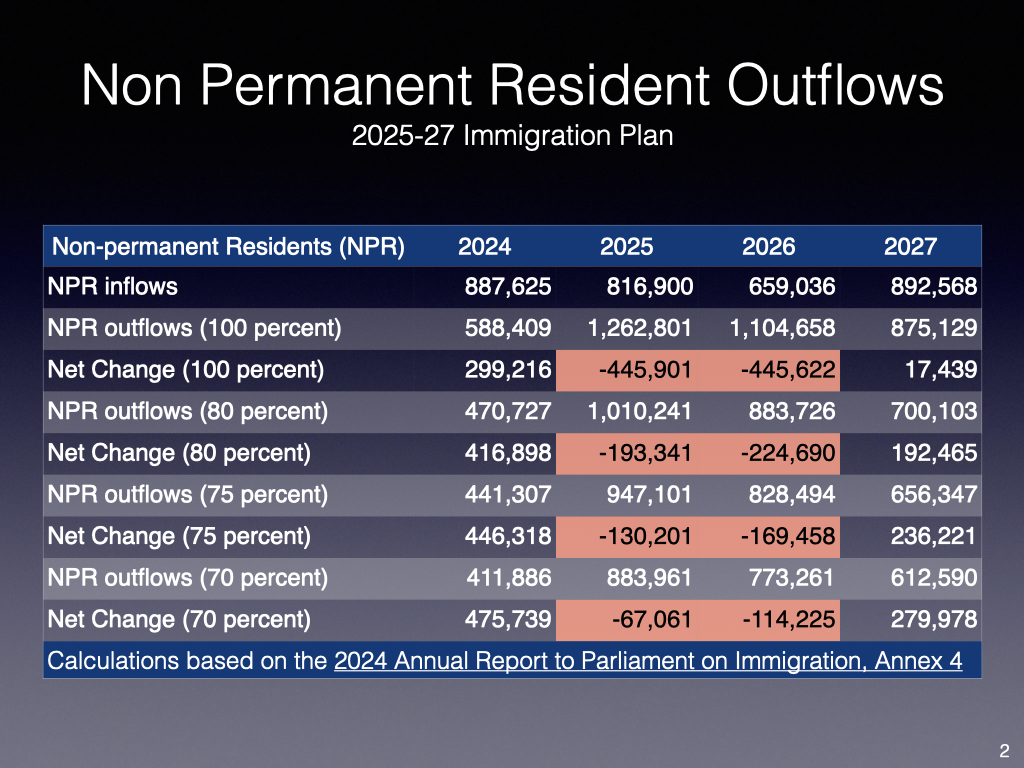
When IRCC released its annual immigration plan last month, eyebrows were raised over the plan’s prediction of large outflows of temporary residents upon expiry of their visas. The Parliamentary Budget Office noted that “there is significant risk to the demographic projection presented in the Government’s new immigration plan—particularly to the projected outflow of non-permanent residents.” The plan included a table covering projected outflows without indicating the methodology and assumptions behind the table. Subsequently, IRCC has confirmed that the calculations assumed that all temporary residents would leave when their visa expired, save for those who transitioned to permanent residency.

This assumption is just wrong as many temporary residents may well remain in Canada and appears aimed at misleading the public. For illustrative purposes, I revised the plan table to include four assumptions: 100 percent of temporary residents leave (the plan’s assumption), and three alternatives where 80, 75 and 70 percent leave. Should 60 percent or less leave, there would not be any net reduction in the temporary resident population.

The overly precise nature of the numbers—down to individual persons—highlights that the government adapted a purely mathematical approach in its estimates. In the case of permanent resident levels, the government more sensibly uses ranges rather than precise numbers which reflect more accurately operational realities. While politically difficult to admit that some non permanent residents will remain, by not doing so the government attracts more scepticism regarding its plans.

Moreover, as Canada does not track outflows systematically, we will not have accurate data on how many actually leave. The government should explore coordination of flight and CBSA data to obtain better anonymized information on outflows and those who overstay their visa.

The Prime Minister has stated that “Between the amount of people coming and going, we’ll effectively pause population growth for the next two years, then from 2027 onwards, it will balance out and slowly start increasing again at a sustainable pace.” However, this is based on the false assumption that all temporary residents will leave when their visa expires. Unfortunately, as we will not know how many people will stay versus how many people will leave, it will not be possible to verify the extent of errors and estimates.

In short, while inclusion of temporary residents in the annual immigration plan is both overdue and welcome, a more serious approach is needed that better reflects the reality and challenges.