The niqab ban: 2011-2015 – The new Liberal government officially puts an end to the former Conservative government’s attempt to ban the niqab during the citizenship oath

RIP:

The niqab’s emergence as an election issue was unexpected and odd, but perhaps fated–a consequence of the Conservative government’s own policy, its determination to defend the policy in court and the whim of the Federal Court of Appeal’s calendar.

Though seemingly popular, the ban on the niqab is now linked with the Conservative government’s defeat. “Voters—including many who supported him—were personally offended by Harper’s blatant effort to exploit the niqab issue as a divisive wedge in the campaign,” Ensight reported after the election. As a result of that defeat, history will record Bill C-75, an attempt to put the ban into law, as the last piece of legislation tabled in the House of Commons by the Conservative government—its tabling coming just hours before the House adjourned for the last time before the election, an entirely symbolic gesture of pre-campaign posturing. Both the sponsor of the bill, Chris Alexander, and the minister who tabled the bill on his behalf, Tim Uppal, were subsequently defeated on October 19.

The Liberal government’s decision to abandon its predecessor’s legal appeal does not seem to have roused much, if any, condemnation from Conservatives.

Source: The niqab ban: 2011-2015 – Macleans.ca

The formal press release:

“On November 16, 2015, the Attorney General of Canada notified the Supreme Court of Canada that it has discontinued its application for leave to appeal in the case of Minister of Citizenship and Immigration v. Ishaq. The Federal Court of Canada found that the policy requiring women who wear the niqab to unveil themselves to take the Oath of Citizenship is unlawful on administrative law grounds, and the Federal Court of Appeal upheld this ruling. The government respects the decision of both courts and will not seek further appeal to the Supreme Court of Canada.

“Canada’s diversity is among its greatest strengths, and today we have ensured that successful citizenship candidates continue to be included in the Canadian family. We are a strong and united country because of, not in spite of, our differences.”

Earlier language by then Minister of Defence (and Multiculturalism) Jason Kenney:

“At that one very public moment of a public declaration of one’s loyalty to one’s fellow citizens and country, one should do so openly, proudly, publicly without one’s face hidden,” Conservative Jason Kenney told reporters in Calgary Wednesday.

“The vast majority of Canadians agree with us and that is why we will be appealing this ruling.” (September 15, 2015)
Source: Statement from the Minister of Immigration, Refugees and Citizenship and the Minister of Justice – Canada News Centre

Lawyer in niqab case says Canada must confront anti-Muslim sentiment

Good profile of Lorne Waldman, the lawyer for Zunera Ishaq (and a number of other immigration and refugee cases that went against the Conservative government):

For Mr. Waldman, who unexpectedly found himself and his clients at the centre of the election, the e-mail itself was a tipping point: Even though the niqab controversy ended with the victory of Justin Trudeau, who opposed the ban, an undercurrent of anti-Muslim feeling remains, and needs to be confronted.

“I see the seeds of a huge problem that we in Canada have been able to avoid for many years – some of the worst aspects of the anti-immigrant sentiment that’s existed in Europe,” he said in an interview. “And we avoided it for a long time because we had responsible leaders who didn’t try to stir the pot. All we need is another election where someone else chooses to use these types of wedge issues.”

If it was a very good election for the Liberals, it was a strangely eventful one for Mr. Waldman, even by his own busy standards. He represented Zunera Ishaq, a Pakistani immigrant who successfully fought a Conservative ban on wearing a niqab during the citizenship oath. The niqab became a major election issue. He also represented a Canadian-born convicted terrorist facing the loss of his citizenship; the government’s fight against terrorism was another big election issue. And he was a spokesman for a national refugee lawyers’ group on the Syrian refugee crisis – a third key issue – urging that the government speed up the process by emphasizing the reunification of families.

“I’ve never had an experience like this,” said the 63-year-old father of three, who runs an 11-lawyer firm that includes his daughter. “I’ve done lots of high-profile cases but my God …”

The end of the election may have brought him a respite. Getting tough on refugee claimants perceived to be taking advantage of Canada’s laws and social supports was, like crime and terrorism, a major focus for the Conservatives. Last year, Mr. Waldman won a case against the government’s cuts to refugee health care; a Federal Court judge called them “cruel and unusual treatment.” Shortly after the election, the government’s appeal was adjourned. He doesn’t expect the Liberal government to fight the Federal Court ruling.

… Many of his friends, acquaintances and fellow lawyers also opposed his stand on the niqab. Even his sister and mentor, Ontario Family Court Judge Geraldine Waldman, who died of brain cancer on the same day he received the e-mail, disagreed with his stand.

“The last real conversation I had with her about anything political was about the niqab. She was a diehard feminist. She opened the first all-female law practice in Ontario in the seventies with Harriet Sachs, Lynn King and Mary Cornish. She couldn’t get around the niqab.”

Standing up for the niqab surprised even him.

“It was a bit strange, to be honest, to defend the right of a woman to wear the niqab. It’s not one of the things to have high on my list of rights that I would defend. But it had nothing to do with the niqab. It was defending the right of Canadians to express themselves as they saw fit. It was also opposing an abuse of power by the minister who clearly was acting illegally when he issued this policy statement.” (Both the Federal Court and the Federal Court of Appeal pointed to the wording of the Citizenship Act, which says only cabinet can make changes to the citizenship ceremony. Mr. Kenney had simply issued a directive banning the niqab.)

Mr. Waldman comes from a refugee background – two grandparents came to Canada to escape Russian pogroms in the early 1900s. He says he became a refugee lawyer in response to the Jewish experience with anti-Semitism and the Holocaust, which he called “my defining thing.”

“We have pictures at home of all my mother’s uncles and aunts. On my mother’s side there were at least 12 or 13 uncles and aunts. They all had kids and the kids were married, and so we’re talking about probably 80 or 90 people – three survived.”

Source: Lawyer in niqab case says Canada must confront anti-Muslim sentiment – The Globe and Mail

Robyn Urback and Barbara Kay on the backfiring of wedge politics

Two contrasting views in the details (niqab or snitch line), starting with Robyn Urback on the niqab):

And there, in the 905, was where the second profound impact of the niqab debate seemed to reverberate Monday night. The region, which was Conservative blue in 2011, switched to almost entirely red, except for the ridings of Vaughan and Markham-Unionville. The 905 had been, at one time, a symbol of Conservatives’ immigrant-outreach success, led by one-time minister of immigration, citizenship and multiculturalism Jason Kenney. When the Conservatives swept the region in 2011, taking almost all of the Liberals’ seats in York region, Kenney attributed his success to support from new Canadians. “Our appeal to them has been honest,” he said. “New Canadians increasingly realize that their values are Conservative values.”

Whereas in 2011 the Tories were talking to immigrant communities, in 2015 they were talking about them

Four years later, the Tories were singing a different tune, making a point of listing the ways in which immigrant values are incompatible with Canadian values. While the Liberals spoke about removing unnecessary barriers to immigration and accelerating family reunification, the Tories attacked the niqab, defended bottlenecks in Syrian refugee process and mused about launching a hotline to report “barbaric cultural practices.” Whereas in 2011 the Tories were talking to immigrant communities, in 2015 they were talking about them.

The 905 responded on Monday by giving the boot to many of its once-prominent Tories, including citizenship and immigration minister Chris Alexander, who lost by more than 10,000 votes. It became clear that while the Conservatives may have been correct in pegging the niqab as a wedge issue, they left themselves on the wrong side of it.

Certainly there were other factors at play in the last 78 days: the trial of Senator Mike Duffy, Mulcair’s flip-flopping on pipelines and free trade, Trudeau’s personal gregariousness and aspirational vision for the country. But in Quebec and the 905, two regions that arguably mattered most this election, the niqab — and discussions thereof — appeared to be the foremost factor to tip support away from the Tories, either directly, or by extension. It seems one or two people — specifically, two veiled women — really can make a difference.

Barbara Kay states it was the snitch line:

I think Harper’s big mistake was in taking discontent with the niqab for permission to go big on all culturally-rooted misogynist practices. His proposal for a tip line to report “barbaric cultural practices” like forced marriages to the RCMP was overkill, and struck a sour note, even amongst those Canadians – like me – who were his staunchest supporters for a face-cover ban.

No policy is more likely to make entire communities feel singled out as inherently suspicious than a snitch line

Face cover is a very specific, very public practice that is quite separate from “barbaric” cultural customs carried out in private. Face cover is more than the sum of its single part. As I have argued in many columns over the past few years, face cover is charged with so much negative political, ideological and cultural baggage, it does indeed cause “harm” to the social fabric. I firmly believe Quebec is abiding by a precautionary principle that is wise. Endorsing face cover in situations where the public has no option, and must deal with a covered representative of the government – nurse, policewoman, teacher, passport control officer – is to endorse a barbaric custom entirely at odds with the principles of openness and social reciprocity we take for granted as a social right, but which need protection. Harper recognized this wisdom, and that is where he should have stopped.

Don’t get me wrong. I am very troubled by practices like forced marriage, which is a retrograde, tribal custom that should have no place in our society. We know it is happening in certain cultural communities in Canada, and I applaud any government that tackles the problem.

But there was no pressing need to bring it up at this time, and no public incident that facilitated its organic emergence into public debate. Unlike the niqab, nobody from South Asia was demanding that the government recognize forced marriage as commensurate with Canadian values. And the “tip line” has odious Orwellian connotations to it. It had a seriously chilling effect, and did indeed seem to cast Harper’s “popular” niqab stance in the light of “populism,” even “ugly populism.”

The result was that people who quite defensibly resist face cover in the citizenship ceremony – or in the giving and getting of pubic services – now found themselves in the highly uncomfortable position of seeming to endorse Stasi-era tactics of social control. No strategy is more calculated to bring out racist mischief-makers and vengeful false allegers than a snitch line. No policy is more likely to make entire communities feel singled out as inherently suspicious than a snitch line. And no policy is more likely to make the party that proposes it look imperious, bullying and nativist.

The Conservatives blew it. They occupied what was perceived as the moral high ground by most Canadians, and then, thinking that was base camp rather than a distinctive summit, kept climbing into thin air. They ran out of oxygen, and deserved to.

Barbara Kay: It was the snitch line, not the niqab stance, that hurt Harper

Citizenship ceremony got ‘heated’ over niqab

Convenient that this story came out now during the last week of the campaign. While it could have been an official who leaked it, more likely at the political level (although less sensitive than other leaks – see Neil Macdonald: Government sensitivity over you hearing about ‘sensitive’ information – one wonders whether CIC will call in the RCMP to investigate this one as well?).

None of this excuses the man’s behaviour and it appears CIC officials handled the situation appropriately:

A leaked e-mail obtained by the Toronto Sun, sent to Citizenship and Immigration Canada (CIC) from an official at the ceremony that day, depicts an ugly confrontation between the man and several CIC employees, including the clerk of the ceremony, assisting officers, judges and a manager.

In the e-mail, the official wrote the situation caused “considerable moral distress” to staff and those in attendance. Those involved were “distressed at the prospect of being any part of the husband’s efforts to coerce his wife.” Those who were at the ceremony said the husband and wife were there with their four children.

In accordance with protocol, a female officer with the citizenship court checked the woman’s ID and informed her she would need to unveil during the ceremony.

“This lady said ‘yes,’” a source told the Toronto Sun. “She was willing to do it.” The woman, who was the applicant for citizenship, wasn’t involved in the argument between her husband and officials.

“He’s pacing furiously and she’s just standing there,” said the source.

When the husband’s objections grew increasingly louder, CIC staff pulled the man into a side room.

People walking by could hear the yelling through the door.

“We’re talking the span of an entire citizenship ceremony this was going on.

Loud, loud, loud yelling,” the source said.

“He spent the entire time having a screaming match with the manager,” the source said.

As the argument continued, the woman “slipped into the room” where the citizenship ceremony was taking place, removed her niqab and swore the oath of citizenship.

“It was a terrible, terrible feeling to have this woman want to exercise her legal rights and to have her husband try to use us,” said the source. “And were we, you know, at the back of our minds a little bit afraid for her safety? Yes.” Federal officials refused to give specifics about what happened, but confirmed with the Sun that an incident did in fact take place on that date.

“The 10:30 a.m. ceremony was delayed by more than an hour because of a candidate’s question around a CIC policy,” said CIC spokesperson Remi Lariviere.

The right of Muslim women to remain veiled during Canadian citizenship ceremonies has defined one of the more contentious issues in this election campaign.

Source: Citizenship ceremony got ‘heated’ over niqab | Malcolm | Canada | News | Toronto

Loewen: Support for Conservatives’ niqab ban is deep and wide, even among immigrants

Analysis by Peter Loewen

Analysis by Peter Loewen

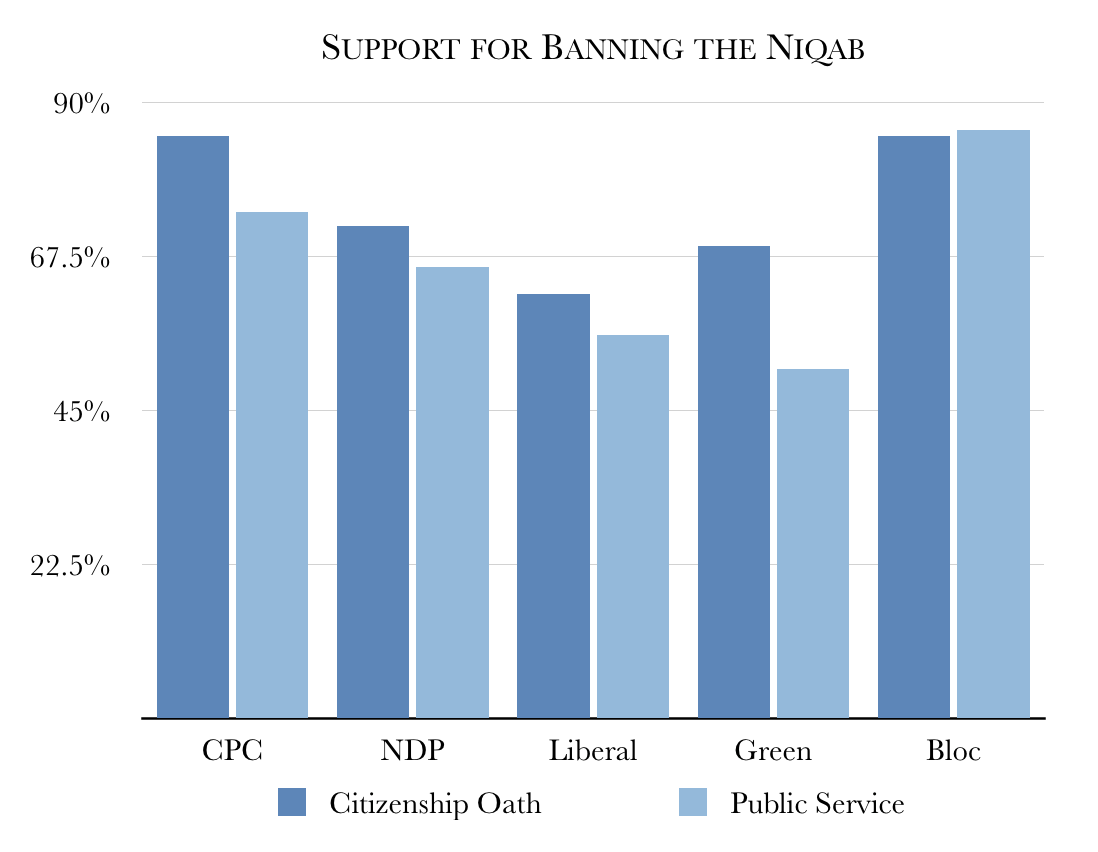
Interesting analysis by Daniel Robinson and Peter Loewen on the changing voting patterns of immigrant voters and the niqab, providing more analysis than in Doug Saunders synopsis (How Tories win immigrant votes using anti-immigrant messages). The chart above compares party supporter views:

On the citizenship oath measure, 72 per cent of Canadians agree. Just 14 per cent disagree. (Another 14 per cent either don’t know or are ambivalent.) This opinion is not isolated to “old stock” Canadians. Among those citizens born outside the country, 70 per cent agree with forcing women to reveal their faces.

… It is a similar story when we ask whether the public service should ban niqabs. Sixty-four per cent of people we surveyed support such a ban. Just 19 per cent oppose it. Support is undiminished among immigrants, where two-thirds (66 per cent) would support a ban and just 16 per cent would not. …

Some have noted that the niqab is an effective issue, not only because it garners wide support but also because it is largely irrelevant to voters. It is, at best, a useful distraction. But this misses something important about voters: they often take their cues from politicians about what is important. By the time we surveyed voters, the niqab had been a point of discussion for more than two weeks. When we asked our respondents how important the issue is to them, 78 per cent indicated that the niqab in citizenship ceremonies is a somewhat or very important issue. We got the same results when we asked about a niqab ban in the public service.

We now have a situation in which opinion-leaders – newspaper columnists, pundits, commentators – almost uniformly insist that a policy is both wrong and unimportant while voters disagree on both accounts.

Our data tell a broader story about multiculturalism and Tory support. Political scientists – especially André Blais and Richard Johnston – have long noted that the 20th century dominance of the Liberal party was attributable to outsized support among Catholics and visible minorities, perhaps especially immigrants (to the extent that those categories overlap). Consequently, the Tories have spent considerable effort courting various groups of immigrants to their party.

Data from both the 2011 Canadian Election Study and Ipsos-Reid’s massive 2011 exit survey suggest that the Tories may have finally closed this “immigrant gap” in the last election. Our data suggest that they have now not only closed the gap, but have created a significant advantage of their own among immigrant Canadians.

To test this, we calculated the odds of Canadians voting Conservative that controls for a respondent’s age, income, education and gender, province of residence and, importantly, religion.

The results, which draw on massive sample sizes, show that a native-born citizen has a 27 per cent likelihood of voting Conservative. The likelihood for an immigrant Canadian voting Conservative is 34 per cent.

Because we controlled for religious affiliation, we can also estimate these effects. Compared to the non-religious, Jews and non-Orthodox Christians have a greater likelihood of voting for the Conservative party. But among Muslim Canadians, there is a clear aversion to the Conservative Party of Canada.

The niqab has become a campaign issue in this election, and perhaps the issue. The are several reasons for this, but public opinion research points to one of the more important ones: given the consistent, widespread support across the political spectrum for the Conservatives’ stated position, the Tories can only stand to gain from the issue playing prominently in the public discourse.

Source: Loewen: Support for Conservatives’ niqab ban is deep and wide, even among immigrants | Ottawa Citizen

Ministers had no objection to niqabs in public service last March | hilltimes.com

Ongoing interest in my study (Religious Minorities in the Public Service):

But at the time Mr. Clement made his remarks as he and other Cabinet ministers were reacting to the court decision in Ms. Ishaq’s case, several of the ministers said their opposition to the wearing of niqabs only pertained to citizenship ceremonies, not in the public service.

Canadian Press reporter Joan Bryden and other journalists questioned the ministers about Prime Minister Stephen Harper’s comment then that wearing the niqab was contrary to Canadian values and “rooted in a culture that is anti-women.”

“That is what the prime minister said and that is a point of view that one can hold,” Ms. Bryden reported Mr. Clement as saying at the time. “That doesn’t mean that you can impose that view in the workplace or in the private sphere. The one place where I think we have a right and an obligation to stress Canadian values is the act of obtaining one’s citizenship.”

As the election sparks flew again this week over Mr. Harper’s view on the niqab, the department that oversees the public service on his behalf, Treasury Board Secretariat, said in response to questions from The Hill Times it does not have “any data or other information pertaining to niqabs” or any complaints about women wearing them in the public service.

The election campaign research by Mr. Griffith might back up a statement to The Hill Timesfrom the head of the Canadian Council for Muslim women, Alia Hogben, that it is likely no Muslim women in the public service wear niqabs.

…Mr. Griffith prepared a brief paper on the topic based on data he obtained from Statistics Canada from an inquiry last April, when his curiosity was piqued after Mr. Clement’s comments after a change Citizenship Minister Jason Kenney ordered for a legal manual citizenship judges must abide by.

Federal Court Judge Keith Boswell ruled last February the change, which required citizenship judges to reject citizenship applications from female candidates wearing niqabs if they refused to show their faces at two successive ceremonies, was unlawful because it violated an existing regulation that requires citizenship judges to administer the oath of citizenship “with dignity and solemnity,” and “allowing the greatest possible freedom in the religious solemnization or the solemn affirmation thereof.”

The Harper government appealed the ruling, failed in a bid to get the Federal Court of Appeal to overturn Judge Boswell’s ruling and also failed in an attempt to get the Federal Court of Appeal to stay the ruling during an appeal to the Supreme Court of Canada.

Mr. Griffith’s paper  included a wider comparison of religious minorities employed in the federal public services and the public services of British Columbia, Alberta, Ontario and Quebec. Quebec was the lowest at 2.1 per cent, compared to 6.2 per cent in the federal public service, 8.7 per cent in Ontario, 6.8 per cent in B.C. and 6.2 per cent in Alberta.

Source: Ministers had no objection to niqabs in public service last March | hilltimes.com

Bureaucracy baffled by Harper’s niqab stance: Quotes and Interview

Following the PM’s more measured comments Wednesday on the niqab and the public service, comments by me and others:

Unions and other political party leaders were quick to condemn the Conservative leader’s remarks. However, it wasn’t clear if there were more than a few, if any, women who wear the niqab – a veil that conceals the face except for the eyes – in the federal public service.

A request to wear the Islamic garb would have to be reviewed on a case-by-case basis under the federal government’s “duty to accommodate” policy – which would set a precedent for all departments, said Andrew Griffith, a former senior public servant who writes extensively on citizenship and multiculturalism.

“Frankly, I don’t think the issue has ever come up and it’s unlikely it would have happened without consultations at the high levels,” he told the Citizen.

At a campaign stop in Saskatoon Wednesday, Harper repeated his intention, if re-elected, to consider federal legislation modelled on Quebec’s Bill 62, introduced by the provincial Liberal government in June. If passed, that law would prohibit public servants from wearing niqabs in provincial offices.

“Let me be very clear, we’ve actually been saying the same thing for several months,” said Harper. “The Quebec government, the Liberal government in Quebec, has brought forward legislation to require that people reveal their identity when delivering or receiving frontline service. They have tabled a bill before the Quebec assembly, we’ve said we will look at that bill before taking further steps.

“The Quebec government has been handling this controversy in a very responsible manner and we will do exactly the same things.”

The Public Service Alliance of Canada, which represents the majority of federal employees, said it doesn’t know how many women working in the public service wear a niqab – if any – and has never received concerns or complaints about the garment.

Still, PSAC President Robyn Benson said a ban on the niqab or any religious symbol would violate the anti-discriminatory provisions of employees’ collective agreements and the Canadian Human Rights Act.

“This is just another cynical attempt by the Harper Conservatives to distract from what is really at stake in this election: the reckless government cuts that have impacted millions of Canadians,” said Benson.

NDP Leader Tom Mulcair Wednesday called Harper’s remarks “bizarre.”

“For him to run an election campaign on the backs of minorities, stigmatizing, singling out, going after minorities … he’s looking to divide Canadians,” Mulcair said.

But beyond the barbs, puzzling questions loom.

Griffith argued the public service should get a better handle on religious and minority groups as part of its employment-equity strategy so managers are better prepared if and when a request to wear the niqab actually does arise.

The number of Muslims working in the public service is likely in line with the proportion who are Canadian citizens (the public service has a hiring preference for Canadian citizens). Muslims women represent about 1.8 per cent of the population.

Source: Bureaucracy baffled by Harper’s niqab stance | Ottawa Citizen

And my interview on CBC’s Ottawa Morning:

Should public servants be allowed to wear the niqab?Andrew Griffith is a former director general at Citizenship and Immigration Canada. He’s also written about multiculturalism and government.Listen 7:10 

Harper wants to ‘examine’ ban on niqab in public service and the ‘duty to accommodate’

Beyond playing identity politics on the issue, there is a need for a more substantive discussion, based upon evidence (including the data on the religious affiliation of public servants as in my background note Religious Minorities in the Public Service) and how the “duty to accommodate” policy would be applied in the case of a request (and how any previous requests – if they exist – were handled).

Any request would not just be handled at the working level but would most likely involve HR officials and more senior officials and would likely emerge into the public domain.

A quick review of TBS’s Duty to accommodate guide for managers shows it largely focuses on accommodation for persons with disabilities, with little guidance with respect to religious accommodation. The Canadian Human Rights Commission and provincial equivalents provide more guidance and examples, but no examples of niqabs or gender-based segregation based upon my quick review (corrections welcome).

And a reminder, the duty to accommodate does not mean agreeing to the specific request or the specific form of accommodation requested:

A re-elected Conservative government would “examine” whether to prohibit public servants from wearing the face-covering garment known as the niqab, leader Stephen Harper said Tuesday.

“That’s a matter we’re going to examine,” Harper told Rosemary Barton during an interview on CBC’s Power & Politics Tuesday. “Quebec, as you know, has legislation on this. We’re looking at that legislation.”

The prime minister was referring to Bill 62, introduced by Quebec’s Liberal government in June, which contains measures to prohibit public servants from wearing niqabs in provincial offices.

Harper’s notion earned swift denunciations.

“Stephen Harper is trying to play politics with sensitive issues. It smacks of political manipulation,” said Paul Dewar, the incumbent NDP candidate in Ottawa Centre.

Catherine McKenna, the Liberal candidate in Ottawa Centre, agreed. “The niqab in the public service is not a serious issue, it’s a diversion tactic.”

Ron Cochrane, co-chairman of the National Joint Council, called it an “example of Harper trying to create a problem where there isn’t one now.”

“If there are people who wear the niqab providing services to Canadians, no one has ever complained about their dress, so why is he making it an issue when it hasn’t been before?”

“This election is too important to be distracted by Mr. Harper’s questionable tactics,” said Debi Daviau, president of the Professional Institute of the Public Service of Canada. “Unlike this prime minister, we respect the rule of law and our focus is on defending our ability to deliver essential public services to Canadians.”

The niqab issue has become a hot-button election topic in recent days, as the Federal Court of Appeal rejected the government’s application for a stay of a Federal Court decision in favour of a Muslim woman, Zunera Ishaq, who wants to wear a niqab during her citizenship ceremony.

Source: Harper wants to ‘examine’ ban on niqab in public service | Ottawa Citizen

Zunera Ishaq cleared by court to take citizenship oath wearing niqab

Pretty clear that a large part of the motivation for the appeal is political and to keep issue prominent, given the weak legal case (lack of Ministerial authority to implement administratively):

Regulations have banned wearing of face veils at citizenship ceremonies, but Ishaq challenged the rule and won in Federal Court. On Sept. 18, the Federal Court of Appeal upheld that decision in a quick ruling from the bench. The federal government had sought a stay of the ruling and said it intended to appeal to the Supreme Court.

“I am pleased that the courts have reaffirmed my right to citizenship and to vote,” said Ishaq in a written statement issued to CBC News through the law firm of Waldman & Associates.

“I am disappointed with the government’s focus on my individual case when there is so much more that merits the attention of Canadians at this time,” Ishaq said. “I’m also disappointed that Mr. Harper continually twists the facts of my case for his gain.

“I wish to confirm that I will be identified without my veil for the purposes of the ceremony. This has nothing to do with identity and everything to do with my right  — and the right of all Canadians — to think, believe and dress without government interference,” she said.

Before reciting the oath, would-be Canadians are required to provide multiple proofs of identity. Those who wear face coverings must remove them before the ceremony in private before a citizenship official.

Ishaq is one of two women who have refused to unveil before taking the citizenship oath since the Conservatives introduced the policy directive in 2011.

Conservatives ‘disappointed’

Conservative Party spokesman Chris McCluskey told CBC News in an email, “We are disappointed in the court’s decision, especially as we were waiting on the Supreme Court to hear our appeal.

“We have committed to rectifying this matter going forward by introducing legislation that will require one to show their face while swearing the oath of citizenship. Legislation will be introduced within the first 100 days of a re-elected Conservative government.”

“At this point, the Federal Court of Appeal has made a clear statement that there’s no basis to grant them a stay, that they upheld their previous ruling that this case has nothing to do with the niqab,” said Lorne Waldman, Ishaq’s lawyer, in a telephone interview with CBC News.

“It’s an issue from the rule of law, and the minister acted illegally in creating a policy that went contrary to the legislation, and that’s what this case is about.”

The Department of Citizenship and Immigration must formally invite Ishaq to attend a ceremony. Several are scheduled in Ontario between now and the Oct. 19 election.

Source: Zunera Ishaq cleared by court to take citizenship oath wearing niqab – Politics – CBC News

A Tory blend of burqa-bashing and sex-education protests: Cohn

Martin Regg Cohn on the odd alliances at play and how he perceives Canada has changed:

Welcome to Canada, a country of diversity that imagines itself a beacon of multiculturalism, a bulwark of secularism, and a bastion of pluralism (which means, by the way, freedom for and from religion).

Now, Conservative Leader Stephen Harper is lifting the veil on the phobias still lurking beneath our vaunted tradition of tolerance. Who knew so many of us could get so hot and bothered about burqas and whipped into such a frenzy about homosexuality and sexuality?

When I returned to Canada a decade ago, after 11 years abroad as a foreign correspondent, I never fathomed that niqabs — a misplaced symbol of Islamist fundamentalism that I encountered overseas — would one day distract voters in a federal campaign.

And when I took over the Ontario politics column four years ago, I never imagined that dogmatic religious conservatism — the intolerance and inwardness I’d left behind abroad — would make a comeback in my home province.

Some days I feel like I’m still stuck in the Middle East watching Palestinians and Israelis at war with one another — or worse, turning on themselves: The baiting, the poking, the code language.

Overseas, it’s fear and loathing. Here at home, it’s smear and goading.

Sex-education protests and burqa-bashing are crossover issues. Like cross-dressing, they can be curious fetishes and phobias.

The fight against sex-education makes for strange bedfellows, for it is the flip side of the battle over the burqa. A vocal fringe within our Muslim minority — many of them clad, it’s worth noting here, in niqabs or hijabs — has made common cause with social conservatives protesting against the provincial sex-education curriculum.

It’s a classic case of the enemy of my enemy is my friend. But with friends like that, who needs enemies?

Oddly for anti-sex-ed Muslim parents, their allies in intolerance of gays are in some cases Conservatives stumping on the campaign trail by stirring up mistrust of Muslims who wear the niqab (which tends to drag down all Muslims).

It’s a teachable moment for any Canadian tempted to join in burqa-bashing: Tolerance is a two-way street.

Not every single parent who has reservations about the provincial sex-education curriculum is homophobic. But if you read the work of the Star’s education reporters, Kristin Rushowy and Louise Brown, it’s hard to ignore the homophobic impulses driving many of the protest organizers — rallying religious newcomers by preying on prejudices they may have carried over from their homelands, where homosexuality equals criminality.

People who defend the right to wear a niqab in public (while requiring them to identify themselves when necessary) aren’t pro-burqa, as NDP Leader Tom Mulcair argued in Friday’s French-language debate, any more than people who are pro-choice are “pro” abortion. Their position is more a variation on the Voltarian dictum, “I disapprove of what you say, but I will defend to the death your right to say it.”

One can disapprove of the niqab without disenfranchising women of citizenship and voting rights. But as a wedge issue, the burqa is unbeatable.

It presses our buttons, offends our sense of openness, makes it hard to connect with our interlocutor. Hence Harper’s undisguised glee in stirring up public mistrust of Muslims who cover up, and wounding his political opponents in the process.

Today the niqab. Tomorrow the hijab?

Will those armchair religious scholars who argue that the niqab has nothing to do with Islam (they are almost certainly right) next turn their sights on Canada’s ultra-orthodox Jews, the Hassidic (putatively pious) who persist in wearing black hats and silk stockings in public because they believe it an essential tenet of the faith (most Jews would disagree)? Shall we judge them next, stripping them of their garb as others did only a few decades ago?

Ah, but black hats and kippah and kirpans do not offend us as niqabs now do, you say? Recall that they were both proscribed in a proposed Quebec law banning religious symbols just a couple of years ago — so spare me the niceties on niqabs.

As for those who oppose an updated sex-education curriculum — the campaigning Conservatives having mischievously transposed a provincial responsibility to the federal polity — beware your bedfellows. All those Conservative candidates who tempt you into intolerance will lead you astray one day soon. Doubtless after voting day.