N.L. immigration minister slams feds over lack of support

Of note:

Newfoundland and Labrador’s minister of immigration, population growth and skills is demanding more help — and more money — from his federal counterpart to support immigration and settlement in a province where deaths outstrip births two to one.

While speaking with reporters on Thursday, Gerry Byrne touted Newfoundland and Labrador’s population growth while slamming the federal government for a lack of support.

“There are many issues that need to be resolved with Ottawa,” he said. “Many.”

Byrne’s central frustration is the province’s federally granted immigration allocation, which he said was fulfilled as of Oct. 7.

Now that those spots have been filled, the provincial government won’t be able to nominate any more newcomers for permanent residency until Jan. 1. He said the province will continue to process applications and submit them to the federal government in the new year — but in the meantime, any newcomers who apply will have to wait.

“There is no room left this year,” Byrne said emphatically. “None.”

According to Byrne, the provincial government can nominate 1,140 people for permanent residency under the federal pathway, and 453 people under the Atlantic pathway.

“In previous years, we were lucky if we could fill a third of those spots,” he said.

Byrne said the provincial government is asking the federal government to expand Newfoundland and Labrador’s nomination capacity for the rest of 2022, and double capacity in 2023.

Byrne said he already asked federal Immigration Minister Sean Fraser for more capacity this year, but was turned down.

“Now we are seeing the results of this,” he said.

CBC News has asked the federal Department of Immigration, Refugees and Citizenship for comment.

Largest population growth in N.L.

According to Byrne, Newfoundland and Labrador’s population grew by 6,200 people in the past 18 months — the largest increase since 1971 — largely through migration from other provinces and countries. He said 5,600 people have immigrated to Newfoundland and Labrador, while 3,700 people have moved to the province from other parts of Canada.

He said the growth doesn’t include Ukrainians who have moved to the province since March.

Byrne also called for more funding for the Association for New Canadians, an agency that helps resettle immigrants and refugees in Newfoundland and Labrador.

According to the province, the federal government provides the association with less funding per refugee than agencies in the other nine provinces.

“The ANC is the lowest-funded support organization in the country,” he said. “That has to change.”

Byrne’s criticisms come during a rocky week for the relationship between the provincial and federal Liberals. On Tuesday, Environment and Climate Change Minister Bernard Davis panned the federal government’s decision to impose the carbon tax on Newfoundland and Labrador.

Just a few hours after the news conference, Premier Andrew Furey reposted a photo of himself with federal Intergovernmental Affairs Minister Dominic LeBlanc.

‘The perfect timing’

Tony Fang, an economics professor at Memorial University, said he’s in “full agreement” with Byrne’s demand for a higher immigration allocation — though he thinks the province should ask for triple, rather than double, the current capacity.

“The federal government certainly should collaborate with the provincial government to take advantage of this large interest in immigration,” he said.

Fang, who leads a research team exploring immigration in Newfoundland and Labrador, said attitudes toward immigrants have improved.

“This is the perfect timing to increase immigration targets,” he said.

Jaclyn Sullivan, executive director of the Newfoundland and Labrador Employers’ Council, said immigration is essential for the province’s economic growth and prosperity, calling the current federal approach “not good enough.”

‘We would like to see much more effort on behalf of the federal government,” she said.

Sullivan said Newfoundland and Labrador doesn’t have enough people to fill jobs.

“We’re all seeing the impact of this,” she said.

NDP MHA Jordan Brown said he supports Byrne’s request for a higher nomination allocation and more funding for the Association for New Canadians, but he also wants to see more help from the provincial government — particularly regarding health care.

“We’re lacking in support both federally and provincially,” he said.

Source: N.L. immigration minister slams feds over lack of support

‘Racist’ junior high immigration assignment has advocates calling for curriculum change

Not convinced by the arguments advanced against the approach of having students contrast and compare opposing perspectives and develop their critical thinking.

Most of the immigration opposing points reflect polling and other data and students will likely be exposed to these positions in any case outside of the more controlled space of a classroom.

Of course, the role of teachers in leading and framing the issues is critical.

And while I hate the term “snowflake,” (which can apply both the “woke” and “non-woke”), this is a classic example of underestimating the ability of people to handle such material:

Advocates and university professors are calling this school assignment ‘dehumanizing.’ (Name withheld)

Anti-racism advocates and a university professor are calling an assignment handed out at a junior high school in St. John’s “racist” and say it could result in bullying and discrimination.

A textbook assignment that was sent to CBC News by a concerned parent asked students to write down two reasons why immigrants and refugees should be allowed into the country — and two reasons why they should not be.

The textbook provides a list of reasons why immigrants and refugees should be allowed in the country; for example, “Canada is a big country with room for many more people” and “Immigrants provide new ideas and skills.”

Source: ‘Racist’ junior high immigration assignment has advocates calling for curriculum change

In Newfoundland and Labrador, a demographic crisis gets worse

Of note:

As Newfoundland and Labrador struggled for decades to keep people from leaving, it could count on one thing: at least St. John’s would keep growing.

Between the 1991 and 2016 census years, the province lost nearly 50,000 people (9 per cent), but the capital region grew by about 34,000 (20 per cent). Thousands may have moved west, but many others migrated from rural areas to St. John’s, part of a broader wave of urbanization seen across the country.

Recently, however, that trend has hit the skids. Over the 12-month period ending in mid-2019, population growth stalled in the St. John’s area, after a meagre gain the previous year, according to recent Statistics Canada data. St. John’s was the only census metropolitan area (CMA) in the country that didn’t see its population rise.

The stagnation amounts to another setback for Newfoundland, which is coping with a demographic crisis of rapid aging and little immigration, along with debt-addled public finances that could desperately use an infusion of new, young taxpayers.

The trend serves as a big risk for the province’s economy, including weaker consumption and labour shortages that hinder the growth potential for homegrown companies.

“[A] deteriorating demographic situation will continue to limit the economy’s momentum in the years ahead,” Royal Bank of Canada economist Ramya Muthukumaran said in a research note.

RBC projects inflation-adjusted gross domestic product for Newfoundland to grow just 1.1 per cent in 2020, while Toronto-Dominion Bank expects a gain of only 0.7 per cent.

“We need a sense of urgency to grasp the issue now, before it’s too late,” said Tony Fang, a Memorial University professor who researches the province’s demographics. “It’s about time to do something quite dramatic.”

For now, the outlook appears bleak. Under a medium-growth scenario, the province’s population will ebb to 460,000 people by 2043, a decline of 65,000 (12.4 per cent) from 2018, according to a Statscan projection published in the fall. There is no scenario in which the province doesn’t lose tens of thousands of residents.

Of late, Newfoundland is afflicted by a familiar story: More people are moving out to other provinces than are moving in. Newfoundland’s net interprovincial loss accelerated to 4,500 people in the most recent year, the largest outflow since 1998-99. More than 3,000 moved to Alberta – the largest number in seven years – despite that province’s own oil-induced economic woes.

The story was much the same in St. John’s. The CMA – which includes the city, along with surrounding places, such as Conception Bay South and Mount Pearl – saw a net loss of 2,600 people to other provinces. That was the largest outflow in Statscan data going back to 2006-07.

The out-migration overshadows a rising intake of immigrants. Newfoundland added 1,850 permanent residents in 2019, up 64 per cent from 2015. In doing so, the province surpassed a government target to bring in roughly 1,700 immigrants a year by 2022.

Even then, immigration is decidedly modest. Newfoundland still has the lowest intake of immigrants by province, both in raw numbers and adjusted for population.

Making things tougher, Newfoundland and its Atlantic peers struggle to hang onto newcomers. Among those admitted to Canada in 2011, only 51 per cent remained in Newfoundland five years later, according to a Statscan analysis of tax filers. That was the third-lowest retention rate by province.

“People who are not able to find a job leave the province, and international immigrants are not looking into a province with high unemployment rates,” said Parisa Mahboubi, senior policy analyst at the C.D. Howe Institute.

Labour troubles are nothing new. While the jobless rate has drifted lower, to 11.9 per cent, it remains easily the highest of any province. Meantime, the number of employed people barely changed in 2019, based on average annual data from the Labour Force Survey. In many ways, stagnation is the norm; the number of employed men, for instance, is roughly the same as four decades ago.

Newfoundland is also hamstrung by challenging finances. While the province is running a sizable surplus for the 2019-20 fiscal year, which includes an infusion of federal cash via the new Atlantic Accord agreement, with $2.5-billion booked now, but flowing to the province over decades. Take that away, and the province’s deficit is close to $1-billion – worse than initially thought, on account of a prolonged shutdown at the Hibernia offshore oil field last year.

The province is increasingly weighed down by debt. On a per-capita basis, Newfoundland had nearly $30,000 in net debt in the last fiscal year, the highest of any province. Still, the provincial Liberal government has committed to a balanced budget – a plan that hinges, in part, on restrained spending in the coming years.

Citing constrained budgets, Ms. Muthukumaran said “there aren’t many growth avenues left for the province.”

The solution, Prof. Fang said, must include higher immigration. To keep the population growing, and thereby shore up the province’s tax base, immigration should be ramped up to at least 1 per cent of the population, or 5,000 people annually, he said.

“The only way out is immigration.”

Source: In Newfoundland and Labrador, a demographic crisis gets worse

How to inject youth into Newfoundland and Labrador’s broken, greying democracy

Providing provincial voting rights to expatriates makes little sense. Provincial services are largely residency-based, unlike federal voting rights which are citizenship-based (even there I have serious reservations as noted in earlier posts):

And not convinced in any case that this will make much difference in overall voting trends and turn-out:

What does it mean to be a voter in a Canadian federation increasingly defined by wealth inequality and economic migration?

As public policy scholars, we argue that politicians, policy-makers and citizens alike need to start rethinking how to ensure everyone’s voice is heard in a regionally diverse federation. More specifically, we think that provinces have good grounds for extending voting rights to expatriate citizens. In the case of Newfoundland and Labrador, extending the vote is particularly warranted.

That’s because of two issues plaguing Newfoundland and Labrador: People are leaving the province, and those who remain are growing older.

As two expatriate Newfoundland and Labradorians — one of us in Australia — we watched from the sidelines during this spring’s provincial election. It was so defined by negativity and an absence of social vision that it inspired a playful CBC podcast with the question: “Does anyone actually want to win the election?”

That things played out this way came as little surprise. The province is trapped between a need to get its financial affairs in order and politicians who look to spending increases instead of long-term solutions as a means of winning elections. The ruling Liberals, for example, opened their campaign with an extra $152 million for the budget, including a cut to the deficit reduction levy which had only come into effect in 2016.

Not sustainable

Every citizen of the province knows this approach is unsustainable. To put the fiscal situation in perspective, Newfoundland and Labrador’s provincial debt is a whopping $21,221 per capita, the highest in Canada, and its debt servicing costs as a per cent of provincial revenues stands at 13.8 per cent compared to the next highest province, Quebec, at eight per cent.

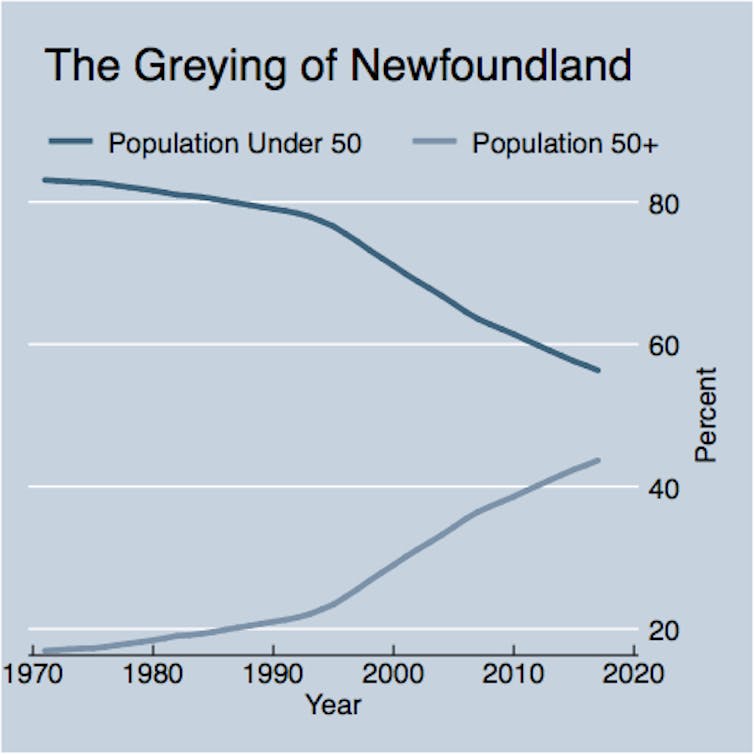
The graph below shows that Newfoundland and Labradorians face a tricky demographic challenge.

The graph vividly portrays how rapidly Newfoundland is growing older. Author provided

The share of the population under 50 years of age has been shrinking for the past 45 years. Since 2000, the population in age quintiles (five-year intervals) has declined in every age group below 50, while increasing in every age quintile above 50. While the population, post-2000, has remained relatively stable, the composition of the province’s population is vastly different.

As the population ages, so too does the median voter.

Citizens who are older are understandably less likely to support long-term reforms that will cut into their more immediate interests. This means that proposing tough solutions to current fiscal problems can make it hard to win elections, especially if there is a rural/urban divide separating younger and older voters.

Unlike Newfoundland’s fiscally tough solutions of the past, we propose a solution that more greatly strengthens attachment to home: Allowing Newfoundlanders and Labradorians living outside the province to vote.

Youth injection

To cast ballots in Newfoundland and Labrador elections, voters must be provincial residents the day before polling day. We propose to extend the vote in a simple, transparent and inclusive manner to anyone 18 or older who has ever attended school in the province.

Why former students? First, many children of Newfoundland and Labrador have been lured or forced abroad to scratch out a living or seek their fortune. All have been victims of the lack of opportunity at home. Many of these people wish to return, and many do return, in their more senior years. Why should their voices not be heard at the provincial ballot box?

A recent study published in the Journal of Labor Economics suggests that the mobility of these workers has boosted pay in their province of origin. Wages rise because employers at home must hike pay to prevent more workers from leaving. This is a real economic gain, on top of any money that workers who leave their home province send back home.

Second, there is precedent — national voter eligibility is not determined by location, but rather by citizenship. The electoral district you vote in federally is determined by your current residential address, but your eligibility to vote is preserved by the government of Canada even when you are living abroad.

Third, consider the civic education that has been instilled in these individuals through the province’s school system. They have a respect for the people and the land, the traditions and the ambitions of their home province.

Generally speaking, we extend the vote to people because they are either directly affected by the collective decisions of government or because they are subject to the laws of that government. Expatriates easily satisfy the first of these two conditions. Provincial policies affect both their ability to return home and their loved ones who remain behind.

To be sure, extending the franchise is not a magic bullet that will immediately solve the province’s problems. And there are no doubt further questions about the voting mechanisms needed to make this proposal a reality.

But we think extending the vote to expatriates strongly aligns with the province’s values. It could also help nudge its politics closer to long-term solutions that respect the roots and rights of all Newfoundland and Labradorians past, present and future.

Source: How to inject youth into Newfoundland and Labrador’s broken, greying democracy