Quebec needs to confront its Islamophobia problem

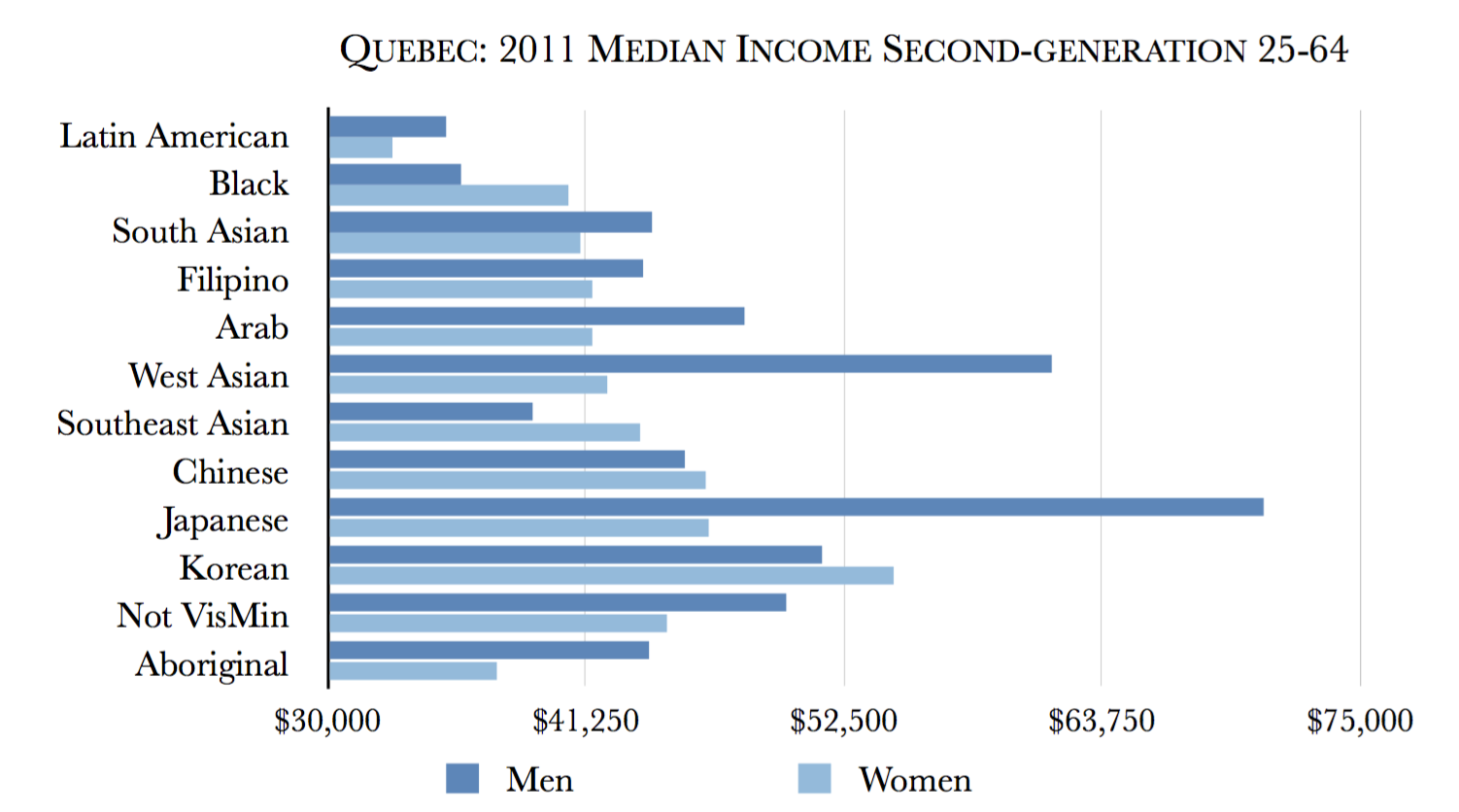
Quebec Second Gen Economic

More on the challenges faced by Muslims in Quebec by Amarnath Amarasingam and Higham Tiflati. Overall, economic outcomes for immigrants and their children are lower than elsewhere in Canada:

While Islamophobia and anti-Muslim animus exists throughout Canada, the nature of it in Quebec seems to be unique, and quite worrisome. Law-enforcement officials and social workers receive calls from concerned citizens wanting to report “suspicious persons” like a man with a long beard in their neighbourhood, and calls from concerned families asking whether their relative, a new convert to Islam, could become a terrorist.

Muslim students also report that Francophone CEGEPs do not allow their students to create Muslim Students’ Associations (MSAs), a policy not even practiced by Anglophone CEGEPs in Quebec.

Polling data backs up much of what these young people are expressing. A 2015 Quebec Human Rights Commission survey found that 43 per cent of Quebecers believe we should be suspicious of anyone who openly expresses their religion, with 49 per cent expressing some uneasiness around the sight of Muslim veils.

For many Muslim youth, this kind of public scrutiny is deeply alienating. Young Canadians from other ethnic and religious backgrounds have the privilege and the freedom to wrestle with adolescent identity issues in private. These struggles, ones we have all experienced, play out quite differently for Muslim youth.

Aspects of Muslim youth identity, such as whether to wear the hijab, are quite often national debates, discussed on the nightly news, and even find their way into speeches given by the prime minister. The young girl wearing a hijab is not someone who has made a fairly harmless and rudimentary religious choice, but is seen as someone making a political statement about Western values or ways of life.

It is no surprise then that these youth express an emotional exhaustion arising from being constantly watched, scrutinized, and pitied. Fairly mundane activities such as walking down the street or riding the bus become “events,” requiring mental and psychological fortitude. It takes a deep toll on their confidence, self-esteem and sense of inclusion. As Safiya remarked, “Shayma didn’t want to feel like a stranger here any more.”

Safiya, though, is committed to changing her life in Quebec, and changing the way Quebecers see her and her community. She has dreams and goals. “My parents brought me here for a reason,” she says. “Sure, things are not perfect, but I see potential in our Muslim community here in Quebec and if everyone just left it won’t help.”

Source: Quebec needs to confront its Islamophobia problem | Toronto Star

There will be some hard things said: Muslim group hears about Truth and Reconciliation

Another good initiative in building bridges and understanding by the Canadian Council for Muslim Women:

It’s a been a time of soul-searching for Muslims trying to find their place in Canada. That’s why it’s the right time to hear about Truth and Reconciliation right from the source, says the organizer of a panel that brought Muslim and Aboriginal people together.

“I thought we should take a step back and put our own problems into perspective,” said Ferrukh Faruqui, who moderated the event on Saturday.

Faruqui grew up in Winnipeg and went to medical school there, but admits she knew little of the historic struggles of Canada’s First Nations. “We want to listen to truths long buried and offer our support.”

The panel organized by the Ottawa chapter of the Canadian Council for Muslim Women consisted of Faruqui as moderator and three guests: Minwaashin Lodge co-founder Irene Compton;  Victoria Tenasco-Commanda, the culture co-ordinator at the Wabano Centre for Aboriginal Health, and Shady Hafez, a Carleton University student whose mother is Algonquin and father is Syrian.

The panel spent much of its time talking about echoes of the residential school system, which operated for more than 150 years. Some 150,000 aboriginal children went through the system, and thousands never returned home. The last school closed only about 20 years ago. The Truth and Reconciliation Commission, which probed the history of that school system and its lasting repercussions were released last June in a summary report. A final report is to be released Dec. 15.

“I am going to warn you that there will be some hard things said,” warned Compton before she started to speak.

Source: There will be some hard things said: Muslim group hears about Truth and Reconciliation | Ottawa Citizen

Good example of Muslim criticism of violent extremists

A reminder to those who continually ask question the perceived lack of criticism of terrorism by Muslims that it is not too hard to find, as this short video attests:

Saudi-Born Singer Shams Bandar: Why Do We Pin All Our Problems on the West?

In the fight against terrorism, Muslims must own their message: Sheema Khan

Sheema Khan, further developing her arguments for the role that Muslims can and should play in the West:

Here in the West, Muslims have the unique luxury – if not the duty – to examine such critical questions, and take ownership of their own narrative. If they don’t, others will do it for them. Do Muslims in the West want to define Islam as a faith rooted in compassion, generosity and pluralism? Or will it be defined as a religion of fear, terror and subjugation, as advocated by extremists? While the choice may be obvious, it requires forceful authentication through repeated words and actions.

Own the message, and declare it with conviction: Islam forbids terrorism, murder and mayhem. Extremists who murder innocent civilians, as retribution for Muslims killed by the West, do not speak for me. I will fight injustice with people of justice, using non-violent means. I will fight to protect my fellow human beings from harm, because my faith demands it. I will look after my neighbour and help to make this country a better place. I will follow on the footsteps of Prophet Mohammed, who was sent as a mercy to mankind.

Such a principled path includes fighting for the rights of innocents abroad through legitimate means. It includes standing up to Islamophobia and engaging in the wider struggle against xenophobia.

It also encompasses the duty to work with law enforcement to ensure the safety of all Canadians. This is evident in the number of plots thwarted by Muslim tips and informants. In a 2007 Environics poll, the overwhelming majority of Canadian Muslims believed it was their responsibility to “report on potentially violent extremists they might encounter in their mosques and communities.”

After the Charlie Hebdo massacre in Paris, Muslims organized grassroots demonstrations in Ottawa, Toronto, Kingston and London, Ont., reiterating the commitment to our shared humanity, while welcoming all Canadians to join in the call. Such efforts are shaping a Canadian narrative of Islam and should be repeated. Grassroots efforts that have spawned interfaith, cultural, charitable and civic initiatives are also moulding an indigenous form of Islam, rooted in a Canadian ethos.

Finally, owning the narrative means purposeful use of language. Those who know the true nature of the Islamic State refer to it by its Arabic acronym, Daesh, which has a derogatory meaning. They certainly don’t label Daesh members as jihadi. Islamic law defines the terror perpetrated by extremists as hiraba, which is diametrically opposed to jihad. They seek legitimization under the moniker of jihad. Let’s not give into that. Call them for what they are: hirabi. In the propaganda war, language means everything.

Source: In the fight against terrorism, Muslims must own their message – The Globe and Mail

Highest ever number of Muslim Canadian MPs elected in new House | hilltimes.com

Good range of interviews on the large number of Muslim Canadian MPs elected:

In interviews last week, MPs, political insiders, and academics said the newly-elected legislators from diverse cultural and religious backgrounds will bring unique perspectives, community feedback and different life experiences to the table which will prove to be valuable in the overall legislation and policy-making process at the highest level of government. They also pointed out that these MPs are not just token representatives of their respective communities but people who have solid credentials in a variety of professions including law, medicine, and business.

“Every Member of Parliament will bring their values to the debates and values are shaped by religion, by experience, by the community that they come from. So, it will shape their values and values will shape what they have to say and their positions, no question,” said Prof. Donald Savoie, the Canada Research Chair in public administration and governance at the Université de Moncton and one of Canada’s leading experts on public administration, in an interview with The Hill Times.

He said Muslim MPs and MPs from other religious backgrounds will have important input in Parliamentary debates in the new Parliament.

“They will have very important points of view that need to be heard,” said Prof. Savoie, adding that Muslim MPs should also not be stereotyped.

“Let them come and debate the issue and let’s hear what they have to say. What they will have to say is as important, as relevant, and ought to be listened to, as much as a white MP from Newfoundland, or from British Columbia.”

Meanwhile, pollster Greg Lyle of Innovative Research said that MPs from different cultural and religious backgrounds will offer valuable input in legislative debates on social and economic issues that affect all Canadians.

“When you are in the room, you don’t have to wait for someone to think about you. You’re right there to bring your concerns front and centre,” Mr. Lyle said.

He said that newly elected MPs from a variety of demographic groups won their ridings because they were the best candidates. Using the example of Justice Minister Jody Wilson-Raybould (Vancouver Granville, B.C.), Mr. Lyle said she is an indigenous woman who ran in a riding that has almost negligible presence of aboriginal people, but won by a margin of about 9,000 votes.

 “In a lot of cases, people are just nominating the best person for this job and they happen to come from different backgrounds,” Mr. Lyle said.

“When you look at their resumés, they’re not getting appointed as tokens. These are people who have really impressive stories to tell,” Mr. Lyle said.

Muslim MPs interviewed for this article said that the previous government’s Anti-Terrorism Bill C-51, the so-called Strengthening Canadian Citizenship Act Bill C-24, the niqab debate, and the barbaric cultural practices snitch line affected the Muslim community directly and motivated it to get engaged a lot more actively than in past elections.

“The community is reaching a new level of maturity, overall. The Muslim community in Canada tends to be a newer community. It’s going through various levels of growth and sophistication, maturity as a newer Canadian community,” said Mr. Alghabra who represented the riding of Mississauga-Erindale, Ont., from 2006 to 2008, lost the two subsequent elections and was elected again on Oct. 19.

“This was a new milestone in that growth process. There’s a greater level of sophistication, greater level of awareness about the importance of getting involved. It was demonstrated through various groups and organizations and individuals,” said Mr. Alghabra.

Ms. Ratansi, who represented the riding of Don Valley East from 2004 to 2011, lost the 2011 election but was re-elected last month, also reiterated that the divisive issues that the Conservatives pushed in the campaign made the Muslim community get involved more actively.

“People got a little concerned about the negativity against Islam. A lot of intelligent people who are lawyers, [legal scholars] who teach law in universities, who are accountants, businesspeople like me, got a little fed up with this constant badgering of Muslims as if we were a homogenous group and we all work the same way. We don’t,” said Ms. Ratansi, adding that unlike the impression portrayed by some in the last government and some news organizations, the Muslim community, overall, is a peaceful hardworking community trying to make the world a better place.

Carleton University Prof. Howard Duncan, who has conducted extensive research on immigration integration theory, multiculturalism theory, globalization, and migration, in an interview, predicted that the election of MPs from different religious and cultural backgrounds will encourage those who did not participate in this election to get engaged in the political process.

“What you’re going to find as time goes by is that immigrants from other countries and other religious and ethnic backgrounds are also going to participate more in politics,” said Prof. Duncan.

Andrew Cardozo, president of Pearson Centre for Progressive Policy, told The Hill Timesthat in the current international political scenario, a number of political conflicts are religion based. He said he hoped that the newly-elected MPs from different religions will prove they can all work together.

“If you think of it in global terms, the biggest division that’s taking place amongst people in the world is around religion. It’s good when you have a country that’s religiously diverse. It’s good to have so many religions represented. With many of them in the same caucus, there should be room for discussion and accommodation when there are differences,” said Mr. Cardozo.

Source: Highest ever number of Muslim Canadian MPs elected in new House | hilltimes.com

UK: Anjem Choudary claims all Muslim MPs and voters are ‘apostates’ sinning against Islam

Hardly representative of most Muslims in the UK, and sharp contrast to Canadian Imams who call for Muslims to vote (Ontario imams to urge Muslims vote in federal election):

Hard to know why someone like that remains in a liberal democracy rather than choosing to living in a Muslim majority country. But for ideologues and fundamentalists like him, no country will be “pure” enough in its application of Islamic practices:

Radical preacher Anjem Choudary has claimed that all Muslim MPs and voters are “apostates” as the general election approaches.

Writing on Twitter that voting is a “sin” against Islam, he argued that Parliament violated religious law because Allah is “the only legislator”.

Mr Choudary wrote: “The only excuse is for a new Muslim or someone totally ignorant about voting and also what’s known from Islam by necessity.”

In a stream of messages using the #StayMuslimDontVote hashtag, the cleric called Muslims who vote or run as an MP are “apostates”, meaning they have abandoned their beliefs.

Anyone doing so does not believe that Allah is the “only, exclusive legislator and commander” and is therefore a “kaafir” (disbeliever), he claimed.

Mr Choudary, who has headed banned groups including Islam4UK and al-Muhajiroun, instructed his followers not to follow any imams who tell them voting is religiously permitted.

It comes after his group released a series of videos as part of the campaign discouraging British Muslims from taking part in the democratic process, while other organisations encourage them to vote.

Anjem Choudary claims all Muslim MPs and voters are ‘apostates’ sinning against Islam – General Election 2015 – UK Politics – The Independent.

Conservative senator: Tories getting bad rap with Muslims, but need to work harder

Good to see some signs of internal debate on the wedge politics strategy:

The messages being sent by the federal government and the Conservative party that form it may be having a negative impact on the country’s Muslim community, a senior Conservative senator acknowledged Monday.

While Sen. Marjory LeBreton said she feels the government is “getting a bad rap” on the issue thanks in part to the media, she told a luncheon crowd she regrets the fact some Muslims are saying they feel unwelcome in Canada.

In recent months, the prime minister has explicitly linked mosques to terrorism and the party has circulated fundraising pitches uses menacing images of Muslim men.

There has also been ongoing controversy over the government’s decision to ban full-face coverings during citizenship ceremonies, as well as a Quebec judge who recently told a Muslim woman she’d have to remove her head covering in order to testify.

Many Muslims have the sense they don’t belong, patent agent Sheema Khan told LeBreton during a luncheon in Ottawa celebrating the political achievements of women.

Khan said her daughters no longer aspire to such achievements, thanks to the government’s approach to Muslims.

“As Muslim Canadians, we are part of this society but we feel that the messaging that is coming out is making us feel a little bit excluded, somewhat under suspicion,” Khan said during a question-and-answer session at the event.

“I have two daughters; I want them to believe that they can be prime minister one day, but they don’t feel they can. They feel they have no voice in politics because they see a political framework where their religion is suspect, where their presence is not perhaps fully welcomed.”

LeBreton said she has many Muslim friends and knows they are just as concerned about radicalization within their communities as non-Muslims, echoing comments made by Multiculturalism Minister Jason Kenney over the weekend about how integral Muslims have been in working with security officials to thwart potential attacks.

“They have every right to be completely respected like all other Canadians,” LeBreton said of the community — and the fact they feel otherwise is unfortunate.

“I very much regret that that is a view and we’ve got to work very hard to dispel that because it happens not to be true,” she said.

Conservative senator: Tories getting bad rap with Muslims, but need to work harder – Macleans.ca.

Liberal leader Trudeau correctly recognizes the politics of fear:

“These are troubling times,” Trudeau told a gathering organized by the McGill Institute for the Study of Canada. “Across Canada, and especially in my home province, Canadians are being encouraged by their government to be fearful of one another.

“Fear is a dangerous thing. Once it is sanctioned by the state, there is no telling where it might lead. It is always a short path to walk from being suspicious of our fellow citizens to taking actions to restrict their liberty.”

Trudeau compared the Conservative government’s approach to Muslims today to Canada’s restrictive immigration policies for Jews during the rise of Hitler’s Nazis.

“We should all shudder to hear the same rhetoric that led to a ‘none is too many’ immigration policy toward Jews in the ’30s and ’40s being used to raise fears against Muslims today.”

Trudeau also castigated the prime minister for his comments last month in the wake of a court ruling that struck down the government’s policy that forbid Muslim women to wear the niqab, a religious garment, over the face during citizenship ceremonies.

At the time, Harper said his government would appeal the ruling because wearing a niqab is “offensive” and it’s “not how we do things here.”

In subsequent days, the Conservative party reinforced that message to its supporters and financial donors, as the Tories gear up for an election campaign.

“We all know what is going on here,” Trudeau said of Harper and the Tories.

“It is nothing less than an attempt to play on people’s fears and foster prejudice, directly toward the Muslim faith.”

Trudeau said people can dislike the niqab and refer to it as a symbol of oppression.

“This is a free country. Those are your rights. But those who would use the state’s power to restrict women’s religious freedom and freedom of expression indulge the very same repressive impulse that they profess to condemn.

“It is a cruel joke to claim you are liberating people from oppression by dictating in law what they can and cannot choose to wear.”

Trudeau said Canada is a land of a million Muslims who should be allowed to thrive in a free and open secular democracy.

“Keeping these freedoms safe from those who would undermine them through violence is a vital national responsibility.

“What we cannot ever do is blur the line between a real security threat and simple prejudice, as this government has done. I believe they have done it deliberately, and I believe what they have done is deeply wrong.”

  Justin Trudeau says Stephen Harper sowing fear and prejudice against Muslims  

Canada stands with peaceful Muslims, Kenney says

In contrast to the PM’s messaging and wedge politics on security, radicalization and Canadian Muslims, and the Conservative Party’s fundraising machine, Minister Kenney borrow from President Obama’s language:

Kenney, who is also Harper’s longtime multiculturalism minister, noted the cost borne by Muslims facing extremist elements around the world.

“The vast majority of the victims of this dystopian vision of the caliphate from Nigeria to the Philippines are innocent, peaceful Muslim people who simply want to raise their families in peace and security,” Kenney told the Manning Networking Conference, a conservative policy gathering.

“And we stand with them, we stand with them around the world, we stand with them in Iraq today, we stand in defence of the vast majority of Muslims who reject this cult of violence. Canadians are in solidarity with them.”

Since the attacks this winter in France and in Denmark by Islamic extremists, the Tories have spoken out about their fight against “barbaric cultural practices” and against women who would cover their faces with the niqab during citizenship ceremonies. “Not the way we do things here,” read one Conservative party online message.

Harper referred specifically to mosques as places of radicalization, and unlike U.S. President Barack Obama has offered no messages of outreach to the Muslim community in the past several months.

“The prime minister of this country has a responsibility to bring people together in this country, not to divide us by pandering to some people’s fears,” Liberal Leader Justin Trudeau said recently.

Harper’s office pointed to a speech the Prime Minister made in December in which he expressed gratitude to those Muslim Canadians who spoke out against attacks that killed soldiers in Ottawa and Montreal last year.

Kenney also rejected the suggestion the party has alienated Canadian Muslims, pointing out he is a frequent visitor to mosques and islamic community organizations, and that his government has offered support against islamophobic vandalism and threats.

He also noted the help the community has offered in combating homegrown terrorism.

“We commend leaders and grassroots members of Canadian Muslim communities for having co-operated with police and intelligence services in reporting incidents or individuals who might be of concern,” said Kenney.

“Indeed our security and police agencies will confirm that potentially violent instances have been prevented, radicalization has been diminished thanks to the proactive co-operation of many in the Canadian Muslim communities so I think that message is clear.”

But it matters that this more inclusive language is made by a Minister, no matter how senior, rather than the PM himself, suggesting the triumph of wedge politics over the very real need, in any counter-radicalization strategy, to have the support of the Muslim communities.

Canada stands with peaceful Muslims, Kenney says – The Globeand Mail.

Interestingly, the Ottawa Citizen account of the speech neglected to mention any of these messages, focussing on Kenney’s hard-line messaging on the risks of further terrorist incidents (valid) and justification of C-51 (not).

Kenney says homegrown terrorism a ‘reality’ in Canada

For A French Rabbi And His Muslim Team, There’s Work To Be Done

Good example of grass roots engagement and outreach in the banlieues:

“In these places they often have specific ideas about Jews,” says [Rabbi Michel] Serfaty. “And if they’re negative, we bring arguments and try to open people’s eyes to what are prejudices and negative stereotypes. We try to show children, mothers and teenagers that being Muslim is great, but if they don’t know any Jews, well this is how they are, and they’re also respectable citizens.”

Serfaty says people need to realize they must all work together to build France’s future.

The rabbi takes advantage of funding from a government program that helps youths without work experience find their first job. Serfaty takes them on for a period of three years, giving them valuable training in mediation and community relations. Serfaty’s recruits also study Judaism and Islam. And he takes them on a trip to Auschwitz, the Nazi concentration camp.

The rabbi takes advantage of funding from a government program that helps youths without work experience find their first job. Serfaty takes them on for a period of three years, giving them valuable training in mediation and community relations. Serfaty’s recruits also study Judaism and Islam. And he takes them on a trip to Auschwitz, the Nazi concentration camp.

Serfaty is looking to hire three or four new people. With his affable manner and easy laugh, the job interviews are more like a friendly conversation. He needs Muslim employees for his work, but French laws on secularism forbid him from asking applicants about their religion. So Serfaty draws out the candidates’ views and beliefs in discussion — and through provocative questions.

“What if I say to you Jews are everywhere and run the media and all the banks?” He asks one young woman. “What would you think?”

For A French Rabbi And His Muslim Team, There’s Work To Be Done : Parallels : NPR.

U.S. Muslims Take On ISIS’ Recruiting Machine – NYTimes.com

More on efforts within the US Muslim community to counter radicalization messages and recruitment:

Ms. Khan, who has four degrees from M.I.T., left lucrative consulting work to develop a prevention program that addresses extremism and the way that technology can be used for manipulation. At one of her events last year, about 30 young Muslims, both high school and middle school students, gathered at the Farmington Valley American Muslim Center in Avon, Conn., for what was billed as a “cybersafety workshop,” with Ms. Khan moving swiftly from how to detect online pedophiles to how to detect Islamist extremists.

“They are telling you, ‘Let’s go fight.’ They are asking you to share gruesome images,” said Ms. Khan, who wore a blue floral-print head scarf. “Be very careful. These people are not your friends.” She told the students, who were quick to raise their hands and ask questions, to avoid contact with strangers online, or with anyone who demanded secrecy. The sexual predators are usually male, she told them, but the extremist recruiters can be male or female, and some of them can be, or can pretend to be, teenagers, too. Her presentation included a picture of a wolf zipped into a sheep’s skin.

“Have you guys heard of grooming?” she asked them, using a term more often used in relation to sexual predators. “They will try to be your friend. They will be nice to you, spend lots of time with you. Some of them will be sending you gifts.”

Programs like this have not been embraced as a widespread priority by American Muslims, at least until recently, in part because the problem seemed to be overseas, not here, Muslim leaders say. And since many American Muslims are immigrants or African-Americans, there is substantial fear and suspicion of law enforcement officials, along with simple defensiveness and denial.

“The family says, ‘It’s not going to happen to me,’ ” said M. Saud Anwar, a pulmonologist and the first Muslim to be elected as a mayor in Connecticut, where he serves South Windsor.

Imam Magid, speaking upstairs at his Muslim center while a team of Muslim girls pounded out a basketball game below, said that real prevention meant programs that give young people as much purpose and inspiration as extremists promise. Once young Muslims buy into the ideology, he said, it is very hard to pry them loose. “You have to reach them before it happens,” he said.

U.S. Muslims Take On ISIS’ Recruiting Machine – NYTimes.com.