New Crop of Immigrants in Parliament Is Seen as Reflection of Canada – The New York Times

New York Times coverage of Canada’s many immigrant and visible minority MPs (and always nice to be quoted!):

Many factors contributed to the sweeping victory last month by the Liberals, whose leader, Justin Trudeau, will take office as prime minister on Wednesday. But several analysts said that one of the most important factors was the immigration and refugee policies of the losing Conservative government.

In a country that generally prizes immigrants as a source of economic growth and officially encourages newcomers to maintain their ethnic identities, the Conservatives and Prime Minister Stephen Harper were widely seen as anti-Muslim, especially after they made an issue of the face coverings worn by some Muslim women.

“The Conservative government tried to use wedge politics, but in the end, it backfired,” said Andrew Griffith, a former director general of the government office that oversees citizenship matters and the author of a book about multiculturalism in Canada. “It should give any political party in Canada food for thought, food for reflection.”

The move was uncharacteristic even for the Conservatives, who assiduously courted immigrant communities even before they first won power in 2006, particularly in two areas that often decide the balance of power in Parliament: the suburbs of Toronto and Vancouver, British Columbia. The Liberals and the New Democratic Party also seek support there, but the Conservatives often found that their more traditional approach to many social issues found an eager audience.

Canadian law makes it relatively easy to move from landed immigrant to citizen, and Mr. Griffith said that many newcomers became politically active once they could vote. Because Canada’s immigration rules favor well-educated and affluent migrants, ethic communities are also an important source of donations to political parties, not least because the country’s campaign finance laws ban contributions from corporations or unions and set a relatively low ceiling for individuals.

“It’s empowering in that there are groups that can no longer be ignored,” said Arif Virani, 43, a newly elected Liberal lawmaker from Toronto who came to Canada with his parents as an Ismaili Muslim refugee from Uganda in 1972. He noted that in some constituencies, all three major parties ran minority candidates.

At times over the past decade, Jason Kenney, a Conservative cabinet minister, seemed to be appearing at just about every ethnic celebration in the country — a butter-chicken circuit that appeared to take a toll on his waistline. But Mr. Kenney’s courtship of ethnic minorities, Mr. Griffith said, was undone when the Conservative government decided to make it harder for recent immigrants to bring in relatives, when it was slow to accept Syrian refugees and when it tried to ban the niqab, or face covering, during citizenship ceremonies. Mr. Harper’s use of the phrase “old-stock Canadians” on the campaign trail made matters worse.

Mr. Griffith reckons that there are 33 electoral districts where a majority of voters belong to what are known in Canada as visible minority groups — people who are not of white European extraction. All 33 districts are in the suburbs of Toronto or Vancouver, and many were held by Conservatives until last month, when Liberals won in all but three of them.

Canada first introduced a policy of official multiculturalism, recognizing the differences in Canadians’ heritage, in 1971 under Pierre Elliott Trudeau, a Liberal prime minister and the father of Justin Trudeau. Initially, the policy provided funds for programs like language classes, but it has since evolved into a broad legal protection of religious and ethnic differences.

Though it was contentious at first, the policy is now frequently cited by Canadians as a defining characteristic of their country — though both Mr. Griffith and Mr. Virani say it has limits.

Canadians tend to think that, where the United States assimilates immigrants’ cultures in a melting pot, Canada allows all cultures to flourish. But Mr. Virani said that the contrast was “a little bit more gray than that.”

Voters appeared to reject Mr. Harper’s plan to ban face coverings during citizenship ceremonies, but Mr. Griffith said there was still widespread unease about the practice of wearing them, which many Canadians believe limits the participation of Muslim women in society.

Still, despite the tenor of the Conservatives’ last campaign, all the major Canadian political parties favor encouraging immigration. New arrivals account for two-thirds of Canada’s population growth, an important factor in a country where there are now more citizens over 65 than under 15. Geography helps form that pro-immigration consensus by making it difficult to slip into the country as an illegal immigrant or a refugee.

“You can’t walk to Canada, apart from the U.S., so we don’t have a neighbor that generates a lot of refugees or immigrants coming across,” Mr. Griffith said. “That helps the discussion.”

Source: New Crop of Immigrants in Parliament Is Seen as Reflection of Canada – The New York Times
Punjabi now third language in the House | hilltimes.com

The changing face of Canada and Parliament:

With the election of 20 Punjabi-speaking MPs on Oct. 19, the Punjabi language is now the third most common in the House of Commons after English and French.

In total, 23 MPs of South Asian origin were elected to the House last month. Three of them—Liberal MP Chandra Arya (Nepean, Ont.) who was born and raised in India, Gary Anandasangaree (Scarborough-Rouge Park, Ont.) who is Tamil, and Maryam Monsef (Peterborough-Kwartha, Ont.) who is of Afghan origin—do not speak Punjabi.

Of the 20 who do speak Punjabi, 18 are Liberals and two are Conservatives.

The NDP does not have any Punjabi-speaking MPs in caucus after B.C. MPs Jinny Sims and Jasbir Sandhu both lost on Oct. 19.

Among the newly-elected Punjabi-speaking MPs, 14 are males and six are females. Ontario elected 12, British Columbia four, Alberta three and one is from Quebec.

Prime Minister-designate Justin Trudeau (Papineau, Que.) is scheduled to unveil his Cabinet this week and some of these Liberal MPs are expected to be included in the front bench.

According to Statistics Canada’s 2011 National Household Survey, 430,705 Canadians identified Punjabi as their mother tongue, making it the third most common language after English and French.

About 100 million people in the world are native speakers of Punjabi, most of them based in Pakistan and India. In the Indian state of Punjab, Punjabi is the official language. In Pakistan, despite being the single largest linguistic group, Punjabi does not have official language status in the province of Punjab. Instead, Urdu and English are used in schools and offices.

 In an interview with The Hill Times, Navdeep Bains, a Liberal elected in Mississauga-Malton, Ont., said that although 20 Punjabi-speaking MPs have been elected, these MPs represent all constituents regardless of their party affiliation or ethnic origin.

“It speaks to our commitment to diversity and allowing individual [MPs] to play an important role in our political institutions,” said Mr. Bains.

Source: Punjabi now third language in the House | hilltimes.com

My article: Visible minorities elected to Parliament close to parity, a remarkable achievement

My article in today’s Hill Times (note updated 25 Oct with the addition of one Conservative MP):

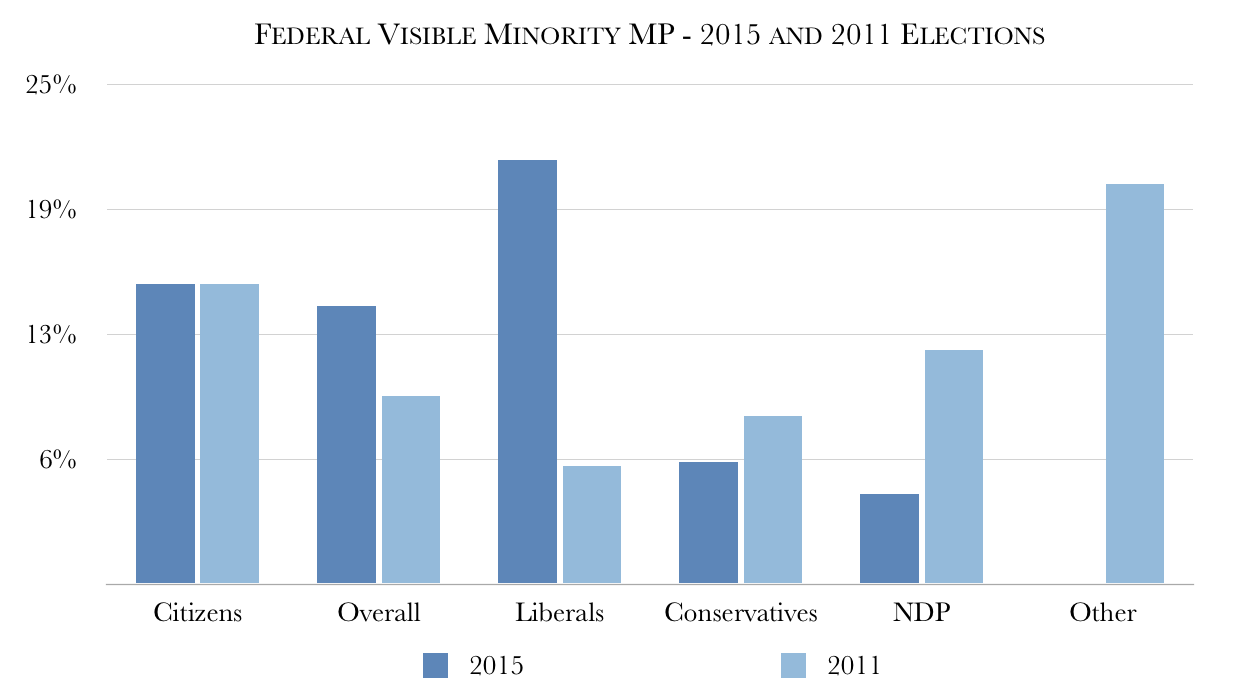
In contrast to the 2011 election, where 9.4 percent of all MPs were visible minorities, 2015 representation is aligned to the number of visible minority citizens (14 percent compared to 15 percent). Moreover, the success of the Liberal Party in decisively winning the visible minority vote  suggests that the Conservative Party’s extensive outreach to immigrant and visible minority communities had limited impact in stemming losses, and that concerns over the impact of changes to citizenship and immigration may have played a part.

Moreover, the percentage of visible minorities elected was identical to the percentage of visible minority candidates, which also had increased to 14 percent from 10 percent in the elections of 2004, 2006, 2008 and 2011 (see Visible Minority Candidates – 2015 Election – Background Note for details). The Liberal party had the most visible minority candidates (16 percent) with the Conservative party and the NDP had slight under-representation (13 percent)

For comparison, the number of women and Aboriginal MPs only slightly increased in 2015. Analysis by Equal Voice shows the number of elected rose from 25 percent in 2011 to 26 percent today (88 women). Representation of Aboriginal peoples also increased to 10 seats (3 percent) from 7.

To assess visible minority representation I have used candidate names, photos and biographies to identify visible minority candidates. Although not as exact as identifying women candidates (e.g., subjectivity in analyzing photos), it nevertheless provides a reasonably accurate indication of how well Canadian political party candidates represent the population of visible minorities who are also Canadian citizens (15 percent). I was not able to break this down by those who are first generation immigrants and those who were born in Canada (second generation).


Federal Election 2015 and 2011 ComparisonThe chart above contrasts the 2015 visible minority representation with the 2011 election results. Not surprisingly, the Liberals, given their overall strong election result, will have the caucus with the largest number of visible minority MPs: 39 or 21.2 percent, significantly above the percentage of visible minority citizens (and Liberal candidates). Conversely, given their poor results, both the Conservatives and the NDP elected less than half of their visible minority candidates.

Federal Election 2015 VisMin Mps GenderLooking at 2015 results only, the chart above provides the comparative numbers for each party in the 47 ridings that elected visible minority MPs, minority, broken down by gender. As others have noted, given that the overall number of visible minority MPs is comparable to the number of visible minority candidates (14 percent), visible minority candidates ran in ridings where they can be elected,.

While 23 of these 47 MPs come from ridings where 50 percent are visible minority, 15 come from ridings between 20 to 50 percent visible minority. Surprisingly, nine come from ridings with less than 20 percent visible minority, and five of those with less than five percent. In other words, visible minorities were even elected in ridings where over 80 percent are non-visible minorities.

Visible minority MPs are 68 percent men, 32 percent women, higher than the percentage of all women MPs (26 percent).

Liberal visible minority candidates won 39 seats (83 percent), the Conservatives five (13 percent), the NDP 2 (4 percent).

Table 1 2015 Election – List of Visible Minority MPs lists the ridings, their percentage of visible minorities, and the MPs elected.

Turning to the 33 ridings where visible minorities comprise more than 50 percent of the population  (which we will call visible majority ridings), the following characteristics emerge:

  • Both two-thirds of candidates (68) and two-thirds of elected MPs (23) are visible minority;
  • 48 percent are visible minority men, 21 percent visible minority women;
  • The Liberals took all but three of these ridings (two went Conservative, one NDP);
  • The popular vote for these 33 ridings shows stronger support for Liberals among visible majority ridings (52.3 percent) compared to overall results (39.5 percent). Riding-by-riding, the winning Liberal candidate won over 50 percent of the vote, a majority not just a plurality;
  • In contrast, the popular vote for the Conservatives in these ridings is virtually identical (31.6 percent) to their overall results (31.9 percent). It would appear their base vote is the same among visible minorities as the general population.
  • The NDP did less well in these ridings (15.9 percent) compared to their overall results (19.7 percent);
  • Out of the 9 ridings where Chinese Canadians formed the dominant group, 3 Chinese Canadians were elected. In contrast, out of the 14 ridings where South Asians formed the dominant group, 8 were elected, mainly Sikh Canadians; and,
  • 10 non-visible minority MPs were elected in these ridings.

Table 2 2015 Election – 33 Ridings more than 50 percent visible minorities provides the demographics of these ridings, along with the names of elected MPs and their share of the popular vote.

Implications

In many ways, this is a remarkable achievement, achieving close to parity in parliamentary representation of visible minorities. No other comparable country is as representative of its population.

Visible minority MPs, as all MPs, will be expected to play not only on the issues of interest to their constituents but also on broader policy issues and debates. And hopefully, the incoming government will provide greater latitude for all MPs for debates and discussion, rather than the excessive reliance on centralized talking points under the Conservative government.

They can be expected also to play on foreign policy and diaspora issues of interest to their community, much as other ethnic communities such as Ukrainian Canadians and Canadian Jews continue to do.

Secondly, with 39 visible minority MPs in the incoming Liberal government, we will need to see how many are appointed to cabinet and to which positions, and how this is balanced against other cabinet representation issues like regional representation (PM Trudeau has already committed to gender parity). The Conservative government relegated visible minorities to junior positions (multiculturalism, sport, seniors) and it remains to be seen whether Liberal Prime Minister Trudeau will appoint a visible minority member to a more senior position.

Thirdly, the Conservative party needs to reflect on the effectiveness of the extensive outreach of Minister Kenney and others to new Canadian communities. Being 20 percent behind the Liberals in many of these ridings means that ‘being there’ is not enough. While some of this shift reflects the general trend in urban Canada, it also likely reflects changes to citizenship and immigration policy which impact on these communities (e.g., more difficult family reunification and citizenship). And overplaying the niqab and related issues in such an obvious wedge politics manner can hardly have helped.

One thing is clear. Visible minorities are an intrinsic part of electoral and political strategies. No party can afford to ignore them, given their size and political weight. And one of the election’s lessons is that the divisiveness of wedge politics is not a winning strategy among visible minority and other voters. Hopefully, that will be an enduring lesson, sparing Canadians of whatever origin, of such approaches in the future, and strengthening overall integration.

Source: Visible minorities elected to Parliament close to parity, a remarkable achievement | hilltimes.com

Nancy Peckford and Grace Lore: When it comes to gender parity in Parliament, better is always possible

More from Equal Voice on women representation in Parliament:

But there is one change that we at Equal Voice hoped for that did not happen. The percentage of women elected to the House of Commons did not meaningfully increase. It is just one point higher than the last time, at 26 per cent. How could this be? Many remarkable women were elected. Eighty-eight in fact. Fifty of them Liberal women. Further, the Conservative party, which fielded the lowest percentage of women, lost. Resoundingly. And yet, still the percentage of women barely increased.

In short, we can’t elect more women unless far more of them are on the ballot. More women won’t win unless many more women run. While overall in this election, there was a small uptick in the percentage of female candidates for the major five parties (33 per cent), it wasn’t enough. The significant variability among parties produced, in the end, a House of Commons whose gender balance is no different. While the NDP has a much smaller caucus of over 44 MPs, 18 are women (41 percent). The Conservatives, now with 99 MPs, elected 17 per cent women, the same as when they were in government. The Greens, despite hopeful projections, elected only the party’s leader Elizabeth May. The Bloc Québécois elected two women out of 10.

The women-held NDP seats that were lost in Quebec went to largely male contenders from the other parties. In Ontario, while Liberal women won far more seats, 28, it wasn’t enough to make up the difference. In Alberta and B.C., while the raw numbers stayed the same even with the addition of new seats, proportionally, women won fewer of them than they did last time. Other than Ontario, only in the Atlantic and Saskatchewan did we see an increase in the proportion of women elected.

Election after election, the uneven addition of women candidates to party slates has meant very small incremental gains when it comes to women in the House. And while the dramatic turnover in party fortunes means the addition of some incredibly talented newly elected women, in addition to the return of some high performers from all sides, the pace of change is incredibly slow. Given this rate of change over the last five elections, it will take 89 years before we reach parity.

We know we can and must do better than this. According to the Inter-Parliamentary Union, Canada’s ranking has changed from 50 to 48 among 190 countries when comparing elected women in national Parliaments. Equal Voice has a plan to change this. Our multi-partisan national board has committed to encouraging and equipping up to 5,000 women to run over the next five years. This way, political parties won’t have to do all of the heavy lifting. We will recruit and help prepare hundreds, if not thousands, of prospective women candidates. So that more women will self identify as candidates, say yes when approached to run or, even better, not wait to be asked.

We know the next prime minister, Justin Trudeau, who understands the merit of a cabinet that is 50 per cent women, wants to make his own mark on the just society to which he believed so many Canadians wished to return. We can imagine no better goal than ensuring gender parity in the House during his lifetime. In his words, better is always possible.

Source: Nancy Peckford and Grace Lore: When it comes to gender parity in Parliament, better is always possible | Ottawa Citizen

Canada federal election candidates include more visible minorities in 2015 than in the past four votes | National Post

More on visible minority candidates, with good commentary by Erin Tolley, Chris Cochrane and Priya Ramanujan:

Notably, this is the first time that the proportion of visible minority candidates in Parliament reflects the per cent of visible minority candidates who ran for election. Usually, a far greater proportion runs than is actually elected, said Erin Tolley, an expert on visible minorities in Canadian politics at the University of Toronto.

“It’s great to benchmark how many arrive in Parliament, but also to think about the mechanism through which they got there,” added Tolley, explaining that the success of visible minority MPs may have had more to do with the Liberal wave than with conscious effort. In 2011, the NDP were hailed for bringing several young MPs into Parliament, but they had “won by accident, by surprise” because of an unexpected surge of support in ridings they hadn’t expected to win.

Thirty nine visible minority MPs, the bulk of those elected yesterday, belong to the Liberal party, which has long had the support of more visible minorities than the other major federal parties.

“A Liberal victory like we saw last night unsurprisingly is going to return a particularly high number of visible minority candidates to Parliament,” said Cochrane.

“As visible minorities become more entrenched, they’re here for many generations. They’ve been living in their neighbourhoods for decades. That’s all a recipe for increased engagement in federal politics,” he added.

Priya Ramanujam, production editor of New Canadian Media, a news website focused on immigrants, said she’s seen such change unfold in her own neighbourhood, which is part of the GTA’s Scarborough North riding.

Until 2011, the area, where more than 70 per cent of voters belong to visible minorities, was represented by a non-visible minority MP. This year all three major parties ran visible minority candidates. And it’s not just the parties who are trying to get more in tune with locals.

“I have definitely noticed an increase in people getting involved in politics, both young people and adults right up to seniors, and that’s across ethnicities,” said Ramanujam, who says that youth are far more engaged than when she was in high school in the late 1990s and early 2000s.

But Tolley said what happens next will dictate how much influence visible minorities have in practice. “To me, a commitment to diversity and equality goes beyond just putting people in the House of Commons. It means giving them a voice of power,” she said.

Visible minorities held token positions under the previous government, she said. “There were visible minorities sitting in cabinet, but those visible minorities had cabinet portfolios that were extremely limited.”

“The visible minorities that tend to get access to power are not the full range of people of colour that we see in Canada,” added Tolley, warning that advancements for minorities in general can distract from the plight of marginalized groups, such as Black Canadians, very of few of which have been elected to parliament.

The Oct. 19 election saw the three major parties field more visible minority candidates than in the past four federal elections, according to a study by Andrew Griffith, former director general for citizenship and multiculturalism at Citizenship and Immigration Canada. The National Post used data from the study to tally the number of visible minority MPs.

In total, 143 of the 1014 candidates that ran for the Conservative, Liberal and NDP parties belong to a visible minorities with 68 of them running in 33 ridings where more than half of residents belonged to visible minorities.

Source: Canada federal election candidates include more visible minorities in 2015 than in the past four votes | National Post

Record number of visible minority MPs elected to Commons

A dramatic increase from the 2011 election. In addition to the overview, some good personal vignettes of newly elected visible minority MPs.

Visible_Minority_MPs_-_2015_Election

I am working on a more detailed analysis that should be ready in a day or so but the chart above provides the overall numbers by party:

Their family histories and beginnings tie them to countries plagued by conflict and upheaval, but in Canada they are making history: the first-ever MPs of Afghan, Somali and Iranian heritage.

Those firsts come on the back of a jump in visible-minority representation in the incoming 42nd Parliament – a measure of growing integration and participation among minority communities. At least 46 visible-minority MPs were elected on Monday, the vast majority of them being Liberal. That figure is 13.6 per cent of the total of 338 seats.

That is a record for visible-minority representation, according to data going back to 1993. Research by now-retired McGill University political scientist Jerome Black showed that the 2011 election was what he called the high watermark – when 28 visible-minority MPs were elected, representing 9.1 per cent of the total number. But 2015 has surpassed that total.

“Having visible minorities in Parliament, whether first- or second-generation, helps ensure their perspective is part of [the] discussion and debate,” said Andrew Griffith, a former federal Canadian civil servant who worked on issues of multiculturalism and citizenship.

“It also facilitates greater identification with Canadian political institutions among visible minorities as they can see themselves reflected in these same institutions,” he added.

Some experts argue that the visible minority representation in the incoming parliament still falls short of the 19 per cent that make up Canada’s total visible minority population.

Source: Record number of visible minority MPs elected to Commons – The Globe and Mail