Montreal mosque facing calls for investigation after imam preaches on anti-Semitic conspiracy theories

Disturbing.

Prayer leader in question has been suspended and his remarks denounced by NCCM but local mosque authorities, like any local religious authorities, need to ensure that prayer leaders do not engage in hate speech:

A Montreal mosque where an imam had prayed for Jews to be killed “one by one” is facing fresh calls for an investigation after more videos surfaced online showing anti-Semitic preaching.

The Middle East Media Research Institute released a video on Tuesday of sermons in which an imam at the Al Andalous Islamic Centre conveyed conspiracy theories about Jews, their history and their origins.

Sheikh Wael Al-Ghitawi is shown in the video clips claiming that Jews were “people who slayed the prophets, shed their blood and cursed the Lord,” reported MEMRI, which translated the Friday sermons.

MEMRI

MEMRI

The imam went on to say Jews were the descendants of “Turkish mongols” and had been “punished by Allah,” who made them “wander in the land.” He further said that Jews had no historical ties to Jerusalem or Palestine.

The view conveyed by the imam has typically been used to deny that Jews have a connection to the land of Israel, said Rabbi Reuben Poupko, co-chair of the Quebec branch of the Centre for Israel and Jewish Affairs.

 “This is a bizarre strain of radical propaganda. It appears in the writings of Hamas and other groups like it and claims to debunk Jewish history,” said the rabbi, who said it was “unseemly” to use a religious service to propagate hate.

He said he did not believe such views, as well as the “deeply troubling” earlier calls to violence, were supported by the broader Muslim community “but its presence in this mosque needs to be investigated.”
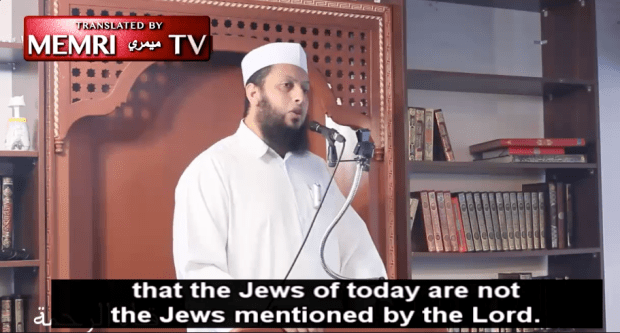
The videos were posted on YouTube in November 2014. The centre was already in the spotlight over an August 2014 video that showed an imam asking Allah to “destroy the accursed Jews,” and “kill them one by one.”

In a press release last week concerning the August 2014 video, the mosque administration blamed “clumsy and unacceptable phrasing” by a substitute imam, whose wording was “tainted by an abusive generalization.” The mosque could not be reached for comment about the most recent video.

“If you examine the annals of history you will see that the Jews do not have any historical right to Palestine,” Al-Ghitawi said in the latest video. He claimed there was “not a single Jew in Jerusalem and Palestine” for lengthy periods.

“Jerusalem is Arabic and Islamic,” he said at a separate sermon. “It is our land, the land of our fathers and forefathers. We are the people most entitled to it. We will not forsake a single inch of this land.”

On Monday the National Council of Canadian Muslims denounced the “incendiary speech” in the earlier Al-Andalous video, as well as a 2016 sermon at a Toronto mosque about the “filth of the Jews.”

The Muslim Association of Canada, which is affiliated with the Toronto mosque, has apologized and said it had suspended the prayer leader in question and launched an internal investigation into the incident.

Diversité et emploi: la piètre performance de la Ville de Montréal | Bouazza Mache

Bouazza Mache on the ongoing lack of representation in Montreal with respect to the municipal government (Montreal is 32 percent visible minority, Montreal CMA is 20 percent):

Encore une énième recherche qui démontre par l’absurde que les immigrants, souvent plus diplômés, sont les plus touchés par le chômage, en particulier dans la ville la plus colorée du Québec. Ainsi, nous apprenons dans cette étude, menée par l’Institut du Québec (IdQ), en collaboration avec la Chambre de commerce du Montréal métropolitain (CCMM) et Montréal International (MI), que « les immigrants sont plus instruits, mais chômeurs ».

Plusieurs recherches et enquêtes ont montré auparavant, par les chiffres et à coup d’investigations, que c’est devenu une réalité criante. Il y a eu même des études sectorielles sur le thème, comme la présence de la diversité dans les médias, dans le système de l’éducation ou encore, la situation des femmes racisées. Et à chaque fois, les résultats vont dans le même sens, négatif.

Il y a 18 mois, je soulevais le caractère folklorique de gérer la diversité à Montréal, en particulier en ce qui a trait à l’emploi. Et six mois plus tard, en janvier 2016, j’ai demandé au maire Coderre de prêcher la diversité par l’exemple, en mettant à niveau la représentativité des minorités visibles dans les effectifs municipaux, et de publier les résultats du plan d’action en accès à l’égalité en emploi de 2013-2015.

Or, je viens de découvrir qu’un « plan d’action pour la diversité en emploi 2016-2019» a été publié en mai 2016 par la Ville de Montréal, sans faire trop de bruit. Ce document expose sommairement les réalisations des plans précédents et élabore les objectifs pour 2019.

Les réalisations de l’administration Coderre ne sont nullement reluisantes: le pourcentage des minorités visibles dans l’effectif municipal peine à dépasser le cap des 12% (en 2015). Dans certaines catégories d’employés, il demeure très difficile de recruter auprès des groupes visés par le plan en accès à l’égalité en emploi. C’est le cas des cadres/contremaitres et du personnel pompier.

Mais le problème ne se limite pas uniquement aux demandeurs d’emploi. Il frappe aussi de plein fouet celles et ceux qui ont décidé de se lancer en affaires. Les réseaux fermés et l’accointance avec les décideurs (acheteurs) constituent un obstacle majeur face à la pénétration des marchés publics.

La faute à qui?

En premier lieu aux gouvernements qui se sont succédé et qui ont préféré gaver les statistiques pour faire contrepoids à un reste-du-Canada « menaçant », sans tenir compte des réalités sociale et économique. On dirait que la politique d’immigration a été en décalage total avec la société et le milieu des affaires.

La stigmatisation récurrente de certains politiciens et acteurs médiatiques envers certains groupes minoritaires envoie également un mauvais message aux employeurs qui hésitent à embarquer dans différents plans de recrutement.

Résultat : une ou deux générations d’immigrants, arabes et musulmans en particulier, laissées pour compte.

Source: Diversité et emploi: la piètre performance de la Ville de Montréal | Bouazza Mache

Port du hijab: le SPVM «ouvert» à l’idée pour ses policières

Good that it provokes discussion in other police forces located in diverse communities (the SPVM does not report publicly on its diversity last time I checked):

La Gendarmerie royale du Canada (GRC) permet désormais à ses policières musulmanes de porter le hijab, mais qu’en est-il des principaux corps policiers du Québec ? Le Service de police de la Ville de Montréal (SPVM) n’a jamais reçu de demandes à ce sujet, mais se dit « très ouvert » à l’idée.

Afin de refléter davantage la population canadienne et d’encourager des femmes musulmanes à envisager une carrière policière, la GRC a récemment décidé d’autoriser le port du hijab. La GRC insiste sur le fait que le foulard a été conçu pour être sécuritaire, après une série de tests rigoureux. La nouvelle a fait le tour du monde.

« Nous n’avons pas pris position sur le sujet, mais nous sommes très ouverts à ce genre de demandes », a indiqué hier la commandante du SPVM Marie-Claude Dandenault. Cette prise de position de la GRC incite le corps policier montréalais à évaluer la question, dit-elle. Au Canada, les forces armées, la police de Toronto et la police d’Edmonton permettent déjà le port du foulard.

« J’ai toujours dit, tant qu’il y a le visage découvert, je n’ai pas de problème avec ça », a quant à lui déclaré hier le maire de Montréal, Denis Coderre, en réponse à une question sur le sujet.

Comme le SPVM, la Sûreté du Québec (SQ) n’a jamais reçu de demandes de ses membres en ce sens.

 « On n’a jamais pris position », a indiqué le lieutenant Jason Allard, responsable des communications au sein de la police provinciale, qui a souligné qu’il ne voulait pas commenter la décision de la GRC

« On n’a jamais eu de demandes d’accommodement d’uniformes pour des motifs religieux », indique le lieutenant Jason Allard, responsable des communications à la SQ.

Le lieutenant Allard affirme que la Sûreté du Québec a fait des efforts au cours des dernières années afin d’augmenter le nombre de femmes et de membres issus des communautés culturelles au sein du corps policier. « On privilégie une meilleure représentation de toutes les cultures, mais on ne vise pas de groupe spécifique comme l’a fait la GRC », dit-il.

And Calgary is already ahead:

Exploring the lack of diversity in Quebec police forces

This has been an issue for a considerable time.

Police_ForcesThe table above compares police force diversity in Montreal, Toronto and Vancouver; what surprised me when collecting this information directly from the respective police forces was the degree to which the information is not public on their website and does not appear to be systematically collected (Surête de Québec does keep good stats):

Quebec’s police academy doesn’t have “a lot of influence” over whether visible minorities apply to become officers, says a spokesman for the academy.

Pierre Saint-Antoine, director of communications of École nationale de police du Québec in Nicolet, said racial minorities made up five per cent of its student population in 2015, despite attempts to “recruit people from all diversities and communities in Quebec.”

“We don’t have a lot of influence on the people that apply here,” Saint-Antoine said, adding that Nicolet has a program in place, in conjunction with the Quebec government, to encourage more diversity among applicants.

Saint-Antoine’s comments come after numbers compiled by CBC News show that Quebec police forces are lagging in their hiring of visible minorities.

For instance, the Sûreté du Québec serves more than 2.5 million people, however, fewer than one per cent of its officers are not Caucasian.

Community activists have said a lack of diversity among police leads to strained relationships with racial minorities.

But getting more people to apply is no easy task, says Paul Chablo, the head of John Abbott’s police technology program.

Before going to Nicolet, prospective police officers must first complete a three-year CEGEP program, and Chablo said many people from minority backgrounds don’t apply.

Out of roughly 250 students at John Abbott, 49 define themselves as having an “ethnic background” and only seven are visible minorities.

‘They have to adjust their techniques’

Chablo, who is also the former director of communications for the Montreal police, points to a multitude of factors — including lacklustre recruiting efforts and poor relationships with some ethnic communities — to explain the lack of diversity among applicants.

He said Quebec police need to a better job of reaching out to prospective employees to encourage them to apply to CEGEP programs in the first place.

“I think they have to adjust their techniques,” he said in an interview.

Source: Exploring the lack of diversity in Quebec police forces – Montreal – CBC News

Immigrants help drive Metro Vancouver’s housing market: study

Dan Hiebert and David Ley continue their insightful work in assessing ethnic concentration and impacts on housing:

Immigrants have a major impact on fast-rising house prices in Metro Vancouver and Toronto, according to the author of a new study.

In a unique research project, UBC geographer Daniel Hiebert discovered that ethnic Chinese and South Asians become homeowners at a much higher rate than other immigrants and the general population.

“There is definitely an impact on the housing market,” said Hiebert, who believes a key factor behind the phenomenon is many new immigrants arrive in Canada’s major cities with a great deal of money.

The veteran researcher’s exclusive cross-tabulation of housing and immigration data, including between 2006 and 2011, found on average that 53 per cent of immigrants to Metro Vancouver during those five years became homeowners in that period.

They bought roughly 100,000 homes in Metro Vancouver during the five years, ranging from suburban condos to ritzy mansions.

“New Chinese immigrants were at the top of all this. Kind of incredibly, their rate of home ownership was 73 per cent,” said Hiebert.

Roughly 52 per cent of newly arrived South Asians, the second largest immigrant group in Metro Vancouver, bought homes in that same five-year period.

Rounding out the five largest recent newcomer groups during that period, the rate of home buying among South Koreans was 51 per cent and among white and Filipino immigrants it was each about 44 per cent.

Hiebert, who has published major studies on immigration, housing and ethnic enclaves, believes immigrants are seriously affecting housing affordability at both the high and low ends of the market.

Prices of Metro Vancouver’s expensive properties, those in the $4-million-plus range, are being dramatically affected by immigrants, Hiebert said. But, at the low end, so are costs for new Syrian refugee families, who need government subsidies to afford a basic place to live.

While some of the new immigrants who end up classified as homeowners might be among the relatively few who arrive on a family reunification program and join an existing household, Hiebert believes most would be buying homes by transferring large financial resources into Canada.

“I think it would be a pretty big stretch for someone to arrive tabula rasa (without a lot of money) in a housing market like Vancouver and within five years be able to purchase a home in this place. That would be really difficult to expect.”

Hiebert’s findings support the conclusions of UBC’s David Ley, holder of the Canada Research Chair in geography and author of Millionaire Migrants. The Oxford-educated professor has found an “unusually decisive” correlation between high immigration to Metro Vancouver and high home prices.

The overall rate of home ownership among all residents in Metro Vancouver is almost 70 per cent — out of a total 1.5 million households, according to Hiebert’s work.

Based solely on visible-minority status, and disregarding immigrant status, ethnic “Chinese have the highest ratio of home ownership, followed by South Asians,” Hiebert said.

“The percentage of home ownership among Chinese is 81 per cent,” accounting for 290,000 Metro households, Hiebert said. “And South Asians are second at 75 per cent,” or roughly 160,000 households.

“Between these two largest groups, you’ve got much of the immigrant picture, which is why the immigrant picture looks better than the other picture (for non-immigrants),” said Hiebert.

Among smaller ethnic groups in Metro Vancouver, 62 per cent of Filipinos own homes, as do 59 per cent of West Asians (mostly Iranians).

Hiebert, who frequently advises the federal government, said his research did not include studying the rate of home ownership among non-immigrants, long-standing residents of Canada, or whites.

Nor does it delve into the specific effects of foreign ownership on Metro Vancouver housing costs.

And even though Hiebert said the high rate of home ownership among immigrants has a “definite” impact on housing, he said more careful analysis of sales is needed to measure it precisely.

He speculated the roughly 100,000 homes bought quickly by immigrants who arrived in Metro Vancouver between 2006 and 2011 would represent a “reasonable fraction” of all houses sold in that period, adding that proportion could be calculated after learning how many homes sell each year in the region.

Craig Munn, spokesman for the Real Estate Board of Greater Vancouver, said in an interview the average number of houses sold between 2006 and 2011 across the region of Metro Vancouver (which contains 21 municipalities from West Vancouver to Langley) was about 44,000 annually.

That adds up 220,000 home sales over that five-year period, which means the proportion bought by immigrants who arrived in that time alone would be about 45 per cent.

Hiebert, basing his work on novel cross-tabulations of the National Household Survey, found “stark differences” in new immigrants’ home ownership rates between Canada’s three largest cities.

While the home ownership rate in Metro Vancouver was 53 per cent and in Toronto 50 per cent among those who arrived between 2006 and 2011, it was just 23 per cent in Montreal.

“The much lower rate of home ownership in Montreal is ironic, because of course housing can be had for (roughly) 40 per cent of the price of Toronto or Vancouver,” he said.

“When housing prices escalate quickly, people feel they have to dive into home ownership. But there’s no sense of urgency in Montreal.”

Source: Immigrants help drive Metro Vancouver’s housing market: study

Le français, non merci – Language of Immigrants in Quebec

Interesting study on the degree to which Quebec immigrants integrate to French or English-speaking environments (the vast majority of immigrants settle in Montreal where this is an option).

Not totally surprisingly, Latin American and Arab immigrants tend to integrate into francophone environnement, those from China, South Asia and the Philippines remain more anglophone in orientation:

Plus de 200 000 Néo-Québécois, soit 20 % de la population immigrée au Québec, ne parlent pas français. La plupart de ces immigrants, soit 160 000, parlent anglais. En dépit de la sélection prioritaire de candidats connaissant le français — 60 % du total —, l’immigration continue de contribuer au déclin du français, surtout dans la région de Montréal.

C’est ce que signale un portrait des efforts du Québec en matière de francisation et d’intégration intitulé Le Québec rate sa cible. Commandité par la CSN, le Mouvement national des Québécois, la Société Saint-Jean-Baptiste de Montréal et le Mouvement Québec français, le document exhaustif de 130 pages, rédigé par le chercheur Jean Ferretti de l’Institut de recherche en économie contemporaine (IREC), s’appuie sur des données du ministère de l’Immigration, de la Diversité et de l’Inclusion (MIDI) et de Statistique Canada ainsi que sur diverses études de chercheurs comme Marc Termotte, Paul Béland, Michel Pagé, Brahim Boudarbat, Gilles Grenier, Patrick Sabourin et Guillaume Marois.

« On dirait que par négligence, le gouvernement du Québec refuse de voir l’impact de l’immigration sur le français à Montréal », a affirmé Jean Ferretti au Devoir.

« La politique migratoire menée depuis 1991 ne permet pas d’atteindre l’objectif du [ministère] de pérenniser le français. Les efforts de sélection ont permis de hausser la part d’immigrants connaissant le français, mais ne sont pas suffisants pour endiguer le déclin du français », écrit Jean Ferretti.

Concurrence linguistique

Le Québec est dans une situation particulière par rapport à d’autres sociétés, note-t-il. « L’adoption de la langue de la majorité par les immigrants ne va pas de soi. À Montréal, la possibilité de vivre dans la langue de son choix et la forte présence des anglophones du Québec créent une situation de concurrence linguistique qui limite les transferts linguistiques vers le français. »

Jean Ferretti cite Paul Béland, qui a démontré que les immigrants de langue maternelle latine ou originaires de la Francophonie, quelle que soit leur langue maternelle, sont enclins à adopter le français, alors que c’est l’inverse pour les immigrants de langue maternelle non latine. Depuis 1971, la proportion des immigrants de langue latine qui adoptent le français a augmenté à 87 %, tandis que le transfert vers le français des immigrants de langue non latine est resté le même en 30 ans, à 15 %.

Ainsi 88 % des Latino-Américains et 90 % des Arabes installés au Québec connaissent le français, alors que plus de 40 % des Chinois et des Sud-Asiatiques ne connaissent pas le français. Dans le cas des Philippins, 58 % d’entre eux ne parlent pas français.

Pour préserver le caractère français du Québec, il importe non seulement de recruter une forte proportion d’immigrants qui connaissent le français, mais il faut choisir parmi les immigrants qui ne connaissent pas le français ceux qui sont les plus aptes à adopter la langue commune, estime l’auteur.

Si le gouvernement du Québec poursuit la même politique en matière d’immigration qu’à l’heure actuelle, le poids démographique des francophones continuera de diminuer. Reprenant les projections des démographes Guillaume Marois et Marc Termotte, les francophones ne représenteraient plus que 75 % de la population du Québec dans 40 ans, contre 82 % en 2006. Si le seuil d’immigration de 50 000 à l’heure actuelle était porté à 65 000 — Philippe Couillard a déjà indiqué son intention d’augmenter le nombre d’immigrants reçus au Québec —, le poids des francophones s’élèverait à 73 %.

De son côté, Marc Termotte évalue qu’avec un seuil de 60 000 immigrants par an, la proportion de francophones sur l’île de Montréal passerait de 52,4 % [donnée de 2011] à 42,3 % en 2056. Ces projections, qui montrent un accroissement de la présence des allophones (de 23 % à 34 %) ne tiennent pas compte des transferts linguistiques au terme de la deuxième génération d’immigrants.

Source: Le français, non merci | Le Devoir

Montréal toujours loin de la parité hommes-femmes

Unfortunately, we do not have consistent cross-municipality data (the NHS/Census allows us to compare gender and median income but the shift to the NHS in 2011 makes comparisons problematic). For all municipal employees across Canada, 59 percent are male:

La proportion de femmes parmi les employés de la Ville de Montréal a diminué depuis huit ans, alors que la métropole s’était pourtant engagée à tendre vers la parité avec les hommes. Le nombre de femmes ayant obtenu un poste de cadre a augmenté, mais celles-ci continuent à gagner moins que leurs collègues masculins. Ce sont là quelques-uns des constats qui se dégagent du plus récent avis du Conseil des Montréalaises, qui sera présenté aux élus de la métropole lors de la prochaine réunion du conseil municipal.

La proportion de femmes parmi les employés de la Ville de Montréal a diminué depuis huit ans, alors que la métropole s’était pourtant engagée à tendre vers la parité avec les hommes. Le nombre de femmes ayant obtenu un poste de cadre a augmenté, mais celles-ci continuent à gagner moins que leurs collègues masculins. Ce sont là quelques-uns des constats qui se dégagent du plus récent avis du Conseil des Montréalaises, qui sera présenté aux élus de la métropole lors de la prochaine réunion du conseil municipal.

Le nombre de femmes cadres progresse

Malgré le recul de la proportion de femmes au sein du personnel de la métropole, le Conseil des Montréalaises se réjouit de constater que leur nombre a tout de même progressé chez les cadres. En 2006, 40 % des cadres étaient des femmes, proportion qui a grimpé à 44 % en 2014 parmi les 1836 cadres de la métropole. Les femmes continuent toutefois à être sous-représentées dans les plus hauts échelons de l’appareil administratif, note le rapport. Celles-ci n’occupaient que 32 % des postes de cadre de direction, soit ceux répondant directement au directeur général. Cette proportion représente tout de même une progression par rapport à 2006, où elles étaient 24 %.

Source: Montréal toujours loin de la parité hommes-femmes | Pierre-André Normandin | Montréal

Montreal Program Works To Prevent Violent Radicalization | Vermont Public Radio

Profile on the approach of the Montreal The Center for Prevention of Radicalization Leading to Violence:

The center runs a 24-hour hotline, and all calls are confidential. Social workers, psychotherapists and even a psychiatrist are available to go into the field and meet with people if “we need to go further,” Rebbani-Gosselin says, and the center offers free, unlimited follow-up counseling sessions.

“We only intervene when the person is engaged in a radical thinking process and they see violence as a way to reach their means. And what we do is to try to disengage a person from violence,” she says.

Since the hotline was launched in March of 2015, the center has received nearly 570 calls, according to Rebbani-Gosselin, and followed up on about 115.

“When we get a call about a specific individual, if through our evaluation [we] really believe that there is indeed a risk, then we automatically meet with the with the individual,” Rebbani-Gosselin says. “But … we don’t contact the individual directly.”

That’s because the goal is always to avoid confrontation, Rebbani-Gosselin says.

“Confrontation does not work. You really have to take different means to reach out to that individual to make sure that she or he is in position to listen to what you have to say.”

“Confrontation does not work. You really have to take different means to reach out to that individual to make sure that she or he is in position to listen to what you have to say,” she says. Sometimes meetings are arranged through parents, or schools, or a coach or friend of the person in question.

The center also doesn’t use the phrase “de-radicalization.”

“Because that’s not what we feel that we do,” says Rebbani-Gosselin. “Individuals are entitled to their ides, obviously, and being radical is a positive thing … Throughout history, we had radical thinkers. You know, the feminist movement, Martin Luther King or Gandhi, and these are important. You know, it’s important in democratic society that people are entitled to their ideas. So we don’t do de-radicalization. What we do is disengagement from violence.”

Sometimes, though, circumstances that appear to be immediately dangerous do warrant contacting the police and other agencies.

“We operate like a suicide hotline,” Rebbani-Gosselin says. “When you call a suicide hotline, if the person on the other end feels like you are going to commit suicide in a very imminent, very short period of time, then they will call 911. And in that sense we operate the same way. If we feel like there’s an imminent threat, then we definitely will transfer.”

Source: Montreal Program Works To Prevent Violent Radicalization | Vermont Public Radio

The Montreal would-be jihadi 10, and what comes next – Globe editorial

Reminder by The Globe editorial board and the need for de-radicalization or deprogramming initiatives, not just passport confiscation and other security measures:

Incarceration isn’t an option without clear evidence of criminal intent. The seizure of passports is a first step in isolating potential jihadis and limiting their ability to act on their beliefs, but it can’t be the last step. In some cases, the RCMP has sought peace bonds against suspects, requiring them to wear a monitoring device and limiting their social-media activity.

Yet we know from Mr. Couture-Rouleau that surveillance is no guarantee of public safety. With the 10 youths in Montreal, and others like them, the catch-and-release approach of passport confiscation is little more than a placebo – it draws attention and buys time until we come up with a better solution.

Teenagers in rebellion, many of whom are as likely to be idealists, however misguided, as aspiring holy warriors, would benefit far more from intelligent dialogue, education and a chance to change their minds. A sincere attempt at reprogramming is required – through conversations that counter the allure of ISIS with both persuasive arguments and an empathetic understanding of what it is that can drive young students to such a state. Removing a passport may be necessary. By itself, it’s insufficient.

The Montreal would-be jihadi 10, and what comes next – The Globe and Mail.

En niqab à sa cérémonie de citoyenneté

This week in Montreal.

She unveiled her face however when making the oath which reflects a certain willingness to compromise, even if the niqab still sends an overall signal of separation, not integration:

Latin American présence d’une candidate citoyenne vêtue d’un tel voile intégral est rarissime, selon une source gouvernementale.

La toute nouvelle citoyenne canadienne a toutefois respecté les règles en vigueur et s’est découvert le visage pendant quelques instants, le temps de prêter serment.

Certaines personnes dans l’audience ont ressenti un malaise face à la présence du niqab, ce voile intégral qui n’est percé que d’une étroite fente pour permettre la vision. Mais aucun esclandre n’est venu troubler la cérémonie, qui s’est tenue mercredi matin.

La femme était accompagnée d’un homme et de deux enfants. La cérémonie, tenue mercredi dernier au Centre hellénique de Montréal de Côte-des-Neiges, réunissait plus d’une centaine de personnes. Les individus sur le point de devenir citoyens canadiens étaient tour à tour appelés à l’avant de la salle pour prêter serment à la reine et au Canada.

«Ce sont des cas très, très, très rares, a indiqué une source gouvernementale. C’est minime, sur le nombre de cérémonies qui se tiennent.»

En niqab à sa cérémonie de citoyenneté | Philippe Teisceira-Lessard | National.