Mixed in the Six pop-up events created to support multiracial Torontonians

Another example of multiculturalism at work:

“At our first coffee date, Haan mentioned that he has wanted to host a dinner bringing together mixed people,” says Oades, who identifies at Filipino and Canadian (her father was adopted), “It wasn’t until we ran into one another with our sisters at a concert that we all became mixed Asian best friends for life and realized that we should do this. It’s a perfect platonic marriage.”

The two got to work on a $25 ticketed event that would showcase live music by local multiracial musicians like Bray, and Charlene Dorland, while guests dined over Palcu-Chang’s fusion-style feasts.

“I think for most people, but particularly those in mixed families, food is a very important element to their stories. It’s a reference point we use to ground us, give us perspective and make us happy,” says Palcu-Chang, who identifies as Chinese-Romanian. “For me, the food element is more than just feeding people. It’s a symbol for what we are trying to do with Mixed in the Six: generosity, community, family, nourishment.”

As the former president of the Mixed Students Association of York, Oades was reunited with members she hadn’t seen in nearly 10 years. And although the 2006 census indicated that 7.1 per cent of GTA marriages were interracial (a number that is expected by Statistics Canada to grow), the sold-out dinner showed Oades that there is still a need for mixed-race spaces in Toronto.

“People have shared with us that they feel a sense of belonging and acceptance at MIT6,” says Oades. “That feeling of not being, for example, ‘black enough or white enough’ seems to dissolve when you get to connect with other people who have had similar experiences as you.”

Professor G. Reginald Daniel, who edits the Journal of Critical Mixed Race Studies, both based out of the University of California, Santa Barbara, understands mixed-race events are naturally fun and exciting but he hopes young attendees recognize the legal, physical and psychological struggles and trauma older multiracial generations have gone through. For example, the U.S. law against interracial marriage was only outlawed in 1967.

And while MIT6 guests often cheekily gush over one another’s attractiveness (many attendees happen to work as models, actors and performers), Daniel hopes mixed-race millennials don’t get caught up in a strictly superficial multiracial discourse.

He notes how the mainstream media has latched onto the “happy hapa,” “magical mixie,” “happy hybrid,” “racial ambassador,” and “post-racial messiah” stereotypes of multiracial individuals that are dangerous because they portray “overenthusiastic images, including notions that multiracial individuals in the post-Civil rights era no longer experience any racial trauma and conflict about their identity.”

MIT6 attendees know too well that a post-racial world free of racial prejudice and discrimination does not actually exist.

“The key is to ground that enthusiasm and capture it in a way that is meaningful so you can work with other groups. So you aren’t seen as so self-centred and seem solely focused on your ‘mixie’ concerns,” Daniel stresses. “This would mean moving beyond the specific concerns of multiracial individuals and see the link with the concerns of other communities relating to anti-immigrant sentiments, Islamophobia, native American land rights, and even the concerns of women, or the LGBT community, etcetera.”

MIT6 is going beyond bringing people together for food, taking on an advocacy role, with a donation drive for Syrian refugees as well as highlighting the difficulty of those with a mixed-race background to find bone marrow transplants. Oades met 11-year-old Aaryan Dinh-Ali, who is Vietnamese and Afghani and is suffering from aplastic anemia and desperately needs a bone-marrow transplant. MIT6 invited U of T’s Stem Cell Club and Canadian Blood Services to set up a clinic at the dinner, successfully registering 17 new mixed-race donors.

Source: Mixed in the Six pop-up events created to support multiracial Torontonians | Toronto Star
For Interracial Couples, Growing Acceptance, With Some Exceptions – The New York Times

In addition to the numbers cited below, some good personal stories in the full article:

It’s a sentiment that mixed-race couples hear all too frequently, as interracial marriages have become increasingly common in the United States since 1967, when the Supreme Court’s decision in Loving v. Virginia struck down laws banning such unions. The story of the couple whose relationship led to the court ruling is chronicled in the movie, “Loving,” now in theaters.

In 2013, 12 percent of all new marriages were interracial, the Pew Research Center reported. According to a 2015 Pew report on intermarriage, 37 percent of Americans agreed that having more people marrying different races was a good thing for society, up from 24 percent only four years earlier; 9 percent thought it was a bad thing.

…People of some races tend to intermarry more than others, according to the Pew report. Of the 3.6 million adults who wed in 2013, 58 percent of American Indians, 28 percent of Asians, 19 percent of blacks and 7 percent of whites have a spouse whose race is different from their own.Asian women are more likely than Asian men to marry interracially. Of newlyweds in 2013, 37 percent of Asian women married someone who was not Asian, while only 16 percent of Asian men did so. There’s a similar gender gap for blacks, where men are much more likely to intermarry (25 percent) compared to only 12 percent of black women.

Source: For Interracial Couples, Growing Acceptance, With Some Exceptions – The New York Times

Douglas Todd: Mixed unions applauded by some, but dismissed by others as brownwashing

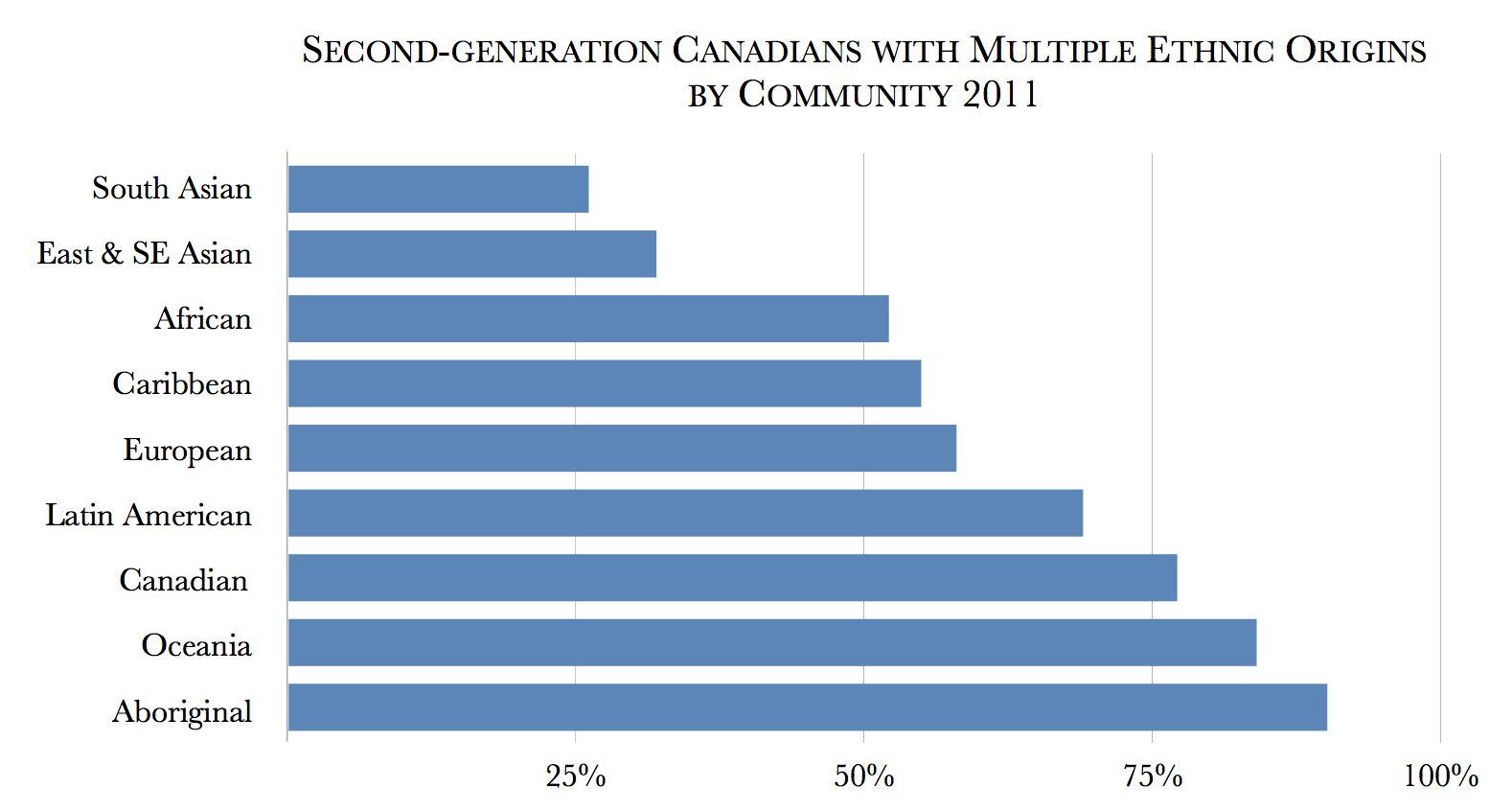
Canadians G2 Multiple origensTodd reports on the study by Feng Hou, Zheng Wu and Christoph Schimmele showing that community size and availability matter (“Group Size and Social Interaction: a Canada-US Comparison of Interracial Marriage”).

The overall StatsCan ethnic origin data shows the longer the community has been in Canada, the greater the number of Canadians with mixed ethnic origins, the result of more mixed unions. The above chart highlights second-generation immigrants who indicate also having Canadian ancestry (the third generation for most of the newer communities are not large enough, and old enough, to analyze):

But three cultural trends are shaking up this utopian dream, which places inter-ethnic couples at the vanguard of cultural fusion.

The first shift is demographic. Canadian statisticians have documented how the growth of ethnic groups in the Western world is actually making inter-ethnic couples less likely in major cities.

Secondly, many of the countries with traditional cultures that produce immigrants to the West remain resistant to ethnic intermarriage, often because of concerns about offsprings’ religious identities.

Thirdly, some race activists and social scientists are criticizing what they call the “brownwashing” of the population, arguing a mixed-union revolution is mostly sought by white liberals.

… A study published this year by Hou, Zheng Wu and Christoph Schimmele found the intermarriage rate among members of an ethnic group goes down in regions that house a large cohort of that group. No one is quite sure why.

The intermarriage rate in mid-sized Canadian cities such as Kelowna, Victoria and Trois-Rivières, where there are relatively few visible minorities, is reaching almost 40 per cent. People there appear motivated to go outside their ethno-cultural group for friends, dates and, importantly, marriage partners.

On the other hand, in Canadian metropolises where visible minorities, mostly Asians, account for almost half the population, the intermarriage rate is much lower. In Metro Vancouver it’s just 9.6 per cent. In multi-racial Toronto it’s only 8.2 per cent.

People seem to feel little need to find a partner outside their ethno-cultural group when living among hundreds of thousands of people with familiar backgrounds.

For instance, South Asians and ethnic Chinese make up the largest immigrant groups to Canada. But Statistics Canada reports they’re among the least likely to intermarry. Only 19 per cent of Chinese-Canadians in a couple, and 13 per cent of South Asian-Canadians, are in a mixed union.

Hou admits researchers can’t explain the complicated causes of intermarriage. But he cautioned against “blindly treating the prevalence of intermarriage as the litmus test of inter-group relations.” Hou says, “The prevalence can be low or go down simply for demographic reasons.”

Douglas Todd: Mixed unions applauded by some, but dismissed by others as brownwashing.

ICYMI: White? Black? A Murky Distinction Grows Still Murkier – NYTimes.com

While not based on a random sample, nevertheless interesting results, showing just how much mixing has occurred, and continues to occur, in the US:

In the United States, there is a long tradition of trying to draw sharp lines between ethnic groups, but our ancestry is a fluid and complex matter. In recent years geneticists have been uncovering new evidence about our shared heritage, and last week a team of scientists published the biggest genetic profile of the United States to date, based on a study of 160,000 people

The researchers were able to trace variations in our genetic makeup from state to state, creating for the first time a sort of ancestry map.

“We use these terms — white, black, Indian, Latino — and they don’t really mean what we think they mean,” said Claudio Saunt, a historian at the University of Georgia who was not involved in the study.

The data for the new study were collected by 23andMe, the consumer DNA-testing company. When customers have their genes analyzed, the company asks them if they’d like to make their results available for study by staff scientists.

Over time the company has built a database that not only includes DNA, but also such details as a participant’s birthplace and the ethnic group with which he or she identifies. (23andMe strips the data of any information that might breach the privacy of participants.)

The scientists also have been developing software that learns to recognize the origins of the short segments of DNA that make up our genomes. Recently they used their program to calculate what percentage of each subject’s genomes was inherited from European, African or Native American forebears.

“This year we saw that we were in a great position to do the analysis,” said Joanna L. Mountain, senior director of research at 23andMe.

On average, the scientists found, people who identified as African-American had genes that were only 73.2 percent African. European genes accounted for 24 percent of their DNA, while .8 percent came from Native Americans.

White? Black? A Murky Distinction Grows Still Murkier – NYTimes.com.

‘Koreans not ready for multiculturalism’

Interesting story on increased diversity within South Korea, particularly through the offspring from mixed unions, and how that comes across in a country with a strong cultural and historical identity:

South Korea is quickly turning into a multicultural society with a growing number of biracial children, but the majority of Koreans are “not ready” for ethnic diversity, according to scholars and experts.

The number of biracial babies in the country increased dramatically, making up 4.7 percent of all newborns in 2012. In 2008, they accounted for 2.9 percent, and 4.3 percent in 2010. A total of 97,701 biracial children were born from 2008 to 2012, according to Statistics Korea.

However, Koreans tend to have racial and ethnic prejudice against immigrants based on their countries of origin, according to research by the Asan Institute for Policy Studies.

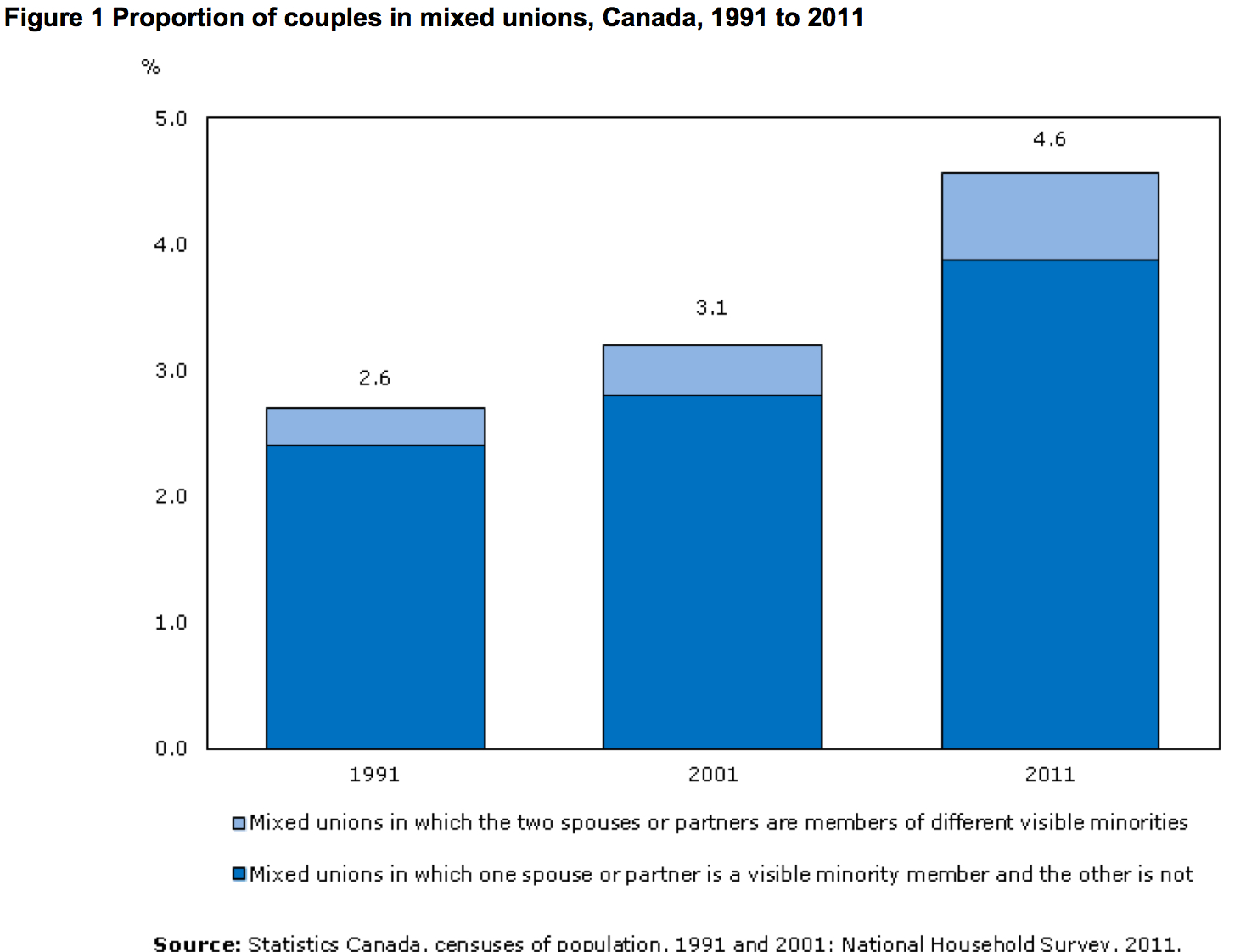
Canada’s figure for mixed unions nationally is 4.6 percent, no data that I have seen about the percentage of mixed union offspring.

‘Koreans not ready for multiculturalism’.

Editorial: Canada is leading the pack in mixed unions

Citizenship Fraud.021Further to my earlier post on the StatsCan study (Metro Vancouver has highest ratio of mixed couples in Canada), the Macleans editorial on what it may mean (I developed the chart above based on the study):

A couple of trends suggest the overall growth rate will move up in future, regardless of ethnicities involved. First, mixed unions tend to track the percentage of visible minorities in the greater Canadian populace. With visible minorities predicted to account for up to a third of the population by 2031, further growth will no doubt occur as the dating pool changes. Mixed unions are more common within younger age groups, as well, suggesting a gradual progression through society. Higher education is also correlated with mixed unions, as is urban living. Vancouver boasts the highest percentage of mixed unions, at nearly 10 per cent, followed by Toronto, Victoria, Ottawa and Calgary. As the number of mixed unions grows, so, too, will the offspring from these relationships. Whatever taboos may have existed for these children in the past, they’re being erased by sheer numbers.

Putting Canada’s record in global context is complicated by different definitions and the availability of data, but we appear to stand out for several reasons. European figures define mixed unions as between two people with different citizenship, a far lower standard of tolerance. Even so, the figures show no strong trend, with most countries no higher than Canada, despite a much broader definition of what “mixed” means. American research tends to focus solely on marriages, ignoring the prevalence of common-law relationships. When all couples are considered, Canadian figures are substantially above those in the U.S.

As for public attitudes, last year, a Gallup Poll announced that American approval of black-white marriage hit an all-time high of 87 per cent, up from four per cent in 1958. Yet Canadian sociologist Reginald Bibby points out that Canadian acceptance rates have long outstripped those in the U.S. A 2007 poll, for example, showed 92 per cent of Canadians approved of mixed marriages at a time when U.S. figures were 77 per cent. “There is probably no better index of racial and cultural integration than intermarriage,” Bibby writes. And Canada leads the pack in both performance and perspective.

Editorial: Canada is leading the pack in mixed unions.

Metro Vancouver has highest ratio of mixed couples in Canada

StatsCan_Mixed_Unions_Graph
Good summary report from the recent Statistics Canada study by Douglas Todd:

Faizal Sahukhan, a Fijian therapist who specializes in counselling “inter-cultural” couples, says he’s found far more people in Metro Vancouver engage in inter-ethnic dating than actually “make the leap into marriage.”

Despite the high proportion of visible minority immigrants and their offspring in Metro Vancouver, Sahukhan said the “biggest barrier to mixed unions is parental influence.”

Asked why the proportion of visible minorities entering mixed unions tends to go down when the size of their ethno-cultural group goes up in a city, Sahukhan said, “Many people who are immigrants to Canada want to preserve homogeneity when their children begin to marry.”

North Shore-raised Kate Worthy, who is married to Paul Chu, was a bit taken aback that multicultural Metro Vancouver doesn’t have a larger proportion of people in mixed unions. She knows quite a few such couples….

Despite high immigration rates to Canada, marriage habits are changing slowly. The Statistics Canada report said “couples in mixed unions in Canada accounted for 2.6 per cent of all couples in 1991, 3.1 per cent of couples in 2001 and 3.9 per cent in 2006.”

The visible minority group members most likely to be in mixed unions in Canada are those of Japanese descent (79 per cent), followed by Latin Americans (48 per cent), blacks (40 per cent) and Filipinos (30 per cent).

The two visible minority groups least likely to enter into mixed unions are the largest ones in Canada and Metro Vancouver.

Of the 352,000 couples involving Chinese people in Canada, 19 per cent were in mixed unions, and of the 407,000 involving South Asians, 13 per cent were in mixed unions.

The Statistics Canada study does not directly report on how many whites are in mixed unions, but it says 85 per cent of mixed couples in Canada include a white person.

Metro Vancouver has highest ratio of mixed couples in Canada.

Link to full study:

Mixed Unions in Canada